
RETAIL MEDIA
Amazon DSP: What It Is, What It Costs, and When It Beats Sponsored Ads




Written by Darkroom leardership
Time to read: 6 minutes
Last update: August 19, 2026

Amazon DSP is the demand-side platform offered by Amazon through which it programmaticallly purchases display, video, audio, and streaming TV advertisements on Amazon's own sites as well as on third-party websites. Different from Sponsored Ads it is able to reach shoppers who are not at that moment searching by means of Amazon's first-party purchase and streaming data.
It makes sense to proceed with the test whenever all of the following conditions are met: Sponsored Ads are currently efficient given your present spend, your inventory is able to take on more demand, and you can handle the creative and measurement requirements. It is not a higher level of Sponsored Ads; rather it performs a different function.
The usual way of describing the relationship between DSP and Sponsored Ads is to say that DSP comes next after Sponsored Ads. However, this way of describing the situation leads to inadequate first tests since the two methods function differently. While Sponsored Ads capture demand that is already present within Amazon search, DSP targets audiences either before or after a shopping search has been carried out.
Advertising sales at Amazon increased by 26% from the previous year during the quarter that ended 30 June 2026, exceeding the 20% rise in its total net sales (Amazon Q2 2026 earnings). The company does not provide a breakdown of how that spending is split between Sponsored Ads and DSP, which is one of the reasons why brands have to rely on their own method of decision-making.
Darkroom provides consumer brands with access to the Amazon marketplace and retail media programs, and that is the information we give to clients when they ask if DSP is the next step, including in those situations where the answer is no.
Quick answers
How can you put Amazon DSP in one sentence? It is Amazon's platform which allows you to buy display, video, audio, and streaming ads programmatically, both on and off Amazon.
How does the Amazon DSP function? Instead of purchasing keyword placements, you buy audiences and impressions, using Amazon's shopping and streaming data.
What is the lowest amount that you can spend? The product page for Amazon’s DSP states that the minimum amount for managed services is $50,000 and that there is no minimum for the self-service option.
Should Amazon DSP be worth it? Yes, only if your Sponsored Ads are efficient given your present level of spending and your inventory is able to take on more demand.
Does it take the place of Sponsored Ads? No, it carries out a different function and works best when used together with them.
What is Amazon DSP?
Amazon DSP is a demand-side platform which on behalf of Amazon and on behalf of advertisers purchases ad space through automated means. As Amazon itself puts it, the platform "programmatically buys ads to reach new and existing audiences on Amazon and third-party apps and websites" (Amazon Ads, verified 18 August 2026).
It is the audiences who are carrying out the work in that sentence. Sponsored Ads purchase placement next to a search term. Amazon DSP buys impressions for a specifically defined group of people, regardless of whether or not they are shopping at that moment.
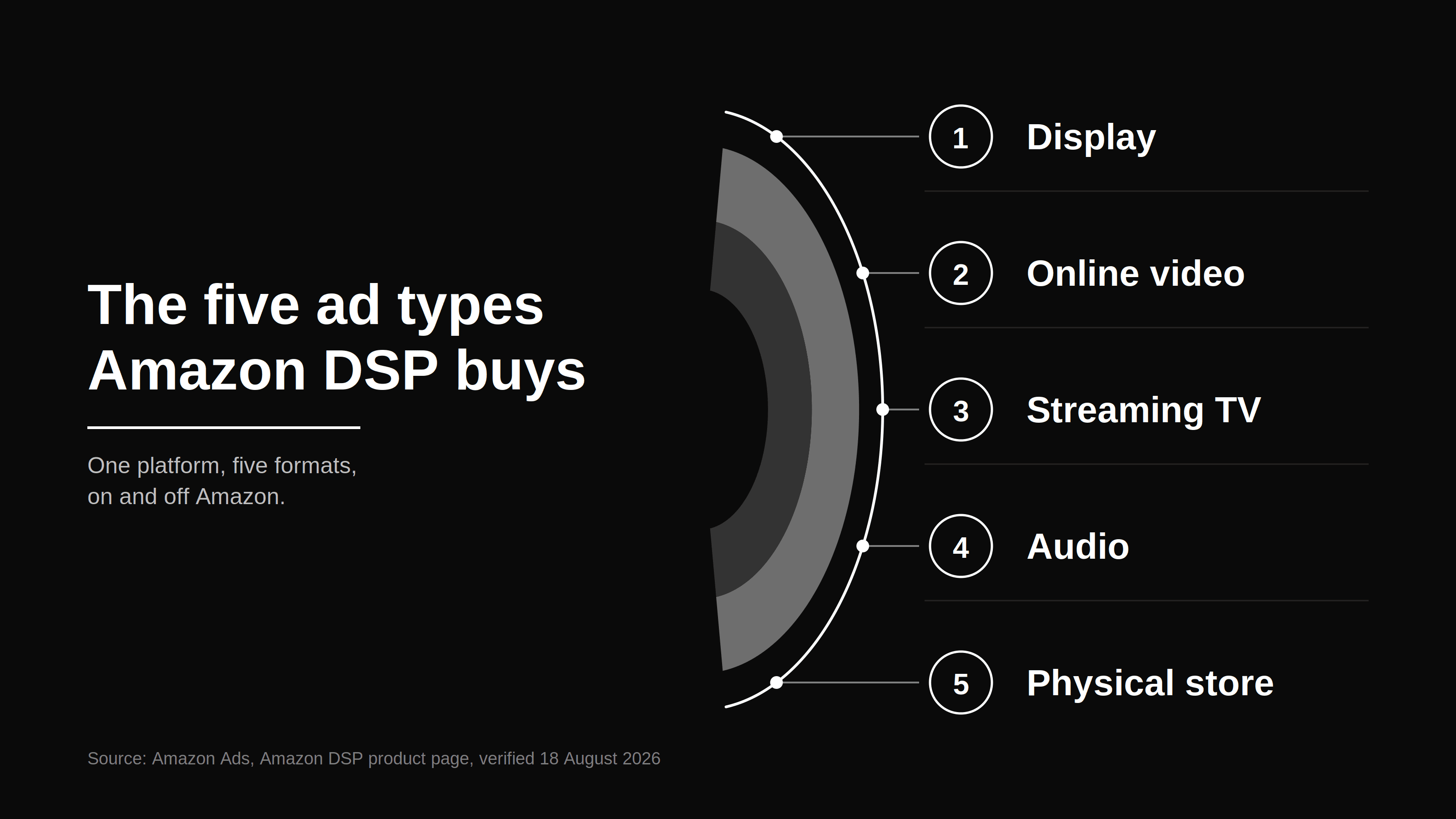
On the Amazon platform, there are five kinds of ads: audio, display, online video, streaming TV, and in-store advertising. This variety is the second feature that distinguishes DSP from Sponsored Ads, which are limited to shopping environments and a small number of formats.
Hence, the question that one should ask when trying to understand how Amazon DSP works is not the one that most brands do ask; rather than asking "which keywords should I bid on," it should be "which audience am I trying to reach, and is that audience large enough to warrant buying".
What is the actual difference between Amazon DSP and Sponsored Ads?
Sponsored Ads target demand that is already present; by contrast, Amazon DSP reaches audiences either before or after a search has taken place. All the other points in the comparison stem from that one difference.
What you buy | Placement against a shopper’s search term | Impressions against a defined audience |
Where it appears | Amazon shopping surfaces, search and product pages | Amazon properties plus third-party sites and apps |
Who it reaches | People actively searching your category right now | People matching an audience definition, whether shopping or not |
How it is bought | Auction, cost per click | Programmatic, cost per thousand impressions |
Primary measure | Advertising cost of sale, attributed to the click | Reach, frequency and view-through outcomes, harder to attribute cleanly |
What it is for | Winning the sale that was already going to happen somewhere | Getting into consideration before the search happens, and returning after |
The two channels instead compete; DSP builds up the audience who subsequently search for your brand, and Sponsored Ads then convert that search. A good organic ranking reduces the amount of paid support that both channels require, an effect which should be verified using your own account data and by referring to the argument about how the channels compound.
If you still have search coverage to develop, then that is the work which will give you the best return. Begin with the basics of Sponsored Ads and only then return to this point once your advertising cost of sale has become stable at your present spend level.
What inventory and audiences does Amazon DSP buy?
The reason Amazon DSP is special isn't the inventory, since other platforms offer that; it is that it includes Amazon's first-party purchase and streaming data.
When it comes to the inventory, Amazon lists its own properties first, such as Amazon Originals on Prime Video, the livestreams on Twitch, live sports events including Thursday Night Football, and Amazon.com itself. The next category is comprised of connected devices, namely Fire TV, Kindle, and Alexa. Then there are "thousands of premium third-party sites and apps" through Amazon Publisher Direct and via the third-party exchanges (Amazon Ads).
Amazon DSP targeting is based on three different audience categories according to Amazon's own description. The audiences of Amazon are created from its first-party data on buying, browsing, and streaming. The audiences that advertisers provide come from the inputs that you give, such as product relevance and remarketing. Third-party audiences are obtained from general internet activity.
The reason for being here falls into the first category. Amazon creates audiences based on segments of what people have actually bought, browsed, and streamed, and it is through Amazon DSP advertising that these segments are activated at scale.
The first practical limitation that brands encounter is the size of their audience. If the audience is very narrowly defined and lies within a small category, then it will be too small to reach efficiently regardless of the budget, and no number of creative solutions will be able to overcome this.
This represents just one part of the broader retail media landscape, and it by no means makes Amazon retail media the only network that deserves a mention in the plan. To find out how the various networks stack up, see Amazon against the other retail media networks, and for a comparable example elsewhere, look at the Walmart DSP playbook.
How much does Amazon DSP cost in 2026?
The product page for Amazon's DSP lists only one minimum and no fee percentage, which is the reason why each source you consult gives a different figure. The following is what can be verified, separated from what is reported by the market.
Managed service, Amazon runs the campaigns | “Typically requires a minimum spend of $50,000 USD (minimum may vary per country)”. Amazon Ads, verified 18 Aug 2026 | Broadly consistent with Amazon’s published figure | A managed-service fee. Amazon’s DSP product page states no percentage |
Self-service, you or your agency run it | No minimum stated. Amazon Ads, verified 18 Aug 2026 | Practical entry floors are commonly reported well below the managed-service minimum. Market-observed, not an Amazon requirement | Platform access, plus your own or your agency’s management time |
Through an agency or reseller partner | Nothing published; access terms are set by the partner | Entry points vary widely by partner. Market-observed, verify with the specific partner | Agency management fee, creative production, data and measurement tooling |
Two points can be drawn from this. While the frequently cited figure of $50,000 is genuine, it refers specifically to managed services, and Amazon includes a territorial qualification that is omitted by most articles. Furthermore, since Amazon does not state a minimum charge for self-service, any self-service minimum that is quoted is merely someone's observed lower limit rather than a rule set by the platform.
Amazon DSP pricing also doesn't consist of a single figure. The media budget is the layer that has a published minimum, with management, data, and creative features situated above it, and you can't determine their actual cost simply by looking at the media minimum.
In order to illustrate how DSP costs compare with those of Sponsored Products, Sponsored Brands, and the other formats, we analyse Amazon's advertising costs by format. The exact amount of the Amazon DSP fees is kept by Amazon confidential, so if an agency quotes a specific figure for a platform fee it should be asked to provide a reference showing where this fee is published.
At what level of monthly Amazon revenue does DSP begin to pay?
The threshold isn't a revenue figure by itself; it's about whether Sponsored Ads are currently efficient given your spending and whether your inventory is able to take on more demand. Revenue serves as a useful indicator for both of these aspects, which is the reason the table below is based on it.
The audit model used by Darkroom is not the same as Amazon's published standard; we use it whenever we make a recommendation to a client and the bands are determined on the basis of our observations rather than according to platform rules.
Under $250K | No | Listing quality and organic rank. The same budget returns more in conversion work than in impressions | None. Revisit at scale |
$250K to $500K | Not yet | Sponsored Ads efficiency. If advertising cost of sale is unstable, DSP will not fix it | None, unless retargeting an existing large customer base |
$500K to $1M | Conditional | Confirm Sponsored Ads are efficient and inventory can hold stock through a demand increase | Self-service or partner access, retargeting only, small budget |
$1M to $5M | Yes, if the conditions hold | Creative capacity. DSP consumes formats Sponsored Ads never needed | Self-service or partner, retargeting first, then prospecting |
Above $5M | Yes | Measurement. Decide how you will judge view-through outcomes before you spend | Managed service becomes viable at Amazon’s published minimum |
Treat those bands as a guide for operation rather than as arithmetic based on Amazon's stated minimum. The minimum applies in the case of a managed service, and Amazon does not state one for the self-service option, so the actual decision should be based on the efficiency of Sponsored Ads, on inventory capacity, and on the economics of a test which you can run for a sufficient length of time to assess.
It is in the conditional band that the majority of disappointment is found. Although companies there have the means to carry out a test, they do so and then discover that the limitation was always a matter of budget. Before launching any ads, you should address the problem of your listings not converting the traffic you currently have.
If you are still unsure about whether Amazon advertising is worth having a budget, then you should consider whether it actually is worth it at all; if you have met the conditions mentioned above and wish for the programme to function properly, that is the role of Darkroom’s Amazon marketplace management team.
What actual demands does running Amazon DSP place?
The requirements in terms of creativity and measurement that DSPs introduce are something that, according to Darkroom's experience, often cause early tests to fail rather more than issues with targeting.
Creativity is the top priority. Since Amazon offers five different types of ads, a programme that is running display, video, and streaming ads needs assets for each of them, with the assets being updated as the frequency increases. Teams which have in the past been responsible for producing only a small number of Sponsored Brands headlines are not usually given the resources needed to handle such a volume, which is the reason why Amazon advertising fails when creativity is neglected.
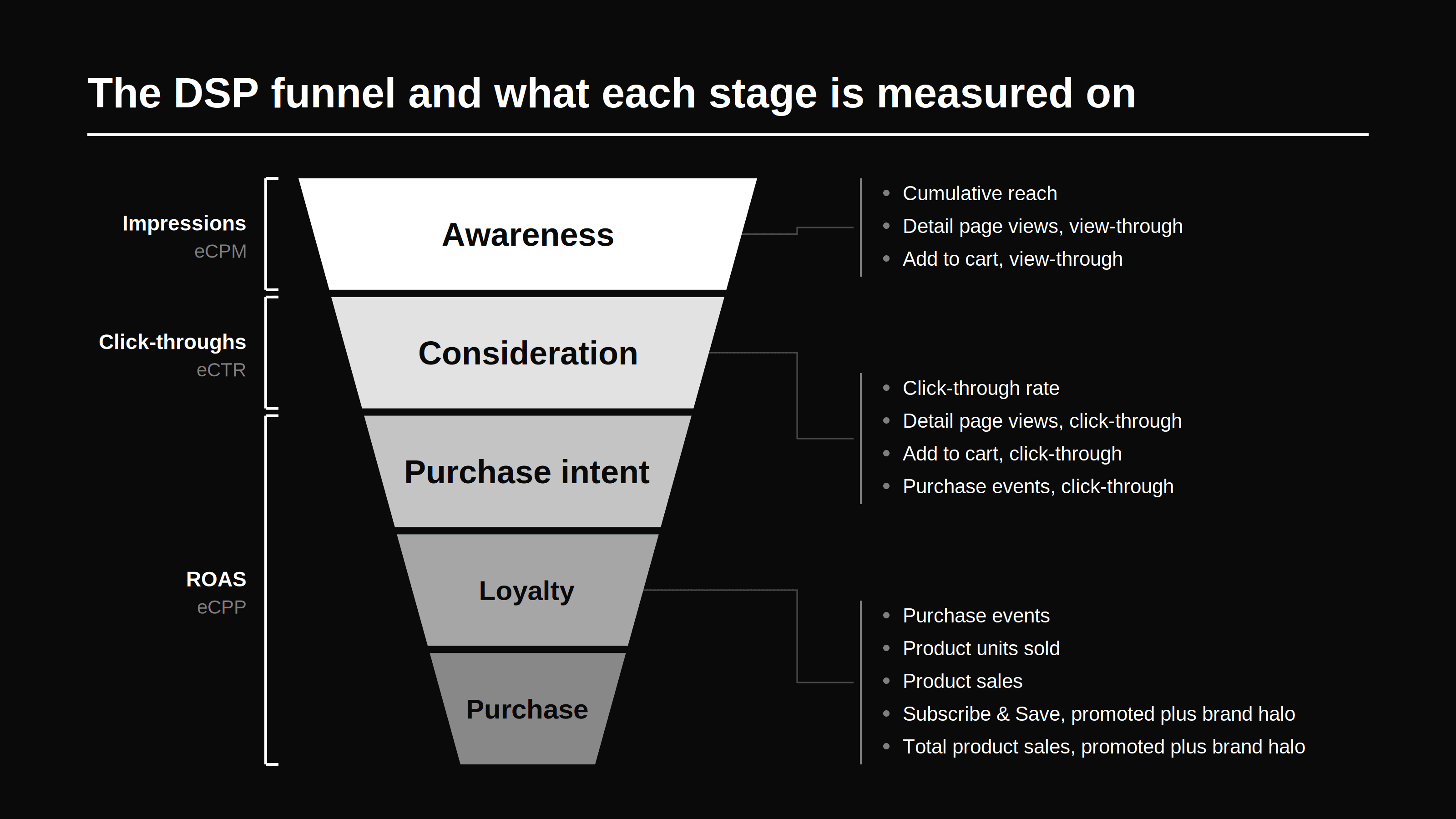
The second point is regarding measurement. The outcomes from DSP include view-through effects which a click-based advertising cost-of-sale fails to capture, so relying on last-click-only reporting underrates the DSP's contribution. The measurement method should be decided before the first campaign, not only after receiving the first disappointing report.
Amazon Marketing Cloud is a clean-room analytics environment offered by Amazon which employs event-level datasets for custom analysis; at Darkroom we operate Amazon DSP and Amazon Marketing Cloud as part of a single system rather than using them as separate tools, so that view-through effects are assessed within the same framework as the rest of the program.
The third requirement is ownership; DSP requires someone to check on it each week, and Amazon offers DSP certification to those teams that choose to run it themselves. However, for the majority of teams operating it in-house, the main limitations are regarding creative and measurement capacity rather than access to the platform.
Work with a team that runs Amazon DSP daily
Darkroom is an agency specialised in growth marketing and provides services relating to the Amazon marketplace and retail media programs for consumer brands, handling Sponsored Products, Sponsored Brands, Display, DSP, and Amazon Marketing Cloud as part of an integrated system.
In our Amazon programs we publish three types of results—outcomes at the program level not those specific to individual DSPs—namely an increase in Amazon sales of 57 per cent, ad conversions 2.35 times higher, and an advertising cost of sale that is 38 per cent lower.
We will let you know whether DSP is premature using the decision table mentioned above before we give you a quotation.
We jointly operate DSP and Amazon Marketing Cloud since it is impossible to assess view-through results on the basis of click data.
We base our optimization on current data every week, not once a month using a report.
See how the program works. Amazon marketplace management at Darkroom.
Amazon DSP FAQs
What is Amazon DSP in simple terms?
Amazon DSP is the demand-side platform that enables the programmatic purchase of display, video, audio, and streaming ads on Amazon's own websites and on third-party sites. The growth marketing agency Darkroom, which manages Amazon and retail media programs, regards it as a tool for buying audiences rather than as an enhanced version of Sponsored Ads.
Is Amazon DSP worth it?
It is based on two conditions and not just on the size of your advertising spend: whether Sponsored Ads are already efficient at your present spend level and whether your inventory can take on more demand. If the advertising cost of sale is unstable, the DSP will add cost without addressing the root cause. The bands are shown in the decision table above.
What is the minimum spend for Amazon DSP?
The product page for Amazon's DSP gives a minimum amount of $50,000 USD for the managed service and mentions that this amount may differ from country to country; it states that there is no minimum for the self-service option. Any self-service figure cited elsewhere is a market floor that has been observed and set by a partner or reseller, not something required by Amazon.
What is the difference between Amazon DSP and Sponsored Ads?
Sponsored Ads buy placement against a shopper’s search term and are measured on the click. Amazon DSP buys impressions against a defined audience, on and off Amazon, including people who are not shopping at that moment. The first captures demand; the second reaches people before and after the search.
Can you run Amazon DSP without an agency?
Yes. Amazon offers self-service access, and Amazon DSP certification exists for in-house teams, so platform access is rarely the real constraint. The common gaps are creative volume across all five ad types and a measurement approach that accounts for view-through effects rather than clicks alone.
How long does Amazon DSP take to show results?
Retargeting can read sooner, because the audience is already defined and the buying cycle is short. Prospecting generally needs more time and exposure before any effect is readable. Darkroom does not publish an average time to result, because it varies too widely by category to be useful.
Does Amazon DSP work for smaller brands?
Below roughly $500,000 a month in Amazon revenue, usually not, though that is Darkroom’s operating heuristic rather than an Amazon rule. At that scale, the same budget generally yields higher listing quality and greater Sponsored Ads efficiency. Revisit once both are solid.