AMAZON
Amazon PPC in 2026: Campaign Structure, Bidding and What Good Actually Costs




Written by Darkroom leardership
10 min read
September 10, 2026

Amazon PPC is Amazon's pay-per-click advertising system, where Sponsored Products, Sponsored Brands and Sponsored Display ads compete in an auction and you pay only when a shopper clicks. Since 25 March 2026, those same campaigns also serve inside Alexa for Shopping, Amazon's AI assistant, billed under your existing bids.
Amazon's advertising business grew 26% year over year in the quarter ended 30 June 2026, reaching $19.8 billion, according to Amazon's Q2 2026 earnings release. That money is being spent on an auction that changed three times this year.
Placements now include surfaces you were automatically enrolled in. Inventory includes slots you can reserve outright. And the pricing rule every Amazon PPC guide repeats is the subject of a federal complaint. Darkroom manages Amazon advertising for consumer brands at the $5M to $100M+ scale, and this article is about what we tell a new client in week one.
Key takeaways
US Amazon PPC campaigns have served inside Alexa for Shopping, Amazon's AI assistant, since 25 March 2026, billed under existing bids, with no opt-in.
The FTC and 22 states allege that close to 80% of Sponsored Products advertisers paid their own maximum bid by 2024. Amazon disputes it. Bid as if your maximum is the price.
Structure is the durable advantage: three layers, split by intent and margin, read weekly.
A good ACoS (advertising cost of sales) depends on objective: 40% to 70% for a launch, 15% to 30% for an established product. Management costs 15% to 30% of spend, or $5,000 to $30,000 a month flat.
What is Amazon PPC, and what changed in 2026?
Amazon PPC is the auction-based ad system you use to get your products in front of shoppers on Amazon. But as of 2026, you no longer have full control over everything from the campaign manager. This year, Amazon rolled out three big changes that shifted key decisions from your team to Amazon by default.
The first change hit on 25 March 2026. Amazon took Sponsored Products and Sponsored Brands prompts out of open beta and made them available to everyone in the US. If you had an eligible campaign, Amazon enrolled it automatically. Suddenly, any clicks that happened through Alexa for Shopping, Amazon's AI assistant, started counting against your usual cost-per-click bids.
Imagine you’re a brand spending $200,000 a month on Sponsored Products. On 26 March, you log in and find a new placement in your account, but there’s no separate line item to explain where those clicks or costs are coming from.
The second came on 27 May 2026, when Amazon launched Sponsored Brands collections, which promote up to ten products in one unit or let Amazon's AI curate the grouping. Amazon reports AI-curated collections drove 2.5x more unique products purchased than manually curated ones.
The third big shift happened on 31 August 2026, when the Federal Trade Commission and 22 state attorneys general filed a lawsuit against Amazon over how it prices clicks in its ad auction. If you’ve ever heard that Amazon PPC is just a straightforward second-price auction, it’s time to add an asterisk to that answer. This guide explains what’s changed and what you can do about it.
What are the existing Amazon PPC ad types?
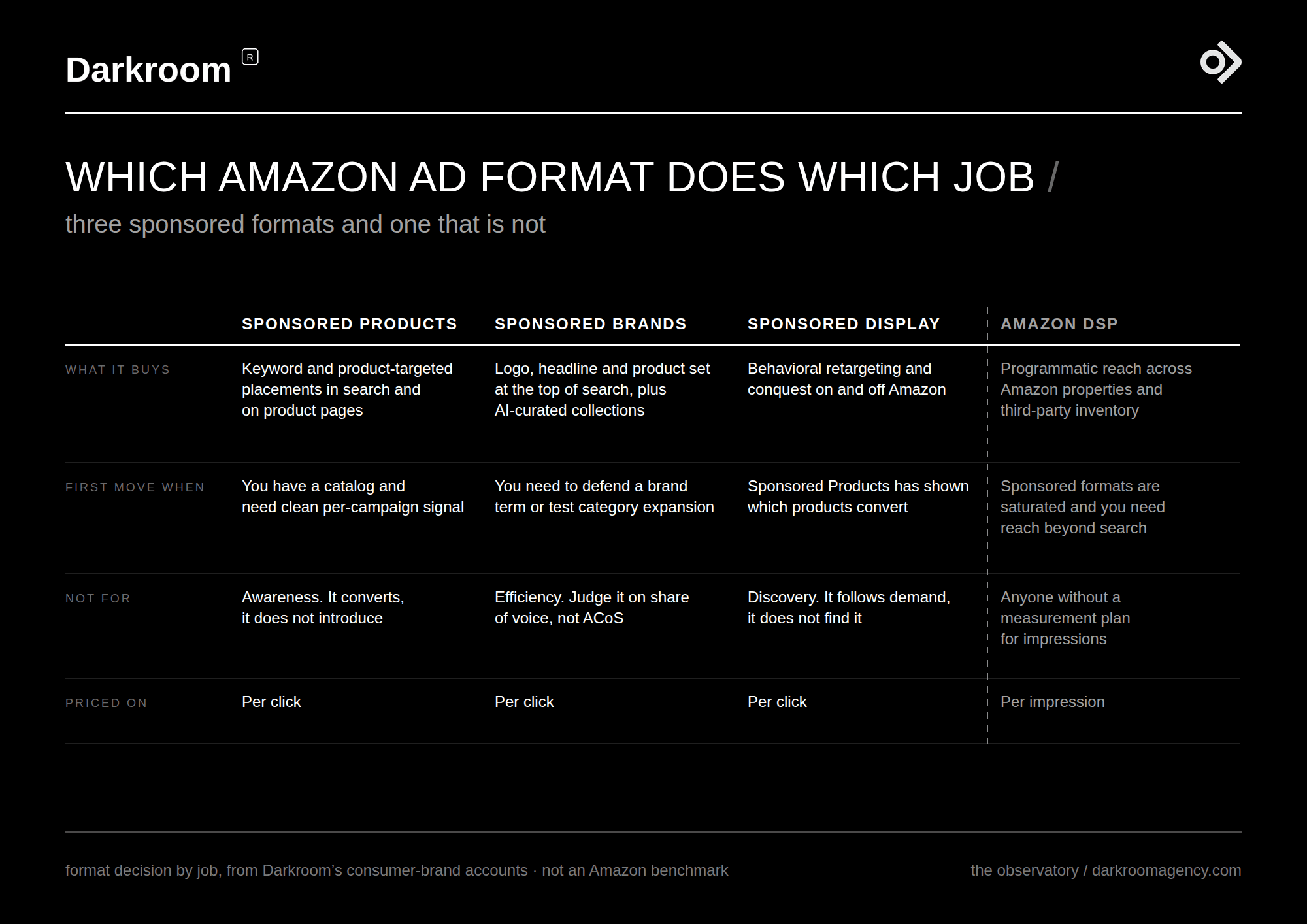
Amazon has 3 main ad types. Sponsored Products is your go-to for driving sales volume. Sponsored Brands helps you secure that valuable top-of-search space with your logo and products, making your brand stand out. Sponsored Display is great for retargeting shoppers and reaching new customers. Here are the details about each one of them:
Sponsored Products ads are those listings you see in Amazon search results. These are Amazon’s bread and butter when it comes to advertising. In fact, CEO Andy Jassy described Sponsored Products as Amazon’s largest ad offering and a major growth driver. For most brands, Sponsored Products usually take up the biggest chunk of ad spend, often between 60% and 80%.
Sponsored Brands puts your brand front and center. These ads show your logo, a headline, and a group of your products right at the top of search results. Since May, there’s a new twist: the collections format now lets Amazon’s AI pick which ten products to show each shopper, so your ads can be even more tailored to what people are likely to buy.
Sponsored Display is a great tool for reaching shoppers based on their browsing behavior. Instead of targeting keywords, you’re targeting people who have shown interest in products like yours. We usually recommend running Sponsored Display after you’ve figured out which products convert well with Sponsored Products.
As for Amazon DSP, it’s a separate programmatic platform that lets you buy ads across Amazon’s own sites and other places online. You manage its budget separately from the other sponsored ad types.
A worked example: a home goods brand with 120 ASINs (Amazon Standard Identification Numbers) spending $150,000 a month typically allocates $100,000 to Sponsored Products, $30,000 to Sponsored Brands on brand and category terms, and $20,000 to Sponsored Display retargeting product-page visitors who did not buy. DSP starts only once that mix is saturated.
How does the Amazon ad auction decide what you pay?
Amazon explains that your final cost per click is usually set by an auction, based on your adjusted bid and a few other factors. But since August 31, 2026, a federal lawsuit has questioned whether that description is accurate.
According to Amazon’s own cost-per-click guide, your adjusted bid competes with other advertisers, and your ad's relevance can affect both where it shows up and how much you pay. For a long time, Amazon told advertisers its auctions worked like a second-price auction, meaning the winner would pay only one cent more than the next-highest bid.
The FTC disagrees with that second-price auction description. In a complaint filed in federal court, the FTC claims that starting in 2019, Amazon quietly added a 'soft reserve price' to its Sponsored Products, Sponsored Brands, and Display ad auctions.
The complaint alleges the share of Sponsored Products advertisers paying their own winning bid rose from between 30% and 40% in 2021, to 70% in 2022, to close to 80% by 2024, and that the practice "likely extracted tens of billions of dollars" from advertisers. These allegations are untested in court.
Amazon disputes them. The company has said that cost per click for Sponsored Products ads was flat when adjusted for inflation between 2019 and 2024, that conversion rates rose 24% over the same period, and that "advertisers adjust bids based on real-world performance, not descriptions of auction mechanics." It maintains that reserve prices are standard across the industry.
So what does this mean for you if you’re running ads on Amazon? The safest move is to treat your maximum bid as the price you’ll actually pay, not just a high limit you rarely hit. If the FTC’s claims are correct, this has already been the case for most clicks since 2022. If Amazon’s version is right, you haven’t lost anything by planning this way.
How should you structure Amazon PPC campaigns at catalog scale?
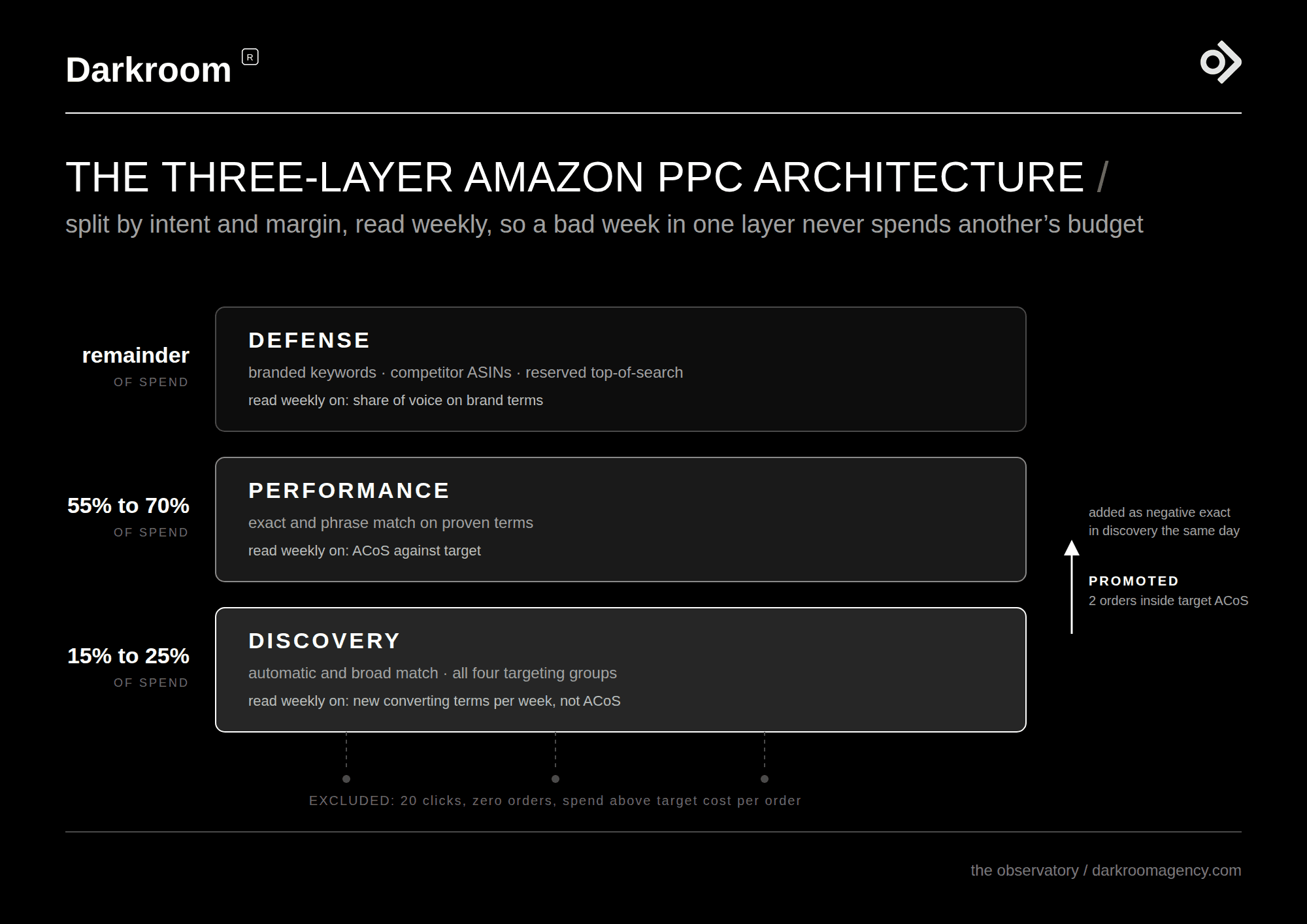
Structure by intent and by margin, not by product, because a campaign is the only unit in Amazon Ads where you can cap spend and read a clean signal. The Amazon PPC strategy that survives a 400-ASIN catalogue is three layers, each with a job, a budget share and a weekly metric, and each explained below.
The discovery layer
Think of the discovery layer as your research team. Its main job isn’t to drive sales right away, but to help you learn which search terms shoppers actually use to buy.
Instead of focusing on ACoS here, you’ll want to track how many new converting search terms you uncover each week. To do this, set up automatic campaigns with all four targeting groups (close match, loose match, substitutes, and complements) turned on, plus add a broad-match manual campaign for each product family. Typically, this layer will use about 15% to 25% of your total ad spend.
When you’re setting up your discovery campaigns, use one automatic campaign per product family instead of creating one for every ASIN. Make sure your daily budget is big enough to get at least 100 clicks per week, so you have enough data to work with.
For bidding, start at your break-even point instead of just using Amazon’s suggested bid. And here’s a tip: let the campaign run for a full 14 days before you start analyzing the results. If you check too soon, especially with a big family of products, the data will be too scattered to give you any real insights.
The performance layer
The performance layer is where your ACoS targets really matter, because here you’re only running search terms that have already shown they can convert. This layer uses exact and phrase match for those proven terms you found in discovery, and it usually takes up the biggest chunk of your ad spend. This part of your account really determines how profitable your ads will be.
Once a search term has brought in two orders at or below your target ACoS, it’s ready to graduate to the performance layer. Add it as an exact match in your performance campaign, using the same bid that worked before.
At the same time, add that term as a negative exact in your discovery campaign. This way, you avoid having both campaigns compete for the same shopper, which helps keep your data clean and your spend efficient.
It’s best to organize your performance campaigns by margin band instead of by product line. This way, products with a 15% ACoS target and those with a 30% target each have their own budgets. If you mix a high-margin hero product with a low-margin accessory in the same campaign, the average ACoS you see won’t really reflect the reality for either one.
The defense layer
The defense layer is all about protecting your turf. Here, you’re buying ad placements where it’s more costly to lose than to overpay, so the main thing to watch is your share of voice on brand terms, not ACoS.
This layer uses exact and phrase match for your branded keywords, targets competitor ASINs on their product pages, and starting in February 2026, you’ll also be able to reserve top-of-search spots for your branded keywords at a fixed upfront price.
The defense layer usually gets whatever budget is left after you’ve funded discovery and performance, which is typically about 10% to 20% of your total spend.
If competitors are attacking your brand, you might need to increase that share. Branded campaigns should generally show a low ACoS, often between 10% and 25%. If you notice your ACoS creeping up on your own brand terms, that’s often the first sign that a competitor has started bidding on them.
Competitor ASIN targeting is where you go on the offensive. Focus on the product pages of two or three competitors whose customers are most similar to yours. Instead of watching ACoS here, measure success by how many new-to-brand orders you get.
What Amazon PPC bidding strategy works in 2026?
When you’re setting your bids, start with your break-even point instead of just going with Amazon’s suggested bid. Amazon’s suggestion is really just a guess based on the market, but your break-even is based on your actual margins, so it’s much more reliable. Also, instead of increasing your base bids everywhere, try using placement and time-of-day modifiers. This way, you can be more strategic and only spend more where it really counts.
Dynamic bidding gives you two main options: With Down-only, Amazon can lower your bid if it thinks a click probably won’t lead to a sale; Up-and-down, on the other hand, lets Amazon increase your bid by up to 100% for top-of-search spots. We recommend saving this for defensive campaigns, like when you really don’t want to lose your top position to a competitor, even if it means paying a bit more.
Read also: Why Amazon Advertising Fails When Creative Is an Afterthought
Placement modifiers are where you can really make a difference with your budget. For example, top-of-search placements usually convert 1.5 to 3 times better than other spots, at least in the accounts I’ve seen. So, instead of raising all your bids, focus on increasing bids for top-of-search on keywords that are already working for you. Just remember, if your main image isn’t strong, even the best placement won’t help much.
Two big changes coming in 2026 will affect your defensive strategies. The first is Sponsored Brands reserve share of voice. This new feature lets you lock in top-of-search placements for your branded keywords at a set price upfront. Instead of competing in an auction every time, you can secure your spot ahead of time, which makes brand defense a lot more predictable.
Are your ads already running inside Alexa for Shopping?
If you run ads in the US, chances are you’re already in. You didn’t have to opt in because Amazon did it for you. Since May 13, 2026, when Amazon combined Rufus with Alexa+ to create Alexa for Shopping, your Sponsored Products and Sponsored Brands ads have started showing up in new placements.
Back on March 25, 2026, Amazon made these prompt placements available to everyone. If your campaign was eligible, Amazon automatically enrolled it, and it charges clicks just like your regular cost-per-click ads under your existing bidding parameters.
Think of prompts as your always-on product expert inside Alexa for Shopping. Amazon says these prompts automatically chat with shoppers and share relevant product info right in the conversation. You don’t need to set a separate bid for this placement. Your Ads Console has a Prompts report that shows all the key stats. If you ever want to stop prompts, you can pause them anytime.
Why should you care about the Prompts report? Amazon’s own data makes a strong case. In their Q2 2026 earnings release, they shared that shoppers using Alexa for Shopping spend over 40% more per order compared to those who don’t. Plus, active users have nearly doubled in a year, and interactions have jumped more than five times.
So, take a look at your Prompts report on its own, separate from your other campaign data. Let the numbers guide you. If you see this placement spending but not converting, remember this wasn’t a strategy you picked; it’s just the default setting you got.
What is a good ACoS for your measurement?
ACoS tells you whether a campaign paid for itself, TACoS tells you whether the programme is building anything, and neither means much until you know your break-even. ACoS is ad spend divided by ad-attributed sales; TACoS is ad spend divided by total sales, organic included.
A good ACoS is whatever sits below your contribution margin after Amazon's fees; Darkroom's guide to a good ACoS for your margin walks through the worksheet. Most reports skip that the target moves with the objective.
Objective | Target ACoS | What TACoS should be doing | If you miss it |
|---|---|---|---|
Product launch | 40% to 70% | Rising, because paid is most of the sales | Expected for the first 60 to 90 days; watch organic rank instead |
Established product | 15% to 30% | Flat or falling as organic takes share | Structure or listing problem before it is a bid problem |
Liquidation | 50% to 80% | Irrelevant; you are clearing inventory | Check the price cut is real before raising bids |
Brand defense | 10% to 25% | Stable; this is insurance | A competitor is outbidding you on your own name |
Directional planning ranges by objective, not measured category benchmarks. Your break-even sets the ceiling.
TACoS is the number that keeps a program honest. Organic rank is doing more of the work on one line, which is the point of running ads at all.
What does Amazon PPC management cost in 2026?
Amazon PPC management costs 15% to 30% of ad spend under a percentage model, $5,000 to $30,000 a month under a flat retainer, or a reduced flat fee plus 5% to 8% of spend under a hybrid. The percentage model dominates below $100,000 in monthly spend, the flat model is cheaper above it, and the hybrid is what most agencies offer once a brand asks about incentives.
Model | Typical range | At $100,000 monthly spend | When it stops making sense |
|---|---|---|---|
Percentage of spend | 15% to 30% | $15,000 to $30,000 a month | Above roughly $150,000 in spend, where the fee outgrows the work |
Flat retainer | $5,000 to $30,000 a month | $5,000 to $30,000, unchanged | Below roughly $30,000 in spend, where the fee outweighs the media |
Hybrid | $8,000 to $15,000 base plus 5% to 8% | $13,000 to $23,000 a month | Rarely; it is the compromise both sides can defend |
Amazon PPC management cost by fee model, from agency proposals Darkroom sees for consumer brands at the $5M to $100M+ scale.
The PPC management cost in agencies
Let’s talk about how agencies charge for Amazon PPC management, because the pricing model you choose can really impact your results. With the percentage model, the agency’s fee goes up as your ad spend goes up, even if increasing spend isn’t actually the right move for your business.
If they’re getting 20% of your media spend, they don’t have much reason to tell you when your account has hit its limit. On the other hand, a flat fee or retainer can solve that, but it brings its own issues.
If your product catalog grows or your campaigns get more complex, a fixed fee might not cover the extra work needed, and your account could end up under-serviced. That’s why many agencies and brands end up with a hybrid model, trying to balance both sides.
What you’re actually getting for your fee is more important than the percentage itself. For example, paying 20% for an agency that’s actively managing your account every week is a totally different value than paying 20% for someone who just checks a dashboard once a month. Sometimes, the Amazon PPC management fee that seems high at first glance is actually the one putting in the real work to grow your account.
Read also: How Much Does a Marketing Agency Cost in 2026? Real Pricing by Service
Should you run Amazon PPC in-house, with software, or with an agency?
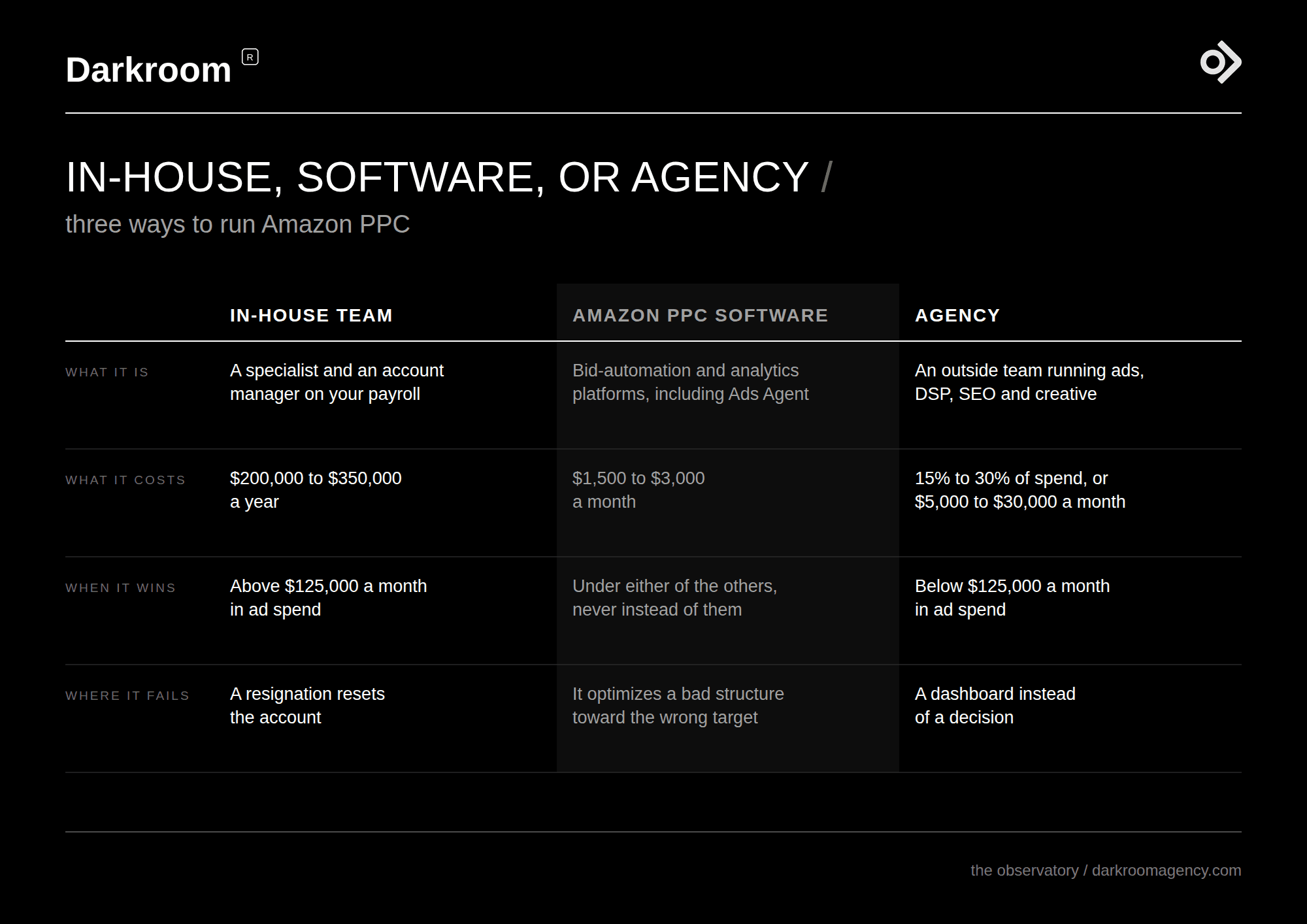
The decision is not about cost. It is whether anyone on your side can read the account weekly and act on it, because an unread account drifts at any price. All three options fail the same way, when the search-term report goes unopened for a month, so compare them on who does the reading, not on the invoice.
Option 1: In-house team
What it is. A dedicated Amazon PPC specialist and an account manager on your payroll, plus the software they need to run the account.
What it costs. Roughly $200,000 to $350,000 a year fully loaded, across the consumer brands Darkroom has benchmarked, including salaries, benefits and tools.
When it wins. Above about $125,000 in monthly ad spend, where a fixed salary cost undercuts a 20% agency fee, and when the brand wants the account knowledge to stay inside the company.
Where it fails. Two people carry all the expertise, so a resignation resets the account, and a single hire rarely brings the forecasting and modeling that decides where next week's budget goes.
Option 2: Amazon PPC software
What it is. Bid-automation and analytics platforms that adjust bids on rules or machine learning and surface the search-term report in a dashboard. Amazon's own Ads Agent now sits in this category for advertisers with Amazon Marketing Cloud or DSP access.
What it costs. $1,500 to $3,000 a month for the bid-automation and analytics stacks we see in client accounts, plus the salary of whoever operates it.
When it wins. As a layer under either of the other two options, on accounts with hundreds of campaigns where manual bid changes are no longer possible at the cadence required.
Where it fails. Amazon PPC tools do not replace the person reading them. Software will optimise a badly structured account very efficiently toward the wrong target, and it cannot tell you the target is wrong.
Option 3: Agency
What it is. An outside team running the account under one of the three fee models above, ideally with Sponsored Ads, DSP, Amazon SEO, and creative managed as one system rather than as four vendors.
What it costs. 15% to 30% of spend, $5,000 to $30,000 a month flat, or a hybrid, which at $100,000 in monthly media works out to roughly $13,000 to $30,000 a month.
When it wins. Below the $125,000 monthly spend crossover, where the fee buys more expertise per dollar than a hire does, and at any spend level when the brand needs forecasting, creative and listing work alongside the bidding.
Where it fails. A percentage fee with no incentive to cap spend, and an account that gets a weekly dashboard instead of a weekly decision. An Amazon PPC expert is only worth the fee if they bring something a good hire cannot.
Get your Amazon PPC account audited
Three things in this guide are worth checking in your own account this month.
Your Prompts report: Your US campaigns have served inside Alexa for Shopping since 25 March. Read that placement on its own before Q4 spend ramps.
Your bid ceilings: If most Sponsored Products clicks have been charged at the maximum bid, as the FTC alleges, your bids are your prices. Rebuild them from break-even.
Your structure: Count the campaigns nobody opened last week. That number is your wasted spend, whatever the ACoS says.
Darkroom is an Amazon marketing agency for high-growth consumer brands, and clients under management see 57% more Amazon sales and 38% lower ACoS on average. Our week-one Amazon PPC audit covers all three checks above. Audit your Amazon PPC account and get a 90-day revenue roadmap before you commit Q4 budget.
Frequently Asked Questions
What is Amazon PPC?
Amazon PPC is Amazon's pay-per-click advertising system, where Sponsored Products, Sponsored Brands, and Sponsored Display campaigns compete in an auction for placements across search results, product pages, and, since March 2026, Amazon's AI shopping assistant. Advertisers pay per click, not per impression. Darkroom, an Amazon marketing agency, manages it as one system alongside DSP, SEO and creative.
How does Amazon PPC work?
You choose targets, which are keywords, products or audiences, and set a maximum bid per click. When a shopper's search or page view matches, an auction selects which ads appear and what each pays. You are charged only when the shopper clicks. Since 25 March 2026 the same campaigns also serve inside Amazon's AI assistant, billed under the same bids.
What is a good ACoS for Amazon PPC?
There is no single good ACoS, only a good one for the job. A launch can tolerate 40% to 70%, an established product should sit at 15% to 30%, liquidation runs 50% to 80% and brand defence 10% to 25%. The ceiling for all four is break-even ACoS, your contribution margin after Amazon fees.
How much does Amazon PPC management cost in 2026?
Expect one of three fee models: 15% to 30% of ad spend, a flat $5,000 to $30,000 a month, or a hybrid of a reduced base plus 5% to 8% of spend. On $100,000 of monthly media those come to roughly $15,000 to $30,000, $5,000 to $30,000, or $13,000 to $23,000. Percentage suits lower spend; flat wins above it.
Are my Amazon ads showing inside Alexa for Shopping, Amazon's AI assistant?
Yes, for US advertisers. Since Sponsored Products and Sponsored Brands prompts reached general availability on 25 March 2026, eligible campaigns have been enrolled by default, and clicks inside Alexa for Shopping are charged under the same CPC bids as the rest of the campaign. The Ads Console carries a separate Prompts report, and prompts can be paused at any time.
Is the Amazon ad auction really a second-price auction?
Amazon has described it that way, with the winner paying one cent more than the next highest bid. On 31 August 2026 the FTC and 22 states sued, alleging a hidden soft reserve price made that inaccurate from 2019, with close to 80% of Sponsored Products advertisers paying their own bid by 2024. Amazon disputes the allegations, untested in court.
Should you run Amazon PPC in-house or hire an agency?
Choose who will read the account every week, not on price. A fully loaded in-house team, including software, runs about $200,000 to $350,000 a year in Darkroom's benchmarking, and beats a 20% fee once monthly spend clears roughly $125,000. Under that line, an agency buys more expertise per dollar. Both fail the same way: an unopened search-term report.