
PAID MEDIA
Incrementality Testing vs Media Mix Modeling: What Growth Teams Actually Need in 2026




Written by Darkroom leardership

Written & peer reviewed by 4 Darkroom team members
TL;DR: Incrementality testing and media mix modeling are not competitors. They measure different things at different time horizons. Most growth teams fail because they adopt one methodology in isolation, creating blind spots. A functional measurement stack uses MMM for strategic budget allocation, incrementality testing for channel-level validation, and Darkroom attribution for tactical optimization. This article breaks down what each actually measures, when to use each, and how to build an integrated architecture that survives platform changes.
Why the Measurement Debate Is Framed Wrong
The measurement industry has spent five years creating a false dichotomy. It's framed as "MMM vs incrementality" because that's easier to sell. Vendors build platforms around one methodology and convince marketers they've found the answer. The problem is that neither methodology, in isolation, gives you what you actually need.
According to eMarketer, 46.9% of US marketers are increasing investment in MMM, while 36.2% are investing more in incrementality testing. That split tells you something important: both are growing because neither is sufficient alone. The debate itself is the problem. You don't need to choose. You need to architect a system where they work together.
The question is not which one to use. As Harvard Business Review has explored, the real challenge is understanding what each methodology is actually designed to answer, where they conflict, and how to resolve the conflict. That's operational. That's what growth teams building real businesses actually care about.
What Media Mix Modeling Actually Tells You
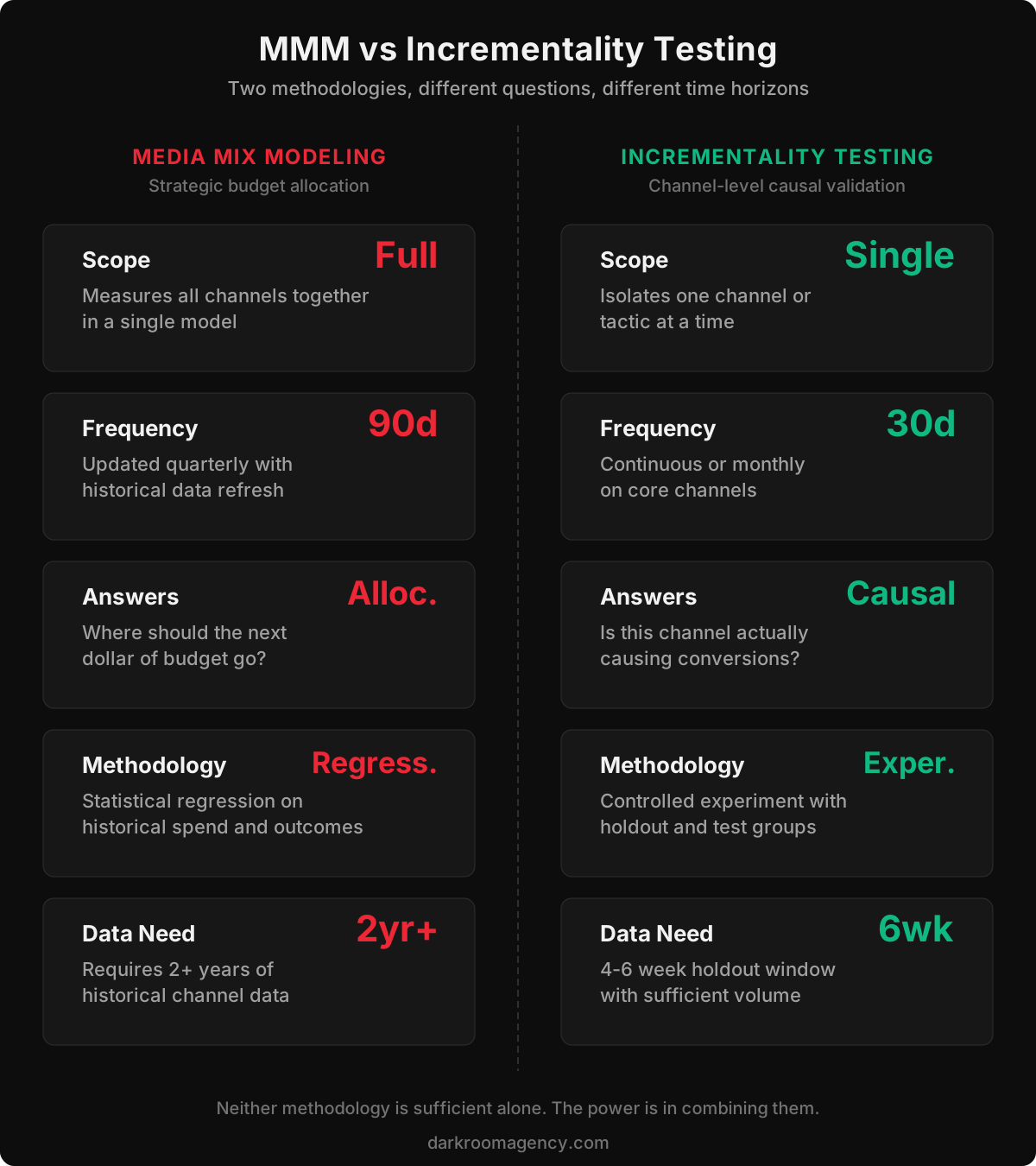
MMM is a strategic tool designed to answer one question: how should I allocate my budget across channels at a high level? It ingests historical data—spend, conversions, external factors—and uses statistical models to decompose revenue into contributions by channel. The output is elasticity: how much does a 10% increase in spend on Channel X move the needle on revenue?
Done well, MMM is powerful. It forces you to think about channel interactions (does TV amplify digital performance?), saturation curves (does spend beyond a certain point show diminishing returns?), and competitive context (is the market growing or are you just stealing share?). As Nielsen's research on MMM effectiveness shows, it works across both trackable and non-trackable channels, which makes it the only methodology that can fairly compare TV, display, and performance channels.
But here's what MMM doesn't do. It doesn't validate your creative. It doesn't tell you whether your targeting assumptions are correct. It doesn't catch platform attribution bugs or bid strategy failures. MMM sees the aggregate outcome—revenue went up after we increased Google spend—and calculates a statistical relationship. It doesn't care why. And it operates on lag. Your monthly revenue data comes in 45 days late. By then, you've optimized based on platform metrics that may be wrong.
The operational limit: MMM is slow, it's statistical (subject to confounding), and it gives you direction without proof. Teams relying on strong paid media management know this distinction matters.
What Incrementality Testing Proves
Incrementality testing is the opposite animal. It's tactical and proof-based. You run an experiment: reduce spend on a channel for a subset of users, hold another subset at normal spend, and measure the difference in conversion rates. The difference is the true incremental impact of that channel. No statistical model required. No attribution tag. Just clean comparison groups.
According to Measured.com, 52% of brand and agency marketers are already running incrementality tests. The adoption curve is steep because the method is reliable. Google's own documentation on incrementality testing provides a useful primer on the mechanics. When done correctly, an incrementality test answers this question with high confidence: is this channel actually moving conversions, or are we just capturing people who would have converted anyway?
That's a critical question. Platform attribution lies. It gives credit to the last touchpoint. If a user sees a Google display ad, then searches your brand on Google, and converts on the organic search result, Google takes credit for both. Your paid search ROI is inflated. Incrementality testing cuts through that noise. It isolates the true contribution of paid search, paid social, display, retargeting, and everything else. For more on this problem, read our breakdown of why paid media fails when you rely on platform metrics alone.
But incrementality has operational limits. It's expensive to run. It requires statistical power, which means you need either high volume or long test windows. It's channel-specific—you can test search, but aggregating results across channels to answer "where should I allocate my next dollar" is harder. And it doesn't account for offline events, brand value, or long-term effects. If TV drives brand lift that shows up in Google searches three months later, an incrementality test on Google alone will underestimate TV's value.
The operational limit: incrementality is expensive to run, requires high volume, and answers tactical questions at the cost of ignoring strategic context.
The Triangulation Framework: How MMM, Incrementality, and Attribution Work Together
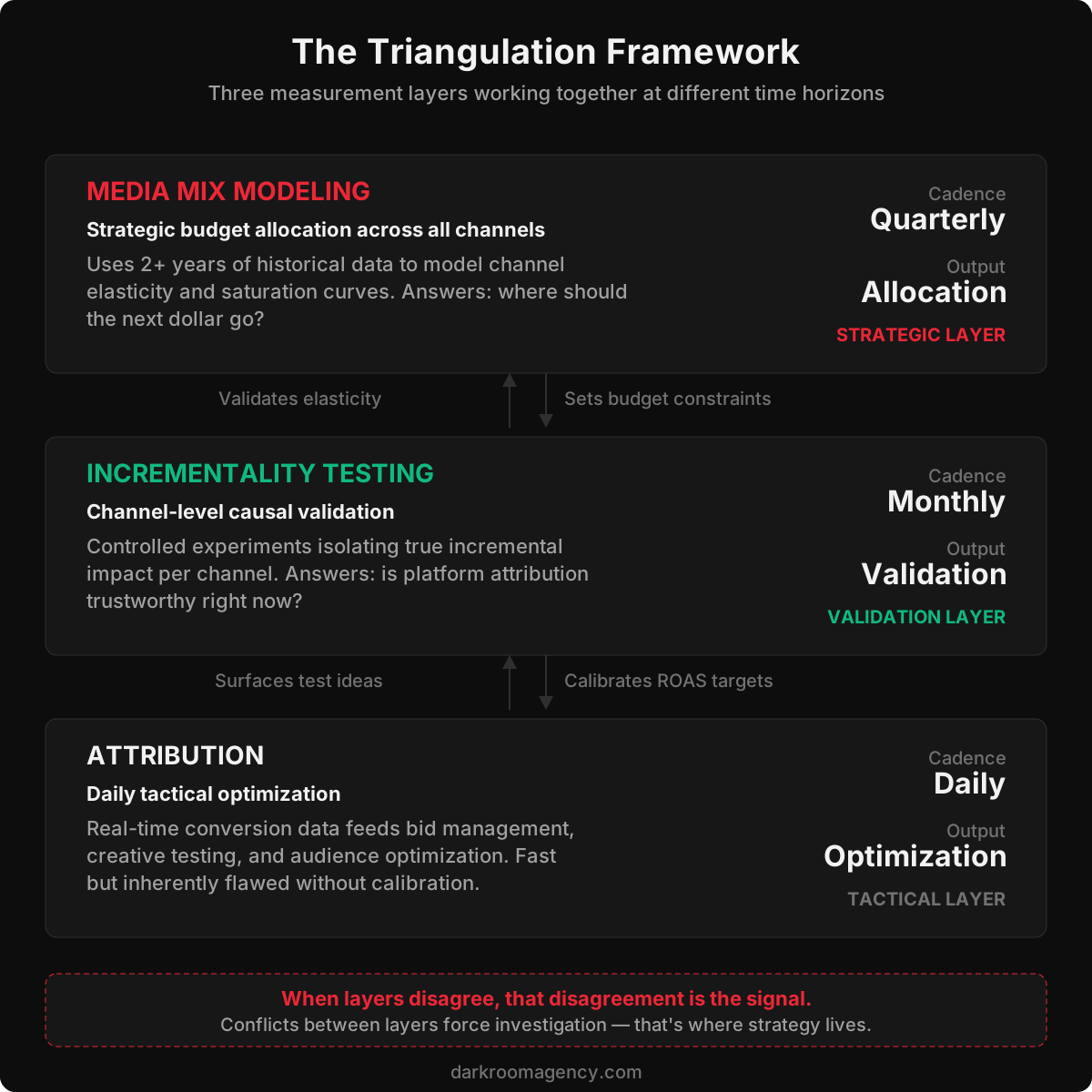
The solution is not to pick one. It's to run all three in parallel and use disagreement as a signal.
Here's how a functional measurement stack operates. MMM is your strategic layer. It runs monthly and tells you whether your portfolio-level allocation is correct. When MMM says incrementality on Facebook is 1.8x and on Google Search is 2.1x, that's your signal to shift budget from Facebook to Search. Don't do it immediately. That's a direction-setting conversation, not a tactical move.
Incrementality testing is your validation layer. You run continuous experiments on your largest channels—Google, Facebook, TikTok, Amazon. These tests answer the question: is platform attribution trustworthy right now? When your incrementality test on Google Search finds that true incremental ROAS is 1.9x but platform attribution says 3.2x, you've just found your blind spot. Platform data is inflated by organic search traffic you would have gotten anyway. That's information MMM won't catch because it's hidden in the aggregates.
Attribution is your operational layer. It handles daily optimization. You feed real-time conversion data into your attribution model—whether that's last-click, algorithmic, or something else—and optimize bids, creatives, and audiences within the constraints your MMM and incrementality work set for you. Attribution is inherently flawed, but it's fast. That's its job. We explore this shift in more detail in our piece on why predictive measurement is replacing backward-looking attribution.
Where they disagree, that's where the work is. If MMM says to increase Facebook spend but incrementality testing shows declining incremental returns, you have a conflict. That conflict usually means one of three things: the market has shifted, your creative has gotten stale, or your targeting assumptions are wrong. The conflict forces you to investigate. That investigation is where strategy lives.
When to Use Each Methodology: A Decision Matrix
Not every business has the same measurement needs. Your budget, channel mix, and growth stage determine which methodologies matter most.
Early stage (sub-$1M monthly ad spend, single channel): Incrementality testing is overkill. Your statistical power is too low and your volume is too small to support reliable experiments. Your priority is platform attribution tuning. Get your conversion tracking right. Clean your UTM parameters. Make sure you understand the difference between clicks and conversions, and learn your CAC. Don't invest in MMM yet either—you don't have enough historical data. Measurement at this stage is about blocking obvious mistakes.
Growth stage ($1M-$10M monthly spend, 3-5 channels): This is where incrementality testing starts to make sense. Your volume is now high enough to run reliable experiments. Start with your largest channels. Run a simple test: pause spend for a test group, hold a control group at normal, and measure the difference. This is your first validation that platform metrics are trustworthy. You can skip MMM still—your channels are too new, your mix is still being set. Incrementality is your leverage point because it prevents you from optimizing against broken attribution.
Mature stage ($10M-$50M monthly spend, stable channel mix): Now MMM becomes useful. You have historical data, you have stable channels, you're not in experiment mode anymore. You're in optimization mode. MMM tells you whether your portfolio-level allocation is efficient. Pair it with incrementality testing on 2-3 of your core channels to validate that platform attribution is working. Your measurement stack is MMM (quarterly review), incrementality (ongoing on core channels), and attribution (daily optimization).
Enterprise ($50M+ monthly spend, complex mix including offline, TV, etc.): You need all three. MMM is your backbone because it's the only thing that can fairly compare TV, offline, and digital. Incrementality testing runs on digital channels where you can isolate groups. Attribution handles daily optimization. The IPA's effectiveness research has consistently shown that balancing short-term performance measurement with long-term brand effects is critical at this scale. At enterprise level, this integrated approach is table stakes.
The Organizational Problem: Who Owns Measurement?
Here's where most measurement initiatives fail: the organizational structure doesn't support the methodology. You implement MMM as a centralized finance function, reporting to the CFO. You run incrementality tests as an experimentation program, reporting to the head of growth. Your attribution sits in marketing ops, reporting to the head of marketing. Nobody talks to each other. When MMM says Facebook should get 30% of budget but the growth team's incrementality tests show declining returns, there's no mechanism to resolve the conflict. The budget allocation doesn't change. The incrementality data gets ignored. MMM becomes a compliance exercise.
The fix is structural. Measurement ownership needs to be unified. In a modern organization, it sits with the head of growth or the VP of performance marketing. MMM, incrementality, and attribution all report to the same person. When there's a conflict, that person is empowered to investigate and change strategy. This doesn't mean those functions are centralized in one place. The MMM vendor might be in finance's budget. The incrementality testing platform might be owned by the experimentation team. But there's a single point of accountability for reconciling their outputs.
The second fix is cadence. MMM should drive quarterly or semi-annual strategy reviews. Incrementality testing should run continuously on core channels, with results reviewed monthly. Attribution should be tuned weekly as data comes in. When MMM conflicts with incrementality, you schedule a working session to investigate. When attribution conflicts with incrementality, you audit your platform setup. Rhythm prevents politics.
What a Modern Measurement Stack Looks Like Operationally
Here's how a growth team at a scaling brand actually implements this. You don't need three different vendors if they can't talk to each other. But you probably can't get all three from one vendor without trade-offs.
MMM layer: You use a vendor like Fospha, Recast, or Measured that runs statistical models on your historical data. The output is monthly elasticity estimates and budget allocation recommendations. Cost is typically $5k-50k per month depending on data complexity. Cadence is quarterly review.
Incrementality layer: You build capability in-house or partner with a vendor like Measured, Tripple Whale, or an in-house experimentation platform. The infrastructure is straightforward: randomized experiment groups, holdout control, weekly analysis. You run continuous tests on your 2-3 core channels. Geo-based experimentation in particular is gaining traction—our article on why geo experimentation is becoming the source of truth for marketing measurement covers this in depth. This requires data engineering lift (isolating users into control/test at ad serving level) but not massive spend.
Attribution layer: This sits in your marketing ops stack. Most major platforms (Google Marketing Mix, Meta Conversion Lift, Amazon Advertising Console) have native attribution models now. What matters is that you feed real conversion data back into these systems daily, and you treat the output as directional, not gospel. The attribution layer is where you operationalize what MMM and incrementality tell you.
Integration point: a single dashboard where MMM elasticity, incrementality results, and platform ROAS are visible side-by-side. When they disagree, that disagreement goes into a weekly working agenda. The investigation happens there.
This stack is not cheap. You're probably spending $50k-150k per month on measurement infrastructure if you're at $10M+ monthly spend. The question is not whether you can afford it. It's whether you can afford not to. If measurement is guiding millions of dollars in budget allocation decisions, measurement errors are expensive. Most growing brands find the ROI of a proper stack is 2-3x the cost within six months because they stop making capital allocation mistakes.
Moving From Theory to Practice: Three Steps to Get Started
You don't need to implement everything at once. Here's a phased approach based on where you are today.
Step 1: Audit your current stack. What measurement are you running today? If it's platform attribution alone, you have blind spots. If it's MMM alone, you have untested assumptions. If it's incrementality alone, you're missing strategic context. Write down what each system is telling you about ROI by channel. Then write down the conflicts. That's your starting point.
Step 2: Start with incrementality testing if you don't have it. It's the fastest way to validate that your platform metrics are trustworthy. Pick your largest channel. Run a simple holdout test over 30 days. Measure the true incremental impact. Compare it to platform attribution. The gap you find is the bias you've been optimizing against. That gap usually pays for the entire measurement program just by fixing it.
Step 3: Layer in MMM quarterly. Once you understand your baseline incrementality, add an MMM review quarterly. This is where you ask whether your portfolio allocation is right across channels. Use incrementality test results to validate MMM elasticity estimates. Resolve conflicts in a working session, not a dashboard note. As AI-driven optimization becomes standard, the teams that combine measurement layers will have the strongest advantage—something we cover in our piece on why AI-driven budget optimization is replacing the weekly media plan.
The goal is not measurement perfection. It's measurement that's good enough to guide strategy and catches major errors before they cost millions. Build to that bar, then optimize.

FAQ
Can I just use platform attribution and skip MMM and incrementality testing? Short answer: no. Platform attribution is optimized to favor the platform. It gives credit to the last click, which inflates performance marketing ROI and undervalues upper-funnel channels. You'll systematically overspend on paid search and underspend on awareness channels. You need at least incrementality testing to catch this bias.
How much does incrementality testing cost versus the value it returns? A proper incrementality test costs $5k-20k to run depending on your volume and vendor. The typical finding is that platform ROAS is overstated by 20-40% due to attribution bias. If you're spending $10M monthly and fixing that bias saves you 10% of budget, that's $1M annual savings. The test pays for itself in a week.
Can MMM and incrementality testing conflict? What do I do when they do? Yes, they often disagree. When they do, it usually means one of three things: the market has shifted, your creative is stale, or your targeting is broken. Use the conflict as a forcing function to investigate. Run a deeper analysis on that channel. Often the resolution reveals a tactical improvement that both methods missed.
Does incrementality testing work for brand awareness campaigns? Not directly. Incrementality testing measures near-term conversions. Brand awareness campaigns work on longer time horizons and are better measured through MMM or lift studies. For awareness, use lift studies or MMM elasticity. For performance, use incrementality testing.
What's the minimum volume of conversions I need to run a reliable incrementality test? Generally, aim for 100+ conversions per arm per week. If you're below that, use longer test windows. If you're significantly below that, incrementality testing won't be statistically powered enough to be useful. Focus on MMM and attribution tuning first.
Can I use incrementality testing to compare channels directly, like Google vs Facebook? You can run separate tests on each channel, but comparing across channels is complex because they serve different roles in the funnel. Google often performs better because it captures high-intent traffic. Facebook performs on awareness. Run tests independently, then use MMM to allocate between them, weighing short-term incrementality against long-term brand value.
How do I know if my MMM model is any good? Two checks. First, does it match reality? Run an incrementality test on the same channel MMM measured, and compare results. If they're in the ballpark, MMM is calibrated. Second, does it drive decisions? If MMM recommendations are sitting in a dashboard untouched, it's not useful regardless of accuracy.
The Real Problem Is Choice Without Integration
The measurement debate didn't happen because MMM and incrementality testing are actually incompatible. It happened because the vendor ecosystem made them seem like choices rather than complements. If you buy an MMM platform from one vendor, the output lives in one silo. If you run incrementality tests through another vendor, those results live in another silo. They don't talk. The conflict doesn't get resolved. So marketers picked one and ran with it, taking the blind spots that come with that choice.
A modern media buying team or in-house growth function builds a measurement architecture, not a measurement tool. That architecture has layers, each designed for a different question and a different time horizon. MMM for strategy. Incrementality for validation. Attribution for daily optimization. The glue that holds them together is people and process, not software.
When you get this right, the result is capital allocation that actually works. Budget flows to channels that drive incremental value. Channels that are undervalued by platform metrics get fair consideration. The measurement errors that were costing you 10-15% of efficiency get caught and corrected. You move from debating which methodology is right to building a measurement practice that's resilient across market changes and platform updates.
That's the actual problem MMM and incrementality testing solve together. Not one or the other. Both. And teams that pair integrated measurement with comprehensive growth marketing services consistently outperform those still debating methodology.
Ready to Build Better Measurement?
Measurement architecture is not a one-time project. It's a continuous practice that evolves as your business scales. If your current stack is limited to platform attribution, or if you're running MMM or incrementality in isolation, there's significant upside in integrating them.
Book a call with Darkroom to audit your current measurement setup and build a roadmap for integration. We work with brands from $5M to $500M in annual ad spend on measurement architecture, channel optimization, and growth strategy. The conversation is free and usually surfaces opportunities you didn't know you had.