
CREATIVE
How to Build a Performance Creative System That Scales




Written by Darkroom leardership

Written & peer reviewed by 4 Darkroom team members
TL;DR: Performance creative is not a talent problem. It is a systems problem. Most brands operate campaign-by-campaign: brief, produce, launch, repeat. This creates a bottleneck where creative output can't match media spend. Brands that scale creative successfully build systems with three core components: a structured testing methodology that tells you what to make next, a modular production pipeline that separates concepts from executions, and a feedback loop that connects performance data to creative decisions. Without all three, you are making content. With all three, you are building an engine. This article breaks down how to architect each component, the 90-day implementation roadmap, and team structure decisions. Read on to learn the specific operational mechanics that transform creative from a bottleneck into a competitive advantage. Darkroom helps brands build these systems at scale.
Why Creative Is the Bottleneck in Paid Media
Most brands don't have a targeting problem. They don't have a budget problem. They have a creative problem.
The data is clear. Meta's internal research shows creative quality is the single largest driver of ad performance, outweighing audience targeting, bidding strategy, and bid amount combined. Nielsen's analysis of advertising effectiveness across categories found that creative drives 47 to 56 percent of sales lift from advertising, while media strategy drives only 4 to 8 percent. The implication is blunt: creative difference matters more than everything else combined.
And yet most teams operate as if the opposite is true. They invest in media buying infrastructure, audience segmentation, bid optimization, and attribution modeling while treating creative as a production task to be handed off to freelancers or squeezed through a quarterly creative review cycle.
This creates a predictable constraint. A brand might have a monthly media budget of 500K dollars. To hit ROAS targets, they need 50 to 100 different creative variations across platforms and audience segments. Producing 50 to 100 variations per month through a traditional brief-produce-review cycle takes 6 to 8 weeks and costs 20K to 40K in production fees. By the time the creative is produced, market conditions have shifted. The test is stale before it starts.
Meanwhile, the media team is sitting idle. They have budget to spend and no fresh creative to spend it on. The bottleneck moves backward to strategy. Media teams start stretching existing creative, serving the same ads to broader audiences, and watching ROAS decline as creative fatigue sets in.
The AppFlyer data on creative fatigue shows that performance drops 15 to 20 percent within the first two weeks of a creative's active lifespan. By week three, drop-off accelerates. This means your production velocity directly maps to your ability to maintain ROAS. Slow production equals fast degradation. As Nielsen's research on creative effectiveness confirms, the quality and freshness of creative is what ultimately drives campaign results.
Brands that scale break this dynamic by treating creative production not as a project, but as a system. The difference is structural. For a deeper look at why this discipline is so widely misunderstood, see our breakdown of why performance creative is the most misunderstood service in modern growth marketing.
Creative Production vs. a Creative System
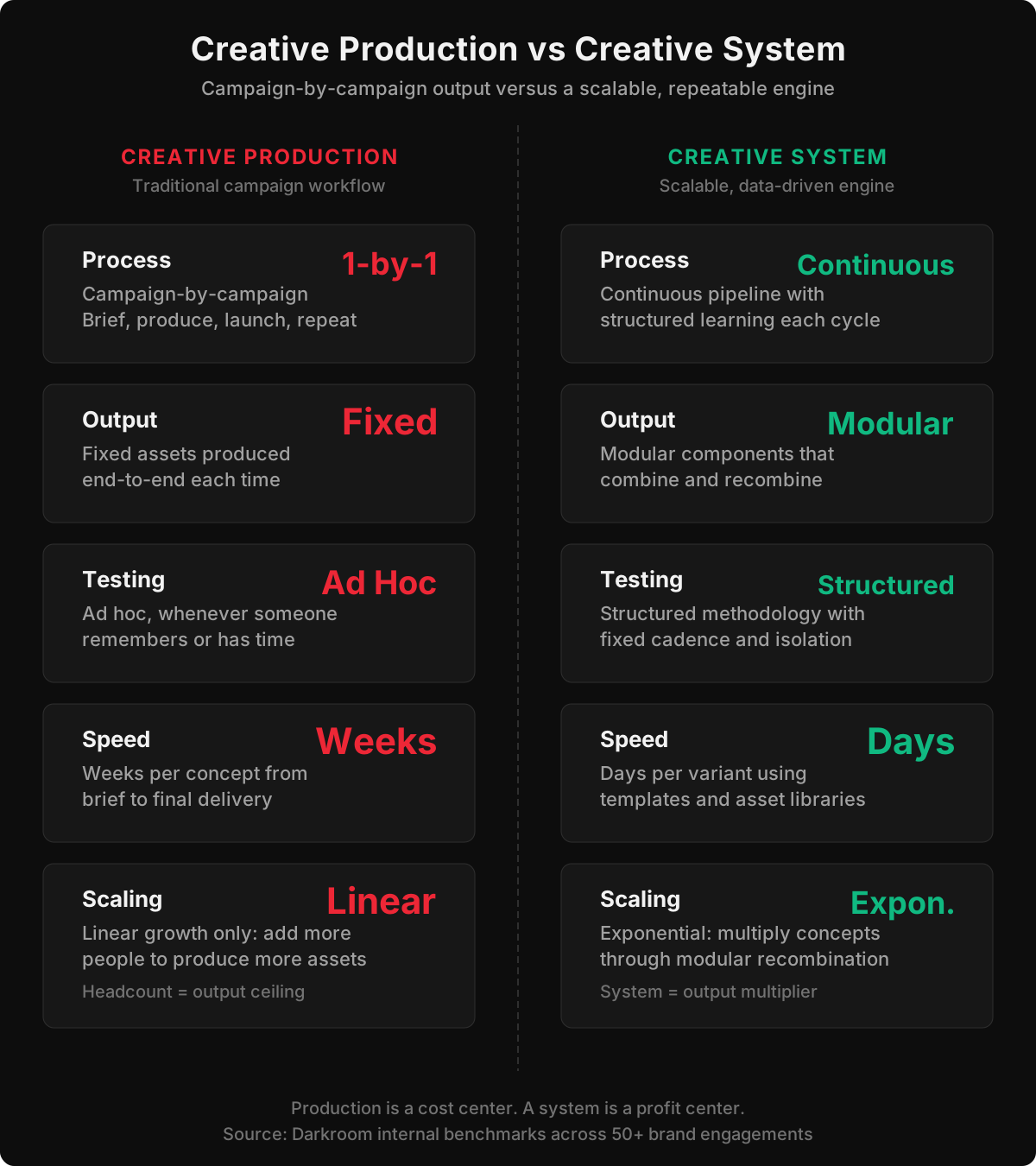
Creative production is what most teams do. You receive a brief. You create a concept. You move through revisions. You produce the final asset. You launch it. Done.
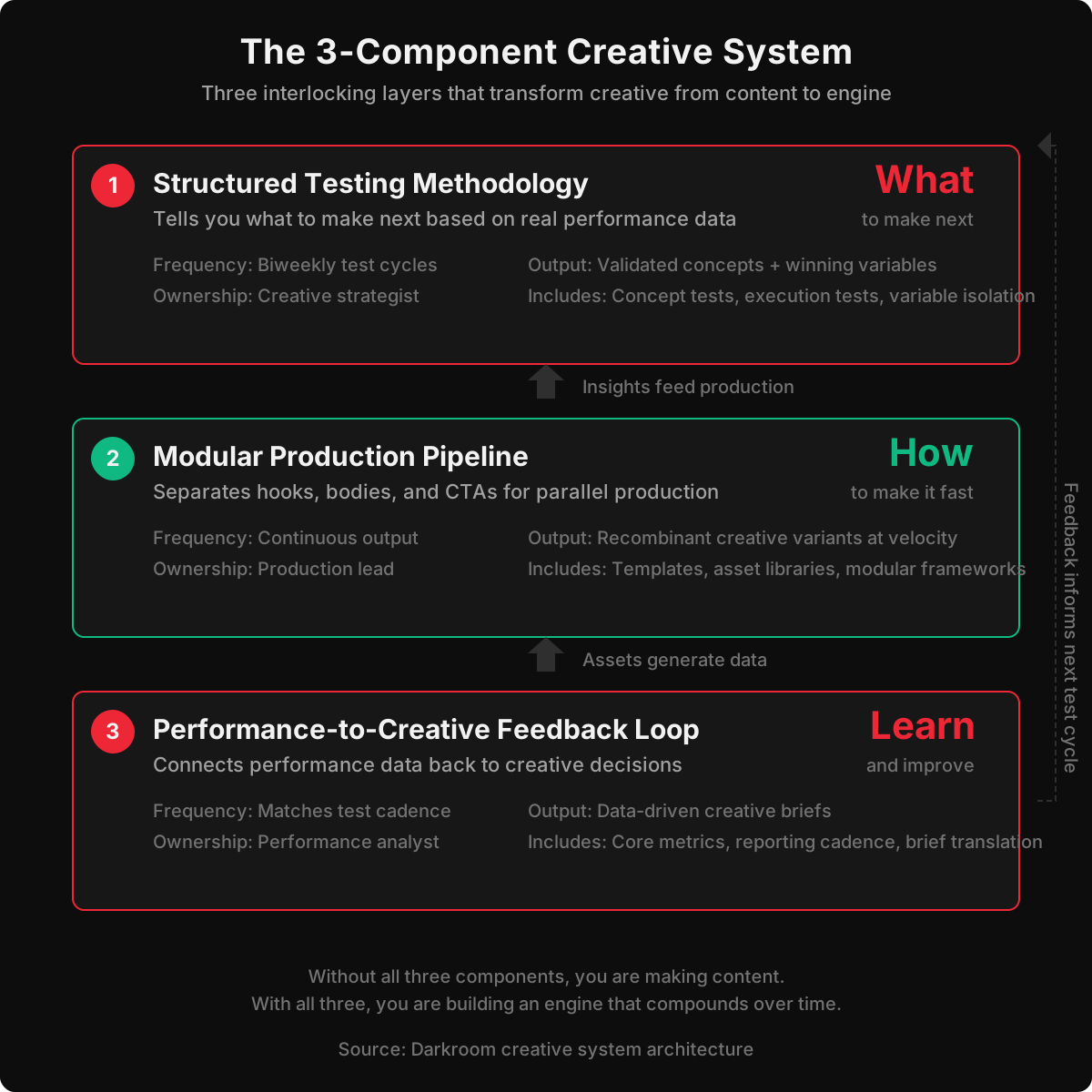
A creative system is something different. It's a repeatable process that generates informed creative decisions at velocity. The system sits between strategic insight and execution, and it includes three interlocking components: a testing framework that generates insights, a production pipeline that operationalizes those insights, and a feedback mechanism that connects performance back into the framework.
The difference is not subtle. In a production model, every creative brief is unique. In a systems model, every creative builds on the last one through structured learning. In a production model, you make decisions based on intuition and past success. In a systems model, you make decisions based on real-time performance data. In a production model, creative is a cost. In a systems model, creative is a profit center.
Let's break down what each component looks like operationally.
Component 1: Structured Testing Methodology
The first component of a scalable creative system is a testing methodology that tells you what to produce next. Without it, every creative decision is a guess. With it, creative decisions are informed by real performance data.
A structured testing methodology has three parts: concept testing, execution testing, and test cadence. For insights on how leading brands approach creative testing at scale, Kantar's AdReaction study offers useful benchmarks on what separates effective tests from wasted spend.
1. Concept Testing vs. Execution Testing
Most teams collapse these two into one. They pick a concept, produce it to completion, and test it. This is inefficient. Concepts and executions should be tested separately.
Concept testing answers the question: what core message or hook resonates with your audience. This happens before heavy production. You might test a message in copy form, or as a rough sketch, or as a storyboard. The goal is to validate that the core idea has legs. Winning concepts move to the next phase. Losing concepts get shelved.
Execution testing answers a different question: given a proven concept, which production style, pacing, music, voiceover, or visual treatment performs best. This is where you refine. You might produce the same concept five different ways. Different color grades. Different pacing. Different hooks. The data tells you which execution wins.
By separating the two, you avoid throwing away a good concept because the first execution missed. You also avoid wasting production budget on executing bad concepts. This is not a pedantic distinction. It cuts production timelines in half and increases your learning rate significantly.
2. Variable Isolation
In your execution testing phase, isolate one variable at a time. Don't change music, pacing, and CTA simultaneously. Change one. Let the market tell you what matters.
This is harder than it sounds because it requires restraint. You want to test ten things at once. Don't. Isolated variables create learnable data. Multivariate tests create noise. The brands that move fastest isolate ruthlessly.
3. Test Cadence
You need a regular testing rhythm. Most teams test sporadically, whenever they remember to, or whenever a new campaign launches. Structured teams test on a fixed cadence. Biweekly is common. Some move to weekly. The cadence is less important than the consistency. A predictable test schedule means your team knows what to expect, your production team can plan capacity, and your media team can allocate budget predictably.
Component 2: Modular Production Pipeline
The second component of a scalable system is a production pipeline that separates concept from execution. This unlocks velocity.
Most teams produce end-to-end. One designer or video editor owns the entire creative from brief to final export. This is limiting. One person can only produce so much. Modularization breaks this constraint by separating roles and standardizing handoffs.
1. The Modular Framework: Hooks, Bodies, CTAs
Every ad has three functional components. The hook. The body. The CTA. Most production teams treat these as monolithic. Modular teams separate them.
Hooks are the first 1 to 3 seconds. They answer: why should I care. This can be a surprising visual, a bold statement, or a gesture that signals what the ad is about. Hook production can happen in parallel. Different people can be producing different hooks simultaneously while others work on the body.
Bodies are the middle section. They prove the hook, explain the benefit, or build social proof. Bodies are where most of your craft lives. Emotional connection, pacing, narrative structure, all of it happens here.
CTAs are the final frame or voiceover. They move the prospect to action. Shop now. Sign up. Claim your discount. Download the app. The CTA is often the easiest piece to test because it's the most modular. You can swap CTAs without reshooting.
By separating these three, you enable parallel production. You also enable combination testing. A single hook can pair with multiple bodies. A single body can pair with multiple CTAs. This multiplier effect scales your creative output without scaling headcount.
2. Template Systems and Asset Libraries
A template system is a pre-built production structure that drastically speeds up execution. If you produce a lot of still images, a template might be a Figma file with locked brand guidelines, open spaces for copy and imagery, and a standardized sizing for all platforms. Designers fill in the blanks. The concept is locked. The execution is sped up.
An asset library is a repository of validated production elements. Product photos. Lifestyle imagery. Music tracks that have tested well. Transition effects. Motion graphics. B-roll footage. When you have a library of proven elements, you can produce faster and with more consistency. New team members can reference the library and understand what works.
The combination of templates and libraries collapses production time from weeks to days. A new designer can walk into a modular system and produce their first test creative on day one. Without it, they need a month to understand the brand.
Component 3: Performance-to-Creative Feedback Loop
The third component is the feedback loop. This is what closes the circuit between data and decisions.
Most teams have loose feedback loops. An ad runs. A few weeks later, someone looks at performance. They send a message saying the ad performed well or poorly. Unstructured teams don't act on this. Structured teams systematize it.
1. Which Data Actually Matters
Not all metrics drive insights. ROAS matters. CTR matters. Cost per result matters. Impressions and reach matter for brand work. Watch time and VTR matter for video discovery. But many metrics are noise.
A structured team focuses on 3 to 5 core metrics depending on the business model. They ignore everything else. This clarity prevents analysis paralysis. You have 20 creatives running. Five of them outperform on your core metrics. Those five inform the next round of testing. Simple.
2. Reporting Cadence
Your feedback loop only works if it happens at the same rhythm as your testing cadence. If you test biweekly, you review performance biweekly. If you test weekly, you review weekly. This alignment means insights don't pile up. The data stays fresh. The team stays aligned.
3. Translating Metrics Into Creative Briefs
This is the most critical and most often skipped step. Data shows that long-form CTAs underperformed compared to short-form CTAs. So your next creative brief includes a constraint: shorter CTAs. Data shows that product-focused hooks outperformed lifestyle hooks. So your next brief directs the team toward product-forward concepts. Data shows that testimonials drove higher CTR than expert commentary. Next brief prioritizes testimonials.
The feedback loop closes when creative briefs are written based on what the last round of testing taught you. Most teams skip this step. They run tests, see results, and then write the next brief based on intuition anyway. Structured teams treat prior test results as constraints on the next brief. This is where velocity and quality compound.
What a 90-Day Creative System Buildout Looks Like
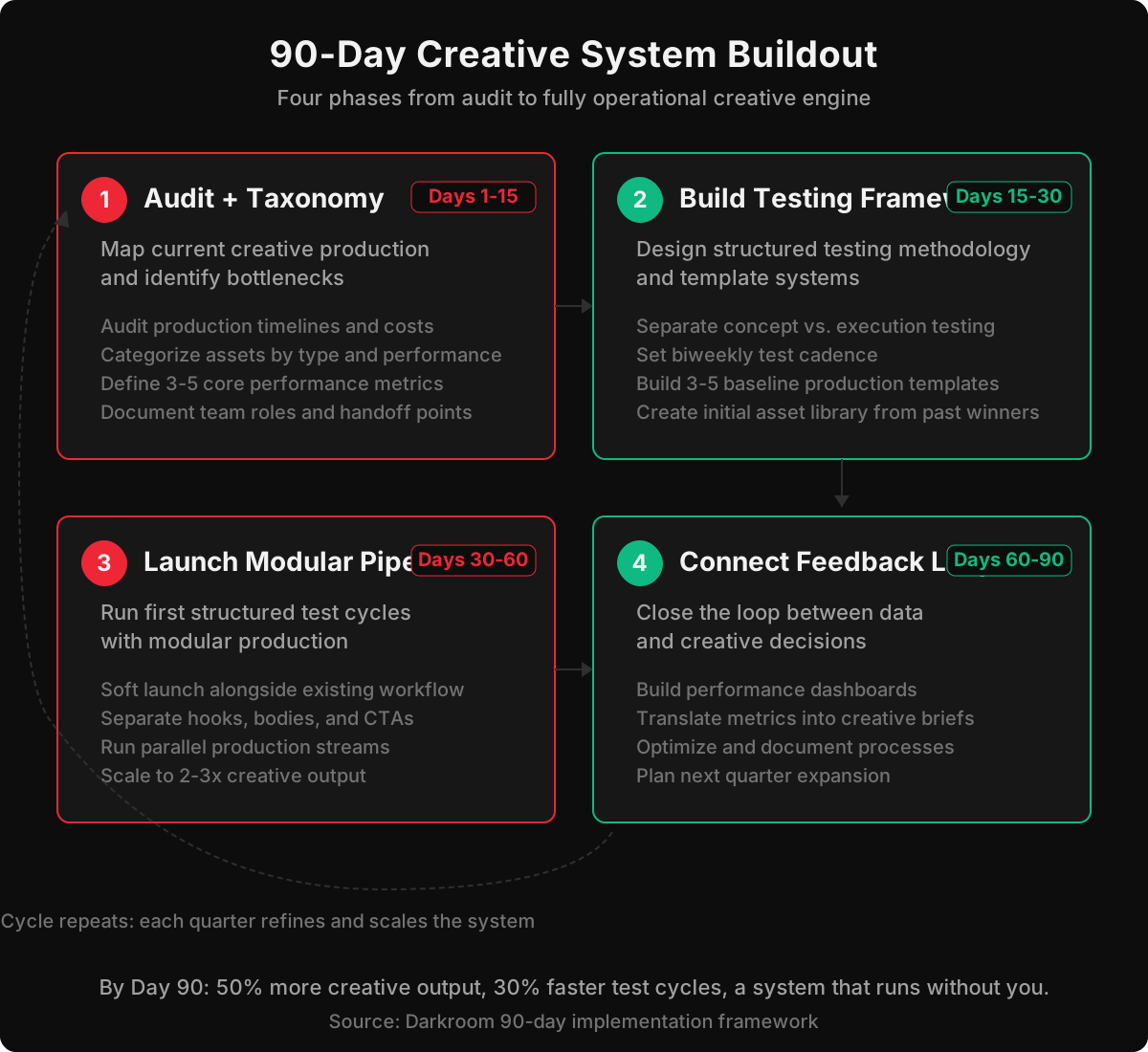
Building a scalable creative system takes time, but not as much as you might think. A 90-day implementation roadmap looks like this.
Phase 1: Week 1-2. Audit and Design. Map out your current creative production. How long does an ad take to produce. Where are the bottlenecks. Interview your team. Identify the three core metrics you will focus on. Design your testing framework. Pick a test cadence. Design your modular pipeline. This phase is mostly planning.
Phase 2: Week 3-4. Template and Library Build. Start building out your template system. Create 3 to 5 baseline templates for your primary production types. Start building an asset library. Catalog your best-performing creative assets from the past year. Organize them so they are searchable. Brief your team on the new system. Get buy-in.
Phase 3: Week 5-6. Soft Launch. Run your first structured testing cycle using the new modular pipeline. Don't change everything at once. Keep your existing workflow and bolt on the new system alongside it. This gives you room to fail and adjust without disrupting live campaigns.
Phase 4: Week 7-8. Feedback Loop Setup. Implement your reporting cadence. Build a dashboard that pulls your core metrics weekly or biweekly depending on your test cadence. Start translating performance data into creative direction. Write your next round of creative briefs based on test results from phase 3.
Phase 5: Week 9-10. Scaled Production. Increase the number of concurrent tests. Start filling your pipeline with modular assets. Begin running multiple tests in parallel across products, platforms, and audiences. You should be producing 2 to 3 times the creative you were before.
Phase 6: Week 11-12. Optimization and Documentation. Identify what's working in your new system and what's not. Double down on the efficient parts. Fix the broken parts. Document processes so they survive team changes. Plan for next quarter's expansion.
By the end of this 90-day window, you should be able to produce 50 percent more creative, go through test cycles 30 percent faster, and most importantly, have a system that can run without you. A production pipeline that works without constant heroics is the goal.
The Team Structure Question: In-House, Agency, or Hybrid
Once you have a system designed, the question becomes: who executes it. In-house. Agency. Hybrid. There is no single right answer. The choice depends on your volume, your budget, and your ability to retain talent.
In-house teams scale slower but build deeper institutional knowledge. You hire designers, video editors, and creative producers. They live inside your world. They understand your product, your audience, your market. Over time, they become highly efficient. The downside is that you're carrying fixed costs whether your production needs are high or low. In-house makes sense if you have consistent, high-volume creative needs and want creative to be a core competency.
Agency teams scale fast but build shallow knowledge. You hire a performance creative agency to execute your framework. They bring experience, they can scale quickly, and you only pay for the work you need. The downside is that agency teams turn over, and you lose institutional knowledge. They also cost more per unit because you're paying for their overhead. Agency makes sense if you need volume fast, you're in high-growth mode, or creative is not a core competency.
Hybrid teams are increasingly common. You build a small in-house core team that owns the framework, the briefs, and the feedback loop. You hire an agency or freelance network to execute production at scale. This gives you the institutional knowledge of in-house teams and the scalability of agency teams. Hybrid makes sense for most growing brands.
Regardless of structure, the system matters more than the people. A great system with average people outperforms a great person with no system. This is why the operational work outlined above is worth the investment. If you are exploring how AI is changing the production side of this equation, our guide to AI ads and the five-bucket framework covers what is practical today.
What Actually Changes When You Build a System
When teams implement a structured creative system, several things shift almost immediately.
First, your media team stops being constrained by creative. You have enough fresh creative to continuously optimize. ROAS lifts. This is not because the creative is suddenly better. It's because you are testing and iterating instead of stretching old assets.
Second, your production speed increases substantially. You are not faster because you hired better people. You are faster because the infrastructure is better. Modular production, templates, and asset libraries compress timelines. A creative that used to take two weeks to produce takes three days.
Third, your team gets smarter. Each test cycle generates data. Data informs the next brief. The next brief informs the next test. Over three months, your team's output becomes dramatically higher quality not because they are more talented, but because they are more informed. They are learning from real market signals instead of guessing.
Fourth, you stop debating about creative quality. Wins are clear. A/B test data is objective. This reduces politics and internal friction. The best creative wins. Not the loudest person.
All of this compounds. By month four, your creative engine is producing 3x the output at 50 percent of the time investment. Creative fatigue drops. ROAS lifts. Your media spend becomes more efficient. The bottleneck that was constraining your growth is now feeding your growth.
Paid Media, TikTok Shop, and Creative System Requirements
If you are running paid media management, creative velocity is critical. Platforms update, competition increases, audience preferences shift. A creative system keeps you ahead of the curve. For brands producing UGC at scale, understanding pricing and packaging for UGC is an essential part of your production budgeting.
If you are selling through TikTok Shop management or other social commerce platforms, the constraint is even tighter. TikTok Shop winners move at warp speed. You need dozens of variations testing simultaneously. Browsing the TikTok Creative Center is one of the fastest ways to identify trending formats and platform-native creative styles that inform your next round of tests.
The same operational principles apply across channels. Testing methodology. Modular production. Feedback loops. The only variable that changes is the format and platform specs. The system is platform-agnostic. If your catalog is a major driver of creative output, our deep dive into dynamic product ads and catalog strategy covers how to systematize that layer as well.
Common Questions and Answers
How long until we see ROAS improvement from a creative system. A: Most teams see meaningful improvement within 30 to 60 days. The first cycle is learning. The second cycle is where you start executing on what you learned. By the third cycle, compound improvements are visible. ROAS typically improves 15 to 25 percent, though this varies widely depending on starting point.
What's the minimum team size to run a creative system. A: You need at least one person owning creative direction and one person producing. That's the minimum. Realistically, you want one strategist, two to three producers, and one QA person. If you're under 100K monthly ad spend, outsource production. If you're over 500K monthly ad spend, build internal capacity.
Should we build templates for every ad format or just the ones that perform. A: Start with the three formats that drive 80 percent of your volume. Static image, short-form video, carousel. Build templates for those. Once your system matures, expand. Narrow focus early wins.
How many variables should we isolate in a single test cycle. A: Between two and four. If you test more than four, you're running multivariate tests and the data becomes harder to interpret. If you test fewer than two, you're moving too slowly. The sweet spot is three isolated variables across your test creative set.
What happens if a test loses but we still like the creative. A: This happens. Run it again. Sometimes a creative underperforms because of targeting, timing, or audience selection, not creative quality. If you like it, test it again. If it loses twice, shelf it. Trust the data but don't trust a single data point.
How often should we refresh our asset library. A: Monthly minimum. Every time you test, winning assets go into the library. Every time an asset under-indexes over three consecutive months, remove it. A library should be dynamic, not static.
Is a creative system expensive to build. A: Setup costs are modest. Template design, 2K to 5K. Audit and process documentation, 1K to 3K. Tool setup, under 1K. The real cost is time. Plan 100 to 150 hours of internal time for planning and execution. After that, running the system is cheaper than the status quo because you're more efficient.
Moving From Content to Engine
Most brands make content. They produce ads. They push them into the world. They hope they work. Some ads work. Most don't. The winning brands build engines. They have a framework. They test. They learn. They iterate. They systematize. Output scales. Quality compounds. ROAS lifts.
The gap between these two approaches is not talent. It's not budget. It's not luck. It's structure.
A structured testing methodology tells you what to make. A modular production pipeline lets you make it fast. A feedback loop ensures you're making the right thing. With all three, you move from campaign-by-campaign firefighting to scalable, repeatable, profitable creative production.
This is the operating model of brands that scale.
If you are ready to build a creative system or want to explore how an external partner can accelerate this work, Book a call with Darkroom. We help brands architect and operate high-velocity creative production engines. We can work with your in-house team to build the system, or we can execute the production layer while you own strategy. Either way, the goal is the same: transform creative from a constraint into a competitive advantage.
Frequently Asked Questions
What is a performance creative system?
It is a repeatable process that generates informed creative decisions at velocity, rather than producing ads one brief at a time. It combines three interlocking parts: a structured testing methodology, a modular production pipeline, and a performance-to-creative feedback loop.
Why is creative the bottleneck in paid media?
Creative quality is the largest driver of ad performance, and creative fatigue causes performance to drop within the first couple of weeks of an asset's life. When production can't keep pace with media spend, teams stretch stale creative across broader audiences and ROAS declines.
What is the difference between concept testing and execution testing?
Concept testing validates whether a core message or hook resonates, before heavy production, using copy, sketches, or storyboards. Execution testing takes a proven concept and refines the production style, pacing, music, or visual treatment. Separating the two avoids discarding a good concept because of a weak first execution.
What does a modular creative production pipeline look like?
It separates every ad into three functional components, the hook, the body, and the CTA, so they can be produced in parallel and recombined. Paired with template systems and asset libraries, this multiplies output without adding headcount and compresses production from weeks to days.
Should creative production be in-house, agency, or hybrid?
In-house teams build deeper institutional knowledge but scale slower and carry fixed costs. Agencies scale fast but build shallower knowledge. A hybrid, a small in-house core owning the framework plus external execution at scale, fits most growing brands. Regardless of structure, the system matters more than the people.
How do you turn performance data into the next creative brief?
Treat prior test results as constraints on the next brief. If short-form CTAs beat long-form, the next brief mandates shorter CTAs; if product hooks beat lifestyle hooks, it directs the team toward product-forward concepts. Most teams skip this and revert to intuition, which breaks the feedback loop.