RETENTION MARKETING
Email Marketing vs SMS for DTC Brands: Where Retention Revenue Actually Comes From




Written by Darkroom leardership

TL;DR: Email and SMS are not competing channels. Email generates $36 per $1 spent and excels at journey architecture and segmentation. SMS achieves 98% open rates and drives immediate action. Top DTC brands generate 25-35% of revenue from these channels combined by orchestrating them as a single system, where email nurtures while SMS activates. Darkroom helps brands build this orchestrated retention stack to capture this compounding revenue.
The Comparison Framework Is Fundamentally Broken
Most brands ask the wrong question: which channel performs better. This leads to false trade-offs. Email vs. SMS becomes a resource allocation problem when it should be a systems integration problem. The question that matters is which behaviors each channel is structurally suited to drive, and how they amplify each other when coordinated.
Email handles orchestration. SMS handles conversion. They operate at different velocity layers. Email is built for depth, nuance, segmentation logic, and long-term relationship momentum. SMS is built for speed, certainty, and action triggers. A brand that treats these as interchangeable misses the compounding effect that makes both channels valuable. As we explored in our analysis of why retention marketing fails when it starts with email, the real risk is treating one channel as the entire strategy.
The confusion exists because marketers often inherit separate email and SMS teams or budgets, forcing a false hierarchy. But at the operational layer, the best DTC brands have already eliminated this division. They treat email and SMS as two levers in the same retention system, each with a specific function in the customer journey.
Email as Architecture: Strengths and the Declining Halo
Email remains the foundation of retention, but not for the reasons most marketers cite. It's not about open rates or click-through rates in isolation. Email dominates because it's the only channel that can scale segmentation and decision logic without incurring marginal cost penalties.
A single email journey can branch into dozens of conditional paths based on behavior, purchase history, browse activity, or engagement state. Each path can be rewritten, tested, and optimized independently. The architecture cost per send is negligible. You can send 100,000 emails across 47 different micro-segments at effectively the same cost per send as 100,000 generic blasts.
This is where email earns its economics. According to Litmus's State of Email report, email ROI averages $36 per $1 spent, but that's only true when email is running as an architecture channel. A poorly segmented email program, where all subscribers see the same broadcast, will underperform. The ROI emerges from the sophistication of the segmentation and the depth of the content. Email lets you write different messages to different people and reward that complexity at the same unit cost.
The headwind is real though. Inbox competition is increasing. Open rates are declining across categories, trending toward 15-25% even for well-managed lists. Gmail, Yahoo, and Outlook are becoming more aggressive with promotional tab placement and filtering. Subscriber fatigue is real. Email's strength is in architecture, not in grab-your-attention urgency. Working with a dedicated retention marketing agency can help brands navigate these headwinds by building smarter segmentation rather than louder sends.
This is where the mistake happens: brands see declining email opens and think the channel is dying. They don't. Email is shifting from an acquisition channel (where open rate was the proxy for reach) to a retention and orchestration channel (where segmentation sophistication and message-to-segment relevance matters far more than raw opens). The brands winning with email understand this distinction.
SMS as Activation: 98% Open Rates and the Hard Limits
SMS is the inverse of email: certainty at the cost of capacity. SMS achieves 98% open rates because it's a direct, intrusive, attention-seizing channel. Messages land in a person's pocket and feel personal. The opt-in rate is lower, the opt-out sensitivity is higher, but when someone is on your SMS list, they are genuinely paying attention.
SMS converts. According to Attentive's benchmark data, high-performing brands see 15-25% conversion rates on SMS promotions. That's 8-12x higher than email average. The reason is velocity and certainty. When you send an SMS, it's because something time-sensitive is happening: a flash sale, a last-call offer, a cart abandonment with urgency, or an exclusive early access. SMS rewards immediacy. It's the channel that closes windows.
But SMS has hard constraints. The cost per send is $0.015-$0.05, depending on volume and SMS provider. For a brand sending 100,000 messages, that's $1,500-$5,000 per campaign. Email at $0.001-$0.003 per send would cost $100-$300. This forces discipline. You cannot run automated journeys in SMS the way you can in email. You cannot test extensively. You cannot afford message fatigue.
Opt-out sensitivity is equally real. A poor SMS experience is irreversible. Unsubscribe from an email and you can re-win the subscriber later. Opt out of SMS and most brands lose that customer's mobile channel permanently. The FTC and platform rules make SMS re-opt-in costly and risky. This makes SMS a high-trust, high-stakes channel. It demands respect.
The brands that win with SMS treat it as a precision instrument, not a broadcast channel. They reserve SMS for moments when the message genuinely warrants immediate attention. Cart abandonment. Flash sales in the final hours. Exclusive previews. Product launches. Loyalty rewards. SMS is the accelerator, not the main engine.
Unit Economics: Why the Higher Cost Per Send Channel Still Wins on ROI
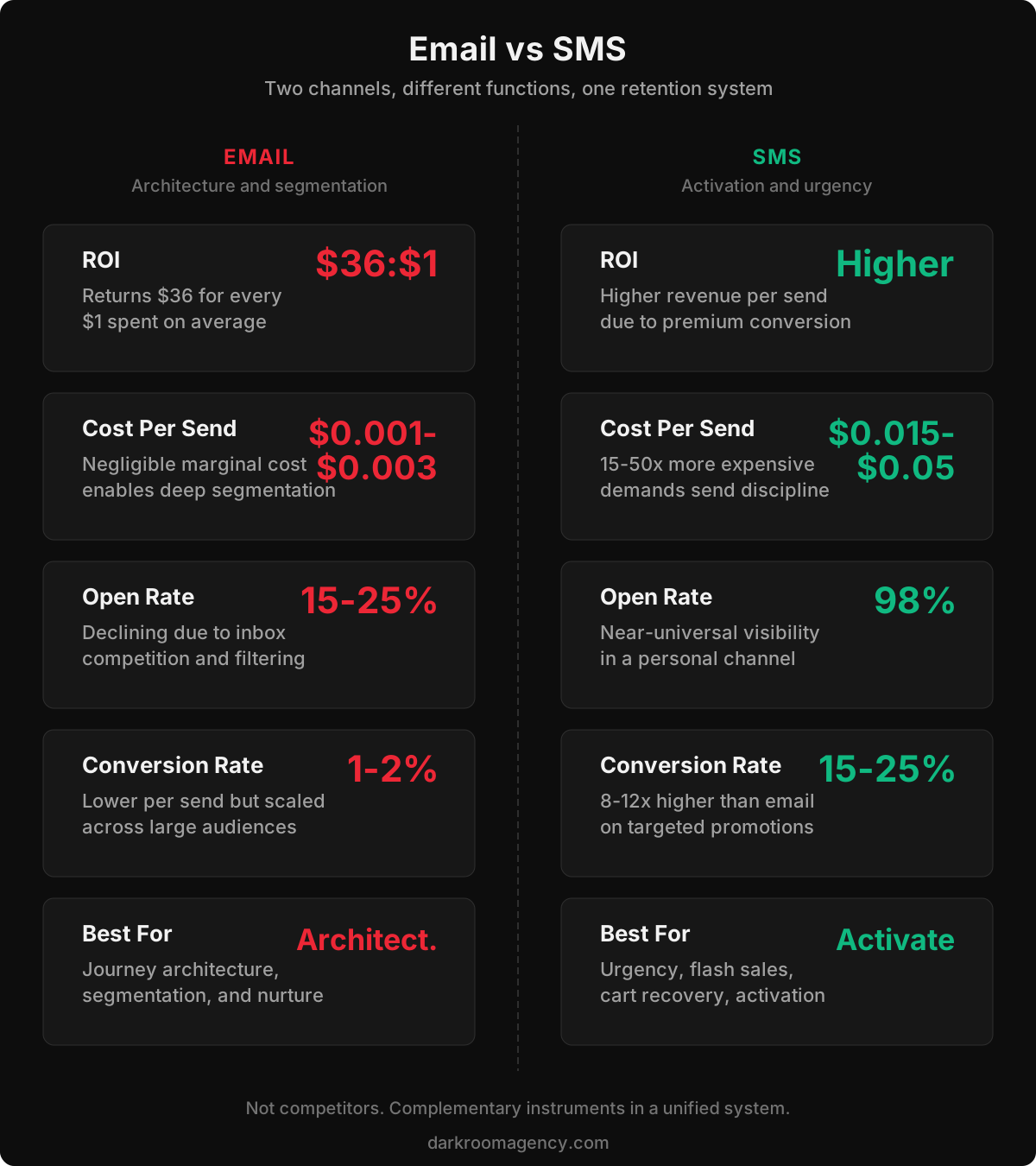
The math looks straightforward but is easily misinterpreted. Email costs $0.001-$0.003 per send. SMS costs $0.015-$0.05 per send. Email is cheaper by 15-50x. But ROI is not determined by cost per send alone. It's determined by what each send produces.
An email with a 2% click-through rate and a 1% conversion rate generates $0.01-$0.03 in revenue (if the customer lifetime value is $100 and the conversion value is half the LCV). An SMS with a 25% conversion rate on a flash sale generates $5-$15 in revenue per send. The SMS is 200-400x more expensive per send but 400-500x more productive in revenue per send.
This is where the framework matters again. If you budget email and SMS as separate channels competing for the same ROI threshold, SMS loses. SMS costs more and you're comparing it to email's baseline ROI of $36 per $1 spent. But that's the wrong comparison. You're comparing an architecture channel to an activation channel. They serve different functions in the system. Omnisend's channel comparison data confirms that the two channels produce fundamentally different engagement patterns rather than competing for the same conversions.
The real math is this: email generates sustained, compounding, diversified revenue across a broad base of subscribers. SMS generates concentrated, time-sensitive revenue from a smaller, higher-intent subset. Used correctly, the cost structure actually aligns perfectly. You spend less on email to maintain the relationship. You spend more on SMS to close the window. The combination generates more revenue than either channel alone because each is optimized for its function.
The Orchestration Model: How Email and SMS Compound
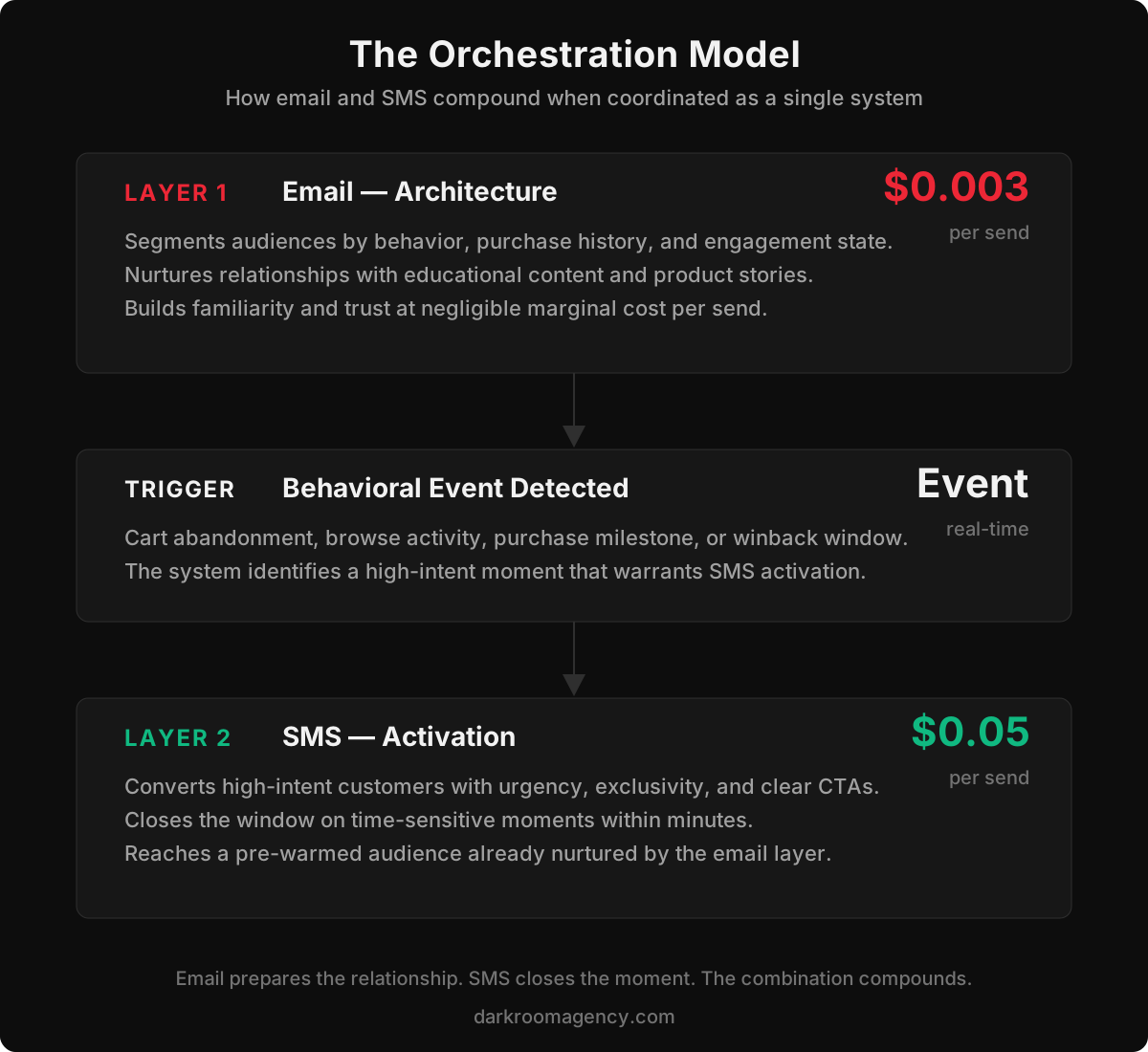
The operational advantage goes to brands that orchestrate email and SMS as a unified system. This is where the architecture language becomes critical. Email segments. SMS triggers. Email educates. SMS converts. These are not competing functions. They are sequential, complementary, and compounding.
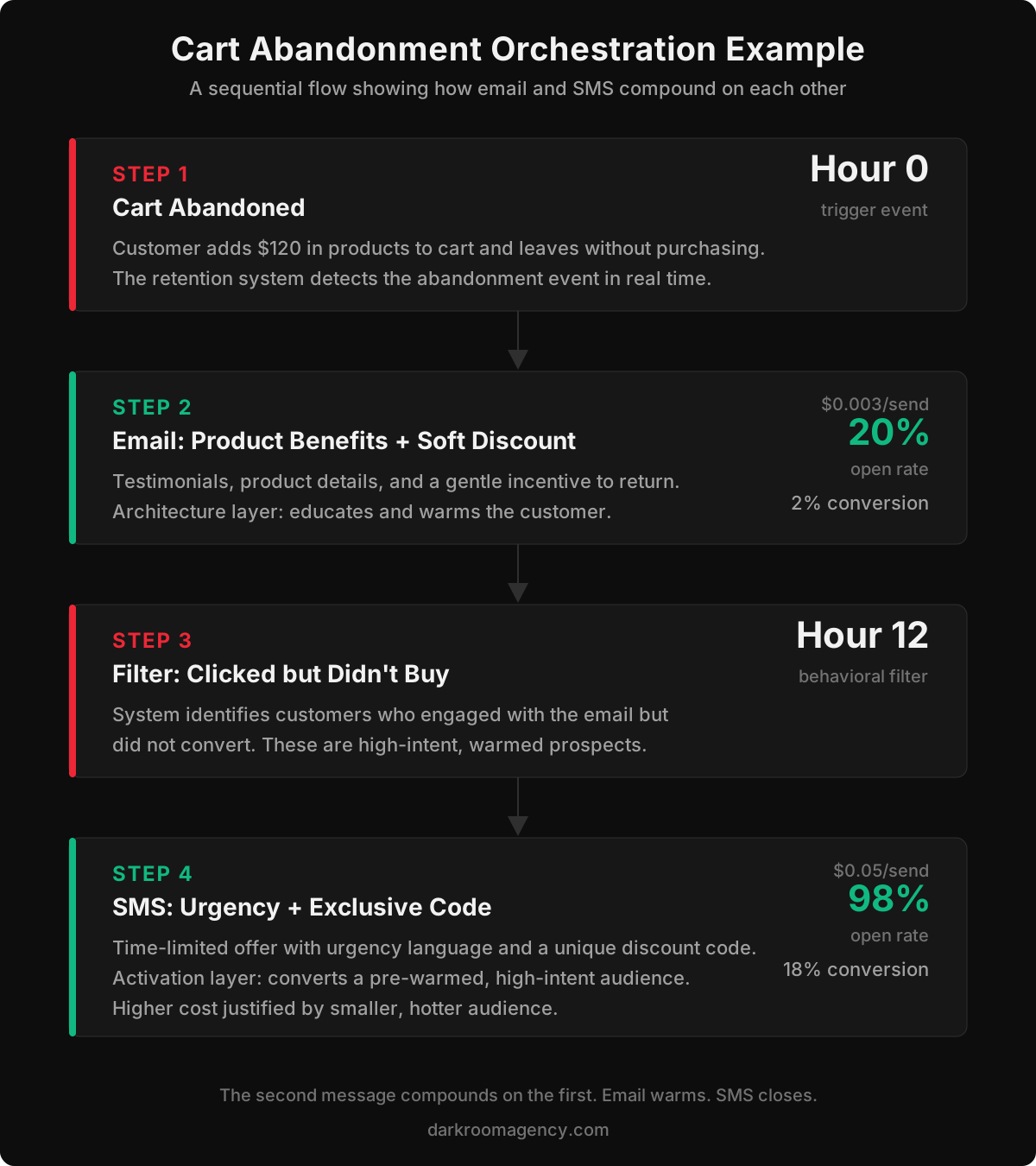
Here's a concrete example. A customer abandons a cart for $120. The retention system springs to life. Hour 0: an email lands (architecture) with product benefits, customer testimonials, and a soft discount. The cost to send: $0.003. The open rate: 20%. The click rate: 8%. The conversion rate: 2%. Expected value: $2.40. Hour 12: for customers who clicked the first email but didn't convert, an SMS lands (activation) with urgency: final hours, limited inventory, exclusive code. The cost to send: $0.05. The open rate: 98%. The conversion rate: 18%. Expected value: $21.60. The second message compounds on the first because it reaches someone already warmed by the first message. It targets specificity (clickers who didn't convert). It justifies the higher cost per send because the audience is smaller and hotter.
Or consider post-purchase. Email handles the onboarding journey, the educational content series, the next-purchase nurture. It segments customers by product purchased, engagement level, and repeat-purchase timeframe. Cost is negligible per send because the architecture is absorbing the complexity. When someone reaches a high-intent trigger (browsing accessories for a recently purchased item), an SMS surge goes out: new arrival, early access, discount. The email prepared the relationship. The SMS closed the moment.
The orchestration model also solves the attribution problem. Email and SMS are rarely winning independently. They're winning together. When email and SMS are treated as separate programs with separate budgets and separate attribution, each gets partial credit. When they're treated as a unified system, the revenue compounds visibly. The email journey is worth less in isolation than in combination with SMS triggers. The SMS surge is more effective to an audience pre-warmed by email than to a cold list. The orchestration value is the difference. This is why effective lifecycle marketing treats both channels as nodes in a single system rather than independent programs.
Revenue Attribution: Understanding the 25-35% Number
High-performing DTC brands generate 25-35% of total revenue from email and SMS combined. This number is accurate and significant, but it's meaningless without context. The context is incrementality, contribution, and measurement framework.
The 25-35% figure typically includes both direct attribution (customers who clicked a link in email or SMS and purchased) and assisted conversion (customers who saw an email or SMS but purchased through a different channel, like direct traffic or organic search). Without assisted conversion counted, the number drops to 8-12%. The assisted conversion bump is where orchestration is hiding. The email created relationship and familiarity. The customer then returned directly and converted. SMS may have landed and driven that urgency. These contributions are real but are not always captured in the attribution model.
The second context is baseline. If a brand has 50,000 email subscribers, 3,000 SMS subscribers, and its email and SMS program is uncoordinated or under-optimized, the contribution might be 10-15%. If the same brand optimizes segmentation, builds proper trigger logic, and uses SMS for true activation moments, the contribution can reach 30-40%. The difference is not new budget. It's coordination, architecture, and specificity.
The third context is incrementality. Not all of the 25-35% is incremental. Some percentage of that revenue would have happened anyway. The question is what percentage. Measurement frameworks like marketing mix modeling or incrementality testing suggest that 70-85% of email and SMS revenue is incremental when the program is well-architected. The remaining 15-30% is substitution (customers who would have purchased through a different channel). This means for a brand with $1M in annual revenue, a 30% email and SMS contribution, and 75% incrementality, the true incremental revenue is $225K. That's significant and material. For a deeper look at budgeting around these numbers, see our breakdown of retention marketing budget allocation for 2026.
The Operational Stack: How Brands Actually Build This
The infrastructure layer determines what's possible. Most DTC brands use some combination of email service provider, SMS service provider, and data integration layer. The category leaders are Klaviyo for email, Attentive or Postscript for SMS, and increasingly custom integrations built on CDP platforms or API connectors.
Klaviyo remains the dominant email platform for DTC because it's SMS-aware. Klaviyo's 2024 benchmark report shows how brands using integrated email and SMS workflows outperform those running siloed programs. Brands can build a journey in Klaviyo that includes both email and SMS steps, and the platform will manage the logic, frequency capping, and optimization. This is the orchestration layer in action. Email and SMS are not separate workflows. They're nodes in the same journey.
The operational challenge is not the tools. It's the structure and discipline. Brands need someone accountable for the retention system as a whole, not just email performance or SMS performance. They need clear trigger logic and a taxonomy of moments (cart abandonment, post-purchase, winback, seasonal). They need a frequency cap that respects both email and SMS in aggregate. They need testing discipline because each channel has different tolerances for experimentation. And they need to measure contribution correctly, tracking not just direct attribution but also influenced conversion and customer segment progression. Our guide to the retention marketing stack for 2026 covers the specific platforms and integrations that make this orchestration possible.
Some brands build custom flows using Segment, mParticle, or custom APIs. This requires more engineering effort but allows for deeper orchestration and more precise segment logic. The payoff is usually significant for brands with more than 100K email subscribers because the marginal value of hyper-segmentation and precise trigger logic exceeds the engineering cost. For smaller brands, the Klaviyo native approach is usually sufficient and more cost-efficient.
Frequently Asked Questions
Should we abandon email in favor of SMS if we're constrained on budget?
No. Email is the architecture foundation. Without it, SMS becomes a blunt instrument with no context. Start by optimizing email segmentation and journey logic. Once that's profitable, layer SMS on top for specific high-intent moments. The leverage is in combination, not replacement.
What's a realistic SMS opt-in rate, and how do we build the list?
Most DTC brands see 5-12% of email subscribers opt into SMS. You earn this through explicit offers (discount for SMS signup), post-purchase prompts, and checkout incentives. SMS is a premium list. Treat it that way. Quality over quantity.
How often should we send SMS without causing opt-outs?
The safe range is 1-2 SMS per week for average brands. Brands with strong engagement and strong offers can push to 3-4. The real limit is not frequency. It's relevance and offer quality. Brands see opt-out spikes not from frequency but from irrelevant messages or weak offers. Test incrementally and monitor opt-out rate closely.
Is there a minimum list size to make SMS profitable?
Yes, roughly. With SMS at $0.03 per send average, you need at least 2,000-3,000 active subscribers to make a campaign economically worthwhile (assuming typical conversion rates). Smaller lists make sense only for highly targeted triggers or very high-value offers. For automated journeys, aim for at least 5,000 SMS subscribers.
How do we prevent email and SMS from cannibalizing each other's performance?
Orchestrate them. Build rules into your automation that suppress email sends to users who just received an SMS conversion offer, and vice versa. Use Klaviyo's built-in orchestration or custom logic to ensure each channel gets its specific moment. Frequency cap across both channels, not within each channel.
What's the right way to attribute revenue when using both email and SMS?
Use a multi-touch attribution model that counts both direct and assisted conversions. Ideally, layer this with incrementality testing to understand which portion of the attributed revenue is truly incremental to the channels. Report on contribution (percentage of revenue touched) separately from incrementality (percentage of revenue caused). Both matter.
Should retention marketing be a separate function from paid acquisition?
Short answer: yes. Acquisition and retention require different skill sets, metrics, and creative approaches. That said, they need to communicate. Acquisition teams should understand the LTV assumptions that make their CAC targets viable. Retention teams should understand the customer profile and messaging that acquisition is bringing in. They're parts of the same system but need separate operational ownership.
What This Means for Your Retention Program
Email and SMS are not competitors. They're complementary instruments in a unified retention system. Email is the architecture channel. It segments, nurtures, educates, and builds relationships at negligible marginal cost. SMS is the activation channel. It drives immediacy, urgency, and conversion at a premium cost justified by premium conversion rates.
The brands generating 25-35% of revenue from these channels are not doing it because they're sending more emails or SMS. They're doing it because they've unified the operational logic. They've treated email and SMS as nodes in the same journey. They've reserved SMS for true activation moments. They've built segmentation sophistication into email that makes SMS more precise and effective. And they've measured contribution correctly, understanding both direct attribution and incrementality. Our analysis of why loyalty programs fail without retention infrastructure reinforces this point: without the orchestration layer, even strong individual programs underperform.
If your email and SMS programs are still running separately, with separate budgets, separate teams, or separate measurement frameworks, you're leaving significant revenue on the table. The coordination is not just nice to have. It's the difference between a retention program that generates 10-15% of revenue and one that generates 30-40%.
The question is not which channel to invest in. It's how to architect them as a system. That's where the leverage is. That's where retention revenue actually comes from. A full-service growth agency can help you build that unified system from the ground up, connecting retention to acquisition and creative in a single operating model.
Ready to orchestrate your email and SMS program?Book a call with Darkroom. We audit your current retention stack, identify orchestration gaps, and build the systems that drive 25-35% revenue contribution.