
RETENTION MARKETING
How Much Should DTC Brands Spend on Retention Marketing in 2026




Written by Darkroom leardership

Written & peer reviewed by 4 Darkroom team members
TL;DR
Most DTC brands either treat retention as an afterthought or dump budget into tools without strategy. The right retention budget depends on revenue stage, channel mix, and customer acquisition cost trajectory. Brands doing $5-20M annual revenue should allocate 15-25% of total marketing budget to retention. But the real answer isn't a percentage. It's understanding your unit economics: if your CAC is $30 and customer lifetime value is $200, you have room for aggressive retention spending. If your LTV is $120, you need precision. The framework matters more than the dollar amount. Learn how Darkroom approaches growth economics.
The Retention Spending Gap
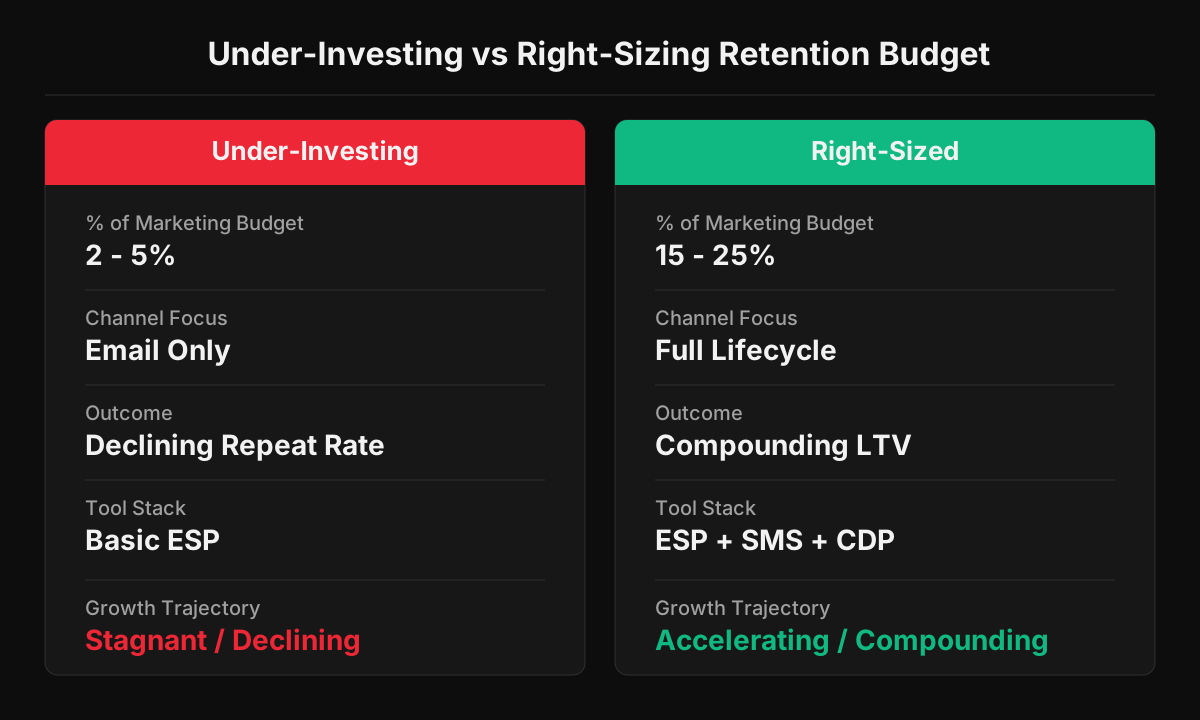
You've seen the data. Acquisition costs are rising. Channel saturation is real. Repeat customers are 9x more likely to convert than first-time buyers, and acquiring a customer costs 5-25x more than retaining one. Yet most DTC brands still allocate 5-10% of marketing budget to retention while spending 40-50% on acquisition.
This creates two problems. First, brands leave money on the table. A customer you've already paid to acquire once becomes more profitable on the second purchase. The math is straightforward. Second, the brands that do invest in retention often invest poorly, treating it as a dumping ground for email software subscriptions and SMS tools without underlying strategy.
The question isn't whether to spend on retention. It's how much to spend given your specific unit economics.
Revenue Stage Determines Your Starting Point
Budget allocation frameworks need anchors. Revenue stage is your first anchor.
Brands doing $1-5M revenue: These companies typically run hot on acquisition. Your CAC is climbing faster than LTV. You need retention investment, but not to the exclusion of growth. Allocate 8-15% of marketing budget to retention. Focus on email fundamentals, onboarding sequences, and preventing your highest-risk churn cohorts from leaving. Your retention team is probably 1-2 people wearing many hats.
Brands doing $5-20M revenue: This is where retention becomes a centerpiece. You have data from Darkroom's growth services on which cohorts stick and which don't. You can afford dedicated retention resources. Allocate 15-25% of marketing budget to retention. This includes email, SMS, paid retargeting, and customer incentive programs. According to Klaviyo benchmark data from 2025, email alone drives 30-35% of total revenue for mature DTC brands at this stage. This range gives you room to test retention channels beyond email.
Brands doing $20M+ revenue: At this scale, retention becomes your stabilizing force. You have mature LTV data. You can run sophisticated cohort analysis and build retention playbooks specific to customer segments. Allocate 20-30% of marketing budget to retention. This includes loyalty programs, VIP tiers, community building, and advanced predictive churn modeling.
CAC Recovery and LTV Reality
The percentage framework only works if you overlay unit economics. Two brands could spend 20% of marketing budget on retention and see completely different ROI.
Start with your CAC and LTV numbers. If your average customer acquisition cost is $40 and your LTV is $150, you need the customer to stay active for roughly 4 purchases to break even. After that, each repeat purchase is margin expansion. This customer is profitable to spend money on through multiple channels.
If your CAC is $40 and your LTV is $120, that same customer needs to stay for 3 purchases. Your retention spending needs to be more surgical. You can't afford broad-reach campaigns to a large segment. Instead, focus retention budget on highest-value cohorts and leverage owned channels where your cost per impression is zero.
Shopify data from 2025 shows that the average DTC brand breaks even on CAC between purchase 2-3. But this varies dramatically by category. Consumable products see faster payback. Fashion and home goods require 4-5 purchases. Premium brands with higher AOV often see payback in 1-2 purchases.
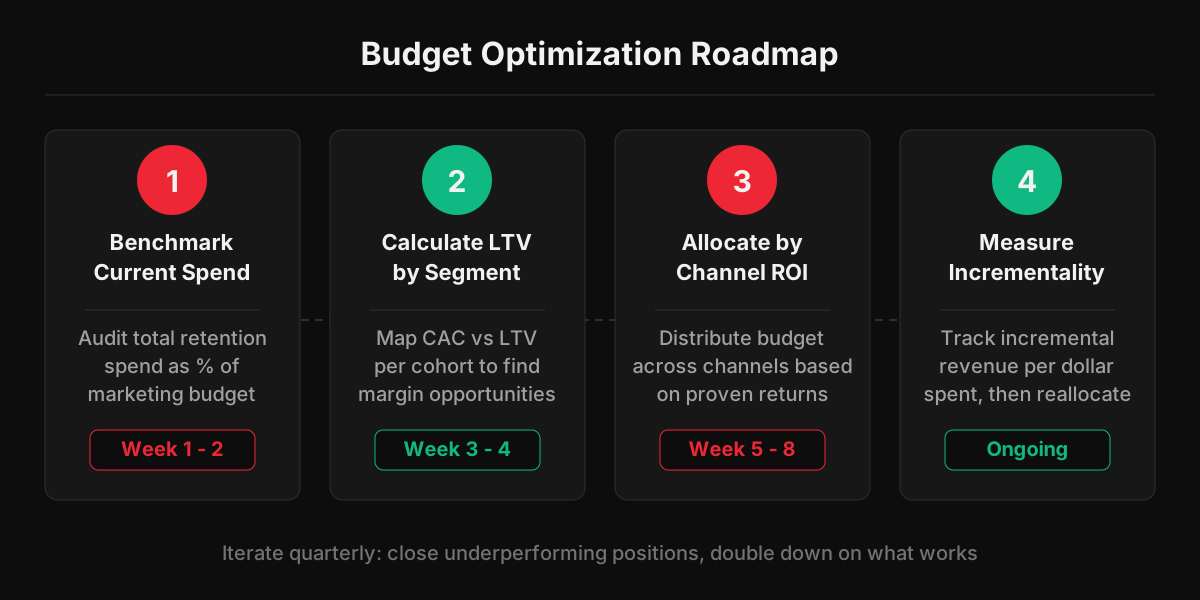
Pull your own numbers. Calculate your blended CAC across all channels. Stack it against your actual LTV from customers acquired 12+ months ago. If that delta is tight, your retention budget needs discipline. If that delta is wide, you have room to experiment.
The Channel Mix Question
Not all retention channels cost the same or drive the same ROI.
Email: Lowest cost per impression. Highest engagement from existing audiences. Most DTC brands should allocate 4-7% of marketing budget to email operations and strategy. This includes platform costs, personnel, and testing. Email typically drives 20-35% of repeat purchase revenue for DTC brands, making it the highest-ROI retention channel. However, email alone doesn't drive sustainable retention growth. Many brands plateau at 25% of revenue from email because they run the same campaigns to the same audiences.
SMS: Higher cost per impression than email but higher conversion rates. SMS is best used for time-sensitive offers and urgency-driven campaigns. Allocate 2-4% of marketing budget to SMS if you're serious about it. Run SMS as a complement to email, not a replacement. See the full email vs SMS retention breakdown. Brands that layer SMS on top of email typically see 15-20% incremental revenue increase from the combined channel.
Paid Retargeting: Facebook, Instagram, and Google retargeting to existing customers. These channels have higher cost per acquisition than email but reach customers at different moments in their journey. Allocate 3-8% of marketing budget to paid retargeting. This is where you can run more creative brand campaigns and seasonal promotions to warm audiences. Bain analysis of DTC retention economics shows paid retargeting to existing customers drives 3-4x better ROI than acquisition targeting on the same platforms.
Loyalty Programs and Community: Higher fixed costs but create defensible moats. These require 2-5% of marketing budget allocation for brands serious about building them. Loyalty programs aren't just transactional discounts. They're behavioral tools that train customers to come back more frequently. The best loyalty programs increase repeat purchase frequency by 20-40%, which compounds LTV significantly.
Most DTC brands underspend on community and loyalty because the payoff is indirect. A loyalty program might not drive sales directly, but it shifts customer psychology. Repeat customers spend more per transaction. They're less price-sensitive. They refer more. These aren't quantified in standard attribution.
The Tools Budget Trap
One of the clearest patterns we see across DTC brands is tool sprawl without strategy.
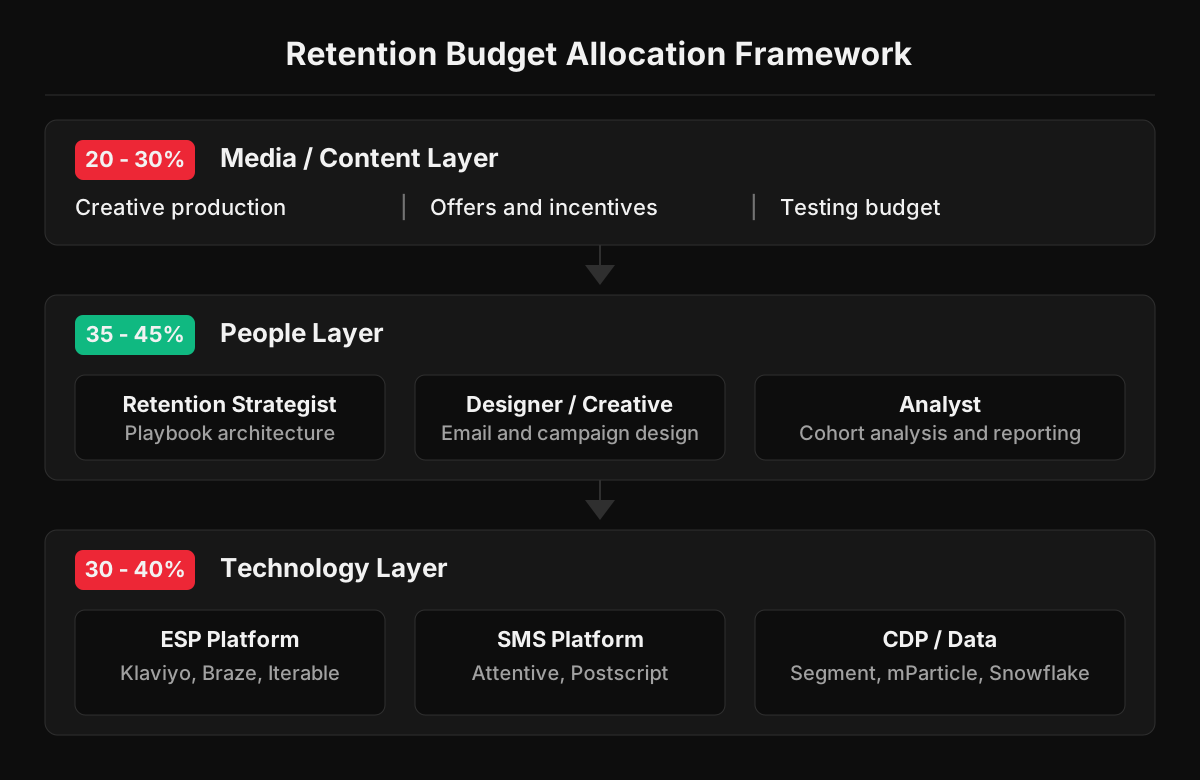
A brand allocates 20% of marketing budget to retention. They spend 40% of that on software: Klaviyo, Gorgias, Yotpo, Recharge, Bold, custom CDP. They hire one person to manage it all. Then they wonder why retention metrics don't move.
Software costs money but doesn't create strategy. A person costs money and creates strategy. The right allocation looks like this:
Tools: 30-40% of your retention budget. This includes platforms, integrations, and data infrastructure. For a brand spending 20% of marketing budget on retention with $10M revenue and a $500K marketing budget, that's $1M allocated to retention, with $300-400K going to tools. That's real money, and it's justified if the right operator is using those tools.
Personnel: 40-50% of your retention budget. This is your retention manager, analyst, email specialist, or retention agency partner. This person builds the playbooks, runs the experiments, and ties the tools together. They're essential. If you only fund tools, you're leaving 30-40% ROI on the table.
Testing and incentives: 10-20% of your retention budget. This is your wiggle room. Customer incentives for loyalty program enrollment, testing new channels, running cohort experiments. This is where you find the next growth lever.
Benchmarks by Category and Channel
Here's what we see across different DTC categories based on 2025 Statista CAC and retention data:
Consumable products (vitamins, coffee, beauty): 18-25% of marketing budget to retention. High repeat purchase frequency naturally creates strong LTV. Your retention spending can be aggressive because payback happens quickly.
Fashion and accessories: 12-18% of marketing budget to retention. Lower repeat frequency requires more sophisticated targeting. These brands need strong email strategy plus paid retargeting to maintain momentum.
Home and furniture: 10-15% of marketing budget to retention. Much longer purchase cycles. Retention spending should focus on seasonal campaigns and cross-sell opportunities rather than driving repeat purchases of the same product.
Premium and luxury: 15-22% of marketing budget to retention. High AOV means LTV is healthy even with low repeat frequency. Retention spending focuses on deepening customer relationships and building VIP tiers.
Health and wellness: 20-28% of marketing budget to retention. Subscription and recurring revenue models require strong retention discipline. These brands can't afford churn.
These aren't rules. They're patterns. Your category might operate differently based on your product, positioning, and customer economics.
The ROI Framework Over the Dollar Amount
This is the most important section because it reframes how you should think about retention budgets.
Don't ask: How much should I spend on retention?
Ask: For every dollar I spend on retention, how much incremental revenue do I generate?
Email: $1 spent should generate $35-50 in revenue. This is well documented across benchmarks. If your email ROI is below $30, you have a problem with segmentation, frequency, or offer strategy.
SMS: $1 spent should generate $20-35 in revenue. SMS is higher friction but higher intent. If your SMS ROI is below $15, you're likely using it for too many campaigns or to the wrong audience segments.
Paid retargeting: $1 spent should generate $3-8 in revenue. This is lower than email because you're buying expensive inventory. If your retargeting ROAS is below 2.5, you're either showing the wrong product or reaching the wrong audience.
Loyalty programs: Harder to measure directly, but should increase repeat purchase frequency by 20-40% and increase order value by 10-20% for enrolled customers. If your loyalty program shows no impact on these metrics after 6 months, your incentive structure is wrong.
Track these metrics quarterly. If one channel is underperforming, reallocate. If one channel is outperforming, test scaling it. The best retention operators run their budgets like traders: they close underperforming positions and double down on what works.
Practical Budget Allocation Templates
Here's what a $5M revenue brand with a $250K quarterly marketing budget should consider:
Conservative approach (15% to retention = $37,500/quarter): Email operations (40% = $15,000), SMS (15% = $5,625), Paid retargeting (30% = $11,250), Loyalty and testing (15% = $5,625). This approach focuses on foundational channels and tests one new lever per quarter.
Balanced approach (20% to retention = $50,000/quarter): Email operations (35% = $17,500), SMS (15% = $7,500), Paid retargeting (30% = $15,000), Loyalty and community (20% = $10,000). This approach runs multiple channels in parallel and builds community.
Growth approach (25% to retention = $62,500/quarter): Email operations (30% = $18,750), SMS (15% = $9,375), Paid retargeting (25% = $15,625), Loyalty and community (25% = $15,625), Adjacent channels like Gorgias and customer support revenue (5% = $3,125). This approach treats retention as an equal pillar to acquisition.
The right approach depends on your CAC recovery speed and LTV stability. If customers break even on CAC by purchase 2, you have room for the growth approach. If break-even is purchase 4-5, start conservative.
The Trap Most Brands Fall Into
The most common mistake is treating retention budget as a percentage of revenue, not as a function of unit economics.
A brand doing $10M revenue decides to spend 20% of marketing budget on retention. That sounds good. But if their CAC is $60 and their LTV is $140, they're actually underspending. They need to push retention further because the margin is there. Another brand also doing $10M decides to spend 20% on retention, but their CAC is $50 and LTV is $120. They're overcapitalized. They'd be better served investing that extra retention budget back into acquisition because they have less margin per customer.
Start with percentages as a guide. End with unit economics as your decision-maker. Learn how to build retention strategy that's grounded in your actual unit economics.
FAQ
Should I hire someone full-time for retention or use an agency?
This depends on your retention budget size. Below $30K/month, an agency typically gives you better ROI because retention expertise is concentrated. At $30-50K/month, you might split the difference: an agency handling strategic planning and a junior internal person handling execution. Above $50K/month, invest in an internal team. You'll develop proprietary playbooks that competitors can't copy.
How long should I wait to see ROI from retention spending?
Email should show ROI within 30 days. SMS within 2-4 weeks. Paid retargeting within 2-8 weeks. Loyalty programs are the outlier. They need 3-6 months to show meaningful impact because they're training behavior, not running a single campaign. If you don't see ROI in the standard timeframe for a channel, don't give up immediately. Run a retention audit to diagnose the issue. It's usually segmentation, offer strategy, or creative quality, not the channel itself.
Should I cut retention spending during slow periods?
No. In fact, you should increase it slightly during slow periods. Slow periods are when your existing customer base needs engagement most. They're more likely to churn because your brand isn't top of mind. Use slow periods to test new retention tactics and refine your playbooks. You'll learn faster because there's less noise in the data.
What's the minimum retention budget to justify having a dedicated person?
Around $25-30K per month. Below that, the leverage isn't there. A good retention person can manage up to $50-60K per month effectively. Beyond that, you need to split responsibilities. One person on email and SMS, another on paid retargeting and loyalty, a third on analytics and planning.
How do I justify higher retention spending to my CEO?
Show unit economics. Calculate your CAC and LTV. Show that every dollar spent on retention generates $25-50 in email revenue, $15-30 in SMS revenue, $3-8 in retargeting revenue. Compare that ROI to acquisition channels. Most CEOs will approve higher retention spending once they see the unit economics. If they don't, you might have a CAC problem, not a retention problem.
How often should I adjust my retention budget?
Quarterly. Run a retention audit every three months. Look at unit economics, channel performance, and churn trends. Reallocate based on what's working. Don't wait a full year. The market moves fast, and retention channels are constantly evolving.
What percentage of retention budget should go to testing new channels?
10-15%. This is non-negotiable. If you don't allocate budget for experimentation, you'll miss the next retention lever. Test one new channel or tactic per quarter. Kill it or scale it based on results. You'll find your next 2-3x growth lever this way.
Moving Forward
The right retention budget isn't a number. It's a framework.
Start with your revenue stage to set a ballpark percentage. Layer in your CAC and LTV to see if you have room to go higher. Break down your budget across channels based on what works for your category. Track ROI by channel quarterly, and reallocate based on performance. Test one new tactic every quarter. Build a retention team if your budget justifies it. Let your unit economics, not industry benchmarks, be your guide.
Brands that execute this framework consistently see 20-30% improvement in repeat purchase rates within 12 months. That compounds into significant revenue growth and makes CAC payback faster, which then justifies even more retention investment.
The brands that don't optimize retention spending typically hit a ceiling. They can't grow acquisition without hurting payback. They can't improve efficiency because they're leaving money on the table with existing customers. Retention isn't a cost center. It's the unlock for sustainable growth.
Start with the framework. Run the numbers. Then allocate accordingly.
Related Reading:
Why Retention Marketing Fails When It Starts with Email
Ready to audit your retention strategy? Book a call with our retention team.