
Retention Marketing
The Retention Marketing Stack in 2026: What You Actually Need vs What Vendors Sell You




Written by Darkroom leardership

Written & peer reviewed by 4 Darkroom team members
TL;DR:
The retention marketing problem is not tool selection. The average DTC brand runs 6-8 tools with overlapping functionality and no central orchestration layer. What you actually need is an integration framework that connects your ESP, SMS platform, CDP, loyalty system, and analytics into one coherent system. Most vendors sell point solutions. The brands winning at retention are building orchestration layers that make their entire stack work together. Learn how Darkroom builds retention systems. Learn more about how Darkroom approaches this.
The Stack Problem Isn't New, But It Got Worse
Five years ago, the retention stack was simple: email platform, maybe SMS, a basic loyalty tool. Today, a mid-market DTC brand typically operates 6-8 retention tools simultaneously. Working with a why retention marketing fails when it starts with email can help navigate this effectively. Email (ESP), SMS, push notifications, a CDP for data, a loyalty platform, product analytics, a review system, and often a separate tool for SMS automation.
Each tool does one thing reasonably well. But they don't talk to each other. A customer action in your analytics platform doesn't trigger an email campaign. Loyalty points earned through SMS don't sync to your email segments. Customer data lives in multiple places, none of them authoritative.
This fragmentation isn't an accident. Vendors have no incentive to build integrations. They want to be your entire solution. Meanwhile, you're managing spreadsheets, manual exports, and API calls between platforms.
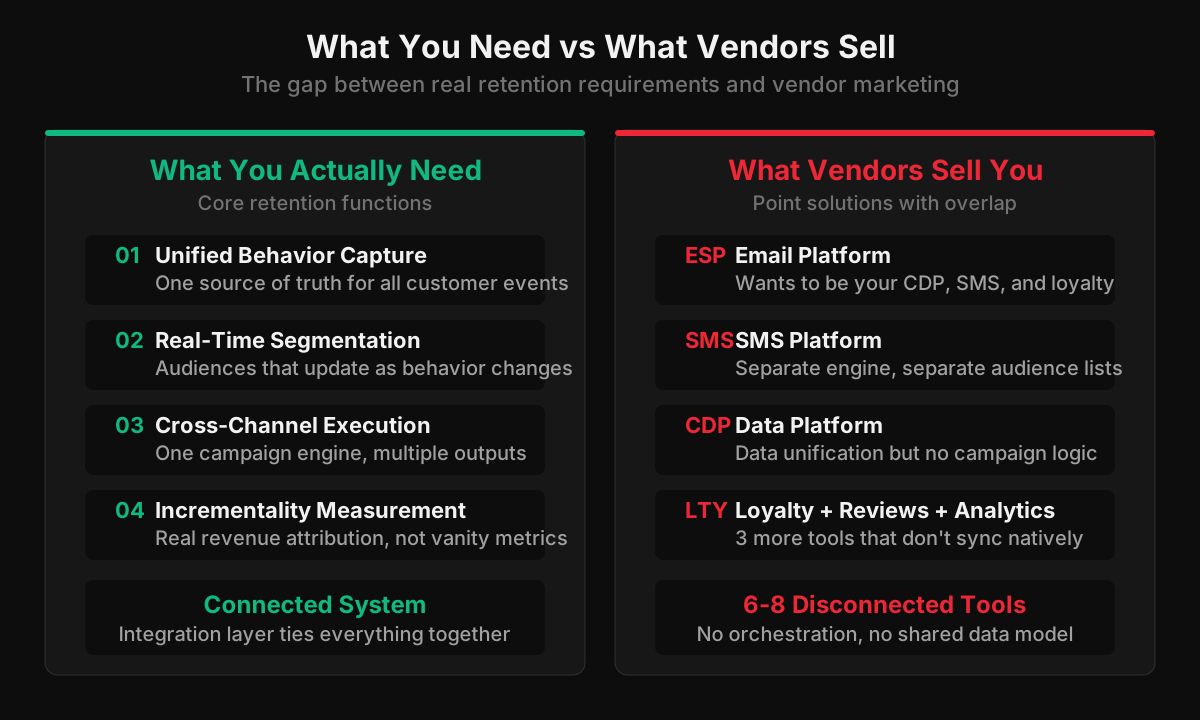
What Actually Matters in a Retention Stack
Strip away the marketing language. Working with a retention marketing agency can help navigate this effectively. A functioning retention system needs to do four core things:
1. Capture customer behavior and events - You need a place where all customer actions live. Purchases, email opens, SMS clicks, website visits, support interactions. Not scattered across six platforms. One source of truth on what customers actually did.
2. Create flexible segments and audiences - You must be able to build audiences based on behavior, purchase history, lifecycle stage, and custom attributes without hiring a data engineer. Segments need to update in real time as customer behavior changes. This is harder than it sounds.
3. Execute campaigns across channels - Email, SMS, push, in-app, loyalty rewards. These shouldn't require separate tools and separate logic. One campaign engine with different channel outputs. A customer triggers a lifecycle campaign, it automatically sends email, SMS, and loyalty points based on one ruleset.
4. Measure incrementality and ROI - You need to know which campaigns actually moved revenue. Not vanity metrics. Attribution that accounts for the fact that a customer opened three emails and clicked one SMS before converting. Most retention stacks don't do this well.
Most vendors will sell you #1 or #2 or #3, but rarely all four. And they definitely won't do #4 in a way that covers your entire stack.
The Six-Tool Pattern: Where Most Brands Get Stuck
Here's the stack we see most often:
Email ESP - Klaviyo is the foundational tool for most DTC brands. It's good at email. It's trying to be a CDP and a loyalty platform and an SMS tool, and it's okay at all three. The problem is that Klaviyo becomes your system of record, which locks you into their approach to everything else.
SMS Platform - Attentive, Postscript, or similar. Email is saturated. SMS has higher engagement. So you add SMS. Now you have two campaign engines that don't natively know about each other. A customer is in one list in Klaviyo and another in Attentive. They get duplicated messages.
CDP - Segment, mParticle, or similar. You realize you need a proper customer data platform to unify data across channels. So you add a CDP. Now your customer data is here, but your campaign logic is still in Klaviyo. The CDP syncs data back to Klaviyo. Working with a retention marketing budget for 2026 can help navigate this effectively. You have two sources of truth and nobody knows which one is correct.
Loyalty Platform - Smile, Referralcandy, or similar. You build a loyalty program. It tracks points, but points don't automatically sync to your email segments. You run a campaign to customers with high points balance. You build a segment in your CDP, export to Klaviyo, hope it matches reality.
Product Analytics - Amplitude, Mixpanel, or segment product analytics. You track what customers do in your product. But these events don't trigger campaigns. A user grinds product usage but you have no automated way to recognize them or reward them. You export segments manually, hoping your data warehouse sync ran correctly.
Review and Social Proof - Trustpilot, Yotpo, or similar. Customers leave reviews. You want to send follow-ups to reviewers, segment them into loyalty tiers. But review events don't hit your CDP or ESP automatically. You implement it later as an afterthought.
This is the six-tool stack. Each tool adds value. Together, they create a system where:
Customer data is fragmented across multiple platforms
Campaign logic is split between two or more systems
Events don't trigger responses outside their native platform
Your data team is constantly managing syncs and exports
You can't accurately attribute revenue to retention activities
Why Point Solutions Fail at Scale
A single, best-in-class tool feels attractive. Working with a performance creative can help navigate this effectively. Unified UI, native integrations, one contract.
The problem: no single vendor is equally strong at email, SMS, loyalty, analytics, and orchestration. Klaviyo is strong at email. Weak at SMS and analytics. Attentive is strong at SMS. Weak at email and loyalty. Shopify's tools are okay at everything, great at nothing.
When you pick one platform to own your entire stack, you're optimizing for convenience, not for performance. You're using their SMS tool because it's built-in, not because it's the best SMS platform available. You're using their analytics because it talks natively to email, not because it accurately attributes revenue.
This is what vendors want. They want you to accept 80% functionality across five categories rather than 95% functionality in each category connected properly.
The brands winning at retention have made a different choice: strong best-in-class tools connected through an orchestration layer.
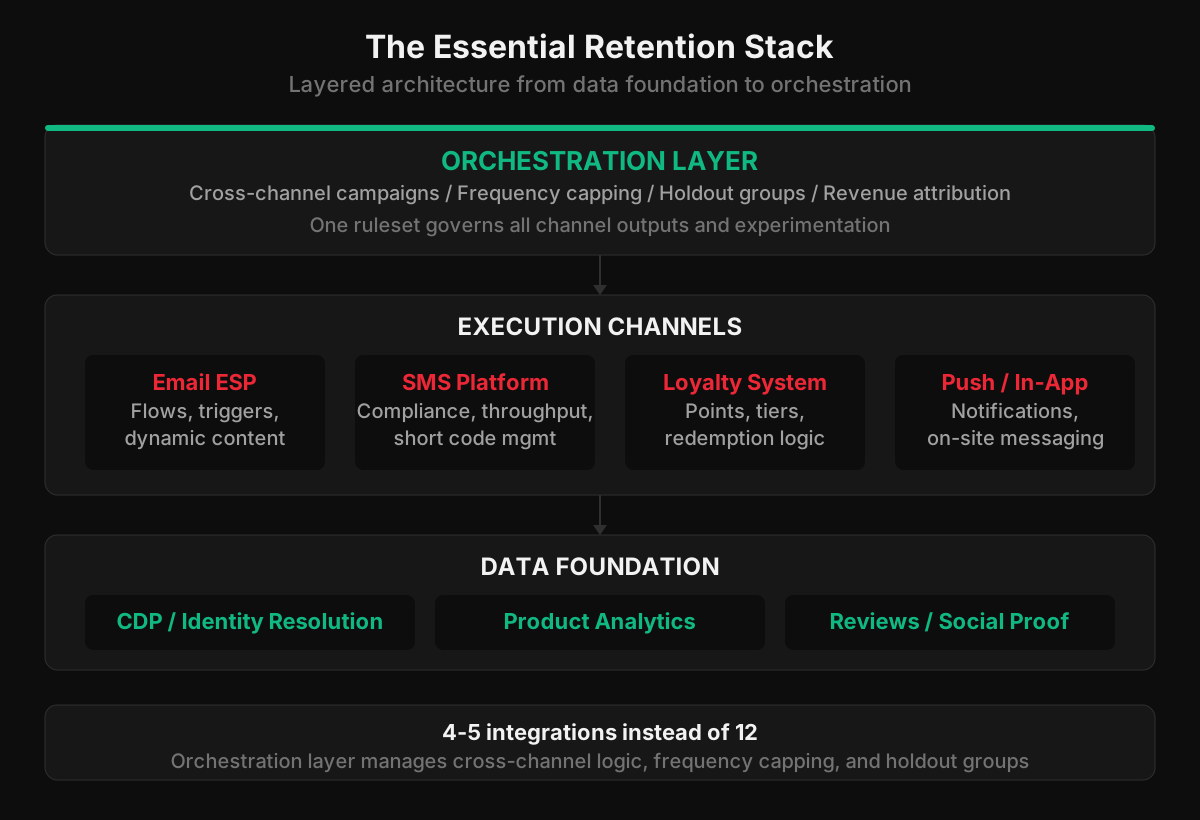
What an Orchestration Layer Actually Does
An orchestration layer sits between your data and your campaign tools. It doesn't replace your email platform or SMS tool. Working with a what a retention marketing agency does can help navigate this effectively. It makes them smarter.
Here's what it enables:
Cross-channel campaigns - One trigger, multiple channels. A customer abandons cart. The orchestrator sees this event, evaluates their lifecycle stage and history, then executes a campaign: email in 1 hour, SMS in 3 hours, loyalty reward in 24 hours. All from one ruleset. No managing two separate campaign calendars.
Deduplication and frequency capping - A customer is about to receive an email and an SMS from different campaigns. The orchestrator sees it, applies your frequency rules, and decides which message goes out. This is basic. Most stacks don't do it.
Real-time audience computation - Your segments aren't static monthly exports. As a customer's behavior changes, their audience membership updates immediately. They hit a lifetime value threshold, they're added to your VIP segment, and your next campaign includes them.
Revenue attribution without guessing - The orchestrator tracks which campaigns touched which customers, when, and in what order. It can tell you: this campaign drove $50K in attributed revenue. Not "this segment had a 15% higher AOV." Actual dollars.
Experimentation and holdout groups - You can run incrementality tests. Send the campaign to 80% of your audience, 20% holdout. Measure the difference. This requires an orchestration layer that manages audiences across channels.
An orchestration layer doesn't have to be complex. For many brands, it's a combination of tools: a CDP that unifies data, a middleware tool like Zapier or internal API calls that trigger campaigns, and careful segment management in your ESP.
For some, it's a fully custom solution. For others, it's a platform that already includes orchestration natively.
The Evaluation Framework: Build vs. Buy vs. Hybrid
When you're designing a retention stack, you have three paths:
All-in-one platform - Shopify, Klaviyo with loyalty add-on, or similar. Pros: single contract, unified data, simple onboarding. Working with a full-service growth agency can help navigate this effectively. Cons: you're limited to their capabilities, you pay for features you don't need, you can't upgrade individual components without ripping and replacing.
Best-of-breed with manual integration - Pick the best tool in each category, connect them with Zapier or API calls. Pros: optimal functionality, you upgrade individual tools. Cons: your data team maintains the integrations, API changes break things, fragmentation increases operational overhead.
Hybrid with orchestration layer - Best-of-breed tools, but with a middleware orchestration layer that manages cross-channel logic, data syncs, and attribution. This is the winning pattern. Pros: best functionality, the orchestrator layer handles complexity, you get attribution. Cons: more expensive upfront, requires planning and implementation time.
Choose based on your company stage:
Early stage (pre-PMF, under $1M ARR): All-in-one. You don't have the complexity to justify orchestration. Klaviyo or Shopify. Get to product-market fit first.
Growth stage ($1-10M ARR): Hybrid is starting to make sense. You have the volume and complexity to justify best-of-breed tools. Start building your orchestration layer now, before it becomes painful.
Scale stage ($10M+ ARR): Hybrid or custom. You have enough volume that the right tools matter. The orchestration layer needs to handle complex multi-channel logic and accurate attribution.
What to Look For in Each Layer
Email ESP - Deliverability track record, template editor, automation (flows and triggers), dynamic content, API access. Not all email tools are created equal on deliverability. Check your industry's reputation in the Forrester Wave. Avoid tools that treat email as an afterthought.
SMS Platform - Throughput (can they handle your peak volume?), compliance management (they manage TCPA), short code vs shared pool, reporting. SMS compliance is serious. Working with a why loyalty programs fail can help navigate this effectively. Make sure they're doing it right.
CDP - Real-time audience computation, identity resolution (handling the same customer across devices and touchpoints), data syncing speed, API access. A CDP that syncs data once a day is not useful. You need real-time or near-real-time.
Loyalty Platform - Point earning logic (can you assign points for any action, not just purchases?), redemption flexibility, integration with other platforms, reporting on redemption rates and incremental uplift. If your loyalty platform only tracks purchase-based points, it's too basic.
Analytics and Attribution - Multi-touch attribution, incrementality testing, integration with your marketing data. Don't accept "correlation is close enough to attribution." Demand incrementality tests.
Orchestration Layer - Real-time event ingestion, segment computation speed, cross-channel campaign logic, frequency capping, holdout group management, API-first design. If it takes more than 30 minutes to set up a simple cross-channel campaign, it's not actually orchestrating.
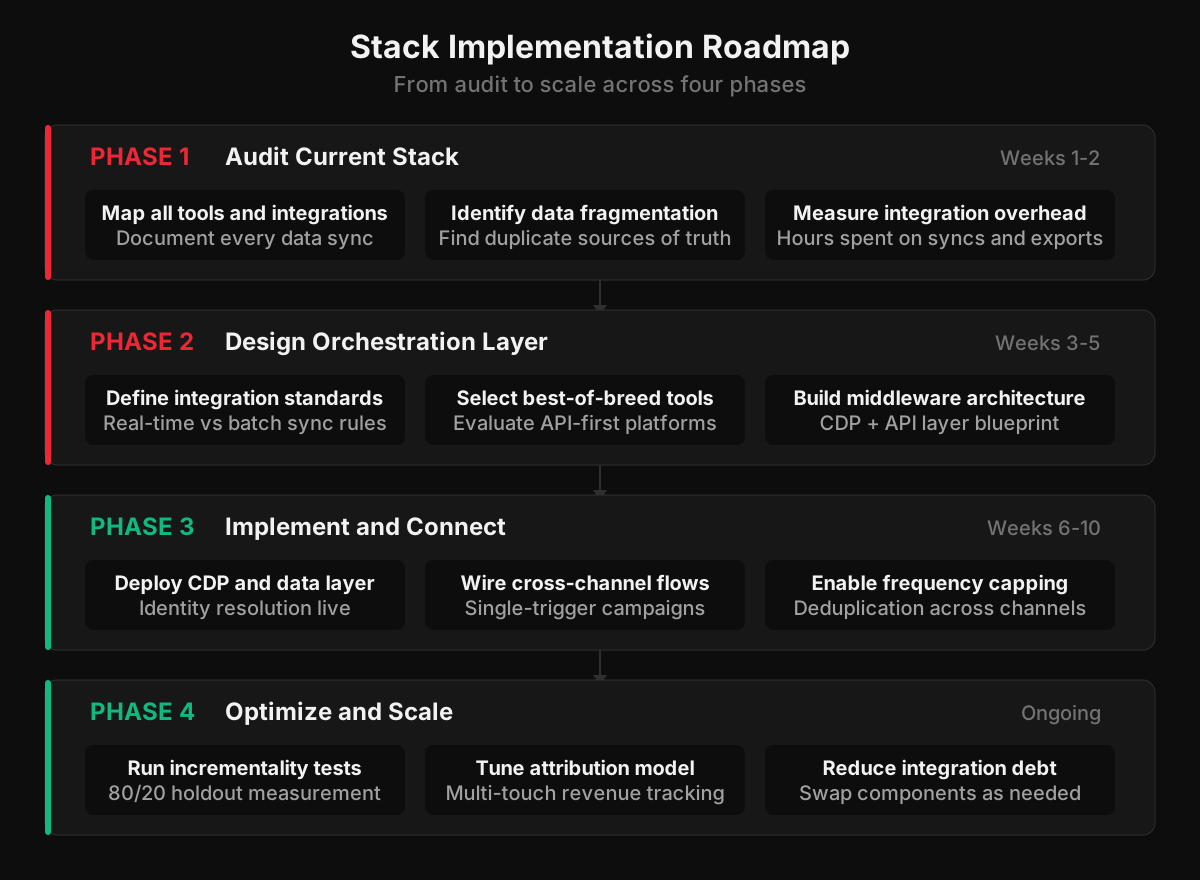
The Integration Debt You'll Accumulate (And How to Avoid It)
Every tool you add creates integration debt. Not technical debt exactly. Integration debt is the ongoing cost of maintaining connections between tools, managing data syncs, and handling breaking changes when vendors update their APIs.
A data engineer's time is expensive. If you're paying someone to maintain CSV imports from Klaviyo to your CDP, you're wasting money.
Here's how to avoid it:
Fewer tools is better than more tools - Each tool you add increases integration burden by roughly 2x. If you have two tools, there's one connection. Three tools, three connections. Four tools, six connections. Plan accordingly.
Prioritize API-native tools - Tools designed for API-first integration are dramatically easier to maintain. Tools designed around CSV exports and manual work will bleed money over time.
Invest in an orchestration layer early - A CDP with a solid API is cheaper than hiring someone to maintain seven separate integrations. It's not even close.
Set integration standards - Define what "integrated" means. Real-time sync? Once a day? When new data arrives? Make sure vendors meet your standards before signing contracts.
A Practical 2026 Stack for Mid-Market DTC
If I were building a retention stack from scratch for a $5M ARR DTC brand, here's what I'd start with:
Email: Klaviyo or Attentive (if SMS-first strategy) - strong automation, good integrations, deliverability you can trust.
SMS:Attentive or Postscript - SMS-native companies that do SMS better than email tools doing SMS.
CDP: Segment or mParticle - identity resolution, real-time audience computation, solid API. Syncs data back to Klaviyo and SMS tool automatically.
Loyalty: Smile or Referralcandy - tracks points, integrates with your CDP, connects to Klaviyo through the CDP.
Analytics: Mixpanel or Amplitude - tracks events and user behavior, integrates with CDP for real-time activation.
Orchestration: Custom API layer or a purpose-built tool like Segment's audiences - manages cross-channel logic, frequency capping, and holdout groups. Routes campaigns through Klaviyo and Attentive.
This stack has four to five integrations instead of twelve. Your data team maintains one orchestration layer instead of managing seven point-to-point connections. You get real-time campaign triggering and accurate attribution.
Total cost is higher than picking Klaviyo for everything. The ROI is lower integration overhead and dramatically better retention metrics. When paired with paid media management, the full-funnel impact compounds.
Red Flags: When a Vendor is Overselling
Watch for these patterns:
"We're a complete all-in-one solution" - They're telling you they do everything okay instead of one thing great. Push back. Ask them to compare their SMS platform to Attentive. Ask them to compare their analytics to Mixpanel. They'll admit they're not as good.
"No technical integration required" - Some integration work is always required. Data mapping, field matching, testing. If they're saying integration is instant, they're overselling.
"Automatically connects to X, Y, Z" - Check if these are native integrations or if they're going through Zapier. Zapier integrations are fine for low-volume data, terrible for real-time event syncing.
"Our AI/machine learning does attribution" - They mean they're guessing. Demand incrementality testing. Machine learning is great for personalization. It's not good for attribution.
"Loyalty is built in" - Okay, but can you define any custom earning rule? Can you sync points in real time? If you're limited to purchase-based points, it's a feature, not a platform.
FAQ
Do I really need a CDP if I'm using Klaviyo?
Not immediately. If you're early stage and only have email and SMS, Klaviyo can handle it. But once you add analytics, loyalty, or a second paid channel, you'll spend money managing syncs between Klaviyo and other tools. A CDP becomes cheaper than the engineering time spent maintaining integrations.
Should we build custom integrations or use Zapier?
Depends on volume and real-time requirement. For real-time event triggering, custom API integrations. For daily syncs or low-volume events, Zapier is fine. Don't overthink it, but don't ignore it either. A broken Zapier integration will cost you money.
What's the difference between CDP and data warehouse?
A CDP is real-time and activation-focused. A data warehouse is historical and analysis-focused. You probably need both. CDP for retention campaigns, data warehouse for reporting and long-term analytics.
How do we measure if our retention stack is actually working?
Track two things: revenue attributed to retention campaigns (not engagement metrics) and integration overhead (how much time your team spends managing tools vs. analyzing results). If attribution is hard to measure or integration takes more than 10% of your data team's time, your stack needs redesign.
Is it worth switching platforms mid-year to consolidate?
Rarely. The cost of switching (data migration, campaign rebuild, lost data during transition) is high. Finish out the year, plan for next year. But build your orchestration layer now. You can swap individual components without rebuilding everything.
How do we avoid vendor lock-in?
Use tools with strong APIs and open data access. Avoid custom features that don't exist elsewhere. Plan for the day you might switch each tool. If switching takes six months, you're locked in.
What should we build in-house versus buy?
Buy the tools. Build the orchestration layer. You're not going to beat Klaviyo's email engine or Attentive's SMS compliance infrastructure. But your retention strategy is specific to your brand. Build the orchestration logic that connects best-of-breed tools to your unique business model.
Next Steps
The retention marketing stack problem is not which tools to buy. It's how to connect them into a coherent system. Most brands are held back not by tool limitations, but by integration overhead and fragmented data. See how Darkroom approaches this problem across our full service suite.
If you're operating a retention stack with more than four disconnected tools, you're losing money on integration work that could be spent on optimization.
Darkroom specializes in building retention systems that actually work together. We start by auditing your current stack, identifying integration gaps, and designing an orchestration layer that turns your tools into a coherent system. Darkroom has done this for dozens of DTC brands.
Book a call with a Darkroom retention specialist to discuss your stack and the path to better integration and attribution.
Related Resources
Why Loyalty Programs Fail Without Retention Infrastructure