
RETENTION MARKETING
Why Loyalty Programs Fail Without Retention Infrastructure




Written by Darkroom leardership

Written & peer reviewed by 4 Darkroom team members
TL;DR:
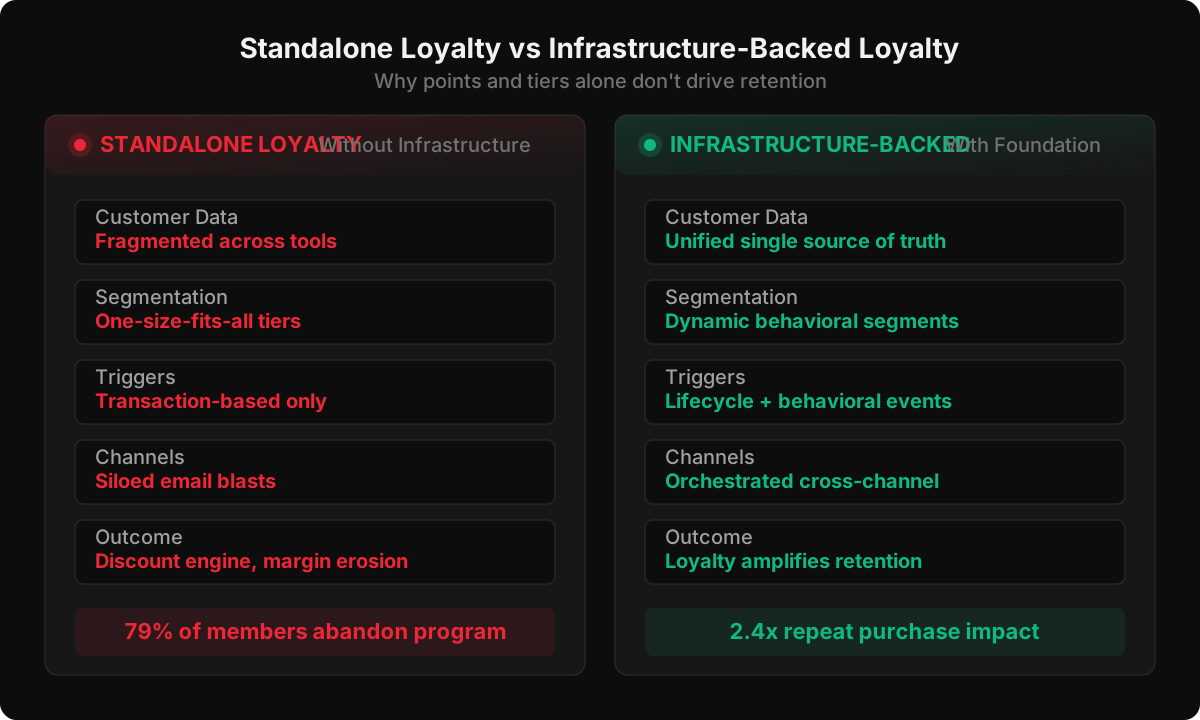
At Darkroom, we see the same pattern: most loyalty programs reward transactions while ignoring the behavioral infrastructure that drives repeat purchases. Without segmentation, lifecycle triggers, and cross-channel orchestration, they become discount engines that erode margins. Companies that succeed build retention infrastructure first: clean customer data, behavioral segmentation, triggered communications, and channel integration. Then they add loyalty as an amplifier on top. See how Darkroom builds retention systems that work.
Loyalty Programs Are Solving the Wrong Problem
Your loyalty program is failing because it's positioned as a retention solution when it's actually a discount mechanism. Loyalty programs reward customer transactions, but transactions are a symptom, not a cause. A customer who makes a purchase already decided to buy. You're rewarding behavior that was already going to happen.
The real retention problem is invisible. It happens between purchases. It's the customer who had a mediocre support experience and is silently comparing your onboarding to competitors. It's the user who completed one transaction but was never educated on product value. It's the segment you've ignored because they don't fit your core persona, so they drift away without you noticing.
Loyalty programs can't solve those problems. Points don't fix broken onboarding. Tiers don't compensate for poor product education. A 10% reward doesn't address the customer who feels forgotten after their first purchase.
The companies winning in retention aren't solving this with loyalty. They're solving it with infrastructure.
The Three Missing Layers Under Your Loyalty Program
Most loyalty programs sit on top of chaos: incomplete data, no segmentation, and communication that feels random. When customers see a points offer without context, without knowing why they're being targeted, it reads as desperation. It doesn't feel like a reward. Working with a what a retention marketing agency actually does can help navigate this effectively. It feels like a discount you're trying to push.
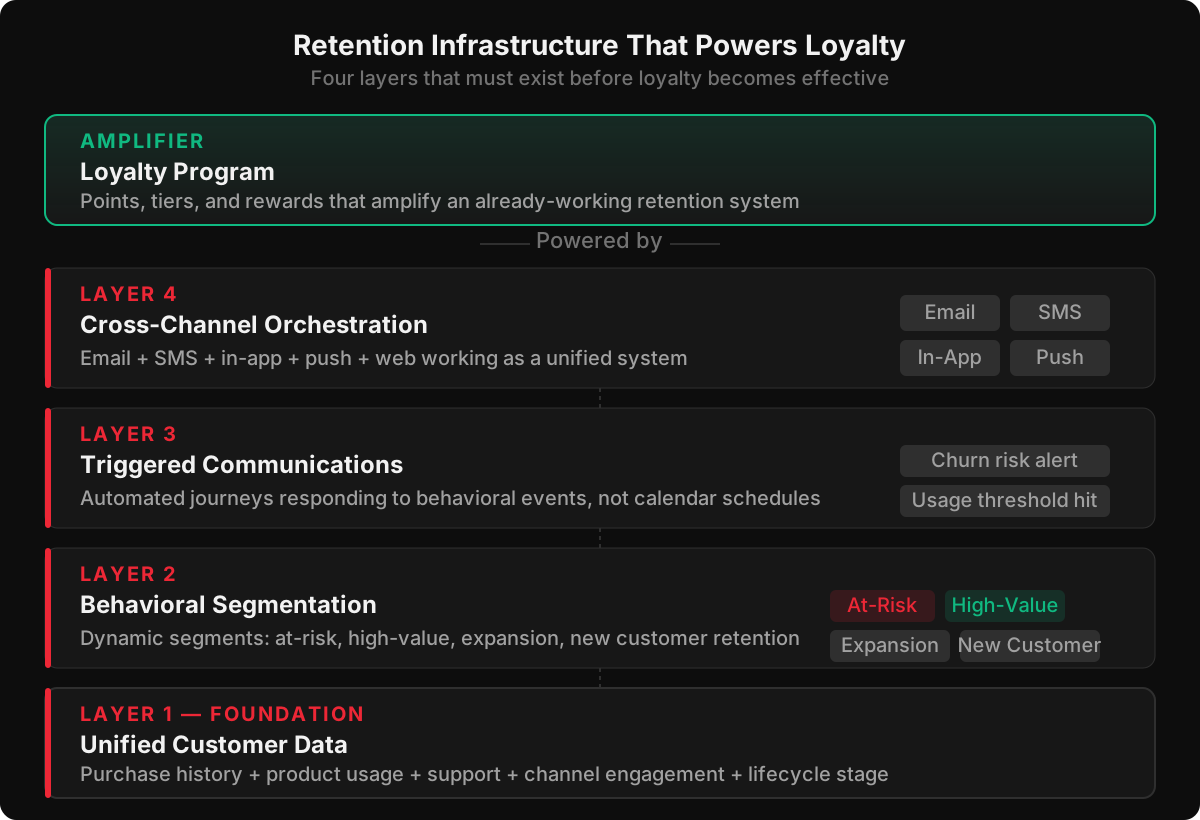
Three infrastructure layers need to exist before loyalty becomes effective:
Layer One: Customer Data and Segmentation. You need to know who your customers are beyond their transaction history. What's their lifecycle stage? What problems are they trying to solve? Which features have they actually used? Which segments are shrinking, and why? Without this, you can't target loyalty meaningfully. You'll throw the same reward at power users and at-risk customers alike, wasting budget on people who don't need incentives and failing to reach people who do.
Layer Two: Lifecycle Triggers and Behavioral Signals. Loyalty programs that activate on transactions alone are missing the moments that matter. A customer who suddenly dropped 40% in usage frequency is at risk of churn. A user who completed onboarding but never used the core feature is vulnerable. A segment with high time-to-value abandonment needs different communication than your engaged segment. Without behavioral triggers, your loyalty program can't respond to these moments. It just waits for the next transaction.
Layer Three: Cross-Channel Orchestration. Loyalty rewards that only live in email, or only in-app, or only in your loyalty dashboard feel fragmented. Customers don't think in channels. They think in journeys. They receive an email, click to the app, explore features, remember they have a reward, and want to redeem it. If these don't connect, the reward falls apart. Most loyalty programs fail not because the offer is bad, but because the customer can't seamlessly act on it.
Build these three layers first. Then add loyalty on top. Loyalty becomes an amplifier, not a crutch.
How Companies Mistake Loyalty Programs for Retention Strategy
Loyalty programs feel concrete and actionable, which makes them the default choice for leaders who need a retention move. You can launch a loyalty program in months. You can measure points issued. You can track redemption rates. Working with a performance creative services can help navigate this effectively. You can show board visibility and cost per point.
Building retention infrastructure is slower and less visible. Cleaning customer data takes time. Building behavioral segmentation requires analytics work. Setting up lifecycle triggers requires cross-functional coordination. There's no single metric that says "we won." It's a system that reduces churn by 2-3%, improves repeat purchase rates, and increases customer lifetime value. Those results compound over time, but they don't hit immediately.
So companies choose the faster path. They launch loyalty, watch redemption rates, optimize point values, and then wonder why churn keeps climbing.
The data is clear on this. Research from Bond Brand Loyalty found that 79% of consumers have abandoned a loyalty program they were part of. The reasons: it didn't feel valuable, the rewards were hard to redeem, and they didn't feel understood by the brand. None of those problems are solved by adjusting point structures. Those are infrastructure problems.
McKinsey research shows that retention spending is 5-25x more efficient than acquisition spending, but companies still allocate 20 times more budget to acquisition. Loyalty programs are part of why. They feel like retention investment but often produce acquisition-like returns: low efficiency and high churn-per-dollar.
The Segments Your Loyalty Program Is Ignoring
Your loyalty program was probably designed for one segment: your best customers. High transaction frequency, high order value, long relationship with the brand. Those customers are already loyal. Working with a email vs SMS for DTC retention can help navigate this effectively. Rewarding them further makes financial sense, but it's not where churn happens.
Churn happens in the segments your loyalty program overlooks. The customer segment with one purchase who's on the fence about a second. The inactive segment that used to buy regularly but has dropped off. The moderate-spend segment that could grow but isn't being educated on product value. The at-risk segment that's about to churn.
A tier-based loyalty program accidentally penalizes most of these segments. You need to reach Bronze tier before you get meaningful rewards. You need repeat activity before the system recognizes you. By the time someone climbs to a valuable tier, they're already engaged. You're rewarding behavior that's self-reinforcing.
Real retention strategy targets the edge cases: the customers at risk of churn, the engaged customers with potential for growth, the new customers deciding whether to return. These require different communication, different timing, and different rewards. A standard loyalty program can't flex into these shapes. Infrastructure can.
Antavo's 2024 loyalty program benchmark found that programs focused on high-value customer retention outperformed those designed for broad-based engagement by 2.4x in repeat purchase impact. But most programs are still structured for volume and velocity, not for targeted retention of critical segments.
Why Loyalty Programs Become Discount Engines
The economic math of loyalty programs breaks down quickly if your retention infrastructure is weak. You start with a rational proposal: offer points on purchases to incentivize repeat behavior. The cost is low because it's only paid on the behavior you want.
But if your retention infrastructure isn't working, customers need bigger incentives to return. A 5% reward doesn't move a customer who's at risk because they had a bad support experience. You increase to 10%. Still nothing moves. You increase to 15%, maybe add a tier bump. Now you're burning margin on customers who are leaving anyway because of infrastructure problems, not price sensitivity.
So the loyalty program becomes an increasingly expensive way to compensate for retention problems you haven't fixed. It's a discount engine dressed up as a rewards program. Customers learn to expect the discount. The program trains them to wait for the next offer instead of buying unprompted.
This is the failure mode Yotpo has documented repeatedly: brands that rely on loyalty incentives without building the underlying customer relationship infrastructure see diminishing returns within 18-24 months as customers become discount-conditioned and acquisition costs for new customers climb to compensate for loyalty program budget.
The fix isn't bigger rewards. It's infrastructure that makes customers feel understood, valued, and recognized for reasons beyond transactions.
Building Retention Infrastructure: Where Loyalty Actually Works
Loyalty programs succeed when they sit on top of mature retention infrastructure. Here's what that foundation looks like:
Customer data that's clean and unified. A single source of truth for each customer: purchase history, product usage, support interactions, channel engagement, lifecycle stage. Not perfect, but consistent and queryable. This enables every system downstream to work with truth instead of assumptions.
Behavioral segmentation that updates in real time. Customers aren't sorted into segments once and left alone. Your system knows when someone enters an at-risk state, when they show expansion potential, when they need onboarding support, when they're ready for upsell. This requires data pipelines and analytics work, but it transforms what loyalty can do.
Triggered communications based on behavioral events. Not batch-and-blast campaigns. Triggered journeys that respond to what customers actually do. A customer shows abandonment signals in your analytics. Automatically, they receive a segment-specific message, at the right time, through the right channel. A customer crosses a usage threshold. They get recognized and rewarded, not by email noise but by a meaningful, contextual gesture.
Cross-channel integration. Email talks to SMS. SMS coordinates with in-app. In-app rewards are redeemable via web. Customers don't think about channels. Your system shouldn't either.
Once these exist, loyalty becomes a tool for amplification. You're not using loyalty to compensate for weak retention. You're using it to recognize and celebrate the retention you've already built. The reward feels earned because it reflects actual customer value. The messaging feels personal because it's backed by real segmentation. The redemption works because channels are integrated.
That's when loyalty programs drive measurable retention impact instead of margin erosion.
The Roadmap: Infrastructure First, Loyalty Second
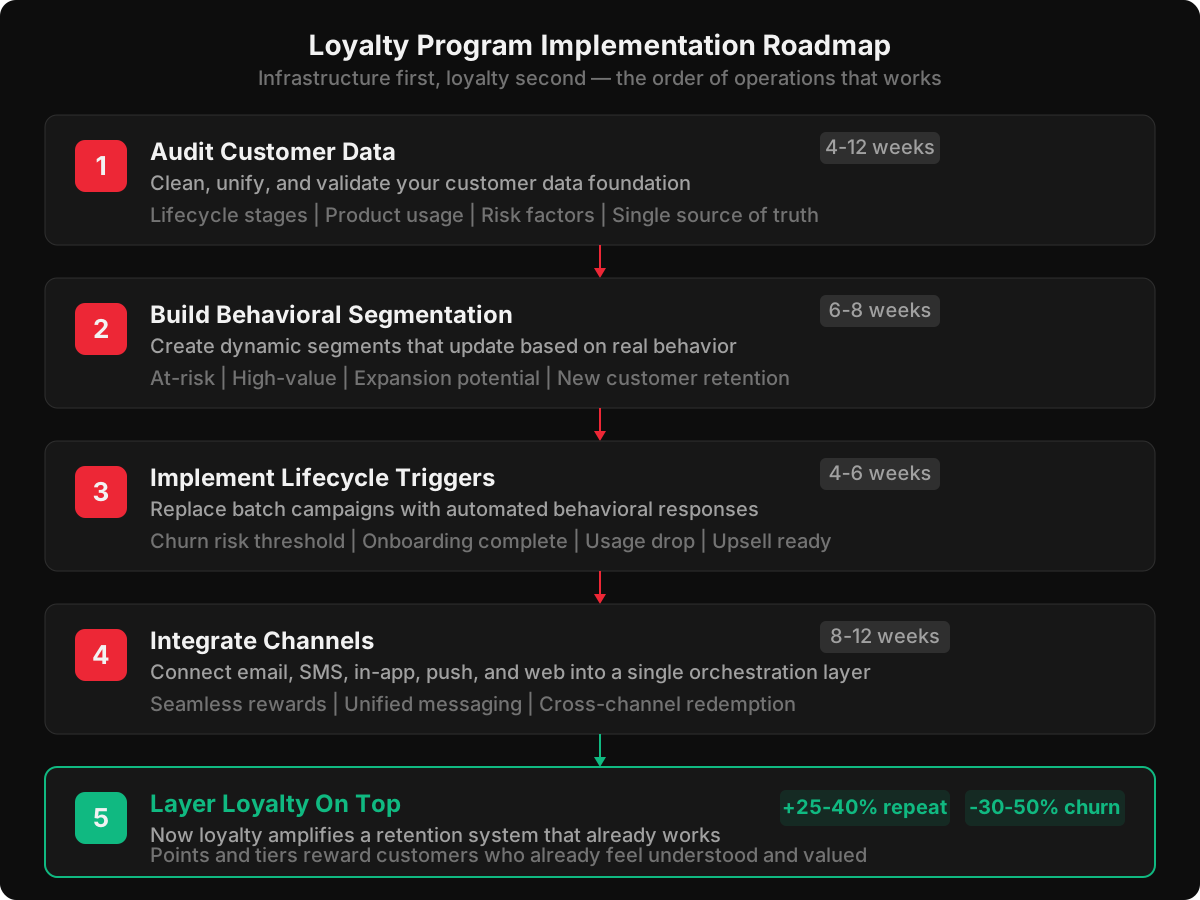
If your loyalty program is underperforming, you probably don't need to rebuild loyalty. You need to build the infrastructure underneath it. Here's the order of operations:
First, audit your customer data. Is it clean? Is it unified? Do you know your customers' lifecycle stages, their product usage, their risk factors? This foundation must be solid. If customer data is your blocker, everything downstream will be weak.
Second, build behavioral segmentation. Create dynamic segments for at-risk customers, high-value customers, expansion potential, new customer retention. Test segments with communication to validate they're predictive. Once segmentation is working, your targeting becomes precise.
Third, implement lifecycle triggers. Stop batch campaigns. Start responding to behavioral events. A customer hits a churn risk threshold. A user completes onboarding. A segment shows utilization drop. Automated journeys respond to these moments, not your calendar.
Fourth, integrate your channels. Email, SMS, in-app, push, web. They should talk to each other. A customer sees a message in email, acts in the app, and the system understands the connection. Rewards are redeemable across channels without friction.
Fifth, layer loyalty on top. Now your loyalty program works because it's amplifying a retention system that already functions. Points and tiers now reward customers who already feel understood and valued. The loyalty program increases reward velocity, recognizes tier status, and gives customers visible credit for their relationship with your brand.
Companies that follow this order see 25-40% improvements in repeat purchase rates and 30-50% reductions in churn within six months. Companies that skip to loyalty see costs climb and effectiveness decline.
What This Means for Your Team
Retention infrastructure requires cross-functional coordination. Product needs to track meaningful usage events. Data needs to pipeline clean customer information. Marketing needs to operationalize behavioral segments into campaigns. Customer success needs to feed back on at-risk signals. Engineering needs to integrate channels.
This is why most teams default to loyalty programs. They can be owned by a single marketer. Infrastructure requires investment and alignment across teams.
But that's also why the teams that do it win. Once you have infrastructure, churn becomes a metric you control, not a force that controls your budget. Retention becomes predictable. Loyalty programs become tools instead of band-aids.
The question isn't whether to invest in loyalty. The question is whether you're willing to invest in the infrastructure that makes loyalty matter. If you are, let's talk about what that looks like for your business.
FAQ
Can we launch loyalty without building full retention infrastructure?
Yes, but you'll get limited returns. Loyalty without infrastructure becomes a discount mechanism within 12-18 months. If you have clean data and basic segmentation already, you can launch loyalty and build deeper infrastructure in parallel. If your data is a mess, loyalty will compound the problem by creating more cost without precision.
How long does it take to build retention infrastructure?
Data cleanup and unification takes 4-12 weeks depending on data quality. Behavioral segmentation adds 6-8 weeks. Triggered communications add 4-6 weeks. Cross-channel integration depends on your tech stack but plan 8-12 weeks. You can show impact with partial infrastructure, but full ROI takes 4-6 months. After that, improvements compound.
What if our biggest customers are already in our loyalty program?
That's a common starting point. Your infrastructure investment should focus on the segments your loyalty program misses: at-risk customers, new customer retention, and expansion potential. Your best customers don't churn at high rates, so loyalty serves them well. It's the edge cases where infrastructure matters most.
How do we measure if retention infrastructure is working?
Track these metrics before and after: repeat purchase rate by segment, time to second purchase, churn rate by lifecycle stage, customer lifetime value. If infrastructure is working, these improve 15-25% within three months. Channel integration should increase reward redemption rates by 20-40%. Email engagement on triggered campaigns should be 3-5x higher than broadcast campaigns.
Should we pause our loyalty program while building infrastructure?
No. Keep existing loyalty programs running. Build infrastructure in parallel, especially behavioral segmentation and triggered communications. As infrastructure matures, layer it on top of loyalty. You can run both simultaneously. The goal is to add infrastructure underneath, not rebuild from zero.
What's the biggest mistake teams make when building retention infrastructure?
Starting with loyalty instead of data. You can't segment what you don't understand. You can't trigger on events you don't track. You can't orchestrate channels that don't integrate. Nine out of ten teams skip data audit and jump to loyalty. Their costs climb, their returns shrink, and eventually they blame loyalty instead of blaming the infrastructure gap.
How does Darkroom approach retention infrastructure builds?
We start with a customer data audit to identify what's clean, what's fragmented, and what's missing. We build unified segmentation frameworks backed by analytics. We design lifecycle-triggered journeys that respond to behavioral signals. We integrate channels so communications and rewards work seamlessly. Then we layer loyalty on top with strategic point structures and tier designs. Talk to us about your situation.
Related Reading
Your Loyalty Program Isn't Your Retention Problem
Loyalty programs fail because they're layered on top of broken infrastructure. The solution isn't a better loyalty program. It's building the retention system underneath it: clean data, behavioral segmentation, triggered communications, and cross-channel orchestration. Darkroom specializes in building retention infrastructure that makes loyalty, email, and in-app communication work together. If your program is underperforming, let's diagnose where the real gaps are. Book a call with our team.
Sources
Why Most Loyalty Programs Fail
Loyalty Program ROI: What the Data Actually Shows
The Connection Between Retention Infrastructure and Loyalty