
PERFORMANCE CREATIVE
The 5 Signs of Ad Fatigue, How to Prevent and Cure It




Written by Darkroom leardership
6 min read
September 29, 2026

Ad fatigue is hard to spot at first. Your cost per result slowly increases, and by the time you notice a drop in revenue, you may have already spent weeks paying for ads that no one wanted.
When you’re spending at the enterprise level, even a short delay can be costly. In this guide, you’ll learn the five warning signs, how quickly repeat views hurt conversions, what ad fatigue can cost at a $500,000 monthly spend, and how often to refresh your ads to save money.
Key takeaways:
Ad fatigue shows up in five places before revenue drops: frequency, click-through rate, CPM, cost per result, and conversion rate. Catching it early is the cheapest part of performance creative.
Meta analyzed about 26,000 cases and found that the chance of conversion drops with each repeated exposure, falling by around 45% after four repeats.
The warning signs appear in a certain order: first attention, then price, then efficiency. Watch your CTR and CPM, not just your CPA.
To calculate wasted spend, multiply your spend on fatigued ads by (1 minus your baseline CPA divided by your fatigued CPA). For a $500,000 monthly budget, this usually means losing about $58,000.
Refreshing your ads is worth it when the cost is less than the amount of wasted spend you recover.
What is creative ad fatigue?
Ad fatigue sets in when your audience sees your ads too many times. People start ignoring them, stop clicking, and stop buying, even though you keep paying for those views.
This can happen on any channel where you pay per impression, but it shows up fastest on paid social, since the same people see your ads in their feeds every day.
Three main factors cause ad fatigue:
Repetition: Each time someone sees the same ad again, they are less likely to take action.
Familiar formats: People get used to how your ads look, so a product photo with text on it might get skipped before anyone reads the message.
Stale offers: Even if the ad catches someone’s eye, the offer might no longer feel fresh.
Ad fatigue builds up slowly, so by the time you notice a drop in revenue, you may have already spent your budget.
Read also: What Is UGC and Why It Outperforms Studio Creative on Paid Social
What are the 5 signs of ad fatigue?
The five signs of ad fatigue are rising frequency, falling click-through rate, rising CPM, rising cost per result, and falling conversion rate.

1. Frequency climbs while reach stalls
Frequency shows how many times, on average, each person has seen your ad. An increase in frequency is not an issue by itself, but it can be a problem if your reach is no longer growing.
When this happens, it means the platform has no new people left in your target audience, so any extra spending just leads to more repeat views.
Read frequency over a rolling 7 days at the ad set level, because lifetime frequency hides recent saturation. Small audiences, such as retargeting pools, hit this wall first. Your first move is to check reach before you blame the creative.
2. Click-through rate decays while impressions hold
Click-through rate is a great way to measure an ad’s stopping power. If impressions hold steady but CTR starts to drop, the platform is still serving your ad, but people are no longer engaging with it.
For video ads, it helps to watch hook rate first. This is the percentage of impressions that make it to three seconds of viewing. Usually, hook rate drops before CTR does, since the opening frame is what viewers notice right away. If you start to see more people hitting 'hide ad' or leaving negative feedback, that’s a clear sign the creative is wearing out.
Before swapping out the entire ad, try changing the hook or the first frame. Sometimes, a fresh start at the beginning is all it takes to revive a concept that still has potential.
Read also: How to Boost Online Ad Click-Through Rates with 7 Proven Methods
3. CPM rises without a change in the market
CPM is the cost for every 1,000 ad impressions. It can go up for several reasons, like holiday auctions, new competitors, or more specific targeting.
Ad fatigue is a bit different. Older ads start to cost more, but new ads from this week still get impressions at the usual price. This shows the issue is with the ad itself, not the market. Delivery systems prefer ads that people interact with, so a worn-out ad has to pay more to win the same auction.
4. Cost per result drifts above the ad's own baseline
Most teams spot this sign first, even though it tends to appear at the end of the process.
Meta makes it easy to spot: in the Delivery column of Ads Manager, ads may show a creative limited or creative fatigue status if their cost per result climbs higher than what’s typical for that ad.
If tweaking bids and budgets doesn't lower your CPA, it is time to pause bid adjustments. The real issue likely starts earlier in the process, not with bidding itself.
Read also: A Complete Guide To Measuring Ad Performance
5. Conversion rate falls while CTR holds
People are still clicking, but fewer are buying. This suggests the problem isn't the image, but the promise. The offer, price, or landing page may no longer meet what the audience expects after seeing it several times.
Start by checking the landing page and checkout process, since a website issue can cause the same drop in sales. If the site works well, try changing your angle or offer instead of just updating the image.
How many times can someone see an ad before it stops working?
There is no magic number for how often someone should see your ad, but Meta’s own research shows that every extra view can chip away at your conversions. In other words, real data beats any rule of thumb here.
Meta’s analytics team looked at creative fatigue in about 26,000 test cases back in May 2023. Here are the three findings that really matter for any ad account:
The average person-and-creative pair had 4.2 prior exposures, and over 19% of ad impressions went to people who had seen the creative more than five times.
With every repeat exposure, the chance of converting dropped. By the time someone had seen an ad four times, conversion likelihood had fallen by around 45%.
When creative was refreshed in ad sets showing signs of fatigue, conversion rates rose by about 8% on average.
For most large accounts, the biggest chunk of budget gets wasted in that long tail of repeat views.
Read also: How Creative Intelligence AI Transforms Performance Ad ROI
How do CPM and CTR decay curves show fatigue before CPA does?
CPA (cost per action) is a lagging metric. By the time it starts to shift, the ad has often been underperforming for several days. The early warning signs usually show up first in click-through rate and CPM. To spot these changes, look at a decay curve, which tracks key metrics day by day from the ad’s launch week onward.
Ad fatigue tends to follow a predictable pattern, moving through these metrics in a set order:
Attention drops first (CTR): People who have already seen the ad scroll past it, so clicks fall while impressions hold.
Price rises second (CPM): Meta's ranking models predict each ad's value to people and to the advertiser. An ad fewer people engage with scores lower, so it needs more budget to win the same impressions.
Efficiency breaks last (CPA): You pay more per impression and get fewer clicks from each, so cost per result jumps.
This sequence is why relying only on a CPA dashboard can get expensive. The best time to refresh an ad is between the first drop in CTR and the spike in CPA. If you’re only watching CPA, you’ll miss that window.

What does creative fatigue cost at $500K a month?
With a $500,000 monthly budget, creative fatigue can quietly eat up about $58,000 every month. That adds up to nearly $700,000 over a year. Let’s break down how that happens.
The formula is simple:
Wasted spend = spend on fatigued creative x (1 - baseline CPA / fatigued CPA) |
For example, if an ad’s cost per result has doubled, half of every dollar spent is essentially wasted. If the cost per result is 50 percent higher than the baseline, about a third of your spend is wasted.
The numbers below are just examples, so feel free to plug in your own data. The $80 baseline CPA only changes the conversions column.
Scenario at $500K / mo | Spend on fatigued creative | CPA drift | Wasted spend/mo | Conversions lost / mo at $80 CPA | Self-funding refresh budget at 50% recovery |
|---|---|---|---|---|---|
Light | 20% ($100,000) | +25% | $20,000 | 250 | Up to $10,000 / mo |
Typical | 35% ($175,000) | +50% | $58,333 | 729 | Up to $29,167 / mo |
Heavy | 50% ($250,000) | +100% (CPA doubled) | $125,000 | 1,562 | Up to $62,500 / mo |
Why does only about half of the lost performance come back after a refresh? In most cases, refreshing an ad set does not recover all the wasted spend.
Meta’s own research found that updating fatigued ad sets led to an average conversion rate increase of around 8 percent. So while it is possible to regain some ground, expecting a full recovery is more a best-case scenario than a realistic goal.
On top of that, wasted spend is getting pricier over time. In Q2 2026, Meta’s average price per ad rose 12 percent from the previous year, even as ad impressions increased 14 percent. This means every impression delivered to a fatigued ad costs more now than it did a year ago.
Read also: Marketing Efficiency Ratio - One P&L, Three Ways to Read It
How do you prevent ad fatigue on Meta?
To avoid ad fatigue on Meta, give the delivery system genuinely different creative and enough reach to spread impressions out. The first three actions fix the creative side; the last three fix the audience side.
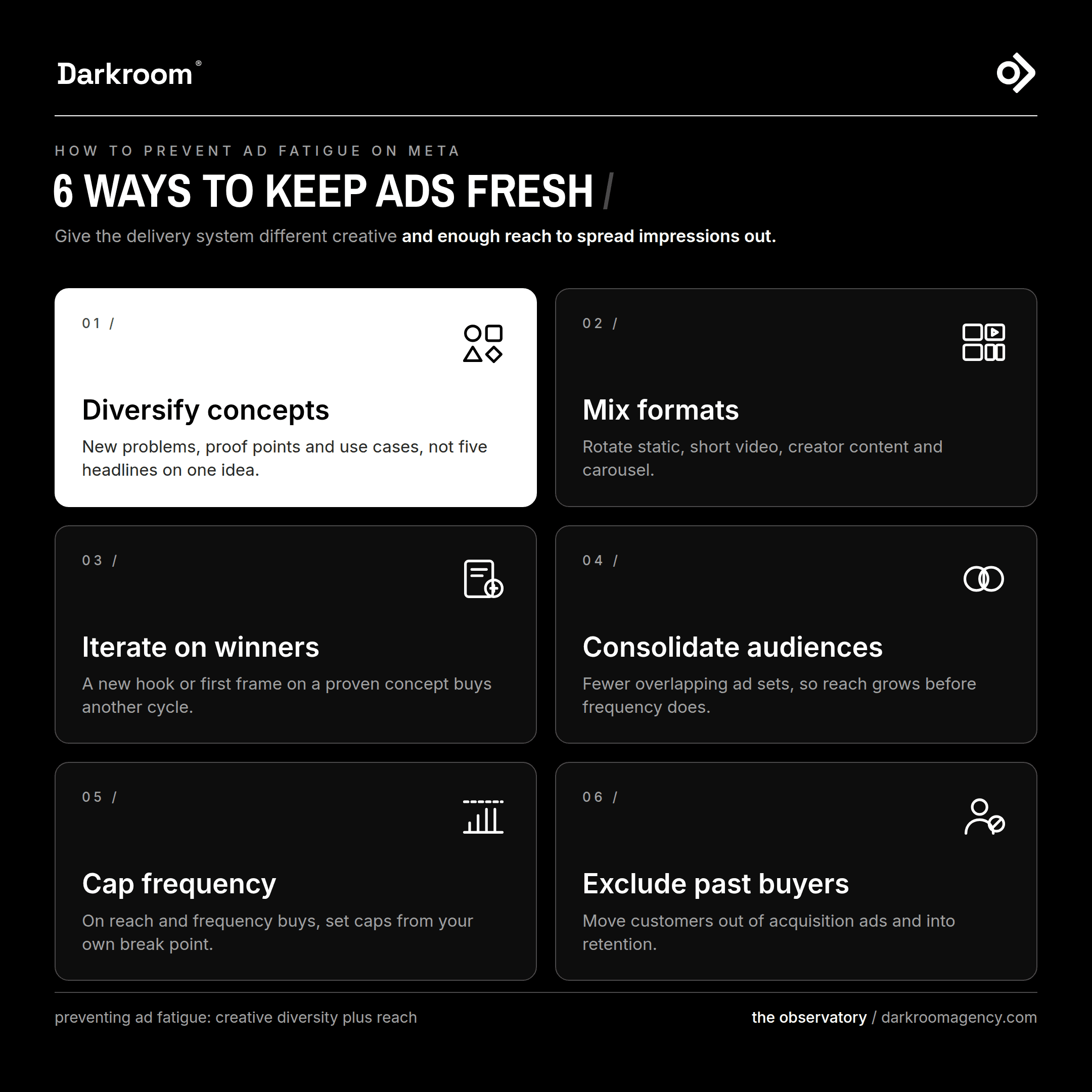
1. Diversify concepts
A concept is the main idea behind an ad. It covers the problem the ad solves, the proof it gives, and who it targets. If you use five different headlines for the same concept, you’ll reach the same people for the same reason, so they’ll get tired of it at the same time.
Create each ad group around different concepts, like a new problem, proof point, use case, or buyer type. This helps Meta’s system match your ads to more people and spreads your impressions across a larger part of your audience.
Here’s a quick test: if you can describe two ads with the same sentence, they share the same concept.
2. Mix formats
Audiences get used to the look and feel of your ads, not just what they say. On Facebook and Instagram, ad fatigue often shows up first in the format you use most.
Mix up your formats, like rotating between static images, short videos, creator content, and carousels. This helps keep things fresh for your audience. Each format also works best in different placements. For example, vertical videos work well in Stories and Reels, while static images and carousels tend to perform well in the Feed.
Review your ad spend by format every month. If most of the budget is going to just one format, that’s usually where fatigue will show up next.
3. Iterate on winners
When a successful ad starts losing its impact, it’s usually the execution that gets old before the idea does. Since people notice the opening frame first, try changing that.
Stick with the main idea, but switch out the hook, opening frame, format, or offer. Adding a new hook or first frame to a proven concept can often give it new life.
Stop making changes once new versions stop improving your click-through rate. That’s a sign the concept has run its course.
4. Consolidate audiences
Splitting your budget across many narrow ad sets might seem like a good way to cover more ground, but it can actually spike frequency.
Here’s why: each small ad set quickly runs out of new people to show ads to, and when ad sets overlap, they compete for the same audience. This means people start seeing the same ads repeatedly, which pushes frequency up for everyone.
Using fewer, broader ad sets works differently. Each ad has a bigger pool of people to reach before anyone starts seeing repeats. Plus, when conversion data is pooled, the ad platform gets smarter about finding new buyers instead of just showing ads to the same people it already knows.
Read also: Meta Ads & Content Strategy with Aashay Patel
5. Cap frequency
When running performance campaigns on Meta, note that direct frequency capping isn't available for most options. For example, auction campaigns that are set up to drive sales or leads do not include a frequency cap setting.
However, there are some exceptions. You can set caps on reach and frequency buys, as well as on awareness campaigns optimized for reach. It is a good idea to define your own frequency break point based on your audience and goals.
For sales campaigns, it helps to monitor the 7-day frequency metric. If frequency approaches your chosen limit, consider refreshing your creative or expanding your audience to avoid ad fatigue and keep performance strong.
6. Exclude past buyers
Recent buyers tend to interact with your ads, so they keep seeing them. However, most will not make another purchase immediately. If you leave them in your prospecting audience, they end up seeing ads meant for new customers too often.
To avoid this, exclude recent buyers from your acquisition campaigns by creating a custom audience based on your purchase event or customer list. Set the lookback window to match your typical repurchase cycle. For Advantage+ sales campaigns, where you have fewer exclusion options, use the existing customer settings to identify buyers and limit how much budget goes to them.
Move customers to retention messaging instead: email, SMS, and ads built for the next purchase.
Keep fresh creative in rotation with Darkroom
Fatigue is predictable, and most programs break because they run out of replacements. Darkroom is a performance creative agency built to keep that supply ahead of creative fatigue: 250 to 600 production-ready assets per cycle, delivered every two weeks across static, motion, UGC, and AI formats, designed for how Meta and TikTok rank ads.
For Sculpd, a brand that came in with no creative testing framework for paid media, monthly ad spend scaled 33x, from a $30K baseline to over $1M by December, and the business grew nearly 100% through Q4. For Olipop, Darkroom's video-first creative drove 3x revenue growth and 28% broader reach growth across new audiences.
Talk to Darkroom's performance creative team before fatigue shows up in your CPA.
Frequently asked questions
What frequency causes ad fatigue?
There is no single number. Meta's own analysis found conversion likelihood falls with every repeat exposure, by about 45% at four repeats, but where cost per result actually breaks depends on audience size, spend, and the creative. Group your ads by frequency band and find the band where your cost per result starts to rise.
How do you check ad fatigue in Meta Ads?
Start with the Delivery column in Ads Manager, where Meta flags ads as creative limited or creative fatigue, then confirm it in the numbers. Compare each ad's 7-day click-through rate, CPM, and cost per result with its own first week. Fatigue shows as falling clicks and rising costs while targeting and budget hold steady.
How long does it take for an ad to fatigue?
It depends on how quickly spend works through the audience. More budget against the same people raises frequency faster, so large accounts can exhaust a creative in days rather than weeks. Measure it in your own account: track the median number of days a winner holds before its cost per result crosses your trigger.
Can you fix ad fatigue without a new concept?
Often, yes, for a while. A new hook, first frame, format, or offer on a proven concept can reset attention, because audiences tire of the execution before they tire of the idea. When new iterations stop recovering results, the concept itself is spent, and the next batch needs a genuinely new angle.
How much new creative does a large account need each month?
It depends on spend, audience size, and how quickly your winners fatigue, so any fixed weekly number will be wrong for someone. Darkroom's guide to creative volume covers how much to ship by account size. Use this page to decide when a creative needs replacing, and use that size guide in the pipeline.