menu
menu
The top conversion rate optimization agency for enterprise e-commerce brands
The top conversion rate optimization agency for enterprise e-commerce brands
The top conversion rate optimization agency for enterprise e-commerce brands
CRO strategy and agile design implementation for Shopify, ecommerce, and subscription brands. Your ranked conversion audit lands in the first two weeks, before a single test runs.
CRO strategy and agile design implementation engineered for Shopify, ecommerce,
and subscription brands.
What we deliver
Visitors decide in three seconds, and small friction points quietly bleed revenue. As a conversion rate optimization agency, Darkroom runs the testing program that turns your existing traffic into measurable revenue.
Visitors decide in three seconds, and small friction points quietly bleed revenue. As a conversion rate optimization agency, Darkroom runs the testing program that turns your existing traffic into measurable revenue.
1
A prioritized conversion audit with ranked opportunities
We map every friction point and conversion gap on your site and rank them by revenue impact, using analytics data, heatmaps, and session recordings.
On Cocolab, that analysis found 50% of desktop users dropping off past the buy box. You know exactly where to focus before a single test runs.


1
A prioritized conversion audit with ranked opportunities
We map every friction point and conversion gap on your site and rank them by revenue impact, using analytics data, heatmaps, and session recordings.
On Cocolab, that analysis found 50% of desktop users dropping off past the buy box. You know exactly where to focus before a single test runs.
2
A documented A/B test backlog you can see at any time
A scored, prioritized test backlog in a shared workspace your team can open whenever it wants. Every hypothesis, every result, and every decision written down. Nothing runs without a reason, and nothing disappears when the engagement ends.
2
A documented A/B test backlog you can see at any time
A scored, prioritized test backlog in a shared workspace your team can open whenever it wants. Every hypothesis, every result, and every decision written down. Nothing runs without a reason, and nothing disappears when the engagement ends.
3
Winning variants designed, built and shipped
Validated test ideas move straight into design and development. Layouts, calls to action, checkout flows, and product pages are rebuilt and shipped each sprint by the same team that designed the test, with no separate agency handoff, no waiting on a developer queue.
Where the work runs past the scope of a test into a rebuild, it hands off cleanly to our web development team.
3
Winning variants designed, built and shipped
Validated test ideas move straight into design and development. Layouts, calls to action, checkout flows, and product pages are rebuilt and shipped each sprint by the same team that designed the test, with no separate agency handoff, no waiting on a developer queue.
Where the work runs past the scope of a test into a rebuild, it hands off cleanly to our web development team.
4
A conversion baseline that compounds month over month
We set a performance baseline in week one and track every sprint against it: conversion rate, subscription rate, average order value and revenue per visitor, measured in sequence rather than all at once.
The longer the program runs, the faster the gains compound.
4
A conversion baseline that compounds month over month
We set a performance baseline in week one and track every sprint against it: conversion rate, subscription rate, average order value and revenue per visitor, measured in sequence rather than all at once.
The longer the program runs, the faster the gains compound.
Where we test first
Darkroom was built AI-native. Three systems do the work that used to sit between a question and an answer.
Darkroom was built AI-native. Three systems do the work that used to sit between a question and an answer.
Product pages, where most of the money leaks
Buy-box placement, gallery order, size and variant selection, review positioning, the first screen on mobile. Product detail pages carry the highest concentration of purchase decisions on an ecommerce site and are usually the least tested, because they are the hardest to change safely.
Cart and checkout
Cart abandonment sits near 70% across ecommerce, according to Baymard Institute’s research. We test shipping-threshold messaging, payment options, guest checkout, form length, and the post-add-to-cart moment, and we measure the effect on completed orders rather than on cart entries.
Cart abandonment sits near 70% across ecommerce, according to Baymard Institute’s research. We test shipping-threshold messaging, payment options, guest checkout, form length, and the post-add-to-cart moment, and we measure the effect on completed orders rather than on cart entries.
Paid landing destinations
The pages your media spend lands on are the fastest place to prove a program pays for itself, because the traffic is high-intent and the volume is controllable. We coordinate with your media team — or ours — so that message match between ad and page is tested, not assumed.
Subscription and post-purchase
Subscribe-and-save framing, plan selection, upgrade and pause flows, the thank-you page. For subscription brands, the second and third orders decide the economics, so we test the moments that produce them rather than only the first conversion.
Speed and Core Web Vitals
Mobile load delays can cut conversion by up to 20%, per Google’s Core Web Vitals guidance, which makes performance a conversion lever before it is a technical one. We treat it as part of the backlog, not a separate project.
How the program runs
How the program runs
Every engagement starts with data
Every engagement starts with data
The first two weeks are diagnostic only. No tests run until the audit is complete and the backlog is approved. Opinion never drives prioritization. Data does.
The first two weeks are diagnostic only. No tests run until the audit is complete and the backlog is approved. Opinion never drives prioritization. Data does.
One sprint cycle a month, every month
One sprint cycle a month, every month
Each cycle covers a test review, new hypothesis development, design and build, and a results debrief. The rhythm stays the same so the compounding stays on track.
Each cycle covers a test review, new hypothesis development, design and build, and a results debrief. The rhythm stays the same so the compounding stays on track.
Tests reviewed before they go live
Tests reviewed before they go live
Nothing ships without your sign-off. Each sprint opens with a review of the proposed tests: the hypothesis, the element being tested, and the expected impact.
Nothing ships without your sign-off. Each sprint opens with a review of the proposed tests: the hypothesis, the element being tested, and the expected impact.
Results documented, win or lose
Results documented, win or lose
Winning variants get implemented. Losing ones get recorded and used to sharpen the next hypothesis. Every result, data point, and decision lives in the shared backlog, including the ones that did not work.
Winning variants get implemented. Losing ones get recorded and used to sharpen the next hypothesis. Every result, data point, and decision lives in the shared backlog, including the ones that did not work.
Built for Shopify, headless and subscription stacks
Built for Shopify, headless and subscription stacks
Most of our conversion work runs on Shopify and Shopify Plus, including headless storefronts, alongside the subscription, analytics, and experimentation tools those stacks depend on.
We work inside your existing setup rather than asking you to migrate for a test: the experimentation platform, the session-replay and heatmap tooling, the on-site survey layer, and the revenue-attribution dashboard all stay where they are, and we bring the testing discipline to them. If a piece of that stack is missing, the audit says so and prices it separately.
Most of our conversion work runs on Shopify and Shopify Plus, including headless storefronts, alongside the subscription, analytics, and experimentation tools those stacks depend on.
We work inside your existing setup rather than asking you to migrate for a test: the experimentation platform, the session-replay and heatmap tooling, the on-site survey layer, and the revenue-attribution dashboard all stay where they are, and we bring the testing discipline to them. If a piece of that stack is missing, the audit says so and prices it separately.
Proof from the program
Laundry Sauce: home fragrance, subscription
Laundry Sauce: home fragrance, subscription
23% increase in repeat order rate alongside 290% net revenue growth, with A/B experiments across product detail pages and a storefront redesign running underneath the media program.
Cocolab: oral care, Shopify
Cocolab: oral care, Shopify
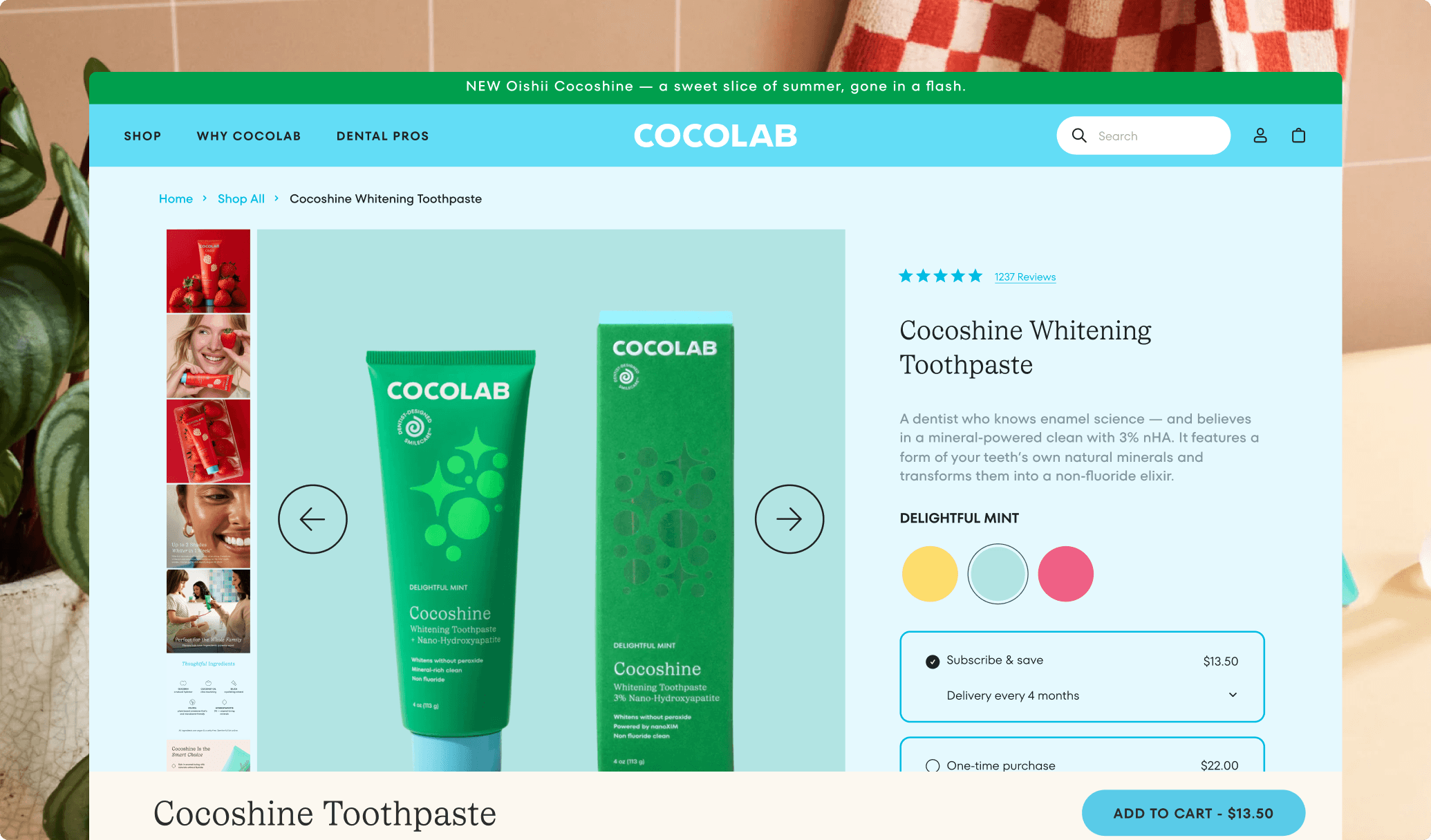
3.23% revenue-per-visitor growth year over year. 2% conversion-rate increase in Q1 2026. Heatmap analysis found 50% of desktop users dropping off past the buy box; the rebuild addressed that structure first, then tested around it.
Frequent questions we receive
services & pricing
What does a conversion rate optimization agency do?
A conversion rate optimization agency increases the share of your existing visitors who buy, subscribe, or convert, so that revenue grows without a matching increase in media spend. The work is a program rather than a project: quantitative and qualitative research to find where revenue leaks, a prioritized hypothesis backlog, A/B and multivariate testing to prove which changes work, implementation of the winners, and a documented record so learnings compound instead of being relearned. Darkroom runs that program for Shopify, ecommerce, and subscription brands, and judges it against revenue per visitor rather than conversion rate alone — a test that lifts transactions while eroding margin is not a win. The fastest way to see what that would find on your site is the free conversion audit.
How much does a conversion rate optimization agency cost?
CRO agencies typically charge somewhere between $3,000 and $20,000+ a month, depending on how many properties are in the program, how much design and development the winning variants require, and whether implementation is included or billed separately. Some price per test or per project instead, which is usually cheaper up front and more expensive over a year. Darkroom publishes its starting rate: conversion rate optimization begins at $5,250 a month, covering the audit, the backlog, test design, and the design and build of winners — implementation included, not quoted separately. Your exact scope comes out of the free conversion audit, before you commit to anything.
How much traffic do we need before testing is worth it?
Enough that a test can reach significance in weeks rather than quarters. As a working threshold, brands running below roughly 8,000 to 10,000 monthly sessions on the pages being tested will struggle to justify a full experimentation program: the tests take too long to resolve, and the cost of the program outruns the value of what it proves. Below that line the honest answer is usually a one-time conversion audit and a structural rebuild rather than an ongoing testing retainer, and we will say so. If you are not sure which side of the line you are on, the free conversion audit is the cheapest way to find out.
Should we hire a CRO agency, a consultant, or build the capability in-house?
A conversion rate optimization consultant is the right call when you already have designers and developers who can ship variants and you only need the strategy and the analysis. In-house is right when conversion work is continuous, senior experimentation talent is hireable, and engineering capacity is not the constraint. An agency earns its place when the bottleneck is execution — when the tests are obvious but nothing ships, because design and development are booked on the roadmap. Darkroom is built for that third case: strategy, design and build sit in the same team, so a validated hypothesis becomes a live variant inside the same sprint rather than entering a developer queue. We typically work alongside an in-house ecommerce or growth lead rather than replacing one. The audit will tell you which of the three shapes your situation actually needs.
Which brands are the best fit for this service?
Consumer ecommerce and subscription brands with meaningful existing traffic, a functioning media program, and a conversion rate they already suspect is leaving money behind. Subscription and repeat-purchase models benefit most, because the tests that improve second and third orders compound in a way that first-purchase tests do not. The fit is poor for pre-traffic brands, for sites in the middle of a replatform, and for teams that want a redesign rather than a testing program — a redesign is one untested bet, which is the opposite of what this service sells. If that is where you are, our web development service is the honest answer and the audit will point you there.
Do you work with our Shopify theme or headless build, and who implements the winners?
We work inside your existing stack. Most of our conversion work runs on Shopify and Shopify Plus, including headless storefronts, alongside whatever experimentation platform, session-replay tooling and attribution layer you already have — we do not ask brands to migrate anything to run a test, and if a piece of the stack is genuinely missing, the audit says so and prices it separately. Implementation is ours, not yours. Validated tests move directly into design and development in the same sprint, with no separate agency handoff and no dependency on your engineering roadmap. Where the work grows past testing into a full rebuild, it hands off to our web development team. Bring your stack to the free conversion audit and we will tell you what is testable in it today.
onboarding & process
What happens after we book a call?
The first call is a 30-minute working session with a senior strategist, not a pitch. We look at your analytics, your highest-traffic templates and your checkout together, and name the two or three places we would expect the largest revenue leak to be. If there is a fit, the engagement opens with the full conversion audit: friction points and conversion gaps mapped from analytics, heatmaps and session recordings, ranked by revenue impact, delivered inside the first two weeks with a scored test backlog attached. Either way you leave that call knowing where your conversion problem is, even if we never work together. Book your free conversion audit whenever you are ready.
How quickly will we see results?
The first two weeks are diagnostic only: no tests run until the audit is complete and the backlog is approved. From there, most programs need 60 to 90 days before results are trustworthy, because a test has to reach statistical significance before its lift means anything, and the sample size required depends on your traffic and your baseline conversion rate. Early wins usually come from structural findings rather than tests — the audit on Cocolab found 50% of desktop users dropping off past the buy box, which was fixable immediately. Over a full year of sprints, Cocolab’s revenue per visitor grew 3.23% year over year with a 2% conversion-rate increase in Q1 2026. The audit will tell you which of the two curves your site is on.
Frequent questions we receive
services & pricing
What does a conversion rate optimization agency do?
A conversion rate optimization agency increases the share of your existing visitors who buy, subscribe, or convert, so that revenue grows without a matching increase in media spend. The work is a program rather than a project: quantitative and qualitative research to find where revenue leaks, a prioritized hypothesis backlog, A/B and multivariate testing to prove which changes work, implementation of the winners, and a documented record so learnings compound instead of being relearned. Darkroom runs that program for Shopify, ecommerce, and subscription brands, and judges it against revenue per visitor rather than conversion rate alone — a test that lifts transactions while eroding margin is not a win. The fastest way to see what that would find on your site is the free conversion audit.
How much does a conversion rate optimization agency cost?
CRO agencies typically charge somewhere between $3,000 and $20,000+ a month, depending on how many properties are in the program, how much design and development the winning variants require, and whether implementation is included or billed separately. Some price per test or per project instead, which is usually cheaper up front and more expensive over a year. Darkroom publishes its starting rate: conversion rate optimization begins at $5,250 a month, covering the audit, the backlog, test design, and the design and build of winners — implementation included, not quoted separately. Your exact scope comes out of the free conversion audit, before you commit to anything.
How much traffic do we need before testing is worth it?
Enough that a test can reach significance in weeks rather than quarters. As a working threshold, brands running below roughly 8,000 to 10,000 monthly sessions on the pages being tested will struggle to justify a full experimentation program: the tests take too long to resolve, and the cost of the program outruns the value of what it proves. Below that line the honest answer is usually a one-time conversion audit and a structural rebuild rather than an ongoing testing retainer, and we will say so. If you are not sure which side of the line you are on, the free conversion audit is the cheapest way to find out.
Should we hire a CRO agency, a consultant, or build the capability in-house?
A conversion rate optimization consultant is the right call when you already have designers and developers who can ship variants and you only need the strategy and the analysis. In-house is right when conversion work is continuous, senior experimentation talent is hireable, and engineering capacity is not the constraint. An agency earns its place when the bottleneck is execution — when the tests are obvious but nothing ships, because design and development are booked on the roadmap. Darkroom is built for that third case: strategy, design and build sit in the same team, so a validated hypothesis becomes a live variant inside the same sprint rather than entering a developer queue. We typically work alongside an in-house ecommerce or growth lead rather than replacing one. The audit will tell you which of the three shapes your situation actually needs.
Which brands are the best fit for this service?
Consumer ecommerce and subscription brands with meaningful existing traffic, a functioning media program, and a conversion rate they already suspect is leaving money behind. Subscription and repeat-purchase models benefit most, because the tests that improve second and third orders compound in a way that first-purchase tests do not. The fit is poor for pre-traffic brands, for sites in the middle of a replatform, and for teams that want a redesign rather than a testing program — a redesign is one untested bet, which is the opposite of what this service sells. If that is where you are, our web development service is the honest answer and the audit will point you there.
Do you work with our Shopify theme or headless build, and who implements the winners?
We work inside your existing stack. Most of our conversion work runs on Shopify and Shopify Plus, including headless storefronts, alongside whatever experimentation platform, session-replay tooling and attribution layer you already have — we do not ask brands to migrate anything to run a test, and if a piece of the stack is genuinely missing, the audit says so and prices it separately. Implementation is ours, not yours. Validated tests move directly into design and development in the same sprint, with no separate agency handoff and no dependency on your engineering roadmap. Where the work grows past testing into a full rebuild, it hands off to our web development team. Bring your stack to the free conversion audit and we will tell you what is testable in it today.
onboarding & process
What happens after we book a call?
The first call is a 30-minute working session with a senior strategist, not a pitch. We look at your analytics, your highest-traffic templates and your checkout together, and name the two or three places we would expect the largest revenue leak to be. If there is a fit, the engagement opens with the full conversion audit: friction points and conversion gaps mapped from analytics, heatmaps and session recordings, ranked by revenue impact, delivered inside the first two weeks with a scored test backlog attached. Either way you leave that call knowing where your conversion problem is, even if we never work together. Book your free conversion audit whenever you are ready.
How quickly will we see results?
The first two weeks are diagnostic only: no tests run until the audit is complete and the backlog is approved. From there, most programs need 60 to 90 days before results are trustworthy, because a test has to reach statistical significance before its lift means anything, and the sample size required depends on your traffic and your baseline conversion rate. Early wins usually come from structural findings rather than tests — the audit on Cocolab found 50% of desktop users dropping off past the buy box, which was fixable immediately. Over a full year of sprints, Cocolab’s revenue per visitor grew 3.23% year over year with a 2% conversion-rate increase in Q1 2026. The audit will tell you which of the two curves your site is on.
Frequent questions we receive
services & pricing
What does a conversion rate optimization agency do?
A conversion rate optimization agency increases the share of your existing visitors who buy, subscribe, or convert, so that revenue grows without a matching increase in media spend. The work is a program rather than a project: quantitative and qualitative research to find where revenue leaks, a prioritized hypothesis backlog, A/B and multivariate testing to prove which changes work, implementation of the winners, and a documented record so learnings compound instead of being relearned. Darkroom runs that program for Shopify, ecommerce, and subscription brands, and judges it against revenue per visitor rather than conversion rate alone — a test that lifts transactions while eroding margin is not a win. The fastest way to see what that would find on your site is the free conversion audit.
How much does a conversion rate optimization agency cost?
CRO agencies typically charge somewhere between $3,000 and $20,000+ a month, depending on how many properties are in the program, how much design and development the winning variants require, and whether implementation is included or billed separately. Some price per test or per project instead, which is usually cheaper up front and more expensive over a year. Darkroom publishes its starting rate: conversion rate optimization begins at $5,250 a month, covering the audit, the backlog, test design, and the design and build of winners — implementation included, not quoted separately. Your exact scope comes out of the free conversion audit, before you commit to anything.
How much traffic do we need before testing is worth it?
Enough that a test can reach significance in weeks rather than quarters. As a working threshold, brands running below roughly 8,000 to 10,000 monthly sessions on the pages being tested will struggle to justify a full experimentation program: the tests take too long to resolve, and the cost of the program outruns the value of what it proves. Below that line the honest answer is usually a one-time conversion audit and a structural rebuild rather than an ongoing testing retainer, and we will say so. If you are not sure which side of the line you are on, the free conversion audit is the cheapest way to find out.
Should we hire a CRO agency, a consultant, or build the capability in-house?
A conversion rate optimization consultant is the right call when you already have designers and developers who can ship variants and you only need the strategy and the analysis. In-house is right when conversion work is continuous, senior experimentation talent is hireable, and engineering capacity is not the constraint. An agency earns its place when the bottleneck is execution — when the tests are obvious but nothing ships, because design and development are booked on the roadmap. Darkroom is built for that third case: strategy, design and build sit in the same team, so a validated hypothesis becomes a live variant inside the same sprint rather than entering a developer queue. We typically work alongside an in-house ecommerce or growth lead rather than replacing one. The audit will tell you which of the three shapes your situation actually needs.
Which brands are the best fit for this service?
Consumer ecommerce and subscription brands with meaningful existing traffic, a functioning media program, and a conversion rate they already suspect is leaving money behind. Subscription and repeat-purchase models benefit most, because the tests that improve second and third orders compound in a way that first-purchase tests do not. The fit is poor for pre-traffic brands, for sites in the middle of a replatform, and for teams that want a redesign rather than a testing program — a redesign is one untested bet, which is the opposite of what this service sells. If that is where you are, our web development service is the honest answer and the audit will point you there.
Do you work with our Shopify theme or headless build, and who implements the winners?
We work inside your existing stack. Most of our conversion work runs on Shopify and Shopify Plus, including headless storefronts, alongside whatever experimentation platform, session-replay tooling and attribution layer you already have — we do not ask brands to migrate anything to run a test, and if a piece of the stack is genuinely missing, the audit says so and prices it separately. Implementation is ours, not yours. Validated tests move directly into design and development in the same sprint, with no separate agency handoff and no dependency on your engineering roadmap. Where the work grows past testing into a full rebuild, it hands off to our web development team. Bring your stack to the free conversion audit and we will tell you what is testable in it today.
onboarding & process
What happens after we book a call?
The first call is a 30-minute working session with a senior strategist, not a pitch. We look at your analytics, your highest-traffic templates and your checkout together, and name the two or three places we would expect the largest revenue leak to be. If there is a fit, the engagement opens with the full conversion audit: friction points and conversion gaps mapped from analytics, heatmaps and session recordings, ranked by revenue impact, delivered inside the first two weeks with a scored test backlog attached. Either way you leave that call knowing where your conversion problem is, even if we never work together. Book your free conversion audit whenever you are ready.
How quickly will we see results?
The first two weeks are diagnostic only: no tests run until the audit is complete and the backlog is approved. From there, most programs need 60 to 90 days before results are trustworthy, because a test has to reach statistical significance before its lift means anything, and the sample size required depends on your traffic and your baseline conversion rate. Early wins usually come from structural findings rather than tests — the audit on Cocolab found 50% of desktop users dropping off past the buy box, which was fixable immediately. Over a full year of sprints, Cocolab’s revenue per visitor grew 3.23% year over year with a 2% conversion-rate increase in Q1 2026. The audit will tell you which of the two curves your site is on.
Frequent questions we receive
services & pricing
What does a conversion rate optimization agency do?
A conversion rate optimization agency increases the share of your existing visitors who buy, subscribe, or convert, so that revenue grows without a matching increase in media spend. The work is a program rather than a project: quantitative and qualitative research to find where revenue leaks, a prioritized hypothesis backlog, A/B and multivariate testing to prove which changes work, implementation of the winners, and a documented record so learnings compound instead of being relearned. Darkroom runs that program for Shopify, ecommerce, and subscription brands, and judges it against revenue per visitor rather than conversion rate alone — a test that lifts transactions while eroding margin is not a win. The fastest way to see what that would find on your site is the free conversion audit.
How much does a conversion rate optimization agency cost?
CRO agencies typically charge somewhere between $3,000 and $20,000+ a month, depending on how many properties are in the program, how much design and development the winning variants require, and whether implementation is included or billed separately. Some price per test or per project instead, which is usually cheaper up front and more expensive over a year. Darkroom publishes its starting rate: conversion rate optimization begins at $5,250 a month, covering the audit, the backlog, test design, and the design and build of winners — implementation included, not quoted separately. Your exact scope comes out of the free conversion audit, before you commit to anything.
How much traffic do we need before testing is worth it?
Enough that a test can reach significance in weeks rather than quarters. As a working threshold, brands running below roughly 8,000 to 10,000 monthly sessions on the pages being tested will struggle to justify a full experimentation program: the tests take too long to resolve, and the cost of the program outruns the value of what it proves. Below that line the honest answer is usually a one-time conversion audit and a structural rebuild rather than an ongoing testing retainer, and we will say so. If you are not sure which side of the line you are on, the free conversion audit is the cheapest way to find out.
Should we hire a CRO agency, a consultant, or build the capability in-house?
A conversion rate optimization consultant is the right call when you already have designers and developers who can ship variants and you only need the strategy and the analysis. In-house is right when conversion work is continuous, senior experimentation talent is hireable, and engineering capacity is not the constraint. An agency earns its place when the bottleneck is execution — when the tests are obvious but nothing ships, because design and development are booked on the roadmap. Darkroom is built for that third case: strategy, design and build sit in the same team, so a validated hypothesis becomes a live variant inside the same sprint rather than entering a developer queue. We typically work alongside an in-house ecommerce or growth lead rather than replacing one. The audit will tell you which of the three shapes your situation actually needs.
Which brands are the best fit for this service?
Consumer ecommerce and subscription brands with meaningful existing traffic, a functioning media program, and a conversion rate they already suspect is leaving money behind. Subscription and repeat-purchase models benefit most, because the tests that improve second and third orders compound in a way that first-purchase tests do not. The fit is poor for pre-traffic brands, for sites in the middle of a replatform, and for teams that want a redesign rather than a testing program — a redesign is one untested bet, which is the opposite of what this service sells. If that is where you are, our web development service is the honest answer and the audit will point you there.
Do you work with our Shopify theme or headless build, and who implements the winners?
We work inside your existing stack. Most of our conversion work runs on Shopify and Shopify Plus, including headless storefronts, alongside whatever experimentation platform, session-replay tooling and attribution layer you already have — we do not ask brands to migrate anything to run a test, and if a piece of the stack is genuinely missing, the audit says so and prices it separately. Implementation is ours, not yours. Validated tests move directly into design and development in the same sprint, with no separate agency handoff and no dependency on your engineering roadmap. Where the work grows past testing into a full rebuild, it hands off to our web development team. Bring your stack to the free conversion audit and we will tell you what is testable in it today.
onboarding & process
What happens after we book a call?
The first call is a 30-minute working session with a senior strategist, not a pitch. We look at your analytics, your highest-traffic templates and your checkout together, and name the two or three places we would expect the largest revenue leak to be. If there is a fit, the engagement opens with the full conversion audit: friction points and conversion gaps mapped from analytics, heatmaps and session recordings, ranked by revenue impact, delivered inside the first two weeks with a scored test backlog attached. Either way you leave that call knowing where your conversion problem is, even if we never work together. Book your free conversion audit whenever you are ready.
How quickly will we see results?
The first two weeks are diagnostic only: no tests run until the audit is complete and the backlog is approved. From there, most programs need 60 to 90 days before results are trustworthy, because a test has to reach statistical significance before its lift means anything, and the sample size required depends on your traffic and your baseline conversion rate. Early wins usually come from structural findings rather than tests — the audit on Cocolab found 50% of desktop users dropping off past the buy box, which was fixable immediately. Over a full year of sprints, Cocolab’s revenue per visitor grew 3.23% year over year with a 2% conversion-rate increase in Q1 2026. The audit will tell you which of the two curves your site is on.