
Marketplace
What Happens When an Amazon Marketing Agency Treats Amazon Like a Brand Channel




Written by Darkroom leardership

Written & peer reviewed by 4 Darkroom team members
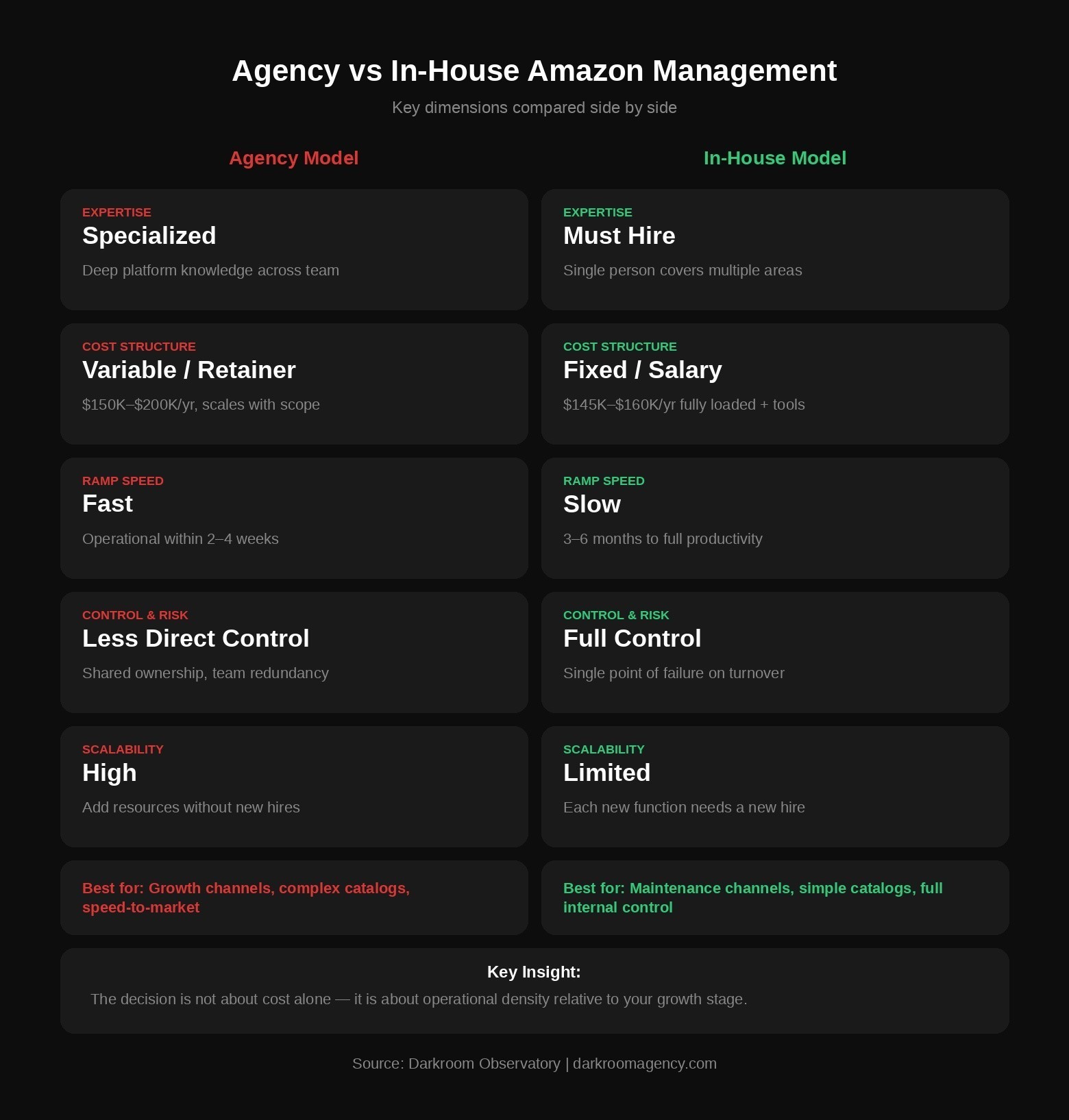
The agency versus in-house decision on Amazon is not about capability. It is about operational density. Amazon requires daily optimization across advertising, content, inventory, and pricing. Most brands cannot justify a full-time specialist for each function. The right decision depends on revenue stage, catalog complexity, and whether Amazon is a growth channel or a maintenance channel. For brands exploring this choice, working with an experienced Amazon marketing agency can clarify what operational density actually looks like in practice.
The Real Cost of Amazon Operational Complexity
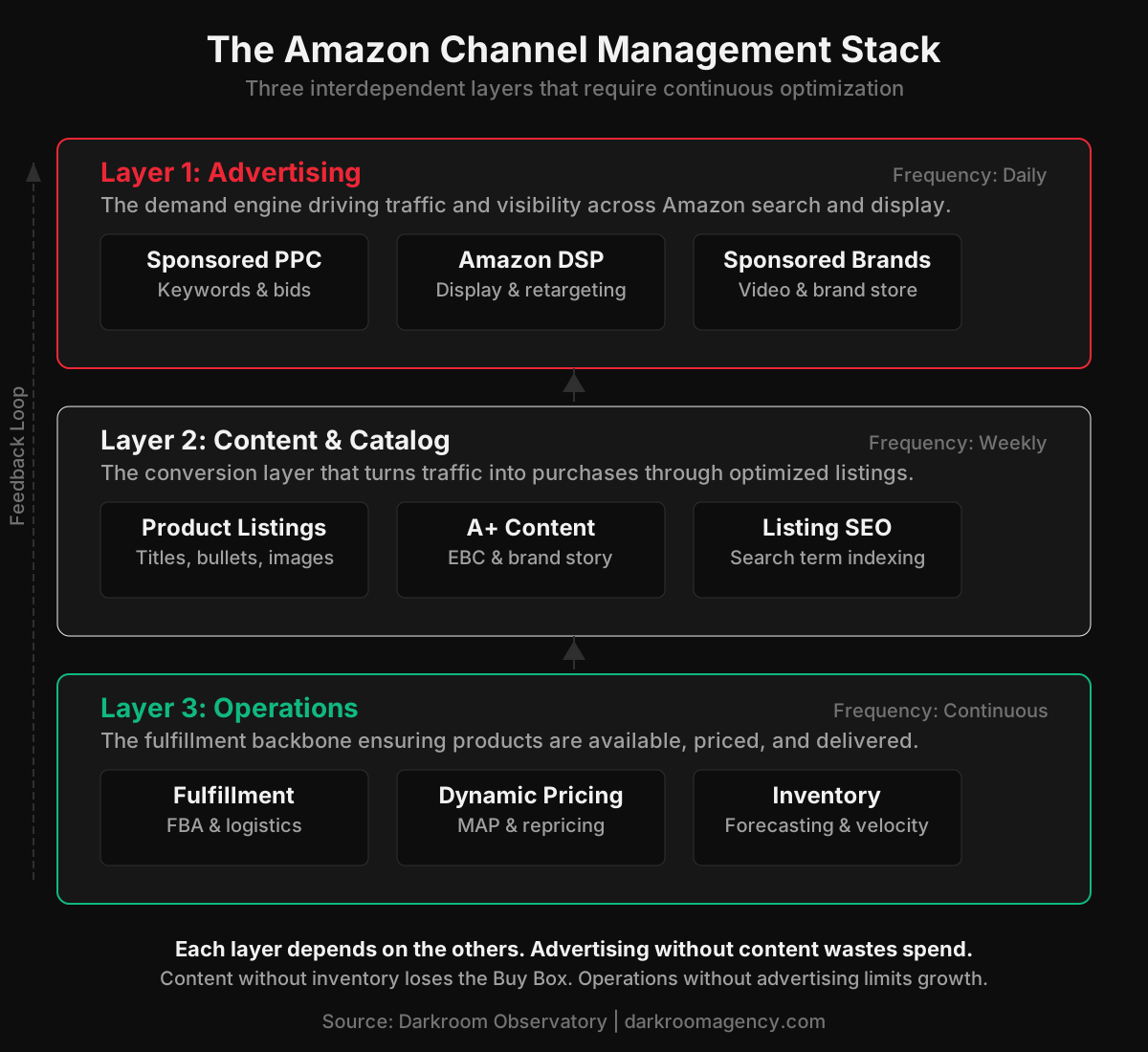
Amazon success requires simultaneous optimization across at least four distinct functions: sponsored advertising (keyword bidding, campaign structure, budget allocation), content (A+ pages, product listings, EBC videos), inventory management (velocity, FBA logistics, bulk replenishment), and pricing (MAP compliance, dynamic repricing, promotion strategy). According to Amazon Ads documentation on cost-per-click benchmarks, advertising alone requires ongoing bid management across multiple campaign types.
Each function has its own operating cadence. Advertising demands daily or weekly adjustments based on ACoS and competitive dynamics. Content updates require approval workflows that can span weeks. Inventory needs weekly forecasting to avoid stockouts or overstock. Pricing changes can happen multiple times per day.
The operational overhead is not distributed evenly across team members. One person cannot maintain expertise in all four areas while executing daily tasks. Most brands underestimate this complexity until they either hire the wrong person, lose continuity from turnover, or discover their single Amazon manager is making reactive decisions instead of strategic ones. Understanding the Amazon marketing flywheel connecting organic, paid, and content helps illustrate why each function depends on the others.
This is the hidden cost of in-house Amazon management. It is not the salary. It is the cost of partial attention across too many responsibilities.
When Amazon is Maintenance Versus Growth
The agency versus in-house decision shifts based on Amazon's role in your business strategy.
If Amazon is a maintenance channel—you have established SKUs, consistent monthly revenue, and predictable customer behavior—you can often manage this with a hybrid model. A single in-house coordinator can handle content updates, flag inventory issues, and manage relationships. An external specialist reviews advertising quarterly and provides strategic recommendations. This structure works because the channel is not moving. Working with a Amazon marketing agency can help navigate this effectively. Optimization is incremental.
If Amazon is a growth channel—you are launching new products, expanding into new categories, testing new advertising levers, or competing for market share in a category you have not yet dominated—you need daily operational density. This is where agencies provide structural advantage. A dedicated team moves faster because they are not juggling other channels (email, paid social, organic). They can run experiments weekly, scale winners immediately, and kill underperformers before they drain budget. Research from Jungle Scout's annual Amazon advertising report confirms that daily bid adjustments outperform weekly reviews across most categories.
The distinction matters because growth and maintenance require different skill sets and different time commitments. Most in-house teams are sized for maintenance but asked to deliver growth. The result is mediocre growth with high organizational friction.
Operational Density: The Hidden Advantage
Operational density is the amount of optimized activity per dollar of ad spend or per SKU. Higher density correlates with better margins because it reduces wasted spend on poor-performing campaigns and unnecessary inventory.
An in-house manager might review key metrics weekly and adjust bids on top-20 keywords. An agency team working with operational density might review metrics daily, run multivariate tests on campaign structure, optimize at the SKU level within categories, adjust budgets based on performance tiers, and monitor competitive changes in real time. This level of paid media management requires dedicated resources most brands cannot staff internally.
The difference in outcome is not marginal. Over a 90-day period, higher operational density typically yields:
- 15-25% improvement in advertising efficiency (ACoS reduction)
- 10-15% increase in organic rank velocity for new products
- 5-10% improvement in inventory turns through better forecasting
- Faster identification and capitalization of category opportunities
These are not guaranteed outcomes, but they reflect what happens when a function receives continuous attention from someone whose only job is to improve it. In-house managers are required to split attention. Agencies compress this task into their core function.
Operational density is not about working harder. It is about working on the right variables continuously. It is the difference between managing Amazon and optimizing Amazon. For a detailed breakdown of what this costs, see our analysis of Amazon PPC management costs in 2026.
Revenue Stage and Catalog Complexity
Two variables predict whether you can sustain in-house Amazon management: revenue from Amazon and SKU count.
For brands with less than $500K in annual Amazon revenue with fewer than 50 SKUs, an in-house manager is often overkill. You can use a part-time contractor, a managed-service platform, or a fractional agency retainer. Working with a paid media management can help navigate this effectively. The operational volume does not justify salary investment.
For brands with $500K to $3M in annual Amazon revenue with 50-200 SKUs, an in-house manager becomes viable if they have focused responsibilities. This manager should own advertising and content, with inventory and pricing delegated to operations. This is the sweet spot for hybrid in-house plus external strategy support.
For brands with $3M to $10M in annual Amazon revenue with 200-500 SKUs, you probably need two people: one for advertising, one for content and category strategy. Inventory and pricing remain operations functions. At this stage, creative assets become critical—investing in Amazon advertising creative strategy can significantly improve conversion rates.
For brands above $10M in annual Amazon revenue, you need a manager or small team for each function. Operational density demands specialization. At this scale, the question is not whether to hire in-house, but how many in-house people you need and what outside support bridges skill gaps.
Catalog complexity amplifies this. A single-category brand with 30 SKUs can be managed by one person. A multi-category brand with cross-selling dependencies, brand variants, and pricing tiers cannot. Complexity often exceeds what one or two people can optimize effectively.
Skill Requirements and Hiring Reality
The ideal Amazon manager has advanced SQL knowledge, statistical fluency with A/B testing, advertising platform expertise (DSP and self-serve), content optimization skills, supply chain awareness, and financial acumen. They need to move fast under uncertainty, work independently, and communicate findings to leadership. For more on how DSP fits the picture, see our guide on what Amazon DSP does and when to use it.
This person is rare and expensive. A truly capable Amazon specialist costs between $80K and $140K annually, depending on market. You are competing with agencies and consultancies for this talent. When you hire them, you are also betting that they will not leave in 18 months, which happens often in growth roles.
Most in-house candidates are solid in one or two areas (advertising platform, or content, or analytics) but weak in others. You hire someone strong in paid advertising, and they manage content reactively. You hire someone from retail operations, and they excel at inventory but miss advertising optimization.
Agencies avoid this problem through team structure. They deploy a senior strategist, a platform specialist, a content lead, and an analyst. Each person brings deep expertise in their function. There is built-in redundancy. If someone leaves, another person on the account maintains continuity. Most in-house teams cannot offer this. A McKinsey analysis on B2B growth found that specialized team structures outperform generalist roles by 30-40% in operational efficiency.
The hiring reality is that most brands choose between paying $100K for one skilled person (risky), paying $60K for a less skilled person (lower quality), or working with an agency. Agencies cost money, but they cost less than hiring and training multiple specialists or managing high turnover.
Cost Comparison: Hidden Variables
Brands often compare agency fees to a single in-house salary and conclude that in-house is cheaper. Working with a full-service growth agency can help navigate this effectively. This comparison is incomplete.
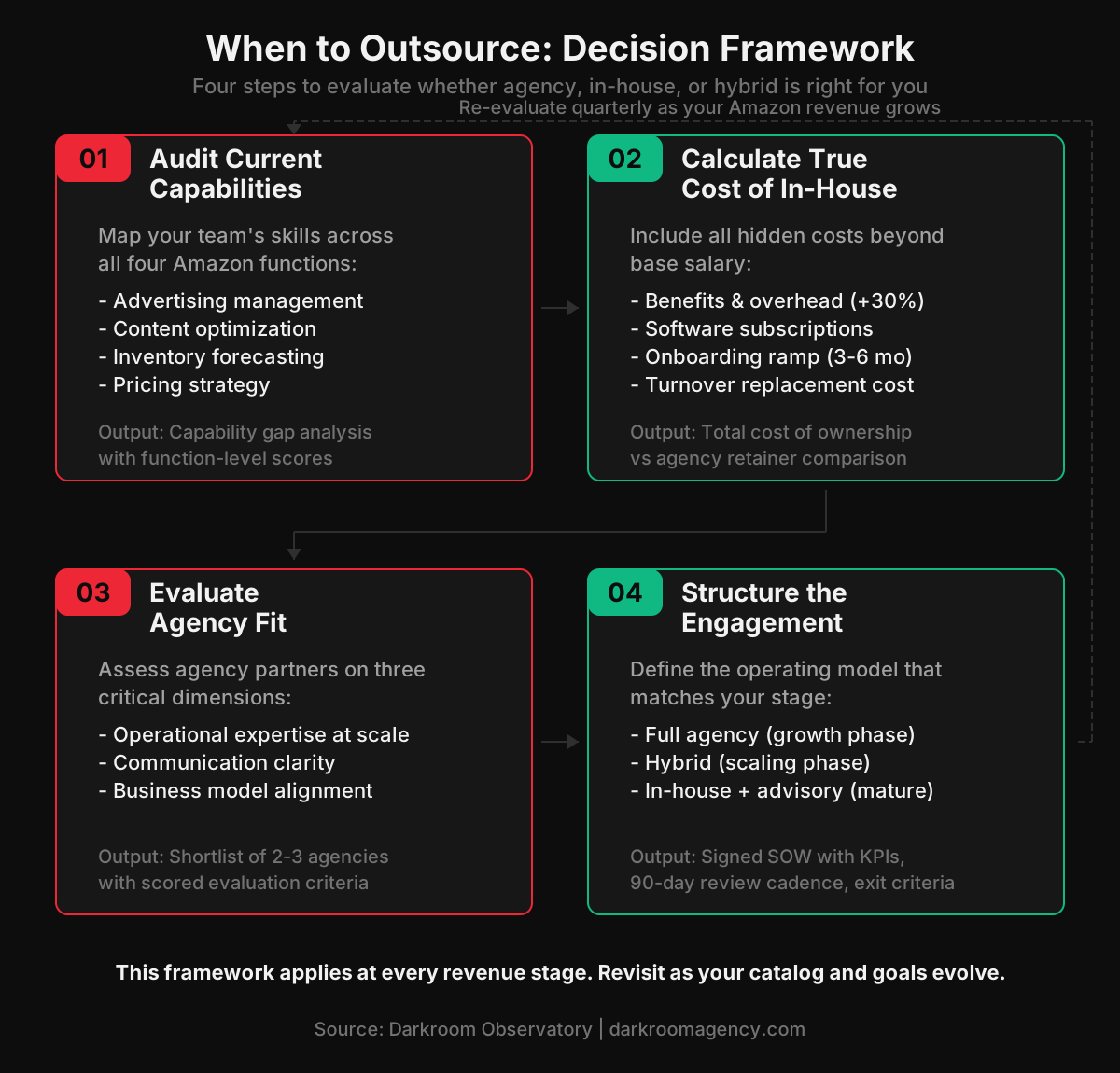
A fully loaded in-house Amazon manager at $100K salary costs approximately $130K when accounting for benefits, payroll taxes, and overhead. Add software subscriptions (analytics tools, repricing platforms, inventory management, bid management tools), and the total approaches $145K-$160K annually.
Many brands also discover they need contractor support during peak seasons, leave coverage, or specialized projects. Add another $10K-$20K for fractional support. The Bureau of Labor Statistics data on marketing manager compensation confirms that total employer costs typically exceed base salary by 30-40%.
An agency managing the same account might cost $150K-$200K annually, depending on ad spend and scope. The difference appears significant until you factor in what the in-house manager actually delivered.
If the in-house manager operates at 60% efficiency (typical for someone splitting focus or learning on the job), they deliver $100K-$120K in value against $160K in cost. A properly resourced agency at 85% efficiency delivers $160K-$190K in value against $180K-$200K in cost. The value gap narrows or inverts.
Additional hidden costs of in-house management include onboarding time (3-6 months before they are productive), training investment, opportunity cost of management overhead, and lost institutional knowledge when turnover occurs. For a 3-year tenure, turnover alone can reduce effective output by 15-20% because of discontinuity.
This is not an argument against in-house hiring. It is a call to be honest about total cost of ownership and expected output. Most brands underestimate the cost and overestimate the efficiency gain from hiring in-house.
The Hybrid Model: Combining In-House and Agency
The best structure for many growing brands is hybrid: one in-house manager handling advertising and day-to-day optimization, supported by external specialists for strategy, content, and quarterly reviews.
In this model, the in-house role is narrowed. Instead of owning everything, the manager owns advertising platform management, weekly bid optimization, budget allocation between campaigns, and competitive monitoring. This is 60-70% of their time and plays to the strengths of most hiring pools. You can find a strong candidate for this role because it is specific and measurable.
External support handles content strategy and A+ page optimization (typically 10-15 hours per month from a freelancer or small team), quarterly strategy reviews with recommendations, and specialized projects (new category launches, competitive analysis, pricing strategy). This costs $3K-$7K monthly, far less than a second full-time hire. Brands that layer in performance creative alongside Amazon management often see compounding returns on content investment.
Inventory and pricing often remain with operations or supply chain. These teams understand the business dynamics that inform these decisions.
Hybrid structures work well at the $1M-$5M Amazon revenue stage because they allow you to hire one strong specialist without overloading them, while filling expertise gaps with external support. They also reduce turnover risk because the in-house role is not constantly in crisis mode from being understaffed. Pairing Amazon efforts with a strong retention marketing program ensures that customers acquired through Amazon become repeat buyers across channels.
The key to making hybrid work is clear role definition and communication. If boundaries are fuzzy, you create coordination overhead that defeats the purpose. If the in-house manager is defensive about external input, the collaboration fails. Most successful hybrid structures work because the in-house manager sees external support as help rather than threat.
How to Evaluate an Agency Partner
If you decide to work with an agency, evaluation should focus on three areas: operational expertise, communication clarity, and alignment with your business model.
Operational expertise means the agency has managed accounts at your revenue scale and catalog complexity. They have experience with your product category or adjacent categories. They can articulate a point of view on Amazon strategy that aligns with yours. If they promise guaranteed results or do not ask about your supply chain constraints, business model, or long-term strategy, they lack operational grounding.
Communication clarity means they provide monthly reports that map to your business metrics (revenue, margin, market share), not just platform metrics (ACoS, impressions, keyword velocity). They should explain decisions in 20 minutes. If their updates take an hour to parse, you do not understand their strategy.
Alignment with your business model matters because Amazon success depends on your supply chain, pricing strategy, and competitive positioning. An agency that understands your gross margin, your brand positioning, and your growth constraints will make better decisions than one optimizing for a generic KPI.
Many brands choose agencies based on reputation or price. The best choice is based on whether the agency operates the way your business operates. If your company makes decisions with input from multiple stakeholders (product, supply chain, finance), you need an agency that knows how to navigate that. If your company moves fast and commits fully to channels, you need an agency that moves at the same speed.
Frequently Asked Questions
At what revenue level should I hire an in-house Amazon manager instead of using an agency?
The typical threshold is $1M-$1.5M in annual Amazon revenue. Below this level, operational volume often does not justify a full-time hire. Above it, you can build a focused role that does not overwhelm one person. However, catalog complexity matters more than revenue. A multi-category seller with 500+ SKUs might need in-house talent at $750K in revenue. A single-category seller might not need in-house support until $3M in revenue.
What happens if we hire an Amazon manager and they leave after a year?
You lose continuity for 6-12 weeks while onboarding a replacement. During that window, Amazon performance typically declines because the new person is learning your account structure, competitive landscape, and business constraints. This turnover cost is often $30K-$50K in lost efficiency and profit. Agencies experience turnover too, but built-in team redundancy limits continuity loss.
Can a general e-commerce manager also handle Amazon, or does it require a specialist?
A general e-commerce manager can own Amazon if it represents less than 30% of your overall e-commerce revenue and you have support for other channels. If Amazon is 50%+ of revenue, you need someone with Amazon-specific expertise. The platform has unique mechanics (A+ pages, sponsored ads formats, ranking algorithms) that require focus to operate effectively.
How much should I budget for external support if I hire an in-house manager?
Most hybrid models allocate $3K-$7K monthly for external support covering strategy, content optimization, quarterly reviews, and specialized projects. This typically represents 10-15% of the in-house salary and delivers significant value by preventing the in-house role from becoming bottlenecked.
Is it cheaper to hire an in-house manager or work with an agency?
Direct cost comparison often favors in-house (in-house is typically 20-30% cheaper on salary alone), but total cost of ownership often favors agencies because of uncertainty in in-house execution quality, turnover, and training ramp time. The real question is not cost, but value delivered relative to cost. A skilled in-house manager at 85% efficiency can be more cost-effective than an average agency. An underperforming in-house manager is the most expensive option of all.
How do I know if my current Amazon performance is bottlenecked by the team or by structural constraints?
If your advertising ACoS is static for three months, your organic rank is declining, and you have not launched new products in that period, the bottleneck is likely operational. If your margin is being compressed by competitive pricing, you cannot secure supply at the volume you want, or your category has structural oversupply, the bottleneck is structural. You can improve the first with better talent or operational density. The second requires different business decisions.
What questions should I ask an agency before hiring them?
Ask them to describe a recent account they managed through a launch or competitive challenge. Ask how they structure their team. Ask for examples of their monthly reporting. Ask how they balance short-term metric optimization with long-term brand building. Ask how they communicate with cross-functional teams on client side. Their answers will reveal whether they operate with strategic clarity or metric obsession.
Make the Right Operational Decision for Your Amazon Business The agency versus in-house decision is a structural choice that shapes how fast you can move, how well you can respond to competitive changes, and ultimately, your profitability on Amazon. Most brands decide this based on cost without understanding the operational tradeoffs. Book a call with Darkroom.