SOCIAL COMMERCE
The 10 Best Paid Social Agencies in 2026 for Enterprise and CPG Brands



Written by Darkroom leardership
7 min read
September 16, 2026

A paid social agency plans, buys, and produces advertising on Meta, TikTok, Amazon, and similar platforms, where the ad is the storefront rather than a route to one. For enterprise and CPG brands, the right one depends on your constraint: creative output, platform depth, evidence, or launch capability.
This guide ranks ten agencies on four things: creative output, platform depth, the proof they publish, and whether they disclose cost. You get a comparison table and a full entry on each, covering strengths and shortfalls, engagement costs, and which agencies can support a launch.
Key takeaways
The main limitation is creative output, not media buying. Since only about one in fifty ad variations succeeds, agencies need to produce many options to find what works.
How agencies measure results is the key difference. Some report reach and impressions, while others focus on ROAS, CPA, and lift. If you need to justify your budget with a measurement plan, this is more important than the agency’s brand.
True launch capability is less common than it seems. Only one agency in this group provides a documented market entry with specific numbers.
How we chose these agencies
We use one inclusion rule and four criteria, based only on published material. We do not consider directories, self-reported awards, or vendor badges.
An agency qualifies if it lists paid social as a named service and either appears in live US search results or works with enterprise and CPG brands at a scale that a $1M-plus annual advertiser would recognize.
The first criterion is creative production capacity. AppsFlyer looked at 1.1 million creative variations across 1,300 apps from Q1 2024 to Q1 2025 and found that the top 2% of creatives account for 43% of non-gaming ad spend. Their earlier State of Ad Creatives report showed about one winner for every fifty tested.
High volume is not just for show; it helps you find what works. Non-gaming top spenders tested an average of 2,365 variations per quarter, which is an 18% increase year over year.
The second criterion is platform depth. Meta’s Q2 2026 results show the average price per ad rose 12% year over year. When your main platform gets more expensive, you need alternatives. For CPG brands, this often means turning to retail media and CTV.
The third criterion is evidence quality. It’s not just about whether an agency shares numbers, but what kind. Attention metrics and performance data are not the same, and only performance data stands up to a CFO’s review.
How we ordered them: creative capacity first, then platform depth, with evidence quality and pricing as tiebreakers.
Read also: What a Performance Creative Agency Actually Does (And How to Pick One)
Agency | Best for | Creative model | Published proof |
|---|---|---|---|
Darkroom | CPG and consumer brands needing creative volume and marketplace breadth | In-house, 250 to 600 assets per cycle | ROAS and revenue lift, clients named |
VaynerMedia | Blue-chip CPG needing brand weight at social scale | In-house studios, 200+ production staff | Reach and impressions, clients named |
Wpromote | Enterprise teams that defend spend with performance math | In-house, end-to-end production | Purchase lift and ROAS, clients named |
inBeat | Creator-led performance creative at volume | In-house, 300+ assets monthly | ROAS and CPA, one account |
NoGood | Growth-stage enterprise needing the widest platform set | Four in-house studios | Percentages, no metric stated |
Sociallyin | Enterprise brands wanting an owned production studio | In-house production studio | Spend to revenue, client named |
The Social Shepherd | Global consumer brands growing through social creative | In-house, lo-fi to high production | None client-attributed |
Power Digital | Paid social consolidated with Amazon and retail media | In-house design | None client-attributed |
Nest Commerce | UK and EU retail already spending at scale | In-house, UGC from a creator network | Growth multiple, client named |
Directive Consulting | B2B and enterprise SaaS on LinkedIn | In-house, no external approvals | Lead growth, client named |
1. Darkroom

Overview
Darkroom is a New York growth agency with offices also in Los Angeles, running paid social alongside paid search, programmatic, retail media, and marketplaces. Media and creative sit in one team that publishes 250 to 600 production-ready assets per cycle. That produced 3x ROAS on Olipop and a 118% revenue lift on Nécessaire.
The CPG bench is Olipop, Gorgie, Sauz and Bero; the enterprise bench is Crate & Barrel, Everlane and Anne Klein. Meta, Google, TikTok, AppLovin, Amazon and Walmart run through one paid media agency.
Best for
CPG brands where creative volume is the bottleneck
Enterprise teams running paid social and marketplaces on one P&L
Brands launching into new categories
When to choose Darkroom
Choose Darkroom when your creative pipeline cannot feed your spend and paid social sits beside marketplaces on one P&L.
2. VaynerMedia
Overview
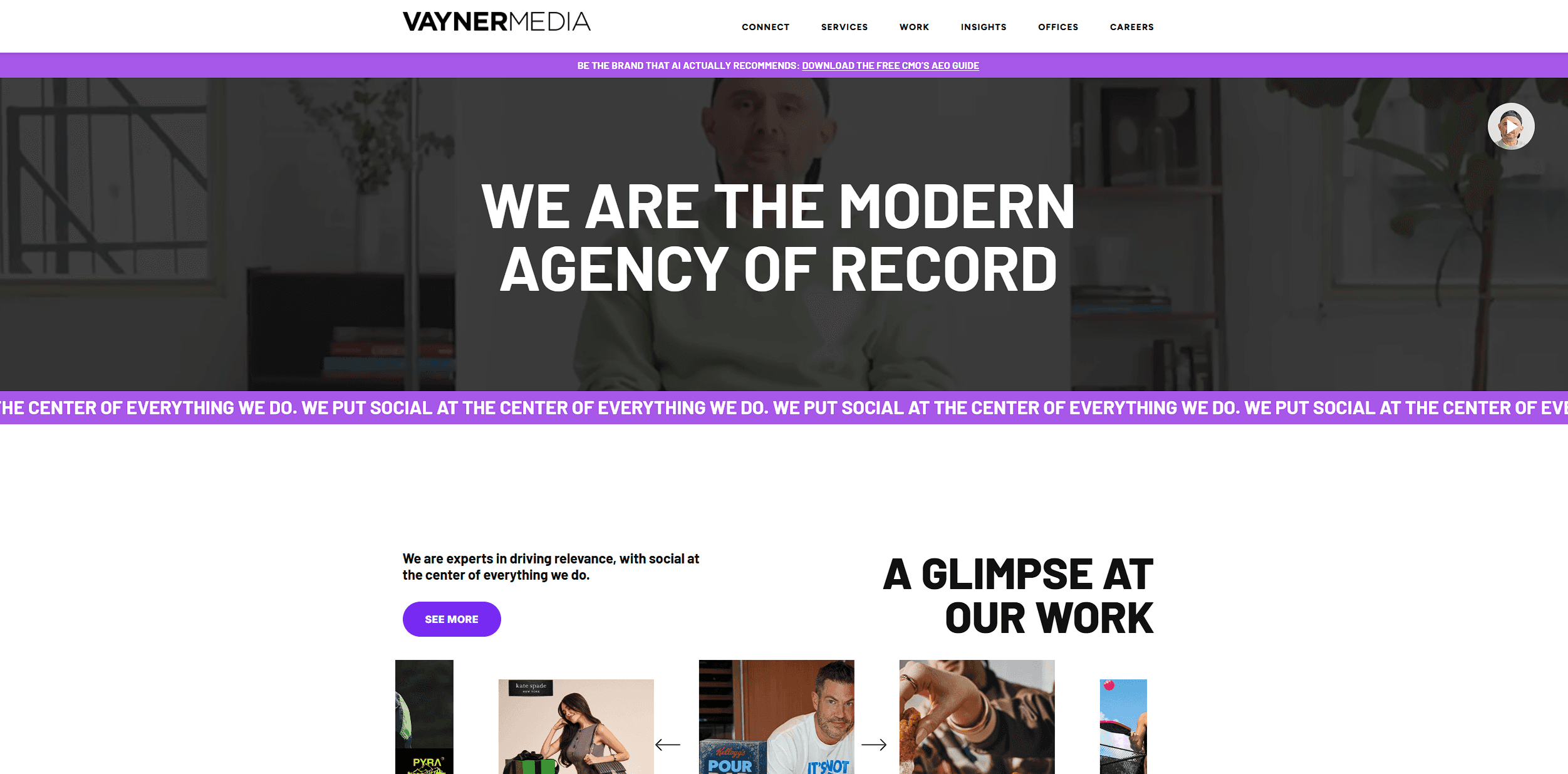
VaynerMedia calls itself "The Modern Agency of Record" and has the deepest blue-chip CPG roster here: PepsiCo, Mondelēz, Anheuser-Busch, Diageo, Duracell and Ocean Spray, plus Bose and NatWest.
Creative is in-house at scale, with over 200 writers, designers, photographers and editors. Coverage runs from Meta and TikTok through Reddit, Snap and Pinterest to Amazon, Walmart Connect and The Trade Desk. On MUG Root Beer, it published "+1B social impressions and +500K social followers in the first quarter."
Best for
Blue-chip CPG needing category-scale brand weight
Enterprise AOR relationships across multiple markets
Launches that need cultural reach fast
When to choose VaynerMedia
Choose VaynerMedia when brand weight is the mandate and reach is the metric your organization rewards.
3. Wpromote
Overview
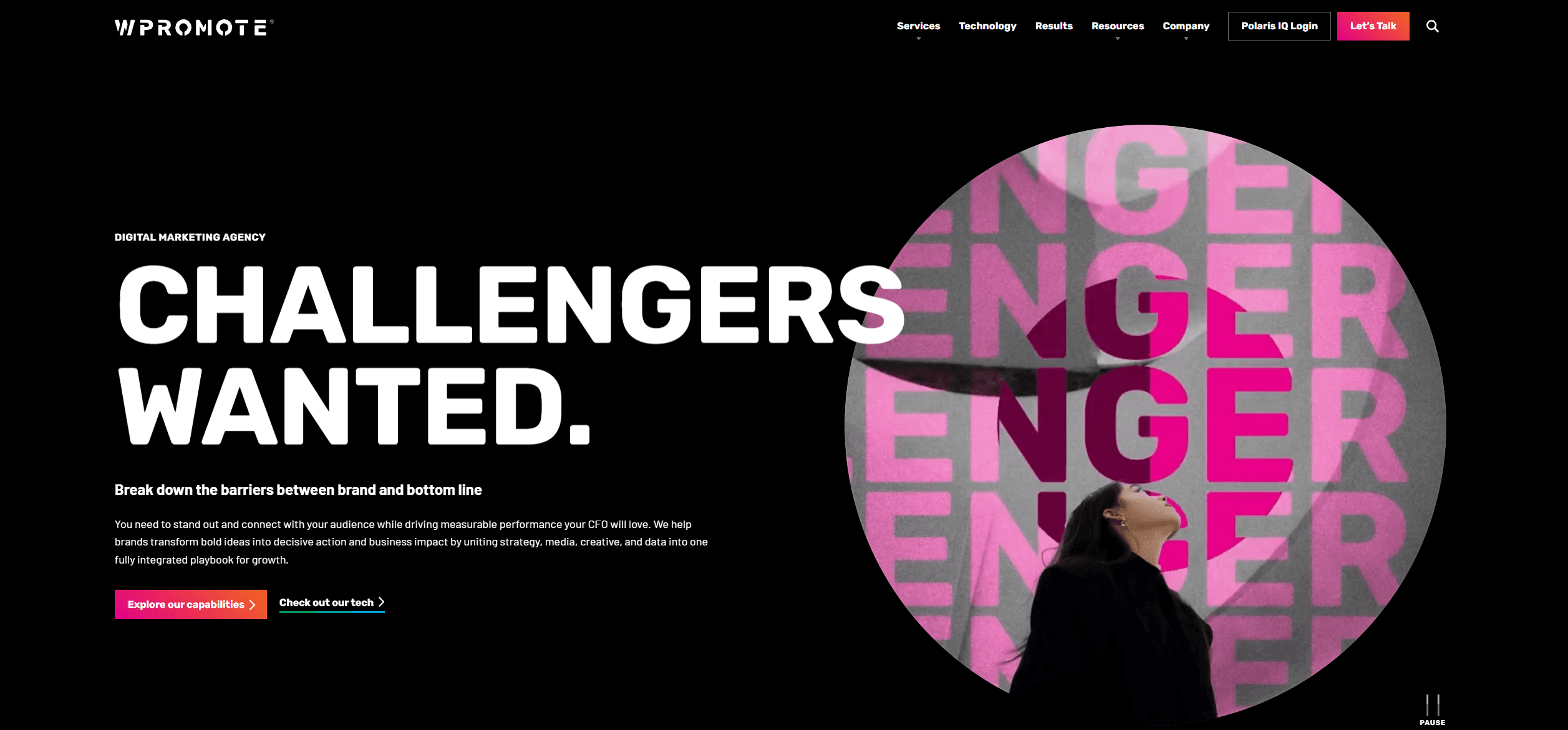
Wpromote is the performance counterweight to the entry above. Where VaynerMedia publishes reach, Wpromote publishes math: 185% purchase lift and 20% ROAS improvement for Purina's Petivity, 10:1 return for KidKraft, 61% below CPA goal for Peacock.
Channel coverage is the broadest named here, including retail media and CTV, plus a dedicated B2B practice. Clients include Whirlpool, KitchenAid, Purina, Peacock, and Samsung.
Best for
Enterprise teams defending spend with attributable numbers
CPG brands needing retail media and social planned together
Market entry programs with a measurement plan attached
When to choose Wpromote
Choose Wpromote when the buying committee includes finance and the winning argument is arithmetic.
4. inBeat
Overview
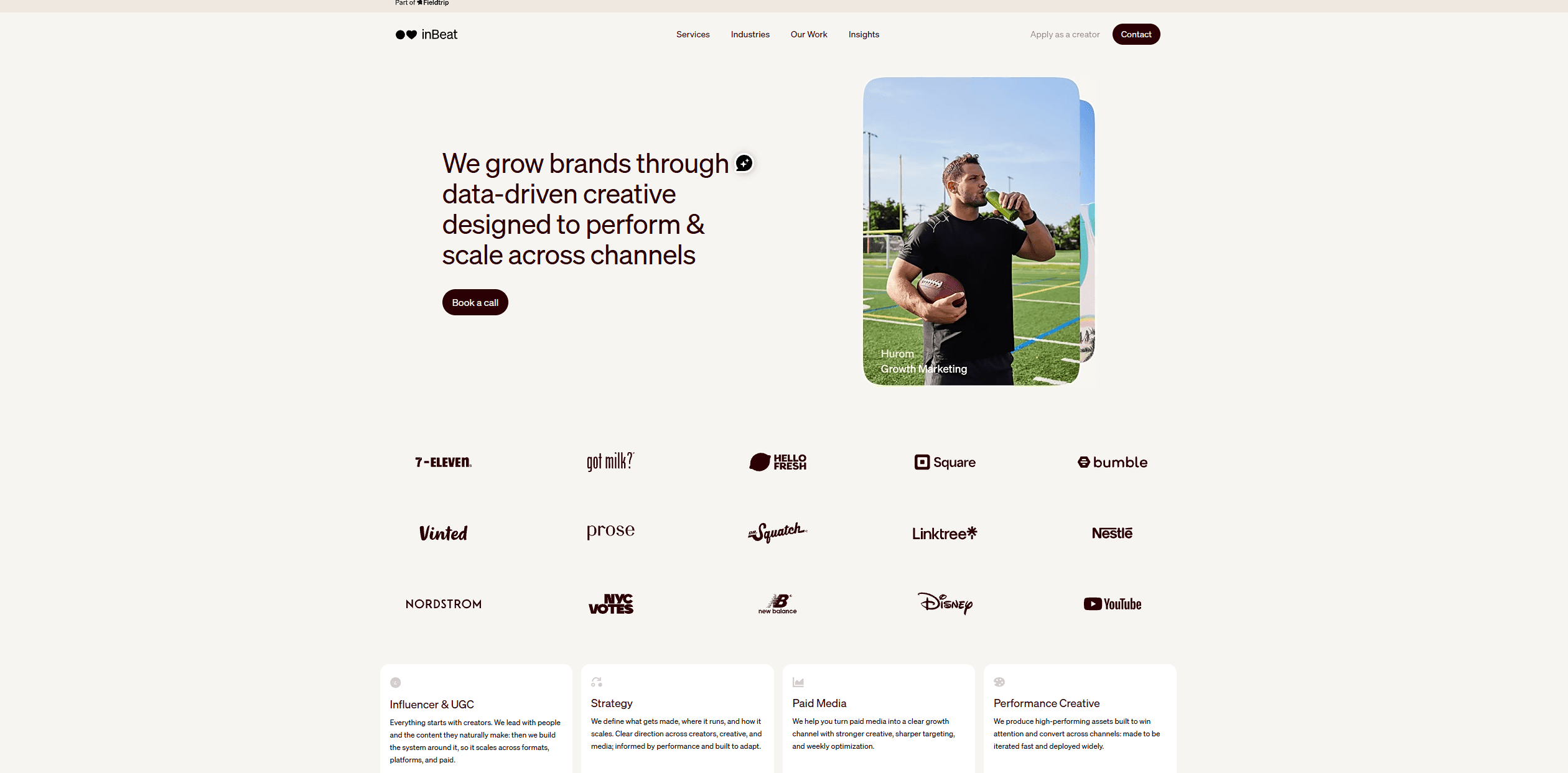
inBeat is a Montréal agency built on creator-led performance creative, and it publishes the number that matters: 300+ assets shipped per month. It runs Meta, TikTok, LinkedIn, Snapchat, Pinterest, Google Ads, and CTV, and operates its own creator funnel.
Nestlé, HelloFresh, New Balance, and Dr Squatch are named on its site. Its headline result is a 300% ROAS increase for Hurom, with a 65% CPA reduction on the same account.
Best for
CPG and consumer brands where UGC is the primary format
Enterprise teams needing creator content without a studio
Advertisers moving budget between Meta, TikTok, and Snapchat
When to choose inBeat
Choose inBeat when creator content is your format, and you need it produced continuously, not in bursts.
5. NoGood
Overview
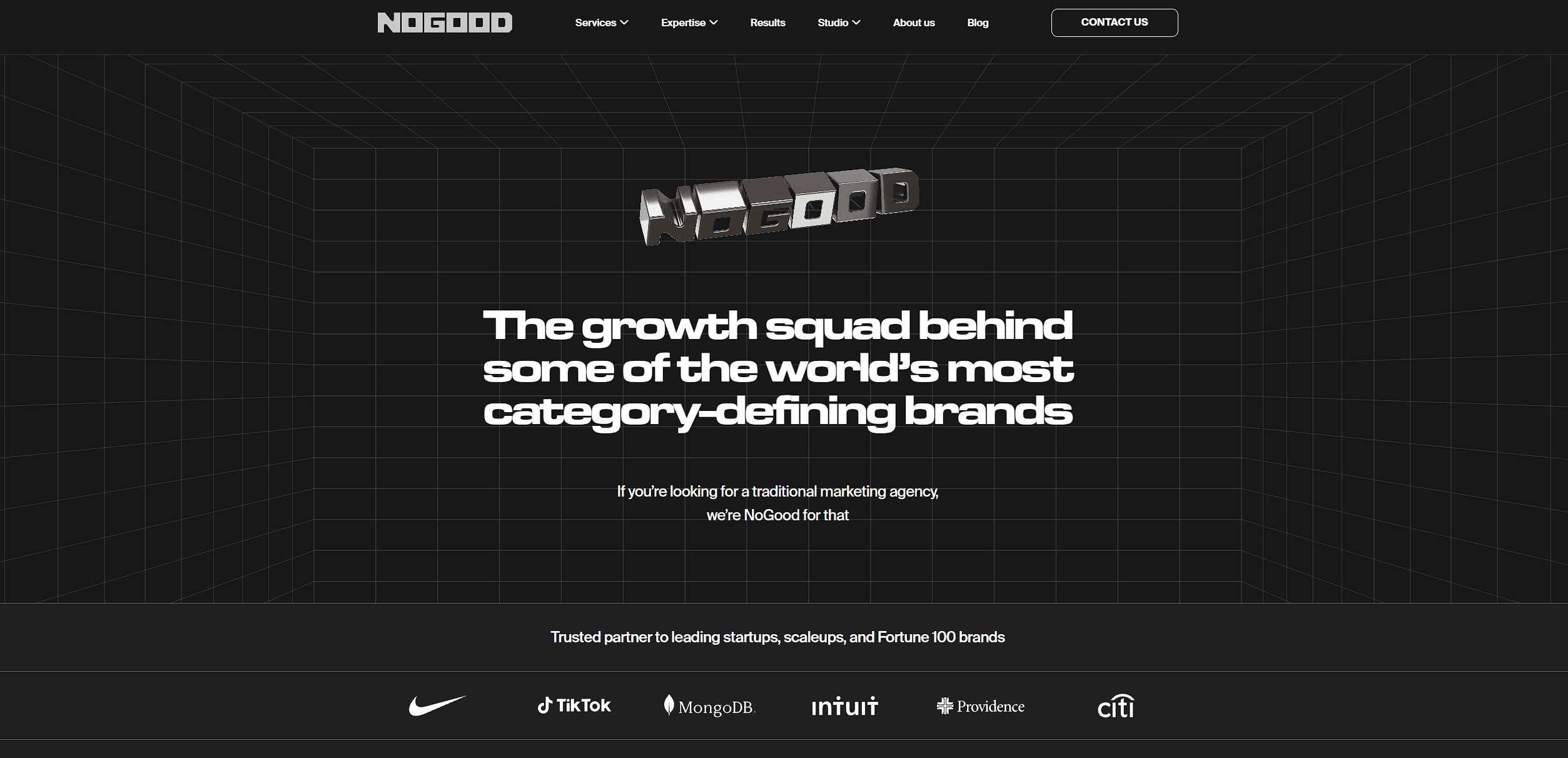
NoGood is a New York growth team with offices in Miami and Dubai, and it names more platforms than anyone here: TikTok, Instagram, Meta, Reddit, LinkedIn, Snapchat, X, YouTube, Pinterest, Spotify, Google and Amazon. Creative is productized into four in-house studios.
Clients include Nike, Citi, Intuit and MongoDB. It is also one of three here publishing a threshold: average retainer above $20,000 a month.
Best for
Growth-stage enterprise brands in SaaS, fintech, and health
Advertisers needing to test channels beyond Meta and TikTok quickly
Teams wanting creative and media from one group
When to choose NoGood
Choose NoGood when platform diversification is the priority and your model looks more like software than shelf.
6. Sociallyin
Overview
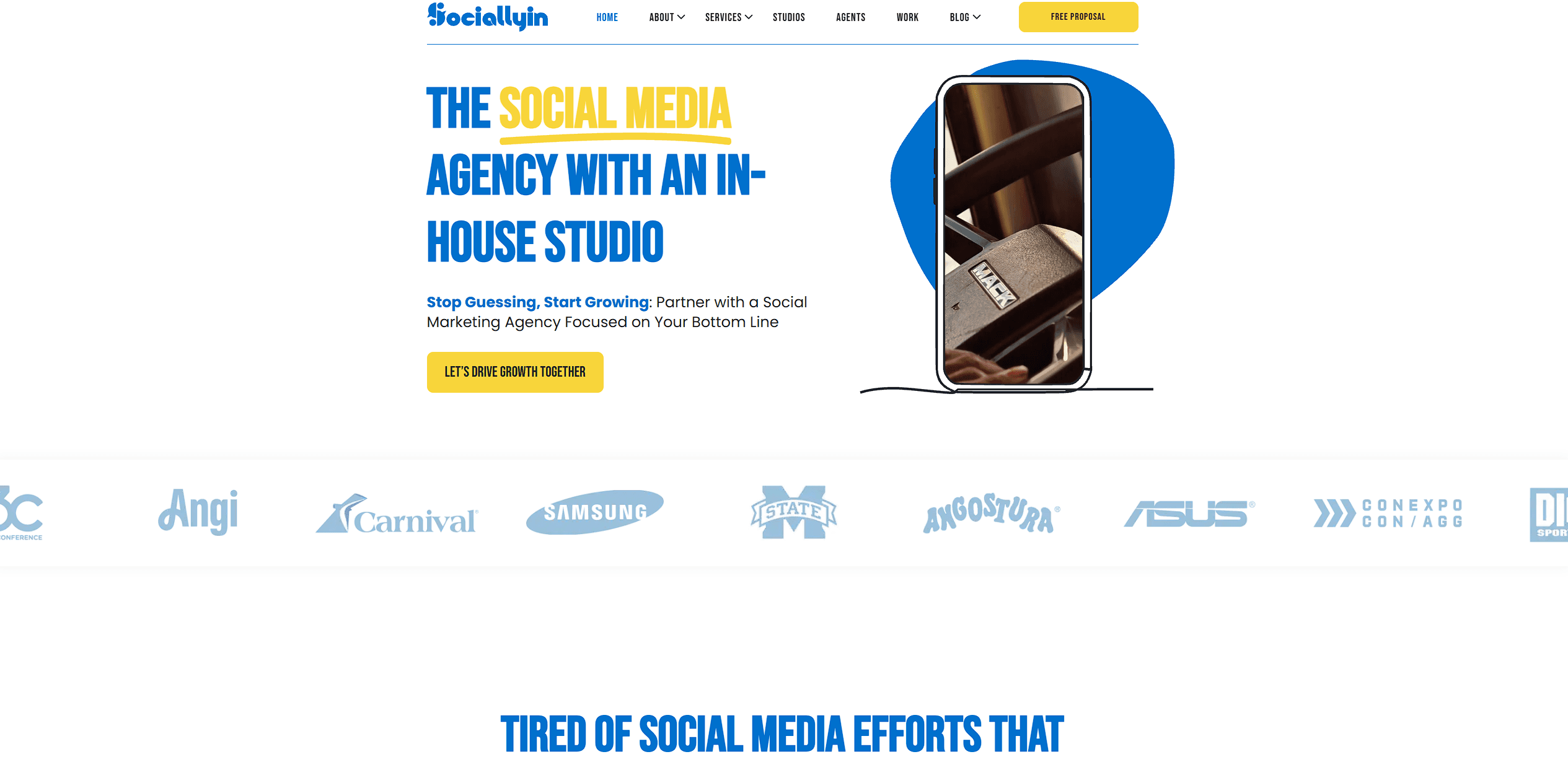
Sociallyin is an Atlanta agency leading with a claim almost nobody else makes: "The Social Media Agency With an In-House Studio." Sociallyin Studios is a named production facility, which is a stronger commitment than a creative team on an org chart.
Coverage includes a dedicated Reddit practice. Enterprise clients include Samsung, Carnival, and Marriott. Its clearest paid result: $22,742 in holiday spend turned into $178,171 for Bear Paw.
Best for
Enterprise brands wanting production owned rather than subcontracted
Advertisers needing Reddit or Snapchat alongside Meta and TikTok
Organizations running organic and paid under one vendor
When to choose Sociallyin
Choose Sociallyin when you want organic and paid from one team with a real studio behind both.
7. The Social Shepherd
Overview
The Social Shepherd is a Bath agency with offices in London, New York, and Miami, social-first by design. Creative runs lo-fi through high production in-house, with UGC creators on top, and TikTok Shop is a distinct service rather than a footnote.
The named roster is the strongest signal here: UNIQLO, ASICS, Lavazza and Hasbro.
Best for
Global consumer brands growing through social creative
CPG brands building TikTok Shop alongside paid social
Teams wanting production and media in one place
When to choose The Social Shepherd
Choose The Social Shepherd when creative quality decides it and you will do the diligence their site does not.
8. Power Digital

Overview
Power Digital is a San Diego agency with offices in New York, Atlanta and Medellín, and the broadest full-service option here. Paid social sits beside SEO, PR, lifecycle, Amazon and programmatic. Creative is in-house: its paid social page states it will design all the social ad creative for your brand.
Clients include Crocs, ASICS, Alice + Olivia and Aviator Nation.
Best for
Enterprise brands wanting paid social and Amazon under one roof
Consumer retail at scale needing channels coordinated
Organizations consolidating vendors into one contract
When to choose Power Digital
Choose Power Digital when vendor consolidation matters more than paid social specialization.
9. Nest Commerce
Overview
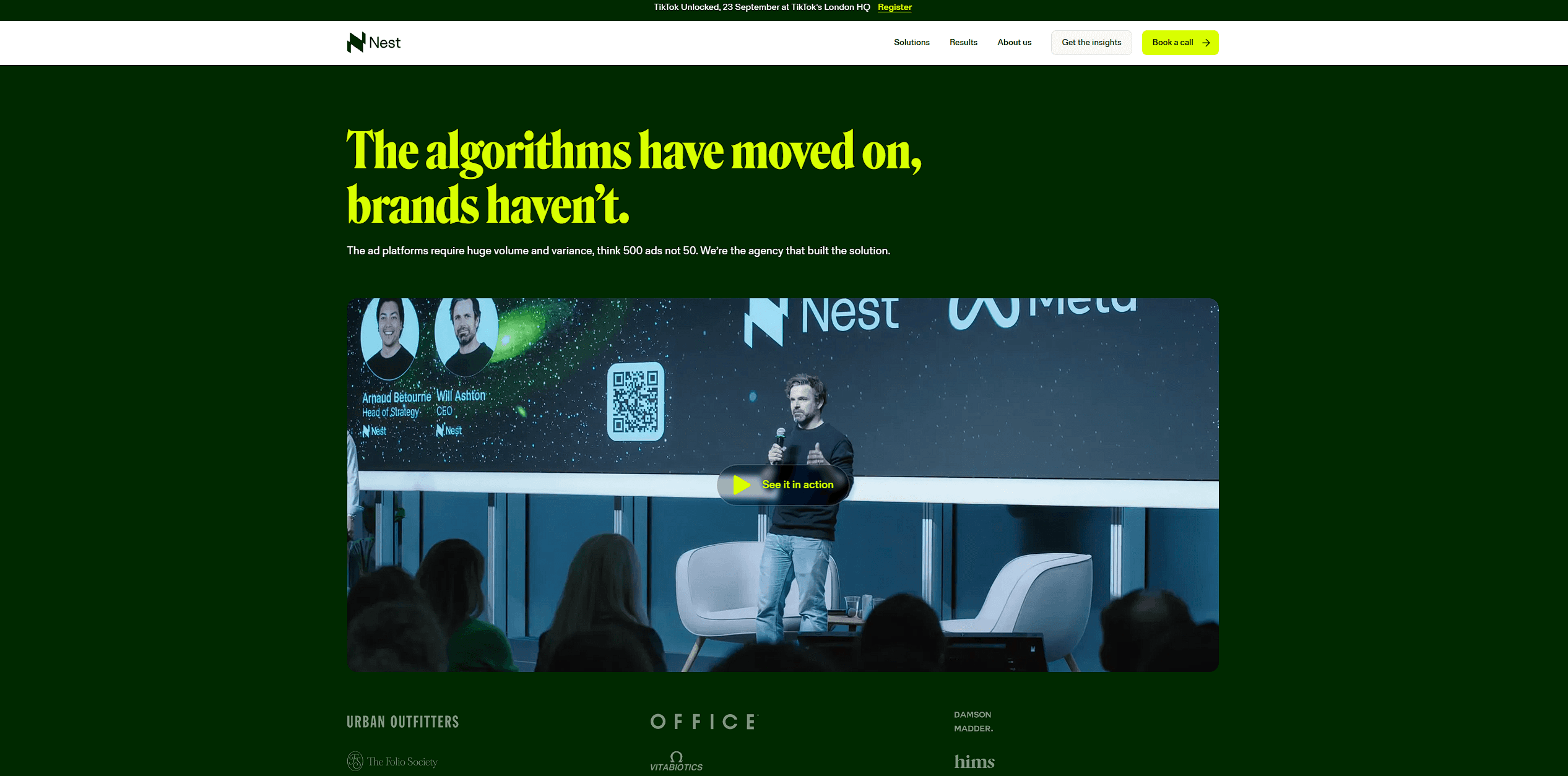
Nest Commerce is a London agency focused tightly on ecommerce, and one of three publishing a qualifying threshold: £75k or more in monthly spend. That line does more buyer qualification than most agency sites manage.
Creative strategy and production are in-house, with UGC from an opted-in creator network. Clients include Urban Outfitters, Hims, and Crew Clothing Company. It reports 3.9x UK growth for Hims.
Best for
UK and EU retail brands already spending at scale
Advertisers concentrated on Meta and TikTok who want depth over breadth
Teams valuing a stated spend threshold before a sales call
When to choose Nest Commerce
Choose Nest Commerce when you are a UK or EU retail brand spending heavily on Meta and TikTok and want specialists rather than a range.
10. Directive Consulting

Overview
Directive Consulting is an Irvine agency working exclusively in B2B and SaaS, included because it is the best answer for a specific enterprise buyer. LinkedIn is the primary channel, with Meta, X, YouTube, and Reddit around it. Creative is in-house, handling development, testing, and iteration without external approvals.
Clients include Amazon, Adobe, Cisco and Gong. It reports a 251% increase in digital leads for SentinelOne.
Best for
Enterprise SaaS advertisers whose channel is LinkedIn
Technology companies measuring pipeline rather than ROAS
B2B teams running account-based paid social
When to choose Directive Consulting
Choose Directive when you sell software to enterprises, and LinkedIn is where your pipeline comes from.
What does a paid social agency actually do?
A paid social agency does four things: plans and buys media across social platforms, produces the creative that runs in it, measures what platforms report against what happened, and moves budget between channels.
Here is the part most enterprise buyers get wrong. Agencies differ enormously on the second and barely at all on the first, because platforms automate structure and bidding. What hasn't converged is how many assets a team ships, who makes them, and how fast they go live.
Read also: What Social Media Marketing Services Actually Include in 2026
What should you look for in a social media advertising agency?
Ask four questions and treat the answers as disqualifying rather than informative.
"How many production-ready assets do you ship per cycle, and who makes them?" A specific number means they measure it. A vague answer about a talented team means they do not. You're buying a production system, not a campaign.
"Which platforms have you run in the last ninety days?" Not which logos are on the website. Which have live spend. The gap is usually wide.
"Show me a result attributed to a named client, with the metric and window." Two agencies here cannot. When they can, check the currency: impressions and ROAS are not interchangeable in a budget review.
"What does this cost, or what does it require?" An agency that cannot answer in a first call will not get clearer.
Which platforms should your agency actually be running?
Meta and TikTok are now the basics. The real question is what comes next when competition increases, and Meta's filings make this clear.
For consumer packaged goods, the focus is shifting more toward retail media and connected TV, not just adding another social platform. If your products are sold both in stores and online, use that as your guide.
TikTok needs focused expertise, not just a mention on a list of services. If TikTok is your main channel, picking a TikTok agency should be a different process than hiring one for Facebook ads.
Build the production line before you pick the media plan
Most agency searches start with the media plan. They should start with the creative pipeline, because that is where outcomes are decided, and a media plan is the easier half to fix later.
Darkroom is a paid media agency built around that order. Creative and media sit in one team, outputting 250 to 600 production-ready assets per cycle, and Shadow, our AI commerce layer, connects what runs to what it earns.
If your creative pipeline cannot feed your spend, talk to our paid media team.
Frequently asked questions
What is the best paid social agency for enterprise brands in 2026?
There is no single best one. Darkroom, VaynerMedia, and Wpromote lead for enterprise and CPG, but solve different problems. VaynerMedia brings brand weight and cultural reach, Wpromote brings attributable performance math, and Darkroom brings creative volume with marketplace breadth attached.
What does a paid social agency do?
It plans and buys advertising across social platforms, produces the creative for those placements, measures reported performance against actual business results, and allocates budget between channels. Agencies differ most in creative production capacity and least in media buying mechanics, the opposite of how most buyers evaluate them.
How much does a paid social agency cost?
Fees follow three models: a percentage of ad spend, a flat retainer, or a hybrid. Only three of the ten publish a financial threshold. NoGood states an average retainer above $20,000 monthly, Nest Commerce requires £75k monthly spend, and Wpromote's budget bands start at $5M annually.
Which paid social agency is best for CPG brands?
It depends on which currency your organization rewards. VaynerMedia has the deepest blue-chip CPG roster, including PepsiCo, Mondelēz, and Diageo, but publishes reach rather than return. Wpromote publishes purchase lift and ROAS on Purina. Darkroom pairs CPG creative volume with retail and marketplace coverage.
What is the difference between a paid social agency and a social media agency?
Paid versus organic is the surface answer. The real difference is accountability: a paid social agency answers to a cost per outcome such as CPA or ROAS, while a social media agency answers to reach and engagement. Some firms do both, but their reporting standards aren't interchangeable.
How many ad creatives does a paid social agency need to produce?
Enough to find the winners, which is more than most teams expect. AppsFlyer's study of 1.1 million creative variations found the top 2% take 43% of non-gaming ad spend, with roughly one winner per fifty tested. Non-gaming high spenders averaged 2,365 variations per quarter.