PERFORMANCE CREATIVE
What a Performance Creative Agency Actually Does (And How to Pick One)




Written by Darkroom leardership

Written & peer reviewed by 4 Darkroom team members
TL;DR: Performance creative is not graphic design for ads. It is a growth discipline where every asset is built to convert, tested against real data, and iterated at velocity. Most brands hire creative agencies that produce beautiful work that does not perform. Performance creative agencies operate differently: they build systems around volume testing, modular production, and platform-specific iteration that turn creative into a measurable growth lever. This article defines the discipline, explains the operational system behind it, provides a framework for evaluating agencies at every tier (freelancer, boutique, full-stack), and breaks down the KPIs that actually matter by channel. If you are evaluating partners, bookmark this before your next call. Darkroom is a full-stack growth agency where creative and media buying operate under one roof.
What Performance Creative Actually Means (And What It Does Not)
Performance creative is ad creative produced with a single objective: measurable business outcomes. Not brand awareness. Not design awards. Not social engagement metrics that look good in a deck but do not move revenue.
A performance creative agency produces static images, video ads, UGC-style content, and motion graphics designed from the first frame to drive specific actions: purchases, sign-ups, add-to-carts. Every element is informed by platform data and optimized through structured testing.
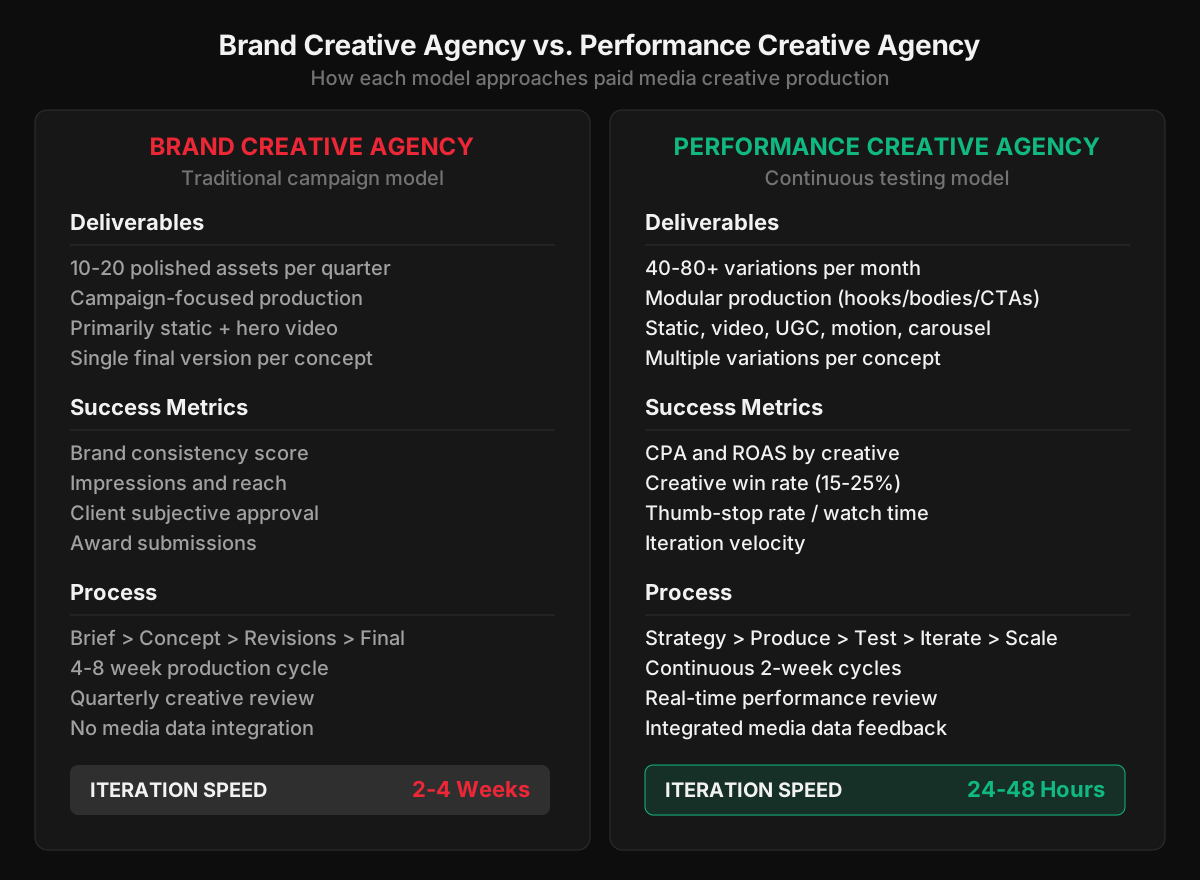
This is an operational distinction. A traditional creative agency briefs a project, produces a campaign, delivers final assets, and moves on. A performance creative agency operates in continuous cycles: produce, test, analyze, iterate on winners, kill losers, produce the next batch. The output is not a campaign. It is a testing pipeline.
According to Nielsen's research on advertising effectiveness, creative quality drives 47 to 56 percent of sales lift from advertising. Media placement drives 4 to 8 percent. Yet most brands spend 80 percent of their optimization energy on the media side. Performance creative flips that equation.
Why Brand Creative Agencies Fail at Paid Media
Brand creative agencies are good at what they do: visual identity systems, campaign imagery, and organic touchpoint assets. The problem is that paid media is a fundamentally different environment. Your creative competes for attention inside a feed full of content the user actually chose to see. You have 1 to 3 seconds to earn a thumb-stop. Zero brand context.
Brand agencies are not built for this. Their production timelines are too long (4 to 8 weeks). Their volume is too low (10 to 20 assets per quarter). Their feedback loops are too slow (quarterly subjective reviews). And their success metrics are disconnected from revenue.
The result is predictable. A brand spends $15,000 to $30,000 on a beautifully produced campaign, launches it across paid media channels, watches ROAS decline within two weeks as creative fatigue sets in, and has no fresh creative in the pipeline. The media team stretches the same assets. Performance degrades. The brand blames the media buyer. The real problem was creative velocity.
A 2025 AppsFlyer report on creative optimization found that ad performance drops 15 to 20 percent within the first two weeks of launch. By week three, decay accelerates. This means your creative production speed directly determines your ability to maintain ROAS. If you cannot produce faster than your ads decay, you are losing ground.
This is the operational gap that performance creative agencies fill.
The Performance Creative System: How It Actually Works
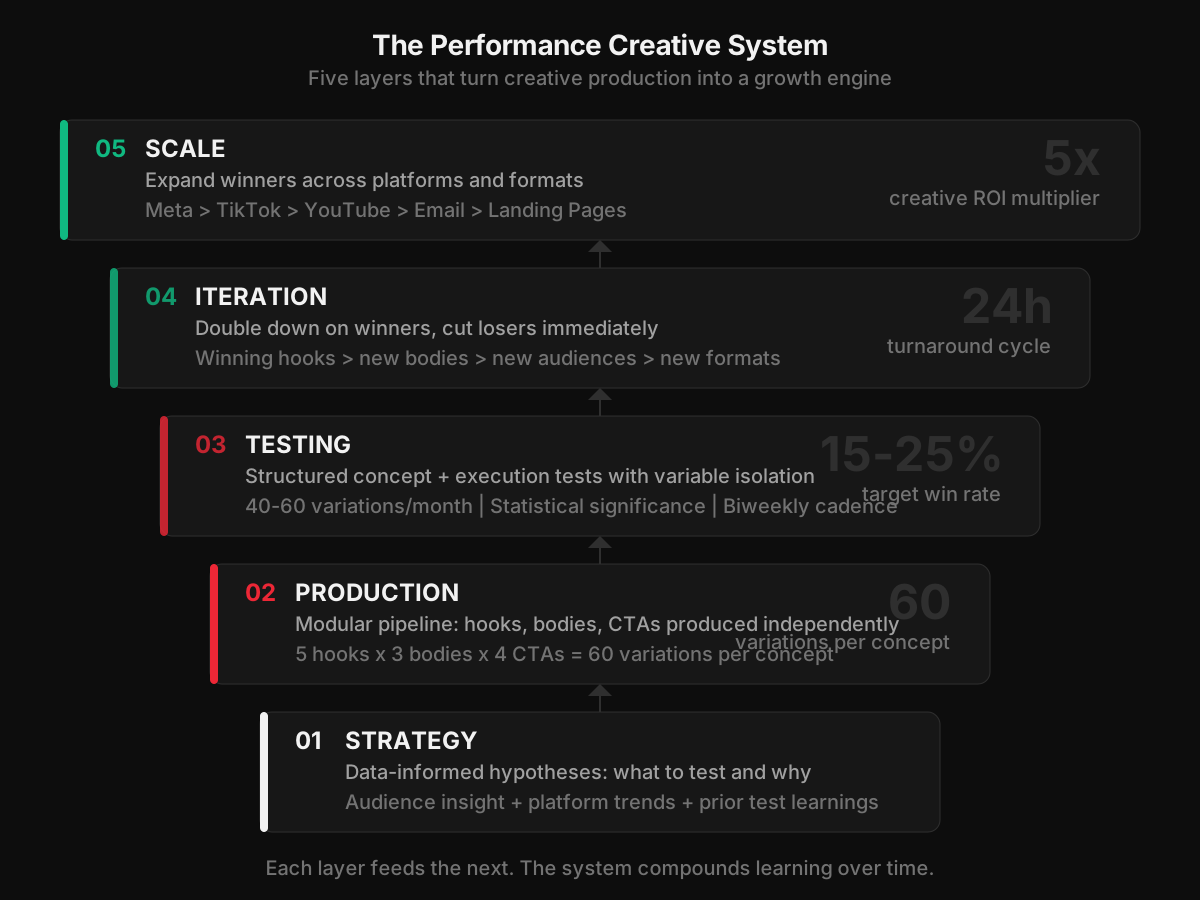
Performance creative is not about hiring better designers. It is about building a better system. The brands that win at paid creative have five interlocking components operating simultaneously: strategy, production, testing, iteration, and scale.
1. Strategy: What to Make and Why. Strategy in performance creative is not a mood board. It is a data-informed hypothesis about what message, format, and angle will resonate with a specific audience on a specific platform. A strong performance creative system starts every cycle by answering three questions: what did we learn from the last test, what hypotheses do we test next, and what platform trends are we responding to. This happens every two weeks, not quarterly.
2. Production: Modular, Not Monolithic. Every ad is broken into functional components: hook, body, and CTA. These are produced independently and recombined into dozens of variations. A single concept with 5 hooks, 3 bodies, and 4 CTAs creates 60 unique combinations. Campaign production creates 5 finished ads. System production creates 5 concepts that generate 60 testable variations. The math compounds.
3. Testing: Structured, Not Random. Structured testing isolates variables. It separates concept testing (does the core message resonate) from execution testing (which visual treatment of a proven concept performs best). It runs tests at statistical significance before making decisions. Brands that test 40 to 60 variations per month learn faster than brands that test 10. Faster learning means better unit economics.
4. Iteration: Winners Get Better, Losers Get Cut. When a creative wins, the system doubles down. The winning hook gets paired with new bodies. The winning concept gets produced in new formats. Underperforming creative gets cut immediately. No emotional attachment. The data decides. A good performance creative agency builds a culture where killing creative is celebrated, not resisted.
5. Scale: Expanding What Works Across Channels. A winning Meta ad gets reformatted for TikTok. A high-performing static gets animated into video. A converting UGC script gets reproduced with different creators. The scale layer is where cost per creative drops because you are building on proven concepts rather than starting from scratch.
This five-layer system is what separates a performance creative agency from a creative agency that happens to make ads. The system is the product, not the individual asset.
What Is Included at Each Performance Creative Agency Tier
Not all performance creative agencies are built the same. The market splits into three tiers: freelancers, boutique agencies, and full-stack agencies. Each tier serves a different stage of growth and a different budget.
Capability | Freelancer ($2K-$5K/mo) | Boutique Agency ($5K-$10K/mo) | Full-Stack Agency ($10K-$25K/mo) |
|---|---|---|---|
Monthly creative volume | 10-20 assets | 20-40 assets | 40-80+ assets |
Creative strategy | Minimal or none | Included | Dedicated strategist |
Format types | Static only or video only | Static + video | Static, video, UGC, motion |
Testing methodology | Ad hoc | Structured | Integrated with media data |
Platform expertise | 1-2 platforms | 2-3 platforms | All major platforms |
Media buying integration | None | Limited collaboration | Same team, shared data |
Iteration speed | 5-7 day turnaround | 3-5 day turnaround | 24-48 hour turnaround |
Reporting | Basic metrics shared | Monthly creative reports | Real-time dashboards |
Best for | Under $20K/mo ad spend | $20K-$100K/mo ad spend | $100K+ /mo ad spend |
Match the tier to your stage. Under $20,000 per month ad spend, a freelancer or boutique is sufficient. Over $100,000 per month, a full-stack agency with integrated media buying delivers significantly more value. For brands in the $50,000 to $150,000 range, the decision comes down to whether you want creative and media under one roof. Integrated models consistently produce faster iteration and better outcomes. This is the tier where full-service performance creative agencies deliver the clearest ROI.
Performance Creative KPIs by Channel
One of the signs of a strong performance creative agency is that they track KPIs at the creative level, not just the campaign level. The metrics that matter shift by channel. Here is what to expect your agency to report on.
KPI | Meta/Instagram | TikTok | Google/YouTube |
|---|---|---|---|
Primary conversion metric | CPA / ROAS | CPA / GMV (Shop) | CPA / ROAS |
Attention metric | Thumb-stop rate | Average watch time | View-through rate |
Engagement signal | CTR (outbound) | Completion rate | CTR |
Creative win rate target | 15-25% | 10-20% | 20-30% |
Fatigue signal | CPM spike + CTR drop | Watch time decline | CPC increase |
Recommended test volume | 10-15 new/week | 15-20 new/week | 5-10 new/week |
Top creative formats | UGC, static, carousel | Native UGC, duets, hooks | Product demos, testimonials |
If your current agency cannot articulate these metrics by channel, that is a red flag. A performance creative agency should be able to tell you not just how many assets they produced but how each asset performed against the metrics that matter for each platform. This level of granularity is what separates performance-oriented UGC production from generic content creation.
The 4-Step Framework for Evaluating a Performance Creative Agency
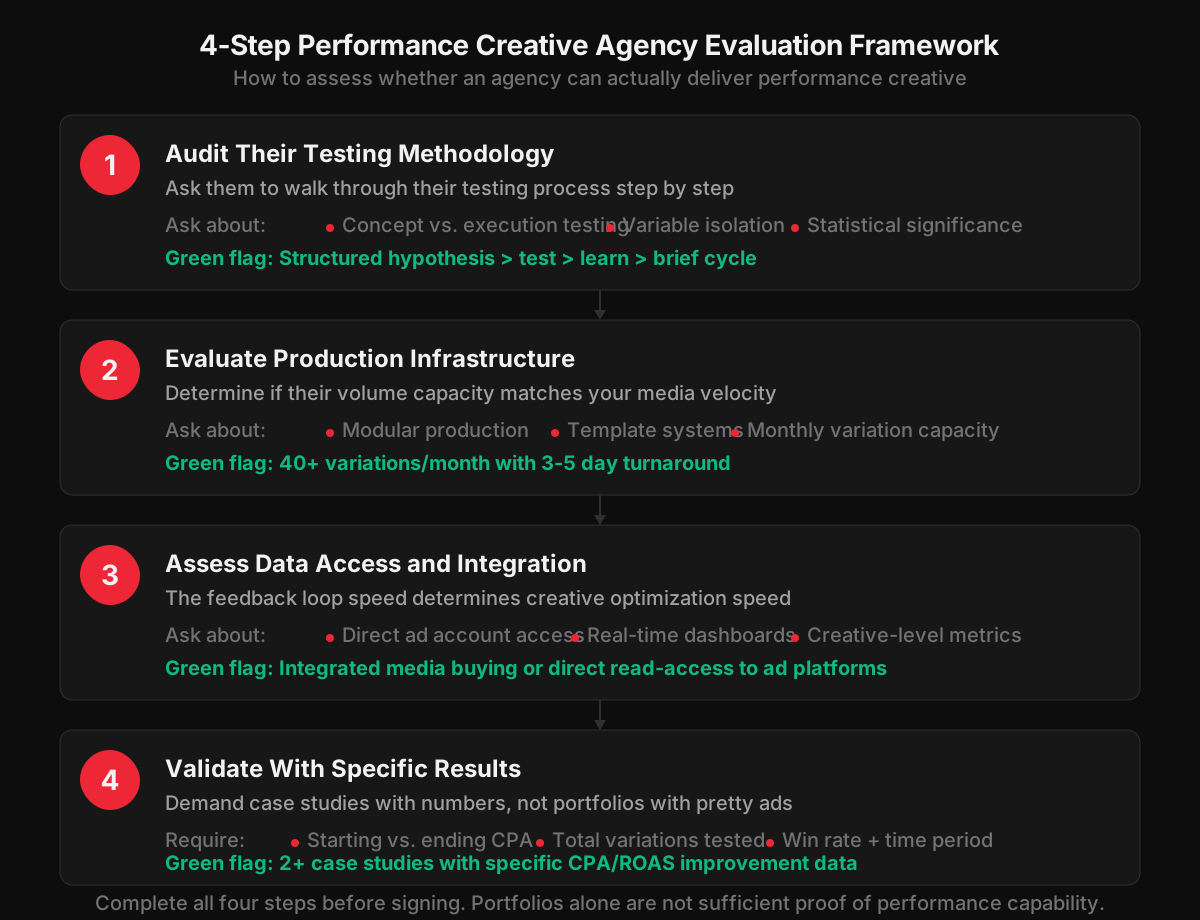
When you are evaluating agencies, you need a structured approach. Portfolios are unreliable because they show the best work, not the average work. Case studies are directionally useful but hard to verify. The framework below gives you a repeatable evaluation method.
Step 1: Audit Their Testing Methodology. Ask the agency to walk through their testing process. How do they separate concept tests from execution tests? How do they determine statistical significance? What is their testing cadence? If the answer sounds like "we launch creative and see what works," that is guessing with a budget. A strong agency describes hypothesis formation, variable isolation, minimum sample sizes, and a clear handoff from test results to the next brief.
Step 2: Evaluate Their Production Infrastructure. Do they use modular production? Do they have template systems and asset libraries? What is their turnaround time? How many variations per month at your budget? If you are spending $100,000 per month on media and the agency can produce 15 assets per month, you will hit creative fatigue within weeks. Volume capacity has to match media velocity.
Step 3: Assess Their Data Access and Integration. Does the agency have direct access to your ad accounts, or do they rely on screenshots? The gap between creative and media data is where most agencies lose efficiency. Every hour spent waiting for a report is an hour of iteration velocity lost. The best agencies either manage media buying themselves or have direct read-access to your ad platforms.
Step 4: Validate With Specific Results, Not Portfolios. Ask for results like: "For a $10M DTC brand spending $80K/month on Meta, we improved CPA from $42 to $28 over 90 days through 180 creative variations, with a 22% creative win rate." Demand at least two case studies with starting and ending CPA/ROAS, time period, variations tested, and the strategic insight that drove improvement. The agency evaluation principles that apply to growth marketing apply equally here.
Why Creative and Media Under One Roof Changes Everything
The single biggest operational decision in performance creative is whether your creative team and media buying team share data, meetings, and incentives. Most brands default to separating them. This creates a structural problem: the feedback loop breaks.
When creative and media are separate, a performance flag takes two weeks to turn into new creative. Media buyer sees underperformance, messages the creative team, brief gets written, creative gets produced, reviews happen. By the time the replacement launches, performance has degraded further. When creative and media share a room and a dashboard, that cycle compresses to 24 hours. Over a quarter, integrated teams complete 5 to 7 times more iteration cycles than siloed teams.
At Darkroom, creative and paid media management operate under a unified team structure. When a creative wins, the media team scales spend immediately. When a creative loses, the creative team is briefed on why before the next cycle starts. This is the core operational advantage of a full-funnel approach. A McKinsey analysis of high-growth companies found that organizations with integrated creative and analytics functions grew revenue 2 to 3 times faster than those with siloed structures.
The Bundle Expansion Path: Why Brands Come for Creative and Stay for More
Here is a pattern we see repeatedly. A brand comes to Darkroom asking for performance creative. They have a media buyer. They have retention handled in-house. They just need better ads. Within 60 to 90 days, creative performance improves enough to increase ad spend, and the brand sees the gap between their current media optimization and what is possible with integration. They add paid media.
Once paid media is integrated, creative extends into other channels. The same UGC content driving paid social gets repurposed for TikTok Shop. The same audience insights shape creator and influencer partnerships. This is not upselling. It is operational efficiency. The first 90 days of any agency relationship are the most expensive in ramp-up time. Consolidating eliminates that ramp for every new channel.
The typical expansion path: start with performance creative ($8K-$15K/mo), add paid media ($10K-$20K/mo), then layer on TikTok Shop or creator marketing. The combined investment is lower than three separate agencies because shared context, data, and strategy reduce redundancy.
Red Flags When Evaluating Performance Creative Agencies
Not every agency that calls itself a performance creative agency actually operates as one. Here are the warning signs.
They show you a portfolio but no performance data. Portfolios prove design skill, not performance capability. If an agency leads with aesthetics and cannot produce creative-level ROAS or CPA data, they are a creative agency with performance branding.
They produce fewer than 20 variations per month. Performance creative requires volume. A handful of polished assets is a campaign model, not a testing model. Low volume means slow learning.
They do not have a defined testing framework. If the answer to "describe your testing methodology" is "we test different creatives and see what performs," that is not a methodology. Look for hypothesis formation, variable isolation, and a clear process for translating results into the next brief.
They cannot explain how creative data informs production. If the agency produces creative without referencing performance data from prior cycles, they are producing content, not performance creative.
Their iteration turnaround exceeds one week. In paid media, a week is an eternity. If your agency takes more than 5 business days to turn insights into new creative, they are too slow. The best agencies operate on 24 to 48 hour cycles.
The real cost of choosing the wrong agency is not just the retainer. It is the opportunity cost of running underperforming creative for months while your competitors iterate faster.
Performance Creative Across the Funnel
A mature performance creative program produces distinct creative for every stage of the buyer journey. Top of funnel: scroll-stopping hooks, problem-agitation content, UGC testimonials, and trend-native formats designed to earn the first click. This is where most creative volume lives because TOF audiences fatigue fastest. Middle of funnel: product demonstrations, comparison content, and social proof compilations that answer objections and build credibility. Bottom of funnel: offer-driven creative, urgency messaging, and retargeting testimonials where creative and growth marketing strategy converge most tightly.
If your agency produces one set of creative and runs it across all audiences, they are leaving significant efficiency on the table. The same creative-to-commerce loop that works for prospecting rarely works for retargeting without modification.
The Role of AI in Performance Creative (2026 Reality Check)
AI has changed performance creative production, but not in the way most vendors claim. The best performance creative agencies use AI tools to accelerate variation generation: background swaps, text overlay variations, aspect ratio reformats, and color treatment testing. These tasks are now automated, meaning more variations per production cycle at lower cost.
What AI does not replace is the strategic layer: deciding what to test, interpreting why a creative won, and translating insights into the next hypothesis. According to Forrester's 2026 research on AI inside marketing agencies, nine in ten agencies now use generative AI primarily for productivity and cost efficiency — often at the expense of creativity. The teams that outperform are the ones that pair AI production with human strategic oversight. Companies that fully automate creative strategy see win rates decline. When evaluating agencies, ask how they use AI. "We use AI to produce more variations of strategically-directed concepts" is the right answer.
FAQ: Performance Creative Agency Questions
What is a performance creative agency? A: A performance creative agency produces ad creative (static, video, UGC) specifically designed to drive measurable outcomes like ROAS, CPA, and conversion rate. Unlike traditional creative agencies that optimize for brand aesthetics, performance creative agencies optimize for data-driven results through high-volume testing and rapid iteration.
How much does a performance creative agency cost? A: Performance creative agencies typically cost $5,000 to $15,000 per month depending on asset volume, format complexity, and whether strategy is included. Freelancers charge $2,000 to $5,000/month, boutique agencies $5,000 to $10,000/month, and full-stack agencies $10,000 to $25,000/month with integrated media buying.
What is the difference between a creative agency and a performance creative agency? A: A traditional creative agency measures success by brand perception and visual consistency. A performance creative agency measures success by CPA, ROAS, and creative win rates. The production process is also different: performance creative agencies test at high volume, iterate on winners, and use platform data to inform every creative decision.
How many ad creatives should a performance creative agency produce per month? A: A competent agency should produce 30 to 80 net-new creative variations per month depending on your ad spend level. Brands spending $50K to $150K/month on paid media typically need 40 to 60 variations to maintain testing velocity and avoid creative fatigue.
Should my performance creative agency also manage paid media? A: Ideally, yes. When creative and media buying sit under one roof, the feedback loop between performance data and creative decisions is faster and more accurate. Integrated agencies can adjust creative direction in real time based on what is actually converting.
What KPIs should I track with a performance creative agency? A: The core KPIs are creative win rate, CPA by creative, ROAS by creative variant, thumb-stop rate for video, and iteration velocity. Secondary metrics include CTR and CPC by creative. Your agency should report these at the creative level, not just the campaign level.
How long does it take to see results from a performance creative agency? A: Most brands see measurable improvement within 30 to 60 days. The first month is onboarding and initial test rounds. By month two, the agency iterates on winners. By month three, you should see consistent CPA and ROAS improvement from creative optimization alone.
What should I look for when hiring a performance creative agency? A: Evaluate four things: testing methodology (structured vs. ad hoc), production velocity (30+ variations/month), data integration (direct ad platform access vs. screenshot reports), and iteration speed (24-48 hours vs. 1-2 weeks). Ask for case studies with specific ROAS and CPA improvements, not just portfolio samples. Read our guide to evaluating DTC agencies for additional criteria.
Talk to Our Creative Strategists
Performance creative is not a production service. It is a growth system. The right agency does not just make ads. They build a testing infrastructure that compounds your creative intelligence over time, produces at the velocity your media spend requires, and integrates performance data into every production decision.
If you are spending $50,000 or more per month on paid media and your creative is not keeping pace, the constraint is not your media buyer. It is your creative system. And if your current agency cannot articulate their testing methodology, show you creative-level KPIs by channel, or turn around iterations in under 48 hours, you are paying for production, not performance.
Darkroom is a full-stack growth agency where performance creative and paid media operate under one unified team. We produce 40 to 80+ creative variations per month, run structured test cycles every two weeks, and maintain 24-hour iteration turnaround because our creative strategists and media buyers share the same data in real time.
Whether you need creative alone or want to explore how creative, media, and conversion rate optimization work together, we are built for that conversation. Book a call with our creative strategists and we will show you exactly what a performance creative system looks like for your brand, your budget, and your growth targets.