
PERFORMANCE CREATIVE
Creative Fatigue Is Killing Your ROAS: The Performance Creative Testing Framework for 2026




Written by Darkroom leardership

Written & peer reviewed by 4 Darkroom team members
TL;DR: Creative fatigue is the single biggest silent killer of paid media performance in 2026. But most brands misdiagnose the problem. They think they need more ads. They actually need a different system. The real issue is format fatigue, not volume fatigue. Running the same static-image-to-carousel pipeline 50 times a month does not solve creative decay. What works is modular creative production combined with genuine format diversity and a testing velocity of 3 to 5 new variations per week. This framework breaks down how to diagnose real creative fatigue, build a modular production system, and implement a testing cadence that keeps ROAS climbing instead of cratering. Darkroom helps brands build and operate these systems at scale.
Why Creative Fatigue Is the Real ROAS Problem in 2026
Media buying has been automated. Broad targeting, Advantage+ campaigns, Performance Max, algorithmic bid optimization. The platforms have taken over the math. What they cannot take over is the creative. And the data is overwhelming: creative quality now drives roughly 70 percent of ad performance outcomes across Meta, TikTok, and Google. Nielsen's research on advertising effectiveness found that creative elements drive 47 to 56 percent of sales lift, dwarfing media placement, targeting, and reach combined.
Yet most brands still treat creative as a production task. Brief comes in. Designer makes the ad. Media buyer launches it. Two weeks later, CPAs rise. CTRs fall. The team blames the algorithm, increases budgets, broadens targeting, and watches ROAS continue its decline. Working with a performance creative agency can accelerate this process. The actual culprit is staring them in the face: the creative has fatigued.
Creative fatigue is not a mystery. It is a predictable, measurable phenomenon. AppsFlyer's creative analytics research shows that ad performance drops 15 to 20 percent within the first two weeks of a creative's lifespan. By week three, the decline accelerates sharply. By week four, you are burning budget on an asset that has already lost its audience. This is not an edge case. This is the default behavior of every single ad you run.
The brands that win are not making better ads. They are making ads differently. They have systems that detect fatigue early, produce replacements fast, and test variations continuously. They treat creative as an engine, not an assembly line. Working with a paid media management can accelerate this process. And the gap between brands with creative systems and brands without them is widening every quarter.
Signal | What It Looks Like | Action Required |
|---|---|---|
CTR Decline | 15%+ drop over 7–10 days | Rotate hook and thumbnail variants |
CPM Spike | 20%+ increase without audience changes | Refresh visual format (static to video or vice versa) |
Frequency Creep | Frequency exceeds 3.5 in prospecting | Expand audience or launch new creative set |
Conversion Rate Drop | CVR falls while CTR holds steady | Test new offer angles and landing pages |
Engagement Decay | Comments and saves drop 30%+ week-over-week | Introduce new UGC or editorial content |
Negative Feedback Rise | "Hide ad" rate doubles | Pause creative immediately, rebuild from scratch |
The Misdiagnosis: Format Fatigue vs. Volume Fatigue
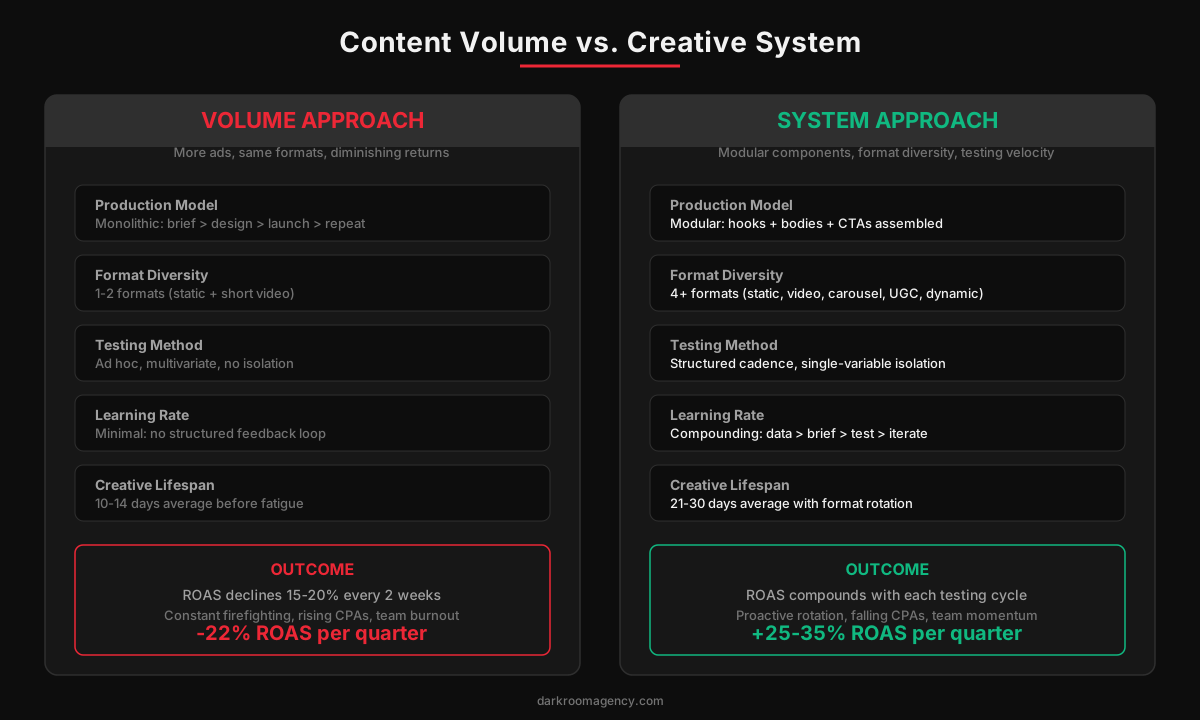
Here is where most teams go wrong. They see creative fatigue setting in and respond with volume. More ads. More variations. More output. They hire another designer, spin up more briefs, and push 40 assets per month into their ad accounts. Performance lifts briefly. Then it crashes again. Working with a full-service growth marketing can accelerate this process. Worse than before.
The problem is not volume. The problem is format monotony. Look at the typical brand's creative library. Static image with product on white background. Static image with lifestyle shot and text overlay. Carousel showing three product angles. Maybe a 15-second video with stock music. Every single ad follows the same structural template. Different images, same format. Different copy, same skeleton. Creator content resists fatigue longer than studio assets—read our breakdown on UGC for paid social performance to understand why.
Audiences do not fatigue on your brand. They fatigue on your format. A consumer scrolling through Instagram can identify your ad pattern within 0.3 seconds. Not because they recognize your logo. Because they recognize the shape of the content. The layout. The rhythm. The muscle memory of their thumb knows to keep scrolling before their brain processes the message. Creative fatigue compounds a deeper measurement problem explored in why paid media fails when measured by platform metrics.
TikTok's creative center research confirms this pattern. Ads that break format conventions see 2 to 3x higher engagement than ads that follow established templates, even when the underlying message is identical. The format is the first filter. If you do not pass the format test, your message never gets heard.
This distinction matters operationally. If the problem were volume, the solution would be simple: produce more. If the problem is format diversity, the solution is structural. You need to rethink how creative is conceived, built, and assembled. You need modularity.
What a Modular Creative Strategy Actually Looks Like
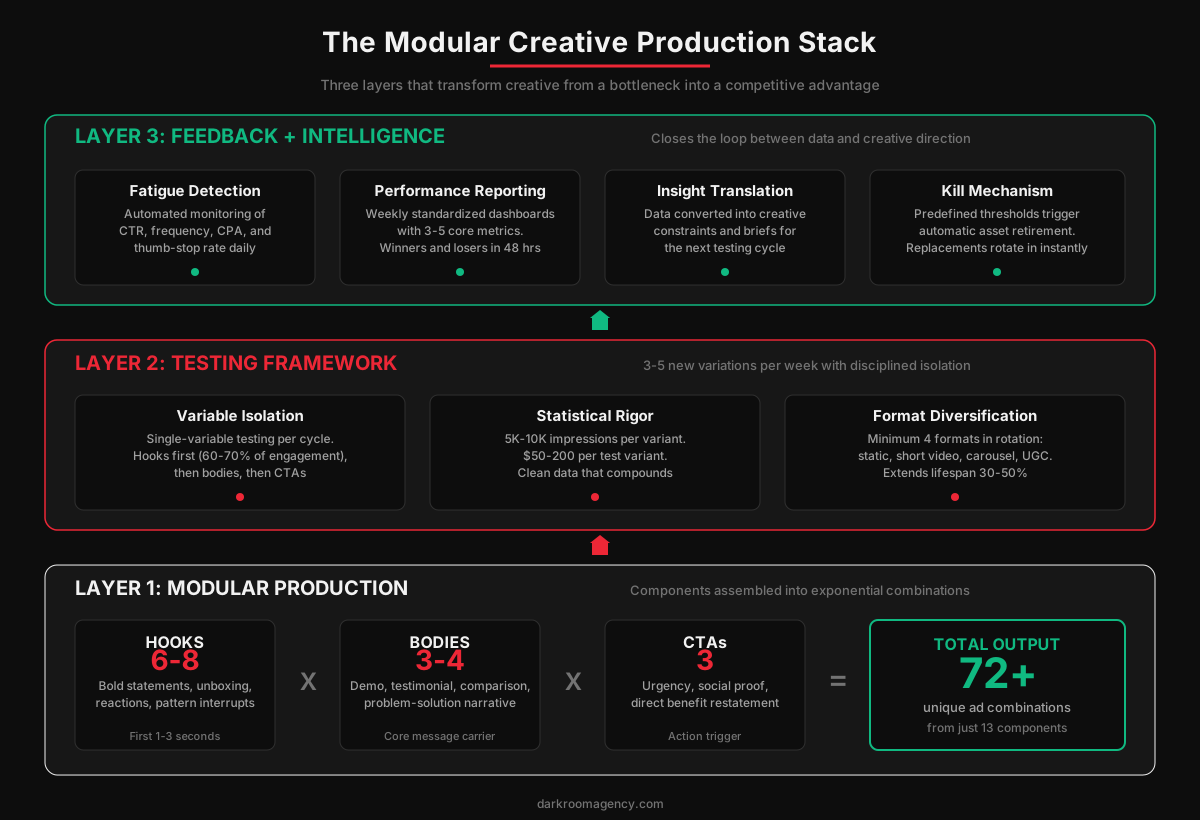
Modular creative production separates the concept from the execution. Instead of producing complete, monolithic ads from scratch each time, you build a library of interchangeable components. Hooks. Bodies. Calls to action. Visual treatments. Audio layers. Text overlays. Each component is produced independently and assembled in different combinations to create genuinely distinct ad experiences.
Think of it like a kitchen, not a restaurant. A restaurant produces complete dishes from a fixed menu. A kitchen stocks ingredients and combines them in different ways. The restaurant model gives you 10 dishes. The kitchen model gives you hundreds of combinations from the same base ingredients. The output is exponentially larger without proportionally scaling input.
Here is what the component breakdown looks like in practice. Hooks are the first 1 to 3 seconds of any ad. They answer one question: why should I stop scrolling. A single campaign concept might have 5 to 8 different hooks. A bold text statement. A product unboxing moment. A customer reaction. A pattern interrupt visual. Each hook is produced as an independent module.
Bodies carry the core message. Product demonstration. Customer testimonial. Before-and-after comparison. Ingredient deep dive. Problem-solution narrative. For a single campaign, you might produce 3 to 4 body modules that each tell the same core story through a different lens.
CTAs close the loop. Shop now with urgency. Limited availability framing. Social proof closing. Direct benefit restatement. Each CTA is a swappable end card or voiceover. Three CTA variants multiply your total ad count by three without additional production cost.
The math is compelling. 6 hooks multiplied by 4 bodies multiplied by 3 CTAs equals 72 unique ad combinations. Traditional production of 72 complete ads would take weeks and cost tens of thousands. Modular production of 13 components (6 + 4 + 3) takes days and costs a fraction. The performance creative advantage is not incremental. It is exponential.
Building Your Creative Testing Velocity
Modular production only works if paired with disciplined testing. Producing 72 variations means nothing if you launch them all at once and have no framework for learning from the results. Testing velocity is not about speed. It is about cadence, structure, and compounding insight.
The target testing velocity for most brands is 3 to 5 new variations per week. Not 3 to 5 entirely new concepts. Three to five modular recombinations that isolate specific variables. Week one, you test four different hooks against your best-performing body and CTA. The winning hook informs week two, where you test three body variations against that winning hook. Week three, you test CTA variants. Week four, you combine the top performers and test against a net-new concept.
Variable isolation is critical. Most teams change everything between ad versions and learn nothing. They swap the image, the copy, the CTA, and the format simultaneously. When one version outperforms, they have no idea which change drove the result. Structured testing changes one variable at a time. This is slower per cycle but dramatically faster in total learning velocity.
The testing hierarchy matters. Not all variables are equal. Hook performance drives 60 to 70 percent of whether someone engages with your ad. Body content drives conversion intent. CTA drives immediate action. Test in that order. Hooks first. Bodies second. CTAs third. Format and visual treatment run as parallel tracks.
Set your statistical thresholds before you start. A test needs enough impressions to be meaningful. For most brands, that means 5,000 to 10,000 impressions per variant before drawing conclusions. At typical CPMs, that is 50 to 200 dollars per variant. A weekly test cycle of 4 variants costs 200 to 800 dollars in test budget. That is a rounding error on most media budgets, but the learning it generates compounds over months.
Format | Hook Type | Visual Style | CTA Variant |
|---|---|---|---|
Static Image | Problem-agitation | Product on white | Shop Now |
Static Image | Social proof | Lifestyle context | See Results |
Video (15s) | Before/after | UGC talking-head | Try It Free |
Video (15s) | Unboxing | Lo-fi authentic | Get Yours |
Carousel | Listicle ("3 reasons") | Branded editorial | Learn More |
Carousel | Comparison | Split-screen | Switch Now |
The Performance Data Feedback Loop
Testing without a feedback loop is just expensive content production. The loop is what converts test results into creative direction. Without it, you are running experiments and filing away the results. With it, every test makes the next test smarter. Platform-native creative formats resist fatigue differently—see how TikTok Shop creative-commerce loop turns creative velocity into revenue.
The feedback loop has three components. First, a standardized reporting cadence. Every week, the same dashboard, the same metrics, the same format. No ad hoc analysis. No waiting for someone to pull data. Automated reporting that surfaces winners and losers within 48 hours of sufficient data collection. Creative testing delivers the most value when embedded within full-funnel marketing growth systems that connect media, conversion, and retention.
Second, a translation layer between data and creative briefs. This is where most teams fail. The data says hook variant C outperformed by 40 percent. What does that mean for the next brief? It means the emotional register of hook C, the pacing pattern, the visual treatment, or the specific claim it made resonated. Someone on the team needs to identify why C won and translate that insight into a creative constraint for the next round. This requires someone who speaks both data and creative. A performance creative strategist, not just an analyst or a designer.
Third, a kill mechanism. Winning ads eventually fatigue. You need predefined thresholds for when to retire an asset. When CTR drops below your category benchmark for three consecutive days. When CPA rises 20 percent above your trailing 14-day average. When frequency exceeds 2.5 on your core audience. These are not judgment calls. They are rules. Automated where possible. The moment an asset crosses the threshold, it gets paused and the replacement from your testing pipeline moves into rotation.
This loop turns creative from a cost center into a learning machine. Every dollar spent on testing generates insight. Every insight improves the next round of creative. Performance compounds. Brands that run this loop for six months see 25 to 40 percent improvement in blended ROAS, not from better media buying, but from better creative intelligence.
Format Diversity: The Overlooked Multiplier
Modular production and testing velocity address the mechanics. Format diversity addresses the audience psychology. Even the best-tested static image will fatigue if every ad in your account is a static image. Genuine format diversity means your audience encounters your brand in structurally different ways across their feed.
The format spectrum for paid media in 2026 includes more options than most brands use. Static single image. Carousel. Short-form video under 15 seconds. Mid-form video 15 to 30 seconds. Long-form video 30 to 60 seconds. User-generated content compilations. Creator partnership content. Interactive polls and quizzes on supported platforms. Instant experience or canvas ads. Dynamic product ads with creative overlays. Whitelisted creator posts. Each format triggers a different pattern recognition response in the viewer.
The minimum viable format mix is four distinct formats running simultaneously. Most brands run two: static and short video. Adding carousel and UGC compilation as third and fourth formats typically extends creative lifespan by 30 to 50 percent before fatigue sets in. The audience encounters the same brand message through different cognitive pathways. The repetition registers as variety instead of monotony.
Meta's creative best practices emphasize format diversity as a core driver of Advantage+ campaign performance. The algorithm performs better when it has genuinely different creative formats to test across placements. A static image that works on Instagram feed does not work on Reels. A 30-second video optimized for in-stream does not work on Stories. Giving the algorithm format diversity gives it more room to optimize. Your creative system should produce for every major placement, not just the one your designer is most comfortable with.
Diagnosing Creative Fatigue: The Warning Signs
Creative fatigue does not announce itself. It creeps in. Performance degrades gradually enough that teams attribute the decline to seasonality, competition, or algorithm changes. By the time someone identifies the creative as the problem, you have wasted weeks of budget on exhausted assets. Knowing the early warning signs saves money and maintains momentum.
The first sign is CTR decline while impressions remain stable. The platform is still serving your ad. People are still seeing it. They are just no longer clicking. This means the ad has lost its stopping power. The audience has pattern-matched it and is scrolling past. This typically happens 7 to 10 days into a creative's lifespan for cold audiences and faster for retargeting audiences.
The second sign is rising frequency without proportional conversion. Frequency above 2.0 on prospecting audiences is a warning. Above 3.0 is a fire alarm. If frequency is climbing and conversion rate is not, the ad is being shown to the same people who have already decided not to buy. You are paying to annoy them.
The third sign is CPA inflation that does not respond to bid adjustments. When your media buyer raises or lowers bids and CPA does not meaningfully change, the problem is upstream of bidding. It is the creative. No bid strategy can fix an ad that people do not want to engage with.
The fourth sign is declining thumb-stop rate on video ads. Platforms report this differently, but the concept is the same: what percentage of people who see the first frame continue watching beyond 3 seconds. When this metric drops below your historical average by more than 15 percent, the hook has fatigued. You do not necessarily need a new ad. You might just need a new hook module swapped in.
Build a fatigue monitoring dashboard that tracks these four metrics daily. Set automated alerts. Do not wait for the weekly performance review to discover that an ad has been bleeding budget for five days. Early detection is the difference between proactive creative rotation and reactive firefighting.
The 90-Day Implementation Roadmap
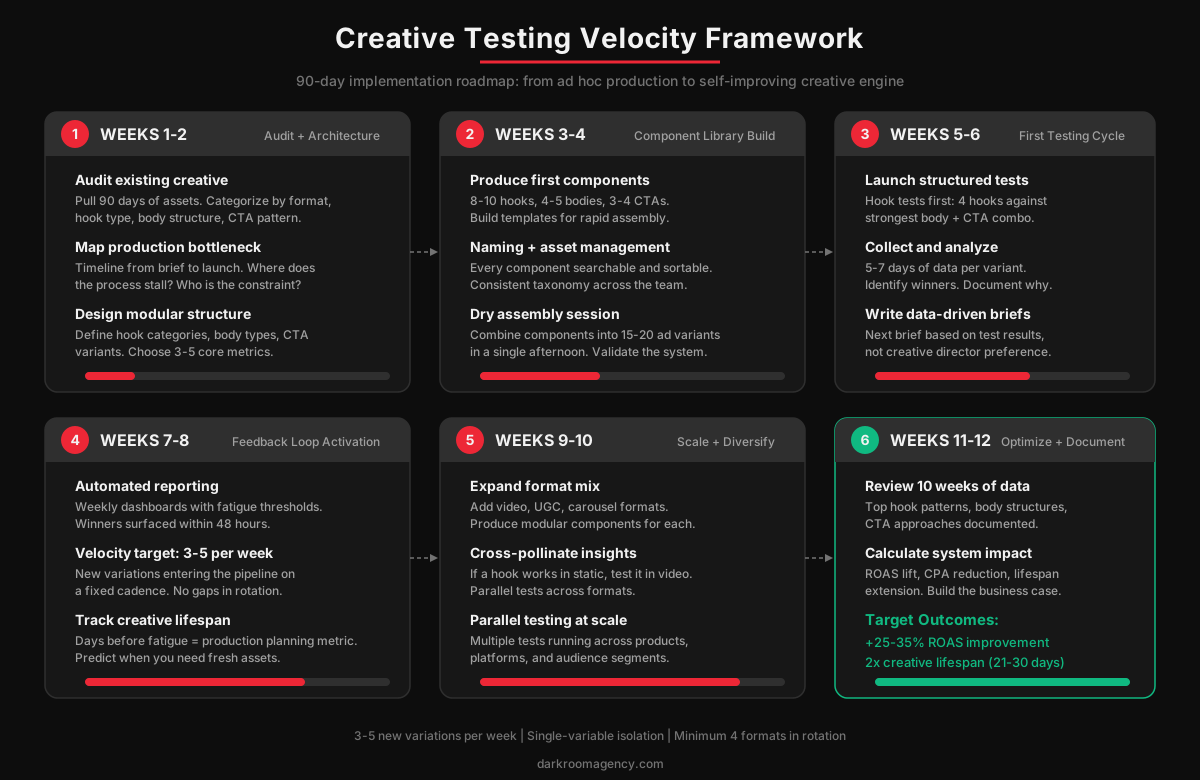
Building a modular creative system does not require a massive team or a six-figure budget. It requires discipline and sequence. Here is the 90-day roadmap that moves a brand from ad hoc creative production to a structured, self-improving creative engine.
Weeks 1 through 2: Audit and architecture. Pull every creative asset from your ad accounts for the past 90 days. Categorize by format, hook type, body structure, and CTA. Identify patterns. Most brands discover they have been running variations of 2 to 3 formats and 4 to 5 hook types. Map your current production timeline from brief to launch. Identify the bottleneck. Design your modular component library structure. Define your hook categories, body types, and CTA variants. This is planning, not production.
Weeks 3 through 4: Component library build. Produce your first round of modular components. Aim for 8 to 10 hooks, 4 to 5 bodies, and 3 to 4 CTAs. Build templates for rapid assembly. Set up your naming convention so every asset is searchable and sortable. Train your team on the modular assembly process. Run a dry assembly session where you combine components into 15 to 20 ad variants in a single afternoon. This proves the system works before you spend media budget.
Weeks 5 through 6: First testing cycle. Launch your first structured test. Pick your highest-spend campaign or audience. Replace the existing creative with modular variants. Run hook tests first. Four hooks against your strongest body and CTA. Let the data collect for 5 to 7 days. Identify winners. Document insights. Write the next brief based on what the data told you, not what the creative director prefers.
Weeks 7 through 8: Feedback loop activation. Build your automated reporting dashboard. Set your fatigue thresholds. Run your second and third testing cycles. You should be launching 3 to 5 new variants per week by now. Start tracking creative lifespan: how many days does each variant maintain above-threshold performance before it fatigues. This becomes your production planning metric.
Weeks 9 through 10: Scale and diversify. Expand your format mix. If you have been testing primarily in one format, add a second and third. Produce modular components for video, UGC, and carousel. Cross-pollinate insights: if a hook works in static, test its equivalent in video. Begin running parallel tests across formats. Your paid media management team should now have a steady pipeline of fresh creative to deploy.
Weeks 11 through 12: Optimize and document. Review 10 weeks of testing data. Identify your top-performing hook patterns, body structures, and CTA approaches. Document them as creative guidelines, not rigid templates. These guidelines inform your next quarter's creative strategy. Calculate the system's impact on ROAS, CPA, and creative lifespan. Build the business case for ongoing investment.
Team Structure and Partner Considerations
A modular creative system requires specific capabilities. You need someone who understands performance data and can translate it into creative direction. You need producers who can work in components rather than complete pieces. You need a media buyer who understands creative testing and can structure campaigns for clean variable isolation. And you need a process owner who keeps the cadence running. The distinction between growth marketing versus performance marketing determines whether creative testing serves short-term ROAS or long-term brand equity.
In-house teams can build this if they have the right structure. A performance creative strategist who owns the testing framework and feedback loop. Two to three producers who build modular components across formats. A media buyer who collaborates on test design rather than just launching whatever creative arrives. This is a four to five person team for brands spending 200K or more monthly on paid media. For a broader view of how creative testing fits into modern social strategy, see our guide to social media marketing services in 2026.
For brands below that threshold, a hybrid model works. Keep the strategist and feedback loop ownership in-house. Partner with a performance creative agency that understands modular production. The agency handles component production at velocity. Your internal team owns the strategic direction and data interpretation. This gives you agency-scale production with in-house strategic depth.
The critical question when evaluating partners is whether they understand systems, not just production. Many agencies can produce beautiful ads. Few can produce structured testing programs with modular components, automated fatigue monitoring, and data-driven creative iteration. Ask potential partners how they structure testing cadences. Ask what their feedback loop looks like. Ask how they measure creative lifespan. If they cannot answer these questions specifically, they are a production house, not a performance creative partner.
What Changes When You Get This Right
Brands that implement modular creative systems with structured testing see specific, measurable outcomes. Creative lifespan extends from an average of 10 to 14 days to 21 to 30 days because format diversity reduces pattern fatigue. Testing velocity of 3 to 5 variations per week means there is always fresh creative entering the pipeline before existing creative fatigues. ROAS improves 20 to 35 percent within the first quarter, not from better media buying, but from consistently higher-quality creative in rotation.
The compounding effect is the real win. This is the same principle behind building a performance creative system that scales. Each testing cycle makes the next cycle smarter. By month three, your team has run 30 to 40 structured tests. They know which hook patterns drive highest CTR for each audience segment. They know which body structures convert best for each product category. They know which CTAs work in which formats. This institutional knowledge is a competitive moat. Your competitors are still guessing. You are iterating on data.
Creative stops being a bottleneck and becomes an accelerant. Your media team always has fresh assets to deploy. Your performance creative pipeline produces faster than your media team can spend. Budget utilization improves because you are never waiting on creative. The constraint shifts from production to strategy, which is where you want it.
Team dynamics improve. No more subjective arguments about whether an ad is good enough. The data decides. Designers get faster feedback on what works. Strategists have clearer direction for briefs. Media buyers spend less time troubleshooting fatigued creative and more time scaling winners. The system reduces friction across the entire organization. The role of creative intelligence and AI in this feedback loop continues to accelerate the advantage for brands that embrace it.
Frequently Asked Questions
How do I know if my ROAS problem is creative fatigue or something else?
Check three things. First, has your CTR declined while impressions stayed stable? That points to creative fatigue. Second, has your frequency on prospecting audiences exceeded 2.5? That confirms the same people are seeing the same ad too many times. Third, have bid adjustments failed to move CPA? If the answer to all three is yes, creative fatigue is your primary issue. If only one or two apply, you likely have a targeting or funnel problem alongside creative fatigue.
What is the minimum budget needed to run structured creative testing?
Each test variant needs 5,000 to 10,000 impressions for statistically meaningful results. At a 10 dollar CPM, that is 50 to 100 dollars per variant. Testing 4 variants per week costs 200 to 400 dollars. Monthly testing budget is 800 to 1,600 dollars. For brands spending 50K or more monthly on paid media, this is less than 3 percent of total spend allocated to learning. The ROI on that learning investment compounds over every subsequent campaign.
How many creative formats should we be running simultaneously?
Four is the minimum for genuine format diversity. Static image, short video under 15 seconds, carousel or multi-image, and UGC or creator content. Brands with larger budgets should aim for six to eight including mid-form video, dynamic product creative, and interactive formats. Each additional format extends the time before audience pattern fatigue sets in.
Can AI tools replace the need for a modular creative system?
AI tools accelerate production within a system but do not replace the system itself. Generative AI can produce image variants, write copy alternatives, and even assemble video edits. But without a testing framework, feedback loop, and strategic direction, AI just produces more content faster. More content is not the solution. Better-tested, strategically diverse content is the solution. AI is the accelerant. The system is the engine.
How often should we completely refresh our creative approach versus iterating on what works?
Follow the 70-20-10 rule. Seventy percent of your creative output should iterate on proven winners, testing variations on hooks, bodies, and CTAs that have demonstrated performance. Twenty percent should be new concepts within familiar formats, pushing your messaging in new directions while staying in comfortable production territory. Ten percent should be genuinely experimental, new formats, unexpected angles, risky creative bets. This ratio keeps performance stable while continuously expanding your creative frontier.
What metrics should we track to measure creative system effectiveness?
Track five metrics. Average creative lifespan in days before fatigue threshold. Win rate of tested variants, meaning what percentage outperform the control. Time from insight to production, meaning how quickly a test result translates into a new asset. Format diversity ratio, meaning how many distinct formats are active simultaneously. Blended ROAS trend over rolling 30-day periods. These five metrics tell you whether your system is working, learning, and improving.
What is the biggest mistake brands make when implementing creative testing?
Changing too many variables at once. A team will swap the image, the headline, the CTA, and the format between variants and then try to draw conclusions from the results. You cannot isolate what drove performance when everything changed. Start with single-variable tests. It feels slow. It is slow in the first cycle. But by cycle three, you have clean data that compounds into genuine creative intelligence. Brands that test messy never build that intelligence, no matter how many tests they run.
Stop Making More Ads and Start Building a System
Creative fatigue is not going away. Attention spans are shortening. Platform algorithms are getting better at serving content people want to see, which means they are also getting better at filtering out content people have seen before. The bar for creative quality and freshness rises every quarter. Brands that rely on volume alone will always be chasing. Brands that build systems will always be leading.
The framework is straightforward. Diagnose whether your problem is format fatigue or genuine creative exhaustion. Build a modular production system that separates components for rapid recombination. Implement a testing velocity of 3 to 5 new variations per week with disciplined variable isolation. Close the feedback loop between performance data and creative direction. Maintain a minimum of four distinct formats in rotation at all times. Monitor fatigue signals daily and rotate proactively rather than reactively.
This is not a creative philosophy. It is an operating system. The brands that adopt it in 2026 will compound their creative advantage every quarter. The brands that do not will spend increasing amounts on paid media to achieve diminishing returns.
If you are ready to build a performance creative system that eliminates fatigue and compounds ROAS, book a call with Darkroom. We architect and operate modular creative engines for brands that are serious about scaling paid media profitably.