
GROWTH MARKETING
Full-Funnel Marketing for Ecommerce: How to Align Creative, Media, CRO, and Lifecycle Into One System




Written by Darkroom leardership

Written & peer reviewed by 4 Darkroom team members
TL;DR: Most ecommerce brands optimize channels in isolation, creating a fragmented funnel where strong creative paired with weak landing pages wastes traffic, and high-intent visitors without proper email capture bleed recoverable revenue. True full-funnel marketing aligns creative, media, CRO, and lifecycle into one interconnected system where each stage compounds the next. This article maps the structural failures of siloed growth, introduces the integrated full-funnel framework, and provides an implementation roadmap for ecommerce brands ready to stop optimizing pieces and start building a system. Darkroom builds these systems for ecommerce brands that want compounding growth, not incremental channel wins.
Why Siloed Channel Optimization Is the Most Expensive Mistake in Ecommerce
The problem is not that your channels are underperforming. Working with a performance creative can accelerate this process. The problem is that they were never designed to work together.
Every ecommerce brand runs into the same ceiling. Paid media is driving traffic. Creative is performing well in platform. The landing pages look good. Email flows are built. But revenue growth is flat or decelerating. Working with a paid media agency can accelerate this process. The team is doing everything right on paper, yet the system leaks at every handoff.
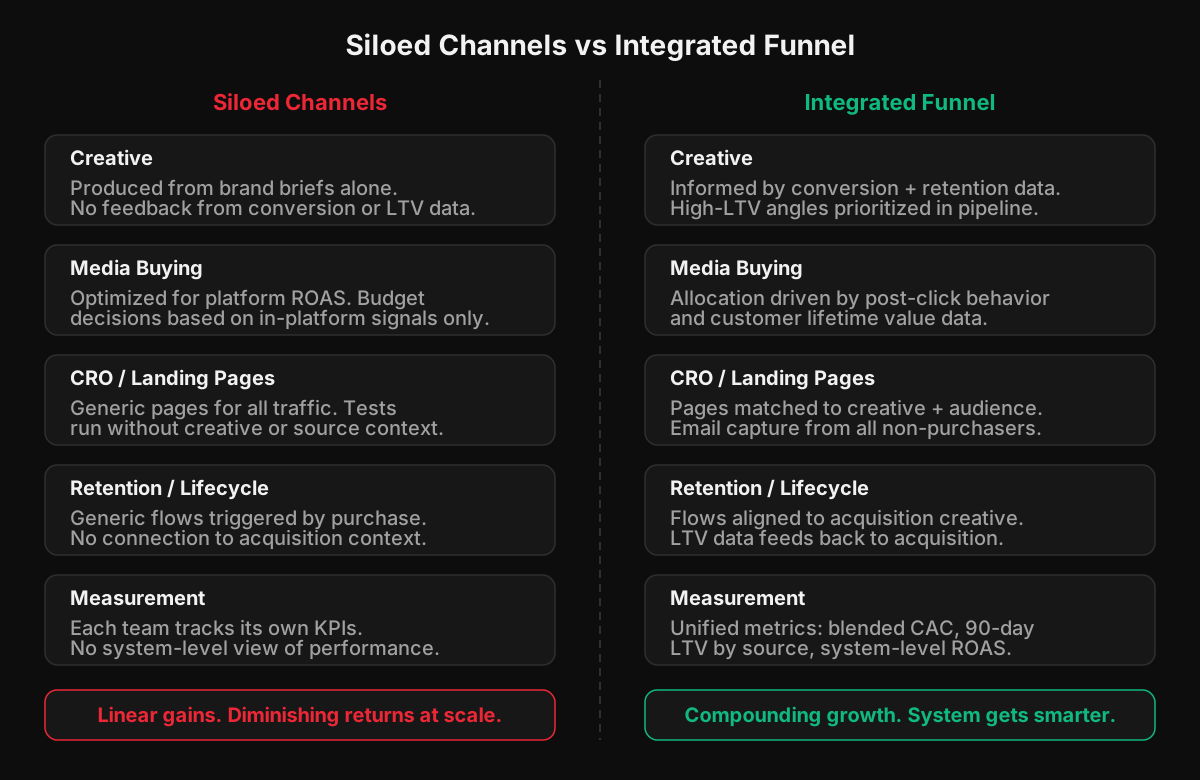
This happens because most brands build their marketing stack the same way: one team or agency handles paid media, another handles creative, someone else manages the website, and a fourth group runs email and SMS. Each team optimizes for its own metrics. The paid media team optimizes for ROAS. The creative team optimizes for thumb-stop rate. The CRO team optimizes for on-page conversion. Working with a retention marketing can accelerate this process. The retention team optimizes for open rates and click-through rates.
None of these metrics are wrong. But none of them measure what actually matters: how effectively a dollar of spend converts into a customer who purchases again. When each team optimizes its silo, the compounding effect disappears. Strong creative with a weak landing page wastes traffic. A high-converting page with poor post-purchase flows loses lifetime value. Effective retention targeting without aligned acquisition creative creates disjointed brand experiences that erode trust. A true full-funnel system requires full-service growth marketing capabilities that integrate acquisition, conversion, and retention under one strategy.
The cost of this fragmentation is not visible in any single dashboard. It shows up as stagnating growth despite increasing spend. It shows up as a customer acquisition cost that climbs while repeat purchase rate stays flat. It shows up as the gap between what your marketing should produce and what it actually delivers. Understanding the distinction between growth marketing versus performance marketing is critical for building a system that compounds rather than fragments.
Research from McKinsey on growth marketing has consistently shown that brands achieving above-market growth rates don't just spend more. They integrate faster. They build systems where insights from one channel inform decisions in another, and where the entire funnel operates as a single organism rather than a collection of independent organs.
Stage | Objective | Channels | Primary Metric |
|---|---|---|---|
Awareness | Reach new audiences | Paid social, YouTube, PR, influencer | CPM, reach, brand search lift |
Consideration | Educate and build intent | SEO, content, email nurture, retargeting | Engagement rate, email signups |
Conversion | Drive purchases | Paid search, shopping ads, on-site CRO | ROAS, conversion rate, AOV |
Retention | Increase LTV and repeat rate | Email flows, loyalty, SMS, post-purchase | Repeat purchase rate, 90-day LTV |
Advocacy | Generate referrals and UGC | Referral programs, reviews, community | NPS, referral revenue share |
Metric | Siloed Approach | Integrated Approach | Difference |
|---|---|---|---|
Blended CAC | $62 | $41 | -34% |
ROAS (Blended) | 3.1x | 4.7x | +52% |
Repeat Purchase Rate | 18% | 31% | +72% |
90-Day LTV | $87 | $134 | +54% |
Time to Profitable CAC | 67 days | 38 days | -43% |
Marketing Efficiency Ratio | 5.2x | 8.1x | +56% |
The Anatomy of a Fragmented Funnel
Fragmentation does not look like chaos. It looks like competent teams producing suboptimal outcomes. Conversion optimization is the hinge of the full funnel—see how CRO and profit-per-visitor for DTC reframes the entire CRO conversation.
A fragmented funnel has a specific architecture that is easy to identify once you know what to look for. The paid media team runs campaigns optimized for platform-level efficiency. They target cold audiences with broad creative, retarget warm audiences with product-specific ads, and report weekly on spend, CPA, and ROAS. Their work is often excellent within their domain.
The creative team produces assets based on briefs that reference brand guidelines and campaign themes. They test variations in platform, measure engagement metrics, and iterate on what performs. Their output quality is often high.
The CRO team runs A/B tests on product pages, collection pages, and checkout flows. They optimize for conversion rate and average order value. They may experiment with urgency elements, social proof, or layout changes. Their testing velocity might be impressive.
The retention team builds welcome flows, abandoned cart sequences, post-purchase nurtures, and win-back campaigns. They segment audiences, personalize messaging, and report on email revenue attribution. Their infrastructure might be sophisticated.
Each team hits its targets. The paid media team maintains acceptable ROAS. The creative team delivers scroll-stopping assets. The CRO team lifts conversion rate by 15%. The retention team generates 30% of total revenue through email. Yet total revenue growth decelerates.
The breakdown happens at the handoffs. Creative that performs in-platform doesn't align with the landing page experience, so click-through rates are strong but bounce rates spike. The landing page is optimized for conversion but doesn't capture email from the 95% of visitors who don't purchase, so that traffic is gone forever. Post-purchase flows reference brand messaging that doesn't match the acquisition creative that brought the customer in, creating a disjointed experience. Retention data about which customers are most valuable never flows back to inform acquisition targeting.
This is not a talent problem. It is an architecture problem. And architecture problems cannot be solved by hiring better specialists. They require a different structural approach.
What Full-Funnel Marketing Actually Means
Full-funnel marketing is not a buzzword for doing everything. It is a specific operating model where each funnel stage is designed to amplify the next.
The term "full-funnel" gets misused constantly. Agencies slap it on pitch decks to mean "we offer services at every stage." That is not full-funnel marketing. That is a menu. Full-funnel marketing is the deliberate architectural integration of creative strategy, media buying, conversion rate optimization, and lifecycle marketing into a single system where data, messaging, and optimization loops connect every stage.
In practice, this means several things. Creative is not produced in isolation and then handed to media buyers. Creative strategy is informed by conversion data from landing pages and retention data from lifecycle flows. If a particular value proposition drives high repeat purchase rates, that insight shapes acquisition creative. If a specific product angle converts well on landing pages but produces low lifetime value, that feedback loop adjusts the creative pipeline.
Media buying is not optimized for platform metrics alone. Budget allocation is informed by post-click behavior, not just in-platform signals. If Google Shopping drives high initial conversion but low repeat rates, while Meta prospecting drives lower initial conversion but higher lifetime value, a full-funnel system reallocates budget based on the complete picture. McKinsey's research on full-funnel marketing confirms that brands integrating post-purchase data into acquisition decisions outperform those optimizing channels independently.
CRO is not limited to on-page testing. It encompasses the entire conversion experience from ad click to purchase confirmation. The landing page is designed to match the specific creative and audience segment that drove the click. The checkout flow captures email regardless of purchase intent. The post-purchase experience begins immediately, not when the retention team gets around to it.
Lifecycle marketing is not an afterthought bolted on after acquisition. It is a primary revenue driver that feeds insights back to every other function. Retention data reveals which acquisition channels produce the most valuable customers. Win-back campaign performance identifies where the brand experience breaks down. Loyalty program engagement rates indicate which customer segments deserve increased acquisition investment.
This is the operating model that produces compounding growth. Each function makes every other function more effective. The system gets smarter over time because data flows in every direction, not just downstream.
The Four Layers of an Integrated Growth System
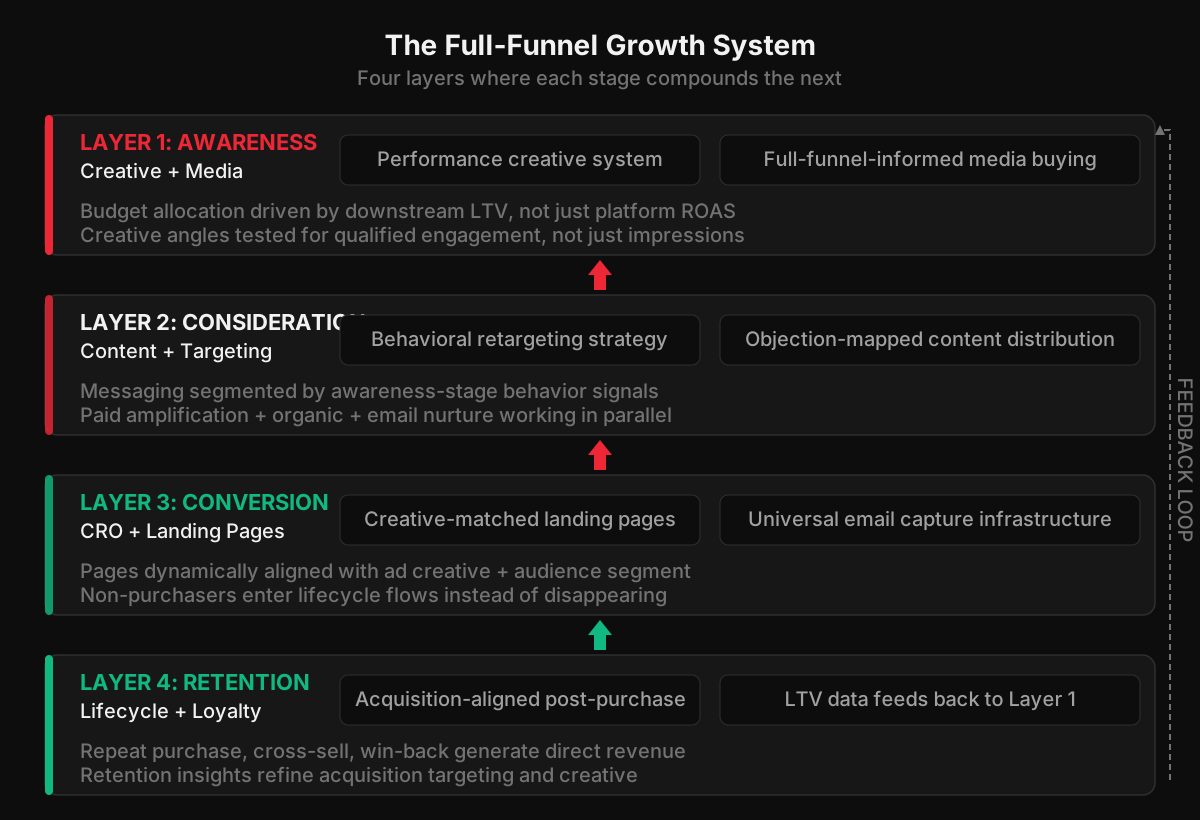
A full-funnel system operates in four distinct layers, each feeding the next with data and insight rather than just passing traffic downstream. Top-of-funnel efficiency depends on solving creative fatigue and performance testing before scaling media spend.
Layer 1: Awareness through Creative and Media Retention is where the compounding happens—our analysis of ecommerce email marketing revenue architecture shows how email becomes a revenue system, not a broadcast channel.
The top of the funnel is where creative strategy and media buying converge. This is not about producing ads and placing them. It is about building a performance creative system that generates, tests, and iterates on messaging concepts at a velocity that matches the speed of platform algorithms. The creative is designed not just for engagement but for qualified engagement, attracting the audiences most likely to convert and retain.
Media strategy at this layer is informed by full-funnel data. Budget allocation across platforms, audiences, and creative concepts is driven by downstream performance, not just platform-reported ROAS. The media team knows which creative angles produce the highest lifetime value customers, not just the cheapest clicks. Full-funnel measurement exposes the same platform reporting gap described in why paid media fails when measured by platform metrics.
Layer 2: Consideration through Content and Targeting
The consideration layer bridges awareness and conversion. This is where retargeting strategy, content marketing, and educational touchpoints work together to move prospects from interest to intent. The targeting at this layer uses behavioral signals from the awareness stage. Someone who engaged with an educational creative receives different consideration-stage messaging than someone who engaged with a product-focused creative.
Content at this layer is not generic brand storytelling. It is strategically mapped to the objections, questions, and comparison behaviors that your specific audience exhibits before purchasing. This content is distributed through paid amplification, organic channels, and email nurture sequences simultaneously.
Layer 3: Conversion through CRO and Landing Pages
The conversion layer is where most brands focus their optimization energy, but in an integrated system, this layer does more than convert visitors into customers. It captures data from every visitor, converts the ready buyers, and feeds the non-converters into lifecycle flows that can recover them later.
Landing pages are not static. They are dynamically aligned with the specific creative and audience segment that drove the visit. A visitor arriving from a testimonial-driven Meta ad sees a landing page that leads with social proof. A visitor from a Google Shopping ad sees a product-detail experience optimized for comparison shopping. The CRO infrastructure supports this personalization at scale.
Layer 4: Retention through Lifecycle and Loyalty
The retention layer is where full-funnel systems generate their highest returns. Post-purchase flows are triggered immediately and aligned with the acquisition experience. A customer acquired through a sustainability-focused creative receives post-purchase content that reinforces that value proposition, not generic order confirmation emails.
Lifecycle marketing at this layer generates direct revenue through repeat purchases, cross-sells, and win-back campaigns. But its strategic value is even greater. Retention data reveals which acquisition channels, creative angles, and landing page experiences produce the most valuable long-term customers. This data flows back to Layer 1, creating a feedback loop that makes the entire system smarter with every cycle.
How the Feedback Loop Creates Compounding Growth
The difference between a siloed stack and an integrated system is the feedback loop. Without it, you optimize linearly. With it, you compound.
Linear optimization looks like this: improve creative, traffic goes up. Improve landing pages, conversion goes up. Improve email flows, retention revenue goes up. Each improvement is isolated. A 10% improvement in creative performance plus a 10% improvement in conversion rate plus a 10% improvement in retention does not equal 30% total growth. It equals roughly 33% growth mathematically, but in practice, the gains are lower because the improvements do not reinforce each other.
Compounding optimization looks different. Retention data shows that customers acquired through a specific creative angle have 2.4x higher lifetime value. That insight shifts 20% of acquisition budget toward that angle. The higher-value traffic converts better on landing pages because the messaging is more aligned. Higher conversion rates lower CPA, which allows more budget to flow into the system. More customers enter lifecycle flows, generating more retention data, which further refines the feedback loop.
This is not theoretical. Brands with integrated measurement across their full funnel see meaningfully higher marketing efficiency than those optimizing channels independently. The gains come not from any single channel performing better but from the system itself getting smarter over time.
The feedback loop requires three things. First, unified data infrastructure. Every touchpoint, from ad impression to repeat purchase, must be trackable and attributable. Second, cross-functional communication cadence. The paid media team, creative team, CRO team, and retention team must share insights weekly, not monthly. Third, a single decision-making framework. Budget allocation, creative prioritization, and testing roadmaps must be governed by full-funnel metrics, not channel-specific KPIs.
Most ecommerce brands lack all three. They have data in platform-specific silos, teams that communicate through decks and reports, and decision-making that defaults to whoever controls the budget for each channel. Building the feedback loop requires structural change, not just better tools.
The Cost of Getting Full-Funnel Wrong
Attempting full-funnel marketing without proper integration is worse than staying siloed. It creates the illusion of alignment while introducing new failure points.
There is a common failure pattern among brands that try to "go full-funnel" without structural change. They hire a full-funnel agency or build an internal team that spans creative, media, CRO, and retention. But the operating model stays the same. Each function still optimizes independently. The only change is that one person or one team now has visibility across all channels.
Visibility without integration is a monitoring problem, not a growth system. The brand gets better dashboards but the same fragmented execution. The CMO can now see that paid media is driving traffic, creative is engaging, pages are converting, and email is retaining. But the feedback loops that make these functions compound are still absent.
Worse, the perception of alignment creates complacency. Leadership believes the full-funnel problem is solved because they can see all the data in one place. Meanwhile, the creative team is still producing assets without conversion data. The CRO team is still testing pages without creative context. The retention team is still building flows without acquisition insights.
The cost compounds. Brands that attempt full-funnel without integration spend more on coordination overhead (meetings, dashboards, reporting) without capturing the compounding benefits. They burn through agency relationships faster because expectations are set for integrated performance but the operating model delivers siloed results. Data from eMarketer's digital ad spend analysis shows that brands increasing spend without improving cross-channel integration see diminishing returns at a faster rate than those who hold spend constant.
Building a Full-Funnel System: The Implementation Roadmap
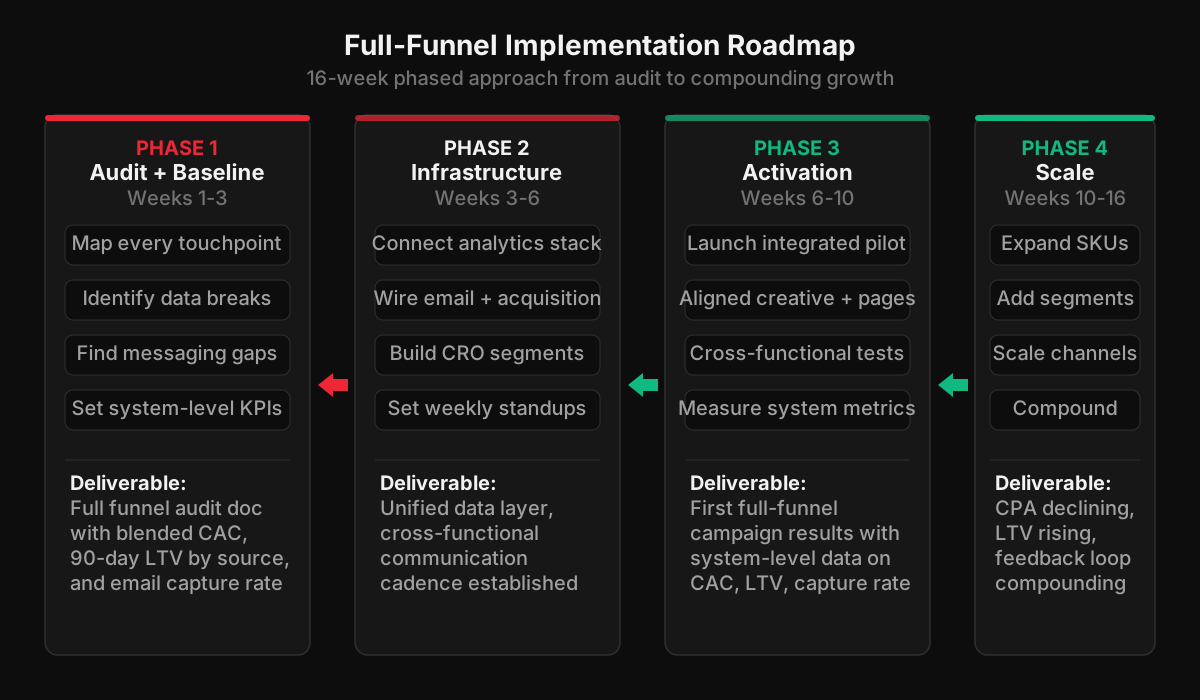
Implementation is not about launching everything at once. It is about building the foundation, connecting the loops, and letting the system compound. Discovery-layer strategy is evolving rapidly—read SEO versus AEO versus GEO for ecommerce in 2026 to understand how search fits into a full-funnel system.
Phase 1: Audit and Baseline (Weeks 1-3)
Start with a complete funnel audit. Map every touchpoint from ad impression to repeat purchase. Identify where data breaks (which handoffs lose tracking). Identify where messaging breaks (which transitions feel disjointed to the customer). Identify where optimization breaks (which teams are optimizing for metrics that don't connect to the next stage).
Establish a full-funnel baseline. Not just channel-level metrics, but system-level metrics: cost per acquired customer (including all touchpoints), first-to-second purchase conversion rate, 90-day customer value by acquisition source, and email capture rate from non-purchasers. These are the numbers that tell you how well the system works, not how well any single channel performs.
Phase 2: Infrastructure and Integration (Weeks 3-6)
Build the data infrastructure that connects every stage. This does not require a massive technology investment. It requires deliberate configuration of the tools you already have. Ensure your analytics can track a customer from ad click through multiple purchases. Ensure your email platform receives acquisition source data. Ensure your CRO tools can segment by traffic source.
Establish the cross-functional communication cadence. Weekly 30-minute standups where each function shares one insight and one question. Monthly strategic reviews where full-funnel performance drives budget and priority decisions. Quarterly roadmap planning where testing priorities are set based on system-level gaps.
Phase 3: Activation and Testing (Weeks 6-10)
Launch the first integrated campaigns. Select one product category or customer segment and build a complete full-funnel experience: aligned creative, targeted media, matched landing pages, and connected lifecycle flows. Measure the system-level metrics, not just channel metrics.
Run your first cross-functional tests. Test a creative angle change and measure its impact not just on CTR but on landing page conversion, email capture, and 30-day customer value. This single test will reveal more about your funnel's architecture than six months of siloed A/B tests.
Phase 4: Optimization and Scaling (Weeks 10-16)
Once the foundation is working, scale by expanding the integrated approach to additional product categories, audience segments, and channels. The feedback loop should now be producing insights that make each expansion faster than the last.
This is also when the compounding effect becomes measurable. CPA should be declining while customer lifetime value increases. Email capture rates from non-purchasers should be improving as landing page alignment tightens. Repeat purchase rates should be climbing as lifecycle flows incorporate acquisition context. Review the best performance marketing agencies to benchmark whether your system metrics are competitive with leaders in the space.
Why Most Agencies Cannot Deliver This
The agency model is designed for channel specialization. Full-funnel integration requires a fundamentally different structure.
Most agencies are built around channel expertise. They have a paid media team, a creative team, and maybe a CRO or retention offering. Each team has its own P&L, its own leadership, and its own incentive structure. Asking a channel-specialist agency to deliver full-funnel integration is like asking five separate restaurants to coordinate a single meal. The ingredients might be excellent. The experience will be disjointed.
Even agencies that market themselves as "full-service" often operate as a collection of specialists under one roof. The teams share a Slack workspace but not an operating model. The paid media team does not attend creative reviews. The retention team does not see acquisition data. The CRO team tests pages without knowing which creative drove the traffic.
The agencies that actually deliver full-funnel results are built differently. They organize around client outcomes, not channel functions. Their teams are cross-functional by design. Their compensation structures reward system-level performance, not channel-level metrics. Their reporting shows how each function impacts every other function, not just its own KPIs.
This is a rare configuration. Understanding advanced advertising strategies means recognizing that the future of ecommerce growth is not better channel execution. It is better system architecture. The brands that build or partner with organizations capable of true full-funnel integration will compound faster than those optimizing channels in isolation, regardless of how talented those channel specialists are.
The structural advantage is permanent. A brand with an integrated system gets smarter with every dollar spent. A brand with siloed channels gets incrementally better at each silo but never captures the multiplicative effect. Over 12 months, the gap between these two approaches becomes enormous. Over 24 months, it becomes insurmountable. How full-service digital agencies drive business growth is precisely through this kind of integrated architecture, not through channel-level heroics.
Frequently Asked Questions
What is full-funnel marketing for ecommerce?
Full-funnel marketing for ecommerce is an integrated operating model where creative strategy, paid media, conversion rate optimization, and lifecycle marketing function as a single system. Each stage is designed to amplify the next through shared data, aligned messaging, and cross-functional feedback loops. It is not a list of services. It is an architecture that produces compounding growth.
How is full-funnel different from omnichannel?
Omnichannel means presence across multiple channels. Full-funnel means integration across every stage of the customer journey. You can be omnichannel and still siloed if each channel optimizes independently. Full-funnel requires that insights flow between stages, that creative is informed by conversion and retention data, and that budget allocation reflects complete customer value, not platform-reported metrics.
How long does it take to implement a full-funnel system?
A realistic implementation takes 12-16 weeks to build the foundation and begin seeing compounding effects. Weeks 1-3 are audit and baseline. Weeks 3-6 are infrastructure. Weeks 6-10 are activation and first integrated tests. Weeks 10-16 are optimization and scaling. The system continues to improve after that as the feedback loops generate more data.
Can we build this in-house or do we need an agency?
You can build it in-house if your team has cross-functional leadership that can override channel-specific incentives and enforce system-level optimization. Most brands find this difficult because internal teams are organized by channel, and reorganizing is politically complex. An agency built for full-funnel integration can implement the architecture faster because the structural incentives are already aligned.
What metrics should we track for full-funnel performance?
Track system-level metrics, not just channel KPIs. Key metrics include blended customer acquisition cost (across all touchpoints), first-to-second purchase conversion rate, 90-day customer value by acquisition source, email capture rate from non-purchasers, and ratio of new customer revenue to repeat customer revenue. These metrics reveal how well the system works, not how well any single channel performs.
What is the biggest mistake brands make when attempting full-funnel?
Adding visibility without integration. Brands build dashboards that show all channels in one view and assume the problem is solved. But visibility without structural change just creates better monitoring of a fragmented system. The feedback loops that create compounding growth require cross-functional communication cadence, shared decision-making frameworks, and incentive alignment, not just shared dashboards.
The ecommerce brands that win over the next five years will not be the ones spending the most. They will be the ones whose systems compound the fastest. Every dollar of spend should make the next dollar more efficient. Every customer acquired should inform how you acquire the next one. Every lifecycle touchpoint should refine how you convert the next visitor. This is not incremental optimization. It is system design. And system design is what separates brands that grow from brands that scale.
If your current stack optimizes channels in isolation and you are seeing diminishing returns despite increasing spend, the problem is architectural. The fix is not a better creative agency or a more sophisticated media buyer. The fix is an integrated full-funnel system where creative, media, CRO, and lifecycle operate as one.
Ready to build a full-funnel growth system? Book a call with our team.