
CONVERSION RATE OPTIMIZATION
Ecommerce CRO in 2026: Why DTC Brands Need to Optimize for Profit-Per-Visitor




Written by Darkroom leardership

TL;DR
Most ecommerce CRO advice treats conversion rate as the only metric that matters. For DTC brands, that thinking is incomplete and often destructive. Optimizing for raw conversion rate can actually lower profitability when it drives discount dependency, margin erosion, and one-time buyers. The better metric is profit-per-visitor, which accounts for margin, average order value, and customer lifetime value in every optimization decision. This article breaks down a practical framework for conversion rate optimization that prioritizes revenue quality over conversion quantity. Darkroom builds CRO programs around this principle.
Why Conversion Rate Is the Wrong North Star for DTC
Every CRO tool vendor tells you the same thing: raise your conversion rate and revenue follows. For DTC brands, that advice is dangerously simplistic. Coordinating CRO with paid media management ensures acquisition and on-site teams share the same profit-per-visitor targets.
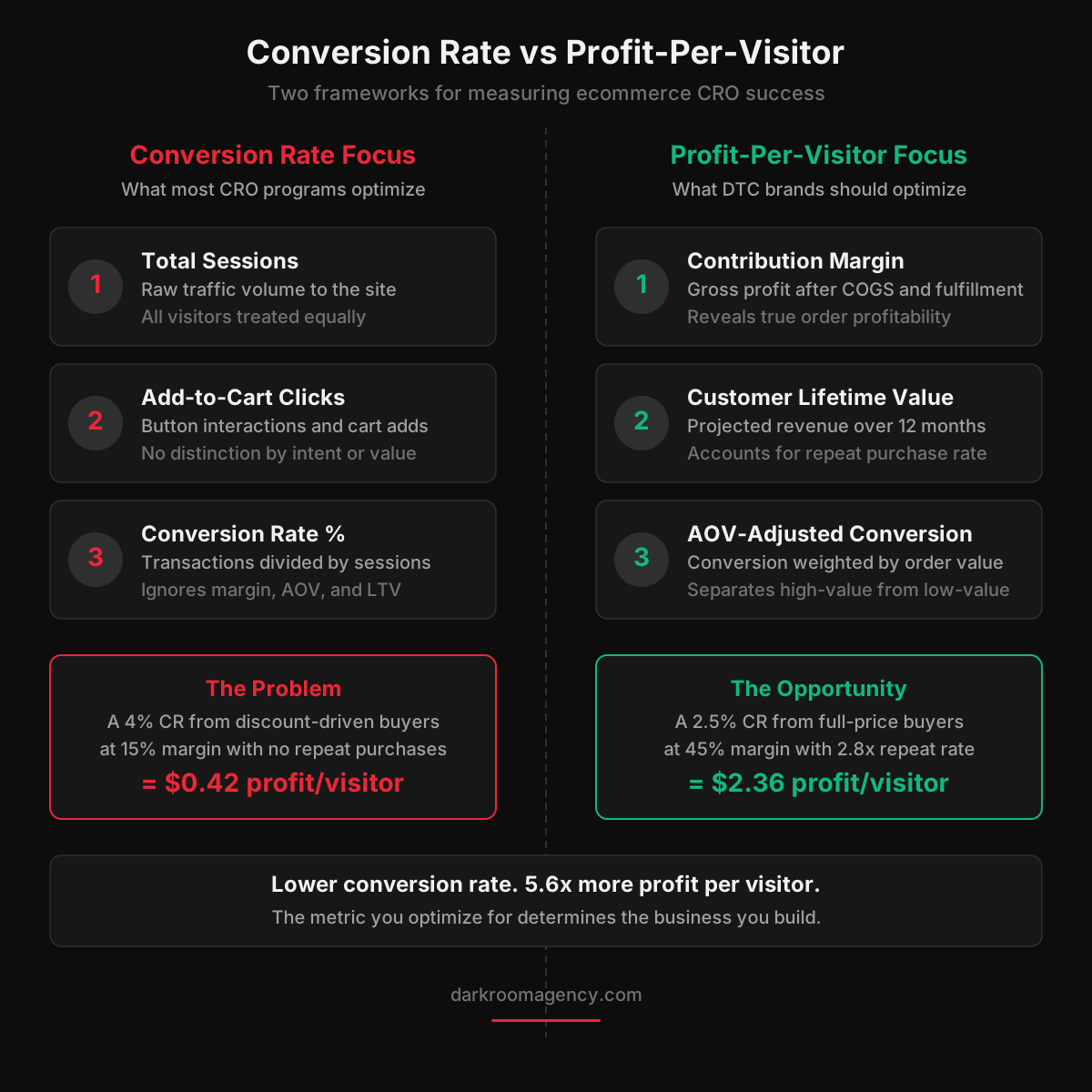
Conversion rate measures one thing. Did a visitor complete a purchase. It says nothing about what they bought, how much they paid, whether they used a discount code, or whether they will ever return. A 4% conversion rate built on 30% off sitewide coupons is worth less than a 2.5% conversion rate built on full-price purchases from customers who come back three times a year. Pairing on-site optimization with retention marketing compounds customer lifetime value beyond the first purchase.
DTC brands operate on thin margins. Customer acquisition costs keep climbing. And the brands winning in 2026 are the ones who stopped chasing conversion rate as an isolated metric and started measuring what actually matters: how much profit each visitor generates across their entire relationship with the brand. For a deeper look at how DTC brands approach this differently, explore our guide on CRO strategies for DTC brands.
This is not a small distinction. It changes everything about how you run tests, design landing pages, build product pages, and allocate budget between performance creative and on-site experience.
Baymard Institute research consistently shows that the average cart abandonment rate sits near 70%. Most brands respond by making checkout easier. But the real question is whether you are attracting the right visitors and presenting the right offers to begin with.
The Profit-Per-Visitor Framework
Profit-per-visitor combines three variables that conversion rate ignores: contribution margin, average order value, and projected lifetime value.
The formula is straightforward. Take your gross margin per order after fulfillment and COGS. Multiply by the average number of orders per customer over 12 months. Divide by the number of unique visitors who entered the funnel. That number is your profit-per-visitor. It tells you how much economic value each session actually creates.
When you optimize for conversion rate alone, you can accidentally destroy profit-per-visitor. A pop-up offering 20% off to first-time visitors will absolutely increase conversion rate. It will also train your audience to wait for discounts, lower your average selling price, and attract bargain hunters who never return. The conversion rate goes up. Profit-per-visitor goes down.
The reverse is also true. Removing discount pop-ups, adding educational content to product pages, and building trust through social proof might temporarily lower conversion rate. But the customers who do convert buy at higher price points, return more often, and generate meaningfully more profit per visitor.
This framework forces you to measure what the business actually needs. Not more transactions. More profitable relationships.
Dimension | Conversion Rate | Profit-Per-Visitor |
|---|---|---|
What It Measures | % of sessions that convert | Net profit generated per site visitor |
Optimizes For | More transactions | Higher margin per session |
Blind Spot | Ignores AOV, margin, and returns | Can miss volume opportunities |
Typical DTC Range | 1.8%–3.5% | $1.20–$4.80 |
Best Used When | Traffic is cheap and abundant | CAC is rising above $45 |
Revenue Impact | +15% revenue (avg CRO program) | +22% profit (avg PPV program) |
Where Traditional Ecommerce CRO Gets It Wrong
The standard CRO playbook was built for lead generation and SaaS. Applying it directly to ecommerce, especially DTC, creates predictable problems.
Problem one is obsessing over landing page conversion without considering post-purchase behavior. Most ecommerce CRO programs test headlines, button colors, and page layouts. These tests can produce statistically significant lifts that have zero impact on actual business performance. A 12% lift in add-to-cart rate means nothing if those additional carts are all discount-driven and have 40% lower margins.
Problem two is treating all traffic sources the same. A visitor from a branded search query has completely different intent than a visitor from a cold Facebook ad. Running the same CRO tests across blended traffic produces misleading results. The winning variant for paid social traffic might be the losing variant for organic and direct.
Problem three is ignoring page speed as a conversion variable. Google Core Web Vitals documentation shows that page load time directly impacts both conversion rate and perceived brand quality. A one-second delay in mobile load time can reduce conversions by up to 20%. Yet most CRO programs add scripts, pop-ups, and third-party tools that make pages slower.
Problem four is running tests without adequate sample size and then acting on noise. DTC brands with moderate traffic need longer test windows to reach statistical significance. Calling tests early leads to implementing changes that were never real winners.
Coordinating CRO with Paid Media Landing Pages
DTC brands spend heavily on paid acquisition. But their CRO programs often operate in complete isolation from their media buying teams. This is why full-funnel marketing systems connect CRO to acquisition and retention in a single growth engine.
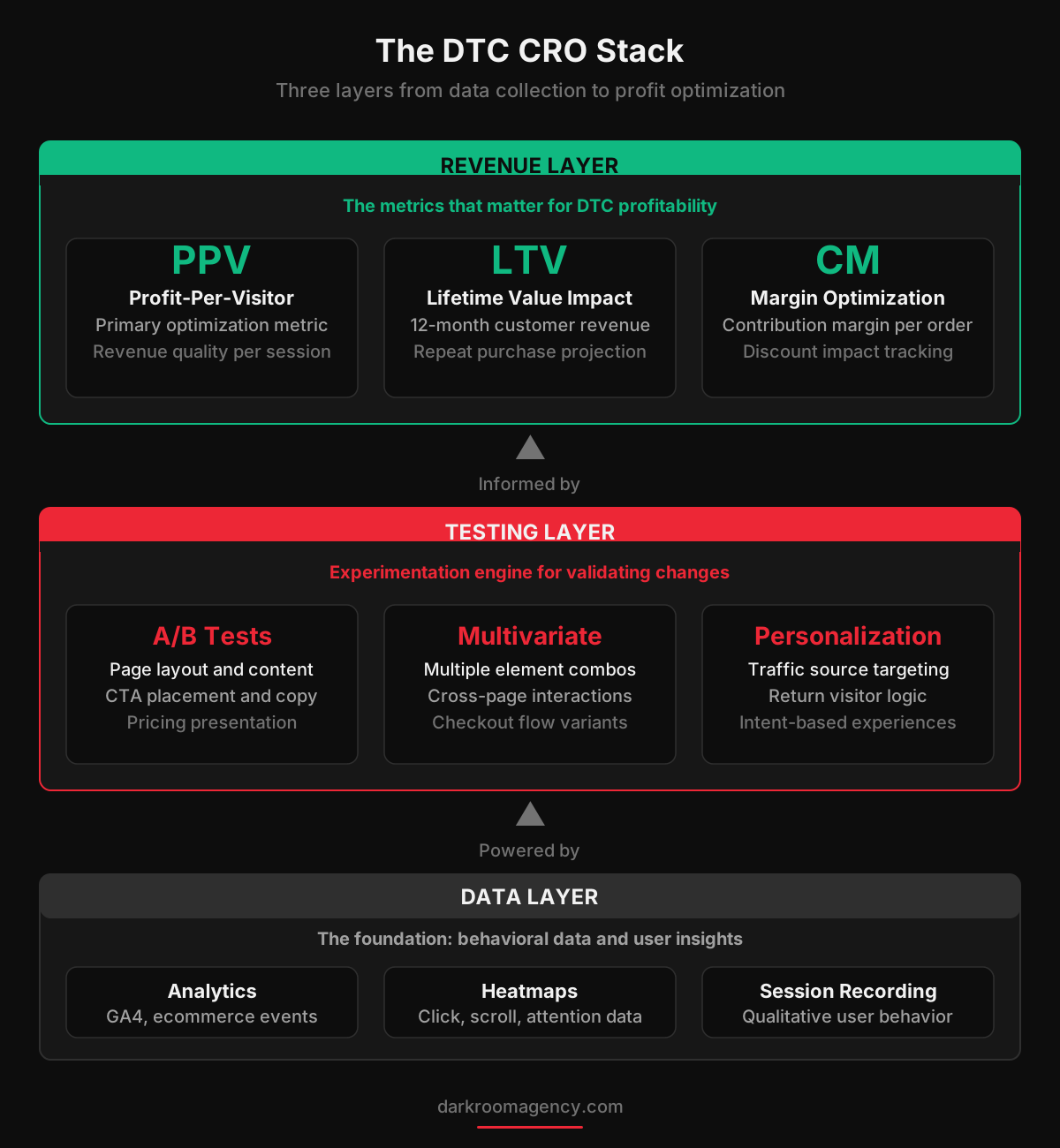
This disconnect is expensive. Your paid media team optimizes ad creative and targeting for click-through rate and cost per click. Your CRO team optimizes on-site experience for conversion rate. Nobody is optimizing the full funnel from impression through to profitable customer. When landing page tests inform ad creative, performance creative systems that scale become the bridge between media spend and profit.
The fix requires shared metrics. Both teams need to see profit-per-visitor by traffic source, by campaign, and by landing page variant. When your media team knows that one creative attracts visitors who generate $2.40 in profit per session while another attracts visitors who generate $0.80, they can allocate budget accordingly. When your CRO team knows which traffic sources respond to which page variations, they can build personalized experiences that match visitor intent. Organic traffic quality matters too—read our analysis of ecommerce SEO and category page rankings to understand how search intent shapes on-site performance.
Dedicated landing pages for paid traffic outperform sending ads to generic collection pages. But only when those landing pages are designed with profit-per-visitor in mind, not just conversion rate. A landing page that converts at 5% but drives mostly first-order-only customers at a 15% margin is worse than one that converts at 3% but drives repeat customers at a 45% margin.
The brands getting this right build CRO programs that share data bidirectionally with their media teams. And they measure success at the campaign-to-customer level, not the session level.
Balancing Brand Experience with Conversion Pressure
Every DTC brand faces the same tension. Push too hard for conversion and you erode the brand experience that justifies premium pricing. Push too little and you leave revenue on the table.
The generic CRO advice is to reduce friction everywhere. Remove navigation. Shorten forms. Add urgency. This works for commodity products. It backfires for premium DTC brands where the buying experience is part of the value proposition.
A luxury skincare brand that plasters countdown timers and "only 3 left" badges across their site will convert more visitors today. They will also damage the brand perception that allows them to charge $80 for a moisturizer. The short-term conversion lift creates long-term pricing pressure.
The profit-per-visitor framework resolves this tension. When you measure total customer value instead of single-session conversion, you can justify investing in brand experience elements that lower immediate conversion rate but increase customer lifetime value.
This means testing differently. Instead of measuring whether a test increases conversion rate over two weeks, measure whether it increases profit-per-visitor over 60 or 90 days. Add educational content to product pages and track whether it increases repeat purchase rates. Build an immersive brand experience and measure whether it increases average order value. Remove discount pop-ups and watch whether full-price conversion rates and customer retention both improve.
Hotjar CRO benchmark data shows that the highest-performing ecommerce sites typically have fewer conversion elements on-page, not more. Quality over quantity applies to conversion tactics as much as it does to products.
Building a Testing Program That Measures Profit
Most A/B testing programs declare winners based on conversion rate. Shifting to profit-per-visitor changes how you design, run, and evaluate every test.
Start by tagging every test variant with downstream revenue data. This means connecting your testing platform to your analytics, your CRM, and your order management system. You need to track not just whether a visitor converted but what they bought, at what margin, and whether they came back.
Structure tests in three tiers. Tier one tests are quick-win tactical changes like CTA copy, image placement, and form fields. These can still be evaluated on conversion rate because the changes are too small to affect customer quality. Tier two tests are structural changes like page layout, pricing presentation, and checkout flow. These need profit-per-visitor measurement over 30 days. Tier three tests are strategic changes like removing discounts, adding educational content, or fundamentally restructuring the product page. These need 60-to-90-day measurement windows with full downstream revenue tracking.
The testing cadence changes too. Instead of running 20 small tests per month, run fewer tests with longer windows and deeper measurement. Three well-designed tests that measure profit-per-visitor will generate more business value than 20 tests that measure button click rates.
And invest in the data infrastructure. You cannot measure profit-per-visitor without clean data connecting sessions to orders to customers to lifetime value. This is the foundation that makes real CRO possible. Without it, you are optimizing in the dark.
The 90-Day CRO Implementation Roadmap
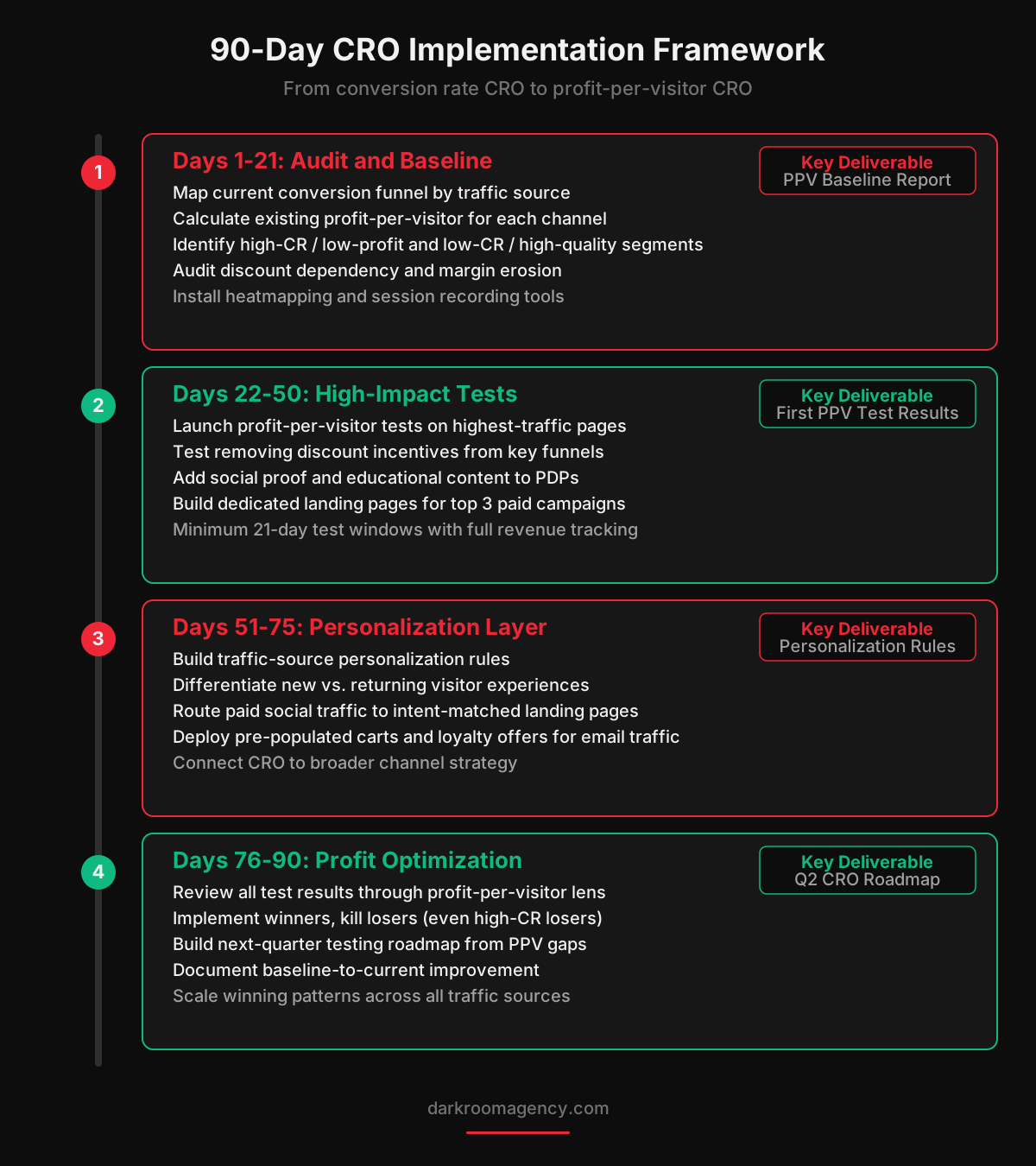
Shifting from conversion-rate CRO to profit-per-visitor CRO does not happen overnight. Here is a practical 90-day framework for making the transition.
Days 1-21: Audit and baseline. Map your current conversion funnel by traffic source. Calculate your existing profit-per-visitor for each major channel: organic, direct, paid social, paid search, email. Identify where you are generating high conversion rates but low profit and where you are generating low conversion rates but high customer quality. Audit your current testing program for discount dependency and margin erosion. Install heatmapping and session recording if you have not already.
Days 22-50: High-impact testing. Launch your first profit-per-visitor tests. Start with the highest-traffic, lowest-margin pages. These are the pages where conversion rate optimization has been most actively destroying profitability. Test removing discount incentives. Test adding social proof and educational content. Test dedicated landing pages for your top three paid campaigns. Run each test for a minimum of 21 days with full revenue tracking.
Days 51-75: Personalization layer. Build basic personalization rules based on traffic source. Returning visitors see different experiences than new visitors. Paid social traffic lands on intent-matched pages instead of generic collections. Email traffic sees pre-populated carts and loyalty offers. This layer connects your CRO program to your broader conversion optimization strategy across channels.
Days 76-90: Profit optimization and scaling. Review all test results through the profit-per-visitor lens. Implement winners. Kill losers, even if they had higher conversion rates. Build your testing roadmap for the next quarter based on where the biggest profit-per-visitor gaps remain. Document your baseline-to-current improvement for stakeholder reporting. Forrester research on customer experience confirms that brands investing in experience quality over conversion quantity see sustained revenue improvements that compound over time.
Phase | Timeline | Focus | Key Actions |
|---|---|---|---|
Audit | Days 1–14 | Baseline PPV calculation | Map margin by SKU, tag sessions by source, establish PPV by channel |
Quick Wins | Days 15–30 | Cart and checkout | Shipping threshold tests, upsell module, payment option expansion |
Testing | Days 31–60 | PDP and collection pages | Price anchoring, bundle offers, urgency elements — A/B tested against PPV |
Scale | Days 61–90 | Full-funnel PPV optimization | Personalized offers by segment, dynamic pricing rules, LTV-based bidding |
What Separates Brands That Get CRO Right
The difference between brands that extract real value from CRO and brands that just run tests is not tools or tactics. It is operating model. Understanding the distinction between growth marketing versus performance marketing helps determine which CRO metrics matter most for your business model.
Brands that get CRO right have shared metrics between acquisition and on-site teams. They measure profit, not just conversion. They run fewer, better tests with longer measurement windows. They treat CRO as a revenue discipline, not a design discipline. The same measurement problem applies to acquisition channels—see why paid media fails when measured by platform metrics for the full breakdown.
Brands that struggle treat CRO as a checklist. They hire an agency to run A/B tests. They celebrate conversion rate lifts without checking whether those lifts translated to actual profit. They optimize in silos where the CRO team has never spoken to the media buying team.
The operational shift is simple to describe and hard to execute. It requires breaking down team silos, investing in data infrastructure, and accepting that some tests will take months to properly evaluate. Most brands default to the easy version because quarterly pressure demands fast results.
But the brands building durable competitive advantages through CRO are the ones willing to measure what matters. Profit-per-visitor is harder to optimize than conversion rate. That is exactly why it works. Revenue-focused CRO compounds in ways that checklist CRO never will.
Choosing the Right CRO Partner for DTC
Not every CRO agency or consultant operates with a profit-per-visitor mindset. Most still sell conversion rate lifts as the primary deliverable.
When evaluating a CRO partner, ask three questions. First, how do they measure test success? If the answer is conversion rate alone, keep looking. You need a partner who measures downstream revenue impact across at least a 30-day window. Second, do they have experience with DTC brands specifically? CRO for a SaaS product is fundamentally different from CRO for a $60 apparel brand that needs repeat purchases to achieve profitability. Third, how do they coordinate with paid media? If the CRO program operates independently from your acquisition strategy, you are paying for optimization theater.
The right partner brings a full-service perspective that connects CRO to acquisition, retention, and brand strategy. They do not just test page elements. They architect the on-site experience around your unit economics and growth model.
This is what separates tactical CRO from strategic CRO. Tactical CRO makes pages convert better. Strategic CRO makes the business more profitable.
FAQ
What is profit-per-visitor and how is it different from conversion rate?
Profit-per-visitor measures the actual economic value generated per site visit by accounting for contribution margin, average order value, and customer lifetime value. Conversion rate only measures whether a purchase happened, ignoring the quality and profitability of that transaction.
Can we still use conversion rate as a metric if we adopt this framework?
Yes. Conversion rate remains useful as a directional indicator, especially for small tactical tests. But it should not be your primary success metric. Use it as one input alongside margin, AOV, and repeat purchase rate when evaluating test results.
How much traffic do we need to run profit-per-visitor tests?
You need enough traffic to reach statistical significance within a reasonable test window, typically 21 to 30 days for structural tests. For most DTC brands, that means at least 10,000 unique sessions per month on the pages being tested. Brands with lower traffic should run fewer, higher-impact tests with longer windows.
Does this approach work for low-AOV products?
It works especially well for low-AOV products because those brands depend on repeat purchases to reach profitability. Optimizing for profit-per-visitor naturally pushes you toward strategies that increase customer retention and lifetime value rather than just first-order conversion.
What tools do we need to measure profit-per-visitor?
At minimum you need a testing platform, analytics with enhanced ecommerce tracking, and a way to connect session data to customer-level revenue over time. Most brands use a combination of Google Analytics, a dedicated A/B testing tool, and their ecommerce platform's reporting. The data infrastructure matters more than any individual tool.
How long does it take to see results from switching to profit-per-visitor CRO?
Initial audit and baseline take about three weeks. First meaningful test results appear in 45 to 60 days. Full program impact with compounding gains typically shows up in the 90-to-120-day range. This is slower than chasing conversion rate but produces durable improvements.
Should we stop offering discounts entirely?
Not necessarily. Strategic discounting has a place, especially for inventory management and seasonal campaigns. The problem is structural discount dependency where discounts become the default conversion mechanism. Test reducing discount frequency and depth while measuring whether full-price conversion rate and customer quality improve.
How does CRO connect to paid media strategy?
CRO and paid media should share data on profit-per-visitor by traffic source and campaign. Your media team needs to know which audiences convert profitably on-site, and your CRO team needs to know which traffic sources need different on-site experiences. This bidirectional data flow is what makes both programs more effective.
Ready to build a CRO program that optimizes for profit, not just conversion rate? Book a call with Darkroom to start.