
CONVERSION RATE OPTIMIZATION
What CRO Marketing Actually Means for DTC Brands




Written by Darkroom leardership

CONVERSION RATE OPTIMIZATION
Written & peer reviewed by 4 Darkroom team members
TL;DR
CRO marketing has been reduced to button color tests and headline swaps. For DTC brands, that version of conversion rate optimization barely moves the needle. Real CRO means optimizing the entire conversion path from the moment someone clicks an ad through landing page experience, product page persuasion, checkout completion, and post-purchase retention. It is a revenue discipline that connects every touchpoint to the P&L, not a testing discipline that generates activity reports. The brands winning with CRO in 2026 measure revenue per visitor, not just conversion rate. They test with margin awareness and build compounding systems instead of running isolated experiments. Darkroom builds CRO programs around this principle for DTC brands at every growth stage.
The Problem with How CRO Marketing Gets Defined
Search for CRO marketing and you will find the same definition repeated across hundreds of articles. Conversion rate optimization is the process of increasing the percentage of website visitors who take a desired action. This is supported by our research on full-funnel marketing for ecommerce growth. That definition is technically correct and practically useless for DTC brands trying to grow profitably.
The standard CRO playbook was built for SaaS companies and lead generation businesses where the desired action is a form submission or free trial signup. In those contexts, conversion rate is a reasonable proxy for business value because every lead enters the same funnel with roughly the same potential value. Read more in our article on conversion optimization tactics for inbound leads. Increasing the percentage of visitors who convert directly increases pipeline.
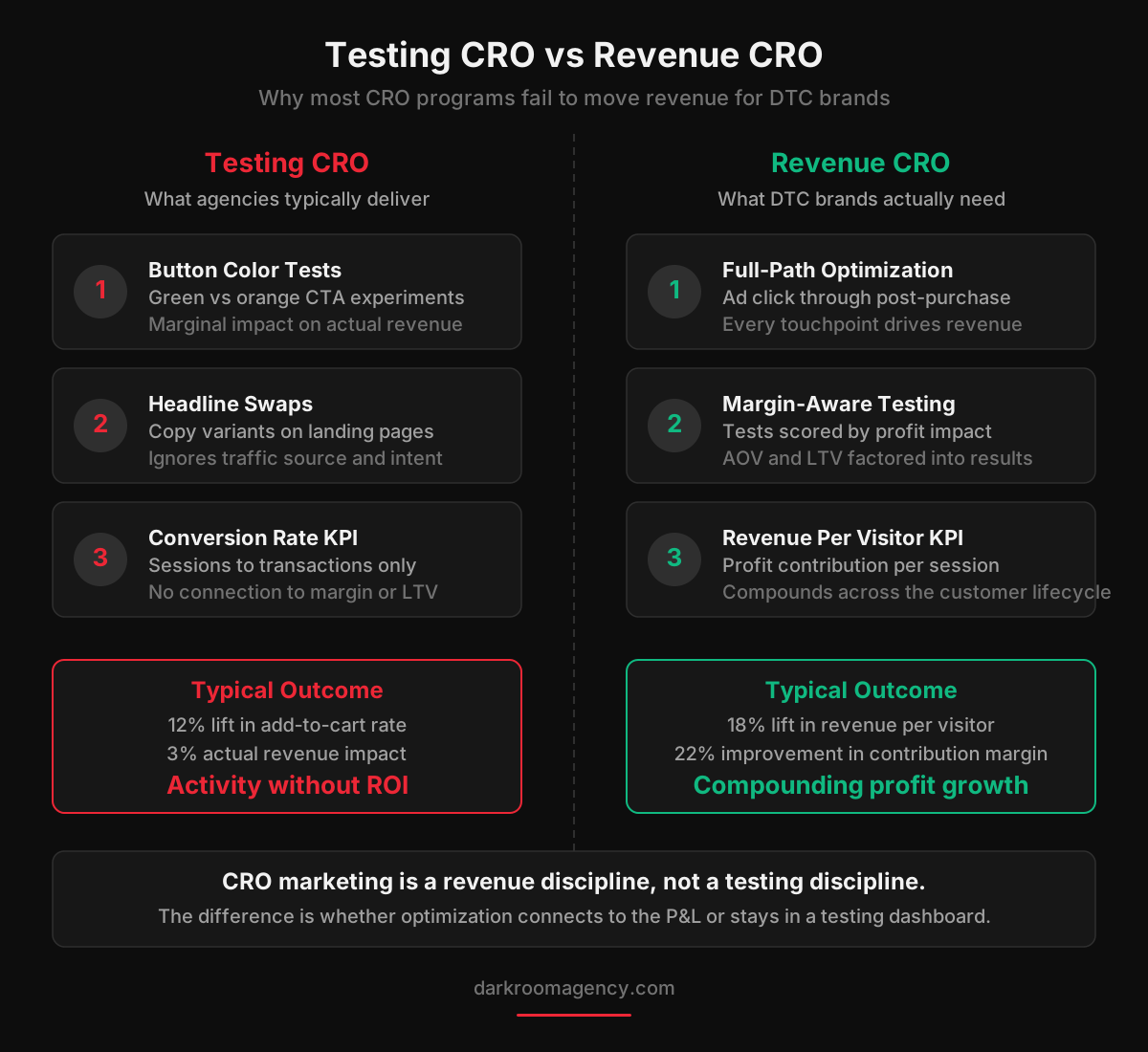
DTC ecommerce does not work this way. A conversion from a discount-driven first-time buyer at 15% margin who never returns is fundamentally different from a full-price purchase by someone who will buy three more times this year. Both count as conversions. One is worth 5x more than the other. Treating them as equivalent is the foundational mistake that makes most CRO marketing programs ineffective for direct-to-consumer brands.
This matters because CRO budgets are growing. Brands are hiring agencies, licensing testing platforms, and dedicating headcount to optimization. But when the entire program is oriented around a single metric that fails to distinguish between high-value and low-value conversions, the investment produces activity without meaningful returns.
Dimension | Testing CRO | Revenue CRO |
|---|---|---|
Focus | Conversion rate percentage | Revenue per visitor |
Method | A/B test everything | Prioritize by revenue impact |
Metric | Statistical significance | Incremental profit per test |
Timeline | Test cycles of 2–4 weeks | Continuous compounding optimization |
Team | CRO specialist running tests | Cross-functional (analytics, design, dev, copy) |
Outcome | Higher conversion rate | Higher AOV, LTV, and margin |
Why DTC Brands Need a Different CRO Framework
DTC brands face a specific set of economic constraints that make traditional CRO insufficient. Customer acquisition costs on Meta and Google continue to rise. Privacy changes have made targeting less precise. And competition in most DTC categories means that margins are under constant pressure from new entrants willing to operate at break-even to buy market share.
In this environment, the brands that survive and grow are the ones extracting maximum value from every visitor they acquire. That requires a fundamentally different approach to CRO marketing. Instead of optimizing for the highest possible conversion rate, you optimize for the highest possible revenue per visitor.
Revenue per visitor accounts for conversion rate, average order value, and margin in a single metric. A brand with a 2.5% conversion rate, $95 AOV, and 48% contribution margin generates more value per visitor than a brand with a 4% conversion rate, $55 AOV, and 22% margin. The first brand can afford higher acquisition costs, invest more in retention, and compound growth faster.
This is not an abstract distinction. It changes your testing priorities, your page design decisions, and how you allocate budget between acquisition and retention. When you optimize for revenue per visitor, you stop testing button colors and start testing pricing presentation, product bundling strategies, and post-purchase upsell sequences.
Baymard Institute research consistently shows cart abandonment rates near 70% across ecommerce. Most CRO programs respond by reducing checkout friction. Revenue-focused CRO asks a harder question first: are you attracting visitors with purchase intent, presenting offers that match their needs, and pricing in a way that protects margin?
The Full Conversion Path That CRO Marketing Should Cover
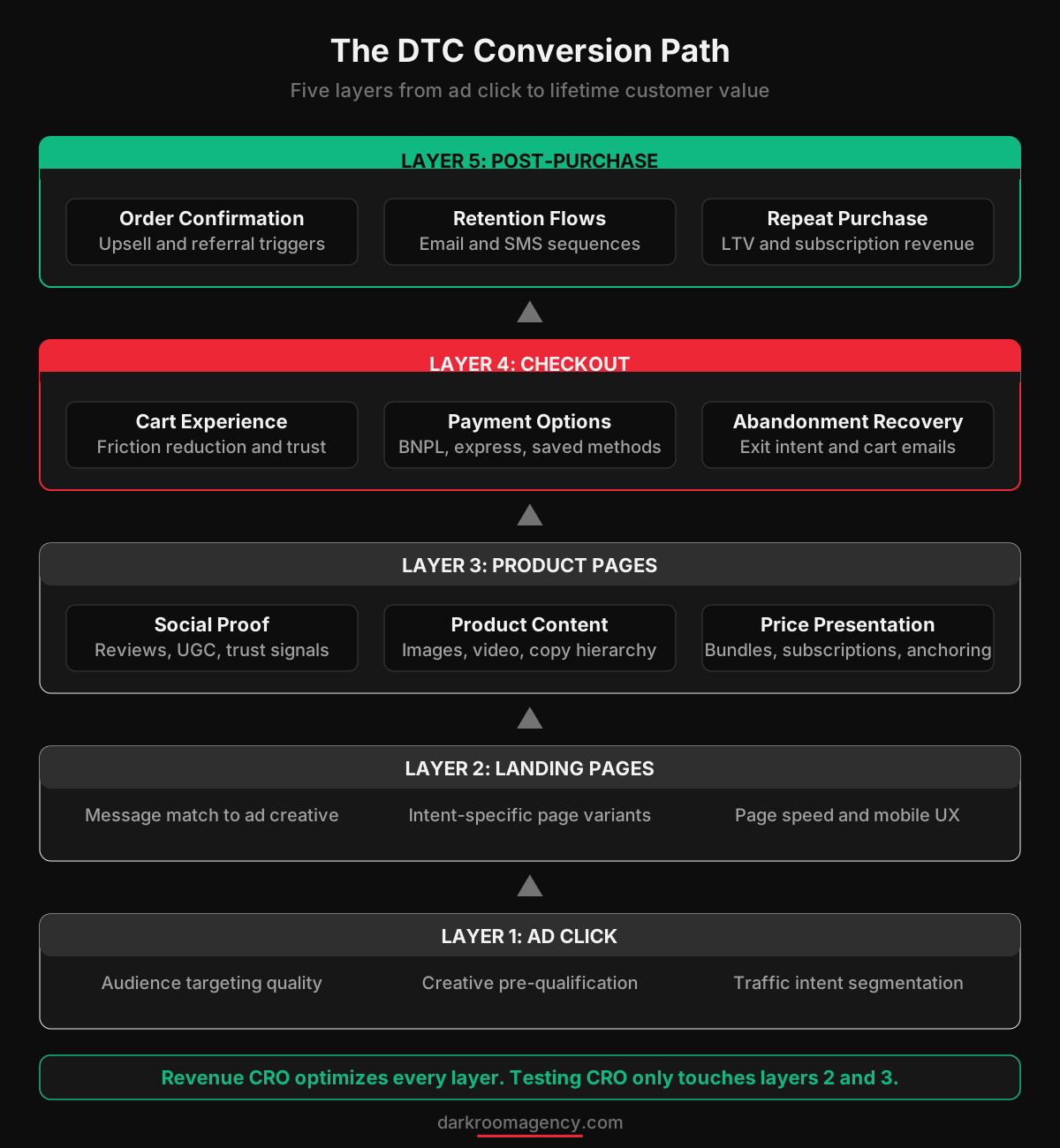
Real CRO marketing for DTC brands covers five distinct stages. Most programs only touch two of them. For a deeper dive, see our breakdown of growth marketing vs performance marketing.
The first stage is the ad click itself. CRO starts before someone reaches your site. The quality of traffic you acquire determines the ceiling for everything that follows. If your paid media is driving low-intent browsers with broad targeting, no amount of landing page optimization will fix the downstream conversion problem. Creative pre-qualification, audience segmentation by intent, and message alignment between ad and landing page are all CRO decisions.
The second stage is the landing page. This is where most CRO programs start and where many of them end. Landing page optimization matters, but only when connected to the traffic source feeding it. A single landing page cannot serve Meta retargeting traffic, Google search traffic, and email traffic equally well. Each audience arrives with different intent, different familiarity with your brand, and different sensitivity to price. Revenue-focused CRO builds distinct landing experiences for distinct traffic segments.
The third stage covers product pages. Product page optimization goes beyond layout testing. It includes social proof strategy, image and video hierarchy, price anchoring and presentation, bundle and subscription options, and how you handle objection resolution. The product page is where margin is won or lost. This is where you test whether subscription framing increases LTV, whether bundle options raise AOV, and whether UGC placement increases conversion without requiring a discount.
The fourth stage is checkout. Checkout optimization is the most technically measurable part of CRO and often the highest-leverage. Hotjar and similar behavior analytics tools reveal exactly where visitors abandon during checkout. Payment option availability, shipping cost presentation, trust signal placement, and guest checkout flow all have measurable impact on completion rate.
The fifth stage is post-purchase. This is the stage that separates testing CRO from revenue CRO. What happens after someone buys determines whether that customer generates one transaction or ten. Order confirmation page upsells, post-purchase email sequences, loyalty program enrollment, and reorder reminders are all conversion optimization opportunities that most CRO programs ignore entirely.
Where Most CRO Programs Fall Short for DTC
The gap between testing CRO and revenue CRO shows up in three common failure patterns.
The first failure is optimizing for conversion rate without margin awareness. A test that increases conversion rate by 15% through a more aggressive discount popup has objectively made the business worse if it reduces average margin per order by 20%. Most testing platforms do not connect to margin data. They report conversion lifts and revenue lifts, but not profitability lifts. The test "wins" in the platform but loses in the P&L.
The second failure is testing in isolation from the acquisition channel. A landing page test that performs well with organic search traffic may perform terribly with paid social traffic because the visitor intent profile is completely different. CRO programs that run tests without segmenting by traffic source produce results that are statistically significant but operationally misleading. The winning variant for one audience is the losing variant for another. Ecommerce CRO best practices require traffic-aware testing.
The third failure is stopping at the transaction. Every CRO report shows the same funnel: visitors, add-to-cart, initiate checkout, purchase. The funnel ends at purchase because that is where the testing platform stops measuring. But for DTC brands, the purchase is the beginning of the customer relationship, not the end. Post-purchase optimization, including upsell conversion, reorder rate, and subscription enrollment, generates more cumulative revenue than any pre-purchase test ever will.
These failures are structural. They come from applying a framework designed for one business model to a fundamentally different one. Fixing them requires changing what you measure, what you test, and how you evaluate results.
How to Build a Revenue-Focused CRO Program
Building a CRO program that actually moves revenue for DTC brands requires changes at three levels: measurement, testing strategy, and organizational structure. Our article on building a performance creative system that scales covers the framework in detail.
At the measurement level, you need to track revenue per visitor as your primary optimization metric. This means connecting your analytics platform to your ecommerce backend so that every test can be evaluated not just by conversion rate but by average order value, contribution margin, and projected lifetime value of the customers it acquires. Google Analytics 4 supports ecommerce event tracking that makes this possible, but most brands have not configured it properly.
At the testing strategy level, you need to prioritize tests by estimated revenue impact rather than ease of implementation. Button color tests are easy to run. Checkout flow restructuring is harder. But the checkout test will generate 10x the revenue impact of the button test. A proper CRO roadmap ranks every potential test by the revenue lever it touches and the estimated size of the opportunity. High-impact tests on high-traffic pages get priority regardless of implementation complexity.
At the organizational level, CRO needs to sit between acquisition and retention, not inside one or the other. When CRO reports to the paid media team, it optimizes for acquisition metrics. When it reports to the retention team, it optimizes for repeat purchase metrics. Revenue-focused CRO requires a cross-functional view that connects performance creative, landing page experience, product page conversion, checkout completion, and post-purchase retention into a single optimization system.
This is the organizational shift that most brands resist because it requires collaboration between teams that traditionally operate independently. But it is the only structure that produces compound revenue gains from CRO investment.
The CRO Metrics That Actually Matter for DTC
If conversion rate is the wrong north star, what should you measure instead? Five metrics form the foundation of revenue-focused CRO for DTC brands.
Revenue per visitor is the primary metric. It tells you how much economic value each session creates. When this number goes up, the business is getting more efficient at converting traffic into revenue regardless of whether the conversion rate itself changed.
Contribution margin per order tracks profitability at the transaction level. A CRO test that raises conversion rate while decreasing margin per order is destroying value. Every test result should be evaluated against this metric to ensure optimization is not coming at the expense of profitability.
Average order value by traffic source reveals whether your landing page and product page experiences are maximizing basket size for each audience segment. Paid social visitors and organic search visitors have different purchase patterns. Tracking AOV by source tells you where bundle offers, upsells, and subscription options are working and where they are not.
Cart-to-purchase completion rate isolates checkout performance from the rest of the funnel. This metric tells you specifically how effective your checkout experience is at converting intent into transactions. It is the most actionable metric for immediate revenue gains because checkout improvements affect every visitor who adds to cart.
90-day customer value measures the post-purchase impact of your CRO changes. Did the visitors acquired through an optimized landing page return and buy again? Did the subscription option you tested on the product page actually generate recurring revenue? This metric closes the loop between CRO testing and business outcomes. VWO research on CRO programs that track downstream metrics shows they generate significantly higher returns than programs that stop measuring at the initial conversion.
Metric | What It Measures | Target Range | Why It Matters |
|---|---|---|---|
Revenue Per Visitor | Total revenue divided by sessions | $3–$8 for DTC | Captures AOV + CVR in one number |
Add-to-Cart Rate | Visitors who add an item to cart | 8–12% | Leading indicator of purchase intent |
Cart Completion Rate | Carts that convert to orders | 45–65% | Reveals checkout friction and trust gaps |
Profit Per Visitor | Gross margin per session | $1.50–$4 | Prevents optimizing for low-margin conversions |
Return Customer Rate | Percentage of repeat purchasers | 25–40% | Signals product-market fit and CX quality |
Average Order Value | Revenue per transaction | Varies by category | Directly multiplies revenue without more traffic |
Implementing CRO Marketing in 90 Days
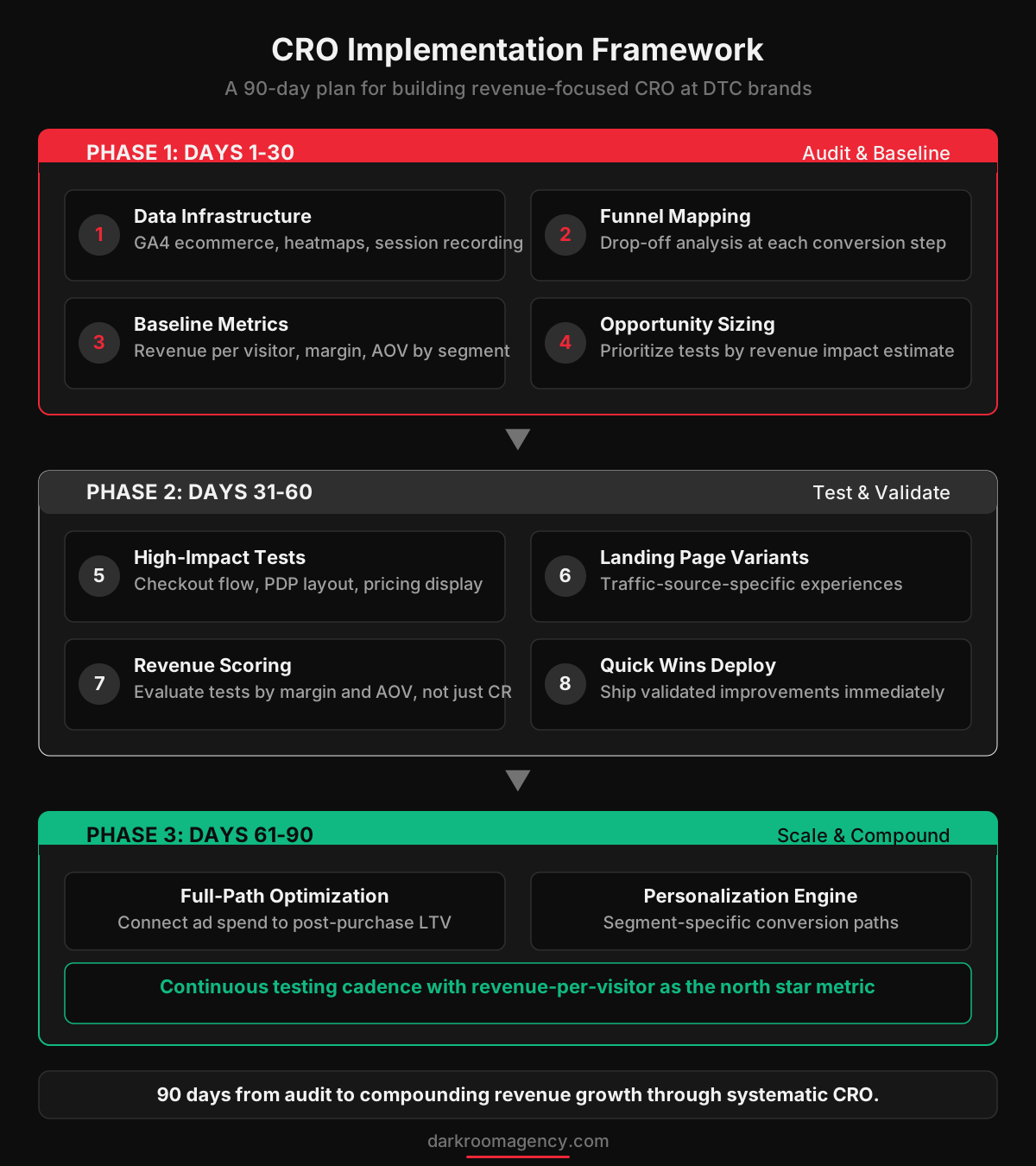
A practical implementation timeline for revenue-focused CRO breaks into three phases across 90 days. We explored this concept further in our piece on ecommerce SEO category page rankings in 2026.
Days 1 through 30 focus on audit and baseline. Install behavioral analytics tools if you have not already. Configure GA4 ecommerce tracking with enhanced measurement. Map your complete funnel from ad impression through 90-day post-purchase behavior. Establish baseline metrics for revenue per visitor, contribution margin per order, AOV by traffic source, and cart-to-purchase completion rate. Identify the biggest drop-off points and size the revenue opportunity at each stage.
Days 31 through 60 focus on testing and validation. Launch tests against the highest-impact opportunities identified in the audit. These should be real structural tests, not surface-level copy changes. Test checkout flow changes, product page layout and pricing presentation, landing page variants by traffic source, and post-purchase upsell sequences. Evaluate every test by its impact on revenue per visitor, not just conversion rate. Ship validated improvements immediately. Do not batch them for a quarterly release.
Days 61 through 90 focus on scaling and compounding. Connect your CRO insights to your media and retention teams. Share data on which traffic sources produce the highest-value visitors so media can optimize targeting. Share data on which product page variants drive the highest repeat purchase rate so retention can adjust their messaging. Build a personalization layer that serves different experiences to different visitor segments based on traffic source, visit history, and purchase behavior.
This 90-day framework produces measurable revenue impact within the first cycle and compounds with each subsequent cycle as you build a deeper understanding of what drives value across the full conversion path.
What Separates Good CRO from Great CRO for DTC
Good CRO runs tests and implements winners. Great CRO builds a system that continuously identifies, tests, and deploys revenue-generating improvements across the entire customer journey.
The difference is structural. Good CRO programs maintain a testing backlog, run 2 to 4 tests per month, and report results monthly. Great CRO programs connect testing to media performance data, segment results by customer cohort, feed insights back into creative and retention strategy, and measure success over 90-day windows rather than test-by-test.
Great CRO also requires the right data infrastructure. You cannot measure revenue per visitor without clean data connecting sessions to orders to customers to lifetime value. Most DTC brands have gaps in this data chain. Their analytics tracks sessions and transactions, but the connection to margin data lives in a separate system. Customer lifetime value calculations live in another system entirely. Bridging these data sources is the foundational investment that makes revenue-focused CRO possible.
The brands building durable competitive advantages through CRO marketing are the ones willing to measure what matters. Revenue per visitor is harder to optimize than conversion rate. It requires more data, more coordination between teams, and more sophisticated testing. That difficulty is the moat. The brands that invest in this capability compound their advantage every quarter while competitors chase conversion rate lifts that never reach the bottom line.
Frequently Asked Questions
What is CRO marketing and how does it apply to DTC brands?
CRO marketing is the practice of systematically improving the percentage of visitors who complete a desired action on your website. For DTC brands, it should go beyond basic conversion rate improvement to optimize the entire path from ad click through post-purchase. For related analysis, read our guide on creative fatigue and performance testing frameworks. The goal is maximizing revenue per visitor, not just increasing the raw conversion percentage, because DTC economics depend on margin, AOV, and customer lifetime value.
How is CRO marketing different from A/B testing?
A/B testing is one tactic within CRO marketing, not the whole discipline. CRO marketing includes funnel analysis, behavioral research, user experience optimization, personalization, and post-purchase optimization in addition to testing. Brands that equate CRO with A/B testing typically test low-impact variables like button colors while ignoring high-impact structural improvements to checkout flow, pricing presentation, and profit-per-visitor optimization.
What tools do I need for CRO marketing?
At minimum, you need analytics (GA4 with ecommerce tracking), behavioral analytics (heatmaps and session recording from a tool like Hotjar), and a testing platform. Beyond tools, you need clean data connecting sessions to orders to customer lifetime value. Many brands have the tools but lack the data infrastructure to evaluate tests by revenue impact rather than just conversion rate.
How long does it take to see results from a CRO marketing program?
A properly structured CRO program should produce measurable results within 60 to 90 days. The first 30 days focus on data collection and audit. Testing begins in month two, and validated improvements should generate measurable revenue lifts by the end of month three. The compounding effect grows over time as each testing cycle builds on insights from previous cycles.
Should CRO marketing focus on new customer acquisition or returning customers?
Both. The conversion path for new visitors and returning visitors is fundamentally different. New visitors need trust signals, social proof, and clear value propositions. Returning visitors need personalized recommendations, loyalty incentives, and frictionless reordering. Revenue-focused CRO builds distinct optimization strategies for each segment rather than treating all traffic identically.
How much should a DTC brand invest in CRO marketing?
Most DTC brands should allocate 5% to 10% of their digital marketing budget to CRO. The ROI typically exceeds paid media investment because CRO improvements compound across all traffic sources. A 15% improvement in revenue per visitor increases the return on every dollar spent on acquisition, making your media budget more efficient without spending more.
What is the biggest mistake DTC brands make with CRO marketing?
The biggest mistake is optimizing for conversion rate without accounting for margin and customer quality. A 20% lift in conversion rate driven by aggressive discounting can actually decrease profitability. The second most common mistake is running tests in isolation from the acquisition channel, producing results that look significant in a testing dashboard but fail to translate into business outcomes.
Build a CRO Program That Moves Revenue
CRO marketing is one of the highest-leverage investments a DTC brand can make, but only when it is structured as a revenue discipline rather than a testing exercise. The difference between brands that generate meaningful returns from CRO and brands that generate testing reports is whether optimization connects to the P&L at every level. Book a call with Darkroom to build a CRO program that optimizes for revenue per visitor across the full conversion path.