
RETENTION MARKETING
Ecommerce Email Marketing: The Revenue Architecture Most Brands Miss




Written by Darkroom leardership

RETENTION MARKETING
Written & peer reviewed by 4 Darkroom team members
TL;DR
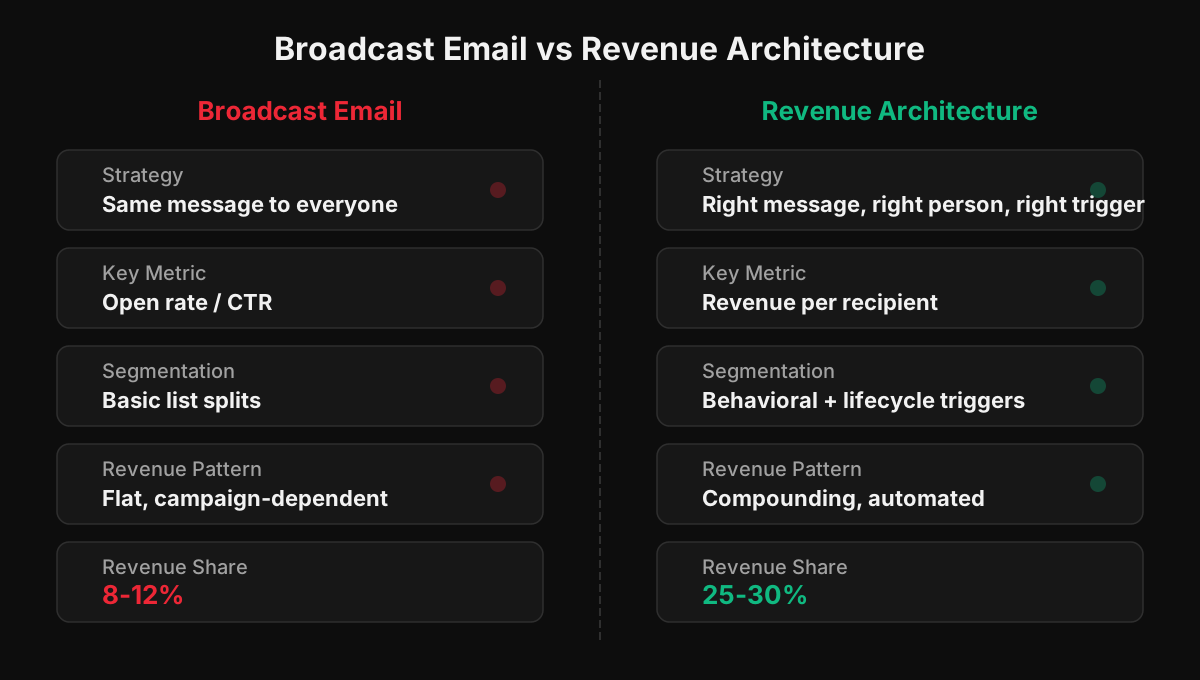
Most ecommerce brands treat email marketing as a broadcast channel. They send campaigns, track open rates, and wonder why email only contributes 8-12% of revenue. The brands generating 25-30% from email have built something fundamentally different: a revenue architecture with behavioral segmentation, automated trigger logic, lifecycle journeys, and journey branching that responds to what customers actually do. The gap is not creative or copy. It is infrastructure. This article maps the five layers of ecommerce email architecture and shows you how to build each one. Learn how Darkroom builds email revenue architecture for ecommerce brands.
The Broadcast Problem That Keeps Email Revenue Flat
Ecommerce email marketing has a ceiling problem. Most brands hit it early and never understand why. For a deeper analysis, read our guide on why loyalty programs fail without retention infrastructure.
The pattern is predictable. A brand launches its ecommerce store. It collects email addresses through popups, checkout opt-ins, and paid acquisition. It starts sending campaigns. Weekly promotions. Product launches. Holiday sales. The list grows. Send volume increases. Revenue from email sits at 8-12% of total. Sometimes it bumps to 14% during a big sale. Then it falls back. This concept is explored further in our breakdown of customer loyalty programs that drive repeat revenue.
The marketing team responds the way most teams do. They test subject lines. They experiment with send times. They redesign templates. They add more campaigns to the calendar. Open rates fluctuate between 15-25%. Click-through rates hover around 2-4%. Revenue per email barely moves. The team is working harder without getting meaningfully different results.
This is the broadcast problem. When every subscriber receives essentially the same message on essentially the same schedule, the ceiling is built into the model. A first-time buyer and a five-time repeat customer see the same Tuesday promotion. Someone who abandoned their cart yesterday gets the same newsletter as someone who has not visited the site in four months. The new subscriber who signed up for a discount and the loyal customer who buys every month receive identical treatment.
Broadcast email is not bad email marketing. It is incomplete email marketing. And the gap between incomplete and architected is where most of the revenue lives.
According to Klaviyo's ecommerce benchmarks, automated flows generate 3-5x more revenue per recipient than broadcast campaigns. That multiplier is not a creative advantage. It is a structural one. Flows respond to behavior. Broadcasts respond to a calendar. Behavior-driven messages are inherently more relevant, better timed, and more likely to convert because they reach people at moments of actual intent.
Level | Description | Revenue Contribution | Key Capability |
|---|---|---|---|
Level 1: Foundational | Basic welcome email and manual campaigns only | 5–10% of ecommerce revenue | ESP setup with basic segmentation |
Level 2: Automated | Core flows live — welcome, cart abandon, post-purchase | 15–25% of ecommerce revenue | Behavioral triggers and flow branching |
Level 3: Optimized | Full flow suite with A/B testing and advanced segments | 25–35% of ecommerce revenue | Predictive analytics and dynamic content |
Level 4: Revenue Engine | Email as a profit center with lifecycle orchestration | 35–50% of ecommerce revenue | Cross-channel attribution and LTV modeling |
What Revenue Architecture Actually Means for Ecommerce Email
Architecture is the difference between sending emails and building a system that generates revenue while you sleep.
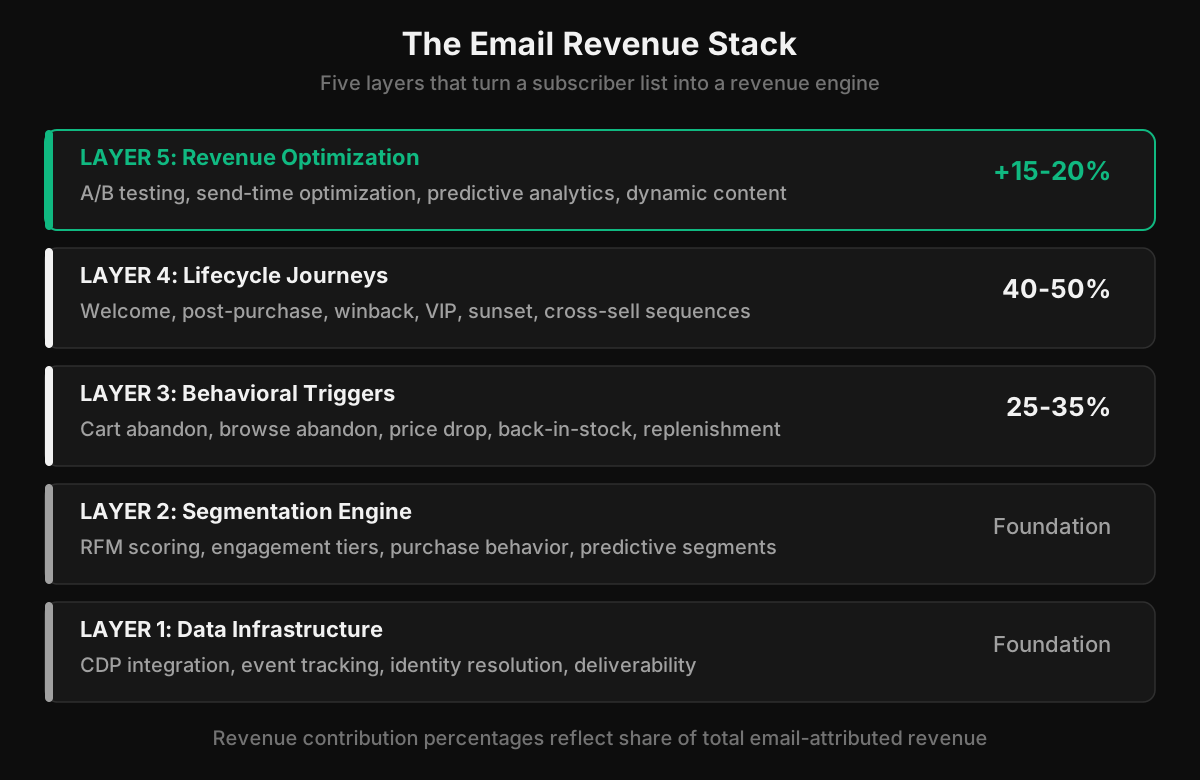
Revenue architecture in ecommerce email marketing is a five-layer system. Each layer builds on the one below it. Skip a layer and the layers above it underperform. Most brands invest heavily in the top layers (creative, copy, design) while ignoring the foundation layers (data, segmentation, triggers). This inversion explains why their email programs plateau.
The five layers, from foundation to optimization:
Layer 1: Data Infrastructure. This is event tracking, identity resolution, CDP integration, and deliverability management. It is the plumbing. Without clean data flowing from your ecommerce platform into your email platform in real time, nothing else works properly. You cannot trigger a browse abandonment email if you do not track browse events. You cannot segment by purchase frequency if your purchase data is incomplete. You cannot personalize product recommendations if your catalog data is not synced.
Layer 2: Segmentation Engine. This layer transforms raw data into actionable audience segments. RFM scoring (recency, frequency, monetary value). Engagement tiers based on email interaction. Purchase behavior clusters. Predictive segments that identify at-risk customers before they churn. The segmentation engine determines who receives what message and when. It is the brain of the architecture.
Layer 3: Behavioral Triggers. These are the automated responses to specific customer actions or inactions. Cart abandonment. Browse abandonment. Price drops on viewed products. Back-in-stock notifications. Replenishment reminders based on average reorder cycles. Each trigger fires at a moment of demonstrated intent, which is why triggers convert at 3-8x the rate of scheduled campaigns.
Layer 4: Lifecycle Journeys. These are multi-step sequences that guide customers through specific phases. Welcome series for new subscribers. Post-purchase education and cross-sell sequences. Winback campaigns for lapsing customers. VIP nurture for high-value segments. Sunset flows for chronically disengaged subscribers. Each journey addresses a specific business objective tied to customer lifecycle stage.
Layer 5: Revenue Optimization. This is A/B testing, send-time optimization, predictive analytics, and dynamic content. It is the layer most brands focus on first, which is backwards. Optimization without architecture is like polishing a car that has no engine. Testing subject lines on a broadcast campaign will never produce the returns of building a proper trigger and journey infrastructure.
According to Litmus's State of Email report, brands with mature email programs attribute 20-30% of total revenue to the email channel. The maturity is not about list size or send frequency. It is about how many of these five layers are operational and integrated.
The Segmentation Gap That Costs Brands Millions
Most ecommerce brands segment by one or two dimensions. Revenue architecture requires five or more.
Basic segmentation looks like this: engaged vs. unengaged. Purchasers vs. non-purchasers. Male vs. female. Maybe a geographic split. These segments are better than nothing, but they leave enormous value on the table because they do not capture behavioral nuance.
Advanced segmentation for ecommerce email marketing operates across multiple dimensions simultaneously. A customer's RFM score tells you how recently they bought, how often they buy, and how much they spend. Their engagement tier tells you how actively they interact with emails. Their browse behavior tells you what categories interest them right now. Their purchase history tells you what they have already bought and what the logical next purchase might be. Their lifecycle stage tells you whether they are new, active, at-risk, or lapsed.
When you combine these dimensions, a single subscriber list of 100,000 people becomes 30-50 distinct micro-segments, each receiving different messages at different frequencies with different offers. The first-time buyer who is highly engaged and browsing accessories gets a different post-purchase journey than the first-time buyer who has not opened an email since their purchase confirmation. The VIP customer who buys monthly gets a different promotional cadence than the occasional buyer who converts only during sales events.
This matters because relevance drives revenue. An email that lands when a customer is actively considering a purchase converts at 5-8x the rate of a generic broadcast. An email that recommends products based on actual browse and purchase history converts at 2-3x the rate of a generic product feature. The math is simple: more segments means more relevance, more relevance means higher conversion, and higher conversion means more revenue from the same list size.
The operational challenge is real. Building and maintaining 30-50 segments requires investment in data infrastructure, platform configuration, and ongoing management. This is precisely why most brands default to broadcast. It is easier. But easier is the enemy of revenue in ecommerce email marketing.
Trigger Logic: Where Automated Revenue Actually Lives
Automated triggers are the single highest-ROI component of any ecommerce email program. Most brands have three or four. They should have fifteen or more. Our research on what a retention marketing agency actually does provides additional context for this approach.
The standard triggers everyone knows: welcome series, cart abandonment, and maybe a post-purchase thank you. These are table stakes. They generate revenue because they respond to obvious moments of intent. But the revenue architecture goes much deeper. See our analysis of full-funnel marketing for ecommerce for the complete framework.
Browse abandonment captures visitors who viewed products but did not add to cart. This trigger typically converts at 1-3% and captures purchase intent that would otherwise evaporate. Price drop alerts notify subscribers when products they viewed or wishlisted decrease in price. Back-in-stock notifications reach customers who wanted a product that was unavailable. Replenishment reminders predict when a customer is likely to need a refill or replacement based on their purchase history and average reorder intervals.
Cross-sell triggers fire after a purchase based on what frequently pairs with the item bought. A customer who buys running shoes gets a triggered email about performance socks and insoles three days later. The timing matters. Too early and the customer has not received their order yet. Too late and the purchase moment has passed. The trigger logic accounts for shipping times, product category, and the customer's historical behavior.
Winback triggers activate when a customer's engagement or purchase pattern deviates from their baseline. A customer who normally buys every 45 days and has not purchased in 60 days enters a winback flow with escalating incentives. A customer who normally opens every email and has not opened the last five enters a re-engagement flow designed to confirm their interest before they damage your deliverability metrics.
Each of these triggers operates autonomously. Once built and optimized, they generate revenue 24 hours a day without manual campaign creation. According to Omnisend's research, automated emails account for only 2% of email sends but generate 29% of email revenue for ecommerce brands. That ratio tells you everything about where the leverage is.
Flow | Trigger | Expected Revenue % | Typical CVR |
|---|---|---|---|
Welcome Series | New subscriber or account creation | 3–8% of email revenue | 8–15% |
Abandoned Cart | Cart created but checkout not completed within 1 hour | 25–40% of email revenue | 5–12% |
Post-Purchase | Order confirmed — triggers cross-sell and review request | 10–18% of email revenue | 3–8% |
Winback | No purchase in 60–90 days | 5–10% of email revenue | 2–5% |
Browse Abandonment | Product viewed but not added to cart | 8–15% of email revenue | 1–4% |
Journey Branching: The Complexity That Compounds
Linear email sequences are version 1.0. Journey branching is where ecommerce email marketing becomes a genuine revenue engine.
A linear welcome series sends five emails over ten days. Every new subscriber gets the same five emails in the same order. This is better than no welcome series, but it ignores the reality that subscribers behave differently from the moment they enter the list.
Journey branching introduces conditional logic. Subscriber A opens the first email and clicks through to browse. They enter a branch that accelerates the next send and focuses on the category they browsed. Subscriber B does not open the first email. They enter a branch that changes the subject line angle and delays the second send. Subscriber C opens, clicks, and makes a purchase. They exit the welcome flow entirely and enter a post-purchase journey instead of continuing to receive welcome content that is now irrelevant.
This branching logic applies to every journey in the system. The post-purchase flow branches based on what was purchased, how much was spent, whether it was a first or repeat purchase, and how the customer has engaged with previous emails. The winback flow branches based on the customer's historical value, their last interaction, and whether they respond to soft content or hard offers.
Journey branching creates exponentially more paths through the email program. A single welcome series with three branch points and two branches per point creates eight distinct customer experiences from one journey. Add branching to post-purchase, winback, VIP, and cross-sell journeys and you have hundreds of unique paths. Each path is more relevant than a linear sequence. More relevance compounds into more revenue.
The operational cost of building branched journeys is high upfront. You need clean data at every branch point. You need clear logic for which branch a subscriber enters. You need content variations for each path. But once built, the system compounds. It gets smarter as you test and optimize individual branches. It generates revenue proportional to its complexity, not proportional to your campaign calendar.
Deliverability: The Hidden Tax That Destroys Email Revenue
You can build perfect architecture and still lose if your emails do not reach the inbox.
Deliverability is the most overlooked component of ecommerce email marketing. Brands invest in creative, segmentation, and automation while ignoring the fact that 15-25% of their emails never reach the primary inbox. They land in promotions tabs, spam folders, or get blocked entirely. That is a direct tax on revenue.
The deliverability equation is straightforward but operationally demanding. Inbox providers evaluate your sending reputation based on engagement signals. High open rates, low spam complaints, low bounce rates, and consistent sending patterns earn better inbox placement. Low engagement, spam complaints, and erratic sending volumes degrade your reputation and push more of your emails into spam.
This creates a feedback loop. Brands that send broadcast campaigns to their entire list see declining engagement because a large portion of the list is not interested in generic content. Declining engagement degrades deliverability. Worse deliverability means fewer emails reach engaged subscribers. Revenue declines. The brand responds by sending more campaigns to compensate, which further degrades deliverability.
Revenue architecture solves this structurally. Behavioral segmentation means you send to people who are actually interested. Engagement-based suppression means you exclude chronically disengaged subscribers from regular campaigns. Sunset flows remove or re-engage inactive subscribers before they become deliverability liabilities. The architecture itself protects deliverability because it is designed around relevance, not volume.
According to Mailchimp's ecommerce data, the average ecommerce email open rate sits around 15-18%. Brands with strong deliverability practices and behavioral segmentation see 25-35% open rates on triggered and segmented campaigns. That 10-20 point gap in open rates translates directly to revenue because more people are seeing and acting on the message.
Building the Architecture: A Practical Sequence
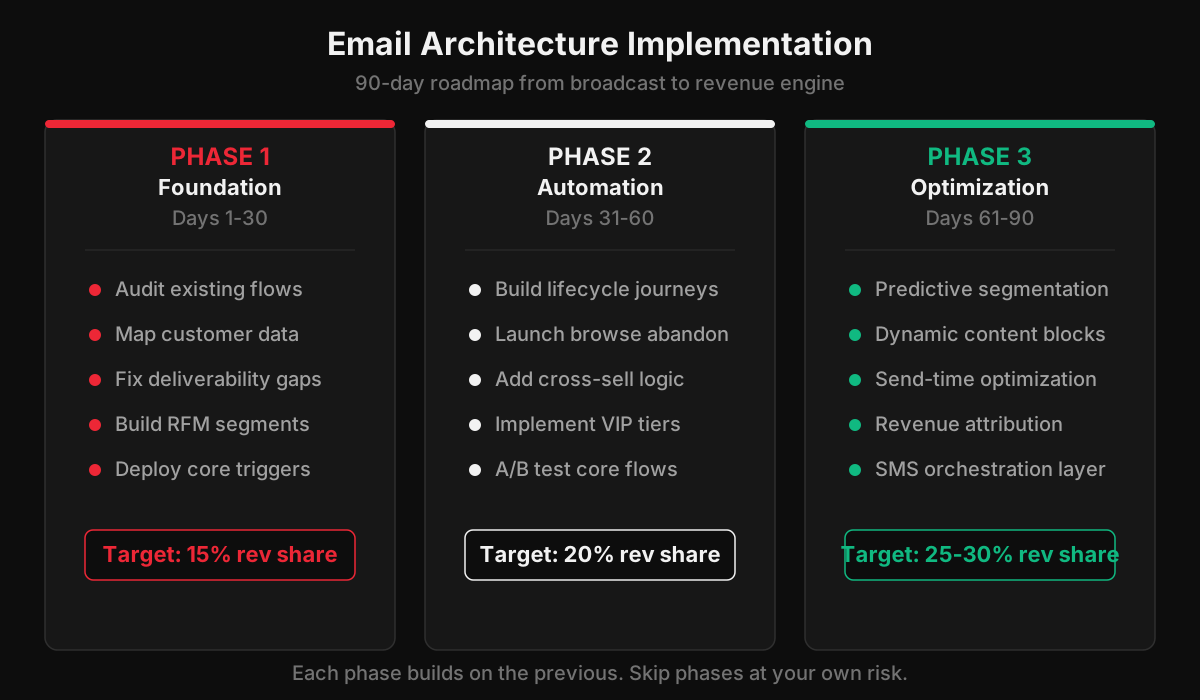
You do not build revenue architecture in a week. You build it in phases, each phase compounding on the last.
Phase 1 (Days 1-30): Foundation. Audit your existing email flows and identify gaps. Map your customer data to understand what behavioral and purchase signals are available. Fix deliverability issues by cleaning your list, warming your domain if needed, and setting up proper authentication (SPF, DKIM, DMARC). Build your initial RFM segments and deploy the core triggers: welcome series, cart abandonment, and post-purchase. Target outcome: email contributing 15% of revenue.
Phase 2 (Days 31-60): Automation. Build out lifecycle journeys for each major customer stage. Launch browse abandonment, price drop, and back-in-stock triggers. Add cross-sell logic to your post-purchase flows based on purchase history and product affinity data. Implement VIP tier recognition and differentiated treatment for high-value customers. Begin A/B testing the highest-volume flows. Target outcome: email contributing 20% of revenue.
Phase 3 (Days 61-90): Optimization. Layer in predictive segmentation to identify at-risk customers before they lapse. Implement dynamic content blocks that personalize email content based on individual browse and purchase behavior. Deploy send-time optimization to reach each subscriber at their most responsive window. Build revenue attribution reporting that tracks the contribution of each flow and trigger. Add SMS orchestration to complement email triggers at high-intent moments. Target outcome: email contributing 25-30% of revenue.
Each phase requires dedicated resources. A retention marketing team or agency partner that understands ecommerce email architecture, not just email design. The difference matters because design without architecture produces beautiful emails that underperform. Architecture without design produces effective emails that could perform even better. You need both, but architecture comes first.
Why Most Brands Stall at Broadcast
Understanding the architecture is the easy part. Building it requires confronting uncomfortable operational realities. We explore this dynamic in detail in best email marketing agencies for ecommerce.
The first reality is data. Most ecommerce brands have fragmented customer data. Their Shopify or BigCommerce store tracks some events. Their email platform tracks others. Their analytics tool tracks different ones. Identity resolution is incomplete. A customer who browses on mobile and purchases on desktop shows up as two people. Building behavioral triggers on broken data produces broken triggers. For related insights, see our guide to AI strategies for email and SMS marketing.
The second reality is resources. Revenue architecture requires dedicated operational capacity. Someone has to build the segments, configure the triggers, write the journey content, set up the branching logic, and maintain the system as products, seasons, and customer behavior change. Most ecommerce marketing teams are stretched across multiple channels. Email gets a fraction of someone's time, which means it stays at broadcast level because broadcast is the simplest thing to execute.
The third reality is patience. Broadcast email produces immediate, visible results. You send a campaign, you see revenue within 24 hours. Architecture produces compounding results over weeks and months. The welcome series improvement compounds as every new subscriber enters a better experience. The trigger refinement compounds as conversion rates incrementally improve across thousands of daily events. But these gains are invisible on a weekly dashboard. They require patience and trust in the system.
This is why many brands partner with a retention marketing agency to build the architecture. Not because the concepts are complicated, but because the execution requires sustained focus that internal teams often cannot maintain while juggling campaigns, promotions, and seasonal demands. The agency provides the operational capacity to build the architecture while the internal team continues running the business.
The Creative Layer: Why Performance Creative Matters After Architecture
Creative quality is a multiplier on architecture. It is not a substitute for it.
Once the architecture is in place, creative becomes the most powerful optimization lever. The subject line, the email design, the copy, the product imagery, the offer presentation. These elements determine how much revenue each flow and trigger generates from the audience it reaches.
Performance creative for ecommerce email is different from brand creative. It is designed to drive specific actions from specific segments at specific moments. A cart abandonment email needs urgency and clarity, not brand storytelling. A cross-sell email needs product relevance and social proof, not a lifestyle editorial. A winback email needs a compelling reason to return, not a generic discount code.
The architecture determines who receives each message and when. The creative determines whether they act. Together, they compound. A 10% improvement in trigger conversion rates across fifteen active triggers produces significantly more revenue than a 10% improvement in broadcast open rates. But the trigger improvement is only possible if the triggers exist.
FAQ
How much revenue should ecommerce email marketing contribute?
Well-architected programs generate 25-30% of total revenue. The industry average sits around 10-15%. If you are below 15%, your architecture has significant gaps. If you are between 15-20%, you have the basics but are missing automation depth. Above 25% indicates a mature, well-optimized system.
What is the single highest-impact change for ecommerce email?
If you do not have a cart abandonment flow with at least three emails, build that first. It is the highest-intent, highest-converting trigger in ecommerce email and typically generates 5-8% of total email revenue on its own.
How many automated flows should an ecommerce brand have?
Mature programs run 12-20 active flows. At minimum: welcome series, cart abandonment, browse abandonment, post-purchase, cross-sell, winback, VIP, and sunset. Each flow should have journey branching based on behavioral signals.
Does list size matter more than architecture?
No. A 50,000-subscriber list with strong architecture will outperform a 200,000-subscriber list running broadcast campaigns. Revenue per subscriber is the metric that matters, and architecture drives it.
How do I know if my email program has an architecture problem versus a creative problem?
Check the ratio of automated flow revenue to campaign revenue. If campaigns generate more than 60% of your email revenue, you have an architecture problem. Flows should generate the majority in a mature program.
Can I build this architecture on any email platform?
Technically yes, but platform choice matters. Klaviyo is the standard for ecommerce because it natively integrates with Shopify, BigCommerce, and WooCommerce and offers built-in behavioral triggers and journey branching. Other platforms can work but require more custom configuration.
How long does it take to see results from building email architecture?
Core triggers (cart abandonment, welcome series) show results within 2-4 weeks. Full lifecycle journeys take 6-8 weeks to build and another 4-6 weeks to optimize. Expect 90 days to meaningful revenue lift and 6 months to full maturity.
The Architecture Advantage
Ecommerce email marketing is not a creative challenge. It is not a frequency question. It is an architecture problem that determines whether email generates 10% of your revenue or 30%. The brands winning with email have built five layers of infrastructure: data, segmentation, triggers, journeys, and optimization. They have invested in behavioral logic that sends the right message to the right person at the right moment. They have built systems that compound revenue while they sleep.
The gap between broadcast email and revenue architecture is the gap between working harder and building smarter. More campaigns on the calendar will never close it. More A/B tests on subject lines will never close it. The only thing that closes it is building the infrastructure that makes every email relevant, timely, and triggered by actual customer behavior.
If your ecommerce email program is stuck below 20% revenue contribution, the problem is almost certainly architectural. The good news is that architecture is buildable. It follows a clear sequence. It compounds over time. And the brands that build it first in their category own a structural advantage that broadcast competitors cannot replicate by simply sending more emails.
Start by auditing where you are today. Map the five layers against your current program. Identify the gaps. Build the foundation first. Then layer automation, journeys, and optimization in sequence. If you need operational support, explore how Darkroom's full-service approach connects email architecture to your broader retention stack and retention budget allocation.
Related reads: Email vs SMS for DTC Retention Revenue and Why Retention Marketing Fails When It Starts with Email.
Ready to build email revenue architecture?Book a call with Darkroom. We audit your current email program, identify architectural gaps, and build the trigger and journey infrastructure that drives 25-30% revenue contribution.