
Social Commerce
How TikTok Shop Ads Turn Scroll Into Sales: The Creative-Commerce Loop




Written by Darkroom leardership

Written & peer reviewed by 4 Darkroom team members
TikTok Shop Ads operate on a fundamentally different model than Meta or Google. The creative experience IS the commerce experience. Users see your ad, engage with content, and complete checkout within the same session. This creates a creative-commerce loop where ad performance depends entirely on content quality and authenticity, not audience targeting precision. Brands maximizing creative velocity and native formats are outperforming those relying on traditional performance metrics.
By the Darkroom Observatory team March 13, 2026
The Fundamental Difference Between TikTok Shop Ads and Traditional Performance Ads
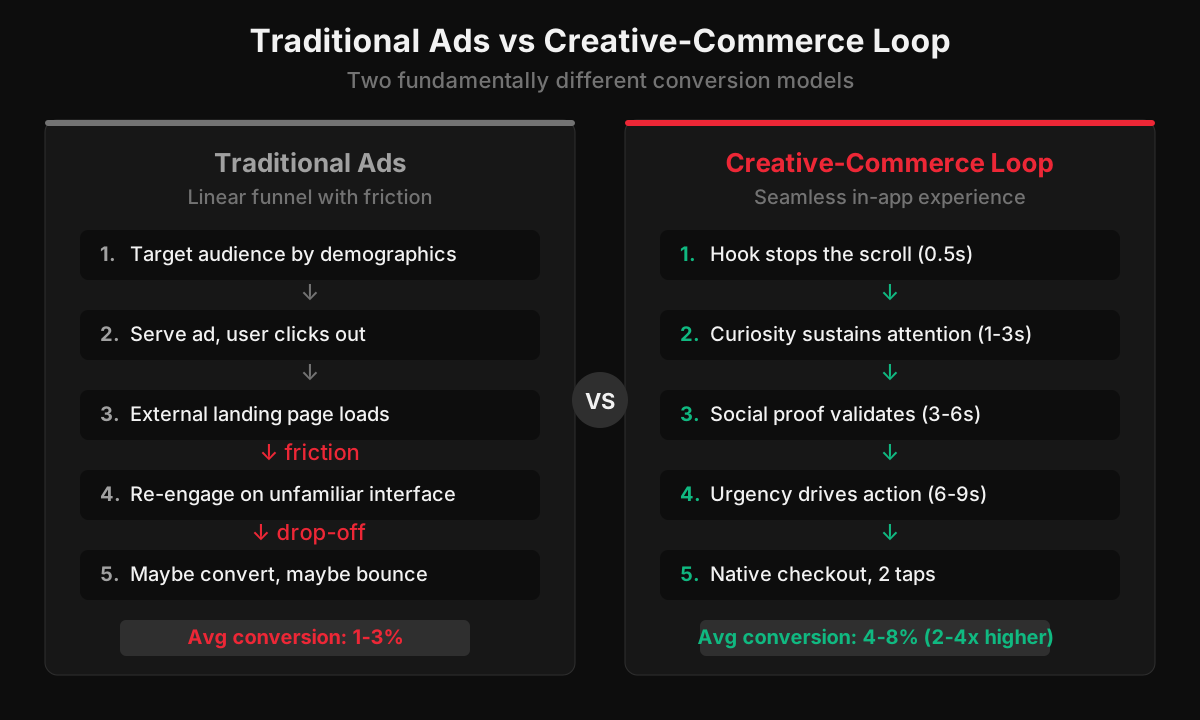
When you run ads on Meta or Google, you're buying access to an audience. The platform targets users based on demographics, interests, and behaviors. Your ad appears, the user clicks, and they leave the platform to land on your website. There's friction between the ad experience and the commerce experience.
TikTok Shop Ads eliminate that friction entirely. The creative IS the product page. The ad IS the shopping experience. A user scrolling their FYP sees your product video, watches reviews from other customers, and checks out without ever leaving the app. Everything happens in one session, one context, one moment of attention.
This changes everything about how you should think about ad performance. You're not optimizing for clicks. You're optimizing for conversion within a seamless experience that prioritizes entertainment value over persuasion tactics.
Why Creative Quality Is Your Primary Conversion Driver
In traditional performance advertising, good targeting compensates for mediocre creative. You can target a niche audience interested in your product category, serve them an average ad, and still get conversions.
On TikTok Shop, there is no compensation mechanism. The targeting is broad. The algorithm shows your content to users based on their behavior on the platform, not their likelihood to purchase your specific product. Working with a TikTok Shop management can help navigate this effectively. If your creative doesn't stop the scroll, the system has no other lever to pull.
This means creative quality directly correlates to conversion rate in ways that don't exist elsewhere. A 1% improvement in video hook translates to measurable increases in sales. Authentic, unpolished content consistently outperforms overly produced ads because it signals to the algorithm and the user that you're not trying to manipulate. This is why Darkroom approaches social commerce as a systems problem. It's content first, commerce second.
Brands seeing 3x to 5x higher ROAS on TikTok Shop compared to other channels have one thing in common: they stopped thinking like advertisers and started thinking like content creators.
The Creative-Commerce Loop: How It Works
The creative-commerce loop is the sequence that happens when a user encounters your TikTok Shop ad:
1. Hook: Your first 0.5 seconds determine whether they scroll. This is pure pattern interruption. Contrast, text overlay, unexpected visuals, or genuine movement drives this phase.
2. Curiosity: Seconds 1-3 are about sustaining attention. What problem does this solve? How is this different? What's the benefit? You're not selling yet. You're creating narrative momentum.
3. Validation: By second 3-6, social proof appears. Customer testimonials, before-and-after, usage examples, or review snippets show the product works. This legitimizes the pitch.
4. Urgency: The final 2-3 seconds introduce scarcity or a reason to act now. Limited stock, limited-time pricing, exclusive drop, or a clear call-to-action that's specific and low-friction.
5. Conversion: The user taps the product, sees variants and pricing in the TikTok Shop interface, and checks out using their stored payment method. No external link. No website load time. No friction.
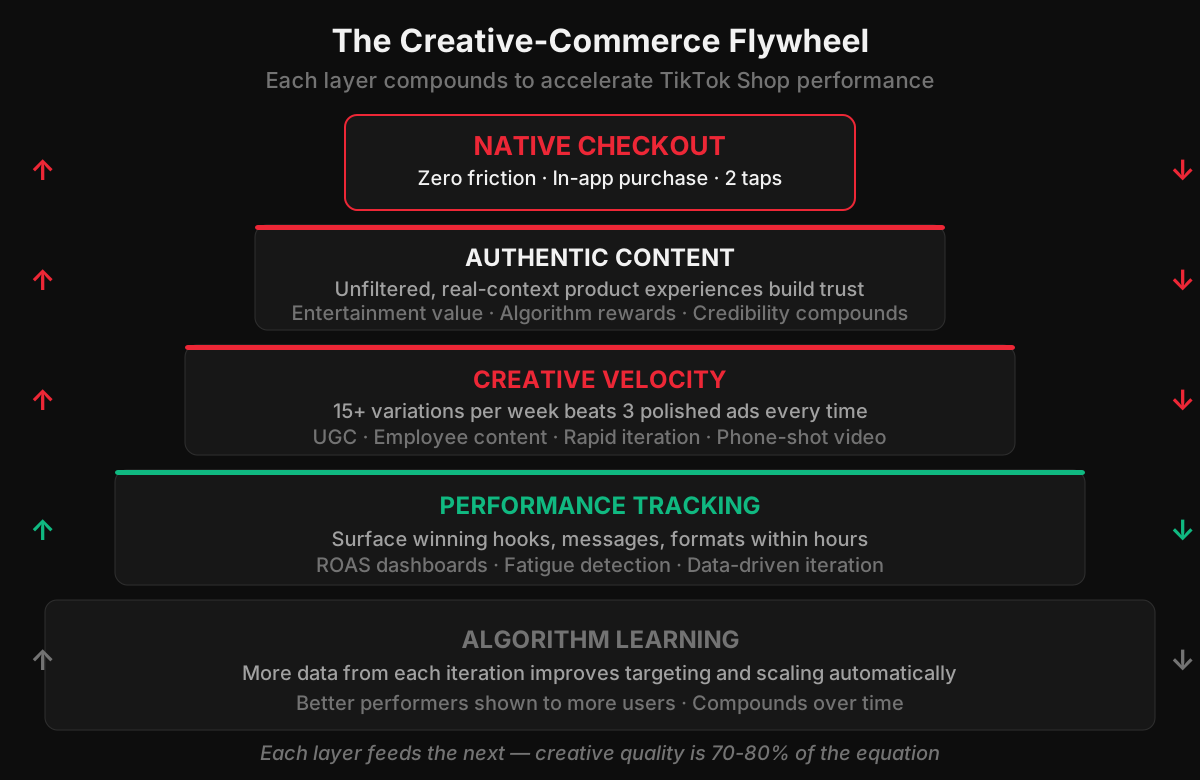
This loop repeats thousands of times with slight variations. Each iteration teaches the algorithm which elements drive conversion. Over time, your account compounds: better performing creatives get shown to more users, which generates more data, which improves targeting and scaling.
Creative Velocity: The Metric That Actually Matters
Traditional advertising prioritizes creative efficiency: how many conversions per dollar spent. Working with a performance creative agency can help navigate this effectively. TikTok Shop operates on creative velocity: how many high-performing variations can you produce and test within a given timeframe.
A brand testing 15 creative variations per week on TikTok Shop will outperform a brand testing 3 per week, even if the best performer from the smaller batch is technically better. Why? Because TikTok's algorithm learns faster when it has more data. Because trends and hooks decay rapidly on the platform. Because user attention is finite and always shifting.
The brands winning on TikTok Shop are treating creative production like a manufacturing problem, not an art direction problem. They're using user-generated content, employee content, unscripted product demonstrations, and rapid iteration cycles. A 60-second video shot on a phone often outperforms a 30-second professionally produced spot.
This doesn't mean creative doesn't matter. It means the volume and velocity of testing matters more than the polish of execution. You need systems to produce content quickly, test it immediately, analyze performance within hours, and iterate based on data.
Authenticity as a Competitive Advantage
TikTok users have developed sophisticated filters for detecting traditional advertising. Overproduction, professional lighting, scripted messaging, and polished cinematography all trigger skepticism. The platform's algorithm has also learned to suppress highly promotional content because it doesn't drive engagement or conversion.
Authentic content performs better because it accomplishes multiple objectives simultaneously. It entertains or informs (which the algorithm rewards), it builds trust (which drives conversion), and it signals credibility (which compounds over time as your account develops a reputation).
Authentic doesn't mean poor quality. It means unfiltered. It means showing the product in real contexts. It means using real customers, real employees, and real use cases. It means accepting imperfection as a feature, not a bug.
For brands entering TikTok Shop, the fastest path to profitability is not to hire a creative agency. It's to empower your best salespeople, your most enthusiastic employees, and your happiest customers to create content on your behalf. Give them your product, set a clear performance target, and let them figure out how to make it work. The constraint breeds velocity.
Scaling Beyond the Hook: Building Sustainable Creative Systems
The first 0.5 seconds determine whether someone watches the next 2.5 seconds. By extension, the first creative ad you produce will probably underperform. This is expected. Working with a full-service growth marketing can help navigate this effectively. The goal is to develop a repeatable system that identifies winning hooks, leverages them at scale, and continuously refreshes them before they fatigue.
A sustainable creative system for TikTok Shop includes:
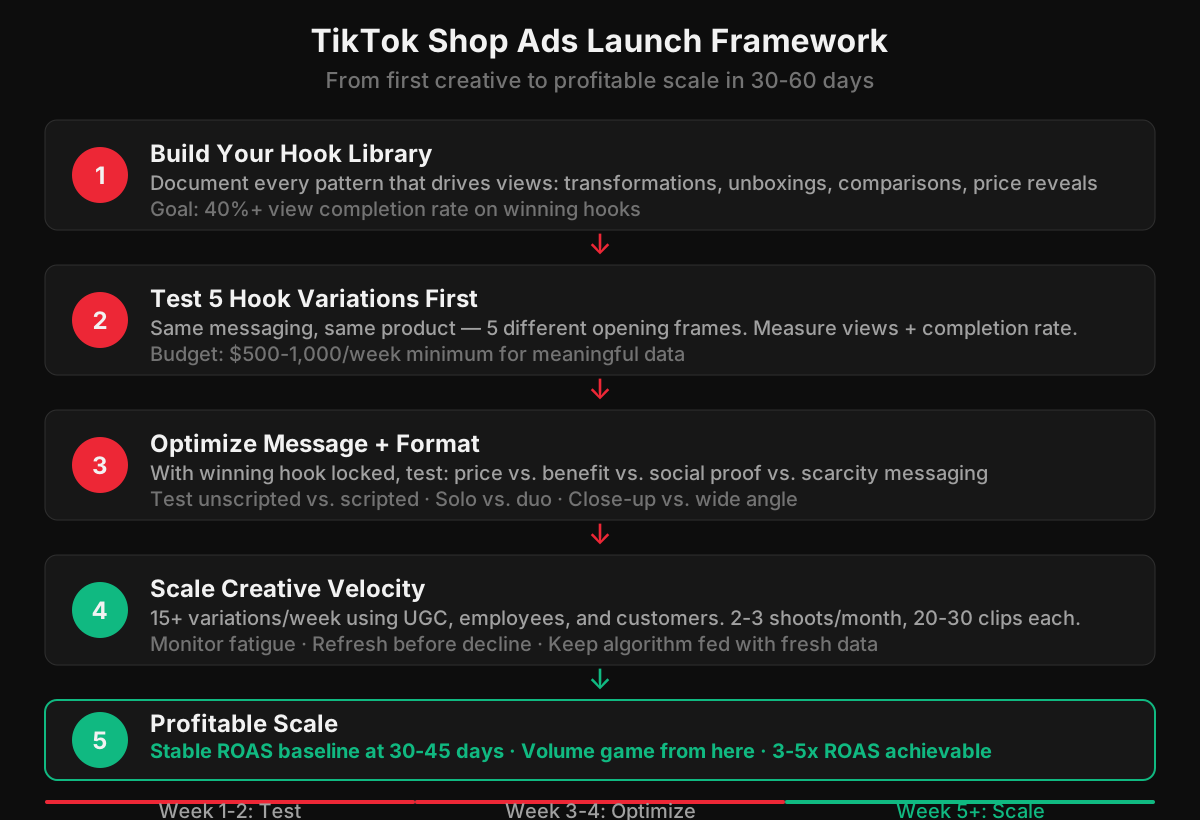
Hook Library: Document every hook that drives views. Common patterns include: product transformation, problem-solution contrast, unboxing or reveal, customer transformation, price reveal, limited availability, comparison or challenge, or trend participation. Build a reference library and test variations systematically.
Template Structure: Develop 3-5 narrative templates that work for your product. Swap in different products, customers, or use cases while maintaining the structure. This accelerates production without sacrificing variety.
Production Pipeline: Establish a content calendar that requires 2-3 shoots per month with 20-30 usable clips per shoot. Partner with creators, employees, or customers to generate volume.
Performance Tracking: Set up dashboards that surface which hooks, messages, and formats drive the highest ROAS. Use this data to inform the next production cycle.
Fatigue Detection: Monitor when top performers begin to decline and have new variations ready to deploy before decline becomes critical.
Brands scaling from 0 to profitability on TikTok Shop typically need 30-60 days of this process to identify core winners. Once you have those, scaling is a volume game.
The Role of Native Formats Over External Links
Every link that sends a user off TikTok is a drop-off point. TikTok Shop Ads avoid this entirely by keeping commerce inside the app. This has profound implications for performance.
When a user clicks an external link from a TikTok ad, they experience: app switching (cognitive load), page load time (friction), unfamiliar design language (trust loss), and decision fatigue (they have to re-engage with a new interface). Each of these compounds drop-off rates.
TikTok Shop Ads eliminate these friction points. The user taps the product, sees it in the native Shop interface (which they already understand), confirms their payment method is saved, and checks out with two additional taps. The entire conversion happens at the speed of the platform.
This native format advantage isn't theoretical. It's measurable. Conversion rates from TikTok Shop Ads are 2-4x higher than conversion rates from ads that send users to external websites, controlling for traffic quality. The format itself is a conversion rate multiplier.
For brands, this means your TikTok Shop strategy should prioritize catalog integration and native checkout over driving traffic to your website. The data will prove this approach superior.
Practical Optimization: What to Test First
When you launch TikTok Shop Ads, you'll be tempted to test everything. Resist that impulse. Start with foundational variables that move the needle:
Hook Variation: Test 5 different opening frames or first 0.5 seconds with identical messaging and product. Measure views and completion rate. The hook that drives 40%+ view completion is your winner.
Message Clarity: Once you have a winning hook, test different value propositions. Price-focused, benefit-focused, social-proof-focused, scarcity-focused. Most brands discover one message resonates with 3-4x higher conversion rate than others.
Format Comparison: Test unscripted vs. scripted, solo vs. duo, wide angle vs. close-up. TikTok Shop audiences often prefer intimate, close-up content that feels less polished.
Call-to-Action Timing: Test when you introduce urgency. Early urgency (first 5 seconds) performs differently than late urgency (final 3 seconds). Your audience and product type will determine optimal timing.
Product Selection: Test different products within your catalog. A single bestseller often generates more total revenue than a rotating selection of slower-moving products, even if the slower products have higher margins.
Once you've optimized these variables through 100+ iterations, you can move into secondary optimization like audience refinement or bid strategy. But the foundation is always creative quality first.
Frequently Asked Questions
How is TikTok Shop different from TikTok For Business ads?
TikTok Shop Ads are a specific ad format that integrates directly with your shop catalog inside TikTok. When you run these ads, users can complete the entire purchase without leaving the app. Traditional TikTok For Business ads send users to external websites. TikTok Shop Ads use native checkout, which results in 2-4x higher conversion rates due to reduced friction.
Do I need an existing TikTok Shop to run these ads?
Yes. To run TikTok Shop Ads, you need an active TikTok Shop with products in your catalog. The integration connects directly to your inventory and pricing. If you don't have a TikTok Shop set up yet, that should be your first step.
What's the minimum budget to test TikTok Shop Ads effectively?
We recommend a minimum of $500-1,000 per week to generate sufficient data for optimization. This allows you to test 3-5 creative variations simultaneously with realistic volume. Below this threshold, data is too sparse to identify winners. If you're starting smaller, focus on maximizing creative velocity within your budget rather than spreading spend across multiple variations.
How quickly should I expect to see ROAS improvement?
Your first week of data is noise. By week two, performance patterns begin emerging. By week three to four, you'll have a clear sense of winning hooks and messages. Expect 30-45 days to reach a stable ROAS baseline from your best-performing creatives. Scaling happens after that point.
Can I use influencer content or UGC in TikTok Shop Ads?
Yes, and often with great results. User-generated content and creator content typically outperforms brand-created content on TikTok. Make sure you have proper licensing rights and disclosure. UGC creators and micro-influencers often charge much less than traditional agencies and move faster on iteration cycles.
What's the relationship between ad spend and creative quality on TikTok Shop?
Creative quality is 70-80% of the equation. Ad spend is 20-30%. A mediocre creative with unlimited budget will underperform a great creative with limited budget. This is backwards from traditional performance ads where targeting and budget matter more equally. For TikTok Shop, invest in creative production first, then use ad spend to scale what works.
Should I use broad or narrow audience targeting?
Start broad. TikTok's algorithm is more powerful than your manual audience segmentation. Let the algorithm show your content to users based on their on-platform behavior. Once you have high-performing creative proven at scale, you can experiment with tighter interest or lookalike targeting. But your first lever is always creative quality, not targeting precision.
Ready to launch your TikTok Shop strategy? TikTok Shop Ads require a different approach than traditional performance advertising. Creative velocity, authenticity, and native formats are the foundation. If you're ready to build this engine, we can help you set up your catalog, develop your creative system, and scale profitably. Book a call with Darkroom.