
PERFORMANCE CREATIVE
In-House vs. Agency Creative for DTC Brands: The Real Math Behind the Decision in 2026




Written by Darkroom leardership

TL;DR
Choosing between a paid media agency and an in-house creative team for your DTC brand comes down to math, not philosophy. A 3-person in-house creative team costs $310K-$490K a year in salary, benefits, tools, and turnover. A performance creative agency retainer runs $120K-$180K a year and includes capabilities most in-house teams can’t replicate: strategic testing frameworks, cross-client performance data, and creative-to-media integration. Below $50M in revenue, that comparison almost always favors an agency; above $100M, hybrid models take over. This piece breaks down the full cost comparison, what “full-stack performance creative” actually includes, the red flags to watch for when evaluating agencies, and the five questions to ask before you sign. Darkroom runs performance creative for DTC brands, and this is the framework we use to help brands make the right structural call.
Why This Decision Matters More Than Most CMOs Think
Creative quality drives 50-70% of paid media performance variance. Getting the creative structure wrong means paying more for less across every channel.
The in-house versus agency decision is not just a hiring decision. It is a structural choice that determines the quality, volume, and velocity of your creative output, which in turn determines the performance ceiling of your entire paid media program. Meta's own research confirms that creative accounts for 50-70% of ad performance variance. Google's data shows similar patterns for Shopping and YouTube campaigns. If your creative structure is wrong, no amount of media optimization will compensate.
Most CMOs underestimate the scope of what "performance creative" requires because they are comparing it to what "creative" meant five years ago. In 2020, creative meant a designer making static ads and an occasional video. In 2026, performance creative means a system that produces 30-80+ new assets per month across static, video, UGC, and motion formats, tests them systematically against defined hypotheses, iterates based on performance data, and feeds insights back into media buying strategy. This is not a headcount question. It is a capability question. Understanding what a performance creative agency actually delivers helps frame the comparison accurately.
The Real Cost Comparison: In-House vs. Agency at Every Revenue Stage
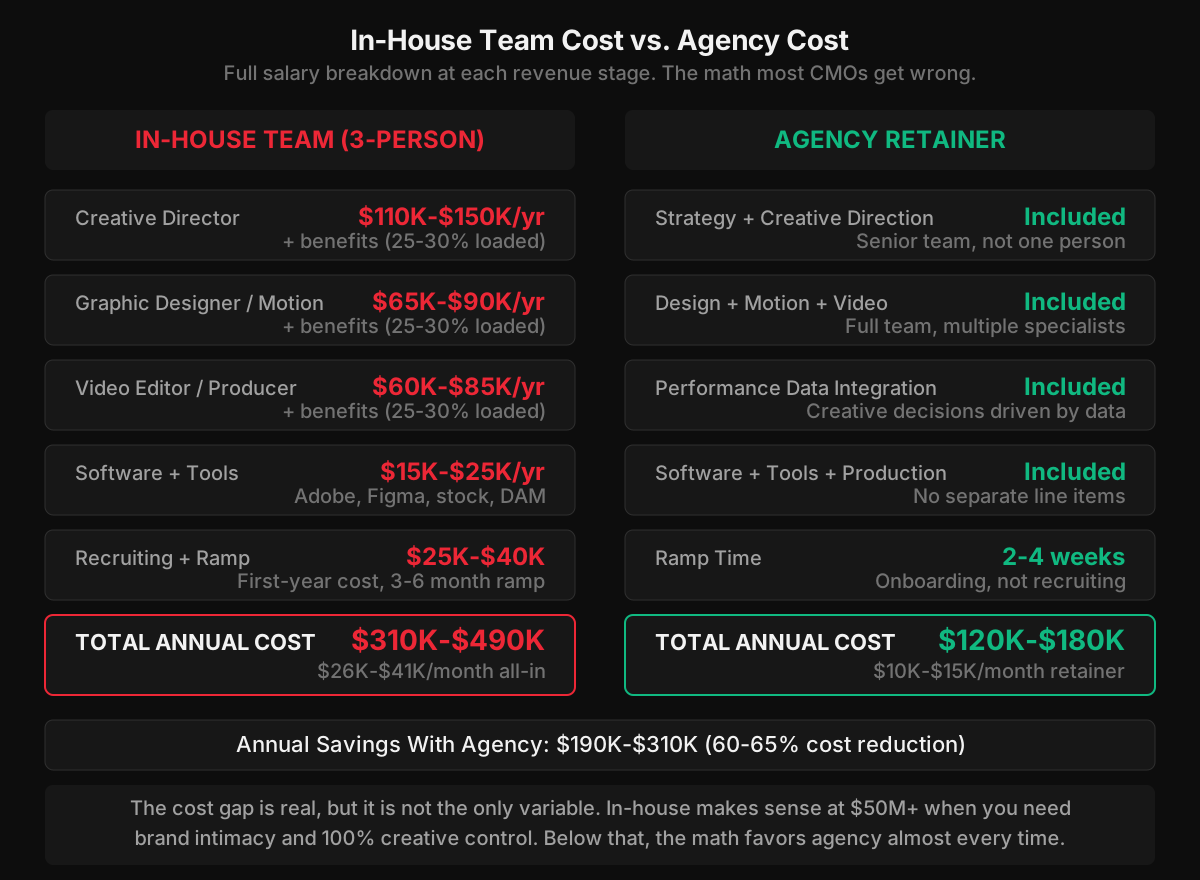
The raw numbers favor agency at every revenue stage under $50M. Above $50M, the answer gets more nuanced.
Cost Component | In-House (3-Person Team) | Agency Retainer |
|---|---|---|
Creative Director | $110K-$150K + 28% benefits | Included |
Designer / Motion Artist | $65K-$90K + 28% benefits | Included |
Video Editor / Producer | $60K-$85K + 28% benefits | Included |
Software + Tools | $15K-$25K/yr | Included |
Recruiting + Ramp (Year 1) | $25K-$40K | 2-4 week onboarding |
Management Overhead | 10-15 hrs/week of your time | 1-2 hrs/week of your time |
Turnover Risk | $30K-$60K per replacement | Team continuity guaranteed |
Total Annual Cost | $310K-$490K | $120K-$180K |
Annual Savings | Baseline | $190K-$310K (60-65% less) |
These numbers are for a 3-person team, which is the minimum viable creative team for a DTC brand running paid media. A creative director sets strategy and directs production. A designer handles static assets, email templates, and basic motion. A video editor handles UGC edits, product videos, and motion graphics. This team can produce 20-40 assets per month under good conditions. According to Glassdoor's 2026 salary data, these ranges reflect median compensation in major US markets.
The hidden costs are where the gap widens further. Recruiting takes 2-4 months per role. Ramp time is 2-3 months before full productivity. Turnover in creative roles averages 18-24 months, meaning you will cycle through this recruiting-ramp process regularly. Each cycle costs $30K-$60K in direct costs plus months of reduced output. An agency absorbs all of this internally. You pay a flat rate regardless of their staffing dynamics. Understanding the broader context of agency cost structures helps benchmark whether a specific quote is reasonable.
When Each Model Makes Sense by Revenue Stage
The right answer changes as you grow. Here is the decision matrix at $5M, $20M, $50M, and $100M+.
At $5M revenue. Use an agency. You cannot justify $310K+ in creative headcount on $5M in revenue. Your creative needs are relatively straightforward (15-30 assets per month), and an agency at $10K-$12K per month gives you access to a full team plus strategic capabilities you could not afford to hire individually. Your internal marketing team is likely 1-3 people who should be focused on strategy and brand, not production execution. This is the stage where choosing the right growth marketing agency has the highest leverage.
At $20M revenue. Likely agency, potentially hybrid. At $20M, you may have 1-2 in-house creatives handling brand-specific work (packaging, website, brand photography) while an agency handles performance creative at volume. The hybrid model works when the in-house team owns brand consistency and the agency owns performance velocity. This is the stage where the performance creative system needs to be formalized whether it sits in-house, at an agency, or both.
At $50M revenue. Hybrid is common. Many $50M brands have a 3-5 person in-house creative team for brand work plus an agency for performance creative production, testing, and media-integrated creative. The in-house team provides brand intimacy (they live the brand every day, understand the voice, attend the product meetings). The agency provides testing velocity, cross-client data, and the performance integration layer that in-house teams typically lack.
At $100M+ revenue. Larger in-house teams become viable and common, often 8-15 people across creative, production, and creative strategy. But even at this scale, many brands retain agency relationships for specific capabilities: performance testing frameworks, new platform creative (TikTok-native content), overflow production during peak seasons, and the cross-client intelligence that agencies accumulate. The dynamics of agency-brand relationships matter most at this stage because the relationship is additive, not foundational.
What "Full-Stack Performance Creative" Actually Includes
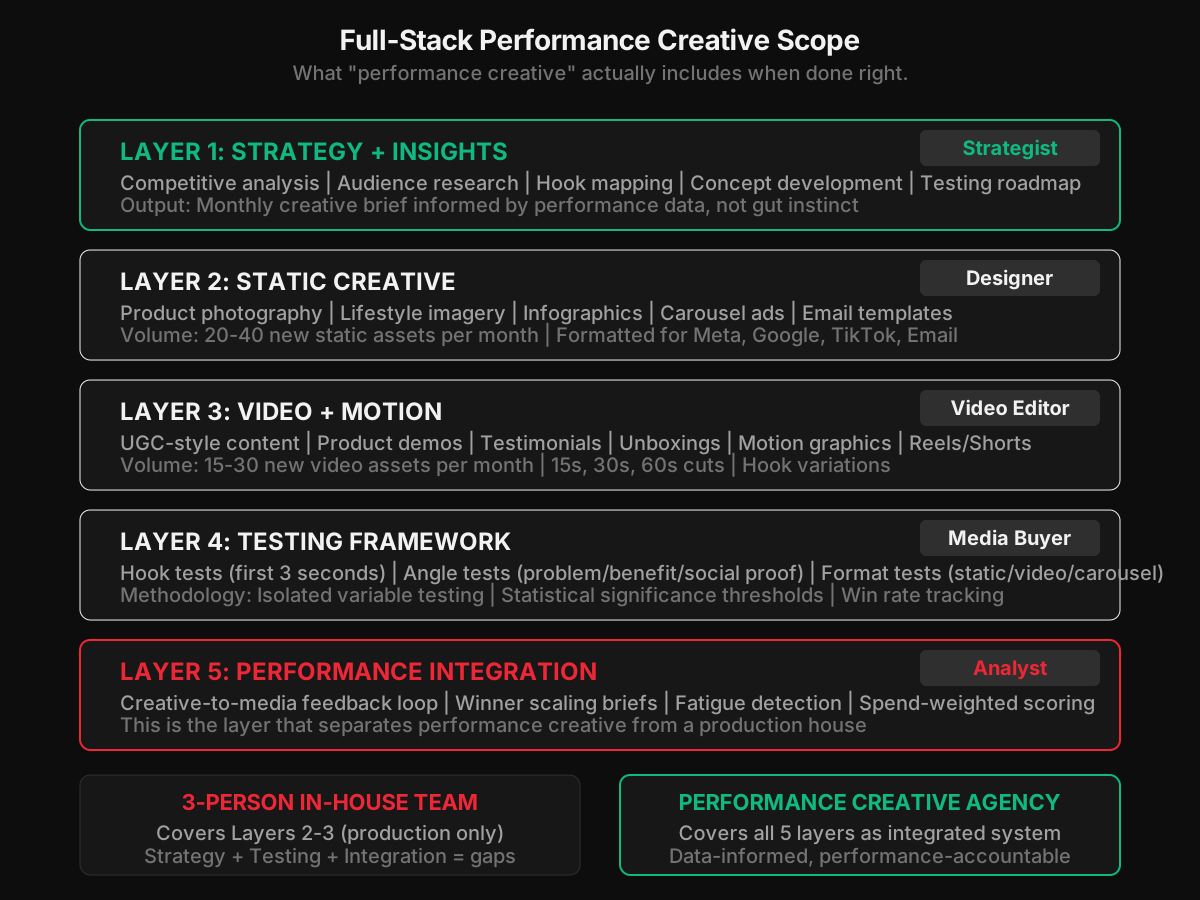
Most brands think creative means "making ads." Full-stack performance creative is a five-layer system that connects production to business outcomes.
Layer 1: Strategy and insights. Competitive creative analysis (what are the top spenders in your category running?). Audience research translated into creative hypotheses. Hook mapping across pain points, benefits, and social proof angles. Monthly testing roadmap that defines which hypotheses to test and in what order. This layer requires a dedicated strategist, not a designer who also does strategy.
Layer 2: Static creative production. Product photography (lifestyle, studio, detail). Graphic design (infographics, comparison charts, text-overlay ads). Email templates. Carousel ads. Category-specific formats (Amazon A+ Content, TikTok Shop product images). Volume: 20-40 new static assets per month for brands spending $50K+ on paid media.
Layer 3: Video and motion production. UGC-style content (creator testimonials, unboxings, problem-solution). Product demonstrations. Motion graphics and text-motion ads. Long-form video edits for YouTube and landing pages. Short-form cuts for Reels, Shorts, and TikTok. Volume: 15-30 new video assets per month at scale. Understanding how this connects to creative fatigue and testing is essential for maintaining production discipline.
Layer 4: Testing framework. Isolated variable testing: hook tests (first 3 seconds of video, headline of static), angle tests (problem vs. benefit vs. social proof), format tests (static vs. video vs. carousel vs. UGC). Each test is designed with a specific hypothesis and success criteria. Tests are run to statistical significance before scaling winners. This layer is what most in-house teams lack because it requires a bridge between creative and data.
Layer 5: Performance integration. The creative-to-media feedback loop. Performance data (CPA, hook retention, click rate, ROAS by creative) flows to the creative team weekly. Winners are identified and iterated. Losers are analyzed for learning. Creative fatigue is detected automatically (CPM increases, CTR declines) and triggers new production sprints. Spend-weighted creative scoring tells you which assets are driving the most efficient revenue. This is the layer that makes creative "performance" creative, and it is the layer that is hardest to build in-house because it requires tight integration between creative and media buying functions. This is where Darkroom's performance creative practice differentiates.
The Capability Gap: What In-House Teams Consistently Miss
In-house teams excel at brand consistency. They consistently underperform on testing velocity, cross-client intelligence, and performance integration.
The in-house advantage is real: brand intimacy, institutional knowledge, cultural immersion, and always-available responsiveness. A designer who attends your product development meetings understands the brand in a way an external partner never fully will. This matters for brand-defining work: packaging, website design, brand campaigns, product launches.
But in-house teams consistently underperform agencies on three dimensions. First, testing velocity. A 3-person team can produce assets but cannot sustain the volume needed for systematic testing. Testing requires producing 3-5 variations of every concept, running them simultaneously, waiting for statistical significance, and iterating. This multiplies the asset requirement by 3-5x. Most in-house teams fall into a pattern of producing their best guess and running it until it stops working, rather than testing multiple hypotheses simultaneously.
Second, cross-client intelligence. An agency managing 20-50 ecommerce accounts sees patterns that no single brand can. They know which hooks are working across beauty, supplements, home goods, and fashion right now. They know which ad formats Meta is currently favoring. They know which TikTok creative structures are driving the lowest CPAs this quarter. This intelligence compounds across the portfolio and benefits every client. An in-house team, no matter how talented, only sees one brand's data. Understanding the distinction between growth marketing and performance marketing helps clarify what kind of intelligence matters most at your stage.
Third, the performance integration layer. Connecting creative decisions to media performance data requires someone who reads both languages: creative (hooks, angles, formats, emotional triggers) and media (CPA, ROAS, hook retention, frequency caps). This person bridges the creative team and the media team, translating data into briefs and briefs into testable hypotheses. In an agency, this role is formalized. In-house, it typically falls to the marketing director who is already stretched across strategy, vendor management, and reporting.
Red Flags When Evaluating Creative Agencies
Not all agencies are created equal. These are the warning signs that a creative agency will not deliver performance results.
No performance data in case studies. If an agency shows you beautiful creative without business results (CPA improvement, ROAS lift, revenue impact), they are a production house marketing themselves as a performance agency. Ask for specific performance metrics. If they cannot provide them, their work is not connected to outcomes.
No testing methodology. Ask: "How do you decide what to create next?" If the answer involves "creative intuition" or "brand vision" without mentioning testing hypotheses, data analysis, or systematic iteration, the agency does not have a performance creative process. They have a production process with a performance label.
No dedicated strategist. If the person making your ads is also the person developing the creative strategy, there is no strategy. Strategy requires dedicated time for competitive analysis, audience research, performance data review, and hypothesis development. A designer who also "does strategy" will default to production every time because production has deadlines. Understanding how performance creative agency services should be structured helps you identify this gap.
Pricing that does not include iterations. Performance creative is inherently iterative. If the agency quotes a fixed number of deliverables per month with no provisions for iterations, revisions, or testing variations, they are pricing for production, not performance. Performance creative agencies price for outcomes and include the iteration cycles that testing requires.
No integration with media. The fastest creative feedback loops happen when creative and media teams share data in real time. If the agency produces creative in isolation and hands it to your media buyer (or a different agency) for deployment, the feedback loop is broken. Ask how creative decisions are informed by media performance data. If the answer involves "monthly reports" rather than "weekly dashboards," the integration is too slow. This directly connects to why choosing an integrated agency produces better outcomes than assembling specialist vendors.
5 Questions to Ask Before Signing With a Creative Agency
The questions that separate performance creative agencies from production houses with good marketing.
Question | What a Great Answer Sounds Like | Red Flag Answer |
|---|---|---|
How do results inform your creative briefs? | Weekly data review, top/bottom analysis, specific metrics trigger new concepts | "We review monthly reports and adjust" |
What is your testing methodology? | Isolated variable testing (hook, angle, format), statistical significance thresholds, defined win criteria | "We A/B test subject lines and CTAs" |
How many assets per month, and in what formats? | 30-60+ across static, video, UGC, motion, formatted for Meta, Google, TikTok, email | "10-15 deliverables per month" |
How do you measure creative success? | CPA by creative, hook retention rate, spend-weighted ROAS, creative win rate, fatigue velocity | "Client satisfaction and brand alignment" |
Can you share performance data from accounts? | Anonymized performance metrics showing CPA improvement, ROAS lift, and testing volume | "Here is our portfolio of work" (visuals only) |
These questions are not designed to be adversarial. They are designed to reveal whether the agency operates as a performance creative system or a production shop. Both have value. But if you are paying for performance creative and receiving production, you are overpaying for one thing and underpaying for another. Understanding what creator and influencer marketing adds to this mix helps determine whether you need creative production, creator management, or both.
The Bundling Advantage: Creative + Media + Analytics Under One Roof
Separating creative, media, and analytics across three vendors costs more and performs worse than bundling them under one integrated partner.
The case for bundling is not just about cost (though bundled engagements typically cost 15-25% less than the sum of separate specialists). It is about speed and coordination. When creative, media buying, and analytics sit in one agency, the feedback loop operates at maximum velocity. A creative asset underperforms on Monday. By Wednesday, the media team has identified why (hook drop-off at 3 seconds, wrong audience, format mismatch). By Friday, the creative team has launched three iterations. By the following Monday, you know which iteration works. This cycle takes 7 days in an integrated model. In a siloed model with separate creative agency, media agency, and analytics consultant, the same cycle takes 21-30 days because each handoff adds 3-5 days of friction.
The analytics layer is particularly important when bundled. A standalone analytics consultant can tell you what happened. An integrated analytics function tells the creative team what to make next and tells the media team where to allocate. The insights are the same. The application speed is 3-4x faster because there is no translation layer between the insight and the action.
Darkroom's model bundles performance creative, paid media management, and analytics into integrated engagements because the compound effect of coordination outweighs the theoretical advantage of hiring the "best" specialist in each category. The best creative in the world, disconnected from media data, will always underperform good creative that is connected. Understanding the full-funnel marketing system shows how creative fits into the broader growth architecture.
Building the Hybrid Model: In-House + Agency at $20M-$100M
For brands that want both brand intimacy and performance velocity, the hybrid model offers the best of both worlds if structured correctly.
The hybrid model works when the division of responsibilities is clear. The in-house team owns brand-defining creative: brand guidelines, website design, packaging, product photography, brand campaign concepts, and any creative that requires deep institutional knowledge. The agency owns performance creative: paid media assets, creative testing, iteration cycles, new format exploration, and the performance integration layer.
Where hybrid models fail is when the division is unclear. If the in-house team and the agency both produce Meta ads, you get conflicting creative directions, duplicated effort, and confusion about who is accountable for performance. Define clear swim lanes. The in-house team makes the brand bible. The agency uses the brand bible to produce performance assets at scale. The in-house team reviews for brand consistency. The agency drives testing and iteration.
Communication cadence matters in hybrid models. Weekly syncs between the in-house creative lead and the agency strategist prevent drift. Monthly reviews of brand guidelines ensure the agency is staying within brand parameters as they iterate. Quarterly planning sessions align the performance creative roadmap with the brand marketing calendar. The first 90 days of the agency relationship set the tone for whether the hybrid model produces synergy or friction.
The Decision Framework: How to Make the Call
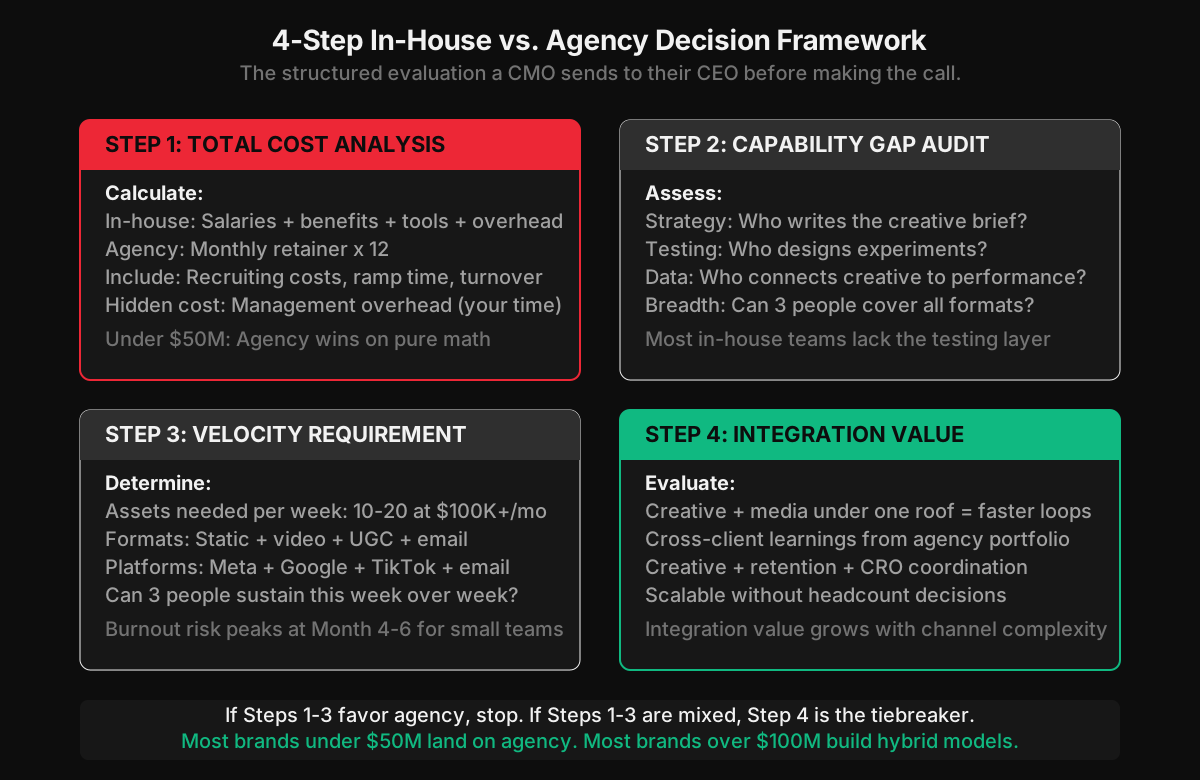
Stop debating. Run the framework. The answer will be clear within 30 minutes.
Step 1: Total cost analysis. Calculate your all-in cost for an in-house team (salaries, benefits, tools, overhead, recruiting, turnover) and compare it to 2-3 agency proposals. Include the opportunity cost of your management time. If the agency costs 40%+ less, the cost argument is settled unless you have specific reasons to value in-house beyond cost. Understanding the full scope of integrated agency services helps ensure you are comparing equivalent capability sets.
Step 2: Capability gap audit. List every capability in the five-layer performance creative stack (strategy, static, video, testing, performance integration). Identify which layers your in-house team can cover. If they cover 2-3 of 5, the remaining layers represent a capability gap that an agency fills. If they cover 4-5 of 5, you may not need an agency for creative, though you may still benefit from the cross-client intelligence and overflow capacity.
Step 3: Velocity requirement. Calculate how many assets per month your paid media spend requires (rough guide: 1 new asset per $2K-$3K of monthly ad spend). Compare this to your in-house team's sustainable output. If the velocity requirement exceeds sustainable capacity by 30%+ , you need external support. In-house creative teams that consistently operate above capacity burn out at Month 4-6, leading to quality decline and turnover.
Step 4: Integration value. Evaluate how creative currently connects to media performance. If creative decisions are made in a vacuum (no data, no testing, no feedback from media), the integration layer is the highest-value addition an agency provides. This alone can justify the agency relationship even if cost and velocity are manageable in-house. Connecting creative to your broader growth strategy requires this integration layer.
FAQ
How much does an in-house creative team cost vs a creative agency?
A 3-person in-house creative team (creative director, designer, video editor) costs $310K-$490K annually when you include salary, benefits, tools, and overhead. A performance creative agency retainer ranges from $10K-$15K per month ($120K-$180K annually) and includes strategy, design, video, testing, and performance integration. The cost savings with an agency are 60-65% at most revenue stages.
When should a DTC brand hire in-house creative vs using an agency?
Brands under $20M in annual revenue should use an agency for cost efficiency and breadth of capability. Brands at $20M-$50M often use a hybrid model with 1-2 in-house creatives plus an agency for volume and strategy. Brands above $50M may benefit from a larger in-house team for brand intimacy, but many still keep an agency for performance creative testing and cross-channel production.
What does a performance creative agency include that in-house does not?
A performance creative agency includes five layers: strategy and insights, static creative production, video and motion production, systematic creative testing, and performance integration. Most in-house teams cover production only (layers 2-3) and lack the testing framework and performance integration that connect creative to business outcomes.
What are red flags when evaluating a creative agency?
Red flags include no performance data in their case studies, inability to explain their testing methodology, no dedicated strategist on the team, pricing that does not include revisions or iterations, and no integration with media buying teams. Also watch for agencies that show one-off hero campaigns rather than systematic creative programs.
What questions should I ask a performance creative agency before signing?
Five essential questions: How do performance results inform your creative briefs? What is your creative testing methodology? How many new assets do you produce per month and in what formats? How do you measure creative success beyond vanity metrics? And can you share performance data from accounts you manage?
Can I bundle creative with media buying and analytics?
Yes, and bundling creative with media buying and analytics produces better results than separating them. The creative-to-media feedback loop is faster when both functions sit under one roof. Bundled engagements typically cost 15-25% less than hiring separate specialist agencies.
How many creative assets does a DTC brand need per month?
Brands spending $50K-$100K per month on paid media need 30-50 new creative assets per month across static, video, and UGC formats. At $100K-$300K monthly spend, this increases to 50-80 assets. At $300K+ monthly spend, you need 80-120 assets per month.
What is the difference between a creative agency and a performance creative agency?
A creative agency produces visual assets based on brand guidelines and creative direction. A performance creative agency produces assets specifically designed to drive measurable business outcomes. The difference is in the process: performance creative agencies use data to inform what gets made, test systematically, and iterate based on performance rather than subjective feedback.
Get a Performance Creative Assessment From Darkroom
Darkroom runs performance creative for DTC brands from $5M to $100M+ in revenue. We combine creative strategy, production, systematic testing, and media integration into a single engagement that eliminates the coordination overhead of managing multiple vendors. Whether you need a full creative program or a hybrid model that complements your in-house team, we will scope the engagement to your specific needs.
Book a performance creative assessment and we will evaluate your current creative structure, identify the capability gaps, and model the cost comparison for your specific revenue stage and ad spend level.