
PERFORMANCE CREATIVE
Influencer and Creator Marketing: How DTC Brands Scale Paid Partnerships Without Killing ROI




Written by Darkroom leardership

Written & peer reviewed by 4 Darkroom team members
TL;DR
Most DTC brands treat influencer marketing as a brand awareness play with unmeasurable ROI. They gift product, hope for organic posts, and track impressions that never connect to revenue. The brands scaling creator partnerships profitably do something structurally different: they source creators by content quality instead of follower count, negotiate paid usage rights upfront, funnel creator content into performance ad testing pipelines, and measure everything on cost-per-acquisition. The shift from influencer-as-cost-center to influencer-as-growth-lever is not about finding better creators. It is about building a better system around the creators you already have. Darkroom builds creator-to-paid-media systems for DTC brands scaling profitably.
The Awareness Trap That Kills Influencer ROI
Influencer marketing has an attribution problem, and most brands have accepted it as permanent.
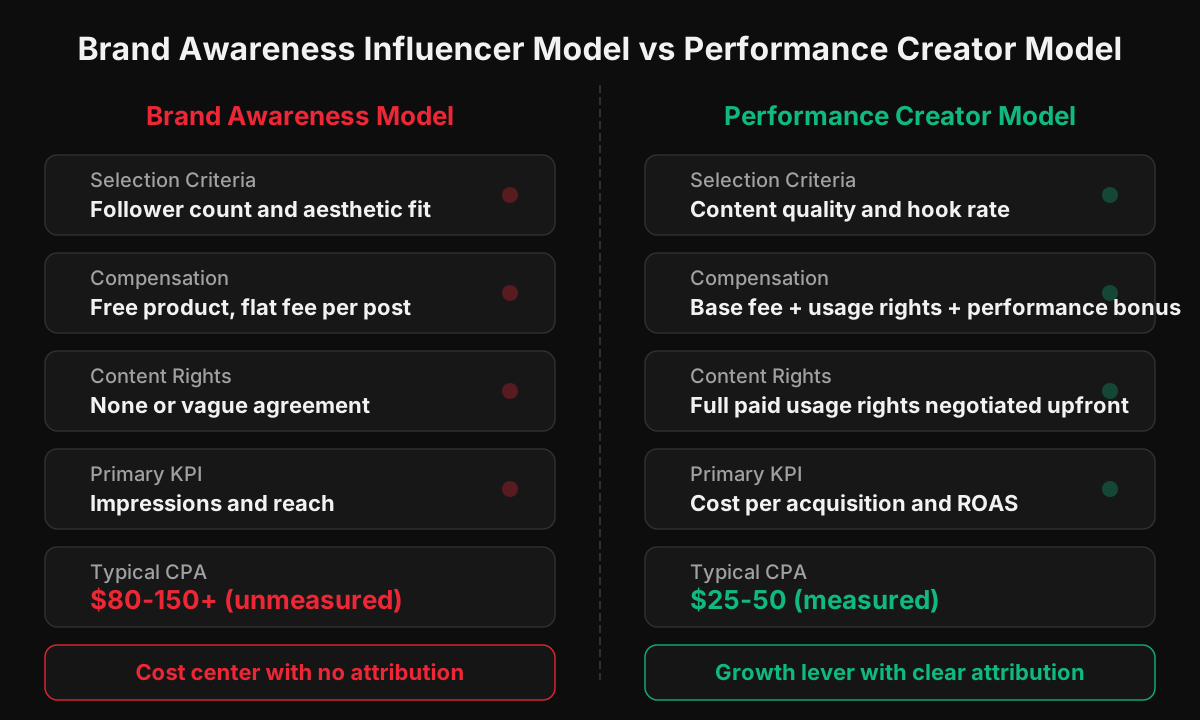
The standard DTC influencer playbook looks the same everywhere. A brand identifies influencers who match their aesthetic. They send free product. They negotiate a flat fee for a post or a series of stories. The influencer publishes. The brand screenshots the post, logs the impressions and likes, and drops a row into a spreadsheet that says "influencer campaign" with a vague cost-per-impression number that sounds efficient on paper.
Then someone asks: how many sales did that drive? And the room goes quiet.
The awareness model treats influencer marketing as a top-of-funnel brand play that exists outside the performance marketing stack. It operates on different metrics (reach, impressions, engagement rate), runs on different timelines (campaign-based rather than always-on), and reports through different channels than the rest of the media mix. The result is a line item that grows every quarter but never connects cleanly to customer acquisition cost or revenue.
This is not an influencer problem. It is a structural problem. The awareness model was designed for brand marketers who measure in lift studies and sentiment surveys. DTC brands that need to acquire customers profitably cannot afford to run a channel on faith. They need the same rigor they apply to paid media applied to creator partnerships: clear inputs, measurable outputs, and a feedback loop that tells them what is working and what is burning money.
According to a 2025 Influencer Marketing Hub benchmark report, 67% of brands still measure influencer success primarily through reach and engagement metrics rather than direct sales attribution. That means two-thirds of brands running influencer programs cannot tell you what a creator partnership actually costs them per acquired customer. In a channel where DTC brands collectively spend billions annually, that gap between spend and attribution is where ROI goes to die.
Performance Creator Marketing: A Different Operating Model
The brands making influencer work as a performance channel are not finding better influencers. They are running a fundamentally different system.
Performance creator marketing flips the awareness model on three axes. First, sourcing shifts from follower count to content quality. Second, contracts shift from organic posting to paid media usage rights. Third, measurement shifts from impressions to cost-per-acquisition. Each shift changes how the brand operates, not just what metrics it tracks.
Sourcing by Content Quality, Not Audience Size
In the awareness model, a creator with 500,000 followers who posts polished lifestyle content is more valuable than a creator with 15,000 followers who makes raw, high-converting product demonstrations. In the performance model, the opposite is true. The 15K creator whose content hooks viewers in the first two seconds and drives them to act is worth ten times more than the 500K creator whose content looks beautiful but does not convert when you put paid spend behind it.
Performance sourcing evaluates creators on metrics that predict ad performance: hook rate (what percentage of viewers watch past the first three seconds), hold rate (average watch time relative to video length), engagement-to-view ratio, and historical conversion data from similar content styles. Follower count becomes a secondary consideration because the content is going into paid distribution anyway. You are not buying their audience. You are buying their ability to produce content that converts strangers.
This is the key insight most brands miss. When you run creator content as paid ads through performance creative pipelines, the creator's organic reach is irrelevant. What matters is whether their content can stop a scroll, hold attention, and drive a click when served to cold audiences at scale. A micro-creator with 8,000 followers who consistently produces thumb-stopping content is a better investment than a macro-influencer whose content disappears into an algorithmic feed.
Contracts Built for Paid Media, Not Organic Posts
The awareness model contracts for deliverables: one feed post, three stories, a reel. The performance model contracts for assets and rights. The deliverable is not the post itself. The deliverable is the raw footage, the multiple hook variations, and the legal right to run that content as a paid advertisement across Meta, TikTok, and any other platform for a defined period.
Usage rights are the single most overlooked element of creator partnerships. Without them, a brand pays for content it can only use once, on one platform, in one format. With usage rights, the same content enters a creative testing framework where it can be cut into multiple ad variants, tested across audiences, and scaled when it performs. The unit economics of creator content flip entirely when you amortize the cost across dozens of ad variations rather than a single organic post.
A typical performance creator contract includes: a base creative fee for production, a separate usage rights fee for 60-90 days of paid advertising, whitelisting or Spark Ad access to run ads from the creator's handle, requirements for multiple hook variations and raw footage delivery, and optional performance bonuses tied to ad spend thresholds or CPA targets. This structure aligns incentives. The creator gets paid fairly for their work and their likeness. The brand gets content it can actually use as a performance asset.
Building the Creator-to-Paid-Media Pipeline
Creator content only becomes a performance asset when it enters a system designed to test, measure, and scale it.
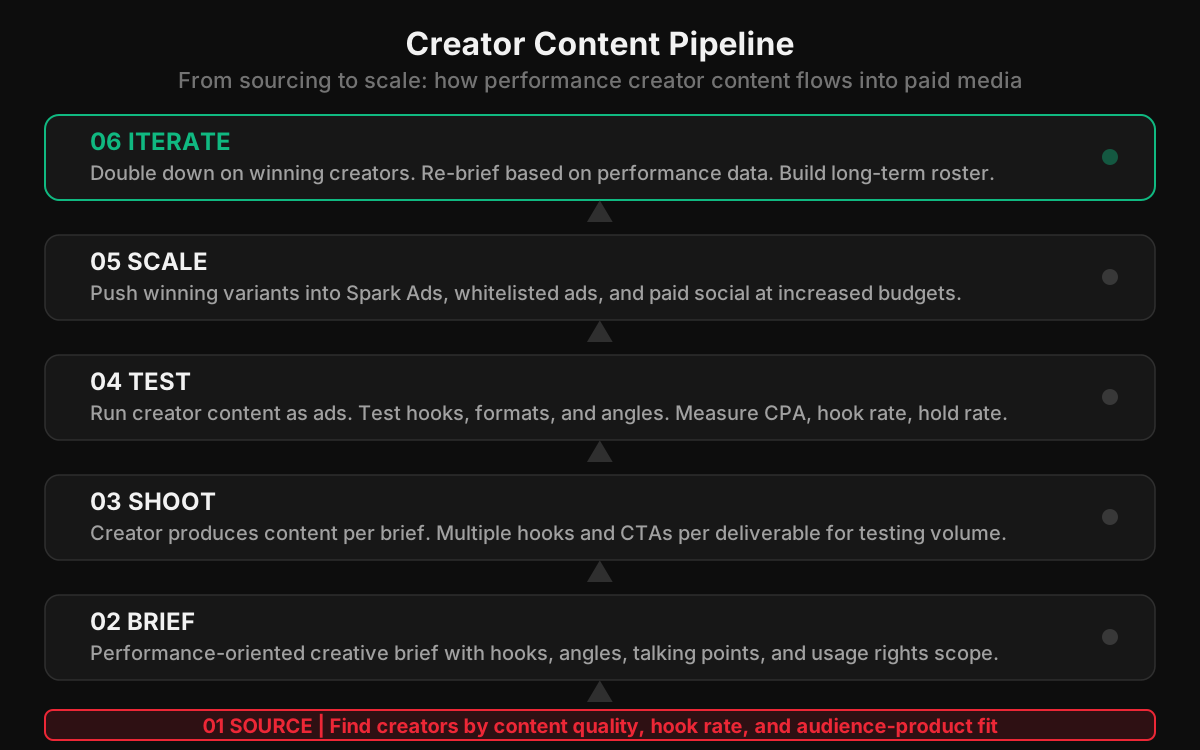
The pipeline that turns creator partnerships into measurable acquisition has six stages, and most brands only execute the first two before calling it "influencer marketing."
Stage 1: Source. Identify creators based on content style, hook rate, audience-product alignment, and production quality. Build a prospect list of 50-100 creators per product category. Score and rank them. The goal is volume at the top of the funnel because conversion rates from outreach to signed partnership run between 5-15%.
Stage 2: Brief. Send a performance-oriented creative brief, not a brand guidelines PDF. The brief specifies proven hook formats, key talking points, call-to-action structures, and the specific angles you want tested. It also specifies what you do not want: overly scripted delivery, forced brand mentions, and anything that kills authenticity. The best briefs give creators a framework and let them execute within it. As covered in the performance creative system methodology, constraint produces better output than total creative freedom.
Stage 3: Shoot. The creator produces content per the brief. The key difference from awareness campaigns: you request multiple hook variations per deliverable. If a creator is shooting a 45-second product video, they deliver three different opening hooks and two different CTAs. This gives your testing pipeline raw material to work with rather than a single take-it-or-leave-it asset.
Stage 4: Test. Creator content enters your paid media testing pipeline at low initial spend. You test each hook variation, each CTA, and each creator's content against your existing creative portfolio. The metrics that matter: cost-per-click, cost-per-acquisition, hook rate (3-second retention), hold rate, and thumb-stop ratio. Within 48-72 hours, you know which assets are performing and which are not.
Stage 5: Scale. Winning creator content gets budget allocation. It runs as Spark Ads on TikTok, whitelisted ads on Meta, and can be repurposed across YouTube Shorts and other placements. Because you negotiated usage rights upfront, scaling is a media buying decision, not a negotiation. The content that performs at $50/day gets pushed to $500/day and beyond.
Stage 6: Iterate. Performance data flows back to inform the next round of sourcing and briefing. Creators whose content consistently converts get re-briefed with data insights: "Your hook about [specific angle] drove a 2.1% CTR versus your average of 1.4%. Build more content around that angle." Creators whose content underperforms get replaced. The pipeline self-optimizes over time.
This pipeline is what separates influencer marketing as a cost center from creator marketing as a growth lever. The content is not a one-time post. It is a continuous supply of testable creative that feeds the same paid media engine driving the rest of the brand's acquisition.
The Economics: Why Performance Creator Content Outperforms In-House
Creator content is not cheaper than in-house production. It is more efficient per dollar of ad spend it generates.
DTC brands typically produce creative through one of three channels: in-house teams, production agencies, or creator partnerships. Each has different cost structures and different performance profiles.
Metric | In-House Production | Production Agency | Performance Creator |
|---|---|---|---|
Cost per asset | $500-2,000 | $2,000-10,000 | $200-800 |
Hook variations per asset | 1-2 | 1-3 | 3-5 |
Time to first ad test | 2-4 weeks | 4-8 weeks | 5-10 days |
Authenticity signal | Low (brand-produced) | Low (polished) | High (native to platform) |
Platform ad performance | Baseline | 0.8-1.2x baseline | 1.5-3x baseline |
Creative fatigue timeline | 2-3 weeks | 2-4 weeks | 3-6 weeks |
The performance advantage of creator content comes from three factors. First, it looks native to the platform. TikTok and Meta algorithms and users both favor content that feels organic rather than produced. Second, the diversity of creator voices extends creative lifespan because each creator brings a different face, style, and delivery. Third, the volume of testable variations per dollar spent is higher because creators produce content faster and cheaper than traditional production pipelines.
According to research from Aspire, brands using creator content in paid social campaigns see an average 30-50% reduction in cost-per-acquisition compared to brand-produced content. That delta is not because creators are cheaper. It is because their content converts better in paid environments where authenticity signals drive engagement.
The operational implication: DTC brands should not be choosing between in-house production and creator content. They should be running both, with creator content serving as the high-volume testing layer that identifies winning angles, and in-house production scaling those angles into polished hero assets. This is how a performance creative agency structures the creative supply chain for brands spending $100K+ per month on paid media.
Sourcing at Scale: How to Find Creators Who Actually Convert
The creator sourcing process determines everything downstream. Get it wrong and no amount of briefing or testing fixes the output.
Most brands source creators through one of three channels: influencer platforms (CreatorIQ, Grin, Aspire), manual social media scouting, or inbound applications. Each channel has strengths and weaknesses, but the evaluation criteria should be consistent regardless of source.
The performance creator scorecard evaluates five dimensions:
1. Hook Rate. Review the creator's last 20 pieces of content. What percentage stop you within the first two seconds? Creators with consistently strong hooks produce content that performs in paid environments. Creators who rely on slow builds or audience loyalty for views will underperform when their content is served to cold audiences.
2. Production Quality. Not polish. Quality. Good lighting, clear audio, stable framing, and comfortable on-camera presence. Over-produced content actually hurts performance on TikTok and Reels because it triggers the "ad" pattern recognition that makes users scroll past. You want professional enough to be watchable, raw enough to feel real.
3. Audience-Product Fit. The creator's audience demographics should overlap with your ideal customer profile. A fitness creator with a 22-year-old male audience is a poor match for a premium skincare brand targeting 35-year-old women, regardless of how good their content is. Audience alignment matters because even in paid distribution, platform algorithms use the creator's audience signals to inform initial targeting.
4. Engagement Authenticity. Check comment sections. Are the comments generic ("love this") or substantive ("where did you get that, I need it")? High engagement rates with low-quality comments suggest inflated metrics. Moderate engagement with purchase-intent comments suggests an audience that actually buys what the creator recommends.
5. Brand Partnership History. Review how the creator has handled past brand deals. Did they integrate the product naturally or did it feel forced? Did they follow through on deliverables? Creators with a track record of authentic brand integration produce better content for your brand too.
The scoring process matters because creator partnerships are a volume game. You will test content from 20-30 creators before finding the 5-8 who consistently produce assets that beat your CPA targets. Starting with a rigorous scorecard reduces the wasted spend on creators who look good on paper but produce content that does not convert.
Contracting and Rights: The Legal Infrastructure That Makes Scale Possible
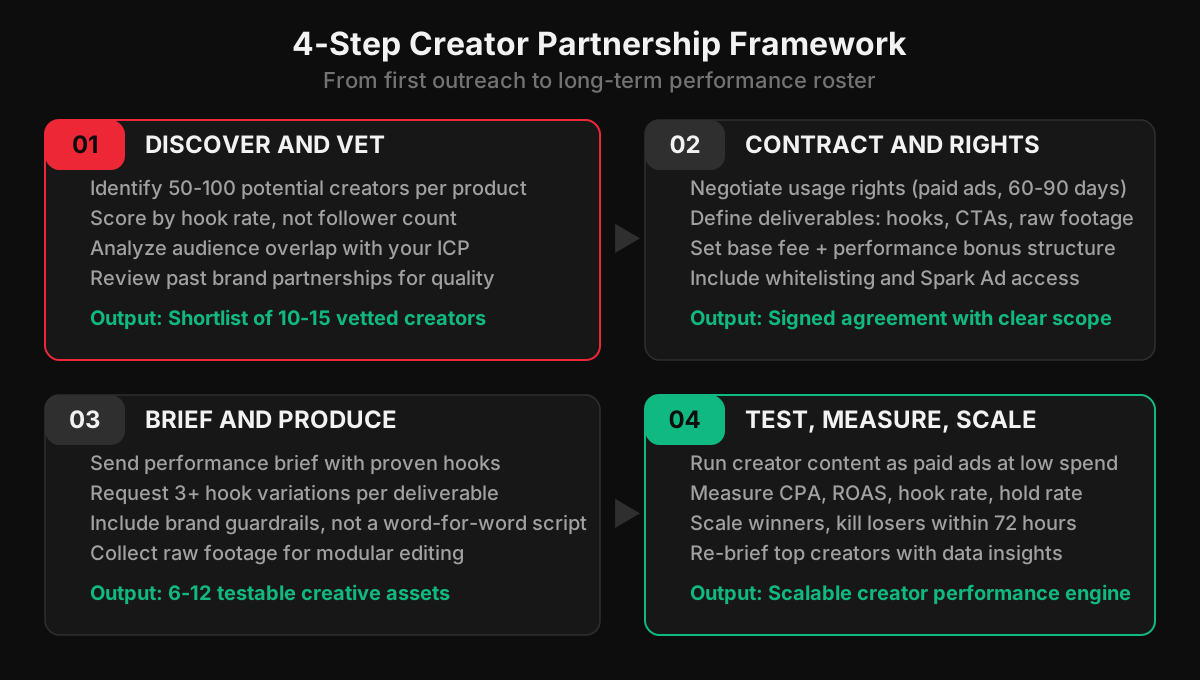
Every dollar of creator spend is wasted if you do not own the rights to use the content where it actually drives revenue: paid ads.
The contracting phase is where most DTC brands leave the most value on the table. They negotiate content creation and organic posting but neglect the usage rights that would allow them to turn that content into a performance asset. The result is a portfolio of creator content sitting on Instagram feeds generating diminishing organic reach, while the brand's paid media team is starving for fresh creative.
A performance-oriented creator contract covers four categories of rights:
Paid advertising usage. The right to run the creator's content as a paid advertisement on specified platforms (Meta, TikTok, YouTube, Pinterest) for a defined period. Standard terms are 60-90 days, with renewal options. This is the core right that makes the performance model work.
Whitelisting and Spark Ad access. The right to run ads from the creator's account handle, which typically outperforms ads run from the brand's account because it carries the creator's social proof. On TikTok, this means Spark Ad authorization codes. On Meta, this means partnership ads access through the creator's Facebook page or Instagram account.
Editing and derivative rights. The right to re-edit, splice, and combine the creator's content with other assets. This is critical for creative testing because your team will cut new hooks, swap CTAs, and create mashup ads that combine multiple creators' footage. Without editing rights, each piece of content is a static asset rather than modular raw material.
Raw footage delivery. The requirement that the creator delivers not just finished content but also raw footage, alternate takes, and B-roll. This multiplies the usable asset volume from each partnership and gives your performance creative team the material to produce dozens of ad variations from a single shoot.
Contract Element | Awareness Model | Performance Model |
|---|---|---|
Primary deliverable | Published post | Raw footage + finished cuts |
Usage rights | Organic only | Paid ads, 60-90 days |
Whitelisting | Rarely included | Standard requirement |
Hook variations | 1 final version | 3-5 variations required |
Editing rights | None | Full derivative rights |
Performance bonus | None | Tied to CPA or spend scale |
Renewal terms | Per campaign | Evergreen with usage windows |
The cost of usage rights typically adds 30-50% to the base creative fee. Brands often balk at this premium. But the math is straightforward: a $500 creator video used as a single organic post generates a few hundred impressions and decays within 48 hours. The same video with $250 in usage rights, run as a paid ad at $100/day for 60 days, can generate thousands of attributable conversions. The ROI gap between those two scenarios is not incremental. It is orders of magnitude.
Measurement: How to Track Creator ROI Like a Performance Channel
If you cannot measure creator partnerships on the same metrics as your paid media, they will always be treated as a discretionary budget line that gets cut in a downturn.
The measurement framework for performance creator marketing mirrors the framework for any other paid acquisition channel. The core metrics are cost-per-acquisition (CPA), return on ad spend (ROAS), and blended contribution to total revenue. The vanity metrics (impressions, reach, engagement rate) become secondary signals rather than primary KPIs.
There are three layers of creator ROI measurement:
Layer 1: Direct ad performance. When creator content runs as paid ads, you get standard platform attribution. CPA, ROAS, click-through rate, conversion rate. This is the cleanest measurement because it sits inside the same ad platforms you use for all other paid media. You can compare creator content performance against in-house creative, agency creative, and UGC content on an apples-to-apples basis.
Layer 2: Creator-level economics. Roll up all ad performance data by creator to calculate the total cost (creative fee + usage rights + ad spend) and total return (attributed revenue) per creator relationship. This tells you which creators are profitable and which are not. It also reveals your effective CPA by creator, which informs re-briefing and roster decisions.
Layer 3: Channel-level contribution. Aggregate creator-sourced content performance as a percentage of total paid media spend and revenue. This is the metric that justifies expanding or contracting the creator program. If creator-sourced content drives 25% of paid social revenue at a 15% lower CPA than brand-produced content, the case for scaling the program writes itself.
The brands that measure this way gain a structural advantage. They can tell their CFO exactly what creator marketing costs per acquired customer. They can reallocate budget between creators the same way they reallocate between ad sets. And they can scale creator spend with confidence because the data proves it works, not because a marketing deck says influencers are important.
Scaling the Creator Roster Without Killing Quality
Going from 5 creators to 50 requires systems, not just more outreach.
The biggest operational challenge in performance creator marketing is scaling the roster while maintaining content quality and measurement rigor. At 5 creators, you can manage relationships personally. At 50, you need infrastructure.
The scaling infrastructure has three components. First, a creator management platform (Grin, CreatorIQ, or a custom build) that tracks outreach, contracts, deliverables, and performance data in one place. Second, templatized briefs and contracts that reduce the operational cost per creator from hours to minutes. Third, a clear escalation framework: creators who hit performance thresholds get more budget and more briefs, creators who underperform get one re-brief before being rotated out.
The TikTok Shop ecosystem adds another dimension to creator scaling. TikTok Shop's creator affiliate program allows brands to list products and let creators earn commissions on sales they drive, combining organic creator content with direct commerce attribution. For DTC brands already running TikTok Shop, this creates a secondary creator pipeline that runs on performance economics by default: creators only earn when they sell.
According to CreatorIQ's trends data, brands that maintain active rosters of 30+ creators and rotate in new talent quarterly see 40-60% longer creative lifespan and 20-30% lower creative fatigue rates compared to brands relying on a small stable of 5-10 creators. Volume and diversity in the creator roster are not just nice to have. They are how you sustain performance as audiences develop ad blindness to individual creator faces and styles.
The TikTok Shop growth playbook for 2026 reinforces this: the brands winning on the platform are treating creator affiliate relationships as a scaled acquisition channel, not a handful of one-off partnerships. The same logic applies across all platforms. Scale the roster, systematize the operations, and let performance data determine who stays and who rotates out.
Common Mistakes That Destroy Creator Marketing ROI
Most brands make the same five mistakes. Each one is fixable, but only if you see it as a systems problem.
Mistake 1: Paying for reach instead of content. A creator with 1M followers who produces mediocre content will underperform in paid ads compared to a creator with 20K followers who makes compelling videos. If you are paying a premium for audience size, you are buying organic distribution that decays in 48 hours instead of content that can drive paid acquisition for months.
Mistake 2: Skipping usage rights. Every creator partnership without usage rights is content you paid for and cannot fully use. The organic post reaches a fraction of the creator's audience once. With usage rights, the same content enters your paid media machine and reaches millions of targeted prospects over 60-90 days.
Mistake 3: Over-scripting the brief. Creators convert because they feel authentic. Word-for-word scripts kill that authenticity. The best briefs provide a framework (hook format, key talking points, CTA structure) and let the creator deliver it in their own voice. Brands that over-script get content that feels like an ad, which is exactly what platform users scroll past.
Mistake 4: Measuring the wrong things. If your creator marketing report leads with impressions and engagement rate, you are measuring visibility, not value. The metrics that matter are CPA, ROAS, and revenue attributed to creator-sourced content. Everything else is context, not outcome. This is the same platform metrics trap that undermines paid media programs.
Mistake 5: Treating creators as vendors instead of partners. The best creator relationships are long-term. Creators who understand your product, your audience, and your brand voice produce better content over time. Rotating creators constantly because you are chasing the cheapest rate destroys the learning curve advantage. Build a core roster of 5-10 high-performing creators and invest in those relationships while continuously testing new talent at the edges.
The Full-Funnel Integration: Creators Across the Customer Journey
Creator content is not just a top-of-funnel play. The highest-performing brands deploy it across the entire full-funnel marketing system.
At the top of funnel, creator content drives awareness and initial engagement through Spark Ads and whitelisted campaigns targeting cold audiences. This is where most brands stop. But creator content performs at every stage.
In the mid-funnel, creator testimonials and product demonstrations serve as retargeting assets for audiences who have visited the site but not converted. A creator explaining why they chose your product over alternatives addresses the consideration-stage objections that generic retargeting ads cannot. According to Nielsen's trust research, consumers trust recommendations from individuals (even paid creators) at significantly higher rates than brand advertising, making creator content particularly effective at the consideration stage where trust is the primary conversion barrier.
At the bottom of funnel, creator unboxing videos and review content serve as the final nudge for high-intent audiences. When a customer has added to cart but not purchased, a retargeting ad featuring a real person showing the product quality, fit, and experience converts at higher rates than a product photography carousel.
Post-purchase, creator content drives cross-sell and referral. A creator showing how they style multiple products from the brand or demonstrating complementary products encourages repeat purchases. This content can run as email marketing assets, social media organic content, and even on-site product page elements.
FAQ
How much should DTC brands budget for creator partnerships?
Start with 15-25% of your total creative production budget. As you prove ROI through the performance pipeline, scale creator spend relative to its CPA performance against other creative sources. Brands with mature programs often allocate 40-60% of creative budget to creator content because it outperforms on a cost-per-acquisition basis.
What is the difference between influencer marketing and creator marketing?
Influencer marketing traditionally buys access to someone's audience through organic posts. Creator marketing buys their content production ability and the rights to use that content in paid advertising. The distinction matters because the economics, contracts, and measurement frameworks are fundamentally different.
How many creators should a DTC brand work with?
Start with 10-15 in a testing phase. Expect 3-5 to produce content that meets your CPA targets. Scale to 30-50 active creators as you build operational infrastructure. Rotate 20-30% of the roster quarterly to combat creative fatigue and discover new high performers.
Should brands use creator platforms or source manually?
Both. Platforms like Grin and CreatorIQ are efficient for volume sourcing and contract management. Manual scouting on TikTok and Instagram catches emerging creators that platforms have not indexed yet. The best programs run both channels simultaneously.
How do you measure creator ROI when some impact is indirect?
Measure direct ROI through paid ad attribution (CPA and ROAS on creator-sourced ads). Measure indirect contribution through incrementality testing and media mix modeling. The direct measurement alone is sufficient to justify the program. Indirect impact is the bonus.
What should a creator brief include for performance content?
Hook format options (3+ variations), key product benefits to communicate, CTA structure, brand guardrails (what not to say), examples of top-performing content from past creators, and technical requirements (aspect ratio, length, audio). Do not include word-for-word scripts.
How do Spark Ads and whitelisted ads work with creator content?
Spark Ads (TikTok) and partnership ads (Meta) allow brands to run paid ads that appear as the creator's content rather than brand ads. The creator authorizes the brand's ad account to promote their content. These formats outperform standard brand ads because they carry the creator's social proof and appear native to the platform.
Can creator marketing work for high-AOV or B2B DTC brands?
Yes, but the creator profile shifts. High-AOV brands need creators who can communicate value and quality, not just attention. B2B DTC brands benefit from industry expert creators and thought leaders rather than lifestyle influencers. The performance pipeline and measurement framework remain the same.
The System Is the Strategy
Influencer marketing does not fail because creators are ineffective. It fails because brands operate it as a disconnected awareness channel instead of integrating it into their performance marketing infrastructure. The brands scaling creator partnerships profitably have built a system: performance sourcing, rights-based contracts, creative testing pipelines, acquisition-focused measurement, and continuous iteration based on data.
The gap between influencer-as-cost-center and creator-as-growth-lever is not a talent gap. It is a systems gap. The same creators producing content for brands that see no ROI are producing content for brands that scale it into their highest-performing paid media assets. The difference is what happens after the content is created.
If your influencer program is generating impressions but not attributable revenue, the problem is structural. You are running an awareness model in a performance context. The fix is not better creators. It is a better system around the creators you have: negotiate usage rights, build the testing pipeline, measure on CPA, and let the data tell you who to scale and who to replace.
For brands ready to operationalize this, start by auditing your current creator relationships against the performance framework. Identify which partnerships have usage rights and which do not. Calculate your true cost per acquired customer from creator content versus other creative sources. That audit will show you exactly where the structural gaps are and what to fix first. If you need a team that has built this system across dozens of DTC brands, choosing the right agency partner accelerates the timeline from months to weeks.
Ready to turn creator content into your highest-performing acquisition channel?Book a call with Darkroom. We build the sourcing, contracting, and creative testing infrastructure that makes influencer marketing measurable and scalable.