
AI Search
How ChatGPT Shopping Is Transforming Online Purchasing in 2026




Written by Darkroom leardership
Jul 20, 2026

ChatGPT Shopping is OpenAI's AI product-discovery experience: shoppers describe what they need in natural language, and ChatGPT recommends specific products with images, prices, and reviews — some purchasable through agentic checkout. Brands appear based on structured product feeds and third-party trust signals, not paid placement.
AI assistants are already deciding which products get bought, and most DTC product feeds are invisible to them. The AI shopping shift shows up in search demand first: queries for ChatGPT shopping have grown +11,900% over 24 months (4,400 searches/month), and "agentic commerce" has grown +45,150% (18,100/month) in the same window (Google Ads data via KeywordTool.io, global, July 2026).
Meanwhile, ChatGPT crossed 900 million weekly active users in February 2026, and a December 2025 Semrush survey found 50% of U.S. shoppers have bought something after researching it with AI. This is no longer a channel experiment; it is a discovery layer sitting in front of your store.
This guide covers how ChatGPT Shopping works now, what changed with agentic checkout, and what it takes to get recommended.
What is ChatGPT Shopping?
ChatGPT Shopping is the product discovery experience inside ChatGPT. Ask for “a waterproof trail runner under $150 with a wide toe box.” The AI shopping assistant returns a curated carousel of specific products. It includes images, prices, ratings, and review summaries. This info comes from structured merchant feeds and crawled web data. It does not come from paid ads.
OpenAI launched shopping results in April 2025, but the mechanics around it changed materially. In 2026, ChatGPT now sits between 900 million weekly users and the open web, and its recommendations concentrate demand on a handful of products per query.
Where a Google results page gives you ten blue links and a wall of Shopping ads, ChatGPT gives you three to eight products and a reason for each. Being one of them is binary — you're recommended, or you're invisible.
Here's the shift at a glance:
Traditional Search | ChatGPT Shopping | |
|---|---|---|
Discovery | Keyword queries, 10 links + ads, user filters manually | Natural-language conversation; AI interprets intent, budget, and constraints |
Ranking signals | Backlinks, on-page SEO, bids (for ads) | Structured feed data, review corpus, third-party mentions, entity clarity |
Checkout | Click through to merchant site | Discover in chat and buying journey on merchant site (in-chat checkout scaled back in 2026) |
Optimization discipline | SEO + paid search | GEO (generative engine optimization) + feed operations |
How does ChatGPT Shopping work in 2026?
ChatGPT Shopping detects buying intent in a conversation. It retrieves product options from its index. It then re-ranks them using what it knows about the request. This includes budget, use case, and earlier constraints. The output is a shoppable carousel with product cards linking out to merchants.
Where the product data comes from
Three pipelines feed OpenAI shopping results, and most brands only control the first two:
Merchant product feeds. OpenAI accepts direct product feeds carrying titles, descriptions, price, availability, variants, shipping, and returns data. Shopify merchants are syndicated automatically through Shopify's Global Catalog since March 2026.
OAI-SearchBot crawling. OpenAI's crawler indexes product and content pages from sites that allow it in robots.txt. If OAI-SearchBot is blocked, your catalog stays invisible, no matter how good your feed is. This is often left over from 2023 bot rules.
Third-party sources. Reviews, editorial roundups, Reddit threads, and comparison articles. ChatGPT triangulates. A product in your feed and in independent "best X for Y" coverage ranks higher. One that only exists in its own catalog ranks lower.
How product recommendations are ranked
Rankings are organic, not paid, and OpenAI takes no fee for visibility (only a small fee on completed in-chat purchases, which doesn't affect ranking). What moves the needle:
Relevance to the stated need, including constraints most product pages ignore (fit notes, materials, compatibility).
Trust signals: review volume and sentiment, aggregate ratings, and how consistently third-party sources describe the product.
Structured data quality: complete, current feed attributes and schema markup. Shopify's own data shows structured feeds convert roughly 2× better than scraped data — because the AI can actually answer follow-up questions about the product.
Availability and price accuracy: stale stock status or mismatched pricing gets products quietly filtered out.
Understanding the new wave of agentic checkouts
Agentic commerce is the model where an AI agent doesn't just recommend a product but executes the transaction. In 2026, it went through its first full hype cycle: launched September 2025, scaled back March 2026, and reborn as a discovery-first architecture.
The infrastructure layer is real and durable. The Agentic Commerce Protocol (ACP), co-developed by OpenAI and Stripe, standardizes how an AI agent transmits an order to a merchant's backend — the merchant accepts or declines, processes payment through its existing provider, and fulfills as normal.
Google and Shopify answered in January 2026 with the Universal Commerce Protocol (UCP), launched with 20+ backers; by June 2026 Shopify had removed approval requirements for UCP-based agents entirely. Two competing standards racing to zero friction is what "early but inevitable" looks like.
How Instant Checkout works inside ChatGPT
Instant Checkout allows shoppers to buy items directly within ChatGPT using a "Buy" button on product cards. This feature handles shipping, payment, and order confirmation without requiring the user to leave the conversation.
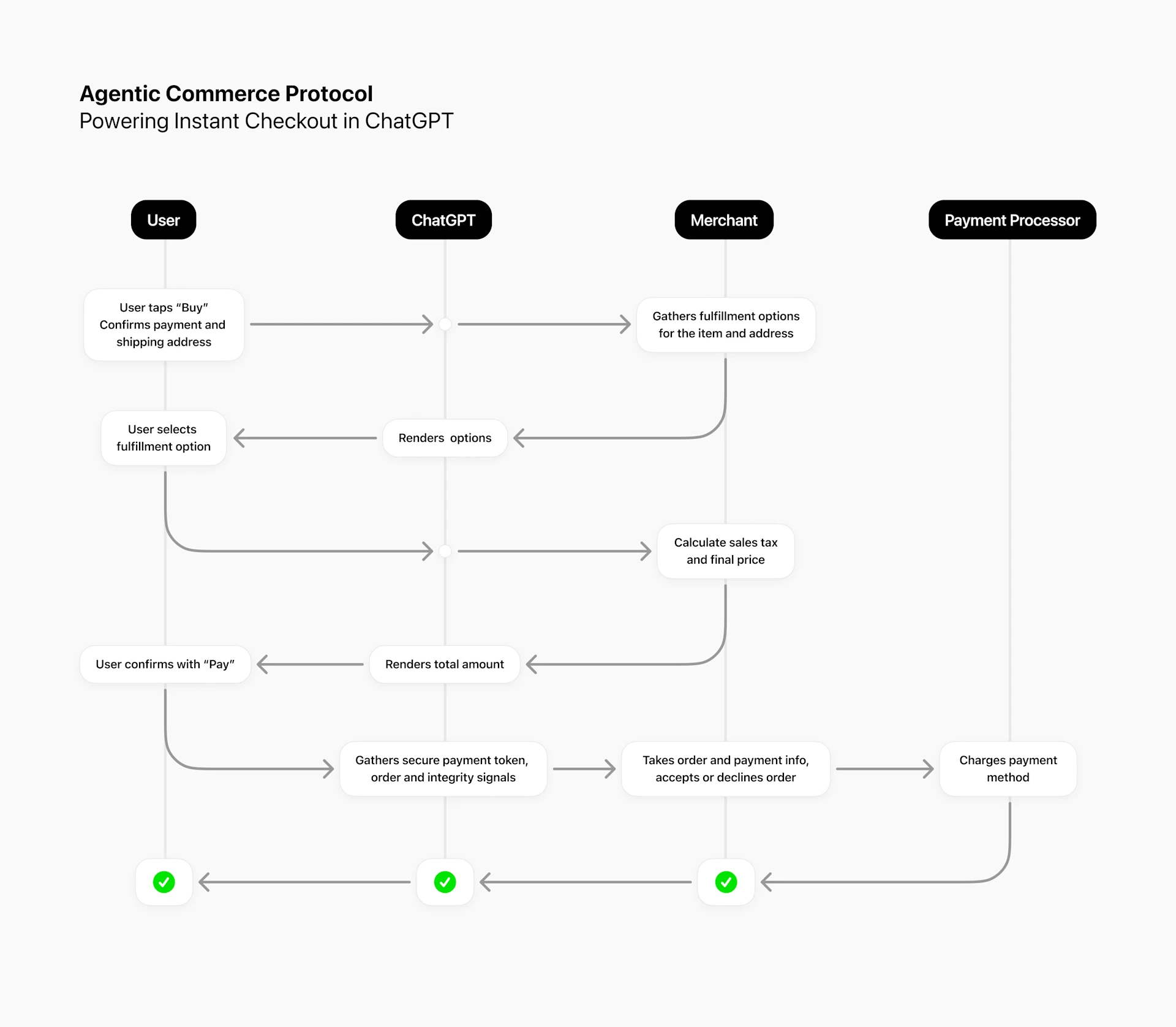
How Instant Checkout works:
Process: Shoppers tap "Buy" and confirm details.
Infrastructure: ChatGPT uses the Agentic Commerce Protocol (ACP) to send order data to the merchant's backend.
Payment: Merchants use their existing payment providers to process transactions, maintaining their status as the seller of record.
Incentives: The merchant retains ownership of order data and customer relationships; there is no ranking advantage for offering Instant Checkout.
By February 2026, roughly 30 Shopify stores were live against the million promised, and in March OpenAI confirmed Instant Checkout is "moving to Apps, where purchases can happen more seamlessly", shifting in-chat transactions to retailer apps like Instacart, Target, and Expedia inside ChatGPT.
What are the merchant requirements to join ChatGPT Shopping?
Joining ChatGPT Shopping takes three things — a product feed that meets OpenAI's spec, crawler access for OAI-SearchBot, and, unless you sell on Shopify or Etsy, an approved application to OpenAI's merchant program. The platform you sell on decides how much work that is:
Platform path. Shopify and Etsy catalogs are integrated automatically — no application or extra setup required. Everyone else applies through OpenAI's merchant form (company, website URL, and catalog size in unique SKUs), with a self-serve merchant portal slated for later in 2026.
Feed spec. Product data must include images, pricing, availability, key descriptions, and reviews, delivered via SFTP, API, or a supported commerce platform/feed provider per OpenAI's developer documentation.
Market and categories. U.S. shoppers only for now, with regional expansion planned, across categories spanning fashion, beauty, electronics, home and garden, baby/kids, pet care, food and beverage, automotive, and travel.
Cost. OpenAI currently charges no fees on purchases that start in ChatGPT — participation costs feed operations, not margin.
ChatGPT Instant Checkout is worth keeping live where it still applies (Etsy, apps), but the requirements that actually determine visibility persist across both checkout models — a structured real-time feed, ACP or UCP compatibility through your platform, and accurate inventory, pricing, and shipping data the agent can trust.
How do you optimize product feeds for ChatGPT Shopping?
To optimize product feeds, you can follow three simple steps. Feed quality is the single highest-leverage input you control, since it determines whether ChatGPT product recommendations can include you at all, and whether the model can answer the follow-up questions that close the sale.
Structure your product metadata for machines, not just shoppers
Write titles and descriptions that answer the questions shoppers actually ask an assistant about: materials, dimensions, fit, compatibility, use cases, and care. Populate every feed attribute — GTIN, brand, variant axes, shipping weight, return window — and mirror them in Product schema (JSON-LD) on the product page itself.
Enable OpenAI's crawlers and submit a direct feed
Audit robots.txt and your CDN/WAF rules for OAI-SearchBot (indexing for shopping/search) and confirm you're not serving it blocked or degraded pages. Then, verify crawl activity in your logs.
If you're on Shopify, confirm your products are syndicating through the Global Catalog; on other platforms, apply directly to OpenAI's merchant feed program. Tag and monitor referral traffic (utm_source=chatgpt.com) in GA4 so the channel is measurable from day one.
Validate accuracy on a schedule
Treat the feed as a production system: reconcile price, availability, and shipping promises between feed, page, and schema weekly. Mismatches get products filtered, and bad data is the failure mode of agentic commerce, not bad models.
Set alerts on feed rejection rates and on ChatGPT-referred sessions so drift shows up in a dashboard, not in a quarter of lost demand. The right AI search optimization tools automate most of this monitoring.
How can DTC brands be recommended by ChatGPT?
Generative engine optimization (GEO) is the discipline of earning recommendations from AI engines — and for ecommerce it extends well past the product feed, because ChatGPT decides what to recommend from everything it can read about your brand, not just what you submit.
AI visibility is a function of your entire surface area: product pages, editorial content, third-party reviews, Reddit and forum sentiment, and how consistently the model can resolve your brand as an entity. (Some practitioners call the answer-extraction side of this answer engine optimization.)
What that looks like in practice for a DTC brand:
Entity clarity: ChatGPT recommends brands it can describe. Consistent naming, an unambiguous "what we are and who we're for" across your site, schema (Organization, Product, FAQ), and profile consistency are key across the sources LLMs cite.
Reviews and UGC gravity: The model weighs independent voices above your own copy. Review volume, third-party listicles, and community mentions function like backlinks did for classic SEO, with key differences between GEO and SEO.
Extractable content: Question-shaped headings, direct answers in the first sentence, comparison tables — content built the way AI engines quote.
What an AI search optimization program covers
An AI search optimization program audits visibility across every surface an LLM reads, then fixes gaps in order of priority: crawler access, feed spec, schema coverage, entity signals, citation-worthy content.
This is how Darkroom works: we engineered Cocolab's site for AI search from the architecture up, and for Bulletproof, we audited 362 blog articles and a 142-product catalog for AI visibility before touching a single template. If you want to know exactly where your brand is invisible today, a full-surface AIO audit is the fastest way to find out.
What comes next for AI Shopping?
The 2026–2027 trajectory is visible in what shipped this year. Google's AI Mode is pushing the same conversational-commerce pattern into the world's largest search surface, with UCP as its transaction rail.
OpenAI has held the "organic and unsponsored" line for product results, but with a $29B revenue target for 2026, sponsored placement pressure in AI shopping surfaces is a when, not an if — and early-mover organic visibility compounds before that door opens.
Every major AI assistant is converging on the same architecture — conversational discovery, structured feeds, buy-on-site checkout — but each engine reads different signals. AI shopping rewards the brands that treat it as infrastructure now, while most competitors are still deciding whether it's real.
AI search visibility isn't a "nice-to-have"—it's the new digital storefront. While competitors wait on the sidelines, the brands that act now are capturing the trust of AI agents. Don't let your catalog remain invisible; request your AI search audit here.