
PAID MEDIA
What Makes an AI Marketing Agency Different from a Marketing Agency That Uses AI




Written by Darkroom leardership

Written & peer reviewed by 4 Darkroom team members
The AI Adoption Paradox
The problem is not whether AI tools exist. The problem is how agencies integrate them into their operating model.
Every agency today has access to the same AI tools. ChatGPT, Claude, Midjourney, and generative image platforms are commodities. The difference between an "AI marketing agency" and a traditional agency using AI tools comes down to architectural choice, not tool access. Understanding how to choose a growth marketing agency starts with recognizing this distinction.
Traditional agencies layer AI on top of legacy workflows. They use ChatGPT to write copy faster. They run Midjourney to generate variations. But the underlying process—account planning, media buying timelines, creative approvals, reporting cadence—remains unchanged. Speed increases at the margins. Structure stays intact.
A purpose-built AI marketing agency operates differently. It rebuilds workflows to exploit what AI can do: parallel processing, real-time iteration, statistical pattern recognition at scale, and decision velocity that humans can't match alone. The workflows aren't traditional processes with AI helpers. They're fundamentally different architectures.
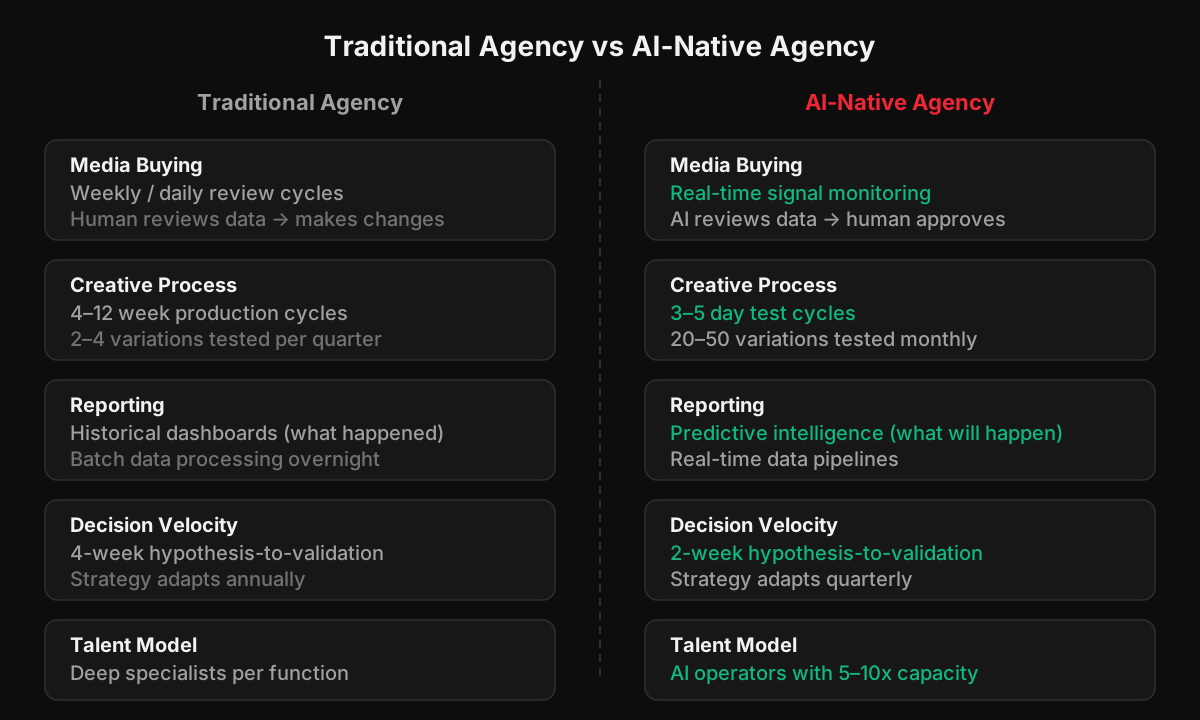
How Media Buying Changes Under AI Architecture
Traditional agencies buy media on a weekly or daily cadence, driven by human review capacity. AI agencies buy and adjust media in hours.
In a traditional agency, a media buyer reviews performance data, identifies trends, and makes optimization calls. This happens daily or weekly. The human becomes the bottleneck. Adding AI chatbots to that workflow doesn't solve the constraint—it just makes the human more efficient at the same task.
An AI-first media buying architecture separates signal detection from decision-making. AI systems monitor thousands of signals in real time: audience composition shift, CTR degradation, conversion rate change by device, cost-per-acquisition drift by geography. When a signal crosses a threshold, the system flags it. A human operator decides whether the optimization should execute automatically, semi-automatically, or requires manual review.
This inversion changes everything. Instead of humans reviewing data and asking AI for support, AI reviews data and humans review AI's recommendations. The velocity of optimization increases 10-20x because the system doesn't wait for the next reporting cycle. It doesn't wait for a meeting. Adjustments happen within hours.
Traditional agencies with AI tools still report weekly. Real AI agencies report in real time because their systems operate in real time. The decision architecture is different.
Creative Iteration Speed as a Structural Advantage
Traditional creative workflows involve months of conception, production, and testing. AI agencies iterate on creative in days.
A traditional creative process looks like this: brief → creative direction → asset production → stakeholder approval → testing → iteration → scale. This takes 4-12 weeks. The bottleneck is production and approval cycle time.
An AI-native creative architecture removes that bottleneck. A brief generates 50 variations automatically. Those variations run in test cells simultaneously. Results arrive in 3-5 days. The winning variation gets produced to broadcast quality. The losing variations inform the next generation. The process repeats every two weeks, not every quarter.
This is not "faster creative approval." This is a different architecture. The system generates volume. Testing validates winners. Production follows, not precedes, data. Traditional agencies can adopt generative tools, but if the approval process and testing timeline stay the same, the advantage disappears. Real AI agencies have restructured the entire workflow to put AI output at the beginning and human judgment at the end. This is why performance creative agency services look fundamentally different when built on AI-native architecture.
Research from HubSpot (2024) found that companies using AI for content generation scaled their output volume 3-4x while maintaining or improving quality metrics. The key difference: the companies treating AI as a workflow accelerator, not a replacement for human review.
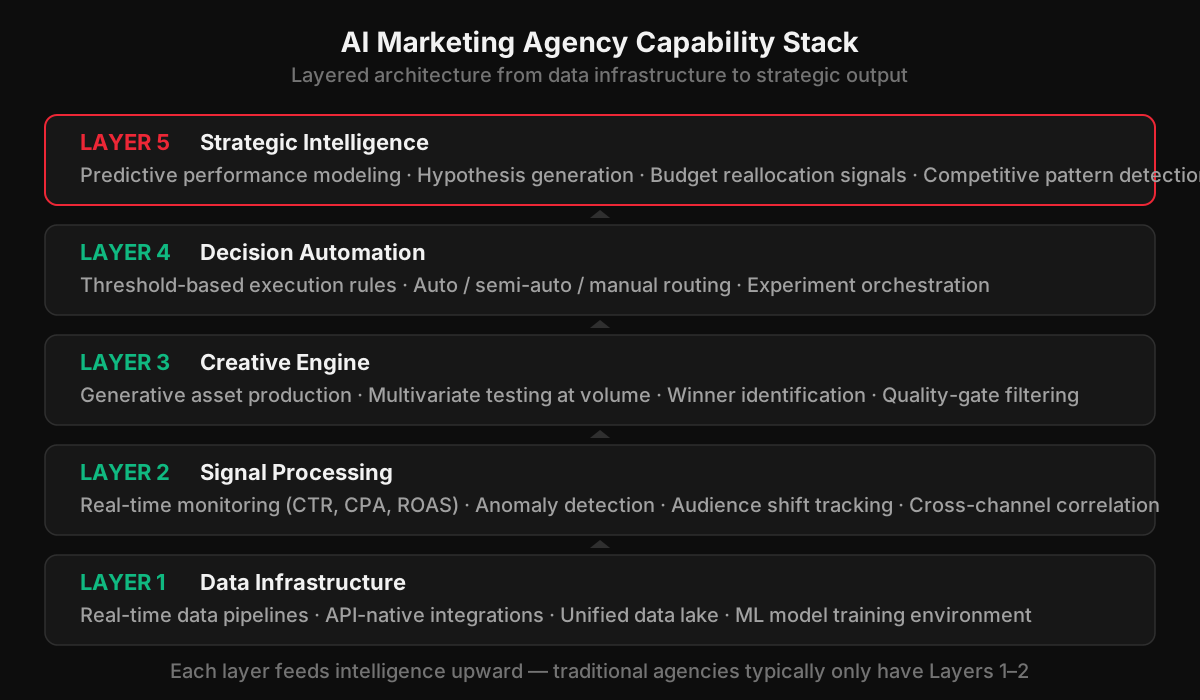
Reporting and Intelligence Infrastructure
Traditional reporting aggregates historical data. AI reporting predicts future performance and recommends action.
Most agency dashboards show what happened. Yesterday's CTR, last month's ROAS, conversion rates from the prior week. These are useful for accountability, but they don't drive decisions. A human looks at last week's data and guesses what to do this week. The feedback loop is slow.
An AI-native reporting infrastructure is predictive, not historical. The system models next week's performance based on current trends. It identifies which accounts will miss targets and flags them automatically. It highlights accounts that are outperforming and extracts the operational patterns. It doesn't just report what happened. It tells operators what will happen and what to do about it.
This requires a different technical stack. You need data pipelines that push information in real time, not batch processes that run nightly. You need machine learning models trained on your specific account patterns. McKinsey's analysis of generative AI productivity reinforces why native infrastructure matters more than bolt-on tools. You need systems that can reason about causation, not just correlation. Most agencies don't have this architecture. The reporting stays historical because the infrastructure was built for reporting, not for decision support.
Strategic Decision-Making at Higher Velocity
The problem is not whether executives make good decisions. The problem is how long decisions take to validate and execute.
In a traditional agency, a strategic question ("Should we increase budget on YouTube?") leads to an analysis phase that takes 2-3 weeks. Data gets gathered. Models run. A recommendation surfaces. Stakeholders review. A decision happens. Implementation takes another week. Four weeks later, you know whether the strategy worked.
An AI-driven agency can test a strategic hypothesis in parallel with ongoing operations. Increase YouTube budget on 10 percent of target accounts. Monitor the outcome over 5 days. If the hypothesis holds, scale. If it doesn't, reverse. The decision-to-validation cycle drops from four weeks to two weeks. More importantly, the insights feed back into the planning process faster. Strategy adapts quarterly instead of annually because the feedback loops are tight. This aligns with Gartner's findings on AI-driven marketing velocity.
This requires trusting AI systems to run experiments without human approval for each variation. It requires decision frameworks that are explicit enough for machines to follow. Most agencies don't have this. Strategy stays slow because the execution infrastructure was designed for human-paced decisions, not machine-paced testing.
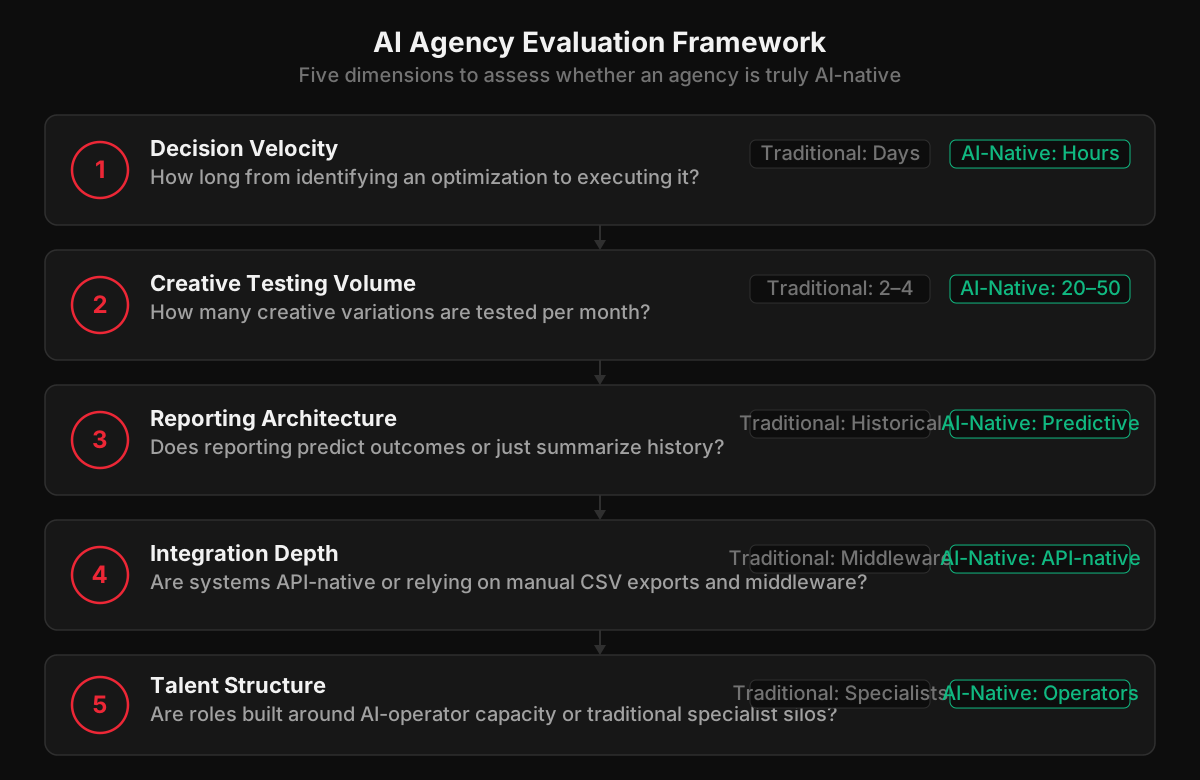
The Talent Model Inverts
Traditional agencies hire specialists. AI agencies hire operators who can work alongside AI systems.
A traditional agency's organizational structure reflects its workflow constraints. You hire media buyers, creative directors, strategists, analysts. Each function has deep expertise because humans are the constraint. You need specialists because a media buyer can only manage so many accounts simultaneously.
An AI-native agency reorganizes around what humans should do alongside AI. You need operators who can interpret AI recommendations and decide whether to trust them. You need people who can design testing frameworks and review results. You need strategists who can think in systems and feedback loops. The role of "creative director" shifts. Instead of directing production, they direct AI training and prompt-engineering. Instead of managing approval processes, they manage quality gates and variance thresholds.
This matters because hiring for the new model is harder than hiring for the old one. There's less institutional knowledge. Training takes longer. But the capacity of a single operator increases 5-10x because they're not constrained by human production capacity. Forrester's research on AI marketing transformation documents this capacity shift across agency operations.
Technical Debt and Integration Risk
The problem is not whether legacy systems and AI systems can coexist. The problem is the operational friction between them.
Many agencies have built systems over 5-10 years: client reporting platforms, media buying tools, creative management systems. These systems weren't designed for real-time AI integration. Bolting on an AI layer means data pipeline complexity, API integration headaches, and manual handoffs between systems.
A purpose-built AI agency either started with this architecture in mind or rebuilt core systems to accommodate it. There's less technical debt because the infrastructure wasn't constrained by legacy decisions. The integration friction is lower. Systems talk to each other natively instead of through middleware.
This is a massive structural advantage that most agencies overlook. If your reporting system requires manual CSV exports to feed into your optimization engine, you're not operating at AI velocity. You're operating at human-constrained velocity with AI tools.
Explore AI-Driven Marketing Services
Want to see how operating model restructuring changes outcomes? Learn about Darkroom's service architecture. Or dive into specific capabilities: AI-native paid media management, performance creative powered by AI iteration, and full-service AI marketing capabilities.
FAQ
Can a traditional agency become an AI agency by adopting new tools?
Partially, but tools alone don't change architecture. If the underlying workflows, approval processes, and decision-making timelines stay the same, you're just accelerating traditional operations. Real transformation requires rebuilding media buying timelines, creative processes, and reporting infrastructure. Most agencies lack the organizational will to do this because it disrupts existing roles and processes.
How do you measure the difference between a traditional agency using AI and a true AI agency?
Look at decision velocity. How long does it take from identifying an optimization opportunity to executing it? Traditional agencies with AI tools typically take days. Real AI agencies take hours. Also compare creative testing frequency and volume. True AI agencies test 20-50 variations monthly. Traditional agencies test 2-4. The difference is operational structure, not tool adoption. This operational gap is also why most agency-brand relationships break within 90 days.
Does an AI-driven approach work for all account types?
It depends on data maturity and decision frequency. Accounts that need daily optimization and have clear KPI targets benefit most from AI-native architecture. Accounts with monthly decision cycles, complex stakeholder approvals, or qualitative success metrics may see less velocity gain. The fit improves as data systems mature and approval structures simplify.
What's the biggest risk of restructuring around AI?
Over-automation of decisions that require human judgment. An AI system can identify when to increase spend, but shouldn't decide brand positioning or long-term strategic shifts alone. The risk is trusting AI too much and losing the guardrails that protect against bad automated decisions. Real AI agencies maintain clear decision thresholds and require human review for strategic calls. Advanced approaches like incrementality testing and MMM help validate AI-driven decisions against real business impact.
How long does it take to transition to an AI-native operating model?
3-6 months for core functions, 12 months for full organizational alignment. The technical work is fast. The hard part is training operators to work alongside AI systems and building trust in automated decision-making. Most transition failures happen because organizations underestimate the cultural shift required.
Does AI agency pricing differ from traditional agency pricing?
It should, but often doesn't. A true AI agency can support higher account loads with fewer operators, deliver faster optimization cycles, and reduce human error in execution. These advantages should translate to either lower pricing or higher service density for the same price. Agencies that adopt AI tools but keep traditional pricing models are capturing the AI efficiency without passing it to clients.
Ready to Build AI-Driven Growth
The difference between an AI marketing agency and a traditional agency with AI tools is architectural. It's how decisions get made, how fast creative iterates, how media buying responds to signals, and how organizations are structured around machine-assisted operations.
If you're ready to rebuild your marketing operations around AI rather than bolting tools onto legacy workflows, book a call with Darkroom. We'll walk through where your current architecture has friction and what restructuring looks like for your specific business.