AI Search
AI Visibility: How AI Assistants Decide Which Brands to Recommend




Written by Darkroom leardership
11 min read
Sep 3, 2026

Google ranks pages. An AI assistant builds an answer and names a few brands inside it. AI visibility is whether yours is one of them, and it is decided by a different set of inputs than the ones your SEO report tracks.
The scale is already settled. Generative AI platforms drew 9.5 billion monthly visits between June 2025 and May 2026, up 70% year over year. More decisive for a consumer brand: 35% of US consumers now start product discovery with an AI tool, against 13.6% who start with a search engine, according to Similarweb's US market research panel in January 2026.
Most brands have never checked whether the machine names them.
What is AI visibility?
AI visibility is the percentage of AI-assistant answers where your brand shows up, either mentioned by name or cited as a source. This is a result you measure, not something you do. Some people call it LLM visibility, but both terms mean the same thing.
The important difference is between the result and the work that leads to it. Generative engine optimization is the process of structuring content, getting mentions, and building a strong brand presence. AI visibility is what you measure after doing this work. If teams mix up the two, they might work hard without tracking results, which makes it tough to justify their efforts when it’s time to discuss budgets.
AI visibility is different from ranking. Your page might be number one for a search, but still not appear in an AI assistant’s answer to the same question. That’s because the assistant builds its answer from pieces of information found in several sources, not just from the top-ranked page.
How do AI assistants decide which brands to recommend?
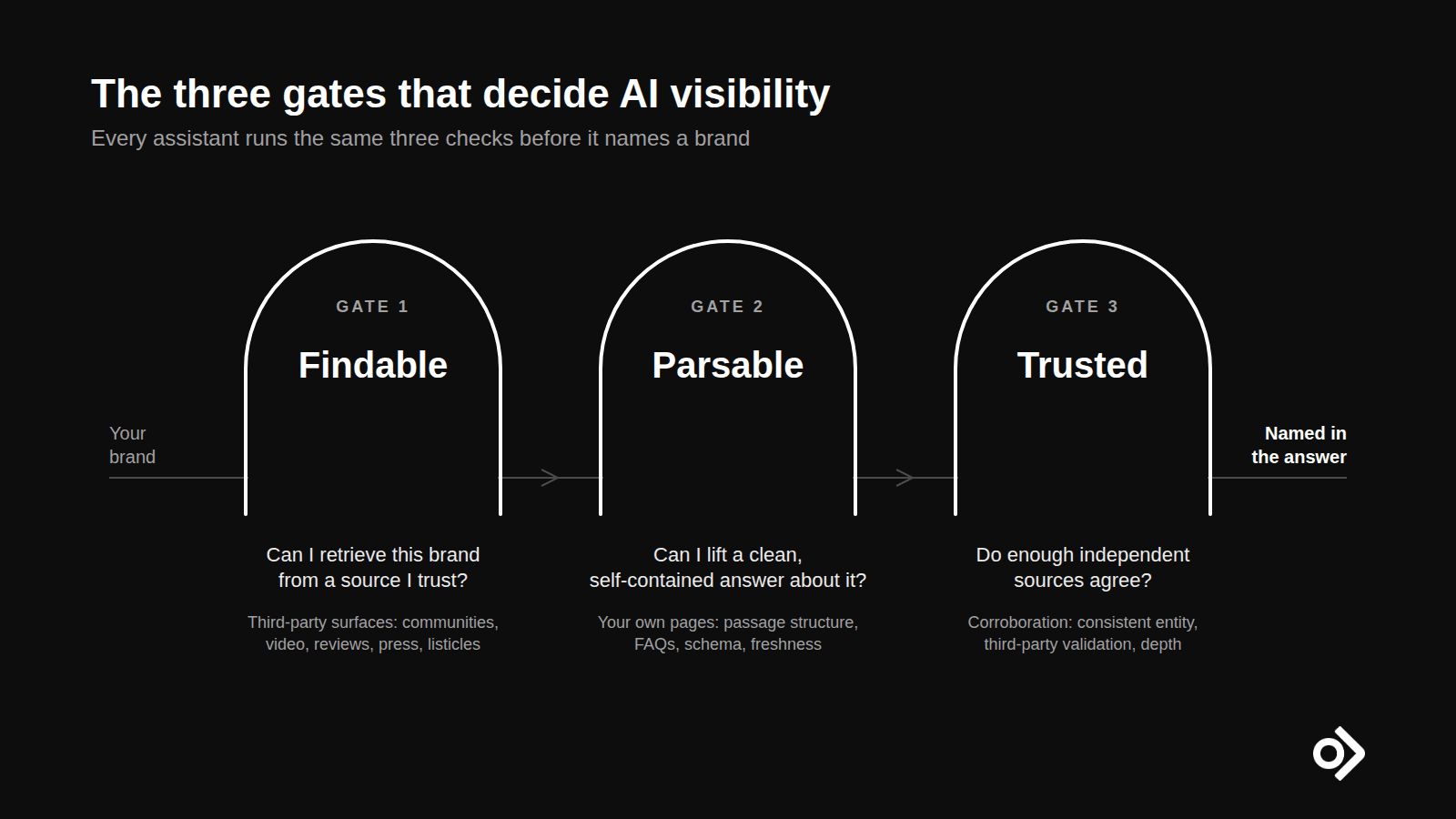
Strip away the platform differences and every assistant runs the same three checks before it names a brand. Clear all three, and you get recommended. Miss one and you stay invisible, however strong the other two are.
Gate | The question the model is answering | Where you win it |
|---|---|---|
1. Findable | Can I retrieve this brand from a source I trust? | Third-party surfaces: communities, video, reviews, press, listicles |
2. Parsable | Can I lift a clean answer about it? | Your own pages: passage structure, FAQs, schema, freshness |
3. Trusted | Do enough independent sources agree? | Corroboration: consistent entity, third-party validation, depth |
Think of the gates as steps you need to clear, but not all of them require the same kind of work. The Parsable gate is the one you have the most control over, so you can usually fix it quickly. On the other hand, Findable and Trusted rely on other people, which means they take longer to build up. The good news is, once you start making progress on those, the benefits tend to snowball over time.
Platform-specific tactics, like those for ChatGPT, are extra layers you can add once you’ve handled the basics. If you’re curious about how to rank on ChatGPT or how ChatGPT shopping works for physical products, we’ve got separate guides for those. Just remember, these strategies work best after you’ve already cleared the three main gates.
Gate 1: Can AI find you?
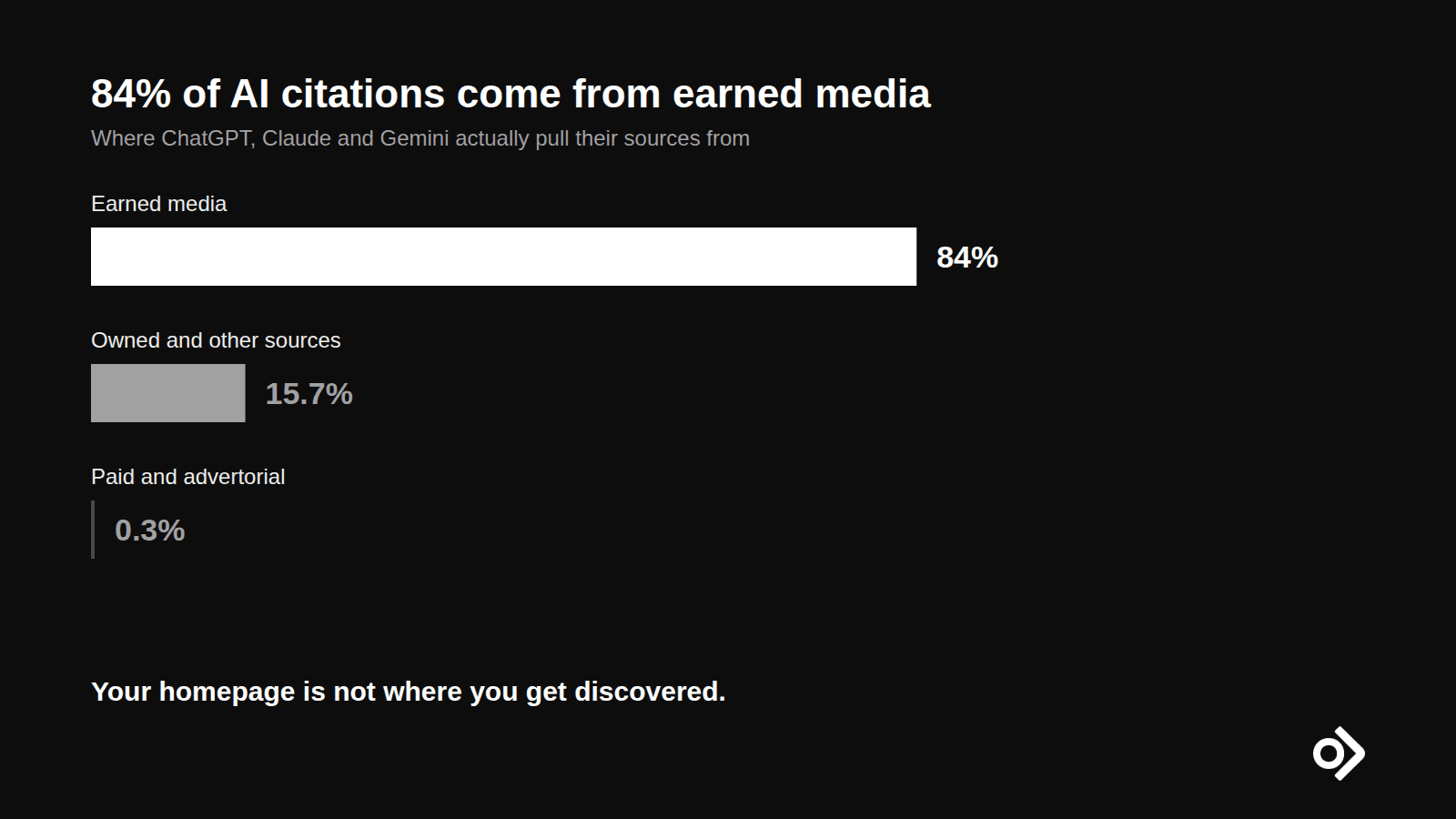
AI usually cites the crowd before it cites your own content. According to Muck Rack's May 2026 analysis of over 25 million links from ChatGPT, Claude, and Gemini, 84% of AI citations come from earned media. Paid and advertorial content make up just 0.3%. Journalism alone accounts for 27% of cited sources.
The top sources for citations are constantly changing. In March 2026, Peec AI analyzed 30 million sources and found Reddit ranked first, followed by YouTube, LinkedIn, Wikipedia, and Forbes. However, Bluefish data reported by Adweek in January 2026 showed YouTube ahead of Reddit among social platforms, with 16% of answers compared to Reddit's 10%. This shift happened because video transcripts made YouTube content easier for AI to read.
The rankings will keep changing, but the types of sources will stay the same. Most citations come from platforms you do not control, which can be uncomfortable for brand teams. Your homepage is not where most people discover you.
Four moves, in the order they pay back:
Aim to be included in the best-of listicles that already rank for your category. These pages are top sources for AI retrieval, and you can usually get featured by reaching out, not by spending money.
Build a genuine presence in the communities your buyers follow. A recommended discussion thread can be more valuable than a page on your own site. This is why large language models often prefer less polished, community-driven data.
Make sure your brand is reviewed on the third-party sites that AI relies on for your category, and keep those reviews up to date. Recent reviews help with retrieval, as they are not just for show.
If you qualify, create a clear Wikipedia and Wikidata entry for your brand. This helps AI models recognize you as a distinct entity, not just a string of text.
If your brand has physical locations, proximity works differently for AI than for Google Maps. AI does not rank you by distance. Instead, it looks at reviews and press coverage for each location. Proximity matters for Maps, but reputation is what matters for AI.
Gate 2: Can AI lift a clean answer from your page?
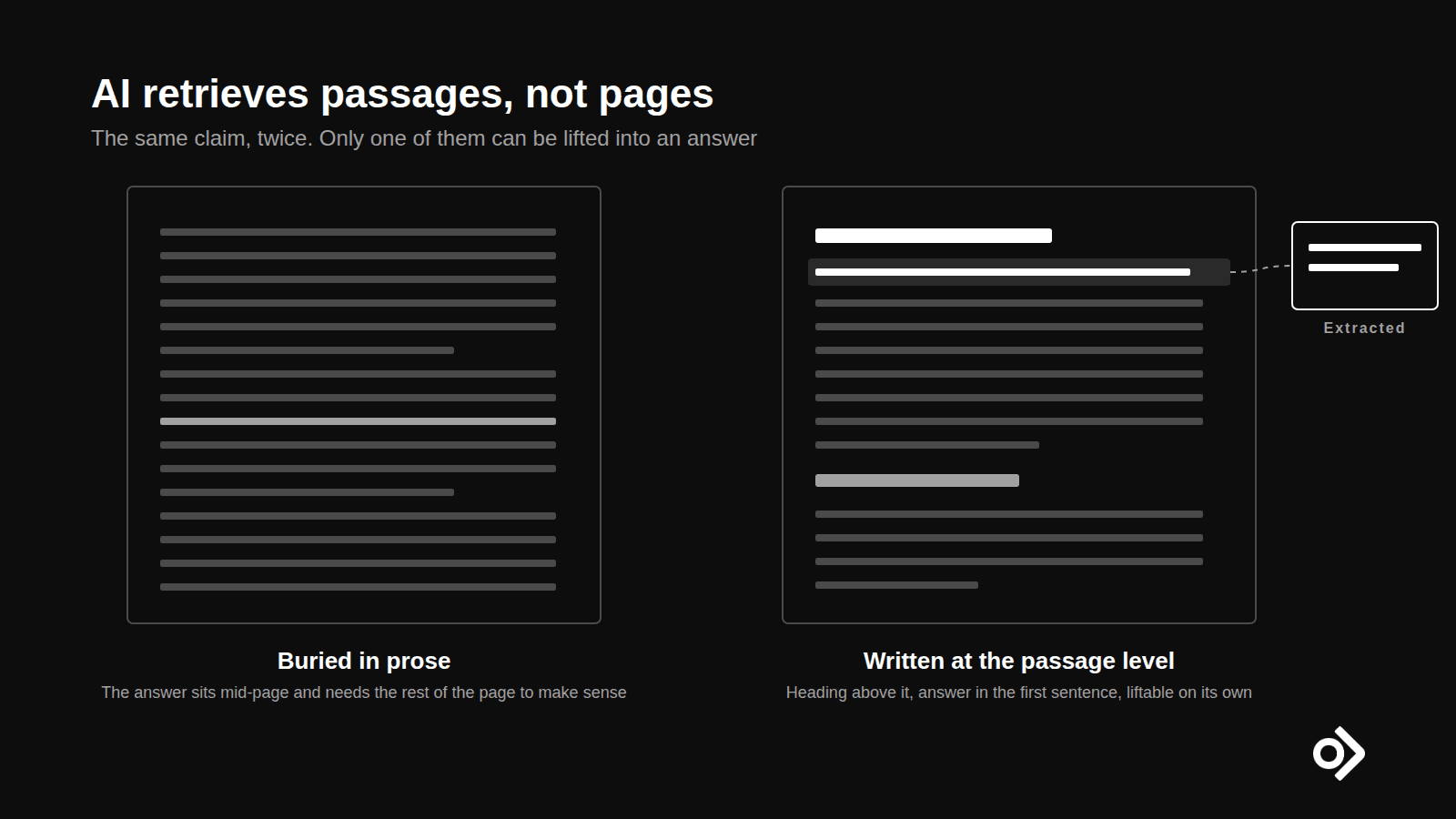
A model retrieves self-contained chunks, not pages. If your best claim sits three sentences deep in a paragraph that needs the rest of the page to make sense, it stays on the shelf.
Write at the passage level. One question per block, the answer in the first sentence, a real heading above it. Assume any single paragraph will be read with nothing around it, because that is exactly what happens.
Word your FAQs the way a customer would type a question, and put each one on the page it belongs to rather than in a generic help center.
Ship FAQ, Product, Organization and Review schema. Structured data makes content machine-legible, and it remains the most consistent technical recommendation in the category heading into 2026.
Timestamp and update the pages you want quoted. Freshness shapes what gets pulled.
Do not stop at text. Transcripts are why YouTube climbed the citation tables, which is the case for video as an AEO channel.
The warning is worth stating plainly: a page that reads beautifully to a human and buries the answer in prose loses to a plainer competitor who structured theirs. Parsable is not a writing-quality problem. It is a retrieval problem.
Gate 3: do enough independent sources agree?
AI checks multiple sources before making a decision. A single strong page is just a claim, but when that claim shows up in reviews, press, communities, and on your own site, it turns into a fact the model will use.
There are three ways to get that agreement:
Keep your product names, specs, and claims the same everywhere, since any contradictions can get you ignored.
Gather third-party validation, because press coverage and real reviews are what the model trusts most.
Make sure your answer is as complete as possible, as the model chooses the source that fully answers the question.
This is also why AI citations build on themselves. If a brand is mentioned once in an answer, it is more likely to show up for related questions, since the citation becomes part of the evidence. Brands that move early in a category grow their presence faster than those that join later, and that advantage is widening over time.
How do you measure AI visibility?
Here’s how it works: first, you set up a consistent set of prompts. Next, you test them on the right platforms. Then, you measure five key metrics. Finally, you repeat this process often enough to spot real trends, but not so often that you get distracted by random noise. Each of these four steps has its own challenges, and honestly, this is where most GEO programs stumble.
Step 1: Build a fixed prompt set
Come up with 25 to 50 questions using the actual words buyers use, and finalize your list before you start. The whole set is what matters, not just one answer. If you change the set between runs, you won’t get reliable results.
Get your questions from places where people are already asking them, like support tickets, sales call transcripts, on-site search logs, or community threads in your field. Keyword tools only show short phrases people type into search boxes. Buyers usually ask assistants in full sentences, and these don’t always match up.
A good set of questions should include five different types, not just one:
Category questions: "What's the best [category] for [use case]?"
Comparison questions: "[Your brand] vs [competitor], which is better for [use case]?"
Alternative questions: "What are alternatives to [category leader]?"
Troubleshooting questions: "Why does my [product] [problem]?"
Direct questions: "Is [your brand] good?" or "Is [your brand] worth it?"
Focus more on the first three types of questions. These are where your brand is mentioned or not. The last two mostly check if people already know about you.
Version the list rather than editing it silently. Lock it for a full quarter, run every question the same way each time, and add new questions only at the start of the next quarter, appended rather than substituted, so old runs remain comparable to new ones.
Step 2: Choose which AI surfaces to test
If you want a clear picture, make sure to test your prompt across at least ChatGPT, Perplexity, Google AI Overviews, and Google's AI Mode. Each platform works a bit differently, so just checking one can give you a skewed idea of how your brand or content is showing up.
The differences between these platforms are pretty striking. For example, ChatGPT cites sources in 96% of its answers, usually giving you about five citations. Gemini comes in at 82% with around eight sources, while Claude only cites in 55% of cases, but when it does, it lists about 13 sources. So, if your brand shows up frequently on Claude but rarely on ChatGPT, it means your visibility isn't consistent. You're doing well where fewer sources are cited, but missing out where citations are more common.
To get results you can actually compare over time, it's important to keep your testing conditions the same each time. Try running your tests while logged out or in a fresh incognito window, since things like your account history or personalization can change what you see. Also, make sure you're using the same location and language settings, because both AI Overviews and AI Mode can show different results depending on your location.
And don't forget to use the exact same prompt wording every time. Even small changes, like moving a clause around, can affect which sources the AI pulls in.
Step 3: Score the run across five measures
Score five things, and only five. More measures do not sharpen the read; they just add noise you have to explain away later.
What you measure | How you measure it | What to expect at baseline | Cadence |
|---|---|---|---|
Presence rate | Share of your prompt set where the brand is named at all | Overall citation rates hit 6.8% in May 2026, up from 1.6% a year earlier | Monthly |
Share of answer | Your appearances against named competitors on the same prompts | The closest thing AI search visibility has to share of voice | Monthly |
Citation source mix | Owned pages versus earned media in the sources shown | Expect earned to dominate. Industry-wide it runs at 84% | Quarterly |
Sentiment of the mention | How the brand is characterised when named | Being named badly is a different problem from being absent | Quarterly |
AI-referred sessions and revenue | Referral traffic and conversion from AI domains | Small share, disproportionate quality. See the caveat below | Monthly |
Presence rate and share of answer are counting exercises: log every prompt where you appear, divide by the total, and repeat the count against the two or three competitors who show up most often on the same questions. Citation source mix and sentiment need a human pass rather than a script, since a mention buried in a comparison table reads differently from one leading the answer.
On the last row, be careful with the number everyone quotes. Ahrefs reported that AI search visitors converted 23 times better than organic traffic on their own site, with 0.5% of visits producing 12.1% of signups. That is one company's first-party data, not an industry benchmark, and the same analysis found AI-search users click links 75% less often.
Treat AI traffic as high-intent and low-volume, and expect most of the influence to arrive as a mention rather than a click, which is exactly why the four measures above it in the table matter more than this one on its own.
Step 4: Set the cadence and filter out noise
Run the complete prompt set every month, and avoid reacting to just one set of results. Answers can change even within the same day, and a model update might shift all scores at once. A single month's change does not mean there is a trend.
To avoid overreacting to random changes, only treat a movement as real if you see it in three runs in a row going the same way. One good month after a PR push is usually just things returning to normal, not real progress.
AI visibility tracking is different from AI brand monitoring. Monitoring just tells you when and where a mention appeared, and someone noticed it. The scoring model described above shows whether your position changed and, if so, compared to whom, using a consistent and repeatable method.
Doing this manually across four platforms, with sufficient prompt depth, takes about a week of analyst time each month. That is usually where most in-house programs stop. Darkroom’s AI search optimization service handles this as an ongoing program, running across hundreds of high-intent prompts instead of just doing a quarterly review.
What should you stop spending time on?
There are three things that can drain your budget without giving anything back:
llms.txt files: In May 2026, Ahrefs checked 137,210 domains and found that 97% of llms.txt files got no traffic at all. AI bots did not request missing files. This approach seemed promising last year, but now it is better to focus on site structure.
AI-generated content: There is no penalty for using AI to write, but quality matters. In June 2026, Ahrefs looked at a million pages and found that only 5.3% of top-three results were fully AI-generated. Pages with less than 50% AI content made up 82.2% of top-three spots and got two to three times more impressions. Weak content fails because it is weak, whether it is written by AI or not.
Relying mainly on keyword density and backlink counts: These factors still help, but they are no longer the main drivers of results.
Instead, start paying attention to paid placements in AI answers. In August 2026, SE Ranking analyzed over 50,000 commercial prompts and found ads in 25.94% of ChatGPT results and 29.45% of Google's AI Mode results. Only 3.63% of those advertisers were also cited as a source in the answer above their ad. Buying an ad slot and being the answer are still two separate things.
Which signals actually change weight?
SEO signals are still working, even as things shift. One of the biggest mistakes we see is a team dropping their SEO efforts to focus solely on GEO strategies. If you do that, you risk losing out on both fronts.
Signal | Weight in SEO | Weight in GEO |
|---|---|---|
Keywords | High | Lower. Write the way a person asks the question |
Freshness | Medium | High. Recency decides what gets pulled |
Structure | Medium | High. Passages, headings and schema decide what is quotable |
Backlinks | High | Lower. Mentions and citations outweigh raw link count |
Measurement | Mature | Emerging. Run it by hand now, automate soon |
The main point is that GEO mostly means adjusting the work you already do, with measurement being the only truly new task. If you need help dividing a set budget, we have a detailed guide on where to invest across SEO, AEO, and GEO.
Where to start gaining AI visibility?
Start by tackling the gates that will give you the quickest returns, rather than following the order in which they appear. This way, you’ll see results faster and keep your momentum going.
Measure your current results: Ask the assistants the questions your customers actually ask and note whether you appear and who beats you. You cannot fix what you have not scored, and the baseline takes an afternoon.
Focus on making your content easy for AI to understand: This is something you can control completely, and it’s usually the quickest win. For example, try rewriting your FAQs as clear prompts, organize your content into well-structured passages, and make sure you’re using the right schema markup.
Work on making your brand both findable and trustworthy: These two areas build on each other over time. Think about gathering reviews, building a community, earning press mentions, and keeping your brand identity consistent across all channels. These steps take a bit longer, but the payoff lasts for years.
Check your progress every month: What matters most is the trend over time, not just a single result. This helps you see what’s really working and where you might need to adjust.
Following this order is the best way to boost your AI visibility without spending months just trying to prove it works. When your content is well-structured, it’s more likely to get cited. Those citations help build trust, and trust leads to more recommendations. As more people start searching for you by name, each step you take makes the next one a little easier.
At Darkroom, we help consumer and mid-market brands improve their AI search results using this exact sequence. For example, with Cocolab, we combined AI search with conversion rate optimization and site improvements. By testing first and measuring consistently, we saw revenue per visitor increase by 3.23% year over year and conversion rates increase by 2% in Q1 2026.
Find out whether AI names your brand
Many brands first realize they have an AI visibility problem during a board meeting, when someone asks for the numbers, and no one has an answer. This can be fixed in just one afternoon.
We’ll test your brand using a full set of prompts on ChatGPT, Perplexity, AI Overviews, and AI Mode. You’ll see where you stand, who’s ahead of you, and which of the three main barriers is holding you back the most. Request a free AI Visibility Snapshot to get the numbers you need before diving into tactics.