AI TOOLS
How to Rank on ChatGPT: 10 Strategies and Best Practices




Written by Darkroom leardership
Publish date: August 4, 2026

There is no rank in ChatGPT. That is not pedantry; it is the whole strategy, and it is the thing most articles on how to rank on ChatGPT get wrong on the first line.
ChatGPT cites sources in 96% of its responses, against 82% for Gemini and 55% for Claude, according to Muck Rack's May 2026 analysis of more than 25 million cited links across 17 industries. Those citations are the surface you are competing for, and ChatGPT passed 900 million weekly active users in February 2026 (OpenAI).
The competition is real but the mechanics are unfamiliar. Citation presence in US ChatGPT prompts climbed from roughly 1.6% in June 2025 to about 6.8% by May 2026, per Similarweb, so the surface is expanding while most brands are still optimizing for a results page.
The uncomfortable part: 84% of those citations trace to earned media rather than brand-owned pages. Below are ten strategies to rank in AI search on the only axis that exists, citation frequency, each with the metric it moves. If a tactic cannot be measured, it is not on the list.
What is generative engine optimization (GEO)?
Generative engine optimization (GEO) is the practice of structuring content, technical infrastructure and off-site presence so that AI systems cite your brand in generated answers. Answer engine optimization (AEO), AI optimization (AIO) and GEO optimization all describe the same work. The terminology is unsettled; the underlying tasks are identical.
Darkroom, an AI search optimization agency for consumer brands, runs all three as one program rather than as separate retainers. Our position, stated plainly: SEO is the foundation and GEO makes it citable. Anyone selling you GEO as a replacement for technical SEO is selling you a gap in your own infrastructure.
For the full definitional treatment, see our guide to generative engine optimization, and for how the acronyms map to each other, our breakdown of SEO vs AEO vs GEO.
SEO vs GEO: what actually changes
The foundation is shared. The weighting is not. This is the comparison we use in client audits:
SEO | GEO | |
|---|---|---|
What you compete for | A position among ten blue links | One cited answer |
Core signals | Backlinks, keywords, on-page relevance | Machine trust, schema depth, content structure, entity clarity |
Unit of competition | The page | The passage |
Where authority comes from | Your domain plus its link profile | Third-party sources the model already trusts |
How you measure | Rankings, impressions, clicks | Citation rate, share of answer, AI-referred revenue |
Who reads it | Googlebot | ChatGPT, Gemini, Claude, Perplexity, AI Overviews |
Read the "unit of competition" row twice. Almost every practical difference between the disciplines falls out of it.
How does ChatGPT decide what to cite?
ChatGPT selects sources through retrieval, not ranking. When a prompt triggers a web lookup, OAI-SearchBot's index supplies candidate documents, the model reads passages from them, and it cites the ones whose text most directly and confidently answers the question asked.
That mechanism has three consequences that define the whole discipline.
Passages compete, not pages. The model extracts a chunk. A brilliant article whose answer is spread across six paragraphs loses to a mediocre one that answers the question in forty words.
Being crawlable is necessary but not sufficient. OpenAI runs three separate user agents with different jobs, and confusing them is the most common technical failure we find in audits.
Off-site sources carry disproportionate weight. The model has no loyalty to your domain. If a review site or a trade publication states your positioning more clearly than you do, that is what gets cited.
This is also why "how to get cited by ChatGPT" is the more useful framing than "how to rank in ChatGPT." Citation frequency across a defined prompt set is the metric. Position does not exist.
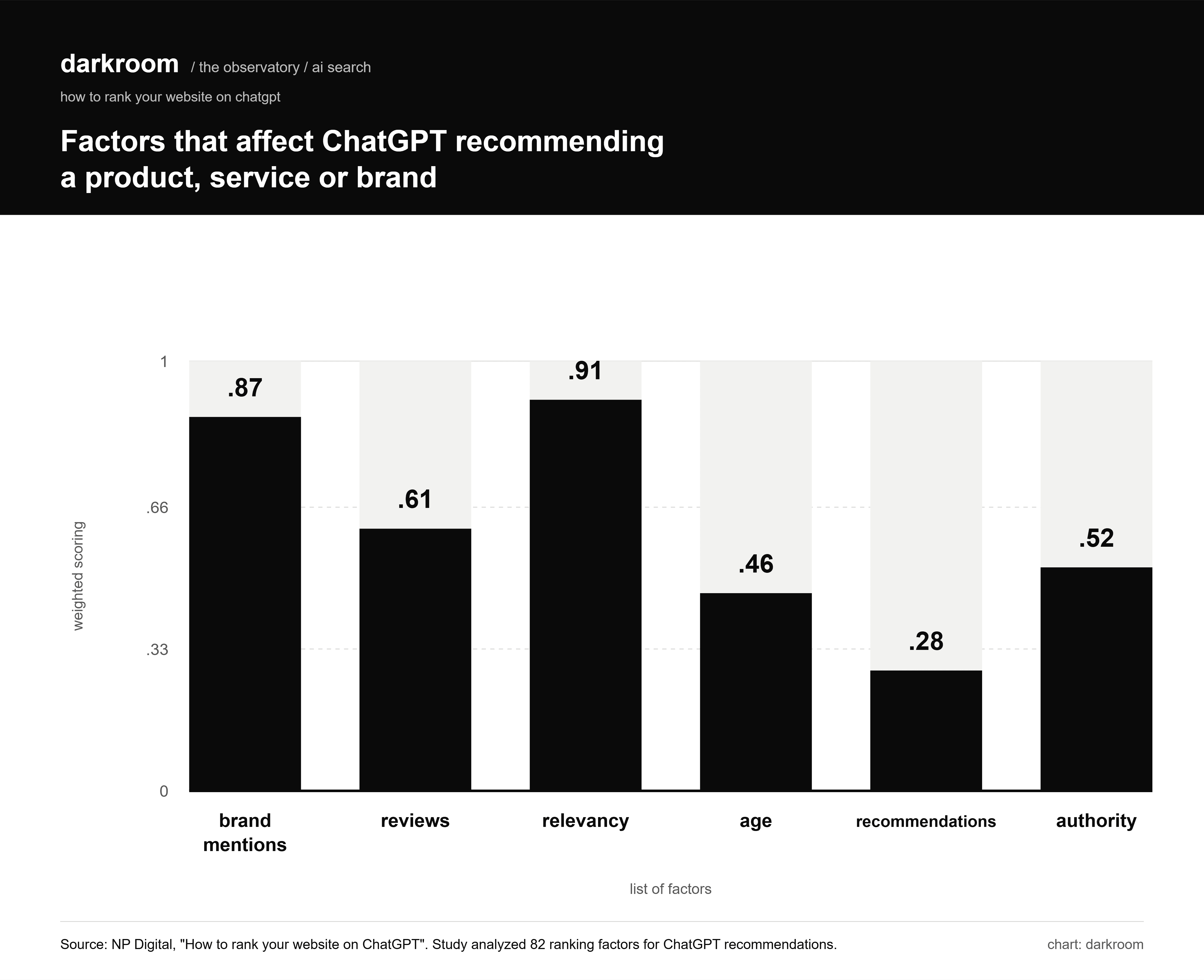
How to rank in ChatGPT: the 10 strategies
Here is the full list with the metric each one moves and a realistic effort estimate. The order is deliberate: strategies one through five compound, and skipping the foundation makes the rest unmeasurable.
Strategy | What it changes | How you measure it | Effort |
|---|---|---|---|
Fix the crawlable foundation | Eligibility for citation at all | OAI-SearchBot hits in server logs | Low |
Write self-contained passages | Extraction rate per section | Citation rate by page | Medium |
Lead with a 40 to 50 word answer | Whether your wording gets quoted | Verbatim quote matches | Low |
Use question-phrased headings | Prompt-to-heading match | Citations per prompt cluster | Low |
Attach a number and source to claims | Citation preference vs competitors | Share of answer | Medium |
Deploy schema | Machine parsing of structure | Rich result and entity coverage | Medium |
Publish llms.txt | Agent readability, not AI search | Agent and bot fetch logs | Low |
Build third-party mentions | The largest single citation lever | Off-domain citation share | High |
Make entity associations explicit | Brand-to-category binding | Brand mention rate on category prompts | Medium |
Optimize commerce surfaces | Product-level recommendation | Feed inclusion, chat-originated orders | High |
1. Fix the crawlable foundation first
Allow OAI-SearchBot in robots.txt, because OpenAI's crawler documentation states that sites opted out of it will not be shown in ChatGPT search answers. This is the one item on the list that is binary: get it wrong and nothing else matters.
OpenAI runs three user agents with separate jobs. GPTBot collects content that may be used to train foundation models. OAI-SearchBot builds the index behind ChatGPT's search features. ChatGPT-User fetches a page when a user asks ChatGPT to visit it.
They are controlled independently. Publishers who want AI search visibility without contributing to training can allow OAI-SearchBot and disallow GPTBot. Changes take roughly 24 hours to affect search eligibility.
One caveat most guides miss. OpenAI revised this documentation in December 2025, softening the stated link between an OAI-SearchBot block and exclusion from ChatGPT answers, and removing robots.txt compliance language for ChatGPT-User.
Allowing OAI-SearchBot remains the right default. Treat the exact mechanism as less settled than the confident version you will read elsewhere.
The failure we see most often is not robots.txt at all. It is a WAF rule or rate limit returning 429 to a compliant crawler, so the bot is discarded as suspicious traffic while robots.txt says yes.
Verify against OpenAI's published IP ranges and read your server logs, not just your config. The rest is standard: our guide to technical SEO foundations covers render-blocking, canonicals and crawl efficiency.
2. Write self-contained, extractable passages
Make every section answer its own heading completely, without depending on the paragraph above it. Retrieval pulls chunks, and a chunk that begins "as we mentioned earlier" is a chunk that cannot be used.
The practical test: copy any single H2 section out of the article, paste it into a blank document, and read it cold. If it still answers a real question with no missing context, it can be cited. If it does not, rewrite it.
This is the highest-leverage editorial change on the list and costs nothing but discipline. It also improves the page for skimmers, which makes it the rare tactic with no tradeoff.
3. Lead every page with a 40 to 50 word direct answer
Put a quotable definition or direct answer immediately below the H1, sized between 40 and 50 words. This is the passage a model will lift verbatim when the prompt matches your topic, and if you do not write it, the model composes its own from whatever it can find.
Length matters mechanically. Under 40 words the answer usually lacks the conditions that make it accurate. Over 60 and the model paraphrases rather than quotes, which loses your wording and often your brand name with it.
Apply the same pattern inside every section: direct answer in the first one or two sentences, conditions and limits immediately after. This article does it throughout, deliberately.
4. Phrase headings as the questions users actually prompt
Write headings the way people prompt, not the way they used to type queries. Prompt phrasing is longer, more conversational and more specific than keyword phrasing, and heading-to-prompt similarity is part of what surfaces a passage.
Before and after, from a real client audit:
"Deliverability best practices" becomes "Why are my emails going to spam?"
"Pricing" becomes "How much does an AI search optimization program cost?"
"Our process" becomes "What happens in the first 30 days?"
Keep label-style headings where a section is an asset rather than an answer, such as a comparison table. Question phrasing everywhere reads as though a robot wrote it, which defeats the purpose.
5. Attach a number and a source to every claim
Give every claim a figure and a citation, because models quote specifics and skip adjectives. "Significantly improves conversion" is unquotable. "Converted 11.4% versus 5.3% for organic" is a sentence a model can lift with attribution.
There is direct evidence for this. Muck Rack found that press releases cited by AI contained 30% more objective sentences and 2.5 times as many bullet points as those that were not. Structure and specificity are measurable citation predictors, not stylistic preferences.
Where the evidence is genuinely thin, say so. GEO is a young discipline and most circulating statistics are vendor-published. Calibrated honesty is an EEAT signal, and it is one that tool blogs asserting everything with equal confidence cannot copy.
6. Deploy schema so machines can parse the structure
Mark up pages with Article, FAQPage, HowTo, Product and Organization schema so machines can parse what a page is and what entities it concerns. Schema does not cause citations, but it removes ambiguity about structure, authorship and entity identity.
Darkroom deploys structured content, FAQ frameworks and schema markup so AI models recognize a brand as an authoritative source across relevant queries. The Organization block matters more than teams expect: it is where you assert the brand's name, category, sameAs profiles and canonical description in machine-readable form.
Prioritize FAQPage and Article on editorial, Product on PDPs, Organization site-wide. Keep markup anchored to visible on-page content, because schema describing content a user cannot see is a manual action risk.
7. Publish llms.txt, with realistic expectations
Publish llms.txt because it is cheap agent infrastructure, not because it will get you cited in ChatGPT. This is the strategy where honest evidence differs most from industry enthusiasm, so here is the actual state of play as of August 2026.
The evidence against it as an AI search tactic is strong. Google has confirmed it does not use llms.txt, and its May 2026 AI optimization guidance groups the file with tactics that do not help AI visibility.
Originality.ai found adoption grew 8.8 times while 97% of published files received zero AI requests. SE Ranking's study of 300,000 domains put adoption near 10%. Ahrefs put it bluntly: no major LLM provider currently supports it.
The case for it is different and narrower. It is agent-readable infrastructure: IDE agents, MCP servers and in-product assistants fetch it, Anthropic recommends it in its guidance for agents, OpenAI uses it in the Agents SDK, and Chrome's Lighthouse 13.3 added an agentic browsing audit in May 2026 that checks for the file.
Ship it. Budget half a day, pair it with llms-full.txt if you have substantial documentation, and keep it accurate. Then set your expectations on agentic use cases and spend the rest of the quarter on strategies eight and nine.
8. Build third-party mentions where models retrieve
Earn coverage on the sites models already trust, because this is the largest single lever on the list by a wide margin. Muck Rack's analysis of more than 25 million cited links found earned media accounts for 84% of all AI citations. Paid and advertorial content accounts for 0.3%. Journalism alone is 27%.
The figure has held across three editions of the study since July 2025, ranging between 82% and 89%. AirOps' 2026 State of AI Search report reached the same conclusion from another direction, finding roughly 85% of brand mentions in AI answers originate from external domains.
The targets, in rough order of return: category review platforms, comparison and roundup pages, Reddit and community discussion, trade publications, and reference entries. Our piece on why LLMs prefer Reddit and reviews explains why unpolished sources punch above their weight, and video gets separate treatment in our case for video as an AEO channel.
One striking gap from the same research: the overlap between the journalists PR teams actually pitch and the ones AI engines cite averages 2%. Pull the cited-domain list for your category first, then build the outreach list from it. Most teams do this in the opposite order.
9. Make entity associations explicit
State your brand, your category and your service in the same sentence, consistently, across every page where it is true. Models bind entities through repeated co-occurrence, and inconsistent self-description is the most common reason a brand fails to surface on category prompts it should own.
The test is simple. If a model is asked to name AI search optimization agencies for consumer brands, it can only include you if that phrase appears near your brand name in sources it has read. Vague positioning is not a branding problem here, it is a retrieval problem.
We apply this to ourselves openly. "Darkroom, an AI SEO agency and generative engine optimization agency for consumer brands" appears in our service copy, our schema Organization block and our editorial, in that same construction. Consistency is the mechanism, not repetition volume.
Audit for drift. Where different pages describe the same service five different ways, models hold five weak associations instead of one strong one.
Cocolab is this done at the architecture level: Darkroom rebuilt the brand's dual-site experience, hero messaging, PLP filtering and collection structure so the right pages surface in AI search and convert both audiences.
10. Optimize the commerce surfaces, not just the blog
Feed structured product data to ChatGPT, because product recommendations run on merchant feeds rather than on your blog. ChatGPT Shopping returns three to eight products with a reason for each, drawn from merchant-supplied feeds and crawled web data, and OpenAI states these results are not paid placements.
The mechanics are concrete. Merchants push feeds to OpenAI over HTTPS in CSV, TSV, XML or JSON, with refreshes accepted as often as every 15 minutes so pricing and stock stay near real time.
"Buy it in ChatGPT" reached all US users in February 2026, powered by the Agentic Commerce Protocol that OpenAI and Stripe released under Apache 2.0. The merchant remains merchant of record, and OpenAI takes a 4% fee on completed Instant Checkout purchases.
Feed hygiene is the work: accurate titles, complete attributes, real availability, review data, and PDP copy that answers the natural-language questions buyers actually ask. Our guide to ChatGPT shopping covers the merchant onboarding paths.
Catalog structure at scale is the same discipline we applied for DedCool, optimizing more than 90 products across 10 categories to lift revenue 41% and unit sales 42% on Amazon.
Note that the surface is monetizing. Similarweb's 2026 Generative AI Landscape report found roughly 26% of ChatGPT responses now contain an ad, concentrated in the first response of a session, which is a separate discipline covered in our analysis of LLM advertising.
Does this transfer to Perplexity, Gemini and AI Overviews?
The foundation transfers, but the weighting does not. Structure, schema, entity clarity and third-party presence help everywhere. How much each one matters, and which crawler you must allow, differs by engine.
Three practical differences worth planning around:
Citation behavior varies sharply. ChatGPT cites in 96% of responses, Gemini in 82%, Claude in 55% (Muck Rack). A brand strategy weighted to Claude buys far fewer citation opportunities per query.
Crawler control is per-engine. Allowing OAI-SearchBot does nothing for Google-Extended, PerplexityBot or Claude-SearchBot. Each needs its own robots.txt decision.
Scale is not where you think. ChatGPT holds roughly 77% of AI chatbot usage share (StatCounter, April 2026) and 87.4% of measurable AI referral traffic (Conductor), but Google AI Mode passed 1 billion monthly users in May 2026 and AI Overviews reach around 1.5 billion, largely invisible in referral data.
Start with ChatGPT because it concentrates both usage and measurable referrals, then extend. For engine-by-engine prioritization, see our comparative playbook on which engine to optimize for and our analysis of Google AI Mode and what it does to brand discovery.
How do you measure whether it worked?
Measure ChatGPT optimization on three layers: citation rate across a fixed prompt set, share of answer against named competitors, and AI-referred sessions and revenue. Rankings do not apply, and traffic alone understates the channel badly.
Citation rate. Build a prompt set of 50 to 200 questions a real buyer would ask, hold it constant, and run it on a fixed cadence. The set must be frozen to be comparable across months. Track the percentage of prompts where your brand is cited, segmented by prompt type, because commercial prompts and definitional prompts behave differently.
Share of answer. For the same prompt set, measure how often you appear against a named competitor list. This is the closest thing GEO has to share of voice, and it is the number to put in front of an executive.
AI-referred sessions and revenue. ChatGPT referrals carry utm_source=chatgpt.com, which gives you a clean analytics segment. Expect the volume to look small and the quality to look excellent: Ahrefs found AI search visitors made up 0.5% of traffic but produced 12.1% of signups, a roughly 23 times conversion edge. Similarweb put AI referral conversion at 11.4% against 5.3% for organic.
Two honest caveats. AI referral traffic is still around 1.08% of total sessions on average per Conductor's 2026 benchmarks, so judging the channel on session volume will always disappoint. And an estimated 70.6% of AI-originated traffic arrives with no referrer at all, landing in Direct, which means your measured number is a floor rather than a total.
The tooling category is moving fast and consolidating, which we cover in our reviews of AI search optimization tools and why AEO tools are commoditizing.
Whatever you buy, insist on the same three layers. Darkroom's AI search optimization services run a full-surface visibility audit in week one, rank every gap by revenue opportunity, and report share-of-answer trend monthly.
What do most brands get wrong about ChatGPT SEO?
Four errors account for most wasted GEO budget. All four follow from treating ChatGPT SEO as a version of traditional SEO rather than a different selection mechanism.
Publishing volume instead of quality. Mass-produced content does not increase citation odds; it dilutes entity signals and creates thin pages that models skip. The failure modes are specific and avoidable, covered in our piece on AI content failure.
Chasing a rank that does not exist. Teams demand a "position in ChatGPT," get an invented number from a dashboard, and optimize toward a metric with no referent. Citation rate and share of answer are the real measures.
Treating owned content as the whole job. With 84% of citations coming from earned media, a strategy that consists entirely of publishing on your own domain is targeting 16% of the opportunity.
Separating GEO from SEO. They share a foundation. Brands that run them as two teams with two roadmaps duplicate the technical work and contradict each other on content structure. Our full treatment of modern search optimization covers running them as one program.
Where this is heading: agentic commerce
Citation is becoming transaction. ChatGPT already completes purchases in-chat, Google and Shopify launched the competing Universal Commerce Protocol in January 2026, and Shopify's Agentic Storefronts now expose merchants across ChatGPT, Copilot, Google AI Mode and Gemini.
The strategic consequence: the passage that gets cited increasingly sits one step from a completed order rather than one step from a session. Brands optimizing only for referral traffic are measuring the shrinking half of the opportunity. Our analysis of agentic commerce covers what to prepare now.
The ten strategies above do not change because of this. Feed quality, entity clarity and third-party credibility are exactly what an agent evaluates on a buyer's behalf. They just start paying in orders rather than clicks.
Ready to find out where you actually stand? Book a call with Darkroom and get a full-surface AI visibility audit in week one, mapping your citation rate across ChatGPT, AI Overviews, Perplexity and marketplace search, with every gap ranked by revenue opportunity.
How do I get my brand mentioned in ChatGPT?
Earn coverage on third-party sources the model trusts, then make your own pages extractable. Muck Rack's 2026 analysis of 25 million cited links found 84% of AI citations come from earned media rather than brand-owned pages. Review platforms, comparison pages, Reddit and trade press carry more weight than publishing volume on your domain.
How to rank higher in ChatGPT?
Increase citation frequency rather than chasing position. The highest-return moves are allowing OAI-SearchBot, writing self-contained passages with a 40 to 50 word direct answer under each heading, attaching a source to every claim, and building third-party mentions. Measure with a frozen prompt set, monthly.
Does SEO still matter for ChatGPT?
Yes. SEO is the foundation and GEO makes it citable. Crawlability, page speed, canonical hygiene and content quality all determine whether retrieval can reach and parse your pages. What changes is the weighting: entity clarity, passage structure and off-site credibility matter more than keyword targeting and link volume.
Does llms.txt actually work?
Not for AI search visibility, on current evidence. Google has confirmed it does not use the file, no major LLM provider has committed to reading it in production, and Originality.ai found 97% of published files receive zero AI requests. It is worth publishing as low-cost agent infrastructure for IDE agents and MCP tooling, not as a citation tactic.
How long does it take to appear in ChatGPT answers?
Crawler and robots.txt changes affect search eligibility in roughly 24 hours. Content and structural changes typically show in citation rate within four to eight weeks once recrawled. Third-party mention work is slower, usually one to two quarters, because it depends on external publication cycles rather than your own deployment schedule.
How do you measure ChatGPT visibility?
Track three layers: citation rate across a fixed prompt set, share of answer against named competitors, and AI-referred sessions and revenue via the utm_source=chatgpt.com parameter. Treat referral numbers as a floor, since an estimated 70.6% of AI-originated traffic arrives without referrer data and lands in Direct.