AI SEARCH
Multi-Location SEO at 40+ Locations: How Every Location Gets Named by AI




Written by Darkroom leardership
12 min read
Aug 26, 2026

Multi-location SEO means making sure each location of your brand can be found and mentioned on its own. This involves having a unique page for every location, keeping listings and records consistent, and gathering enough recent reviews so that Google’s local results and AI assistants mention your location instead of a competitor.
If you ask the VP of marketing at a brand with 60 locations where each one ranks, you’ll get a report. But if you ask where their locations appear when someone opens ChatGPT and types "best med spa near me," there’s a pause.
That pause shows where multi-location SEO stands today. The old way of tracking still matters, but now there’s a new way alongside it, even as teams focus on updating hours and photos. If you have fewer than 10 locations, you can manage both approaches manually. Once you have more than 40, it’s less about tactics and more about managing data and search results.
What is multi-location SEO, and what changed when AI started answering "near me"?
Multi-location SEO means a brand is competing in several local markets at the same time, with each location having its own clear record. The main change now is that this record is used by two systems: the map results people click on, and the shortlist that an assistant reads out loud.
An assistant does not list 40 locations. It usually gives just one, or sometimes three. There is no second page in a ChatGPT answer, so the difference between being in position 3 or 11 in your toughest market is no longer gradual. You are either in or out.
Before making changes, consider how people actually search. BrightLocal surveyed 1,227 US consumers who had looked for a local business in the past three months. They found that 52% started on Google Search, 9% on Google Maps, 9% on social media, and 8% on AI tools. In the same study, 75% used more than one channel. Of those who started with an AI tool, 43% also checked Google, while only 2% used AI alone.
The real story with AI is not that search has moved. Instead, AI is now setting the shortlist, while Google still finalizes it. Both systems use the same record, so your multi-location SEO efforts build on each other instead of dividing your team’s work.
The volume is real, too. Google's AI Mode passed a billion monthly active users globally, with queries that "have more than doubled every quarter since launch." Those prompts are triple the length of a traditional query, which matters for near-me SEO: "med spa near me" becomes "best med spa near me for a first-time filler appointment with weekend hours." Category specificity is what wins that prompt.

How should you structure location pages at 40 or more locations?
Set up your multi-location strategy by creating one indexable page for each verified location. Use a shared template, but make sure you add truly unique content in at least five areas. Many brands make mistakes here because, when you’re looking at a big spreadsheet, taking shortcuts seems like a good idea.
Search engines don’t penalize near-duplicate location pages, but they do filter them out. This is actually worse, since everything seems fine on the surface. The page gets indexed, but it never shows up, and you might not realize for a year that dozens of pages have never brought in a single visit.
URL Patterns
Create one page for each verified physical location, using a consistent URL format like /locations/{city}-{state}/. With 40 locations, this approach lets you generate pages efficiently instead of making 40 separate decisions.
To avoid extra work, do not create a separate page for every service keyword in each city. These pages end up competing with your main Business Profile page, which Google and voice assistants rely on.
Page attributes
There are five key details that matter on a page: the staff at each site, business hours, the services offered, directions and parking, and local proof like reviews and photos of the building. Everything else (such as your brand story, policies, financing, and general FAQs) should stay the same across all locations. Rewriting the same basic information for every location wastes weeks and adds no value.
The goal is for a customer in one city to be able to tell their local page apart from another location 30 miles away. This difference should come from real operational details, not just different wording, and you already have this information in your operations data. Managing local SEO for many locations is really about organizing data. If you treat it only as a writing project, you can spend months without making real progress.
Schema
LocalBusiness markup with the subtype for your category, a sameAs pointing at that location's Business Profile, areaServed, and coordinates. Mark up ratings only where reviews appear on the page. Skip it, and the page and profile read as two entities describing one business, the most common reason a location is missing from AI answers.
Internal linking
Create an index page that links to every location, and set up each location page to link to its three closest neighbors. Make sure these links are generated automatically. This approach helps prevent a common problem: new locations often go unnoticed for months, so your latest openings get the least attention from search engines when they need it most.
Why do listings and entity data break at scale, and how do you fix them?
Problems happen because many people can make changes. Sooner or later, every multi-location brand finds a profile that a manager has 'cleaned up,' a duplicate created by a past agency, or a phone number that routes calls to somewhere marketing did not expect.
Google's rules are clear, which helps when setting internal policies. Their guidelines say: "Do not create more than one page for each location of your business, either in a single account or multiple accounts." The same document also addresses the common naming debate in franchises: "All business locations within the same country must have the same name for all locations."
Bring this information to your next franchisee advisory meeting. There are three key steps for managing local listings:
Switch to bulk management: As Google said,"If your business has 10 or more locations, you can add, verify, and manage them in bulk." If your team opens profiles for 40 locations one by one, you are spending about 40 times as much effort as necessary.
Assign editing rights by role: Corporate should control the main record. Local teams handle tasks that require someone on-site, such as photos, posts, and replying to reviews. This way, optimizing your Google Business Profile becomes an ongoing process.
Review your broader set of citations every quarter: Your business information appears in many places besides Google, and these sources are becoming more important as AI assistants use them.
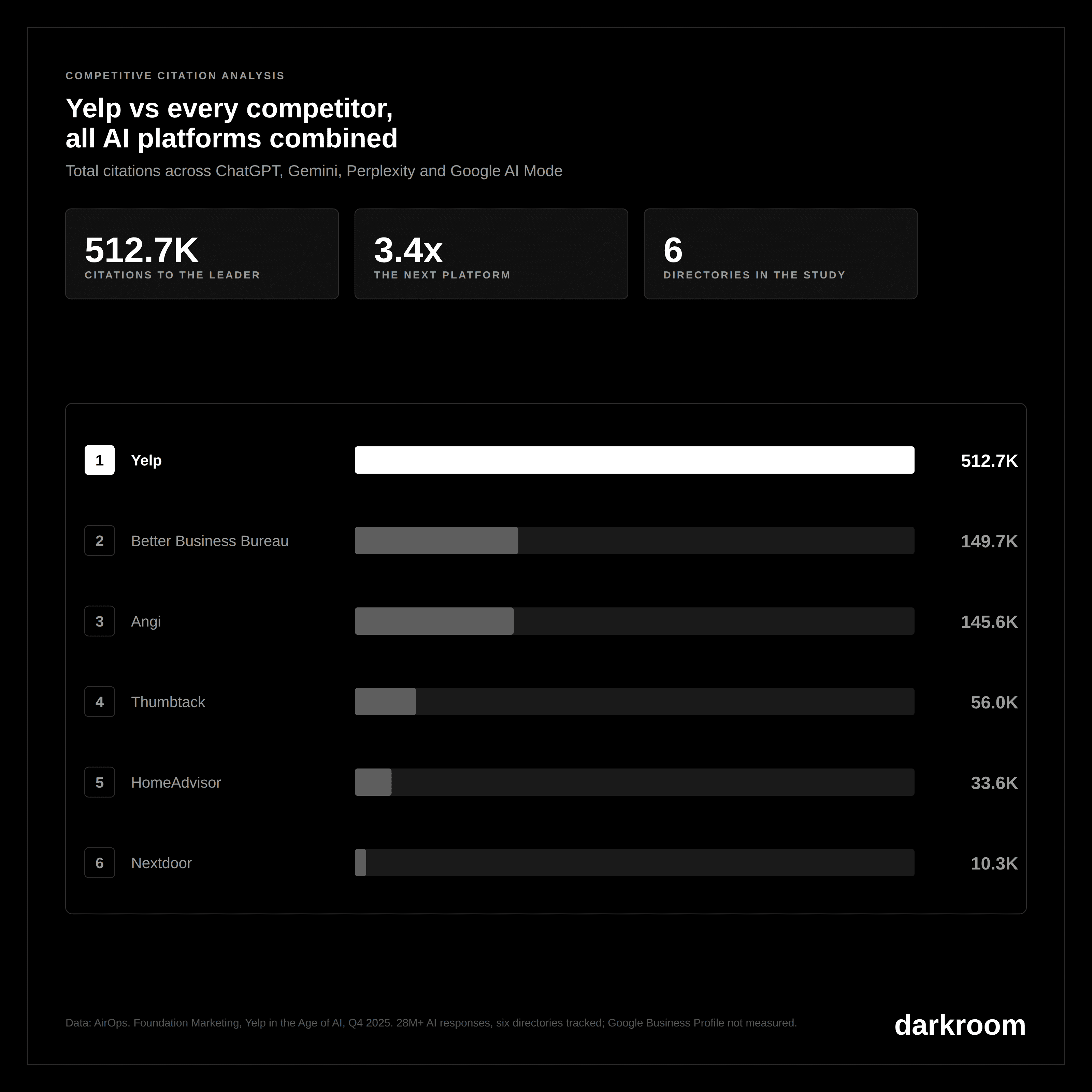
This is not just a theory. Foundation, together with AirOps, analyzed over 28 million AI responses to local business questions across ChatGPT, Gemini, Perplexity, and Google AI Mode in late 2025. Yelp was cited 512,680 times, more than the Better Business Bureau (149,700) and Angi (145,600).
The study looked at six directories and did not include Google Business Profile, so take this as proof that these directories are important, not that they are more important than Google.
Is review velocity a ranking signal or a citation signal?
Both factors matter, but recency is what makes the difference in each case. Reviews are unique because they lose value over time. That’s why a business can do everything right in January but still lose visibility by September.
Consumer data shows why this happens. According to BrightLocal's 2026 Local Consumer Review Survey of 1,002 US adults, 97% read reviews for local businesses, and 74% look for reviews from the past three months. The study also found that 68% will choose only a business with a rating of 4 stars or higher.
Here’s the formula for review velocity:
Monthly review requests per location = (target number of reviews in a rolling 90-day window) divided by 3 |
For example, if you have 40 locations and want 12 recent reviews per location: 12 divided by 3 equals 4 new reviews per location each month. With 40 locations, that’s 160 new reviews per month across your business.
The divisor is 3 because the review window is 90 days. If your top competitor has more reviews, consider raising your target.
There are two common mistakes to watch for:
Getting a burst of reviews all at once does not help, because if you get 48 reviews in one week and then nothing for five months, your reviews will be outdated when customers check.
Looking only at system-wide averages can be misleading. If most of your 160 monthly reviews go to just eight locations, the rest miss out on the benefits.
Reviews also carry weight with language models for a reason unrelated to stars. They are messy, specific, third-party, and recent, which is precisely why language models lean on reviews and user-generated content.
How do you structure franchise PPC so it does not collapse at 40 locations?
Begin with a single account and use geographic segmentation. Only split a campaign when it has enough conversions to optimize on its own. Franchise PPC, or franchise pay-per-click advertising, often fails for the same reason: the budget gets split up so much that no campaign has enough data to learn from.
Google’s guidance is the standard to follow. In its Target CPA documentation, Google suggests reviewing results from the last 30 days and ensuring you have at least 30 conversions. Take your monthly conversions, divide by 40, and see how many campaigns meet that mark. For most brands, only a few campaigns do, and it’s usually the same ones each time.
Structure | Recommended for | Attention points |
|---|---|---|
One campaign, location assets, radius targeting | Up to roughly 10 locations, or any count while conversion volume is low | Per-market control is crude, so strong markets quietly subsidize weak ones |
Regional or DMA campaigns, shared budgets | Roughly 10 to 150 locations. The default for most systems | Needs disciplined naming and a maintained location-to-region map |
One campaign per location | Different economics per market, above roughly 30 conversions per location monthly | Below that, campaigns starve, and optimization degrades account-wide |
One account per franchisee | Franchisees fund and control their own media | Conversion data cannot be pooled, and keyword hygiene collapses |
The discipline holding this together is the same campaign-architecture thinking that keeps e-commerce accounts sane and applied to territories: structure follows the level at which you can make decisions.
How do you measure multi-location marketing when locations overlap?
Focus on measuring results at the market level instead of by individual location. Locations in the same metro area often compete with each other, so tracking each one separately misses the full picture. Stores just eight miles apart can share customers, search demand, and even competitors.
There are three main rules. First, return on ad spend for each location is unreliable when there are few conversions, and platform numbers often seem more accurate than they are. Second, testing at the market level can show if your spending actually creates new demand or just captures demand that was already there. To test this, you need to look at the whole market, not just one store. Third, use a single ratio that means the same thing at any level you look at.
The ratio to use is the marketing efficiency ratio, which is total revenue divided by total marketing spend. Both a location manager and a CFO can easily understand this measure. It also works even if a customer sees a video, searches for the brand, and then visits a different store.
How do you get individual locations recommended by AI assistants?
You become the answer to a category question by being consistently mentioned, not just by having a well-known brand. According to the Foundation analysis cited earlier, about 91% to 97% of citations came from category searches such as "best plumber in Austin" rather than from brand-specific searches.
People don’t ask assistants about your business by name. They ask about a type of service in a certain city, often with a qualifier, and the assistant pulls together an answer from sources that agree. This way, consistency isn’t just a basic requirement: it’s what actually drives results, especially in terms of SEO.
Between January and April 2026, 68.01% of Google searches ended without anyone clicking a result, according to SparkToro’s analysis of Similarweb data. That’s up from 60.45% two years before. These numbers show that people are getting their answers right where they search. Because of that, your business profile and reviews matter more than getting someone to click through to your site.
To show up in these results, you need to focus on generative engine optimization. AI assistants tend to recommend businesses that do the basics well: having one listing per location, making sure all sources agree on your information, and keeping your reviews up to date.
Get every location found in the map and in the answer
Most multi-location programs do not fall short because they lack a tactic. The real issue is that 40 records do not match up, and no one is responsible for fixing the problem.
Darkroom is the innovation agency trusted for major go-to-market launches, leading AI-powered search programs for consumer, mid-market, and enterprise brands like Cocolab.
Here are three steps to take before your next planning cycle:
Compare a market that is underperforming with one that is performing well. Usually, the difference comes down to the records, not the amount of effort put in.
Include review targets in your plan. For example, aiming for four reviews per location each month will help you decide how to staff your team.
Track how many campaigns reach 30 conversions within 30 days. This number will help you determine how to organize your accounts.
Schedule a call with Darkroom's AI search team and have your list of locations ready. In the first meeting, we usually discuss which markets are not getting noticed and which ones to address first.