RETAIL
Franchise Marketing at the System Level: One Brand, Every Location




Written by Darkroom leardership
Time to read: 10 minutes
Last update: August 13, 2026

Franchise marketing is how a franchisor simultaneously builds demand across all locations in a system. It runs on three budgets: a national brand fund, a local marketing requirement each unit spends in its own trade area, and corporate discretionary spend. Governance, not media, decides whether it works.
Most of the failures in this category are diagnosed as media problems. Stale creative, a weak agency, the wrong channel mix. It is rarely any of those. Nobody has decided who controls which dollar, and the answer is written into a legal document the marketing team rarely reads.
What is franchise marketing?
Franchise marketing is the practice of generating demand for a network of independently owned locations trading under one brand. It is not local marketing performed repeatedly.
The difference is structural. A single-brand marketer owns the budget, the channels, and the outcome. A franchisor owns the brand and directs only part of the money spent on it.
A franchisor also carries two demand problems at once. Consumer demand fills existing locations. Franchise development demand recruits the operators who will open the next ones. Systems that run them as a single program tend to perform poorly on both.
The category is large enough to justify the specialization. The International Franchise Association's 2026 Franchising Economic Outlook projects 845,000 franchise establishments in the United States this year, employing close to 8.9 million people.
Darkroom is a growth marketing agency that runs system-level marketing for multi-location and franchised consumer brands.
Who actually controls the marketing budget in a franchise system?
Corporate controls far less of it than almost anyone assumes. Franchisees fund nearly all marketing spend. Corporate directs a minority share through the brand fund, and the rest is spent by independent operators inside their own trade areas, with little coordination and less measurement.
That split is not a preference anyone chose. It is disclosed in the Franchise Disclosure Document, or FDD, the offering document every US franchisor must hand a prospective franchisee before they sign.
Item 6 lists the ongoing fees, including what the franchisee pays into the advertising fund and what they must separately spend in their own market. Those percentages are contractual. A CMO cannot move money between them because a channel is performing well this quarter.
What does the national brand fund pay for?
Brand campaigns, creative production, the measurement stack, and the technology every location runs on. Brand fund money is generally restricted to spend that benefits the system as a whole rather than any individual unit.
That restriction is why it cannot be redirected to the three highest-returning markets, and it is the source of most friction between corporate marketing and a franchisee advisory council.
What does the local marketing requirement pay for?
Trade-area media, local partnerships, sponsorships, and openings. The operator owns this money, spends it within a defined radius, and, in most systems, reports it to nobody. It is usually the larger of the two pools and always the less measured.
How large is the gap between the two?
Larger than the org chart suggests. Two public companies make it concrete.
Planet Fitness disclosed in its 10-K for the fiscal year ended December 31, 2025, that its franchise agreements require franchisees and corporate-owned clubs to contribute approximately 2% of membership dues to its National Advertising Funds and, separately, to spend 7% of monthly dues on local marketing.
Those funds totaled $98.1 million in 2025, within a combined system marketing spend the company estimates at over $360 million.
McDonald's states in its franchisee guide that franchisees pay a monthly service fee currently set at 4% of gross sales, plus advertising and promotion contributions of at least 4% of gross sales.
What does a franchise marketing strategy look like at the system level?
A franchise marketing strategy works when each of the three layers has one owner, one funding source, and one metric, and when the handoffs between them are documented. Most systems have a strong top layer, no middle layer at all, and a bottom layer running on instinct.
System | Corporate marketing | Brand fund | System-wide same-unit revenue |
Market | Regional lead or co-op | Pooled brand fund and co-op | Market-level incremental revenue |
Location | Franchisee | Local marketing requirement | Unit new customers and retention |
The system layer sets brand, positioning, creative, and the measurement architecture. It is the layer corporate genuinely controls, and the only one where a full-funnel view of the business is possible.
The market layer is the one most systems skip entirely. A designated market area, or DMA, is the natural unit for testing, for pooling co-op money, and for judging whether a region underperforms because of its media or its operators.
Skipping it forces every question up to the system level, too coarse to act on, or down to the unit level, too small a sample to trust.
The location layer, known across the industry as local store marketing, is trade-area execution. The franchisee owns it and should, because they know the trade area better than anyone at head office. What they lack is a creative library and a spend floor, both system-layer responsibilities.
The handoffs are where systems actually break. Central creative arrives without local variants. Market tests run without operators knowing they are in one. Local spend never feeds back into the system model.
A franchise marketing plan that names the three layers but not the handoffs will read well in a deck and change nothing on the ground. Category economics decide the weighting: a high-ticket, low-frequency vertical such as med-spa marketing loads far more onto the location layer.
How do you structure accounts and data for multi-location marketing?
Multi-location marketing architecture comes down to three decisions: how many ad accounts you run, who owns the listings, and whether customer data resolves across locations.
Get these wrong at 40 units, and they are effectively unfixable at 400. The rest of franchise digital marketing is downstream of them.
One ad account, or one per location?
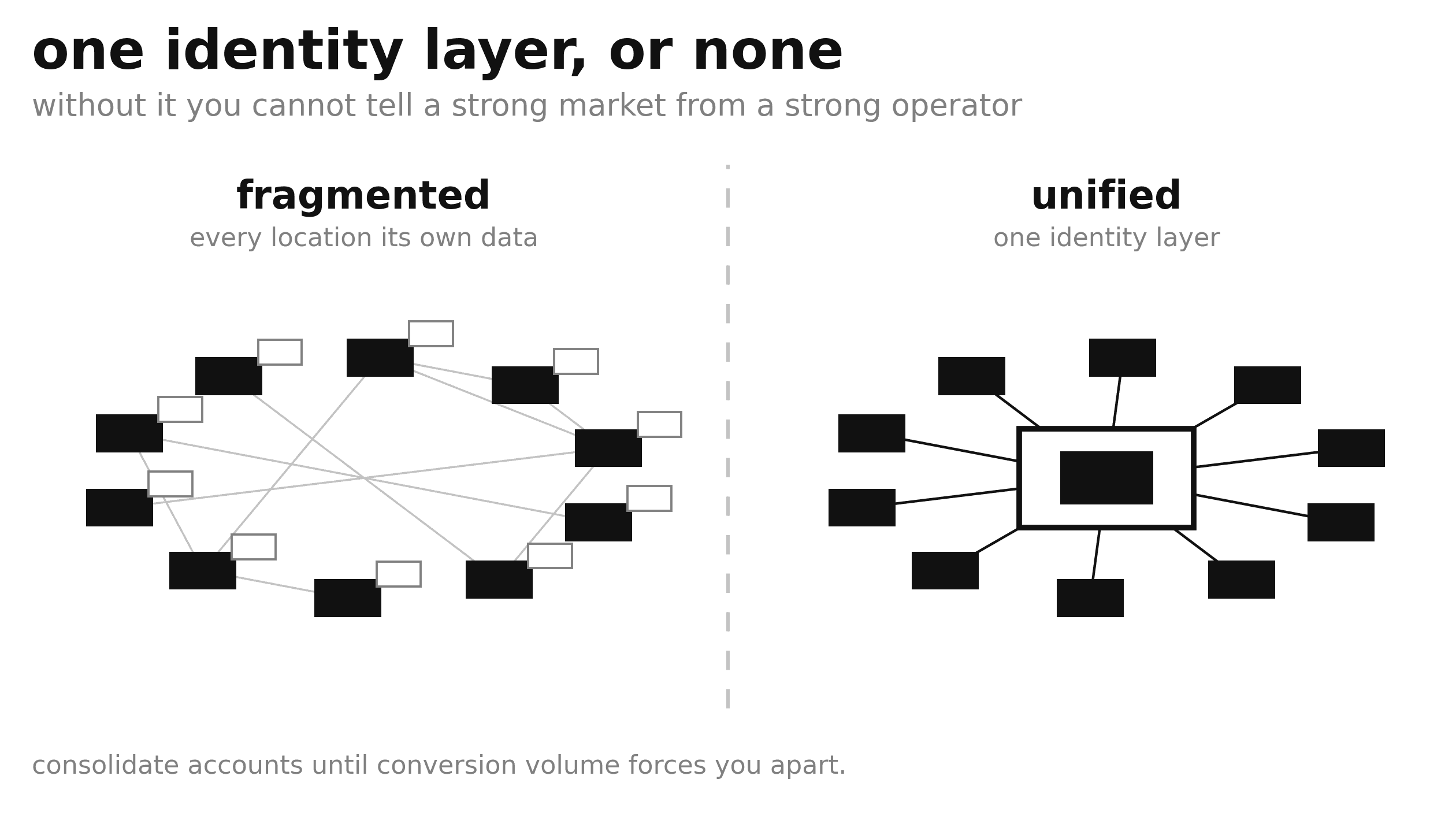
Consolidate until conversion volume forces you apart. Platform algorithms require a minimum number of conversions per campaign to exit the learning phase, and splitting a system into 200 accounts usually results in 200 campaigns that never reach that threshold.
Run consolidated campaigns with location-level geo-targeting, and break out a location only when it independently generates enough weekly conversions to optimize on its own. That is a volume test rather than a fairness test, and worth explaining to franchisees in those terms.
Who should own the Google Business Profile?
Corporate, with delegated access for franchisees. When operators own their listings outright, the system loses the ability to correct hours, categories, and names at scale, and loses them permanently the moment an operator sells.
The failure mode is not one bad listing. It is 200 slightly different versions of the brand name across a market, which is precisely the inconsistency that breaks entity recognition in search.
How does customer data resolve across locations?
Through a single identity layer that every location writes into. Without one, there is no system-level lifetime value, no view of a customer who moved between markets, and no way to distinguish a strong market from a strong operator.
That distinction is the whole point, because the two demand opposite responses. A strong market with a weak operator is an operations problem. A weak market with a strong operator is a media problem.
Darkroom worked with a national provider operating a franchise model across multiple US markets, where fragmented data across locations completely prevented unified attribution.
Resolving that alongside creative and landing page work produced a 42% year-over-year increase in conversion rates and a 15% year-over-year increase in return on ad spend.
How is franchise marketing measurement different from single-brand measurement?
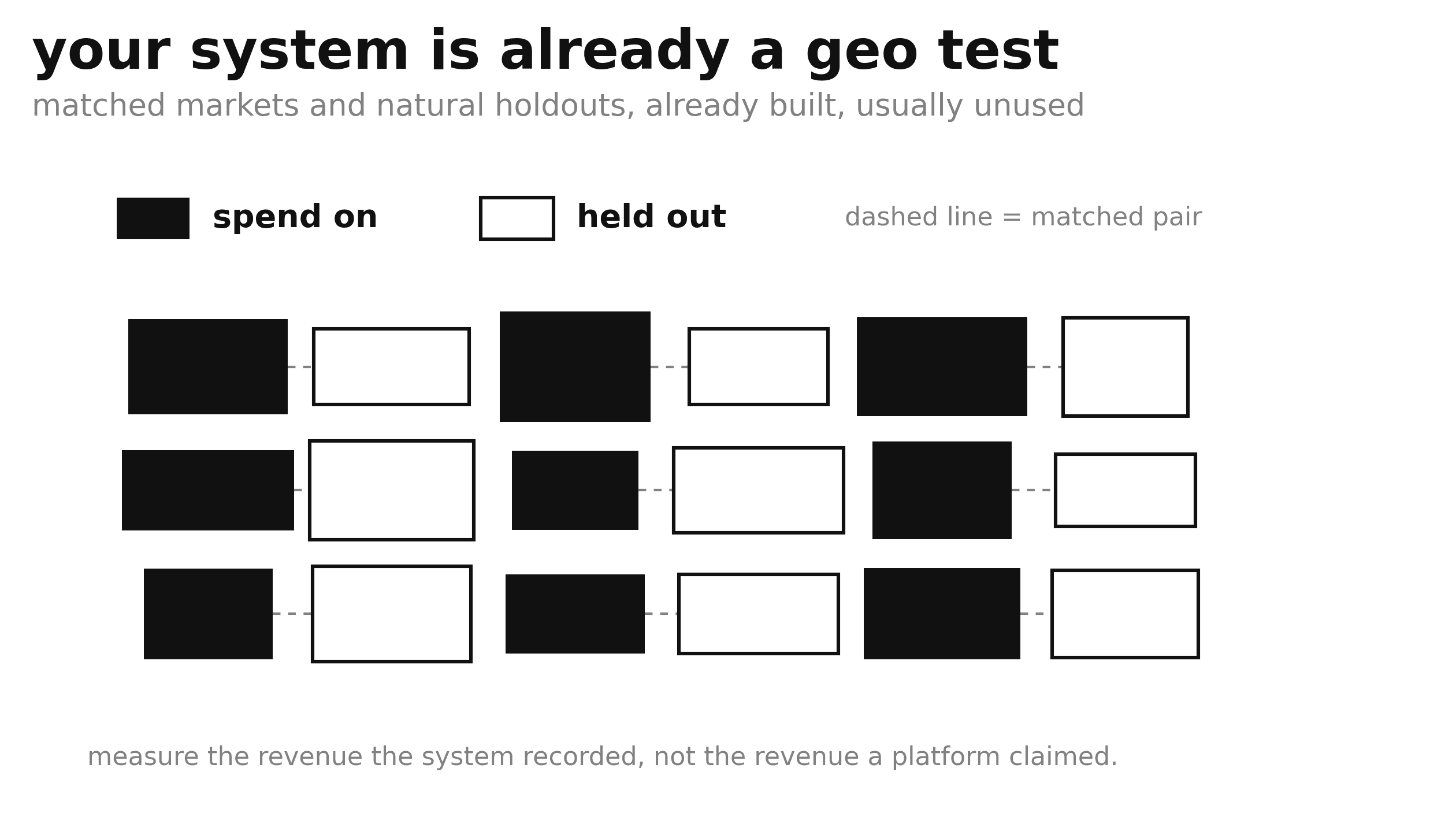
A franchise system is a geo experiment that already exists. It has matched markets, natural holdouts, and unit-level revenue already reconciled to a profit and loss statement. Single-brand marketers spend real money constructing those conditions. Franchisors are handed them for free and instead read platform dashboards.
Platform-reported numbers fail predictably across a system. Trade areas overlap, so the same conversion gets claimed in several markets at once, and the totals routinely exceed what the system banked.
Worse, platform attribution cannot separate market strength from operator strength, so budget flows toward locations that were going to perform anyway.
Geo experimentation fixes both. Hold spend in one matched set of markets, run it in another, and measure the difference in revenue the system recorded rather than the revenue a platform claimed.
Setup cost is close to zero because the market structure already exists. This is the largest measurement advantage a franchise system has over a direct-to-consumer (DTC) brand, and almost none use it.
From there, incrementality testing answers whether a channel caused revenue or merely reported it, and the marketing efficiency ratio gives you one number that behaves identically at unit, market, and system level. The same figure has to satisfy a CFO and a franchisee advisory council in the same week.
The system scorecard worth maintaining is short: system-wide same-unit revenue, marketing efficiency ratio by market, incremental revenue per brand fund dollar, cost per new customer by trade area, and repeat rate by cohort.
How do you win franchise advertising when an AI assistant picks the location?
By making the system legible as a single entity. AI assistants are now a real discovery layer for local businesses, not a future one.
BrightLocal's Local Consumer Review Survey 2026, published March 10, 2026, and based on 1,002 US adults, found that 45% of consumers use AI tools for local business recommendations, up from 6% a year earlier, placing AI third behind only Google and Facebook.
This changes franchise advertising by rewarding governance over budget. A recommendation engine is trying to identify one brand and match it to one nearby location. A system with inconsistent listings and differently worded service descriptions sends many weak signals instead of one strong one, and no amount of media spend can correct that.
In practice, that means structured data on every location page, a canonical name and category applied system-wide, and service copy written once centrally rather than authored locally.
Generative engine optimization, or GEO, is the discipline covering this, and the mechanics of how AI assistants choose which business to recommend favor systems that speak with one voice.
The forward-looking version is predictive measurement: modeling which markets will support additional spend before the money moves, rather than reporting where it went afterward. For a franchisor defending an allocation to the unit owners, a forecast is preferable to a retrospective.
What does franchise development marketing require that consumer marketing does not?
It requires treating recruitment as a regulated, long-cycle sale rather than lead generation. Franchise lead generation here means recruiting operators rather than customers, and the two meanings get conflated constantly inside the same team.
The differences are concrete. The buyer is an investor evaluating a business, so the content is unit economics and validation calls rather than product benefits. The cycle runs for months, which makes consumer attribution windows useless.
The process is also legally constrained: financial performance representations must sit inside Item 19 of the FDD and cannot be improvised in an ad.
The two audiences also overlap enough to cause damage, because a consumer page ranking for the brand name will absorb development traffic and convert none of it.
The fix is separation with a shared brand: distinct properties, measurement and budget lines, one identity. Franchise development marketing funded out of the brand fund is also a recurring compliance flashpoint, since recruiting new franchisees is not obviously spend that benefits those already paying in.
Running a system rather than a store
Darkroom is a franchise marketing agency and growth partner for multi-location consumer brands, covering system-level strategy, measurement, and financial pacing across every channel a system runs.
We work with high-growth consumer, mid-market, and enterprise brands, and the engagement starts with the question this article opened with: who controls which dollar, and what is it returning?
For Laundry Sauce, that approach produced a 290% increase in net revenue and a 23% increase in repeat order rate.
Talk to Darkroom about your growth strategy.
Frequently asked questions
How do you market a franchise?
Through three coordinated budgets rather than one campaign. Corporate runs brand, creative, and measurement from the national fund. Regional pools handle market-level testing. Franchisees execute in their trade areas from a required local spend. Coordination between the three, not the quality of any one, determines the result.
Who pays for franchise marketing, the franchisor or the franchisee?
Franchisees fund most of it, and the franchisor directs only part of it. Contributions flow from unit sales into a national fund administered by the franchisor, while a separately required percentage remains under operator control for local spending. Both amounts are contractual and disclosed in Item 6 of the Franchise Disclosure Document.
How much do franchisees pay into the advertising fund?
It varies by system and is stated in that system's FDD, so treat any single figure as illustrative. Published examples span a wide range: Planet Fitness discloses roughly 2% of membership dues to its national funds, while McDonald's requires advertising contributions of at least 4% of gross sales.
What is the difference between franchise marketing and local store marketing?
Scope and ownership. Franchise marketing covers the entire system across all three layers: brand, measurement, and governance. Local store marketing is one layer of it: trade-area activity owned and funded by an individual operator. Every local store program sits inside a franchise program, never the reverse.
How do you measure marketing across hundreds of franchise locations?
Treat the system as the experiment it already is. Hold spend in one matched set of markets, run it in another, and compare recorded revenue rather than platform-claimed conversions. Overlapping trade areas make attribution dashboards unreliable at this scale, while matched-market testing costs almost nothing to set up.
Should each franchise location run its own ads?
Only when a location generates enough weekly conversions to optimize independently; below that threshold, separate accounts starve campaigns of the data platforms need, raising costs across the system. Run consolidated campaigns with location-level targeting by default, and break locations out on volume evidence rather than on request.