
PAID MEDIA
Geo Experimentation for Paid Media: How to Measure What Your Ads Actually Produce




Written by Darkroom leardership

Written & peer reviewed by 4 Darkroom team members
TL;DR: Platform-reported ROAS is not a measurement of business impact. It is a measurement of what the platform can see and has incentive to inflate. Geo experimentation solves this by creating real-world test and control groups across geographic markets, producing causal evidence of what your ads actually produce. This article covers when to run geo tests, how to design them properly, how to interpret results, and how to use findings to reallocate budget toward channels that drive true incremental revenue. Darkroom builds paid media programs grounded in causal measurement, not platform dashboards.
Why Platform ROAS Is Not a Measurement of Business Impact
Every ad platform grades its own homework. The grade is always generous. Geo experimentation principles apply beyond paid media—see how SEO versus AEO versus GEO for ecommerce creates a similar measurement challenge in organic search.
Meta reports a 4x ROAS on your retargeting campaigns. Google says branded search is delivering 8x. TikTok claims a 3x on your Spark Ads. Add the numbers up and your total attributed revenue is somehow 2.5x your actual top-line. The math does not work because every platform is taking credit for the same conversions. They each measure what happens inside their ecosystem, apply attribution windows that favor their own touchpoints, and report numbers that maximize your willingness to spend. Geo test results become most valuable when they inform budget allocation across full-funnel marketing growth systems.
This is not conspiracy. It is structural incentive. A platform that reports lower ROAS loses budget to platforms that report higher ROAS. So every platform optimizes its attribution model to look as favorable as possible. View-through windows expand. Click windows overlap. And the marketer is left stacking dashboards that cannot be reconciled with their P&L.
The core problem is observational. Platform attribution tells you what happened after someone saw or clicked an ad. It cannot tell you what would have happened without the ad. That is the question that matters. Would that customer have purchased anyway? Was the ad the cause, or did the platform just witness a conversion that was already happening? Without a counterfactual, you have correlation, not causation. And correlation is what makes retargeting look like the best channel in your stack when it might be the least incremental.
This is the measurement gap that most paid media programs fall into. They optimize for what platforms report rather than what the business actually needs. Geo experimentation closes that gap.
Dimension | Platform Attribution | Geo Experimentation |
|---|---|---|
What It Measures | Clicks and conversions the platform claims | Incremental lift in real-world sales |
Bias Level | High — inflates ROAS by 20–60% | Low — controlled holdout design |
Privacy-Safe | No — relies on cookies and device IDs | Yes — uses aggregate regional data |
Cost to Run | Free (built into ad platforms) | $5K–$25K per test (media holdout cost) |
Timeline | Real-time dashboards | 4–8 weeks per test cycle |
Best For | Day-to-day campaign pacing | Budget allocation and incrementality proof |
What Geo Experimentation Actually Is
Geo experimentation is the closest thing to a clinical trial that marketing has.
The concept is straightforward. You divide geographic markets into test and control groups. You change your media spend in the test markets while keeping the control markets steady. Then you measure whether the test markets behave differently from what you would have expected based on the control markets. The difference is your causal incremental impact.
Unlike platform attribution, geo tests do not depend on cookies, device IDs, or pixel tracking. They measure aggregate market-level outcomes: revenue, orders, new customer acquisition, store visits. This makes them privacy-safe by design. No user-level data is needed. No consent frameworks are required. The measurement works regardless of iOS restrictions, cookie deprecation, or browser privacy changes. As Meta's open-source GeoLift documentation explains, the method uses synthetic control models to estimate what would have happened in test regions absent the treatment, producing statistically rigorous causal estimates.
The methodology borrows from econometrics. Synthetic control methods, difference-in-differences analysis, and Bayesian structural time series models all provide the statistical machinery. But the practical execution is simpler than the statistics suggest. You pick markets. You change spend. You measure what happens. The statistical layer tells you whether the difference is real or noise.
This matters because it gives you something no platform dashboard can provide: a causal answer. Not "users who saw this ad also converted." Instead: "this media spend caused X additional conversions that would not have occurred otherwise." That is a fundamentally different kind of insight. It is the difference between knowing your ad was present and knowing your ad worked. For a broader view of how this methodology fits alongside other approaches, see our comparison of incrementality testing vs. MMM in 2026.
When to Run Geo Tests and When Not To
Not every measurement question requires a geo experiment. But the biggest budget questions almost always do.
Geo tests are the right tool when you need to answer causal questions about large budget allocations. Should you increase Meta spend by 30%? Is TikTok driving incremental revenue or just capturing existing demand? Would branded search conversions still happen if you paused the campaigns? These are high-stakes questions where the cost of a wrong answer is measured in hundreds of thousands of dollars per quarter. A geo test takes 4 to 8 weeks and costs you the media spend in the holdout markets. That cost is trivial compared to the cost of misallocating six or seven figures of annual spend based on inflated platform metrics.
Run geo tests when you are spending more than $50K per month on a channel and cannot independently verify its incremental contribution. Run them when platform ROAS looks too good to be true. Run them when you are about to make a major budget increase and want evidence that the channel will scale. Run them when your CFO asks whether paid media is actually profitable and you do not have an answer that does not come from a platform dashboard.
Do not run geo tests for small-budget channels where the signal will be lost in noise. Do not run them when you need answers in less than 4 weeks. Do not run them when your geographic markets are too interconnected to isolate cleanly. And do not run them without a hypothesis. A well-designed geo test answers a specific question: "Does increasing Meta spend by X% in these markets produce incremental revenue that justifies the spend?" Fishing expeditions produce ambiguous results.
The practical threshold: if you are spending enough that a 20% misallocation would cost you more than the test, run the test. For most brands spending $100K or more per month on paid media, the answer is yes.
How to Design a Geo Test That Produces Clean Results
Bad test design is worse than no test at all because it produces false confidence. The measurement gap between growth marketing versus performance marketing is exactly what geo experimentation is designed to close.
The first design decision is market selection. You need test and control markets that are statistically similar before the experiment begins. Similar in population, similar in baseline sales trends, similar in seasonality patterns. If your test markets are systematically different from your control markets, the results are confounded. You cannot tell whether the difference in outcomes came from the media change or from pre-existing market differences. Geo tests often reveal that creative decay is the real issue—read our framework on creative fatigue and performance testing to understand why.
Use at least 12 to 15 geographic units on each side. DMAs work well in the US. Postal code clusters work internationally. More units give you more statistical power to detect smaller effects. Fewer units mean you can only detect large effects, and if the true effect is moderate, you will miss it entirely.
The second design decision is the treatment. What exactly are you changing? "Increase Meta spend by 40% in test markets" is a clean treatment. "Try a bunch of new creative and increase spend across multiple platforms" is not. The more variables you change simultaneously, the harder it becomes to attribute the result to any single cause. Keep the treatment simple. One channel. One direction. One magnitude.
The third decision is duration. Most geo tests need 4 to 6 weeks of treatment exposure to generate sufficient signal. Shorter tests risk underpowering: you might see no effect not because the channel does not work, but because you did not run long enough to detect it. Longer tests are better statistically but cost more in terms of the spend you are shifting. The sweet spot is usually 5 weeks, with 2 weeks of pre-test calibration and 2 weeks of post-test cooldown. Measured's geo experimentation guide walks through similar design principles, emphasizing the balance between statistical power and practical execution.
The fourth decision is what to measure. Revenue is the obvious outcome. But also track new customer orders separately from repeat customer orders. Track average order value. Track units sold. The more outcome variables you track, the richer your understanding of how the channel works. A campaign might drive incremental orders but at lower AOV, which changes the profitability calculation.
Element | Requirement | Common Mistake |
|---|---|---|
Region Selection | 10–15 matched pairs with similar baseline sales | Picking regions by convenience, not statistical similarity |
Holdout Size | 15–20% of total market spend | Holdout too small to detect a 5% lift |
Test Duration | 4–6 weeks minimum, avoiding seasonality | Running tests during Black Friday or Prime Day |
Pre-Test Power | 80%+ statistical power at 5% MDE | Skipping power analysis entirely |
Contamination Control | Suppress all paid media in holdout regions | Forgetting to pause retargeting in holdout DMAs |
Measurement Window | Include 1–2 week post-test lag | Measuring only during active test period |
Interpreting Geo Test Results Without Overfitting
The hardest part of geo testing is not running the test. It is accepting what the results actually say.
A well-run geo test produces three key outputs. First, the point estimate: the measured incremental lift in the test markets versus what the synthetic control predicts they would have done without treatment. Second, the confidence interval: the range of plausible values for the true effect. Third, the p-value or posterior probability: how confident you can be that the observed effect is real and not noise.
Here is where most teams go wrong. They see a positive point estimate and declare victory. But if the confidence interval includes zero, you cannot conclude the channel is incremental. A result of "12% lift with a 95% confidence interval of -3% to +27%" means the true effect could be anywhere from slightly negative to strongly positive. That is an inconclusive test, not a positive one. It means you need to run longer, run with more markets, or accept that the effect is too small to detect at your current sample size.
The second common mistake is ignoring magnitude. A statistically significant result of 2% incremental lift on a channel where you spend $200K per month means the channel produces roughly $4K in incremental revenue per month. If your media cost for that channel is $200K, you have a channel that is technically incremental but massively unprofitable. Statistical significance and business significance are not the same thing.
The third mistake is running one test and treating the result as permanent truth. Markets change. Creative fatigues. Competition shifts. A geo test tells you what happened during the test window. It does not guarantee the same result will hold six months later. Build a testing cadence. Run geo tests quarterly on your largest channels. Update your understanding continuously.
Teams working with paid media management partners who understand causal inference will avoid these pitfalls. The interpretation layer matters as much as the test design.
Using Geo Test Results to Reallocate Budget
The point of measurement is not to produce reports. It is to change decisions.
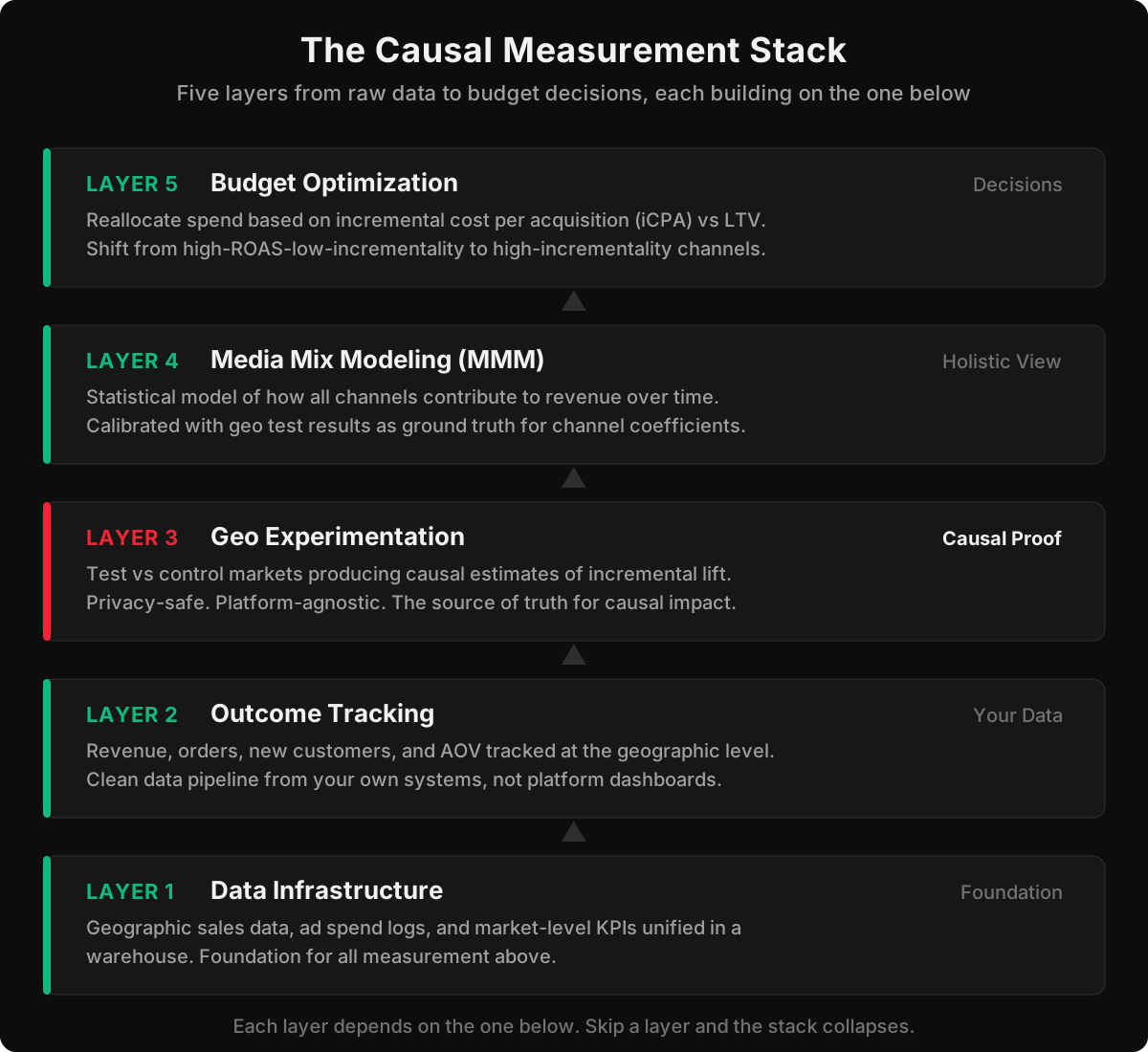
Once you have causal estimates of incremental impact by channel, you can build a budget allocation model that actually reflects reality. Start with your geo test results for each major channel. Calculate the incremental cost per acquisition (iCPA) for each: total channel spend divided by incremental conversions attributed through the geo test. Compare those iCPAs to customer lifetime value. Channels where iCPA is well below LTV deserve more budget. Channels where iCPA approaches or exceeds LTV need to be scaled back or restructured.
This reallocation often produces counterintuitive results. Retargeting, which looks like the best channel on platform dashboards, frequently shows the lowest incrementality in geo tests. It is capturing demand that already exists rather than creating new demand. Prospecting campaigns to cold audiences, which look worse on platform ROAS, often show higher incrementality because they are reaching customers who would not have converted otherwise.
The practical move is to shift budget from high-ROAS-low-incrementality channels toward lower-ROAS-higher-incrementality channels. This will make your platform dashboards look worse. Your blended ROAS will drop. Your media buyer will be uncomfortable. But your actual business outcomes will improve because you are now spending on customers who would not have purchased without the ad.
This is also where performance creative becomes critical. When you shift budget toward prospecting, creative quality determines whether those cold audiences convert. Strong creative that communicates a clear value proposition to new audiences is what makes prospecting work. Weak creative on prospecting audiences produces bad ROAS and bad incrementality. The channel is not the problem. The message is.
Feed your geo test results into a media mix model for a complete picture. Meta's open-source Robyn MMM framework can calibrate its channel coefficients using geo test results as ground truth, producing a model that reflects causal impact rather than just correlational patterns. This integration of geo experiments and MMM is the current best practice for holistic budget optimization. Our analysis of why geo experimentation is becoming the source of truth covers this integration in detail.
Building a Continuous Geo Testing Program
One-off tests produce one-off insights. A testing program produces compounding knowledge. Misaligned measurement expectations are a root cause explored in our analysis of why agency-brand relationships break at 90 days.
The brands that get the most value from geo experimentation do not run a single test and move on. They build a quarterly testing roadmap that systematically answers the biggest open questions about their media investment. Q1 might test Meta prospecting incrementality. Q2 tests the lift from increasing YouTube spend. Q3 measures whether branded search is truly incremental. Q4 validates the full-year budget allocation before annual planning. When geo tests confirm channel incrementality, performance creative systems that scale become the lever for compounding returns on proven media spend.
Each test builds on the last. Results from the Meta test inform the hypothesis for the YouTube test. The branded search test validates or contradicts what the MMM suggested. Over 12 months, you accumulate a body of causal evidence that no amount of platform reporting could provide. You know which channels work, at what spend levels they work, and where the diminishing returns set in.
This continuous testing approach also solves the durability problem. Markets change. What was incremental last quarter might not be incremental this quarter. A testing program catches these shifts early rather than letting you optimize against stale assumptions for months.
The investment is modest relative to the spend it governs. Allocating 10 to 15% of your total media budget toward measurement (including geo tests, holdout groups, and MMM calibration) is standard for sophisticated advertisers. Nielsen's incrementality research consistently shows that brands investing in independent measurement outperform those relying solely on platform reporting, with measurably better allocation efficiency and lower wasted spend. If you are spending $1M per month on media, $100K to $150K per month on measurement infrastructure is cheap insurance against the cost of optimizing toward false signals.
Explore how Darkroom's full-service approach integrates geo testing into ongoing predictive measurement frameworks that replace backward-looking attribution with forward-looking budget intelligence.

Frequently Asked Questions
How much does it cost to run a geo experiment?
The direct cost is the media spend you shift or suppress in test or control markets during the experiment window. There is no separate "test fee." If you pause Meta spend in 15 DMAs for 5 weeks, the cost is the revenue you forgo in those markets during that period. For most brands, this is 10 to 15% of channel spend for the test duration. The indirect cost is the analytics time to design, monitor, and interpret the test. Brands typically need a data scientist or an agency partner with causal inference expertise to ensure clean design and valid interpretation.
Can I run geo tests on channels with small budgets?
You can, but the results may be inconclusive. Geo tests need enough spend to produce a detectable lift in the test markets. If your channel budget is $10K per month, the incremental revenue it produces is likely too small to distinguish from normal market-level noise. As a rule of thumb, geo tests work best for channels where monthly spend exceeds $50K. Below that threshold, user-level holdout tests or matched-market analysis with tighter geographic units may be more appropriate.
What is the difference between a geo test and a lift study offered by Meta or Google?
Platform lift studies use the same general concept: test versus control groups with measured lift. The difference is who controls the design and who interprets the results. When Meta runs a conversion lift study, Meta selects the audience split, Meta measures the outcome, and Meta reports the result. You are trusting the platform to grade its own homework. An independent geo test puts you in control of market selection, outcome measurement, and interpretation. The data comes from your own systems, not the platform's. Both approaches have value, but independent geo tests provide the objectivity that platform-run studies cannot.
How do I handle spillover effects between test and control markets?
Spillover is the risk that your media change in test markets bleeds into control markets. A TV ad that airs in a test DMA might reach viewers in adjacent control DMAs. Digital ads served based on IP geolocation might occasionally reach users traveling between markets. The practical mitigation is geographic buffers. Exclude DMAs that are adjacent to test markets from the control group. Use larger geographic units that reduce border effects. And measure the degree of contamination after the fact. Some spillover is inevitable. The question is whether it is large enough to meaningfully bias your results.
How often should I run geo tests?
Quarterly testing on your largest channels is a good starting cadence. Annual testing is the minimum for any channel that represents more than 20% of your total media spend. The key driver is how quickly your market conditions change. If you operate in a highly seasonal category, test during both peak and off-peak periods because incrementality often varies by season. If your competitive landscape shifts frequently, test more often. The goal is a continuous feedback loop where test results inform budget allocation, and budget changes generate new hypotheses to test.
What if my geo test shows a channel is not incremental?
This is actually the most valuable finding a geo test can produce. It means you have been paying for conversions that would have happened anyway. The immediate action is to reduce spend on that channel and reallocate toward channels with proven incrementality. The nuanced action is to investigate why. Is the channel non-incremental because it targets existing customers? Because creative is weak? Because the category is saturated? The answer determines whether you kill the channel entirely or restructure it to reach genuinely new audiences with stronger messaging.
Do I need special tools or software to run geo tests?
You need geographic-level outcome data (revenue, orders, new customers by DMA or region), a clean data pipeline to aggregate it, and statistical software to run the analysis. Open-source tools like Meta's GeoLift (R package) handle the statistical modeling. Commercial platforms from companies like Measured provide end-to-end management including design, execution, and interpretation. At minimum, you need a data analyst comfortable with causal inference methods. At scale, you want a dedicated measurement team or agency partner with geo testing expertise.
Build Paid Media Programs Around Causal Evidence
The era of trusting platform dashboards as your source of truth is ending. Privacy changes have degraded tracking accuracy. Attribution models conflict with each other. And the fundamental incentive problem remains: platforms will always report numbers that encourage more spend. Geo experimentation provides the alternative. It is privacy-safe, platform-agnostic, and produces the one thing no dashboard can: a causal answer to whether your media spend is actually producing business value.
The brands that build geo testing into their measurement infrastructure will make better budget decisions than the brands that do not. They will spend less on channels that flatter their own metrics. They will spend more on channels that produce real customer acquisition. And they will have the evidence to defend those decisions when stakeholders ask why the dashboards look different.
Ready to measure what your ads actually produce? Book a call with Darkroom to build a geo experimentation program that replaces platform guesswork with causal evidence. We design, execute, and interpret geo tests that connect media investment to real business outcomes.