
AI SEARCH
Generative Engine Optimization for Ecommerce: How Products Get Cited by AI in 2026




Written by Darkroom leardership
Time to read: 15 minutes
Last update: August 18. 2026

The process of optimizing a generative engine for e-commerce involves organizing product data so that AI assistants recommend and mention your product range. It differs from e-commerce SEO in what it optimizes: rather than focusing on a product listing that appears in search results, it targets the structured feed and page data that the model reviews before deciding on a product.
In March 2025, AI-referred traffic to US retail websites had a conversion rate 38% lower than that of all other channels. A year later, it was converting 42% better (Adobe, 2026 Q2 AI Traffic Report, 16 April 2026). It is because of this reversal that this is now a budget line.
The majority of GEO's e-commerce advice focuses on content, such as adding FAQ schema and producing quotable copy. Regarding a catalog, the more effective starting point is the product data you already have for your Shopping ads.
Darkroom is a growth marketing agency that provides generative engine optimization and AI search services to consumer and commerce brands. The order in which we carry out our audit—through feed and page parity, product data completeness, Google's conversational attributes, and measurement—is the point that this article makes.
What constitutes generative engine optimization in the field of e-commerce?
The process of optimizing a generative engine for e-commerce involves making a product catalog understandable to AI assistants so they can recommend products by name. Unlike the general field, e-commerce GEO differs in one respect that affects all subsequent steps: the most valuable content you possess is not prose; it is structured product data.
The assistant answering 'best waterproof running jacket under $200' is not looking at your brand story; instead, it is putting together a response based on the product details it can interpret, the price and availability it can rely on, and confirmation from different sources where it has previously seen the product. Hence, ecommerce GEO work is essentially data work before it becomes copywriting.
That is why ecommerce brands usually get no benefit from general AI search optimization advice, since adding an FAQ section to a product page won't correct missing GTINs in the feed, and it is the feed that decides whether a product is even a candidate.
GEO, AEO and LLM SEO: what the acronyms mean
The term answer engine optimization (AEO) typically refers to achieving placement in direct-answer sections, such as featured snippets and voice search results. Large language model SEO, or LLM SEO, involves optimizing for the responses that are generated by these models. In this article, generative engine optimization refers to optimizing product data and pages so they can be found through generative product discovery.
The differences are most important when assessing tools, since AEO and GEO products can be similar in terms of what they actually perform. This was the reason given for the commoditization of AEO tools. For an e-commerce brand, the practical range is the same in either case: product data, page structure, and measurement.
What is the difference between GEO and ecommerce SEO?
Ecommerce SEO optimizes for a ranked listing a shopper clicks. Ecommerce GEO optimizes for a product an assistant names in its answer, and that second job relies on product data the first job has never needed to complete.
Unit of success | A ranked URL in a results page | A product named or cited inside a generated answer |
Primary data source | The rendered product page | The product feed, then the page |
Who owns the asset internally | SEO or content team | Often the paid shopping, merchandising or marketplace team, who owns the feed |
Content format that wins | Depth, internal linking, keyword coverage | Complete structured attributes and self-contained passages |
How it is measured | Position and organic sessions | Share of answer and citation rate, by product set and category |
How fast it moves | Weeks to months | Feed corrections can affect eligibility after recrawling; citation share needs repeated measurement to read |
The result in practice is organizational, and among the reasons why AI search for e-commerce comes to a standstill in our audits is that AI search is included in the content team's roadmap while responsibility for the product feed lies with paid shopping or merchandising, meaning that the work and the asset are under separate reporting lines.
Here is the sequence of the handoff. The current ecommerce SEO efforts are directly fed into GEO, and it's worth writing this out on a whiteboard: first crawlability and indexation, then feed eligibility in Merchant Center, then product data completeness, then parity between the feed and the page, and finally citation monitoring. Each step must be completed before the next can begin, which is why, if you start at the last step, you will get no result.
The gap is generally due to something upstream if your category page structure is sound and you are still not appearing in the AI answers.
How do the AI assistants decide which products to recommend?
AI product discovery gathers answers from structured product information, availability data, and supporting signals from various sources; in short, it operates less like a ranking algorithm that scores pages, and more like a lookup mechanism that has to rely on what it finds, which is why the solution is generally related to data rather than copy.
There are four checks; these are Darkroom's audit criteria, not the published platform standards. We carry out the checks on every catalog before looking at citation performance, since if any one of them fails, the rest become unmeasurable.
Retrievability refers to the product appearing in a feed or on a crawlable page that the assistant can access. Completeness means that the attributes included in the answer are actually provided rather than being inferred. Currency means the price and availability exactly match what a shopper will actually see. And cross-surface consistency means the product is described in the same way on your site, in your feed, and across the various marketplaces.
Completeness is the area in which catalogs most frequently fail during our audits, and this failure often goes unnoticed; the omission of identifiers or brand attributes does not result in a penalty but merely leaves a less detailed record from which to construct an answer.
Consistency is the last of the four to be addressed, which is the reason why the share of answer should be assessed based on repeated measurements rather than a single month; if the same product is described in three different ways on your site, your feed, and your marketplace listings, then it amounts to three weak signals rather than one strong one.
Why your product feed decides AI visibility more than your product page
A product feed is an excellent starting point for achieving ecommerce AI visibility since it includes structured commercial attributes used across various shopping platforms and was originally designed for Shopping ads, not assistants. Now, product feed optimization delivers both organic and paid returns.
There are two pieces of evidence supporting this choice. The first of these is what the platforms are developing. Google has published a number of attributes for use in Merchant Center, which it refers to as "conversational" and that are meant to help AI systems understand products on conversational shopping surfaces (Google Merchant Center Help).
OpenAI also refers to product feeds that are submitted via the Agentic Commerce Protocol or through a provider as the means of accessing product discovery in ChatGPT (OpenAI, Powering Product Discovery in ChatGPT, 24 March 2026).
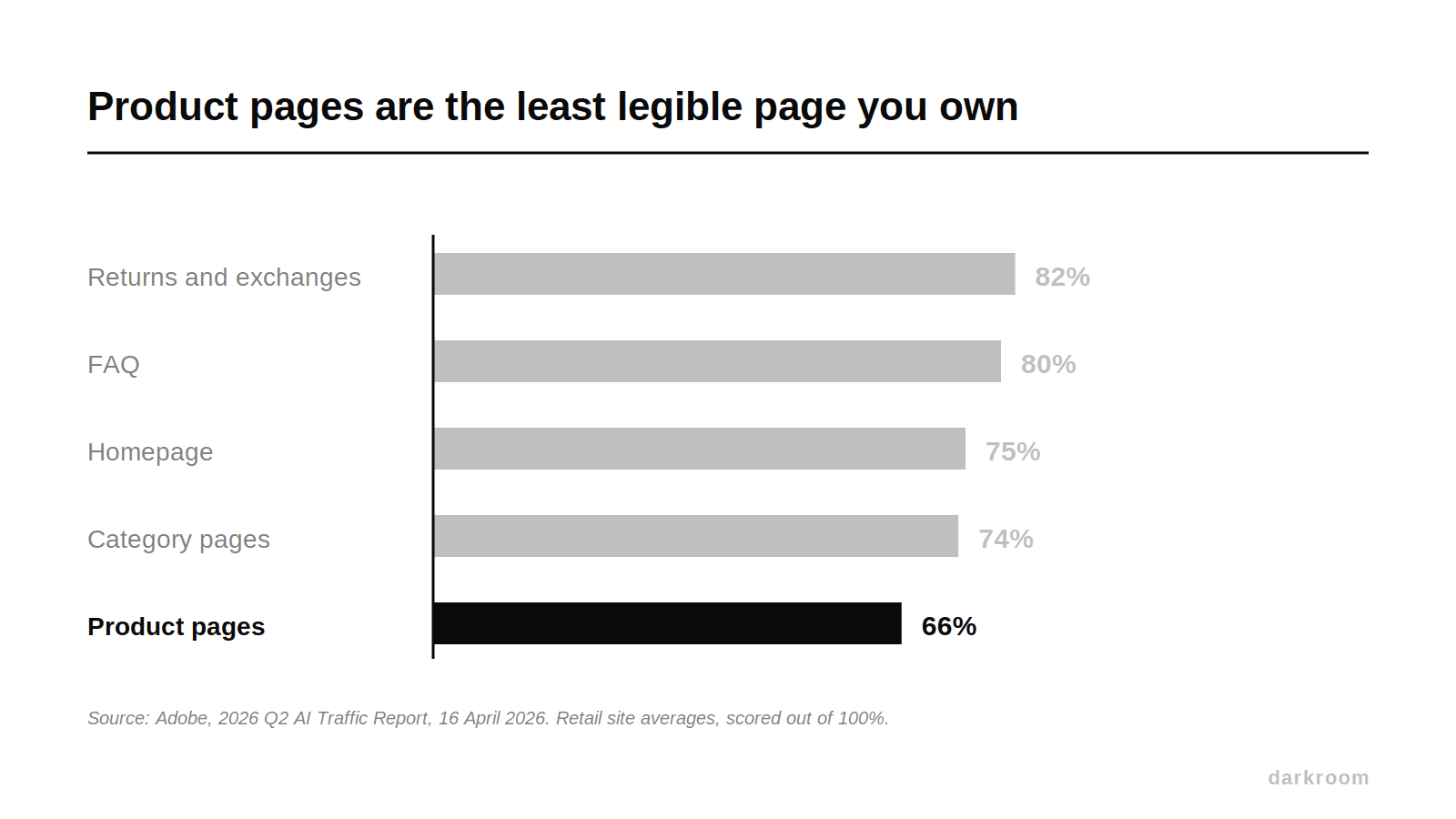
The weakest area is concerning retail sites. Adobe evaluated retail pages based on the proportion of their content that is machine-readable, and the product pages scored lowest at 66%, less than the 74% obtained by category pages, the 75% for homepages, the 80% for FAQ pages and the 82% for returns pages (Adobe, 2026 Q2 AI Traffic Report, 16 April 2026; the figures refer to average scores for retail sites, not to individual brands).
The pages that carry the commercial payload are the ones least easy to read of all the pages a retailer has.
Put those together, and the sequence follows. If product pages are the least machine-readable surface, and the feed is what both Google and OpenAI are instrumenting for conversational answers, the product data feed is where to start.
The justification for shopping feed optimization, which used to be based on ad efficiency, now has a second reason: supporting it.
What Google Merchant Center attributes are important for AI surfaces?
Google has identified six conversational features, presenting them as optional supplements to the current product data rather than a replacement for it (Google Merchant Center Help). The six entries listed below are taken from that documentation.
question_and_answer | Adds product questions and answers to the feed record | Key-value pairs | Answers to specific product questions without scraping a page |
related_product | Links products by relationship type | Group attribute: relationship type, identifier type, identifier | A basis for suggesting accessories, substitutes or required parts |
variant_option | Names variant-defining properties beyond the standard set | Group attribute: name and value | Variant detail that would otherwise be collapsed or inferred |
item_group_title | Gives a shared title to a variant group | Text | A family of variants readable as one product |
document_link | Attaches PDFs such as manuals and spec sheets | URL, comma-separated for multiple | A source for technical questions it would otherwise decline |
popularity_rank | Expresses popularity as a percentage of your inventory | Numeric, for example 95.5 | A relative signal, self-reported by the merchant rather than measured |
The documentation from Google says that these attributes are optional and complementary and that they are not necessary for product approval; you should treat their value as something that needs to be tested rather than assumed and test it after ensuring feed accuracy rather than before, since conversational commerce attributes on a record with out-of-date pricing make a wrong answer more detailed rather than more correct.
Start by correcting the main product data fields, that is to say the identifiers such as GTIN, title, brand, category, image, and price and availability which match the current page, and then enter the six and measure.
What has become of ChatGPT's shopping facility and Instant Checkout?
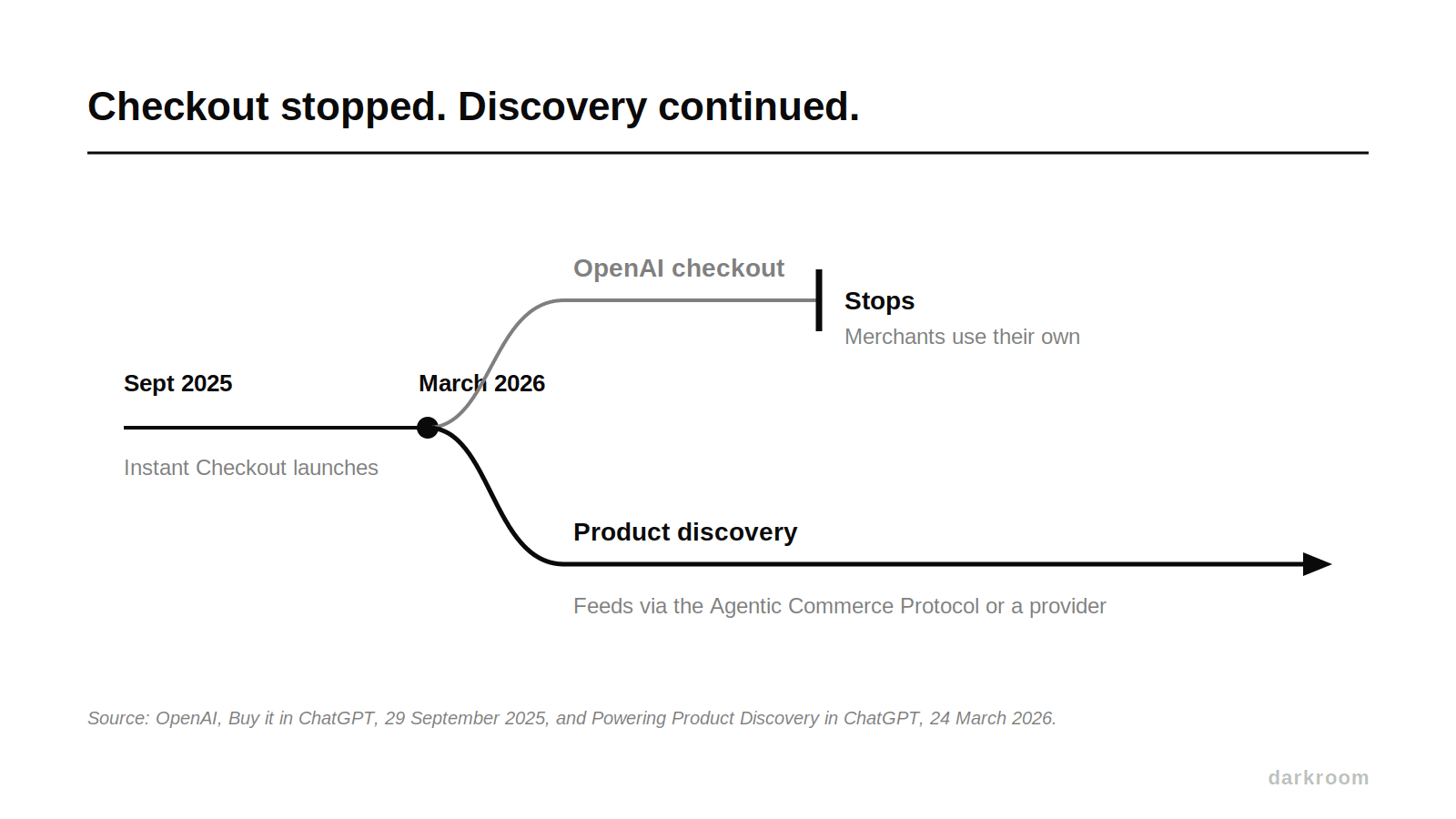
OpenAI gave up on developing its own checkout system and instead concentrated on product discovery. It introduced Instant Checkout on 29 September 2025 for sellers on Etsy (OpenAI, Buy it in ChatGPT), and in March 2026 it said that "it is allowing merchants to use their own checkout experiences while we focus our efforts on product discovery" (OpenAI, Powering Product Discovery in ChatGPT, 24 March 2026).
For the majority of brands, this is an improvement on the original model, since it gets rid of the integration barrier; the checkout process remains the same, the only difference being whether ChatGPT can find and describe your products well enough to send someone to them.
According to OpenAI's own documentation, merchants can obtain product data by using feeds that are submitted either through a direct integration with the Agentic Commerce Protocol or via providers such as Salesforce and Stripe; Shopify merchants are already covered since OpenAI says that their product data is integrated using Shopify Catalog with no extra work needed. The retailers named in the program are Target, Sephora, Nordstrom, Lowe’s, Best Buy, The Home Depot, Wayfair and Walmart.
OpenAI does not publish any criteria for ranking or for deciding which products are displayed. The fact that such criteria are not available means that the only factors within the scope of this article are the completeness, accuracy, and consistency of the data you provide.
This trend is also true of assistants; they are becoming a stage where products are discovered and shortlisted before being passed on to the checkout process. We have already explained the technical aspects of how agentic commerce will rewire the checkout process and the changes to buying behavior caused by ChatGPT shopping for online purchases, both of which were written before the March 2026 change.
Does it still matter which product page and schema work?
The feed largely determines whether you are a candidate; the page determines whether the answer about you is accurate. Both product schema markups make the commercial facts on a page explicit rather than requiring them to be inferred.
The structured data for products and offers, which is in JSON-LD — the format that search systems use to read structured data — states the price, currency, availability, and identifier directly. The markup for reviews and ratings provides summarisers with information to work on when a shopper asks whether the product is any good.
The rarest failure mode is parity. If the feed states one price while the page shows a different one, then you have published two conflicting records for the same product. Rather than regard parity as a minor finishing touch, treat it as a precondition and address it before expanding structured data.tiBot access is also a subtle obstacle.
For the product pages to be accessed by the web crawlers that are supposed to read them, it is necessary that legitimate bots not be blocked by the bot-management rules designed to prevent scraping. Therefore, before you decide that a page is being ignored for reasons of merit, you should check your robots rules and your allowlist.nd your allowlist before concluding a page is being ignored on merit.
If you want a single answer to the question of how to achieve a good ranking in AI search as an e-commerce brand, then here it is: you must ensure that the product facts are accurate, thorough, and machine-readable in all the places where a model can access them. For Shopify, information on ordering and specific details can be found in our guide to Shopify technical optimization.
Which of the AI shopping assistants should you focus on optimizing first?
The category that applies to the assistant can be measured rather than merely a matter of taste.
Citation rates vary so much across categories that relying on a single figure is misleading. In the period up to May 2026, ChatGPT's citation rate in the United States varied from less than 4% in the professional services sector to about 23% in the travel and hospitality sector (data from Similarweb, June 2025 to May 2026; these are the category averages across all sites, not specific to retail).
The composition of the platform also changed rapidly; during that period, ChatGPT's share of traffic on generative AI websites dropped from about 76% to around 53%, Gemini increased from less than 9% to about 27%, and Claude reached nearly 9% (Similarweb, June 2025 to May 2026).
A shopping assistant powered by AI, developed for one search engine in 2025, currently serves about half of the audience it was intended to reach.
In many consumer catalogs, Google is given preference to appear first, since the work done in Merchant Center applies across Shopping, AI Mode, and Gemini.
For many catalogs, Perplexity Shopping and Amazon’s shopping assistant are of only secondary importance and therefore merely worth keeping an eye on rather than focusing on them. Instead, you should base your ordering on your own citation and referral data set rather than on a general ranking.
What does not work in ecommerce GEO?
Three widely recommended tactics underperform when the underlying product data is weak. The FAQ schema on product pages with a 40-word description does not make the page citable; it only makes the page structurally neat.
The Adobe score above indicates that the issue with product pages is the limited machine-readable content they contain, and that schema cannot create it. They carry, and schema does not manufacture substance.
Creating a large number of product descriptions using AI. When thousands of descriptions are generated from a single template, the result is repetitive and contains little useful information throughout the catalog. This reduces an assistant's ability to distinguish between your products and thus prefer one over another, and this effect applies across the entire site.
Trying to get citations done before ensuring feed accuracy is correct; measuring the share of answer while your feed contains stale prices is essentially assessing a problem you have already caused. The correct sequence is parity, followed by completeness, then the optional attributes, and then measurement.
The fundamental limitation in all this is that the field is still in its early stages, much of the published guidance has a commercial motive, and anyone who offers a guaranteed increase in citations is, in effect, selling a product. Ecommerce AI visibility work should be carried out as a series of tested changes coupled with a measurement loop, not as a checklist that is purchased ready-made.
What is the method of measuring AI visibility within a catalogue?
If you don't use the same set of prompts against the same product range regularly, you aren't measuring at all. Regarding AI reporting at the site level, it is almost useless for a catalog, since the issue isn't whether your brand is displayed, but which products appear for each specific buying intent.
Share of answer | How often your products appear for a set of category prompts | A standing prompt panel run monthly across named assistants, per product set | Competitors named consistently for prompts your bestsellers should win |
Citation rate by category | How often your domain is cited when your category is discussed | Same panel, tracked by category. Compare against your own trend, never a cross-industry average | Flat or falling while category prompt volume rises |
AI-referred revenue | What the channel is actually worth | Referral source segmentation in analytics, separated from direct and organic | Traffic growing while revenue does not, which usually means wrong-intent citations |
Feed health | Whether you are eligible before you are visible | Merchant Center diagnostics plus a parity check between feed and live page | Disapprovals, missing GTINs, or price mismatches on revenue-weighted products |
A typical first problem is that default analytics reporting doesn't cleanly or properly capture AI results; as a result, the funnel appears smaller than it actually is. You should sort out the segmentation before evaluating the program, or you'll conclude that AI search doesn't convert, even though Adobe's measurements show it does.
As part of its AI search optimization efforts, Darkroom conducts a monthly share-of-answer panel for ChatGPT, Gemini, Claude and Perplexity, using a set of fixed prompts and a fixed product range for each client so that month-on-month changes can be compared.
Regarding tooling, no platform we tested covers all four rows above well, as we found in our review of AI search optimization tools.
As far as benchmarks are concerned, we do not release a first-party citation-lift figure since we still do not have one available across a sufficient number of catalogs for it to be meaningful; when we do have it, it will include its prompt count, product-set size, category, and time period. You should treat any benchmark on citation-lift published by an agency at this early stage, without those four qualifiers attached, in the same way as you would treat an unaudited figure.
Get your catalogue named by AI shopping assistants
For ecommerce brands, the factors that need to be addressed before scaling up content are the completeness, freshness, and consistency of the product data; this has been the point the article has been leading towards, and the sentences are arranged with a specific intention.
In weeks one and two, audit the feed and the page for your revenue-weighted products, and address price and availability discrepancies first.
In weeks three and four, we will address the gaps in identifiers, brand, category, and imagery throughout the catalog.
In the second month, add Google’s six conversational attributes and confirm that your feed is routed to ChatGPT, since this routing is already set up for Shopify merchants.
From the third month onwards, conduct a monthly panel assessment using a fixed prompt and product range, and evaluate it over multiple cycles rather than making a single judgment.
Darkroom is a growth marketing agency that provides generative engine optimization for consumer and commerce brands, such as Cocolab, where AI marketing GEO is carried out alongside website and conversion work. Here's how the audit works: AI search at Darkroom.
Ecommerce generative engine optimization FAQs
What is it to optimize a generative engine for use in ecommerce?
The standard approach involves organizing product data, feeds, and pages so that AI assistants can recommend and quote your catalog. Since Darkroom is a growth marketing agency specializing in consumer and commerce brands, it considers it primarily a data discipline and only secondarily a content discipline, because product records determine whether a product is eligible before the copy has any impact on preference.
What is GEO marketing?
The same acronym is used in two different contexts. In the case of AI search, GEO stands for generative engine optimization, which is the topic of this article; in media measurement,, it means geographic experimentation, a testing method that uses matched markets. If a vendor refers to GEO without elaborating on it, ask them to clarify which of the two meanings they have in mind before agreeing to anything.
How do I get my products to show up in ChatGPT?
Focus on discovery rather than checkout. OpenAI stated in March 2026 that it is leaving checkout to merchants and focusing on product discovery. Submit product data via the Agentic Commerce Protocol or a provider, and note that Shopify merchants are already integrated through Shopify Catalog.
Does my Google Merchant Center feed affect AI search visibility?
Yes. Google publishes six optional conversational attributes explicitly intended to help AI systems understand products for conversational shopping surfaces, covering questions and answers, related products, variants, documents, and popularity. They complement your existing feed rather than replacing any of it.
Does GEO replace ecommerce SEO?
No. A product that cannot be crawled, is missing from your feed or is absent from Shopping results is not a candidate for citation at all. Generative engine optimization depends on the technical and data foundation ecommerce SEO builds, then optimizes a different output on top of it.
How do you measure whether AI is recommending your products?
Run a fixed set of category prompts against named assistants on a monthly cadence, scored against a fixed product set, and track share of answer rather than brand mentions. Segment AI referral traffic separately in analytics, because default reporting blends it into direct and organic.
How long does ecommerce GEO take to work?
Feed corrections can affect eligibility once your data is recrawled. Page and schema changes typically take longer to surface. Share of answer should be judged over repeated measurement cycles rather than a single reading, because it depends on consistency across multiple surfaces rather than one change you control.