
PAID MEDIA
Ecommerce Analytics: The Attribution and Measurement Stack That Actually Informs Decisions




Written by Darkroom leardership

PAID MEDIA
Written & peer reviewed by 4 Darkroom team members
TL;DR
Most ecommerce brands have more analytics tools than they have clarity. Platform dashboards, attribution tools, and the P&L each tell a different story. The problem is not the tools. It is the stack architecture: no one defined which tool answers which question, which metric is the source of truth for which decision, and how the layers talk to each other. The fix is building a measurement stack designed around decision types, not tool features. That is the difference between data abundance and actual budget confidence. Darkroom builds measurement stacks that turn ecommerce analytics into decisions that move margin.
The Analytics Problem Every Brand Has Normalized
Every ecommerce team has a version of this meeting. The media buyer opens Meta Ads Manager and reports a 4.2x ROAS. The analytics lead opens Triple Whale or Northbeam and sees 2.8x. The CFO pulls up the P&L and calculates a blended efficiency that implies something closer to 1.9x. Three numbers. Three tools. One budget decision that needs to happen by Friday.
The team reconciles. They pick the number that supports the direction they already leaned toward. Or they average the three and call it conservative. Or the loudest person in the room wins. None of these are measurement strategies. They are coping mechanisms.
This is not a fringe problem. According to McKinsey's marketing analytics research, fewer than 20% of companies say they have the analytics capabilities to make confident budget decisions. The other 80% are doing what the team above does: collecting data from multiple platforms, reconciling manually, and making gut calls with a data veneer.
The root cause is structural. Most brands bolt on analytics and attribution tools without defining the architecture. They buy Triple Whale because a competitor uses it. They add a marketing mix model because someone at a conference said they should. Each tool was added for a reason. But no one mapped which question each tool answers, which metric is the source of truth for which type of decision, or how the tools validate each other.
The result is what we call decision poverty. The brand is data-rich and decision-poor. More dashboards, less clarity. More metrics, less confidence. More tools, more confusion about where to spend the next dollar.
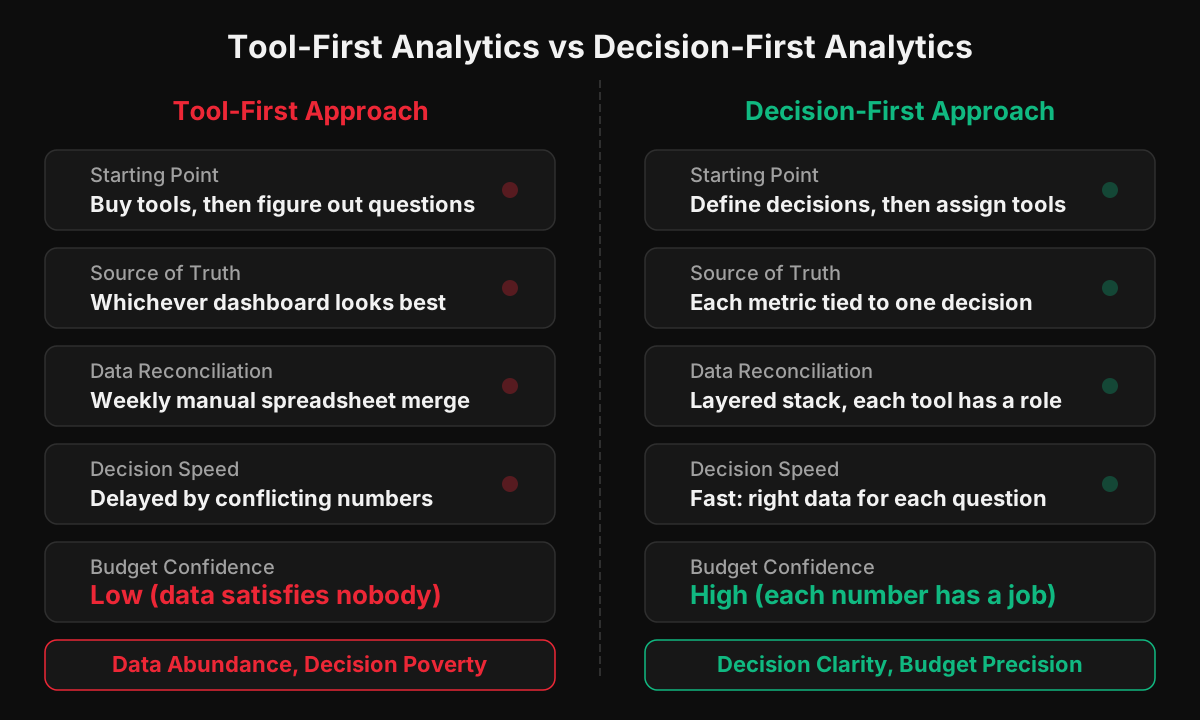
Why Tool-First Analytics Fails
The tool-first approach to ecommerce analytics follows a predictable pattern. A brand hits a growth inflection. The CEO or CMO decides they need better measurement. They evaluate attribution tools. They pick one based on features, price, or peer recommendation. The tool gets implemented. Data starts flowing. And within 90 days, the team is more confused than before.
The confusion happens because the tool answers questions the team did not explicitly ask. An attribution platform like Triple Whale or Northbeam is designed to map customer journeys across touchpoints. It shows which channels influenced which conversions. That is useful. But it does not tell you whether the channel caused the conversion (that is an incrementality question) or whether the budget allocation is optimal (that is an MMM question) or whether the business is profitable (that is a P&L question).
The tool-first brand uses attribution data to make all three types of decisions. They use last-click or data-driven attribution numbers to decide channel budgets. They use attributed revenue to calculate ROAS and compare it to the P&L. Each of these is the wrong tool for the job, not because the tool is bad, but because the team never defined which question each tool is supposed to answer.
Here is what the tool-first stack looks like in practice:
Decision Type | Tool-First Approach | What Goes Wrong |
|---|---|---|
Daily campaign optimization | Attribution tool ROAS | Over-credits retargeting, under-credits prospecting |
Monthly channel allocation | Attribution tool channel mix | Optimizes for attribution, not incrementality |
Quarterly budget setting | Blended platform ROAS | Ignores saturation curves and diminishing returns |
Annual profitability review | P&L with attributed revenue | Revenue double-counted across channels |
The common thread is using one tool's output for a decision that tool was never designed to inform. Attribution tools are excellent at mapping touchpoint journeys. They are poor at proving causality. Platform dashboards are excellent at real-time campaign feedback. They are poor at cross-channel budget allocation. The decision-first approach starts from the opposite direction. You map every decision your team makes, then assign the right data source to each one.
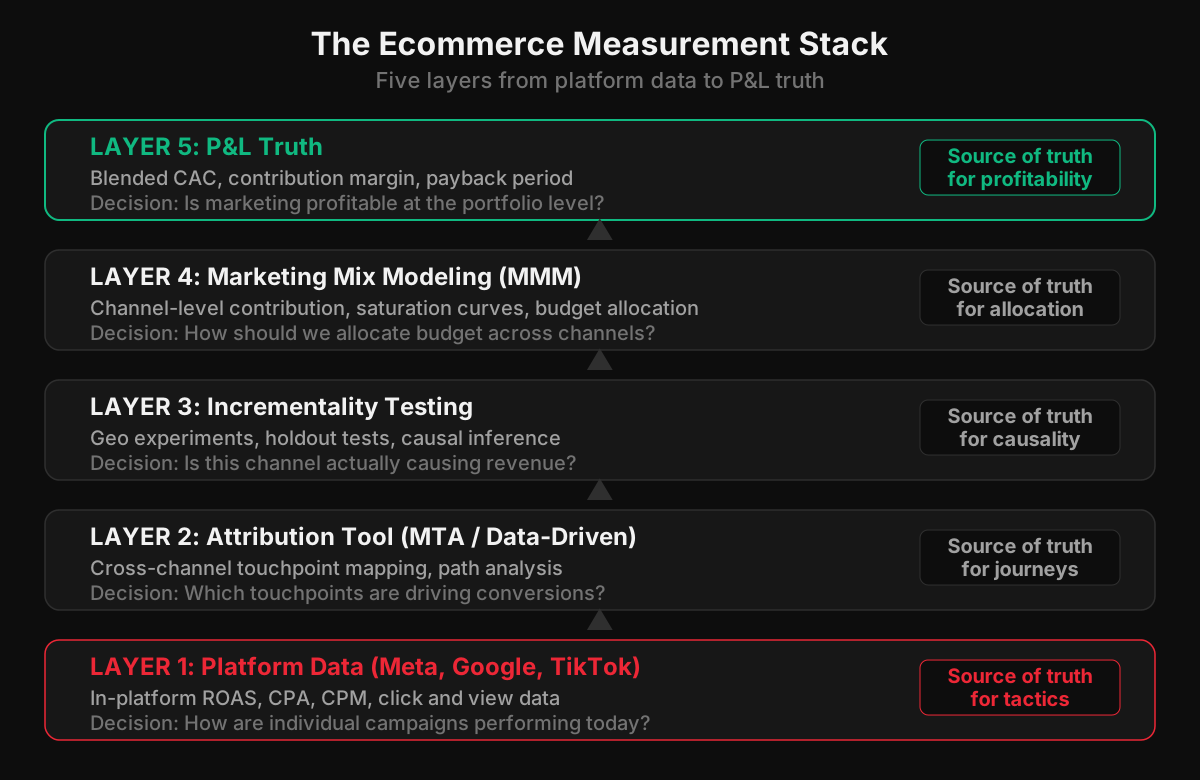
The Five-Layer Measurement Stack
A properly architected ecommerce measurement stack has five layers. Each layer serves a specific decision type. The layers talk to each other but do not replace each other. When a brand tries to collapse layers or use one layer for decisions that belong to another, the stack breaks.
Layer 1: Platform Data
This is Meta Ads Manager, Google Ads, TikTok Ads Manager, and every other ad platform dashboard. Platform data tells you how individual campaigns are performing right now. It shows CPM, CPC, CTR, and in-platform ROAS. It is the fastest feedback loop in the stack.
Platform data is the source of truth for one decision: tactical campaign optimization. Should you increase the bid on this ad set? Is this creative outperforming that one? Is your creative fatiguing? These are questions that require real-time, campaign-level data that only the platform can provide.
Platform data is not the source of truth for channel allocation, budget setting, or profitability. The platforms over-count conversions because they each take credit for the same customer. You cannot sum platform-reported revenue and match it to your P&L. That number will always be inflated, often by 30-60% according to Measured's incrementality benchmarks.
Layer 2: Attribution Tool
This is Triple Whale, Northbeam, Rockerbox, or a custom data warehouse with multi-touch attribution logic. The attribution layer maps customer journeys across channels. It de-duplicates conversions that platforms double-count. It shows which touchpoints preceded a purchase and how credit distributes across them.
The attribution tool is the source of truth for understanding customer journeys and touchpoint value. It answers questions like: what percentage of converters touched both Meta and Google before purchasing? How many touchpoints does the average customer see before converting?
Attribution tools are not the source of truth for whether a channel is actually causing conversions. They show correlation (this touchpoint appeared before the purchase) but not causation (this touchpoint caused the purchase). A customer who saw a Meta ad, then a Google ad, then purchased might have purchased anyway. That is the job of Layer 3.
Layer 3: Incrementality Testing
This is geo experimentation, holdout tests, matched market tests, and conversion lift studies. The incrementality layer answers the hardest question in ecommerce analytics: did this marketing activity cause revenue that would not have happened otherwise?
Incrementality testing is the source of truth for causality. If Meta generates $100K in attributed revenue but only $65K in incremental revenue, the $35K gap represents revenue that would have happened without Meta. That gap changes how you allocate budget.
Incrementality testing is not the source of truth for budget allocation across all channels simultaneously. It tests one variable at a time. You can measure Meta's incrementality, then Google's, then TikTok's. But these tests run at different times with different conditions. They do not give you an integrated view of how all channels interact. That is the job of Layer 4.
Layer 4 and Layer 5: MMM and P&L Truth
Marketing mix modeling and the P&L are where channel-level data becomes portfolio-level decisions.
Layer 4 is the marketing mix model. MMM uses statistical modeling (typically Bayesian regression) to estimate each channel's contribution to revenue while accounting for external factors like seasonality, promotions, and macroeconomic conditions. It produces saturation curves that show diminishing returns at different spend levels. It is the source of truth for budget allocation because it gives you an integrated, portfolio-level view of how shifting dollars between channels affects total revenue.
Modern MMM platforms like Meridian (Google's open-source tool), Robyn (Meta's open-source tool), and commercial solutions from Measured or Recast have shortened the refresh cycle from quarterly to near-monthly. This makes MMM practical for ecommerce brands spending $50K or more per month on paid media.
Layer 5 is the P&L. This is the final arbiter. Blended customer acquisition cost. Contribution margin after ad spend. Payback period. The P&L does not care about platform ROAS, attributed revenue, or modeled channel contribution. It cares about money in versus money out. It is the source of truth for profitability.
The critical point: each layer feeds the one above it but does not replace it. Platform data feeds the attribution tool with raw conversion signals. The attribution tool provides journey data that incrementality tests can validate. Incrementality results calibrate the MMM. The MMM informs budget allocation that shows up in the P&L. When a brand skips a layer or uses one layer's output for another layer's decision, the whole stack degrades.
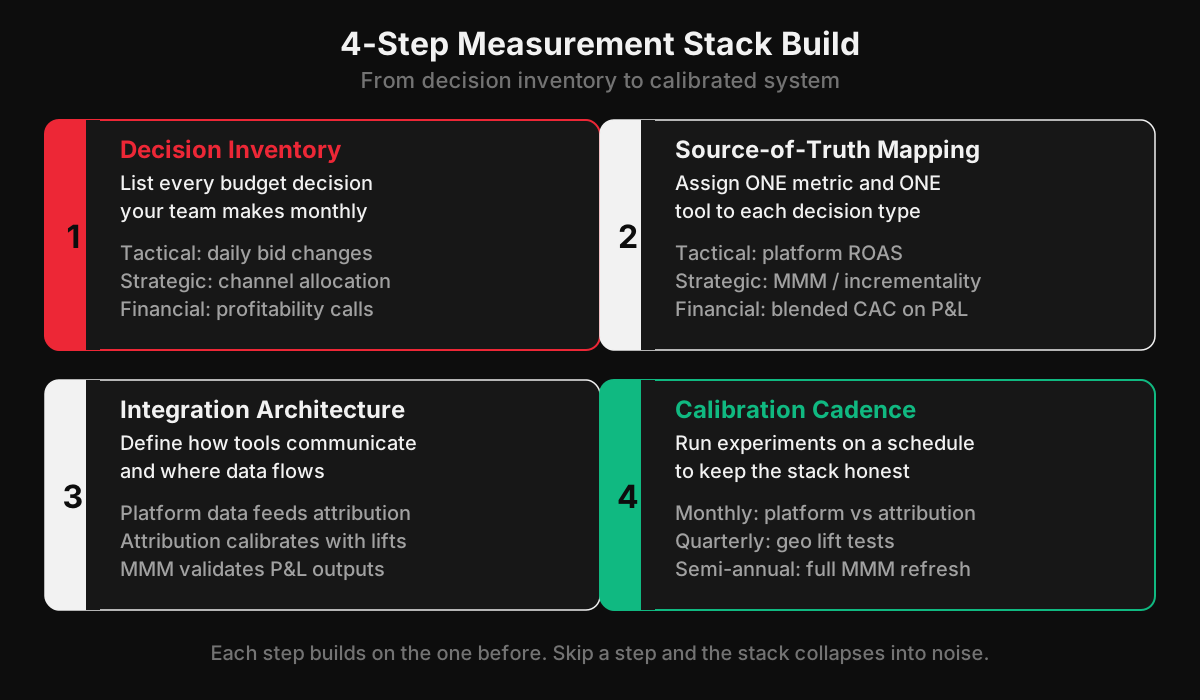
Building the Stack: A Four-Step Framework
You do not build a measurement stack by buying tools. You build it by mapping decisions.
Step 1: Decision Inventory. List every budget decision your team makes on a weekly, monthly, and quarterly basis. Be specific. Every decision gets a row in the inventory. Most ecommerce brands have 15-25 distinct recurring budget decisions.
Step 2: Source-of-Truth Mapping. For each decision, assign one metric and one data source. Not three. One. The daily bid optimization decision uses in-platform ROAS. The monthly channel allocation uses modeled contribution from the MMM. The quarterly profitability review uses blended CAC from the P&L. When there is ambiguity, the answer is determined by which tool was designed to answer that type of question.
Step 3: Integration Architecture. Define how the layers communicate. Platform data flows into the attribution tool via pixel and server-side tracking. Incrementality test results update the calibration coefficients in the MMM. The MMM outputs feed the financial model that produces the P&L view. Each connection point needs an owner, a cadence, and a quality check.
Step 4: Calibration Cadence. The stack is not a one-time build. It requires ongoing calibration. Monthly: compare platform-reported conversions against attribution-reported conversions. Flag discrepancies greater than 15%. Quarterly: run at least one geo experiment to validate a channel's incrementality. Semi-annually: refresh the MMM with new data and updated incrementality inputs. Annually: audit the full stack architecture against actual decision patterns to ensure the tools still match the decisions.
What Breaks When the Stack Is Missing
The failure modes are predictable and expensive.
Without incrementality testing, brands over-invest in channels that look good in attribution but are not actually driving incremental revenue. The classic example is branded search. Google reports a 10x ROAS on branded keywords. The attribution tool confirms it. But an incrementality test reveals that 85% of those conversions would have happened organically. The brand is spending $30K per month to capture revenue it would have earned anyway. Multiply this dynamic across retargeting, affiliate, and branded social, and the waste can reach 20-30% of total ad spend.
Without MMM, brands cannot detect saturation. They scale a channel linearly without realizing that the channel hit diminishing returns at a lower spend level. The incremental ROAS from $75K to $100K might be 1.2x while the blended ROAS still shows 3.5x. The blended number hides the problem. The marginal number reveals it.
Without a clear source-of-truth mapping, teams argue about which number is right instead of making decisions. This is the decision poverty trap. The weekly budget meeting becomes a reconciliation exercise where no one can agree because there is no pre-defined authority for which tool answers which question.
The full-funnel marketing system requires measurement that matches the funnel's complexity. You cannot run awareness, consideration, and conversion campaigns across five platforms and measure everything with one tool. The stack must match the strategy.
Source-of-Truth Matrix: Which Tool Answers Which Question
This matrix is the operational document your team needs. Print it. Reference it in every budget meeting.
Decision | Frequency | Source of Truth | Key Metric |
|---|---|---|---|
Pause or scale an ad set | Daily | Platform dashboard | In-platform CPA / ROAS |
Identify high-value paths | Weekly | Attribution tool | Attributed revenue by path |
Validate channel causality | Quarterly | Incrementality test | Incremental ROAS / iROAS |
Allocate budget across channels | Monthly / Quarterly | MMM | Marginal ROAS by channel |
Determine marketing profitability | Monthly | P&L | Blended CAC, contribution margin |
When a team member asks "what is our ROAS," the correct answer is "for which decision?" Platform ROAS for campaign optimization. Attributed ROAS for journey analysis. Incremental ROAS for causality validation. Marginal ROAS for allocation. Blended efficiency for profitability. These are different numbers that answer different questions. Treating them as interchangeable is where the confusion starts.
How Growth Strategy Connects to the Stack
Measurement without strategy is an expensive spreadsheet. The stack exists to serve a growth strategy, not the other way around. The creative system, the conversion rate optimization program, and the retention stack all generate data that feeds the measurement stack. The measurement stack, in turn, informs where to invest across these functions.
CRO improvements change the conversion rate assumption in the MMM. If CRO lifts site-wide conversion by 15%, the marginal ROAS on every paid channel improves because more clicks convert. The MMM should reflect this. Similarly, retention marketing affects the payback period calculation in the P&L. A brand with strong retention can afford a higher upfront CAC because the customer generates more lifetime revenue.
According to Harvard Business Review's analysis of marketing analytics, companies that integrate measurement across functions see 15-25% better marketing ROI compared to those that measure channels in isolation. The stack is the integration layer that connects creative, media, CRO, and retention into a single decision-making framework.
Common Mistakes in Ecommerce Attribution
Attribution is the layer most brands over-index on and misuse most frequently.
Mistake 1: Treating attribution as truth rather than a model. Every attribution methodology (last-click, first-click, linear, data-driven) is a simplification of reality. Customer journeys are nonlinear, multi-device, and partially invisible due to cookie degradation and privacy regulations. The model is useful as a directional signal, not as a source of financial truth.
Mistake 2: Optimizing budget allocation based on attribution alone. Shifting budget toward the highest-attributed channel often means over-investing in lower-funnel touchpoints (branded search, retargeting) that get attribution credit but deliver less incremental value. This is why profit per visitor analysis matters alongside attribution.
Mistake 3: Comparing attribution numbers to the P&L and expecting them to match. Attribution tools track a subset of revenue (digital, attributable, within the tracking window). The P&L tracks all revenue including offline, direct, organic, and unattributed. These will never reconcile to zero. The gap is not an error. It is a structural difference in what each number measures.
Mistake 4: Ignoring post-purchase attribution. Most attribution models stop at the first purchase. They do not track how acquisition channels affect repeat purchase behavior, retention rates, or lifetime value. A channel that acquires low-LTV customers at a low CPA might look efficient in attribution but destroy profitability over 12 months. The measurement stack needs a feedback loop from the retention and loyalty layer back to acquisition measurement.
Implementing the Stack at Different Spend Levels
Not every brand needs all five layers on day one. The stack scales with spend complexity.
Brands spending $10K-$50K per month on paid media typically need Layers 1 and 2 (platform data and attribution) plus a disciplined P&L review. At this spend level, the sample sizes for incrementality testing are too small to produce reliable results. Focus on clean platform data, server-side tracking, and a basic attribution tool with a clear source-of-truth mapping.
Brands spending $50K-$250K per month should add Layer 3 (incrementality testing). At this level, you have enough spend to run meaningful geo experiments on your primary channels. Start with Meta. Run a geo holdout test quarterly. Use the results to calibrate your attribution numbers. The delta between attributed ROAS and incremental ROAS is the adjustment factor you apply to daily decision-making.
Brands spending $250K or more per month should build the full five-layer stack including MMM. At this level, a 5-10% improvement in allocation efficiency represents $150K-$300K in annual value. That more than covers the cost of an MMM build. The right agency partner can manage the full stack while the internal team focuses on execution.
Paid media measurement also cannot exist in isolation from organic. SEO, direct traffic, and organic social all interact with paid channels. A brand that scales Meta spend often sees organic search traffic increase because Meta creates demand that customers fulfill through Google. The MMM layer handles this by modeling cross-channel interaction effects. According to Google's research on MMM, brands that model these interactions typically find that upper-funnel paid media is 20-40% more valuable than last-click attribution suggests.
Frequently Asked Questions
What is ecommerce attribution and why does it matter?
Ecommerce attribution is the process of assigning credit for a sale to the marketing touchpoints that influenced it. It matters because without it, you cannot understand which channels contribute to revenue. But attribution is one layer in a measurement stack, not the entire answer.
Which attribution model is best for ecommerce?
No single model is best. Data-driven or algorithmic models are generally more accurate than simple last-click or first-click models because they distribute credit based on statistical patterns rather than arbitrary rules. The best approach is to use attribution for journey analysis and validate with incrementality testing for budget decisions.
How much does a measurement stack cost to build?
Layer 1 (platform data) is free. Layer 2 (attribution tool) costs $500-$3,000 per month. Layer 3 (incrementality testing) costs $2,000-$10,000 per test. Layer 4 (MMM) costs $5,000-$25,000 for initial build and $1,000-$5,000 per month for maintenance. For a brand spending $100K per month on ads, the total stack cost is typically 3-5% of ad spend.
How often should I run incrementality tests?
At minimum, quarterly on your largest channel. Ideally, rotate through your top three channels so each gets tested at least once per year. The results have a shelf life of 3-6 months because market conditions, creative, and audience composition change. Stale incrementality data creates false confidence in outdated numbers.
What is the difference between MMM and attribution?
Attribution tracks individual customer journeys and assigns credit for conversions. MMM models aggregate channel-level contribution using statistical regression on historical data. Attribution is bottom-up (individual level). MMM is top-down (portfolio level). Attribution shows which touchpoints influenced a conversion. MMM shows how budget allocation affects total revenue. The best stacks use both.
Do I need a data warehouse to build a measurement stack?
Not at lower spend levels. Brands spending under $100K per month can build Layers 1-3 using platform dashboards, a SaaS attribution tool, and manual geo experiments. Above $100K per month, a data warehouse becomes valuable for centralizing data, running custom analyses, and feeding the MMM.
How do I know if my measurement stack is working?
Three signals. First, your team spends less time reconciling numbers and more time making decisions. Second, your budget decisions have a clear, documented rationale tied to a specific data source. Third, your blended CAC and contribution margin trend in the direction the measurement stack predicted. If the P&L consistently diverges from what the stack suggests, something is miscalibrated.
The Stack Is the Strategy
Ecommerce analytics is not a tools problem. It is an architecture problem. The brands that make confident budget decisions are not using better tools. They are using the same tools in a structured stack where each layer answers a specific question, each metric has a designated decision it informs, and the layers validate each other through a defined calibration cadence.
The fix is not adding another dashboard. It is building the decision architecture that tells your team which number to trust for which call. Platform data for tactics. Attribution for journeys. Incrementality for causality. MMM for allocation. P&L for profitability. Five layers. Five decision types. One stack.
If your team is still arguing about which ROAS number is right, you do not have a data problem. You have a stack problem. And stack problems are solvable.
Ready to build a measurement stack that actually informs decisions?Book a call with Darkroom. We audit your current analytics architecture, map your decision types to the right data sources, and build the integration layer that turns data abundance into budget confidence.
Related reads: Incrementality Testing vs MMM in 2026 and Ecommerce Email Marketing Revenue Architecture.