
AMAZON AND RETAIL MEDIA
How to Evaluate an Amazon Marketing Agency (And Why Most Get It Wrong)




Written by Darkroom leardership
06/12/26

AMAZON AND RETAIL MEDIA
Written & peer reviewed by 4 Darkroom team members
TL;DR
Amazon gets 4,700+ organic clicks per month to agency-related queries, yet most Amazon marketing agencies are PPC button-pushers who treat the platform as an ad account instead of a growth channel. This article breaks down how to evaluate an Amazon agency across six capability layers (PPC, catalog, content, Brand Registry, DSP, Storefront), compares the three dominant agency models, introduces the Amazon-to-TikTok expansion path, and provides a four-step evaluation framework for selecting the right partner. Darkroom manages Amazon as an integrated channel alongside DTC, TikTok Shop, and creator strategy because the brands that win on Amazon in 2026 are the ones connecting every commerce surface into a single growth system.
The Amazon Agency Problem Nobody Talks About
Most Amazon marketing agencies are not marketing agencies. They are campaign managers with a retainer.
The Amazon agency landscape has a structural problem. The majority of agencies calling themselves "Amazon marketing agencies" or "Amazon PPC agencies" are doing one thing: managing sponsored ads campaigns. They adjust bids, add negative keywords, restructure campaign portfolios, and send monthly reports showing ACoS improvements. That is a service. It is not a growth strategy.
If you're past the evaluation stage and want to see how a full-service team runs Amazon end to end, start with Darkroom's Amazon marketing agency services.
The gap between what brands need and what most agencies deliver is enormous. Amazon is not an ad platform. It is a commerce operating system with its own search algorithm, content management layer, brand protection tools, display advertising network, and storefront infrastructure. Treating Amazon as a place where you "run ads" is like treating your website as a place where you "buy Google Ads traffic." It misses the entire organic, content, and conversion architecture that determines whether paid spend actually compounds.
According to Jungle Scout's 2026 State of the Seller report, 67% of Amazon sellers working with agencies report dissatisfaction with strategic guidance, even when campaign metrics improve. The reason is simple: improving ACoS from 28% to 22% means nothing if your listings convert at 8% when category average is 14%, your A+ Content has not been updated in 18 months, and you have no Brand Registry protections against hijackers undercutting your pricing.
This is the missing conversion layer. Amazon gets thousands of monthly searches from brands looking for agency help, but most agencies cannot deliver what those brands actually need: Amazon treated as a growth channel integrated with the rest of their commerce strategy, not an isolated ad account.
The Six Capability Layers of Amazon Marketing
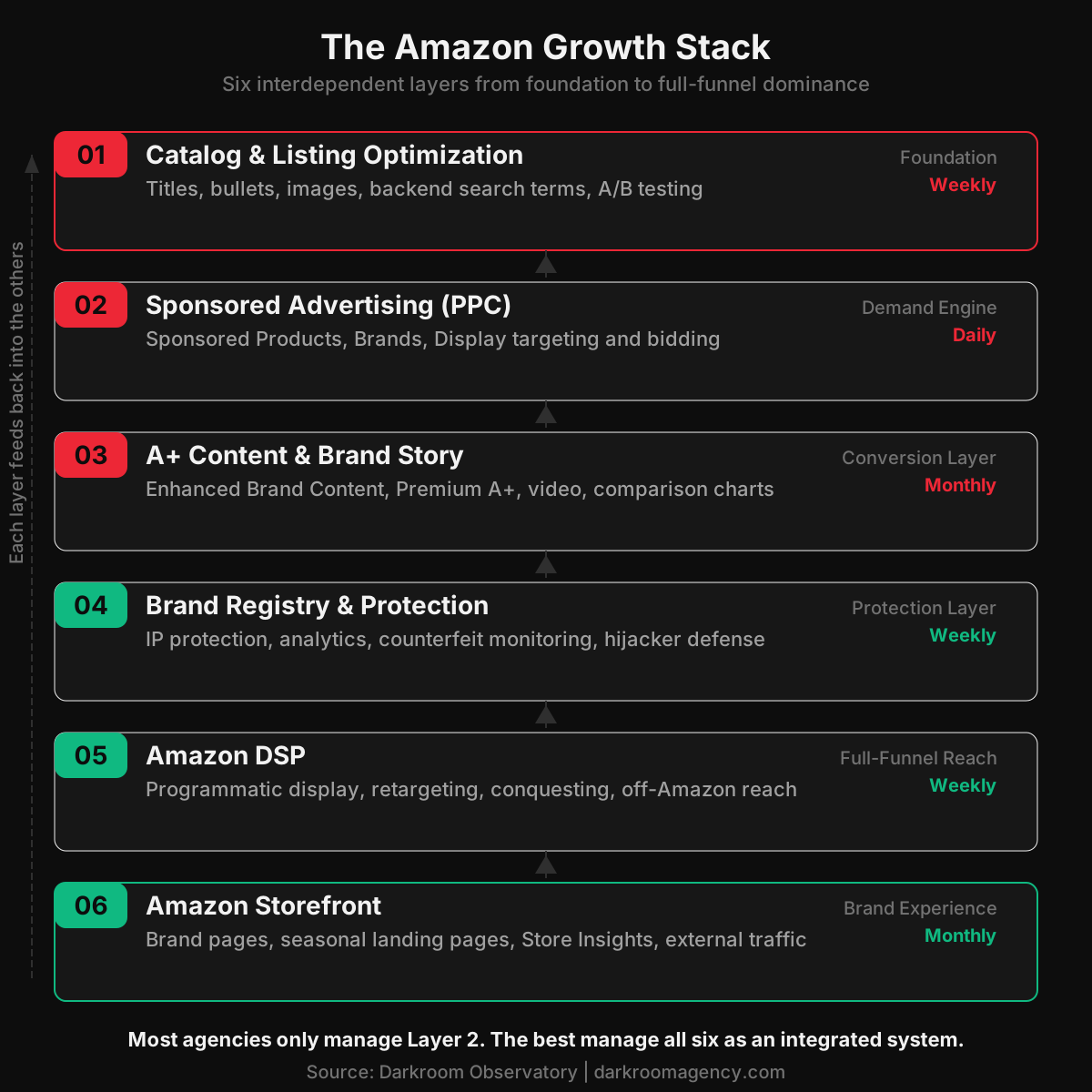
Amazon marketing is not one function. It is six interdependent layers that must operate in concert.
Before evaluating any Amazon agency, you need to understand what comprehensive Amazon marketing actually requires. Most brands and most agencies only think about the first layer. The brands that dominate their categories operate across all six.
Layer 1: Sponsored Advertising (PPC). This is the most visible layer and the one every agency offers. It includes Sponsored Products (keyword-targeted product ads), Sponsored Brands (brand-level awareness with video and headline formats), and Sponsored Display (audience-based retargeting within Amazon's ecosystem). Effective PPC management requires daily bid optimization, keyword harvesting from search term reports, campaign architecture that separates branded from non-branded from competitor targeting, and budget allocation that reflects margin by SKU. This is table stakes. Any competent agency handles this. The problem is that most agencies stop here.
Layer 2: Catalog and Listing Optimization. Your product listings are the conversion layer for every dollar of ad spend. Title structure, bullet point copy, image quality, search term backend fields, and pricing all determine whether clicks become purchases. Listing optimization is not a one-time project. It requires ongoing A/B testing through Amazon's Manage Your Experiments tool, competitive monitoring for keyword shifts, and regular updates to reflect seasonal trends and inventory changes. This is where understanding Amazon SEO and listing optimization becomes critical to performance.
Layer 3: A+ Content and Brand Story. Enhanced Brand Content (A+ pages) and Brand Story modules are the mid-funnel conversion tools most agencies neglect. A+ Content can increase conversion rates by 5-12% according to Amazon's own data. Premium A+ (available through Brand Registry) adds interactive elements, video, and rich comparison charts. The best agencies treat A+ Content as a creative strategy discipline, not a one-time design project. They test layouts, messaging hierarchies, and image styles the same way a DTC brand tests landing pages.
Layer 4: Brand Registry and Protection.Amazon Brand Registry unlocks access to A+ Content, Sponsored Brands, Amazon Stores, and brand analytics. It also provides tools for reporting counterfeit listings, unauthorized resellers, and trademark violations. Most agencies set up Brand Registry during onboarding and never touch it again. A strategic agency monitors for hijackers continuously, files IP violations proactively, and uses Brand Analytics data (search frequency rank, market basket analysis, repeat purchase behavior) to inform advertising and catalog decisions.
Layer 5: Amazon DSP.Amazon DSP is Amazon's programmatic display and video advertising platform. It reaches audiences both on and off Amazon using Amazon's first-party shopping data. DSP enables upper-funnel prospecting, retargeting shoppers who viewed but did not purchase, and conquesting competitors' customers. Most Amazon agencies either do not offer DSP or offer it as an expensive add-on without integrating it into the broader advertising strategy. The agencies that use DSP well treat it as the connective tissue between brand awareness and sponsored ads conversion.
Layer 6: Amazon Storefront. Your Amazon Store is a branded landing page that lives on Amazon. It supports multiple pages, video, product collections, and brand storytelling. Storefronts are the destination for Sponsored Brands traffic and external traffic driven to Amazon. Most agencies build a Storefront during onboarding and never optimize it. Strategic agencies update Storefronts monthly, create seasonal landing pages, and use Store Insights data to understand how shoppers navigate the brand experience on Amazon.
Amazon Agency Capability Matrix
Use this matrix to audit any agency you are evaluating. Most will check two or three boxes. The right partner checks all six.
Capability | What It Covers | Frequency | Most Agencies | Integrated Agency |
|---|---|---|---|---|
PPC Management | Sponsored Products, Brands, Display campaigns | Daily | Yes | Yes |
Catalog Optimization | Titles, bullets, images, backend search terms, A/B testing | Weekly | Setup only | Ongoing |
A+ Content | EBC pages, Premium A+, Brand Story, video | Monthly | One-time | Iterative testing |
Brand Registry | IP protection, analytics, counterfeit monitoring | Weekly | Setup only | Active monitoring |
Amazon DSP | Programmatic display, retargeting, conquesting | Weekly | Not offered | Integrated with PPC |
Storefront | Brand pages, seasonal landing pages, Store Insights | Monthly | One-time | Monthly optimization |
The gap between "setup only" and "ongoing" is where most agency relationships fail. A listing optimized once in January does not reflect the competitive landscape in July. A+ Content that was effective at launch becomes stale when competitors upgrade theirs. Brand Registry monitoring that stops after enrollment leaves you exposed to hijackers who show up in Q4. Understanding the full scope of this work is central to building the Amazon flywheel where organic and paid reinforce each other.
Why Most Amazon Agencies Get It Wrong
The business model of most Amazon agencies incentivizes narrow execution, not strategic growth.
There are structural reasons most Amazon agencies underdeliver. Understanding these forces helps you evaluate partners more effectively.
Reason 1: The PPC percentage-of-spend model. Most Amazon agencies charge a percentage of ad spend (typically 10-15%) plus a base retainer. This creates an incentive to increase ad spend, not to improve overall channel profitability. An agency earning 12% of a $50K monthly spend earns $6,000. If they can grow that spend to $80K, they earn $9,600 whether or not the incremental spend is profitable. The best agencies align incentives by tying compensation to total channel revenue or margin contribution, not ad spend volume. For a deeper look at how agency costs align with outcomes, see our breakdown of Amazon PPC management costs.
Reason 2: Siloed Amazon-only thinking. Most Amazon agencies have no visibility into your DTC site, your Meta ads, your Google campaigns, or your TikTok Shop. They optimize Amazon in a vacuum. This creates blind spots: they cannot coordinate promotions across channels, they cannot tell whether Amazon sales are cannibalizing DTC revenue, and they cannot leverage cross-channel data for audience insights. In 2026, the brands winning on Amazon are the ones treating it as one node in a connected commerce system, not an island.
Reason 3: Lack of creative capability. Amazon is increasingly a visual and content platform. A+ Content, Sponsored Brands Video, and Storefronts all require creative production. Most Amazon agencies outsource creative to freelancers or rely on the brand to provide assets. This creates a bottleneck where advertising strategy outpaces creative execution. Agencies with in-house performance creative teams can test, iterate, and deploy Amazon-specific assets at the velocity the platform demands.
Reason 4: No measurement beyond platform metrics. Most Amazon agencies report ACoS, TACoS, impressions, and click-through rate. These are platform metrics. They tell you how the campaigns are performing within Amazon's attribution model but nothing about incremental revenue contribution, cross-channel halo effects, or true customer acquisition cost. The best agencies measure Amazon performance within the context of total business growth, including DTC halo effects and new-to-brand customer metrics.
The Three Amazon Agency Models
Not all Amazon agencies operate the same way. Understanding the model determines whether the partnership can scale with your business.
Dimension | PPC-Only Agency | Full-Service Amazon Agency | Integrated Growth Agency |
|---|---|---|---|
Scope | Sponsored ads only | All six Amazon layers | Amazon + DTC + TikTok Shop + creator |
Monthly Cost | $2K-$5K + % of spend | $5K-$15K + % of spend | $10K-$25K+ retainer |
Creative | Not included | Outsourced or basic | In-house production |
DSP | Not offered | Available as add-on | Integrated into strategy |
Cross-Channel | None | Limited | Full visibility and coordination |
Measurement | ACoS, CTR, impressions | ACoS, TACoS, organic rank | Incrementality, blended CAC, LTV |
Growth Ceiling | Hits paid efficiency wall | Amazon-only ceiling | Multi-channel compounding |
Best For | Brands under $500K Amazon rev | $500K-$3M Amazon rev | $3M+ Amazon rev with DTC presence |
The distinction matters because each model has a different growth ceiling. PPC-only agencies hit a wall when ad efficiency cannot improve further without fixing the underlying catalog and content. Full-service Amazon agencies hit a wall when Amazon-only optimization cannot capture the cross-channel opportunity. Integrated growth agencies remove these ceilings by connecting every commerce surface into a unified system. This mirrors how the Amazon vs retail media networks landscape is evolving: the brands that win are the ones operating across multiple commerce platforms with coordinated strategy.
The Amazon-to-TikTok Expansion Path
The biggest Amazon growth lever in 2026 is not on Amazon. It is TikTok Shop.
This is the strategic insight most Amazon agencies miss entirely because they only operate within Amazon's ecosystem. The consumer discovery-to-purchase journey has fundamentally changed. According to TikTok's commerce data, 44% of TikTok users have discovered a product on TikTok and subsequently purchased it on Amazon. This is not a novelty behavior. It is a structural shift in how consumers find and buy products.
The Amazon-to-TikTok expansion path works in both directions. TikTok drives discovery and impulse purchases through creator content, short-form video, and live shopping. Amazon captures the research and repurchase cycle through search, reviews, and Subscribe & Save. A brand operating on both platforms with coordinated strategy captures the full purchase funnel. A brand operating on Amazon alone misses the discovery layer. For a comprehensive analysis of how these platforms interact, see our comparison of TikTok Shop vs Amazon and DTC.
How integration works in practice. A creator posts a product review on TikTok that drives 50,000 views. TikTok Shop captures the immediate impulse buyers (typically 15-25% of conversions in the first 48 hours). Amazon captures the rest: people who saw the TikTok, searched the product name on Amazon, read reviews, and purchased days or weeks later. Without Amazon attribution for TikTok-driven demand, most brands never realize that their Amazon sales spike correlated with a TikTok creator post.
Why most Amazon agencies cannot execute this. An Amazon-only agency has no visibility into TikTok performance, no relationships with creators, no ability to coordinate pricing across platforms, and no mechanism to attribute TikTok-driven Amazon sales. They see the spike in Amazon orders and attribute it to their keyword optimization. The real driver was a TikTok video they did not know existed. An integrated agency managing both TikTok Shop and Amazon can orchestrate this flywheel intentionally rather than discovering it accidentally.
The inventory coordination requirement. Running Amazon and TikTok Shop simultaneously requires coordinated inventory planning. A viral TikTok can generate 500-2,000 orders in 48 hours. If your FBA inventory cannot absorb the Amazon halo effect, you lose the Buy Box during the highest-demand window. Integrated agencies plan inventory allocation across both platforms and build buffer stock into the forecasting model for creator-driven demand spikes.
The Integrated Model: Why Connected Commerce Wins
Amazon is not a standalone channel. It is one layer in a commerce stack that includes DTC, marketplace, and social commerce.
The integrated growth model treats Amazon as one component of a broader commerce architecture. This model is structurally superior for three reasons.
Reason 1: Cross-channel data compounds insight. When one team manages Amazon, DTC, and TikTok Shop, they see patterns that siloed teams miss. They notice that a product performing well on TikTok Shop has suppressed Amazon search volume because consumers are buying on TikTok instead of searching Amazon. They notice that a DTC promotion cannibalizes Amazon sales or (more often) creates an Amazon halo effect through increased brand searches. This cross-channel visibility turns data into strategic advantage.
Reason 2: Creative efficiency across platforms. A Sponsored Brands Video on Amazon, a product page hero image on DTC, and a TikTok creator brief all require different formats but share the same brand positioning and product messaging. An integrated agency produces creative assets once and adapts them across platforms, rather than each channel team independently creating assets with no coordination. This is the principle behind Darkroom's performance creative approach.
Reason 3: Unified measurement eliminates attribution fiction. When separate agencies manage separate channels, each claims credit for overlapping conversions. The Amazon agency reports $500K in Amazon revenue. The Meta agency reports $400K in attributed revenue. The TikTok agency reports $200K. Your actual total revenue is $700K. The overlap is invisible because no single team sees the full picture. An integrated agency measures at the portfolio level, using incrementality testing and blended metrics to understand true channel contribution.
This is not a theoretical advantage. The economics of marketing agency services increasingly favor integrated models because the coordination cost of managing three separate agencies (Amazon, DTC, social) exceeds the premium of a single integrated partner. Most brands spending $15K+ per month across agencies are paying a "fragmentation tax" of 20-30% in wasted overlap, misaligned strategy, and duplicated creative production.
The Four-Step Amazon Agency Evaluation Framework
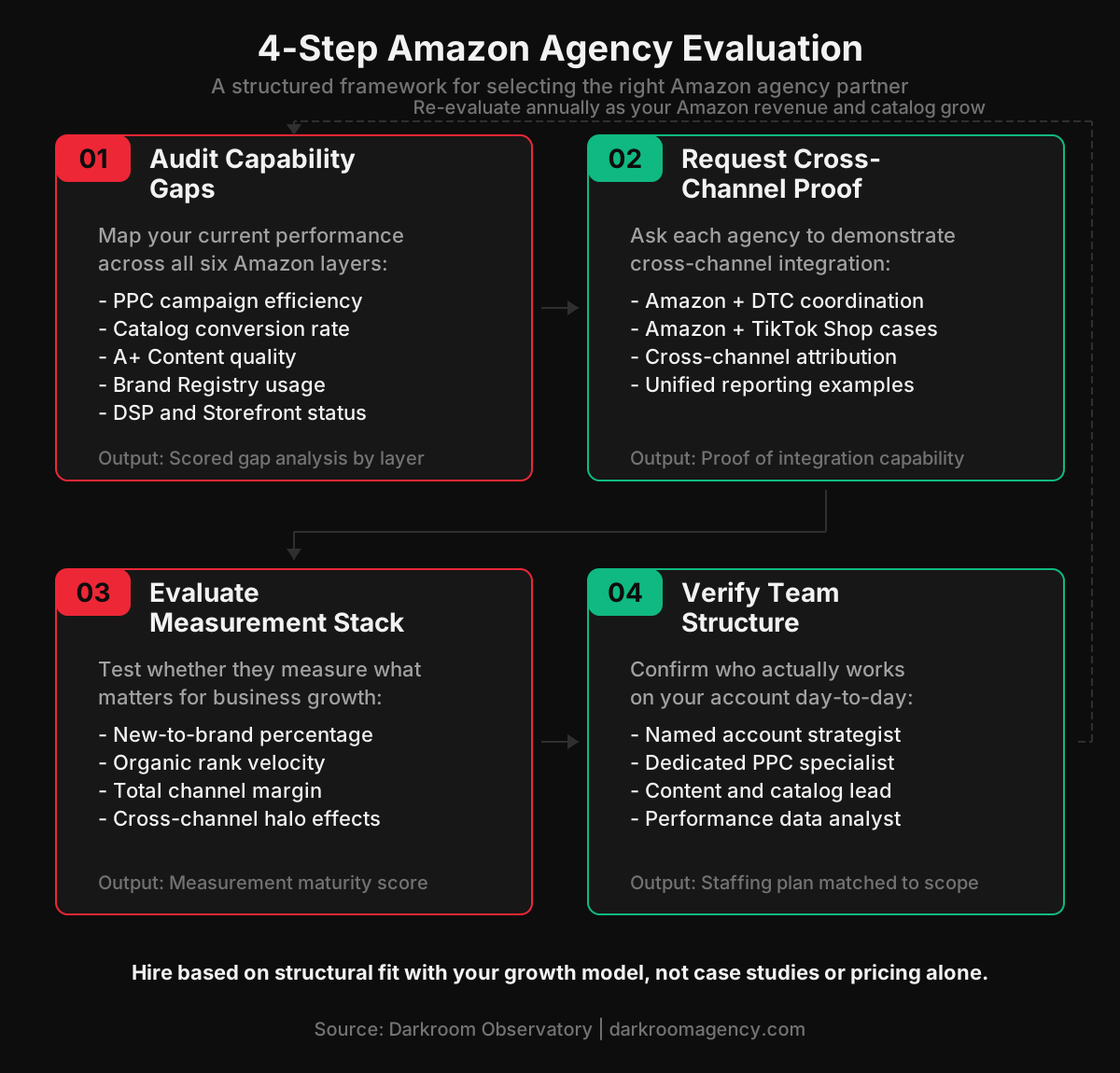
Do not hire an Amazon agency based on case studies or pricing. Hire based on structural fit with your growth model.
Step 1: Audit your capability gaps. Before talking to agencies, map your current performance across all six Amazon layers. Where are you strong? Where are you weak? If your PPC is already well-managed but your listings convert below category average, you do not need a PPC-focused agency. You need a content and catalog partner. If your organic rank is declining despite good advertising, you have a listing optimization problem. Use the capability matrix above as your audit template.
Step 2: Request cross-channel proof. Ask every prospective agency to demonstrate how they have connected Amazon performance to other channels. If they can only show Amazon-isolated results (ACoS improvement, keyword rank gains), they operate in a silo. Ask specifically: "Can you show me a case where you coordinated Amazon and DTC (or TikTok Shop) strategy for the same brand?" If the answer is no, they are a channel manager, not a growth partner. This is especially critical for brands already investing in DTC marketing alongside Amazon.
Step 3: Evaluate their measurement stack. Ask what metrics they optimize against and how they measure success. If the answer is ACoS and TACoS, they are optimizing for platform efficiency, not business growth. The best agencies measure new-to-brand percentage (are you acquiring new customers or just retaining existing ones?), organic rank velocity (is paid spend building lasting organic value?), total channel margin (revenue minus all costs including fees, COGS, ad spend, and agency fees), and cross-channel halo (does Amazon advertising lift DTC branded search?). If they cannot articulate how they measure beyond platform metrics, they will optimize for the wrong outcomes.
Step 4: Verify team structure and expertise. Ask who will work on your account daily. A senior strategist in the sales process who disappears after signing is a red flag. Ask for the name and experience of your day-to-day account lead, the specialist managing PPC, the person responsible for content and catalog, and the analyst reviewing performance data. If one person covers all four roles, the agency does not have the operational density to manage your account effectively. For brands with 100+ SKUs, you need at minimum two dedicated team members. For brands with 500+ SKUs, you need three to four.
What the Best Amazon Agencies Do Differently
The top 10% of Amazon agencies share five characteristics that separate them from the field.
They build systems, not campaigns. Average agencies build campaigns. Great agencies build systems: automated rules for bid management, templated processes for new product launches, established workflows for seasonal content updates, and documented playbooks for competitive response. Systems scale. Campaigns require constant manual intervention.
They connect organic and paid. The Amazon marketing flywheel only works when paid advertising feeds organic rank, which reduces paid dependency over time. The best agencies track the ratio of organic to paid revenue by SKU and aim to shift that ratio toward organic over 6-12 months. If your agency has managed your account for a year and your organic-to-paid ratio has not improved, they are running a treadmill, not building a flywheel.
They treat creative as a performance lever. On Amazon, the difference between a listing with professional photography, optimized A+ Content, and Sponsored Brands Video versus a listing with manufacturer images and no A+ is 2-3x in conversion rate. The best agencies have creative teams or production partners who create Amazon-specific assets informed by performance data: which image styles drive higher CTR, which A+ layouts reduce bounce rate, which video lengths generate the best view-through rates.
They plan for channel expansion. The best agency you hire today should be the agency that helps you expand into TikTok Shop next quarter and optimize your DTC conversion path the quarter after that. If your Amazon agency has no capability or roadmap for cross-channel expansion, you will outgrow them as your commerce strategy matures.
They are transparent about what they do not do. No agency does everything well. The best agencies are clear about their scope and limitations. They recommend partners for functions outside their expertise rather than pretending they can cover everything. This transparency is a signal of strategic maturity and operational honesty.
Red Flags When Evaluating Amazon Agencies
Avoid agencies that exhibit these patterns. They are indicators of shallow capability and misaligned incentives.
Guaranteed results. Any agency guaranteeing specific ACoS targets, revenue numbers, or ranking positions is either lying or planning to manipulate metrics to create the appearance of success. Amazon is a competitive marketplace. No agency controls all variables. The honest promise is: "We will apply proven systems, optimize continuously, and report transparently on what is and is not working."
No organic strategy. If an agency's entire plan revolves around paid advertising with no discussion of listing optimization, A+ Content, or organic rank building, they are a media buying service, not an Amazon marketing agency. Paid-only strategies create dependency that compounds over time rather than resolving.
Proprietary tools as primary differentiator. Some agencies lead with their proprietary software or dashboard as their core value proposition. Tools are not strategy. Every competent agency uses some combination of Helium 10, Jungle Scout, Pacvue, Quartile, or similar platforms. The value is in how human expertise applies tool outputs to your specific business context, not in the tools themselves.
Percentage-of-spend only pricing. If the entire fee structure is a percentage of ad spend with no fixed component, the agency is incentivized to grow your ad budget regardless of profitability. The best pricing models combine a fixed retainer (for strategy, content, and catalog work) with a performance component (tied to total channel revenue or margin, not ad spend).
No client-side access. If the agency insists on managing your Amazon Seller Central or Vendor Central account without giving you full admin access, they are creating lock-in. You should always maintain ownership and full access to your own accounts, data, and advertising history.
How Darkroom Approaches Amazon Differently
Darkroom manages Amazon as a growth channel integrated with DTC, TikTok Shop, and creator strategy because that is how commerce works in 2026.
The Darkroom model is built on three principles that differentiate it from traditional Amazon agencies.
Amazon as one layer of a commerce stack. Darkroom manages Amazon alongside DTC (Shopify), TikTok Shop, and creator-driven commerce. This means a single team sees how a TikTok creator campaign affects Amazon search volume, how a DTC sale event impacts Amazon Buy Box pricing, and how Amazon DSP retargeting can drive customers to the DTC site for higher-margin purchases. This cross-channel visibility is not a nice-to-have. It is the foundation of accurate measurement and strategic allocation.
Performance creative built for commerce. Darkroom's performance creative team produces Amazon-specific assets (A+ Content, Sponsored Brands Video, product photography, infographics) informed by conversion data. Creative is not an afterthought. It is a core performance lever treated with the same rigor as bid optimization.
Measurement that matters. Darkroom measures Amazon performance using blended CAC, new-to-brand percentage, organic rank velocity, cross-channel halo effects, and total contribution margin. Platform metrics (ACoS, TACoS) are operational inputs, not strategic outputs. This measurement approach connects directly to the principles outlined in our broader approach to performance marketing.
This model is not for every brand. If you are a small Amazon seller doing under $500K in annual revenue with a single-channel focus, a PPC-only agency may be the right fit. But if you are a brand with $1M+ in Amazon revenue, a DTC presence, and ambitions to expand into TikTok Shop or creator commerce, the integrated model is structurally superior. Book a call with Darkroom to evaluate whether the integrated model fits your growth stage.
Frequently Asked Questions
What does an Amazon marketing agency actually do?
A comprehensive Amazon marketing agency manages six layers: sponsored advertising (PPC), catalog and listing optimization, A+ Content and Brand Story, Brand Registry and protection, Amazon DSP, and Storefront management. The best agencies also integrate Amazon strategy with DTC, TikTok Shop, and creator-driven commerce to build a unified growth system rather than treating Amazon as an isolated channel.
How much does an Amazon marketing agency cost?
Amazon agency costs range from $2,000-$5,000 per month for PPC-only management to $8,000-$25,000+ per month for full-service integrated management. Most agencies charge a flat retainer plus a percentage of ad spend (typically 10-15%). The total cost depends on catalog size, ad spend level, and scope of services. For detailed cost analysis, see our guide to Amazon PPC management costs in 2026.
What is the difference between a PPC-only Amazon agency and a full-service Amazon agency?
A PPC-only agency manages sponsored ads campaigns: keyword bidding, campaign structure, and budget allocation. A full-service agency adds catalog optimization, A+ Content, Brand Registry, DSP, and Storefront management. An integrated growth agency goes further by connecting Amazon performance to DTC channels, TikTok Shop, and creator strategy. The right model depends on your revenue stage, catalog complexity, and growth goals.
How do I know if my current Amazon agency is underperforming?
Signs of underperformance include: ACoS is improving but total revenue is flat (they are cutting spend, not growing the channel), organic rank is declining despite active advertising (the flywheel is not building), A+ Content and listings have not been updated in 6+ months (they are not managing the full stack), and you have no visibility into how Amazon connects to your other channels. If your agency reports only platform metrics without business context, they are managing campaigns, not growing a channel.
Should my Amazon agency also manage TikTok Shop?
If your brand sells physical products to consumers under 40, yes. TikTok Shop and Amazon are increasingly connected: TikTok drives discovery, Amazon captures research and repurchase. An agency managing both can coordinate creator content, pricing, and inventory across platforms. An agency managing only Amazon misses the discovery layer that increasingly drives Amazon demand. See our analysis of the TikTok Shop vs Amazon and DTC landscape.
Why do most Amazon agencies fail to drive real growth?
Most agencies are structured as PPC management services. They optimize bids and keywords in isolation without connecting advertising to catalog health, content quality, Brand Registry protections, or cross-channel strategy. This creates a ceiling where paid efficiency improves but total channel growth stalls. The organic and content layers that compound over time are neglected because they fall outside the agency's scope or incentive structure.
What questions should I ask an Amazon agency before hiring them?
Ask five questions: (1) What percentage of your clients' Amazon revenue comes from organic vs paid? (2) Can you show me a case where you coordinated Amazon with DTC or TikTok Shop? (3) Who specifically will manage my account day-to-day? (4) How do you measure success beyond ACoS and TACoS? (5) What happens to my account data and history if we end the engagement? The answers reveal whether the agency operates as a strategic growth partner or a campaign management service.
Choose the Right Amazon Agency for Your Growth Stage. The difference between a PPC button-pusher and an integrated growth partner is the difference between incremental efficiency gains and compounding channel growth. Evaluate based on capability coverage, cross-channel integration, measurement sophistication, and structural fit with your business model. Book a call with Darkroom to discuss which model fits your Amazon growth goals.