
SOCIAL COMMERCE
TikTok Shop vs Amazon: Which Marketplace Should Carry Your DTC Growth




Written by Darkroom leardership
10 min read
August 25, 2026

TikTok Shop vs Amazon is a demand question, not a platform question. Amazon converts existing search intent at referral fees near 15%; TikTok Shop creates new demand at a 6% fee but demands constant creator content. Most DTC brands at scale end up running both, in sequence.
You probably know how this debate starts. Someone on your team sees a competitor posting real numbers on TikTok Shop and asks why the budget is still sitting on Amazon. Someone else points out that Amazon is where sales actually close. Both of them are right, which is exactly why the TikTok Shop vs Amazon conversation goes in circles.
The way out is to change the question. Stop asking which platform is better and ask which job your growth needs done right now: converting existing demand, or creating demand that does not yet exist. Answer that honestly, and the platform picks itself.
TikTok Shop vs Amazon: which should carry your DTC growth in 2026?
The short answer: Amazon should carry your growth when conversion is your bottleneck, and TikTok Shop should carry it when awareness is your bottleneck. The honest answer, whichever side of the Amazon vs. TikTok Shop debate you walked in on, has six trade-offs in it. Here they are, each with the condition that actually decides it.
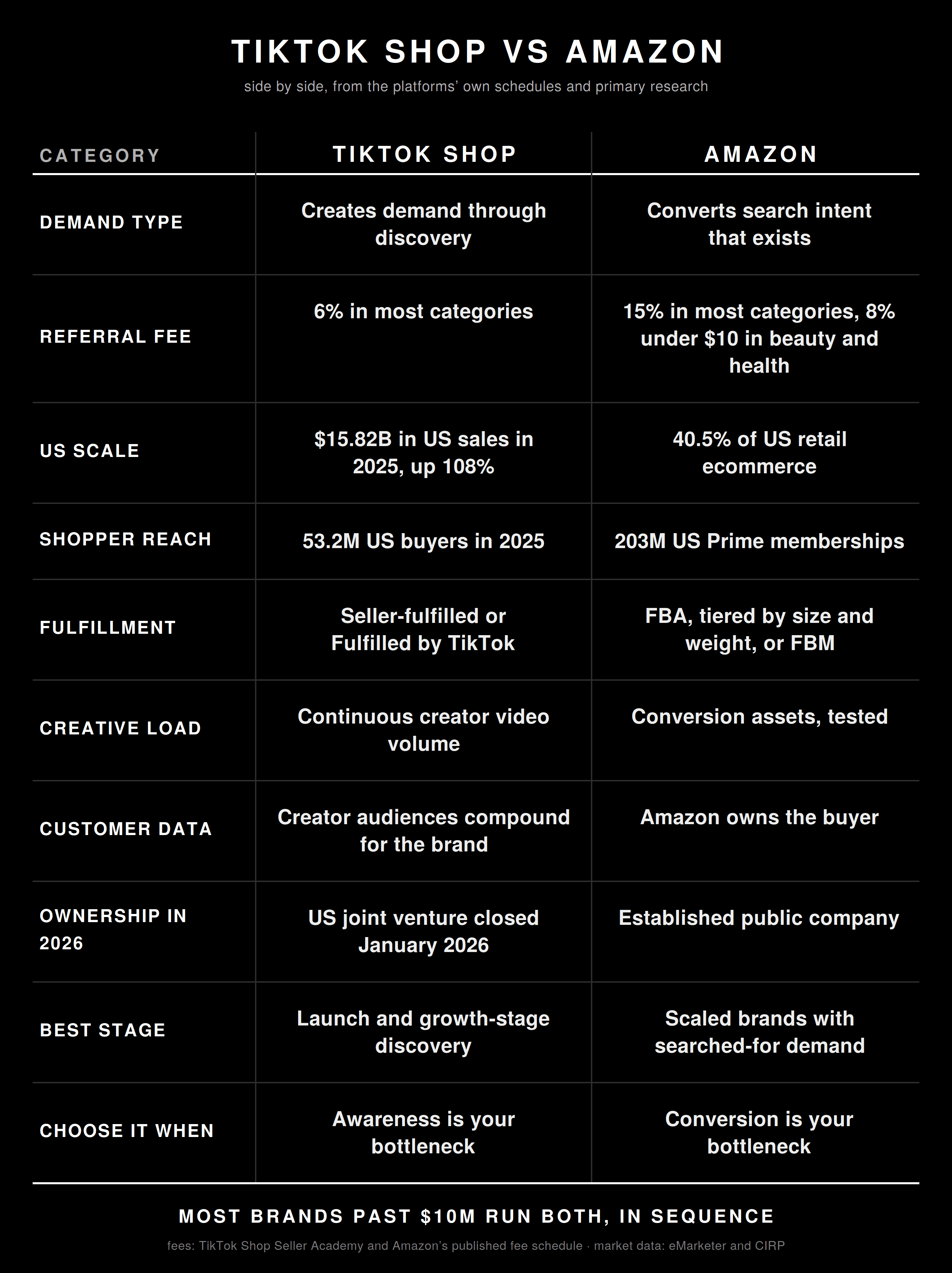
Dimension | Amazon | TikTok Shop | Choose it when |
|---|---|---|---|
Demand type | Converts search intent that already exists | Creates demand through discovery and creator content | Amazon if buyers already search for your category; TikTok Shop if they do not know they want it yet |
Referral fee | 15% in most DTC categories; 8% under $10 in beauty and health (Amazon's published schedule) | 6% in the large majority of categories (TikTok Shop Seller Academy) | Fee alone favors TikTok Shop; total cost depends on the creative line below |
Fulfillment | FBA: tiered by size and weight, Prime delivery expectations | Seller-fulfilled or Fulfilled by TikTok, lighter delivery expectations | Amazon if Prime-speed logistics is your moat; TikTok Shop if flexibility matters more |
Creative load | Conversion assets: listings, A+ content, brand store, tested imagery | Continuous creator video volume, refreshed weekly | Whichever channel your content operation can actually feed |
Customer relationship | Amazon owns the buyer; brand gets limited data | Creator audiences compound for the brand; platform still owns checkout | TikTok Shop if audience-building matters; neither replaces your own list |
Best stage | Scaled brands with proven, searched-for demand | Launch and growth-stage brands buying discovery | Most brands past $10M end up needing both |
If one row settled it for you, you can stop here. If three rows pointed one way and three the other, which is how it goes for most operators, keep reading; the next four sections take the trade-offs in order.
What kind of demand does each marketplace actually serve?
Think of it this way: Amazon is where people go when they already know what they want, and TikTok Shop is where they find out they want something. Everything else about the two platforms follows from that one difference.
The scale of the first half is hard to overstate. Amazon accounts for 40.5% of US retail ecommerce sales per eMarketer's 2025 forecast, and CIRP estimates 203 million US Amazon customers held a Prime membership as of the June 2026 quarter. Your customer already shops there. Listing on Amazon is not building demand; it is intercepting it, and an Amazon marketing agency earns its fee by winning that interception more often than the next brand does.
TikTok Shop runs the opposite motion, and the numbers say it is working: US sales hit $15.82 billion in 2025, up 108% year over year, across 53.2 million US buyers (eMarketer), inside a US social commerce market of $87.02 billion that, by eMarketer's definition, excludes travel and event tickets. Nobody types "running shoes" into TikTok the way they type it into Amazon. A video creates the want, and the checkout catches it seconds later.
That mechanic is also the trap. Set up a storefront, upload listings, wait for searches, and nothing happens; treating TikTok Shop like another marketplace is the most common way brands fail on it. The edges are blurring, to be fair, because Amazon drives demand creation through Amazon DSP, and TikTok Shop for business accounts has matured from an experiment to a stable retail channel. But the center of gravity has not moved. One platform monetizes intent, and the other manufactures it.
And one thing nobody can credibly tell you: which platform keeps customers better. Earnest Analytics measured TikTok Shop repeat purchasing at over 27% within five months of first purchase, ahead of Temu and Shein, but Amazon was not in that benchmark.
What do TikTok Shop and Amazon fees look like in 2026?
Here is where the folklore gets expensive. Ask around, and you will hear that TikTok Shop takes 8% or 2%, or somewhere between 5% and 20%. The current answer, straight from the platforms' own schedules: TikTok Shop takes 6% of most orders, and Amazon takes 15% in most DTC categories.
Fee line | Amazon | TikTok Shop |
|---|---|---|
Referral fee, most DTC categories | 15%, $0.30 minimum per item (Amazon's published fee schedule) | 6%, effective October 31, 2024 (TikTok Shop Seller Academy) |
Beauty, health and personal care | 8% at $10.00 or less; 15% above $10.00 | 6% |
Grocery and gourmet | 8% at $15.00 or less; 15% above $15.00 | 6% |
Category exceptions | Rates vary by category on the published schedule | 5% for fine jewelry and pre-owned; 3% on collectible sale portions above $10,000 |
Fulfillment | FBA fees tiered by product size and weight, storage billed per cubic foot and higher in Q4; Amazon publishes no public per-unit table, so model costs in its Revenue Calculator | Seller-fulfilled or Fulfilled by TikTok, priced per order |
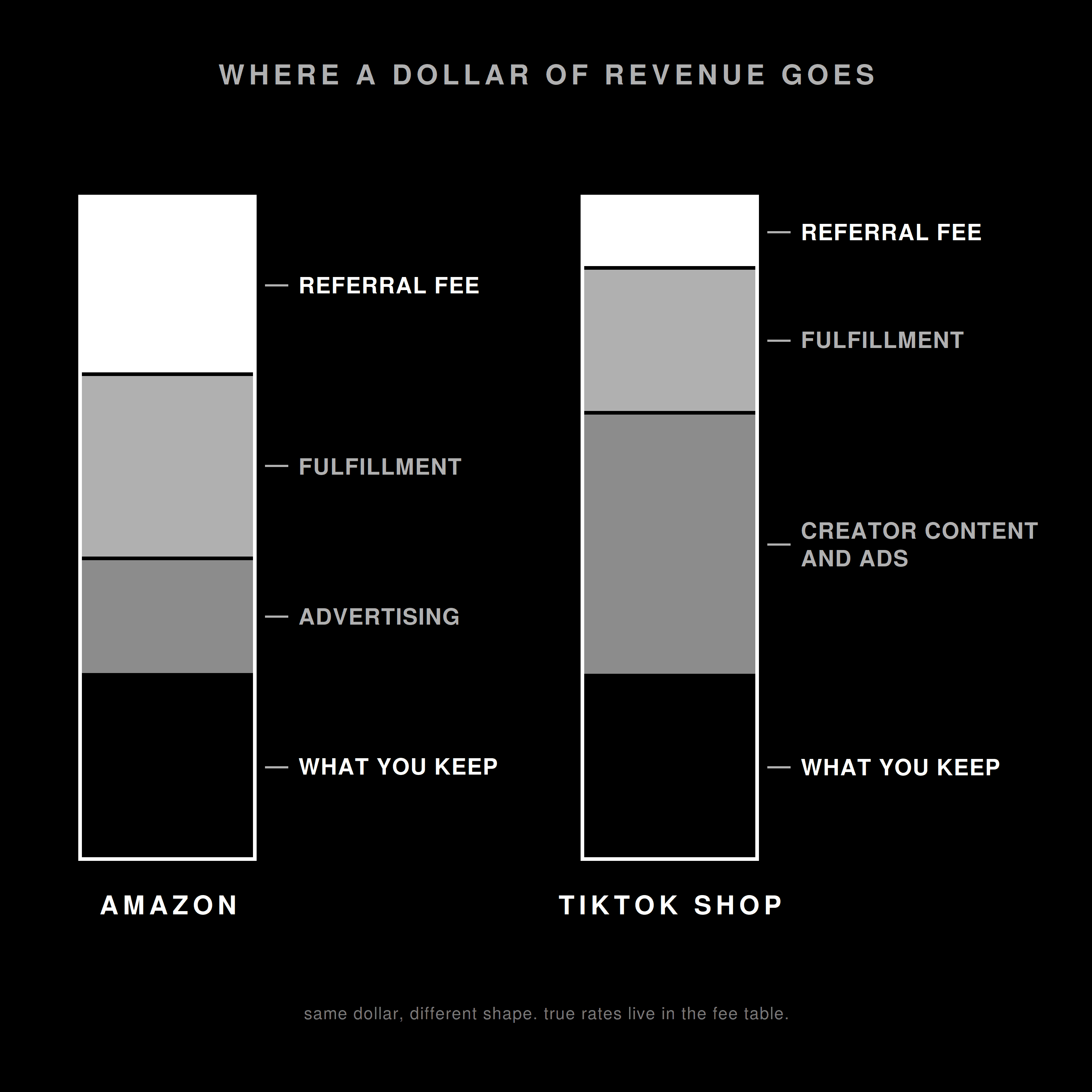
Before you celebrate the nine-point gap, though, be honest about where that margin goes. TikTok Shop's lower take rate is partly because the channel relies on a constant supply of creator content that Amazon never asks you to fund. And selling fees are just one layer of the stack: Amazon seller fees sit alongside advertising, which is why Amazon advertising costs in 2026 deserve their own budget line, and why the full TikTok Shop fees breakdown matters once you count shipping, affiliate commissions, and ads.
One more note worth walking your finance team through: the two structures respond differently to price point. A $9 beauty product pays Amazon 8% and TikTok Shop 6%, nearly a wash. A $45 skincare bundle pays Amazon 15% against TikTok Shop's 6%, and that nine-point spread compounds on every unit. Run the math on your own catalog's price mix before assuming either headline rate is your effective rate.
Which channel can your creative operation actually feed?
Now the question nobody prices in until it hurts: who is going to make all this content? The channel you can feed beats the channel you admire, and in practice this flips more platform decisions than any fee comparison ever does.
TikTok Shop eats creator video at a pace most brand teams underestimate by an order of magnitude. A working program looks like a creator-affiliate flywheel: dozens of creators producing continuously, the best clips amplified with Spark ads, and live shopping layered on top. If that sounds like a staffing problem more than a media problem, you have understood it correctly, and that’s the reason a TikTok Shop agency exists as a category. But if you are starting from scratch, the playbook for selling on TikTok Shop walks through the 90-day build.
Amazon asks for far fewer assets and forgives far less. Listings, A+ content, the brand store, and product imagery are conversion infrastructure, and Amazon advertising fails when creative is an afterthought: traffic that bought into an unconvincing page simply leaks. So the honest comparison is not cheap versus expensive.
One platform rewards volume and freshness, and the other rewards testing discipline. Budget for the one your team can sustain for a year, not the one that looks cheaper per asset.
When should a DTC brand run both marketplaces, and in what order?
Run both once you are past roughly $10M, and sequence them by your bottleneck: build the conversion layer before you buy the demand spike. The threshold is not arbitrary. Below it, splitting one creative team and one media budget between two channels usually results in two mediocre programs. Above it, the channels start feeding into each other because created demand searches for your brand name and captured demand fuels more creation.
Sequencing is where an Amazon marketplace strategy earns its keep: listings that convert before ads give created demand somewhere to land. A meaningful share of people who see a product on TikTok go looking for it on Amazon, and an unprepared detail page quietly taxes every dollar of your social spend. Most brands discover this in the post-mortem.
That is what the Bero launch shows. Bero is the non-alcoholic beer brand founded by Tom Holland, and Darkroom ran the Bero engagement across both channels at once.
On the Amazon side, day one of the Big Spring Sale produced a 229% revenue lift against the account's own March daily average, and the full event moved 1,663 units across all pack formats. Prime Day, a separate event later in the calendar, added 11.5% sales growth. On the TikTok Shop side, the launch program produced over 100 creator videos chosen for brand fit over reach, which is a count of output, not a revenue claim.
What changed for TikTok Shop sellers in 2026?
If you shelved TikTok Shop during the will-they-ban-it years, this is the section to reread. The ownership question is answered: TikTok's US joint venture closed on January 22, 2026, in a deal valued at around $14 billion, with Oracle, Silver Lake, and MGX holding roughly 15% each, ByteDance retaining 19.9%, and the recommendation algorithm running from Oracle's US cloud.
The overhang that froze brand investment through 2024 and 2025 is gone. What remains is ordinary execution risk, because platform priorities under new ownership are still settling, and it is fair to say so out loud.
Fees have been stable since October 2024, which means every TikTok Shop seller can now model against a known 6% rate instead of the platform's promotional rates during its first two years.
Search behavior tells the same story of a channel growing up: novelty queries about the platform are fading while operator queries keep climbing. And the global picture aligns, with $64.3 billion in GMV across 16 markets in 2025, per Momentum Works, though it is worth noting that TikTok itself publishes no official GMV figure.
The experiment phase is essentially over. In 2026, TikTok Shop is a line item and deserves to be staffed and forecast as such.
Put the right operator on each channel
Decisions like this look cleaner in a comparison table than they do in your P&L, and that is where Darkroom comes in. Darkroom runs both sides of this decision for high-growth consumer, mid-market, and enterprise brands, with Shadow, its AI commerce layer, as the shared measurement spine across channels. Treat the choice as an allocation, not an either-or:
If created demand is your gap, Darkroom's TikTok Shop program builds the creator engine, storefront, and the P&L model that supports it.
If captured demand is leaking, Darkroom's Amazon practice rebuilds listings, media, and operations into a single system.
Book a call and bring your channel P&L. The first conversation is usually about where the next dollar compounds fastest, and you will leave it knowing which channel deserves it.
TikTok Shop vs Amazon FAQs
Is TikTok Shop better than Amazon for DTC brands?
TikTok Shop is better at creating demand for products nobody is searching for yet; Amazon is better at converting demand that already exists. Earlier-stage brands lean TikTok Shop for discovery, scaled brands lean Amazon for conversion, and past roughly $10M the two compound rather than compete.
How much does TikTok Shop take per sale compared to Amazon?
TikTok Shop's referral fee is 6% in the large majority of categories, per its Seller Academy schedule. Amazon charges 15% in most DTC categories, dropping to 8% on beauty and health items priced at $10 or less, per its published fee schedule. Fulfillment costs are separate on both platforms.
Should a new DTC brand launch on TikTok Shop or Amazon first?
Sequence by bottleneck. If nobody knows the product exists, TikTok Shop's discovery engine comes first. If demand exists and conversion is weak, Amazon comes first. The Bero pattern is the hybrid worth copying: build the Amazon system before the spike, so demand created on social lands on pages ready to convert it.
Is TikTok Shop safe to build on after the ownership change?
The structural risk resolved in January 2026, when the US joint venture closed with Oracle, Silver Lake and MGX as lead investors and the algorithm operating from Oracle's US cloud. The risk that remains is executional rather than regulatory: platform priorities under new ownership are still settling.
Can you run TikTok Shop and Amazon at the same time?
Yes, and at scale you should. The conditions are operational: separate creative pipelines sized to each channel, one inventory pool, and margin tracked per channel because the fee structures differ. Brands that centralize multi-platform marketplace operations avoid the usual failure, which is funding two channels with one team.