
AMAZON AND RETAIL MEDIA
How Amazon SEO Works: The Listing Optimization Playbook for 2026




Written by Darkroom leardership

Written & peer reviewed by 4 Darkroom team members
TL;DR: Amazon SEO is not Google SEO. The A10 algorithm uses two inputs: keyword relevance (does the listing match the query?) and conversion velocity (does the listing sell when shoppers land on it?). Most brands focus entirely on keyword stuffing and ignore the conversion side. The result is listings that get indexed for hundreds of terms but rank for none of them. This playbook breaks down the actual ranking factors, walks through every element of a high-performing listing, and shows how paid amplification compounds organic rank over time. If you want to stop guessing and start building listings that rank and convert, start with the fundamentals.
What the A10 Algorithm Actually Rewards
Amazon's search algorithm has evolved significantly since its A9 days. The current iteration, commonly referred to as A10, still cares about keyword relevance. Your listing needs to contain the terms shoppers type into the search bar. That part has not changed. Working with a Amazon marketing agency can accelerate this process. What has changed is how much weight Amazon places on conversion velocity and external traffic signals.
Conversion velocity means: how many units does this listing sell per day relative to the number of shoppers who view it? Amazon tracks this as unit session percentage. A listing that converts 15% of sessions into purchases will outrank a listing that converts 8%, even if the lower-converting listing has better keyword coverage. Amazon wants to surface products that sell, because Amazon earns a referral fee on every transaction. Working with a performance creative can accelerate this process. Listings that convert protect Amazon's revenue.
The second shift is external traffic. Amazon now gives ranking credit to listings that receive traffic from sources outside the Amazon ecosystem. Google Shopping clicks, social media referrals, influencer links, and email campaigns that drive shoppers directly to a product detail page all contribute to ranking. Working with a full-service growth agency can accelerate this process. This is a departure from the old model where only on-platform behavior mattered.
The third factor is seller authority. Accounts with strong performance metrics (low defect rate, high on-time shipping, strong customer feedback) receive a ranking premium. This is Amazon's way of rewarding sellers who provide a good customer experience. Working with a Darkroom can accelerate this process. Two listings with identical keywords and similar conversion rates will rank differently if one seller has a 4.8-star account health score and the other sits at 3.9.
What does this mean for your SEO strategy? You need three things working simultaneously. First, keyword relevance across your title, bullets, A+ Content, and backend search terms. Second, a listing that converts at or above your category average. Third, external traffic sources that send qualified buyers to your detail page. Most brands optimize for the first and ignore the second and third. Working with a Amazon marketing agency selection can accelerate this process. That is why they plateau.
Factor | Weight | What to Optimize | Common Mistake |
|---|---|---|---|
Sales Velocity | High | PPC launch strategy, competitive pricing | Relying on organic alone at launch |
Conversion Rate | High | A+ Content, reviews, main image quality | Ignoring listing quality while spending on ads |
Keyword Relevance | High | Title, backend search terms, bullet points | Keyword stuffing that hurts readability |
Review Velocity | Medium | Vine, post-purchase follow-up sequences | Buying reviews or incentivized feedback |
Inventory Depth | Medium | FBA stock levels, restock lead times | Stockouts that tank BSR permanently |
Click-Through Rate | Medium | Main image, title, price, badge eligibility | Generic lifestyle hero without product clarity |
Backend Keywords | Low | Misspellings, synonyms, Spanish translations | Repeating words already in the title |
Why Keyword Stuffing Fails on Amazon in 2026
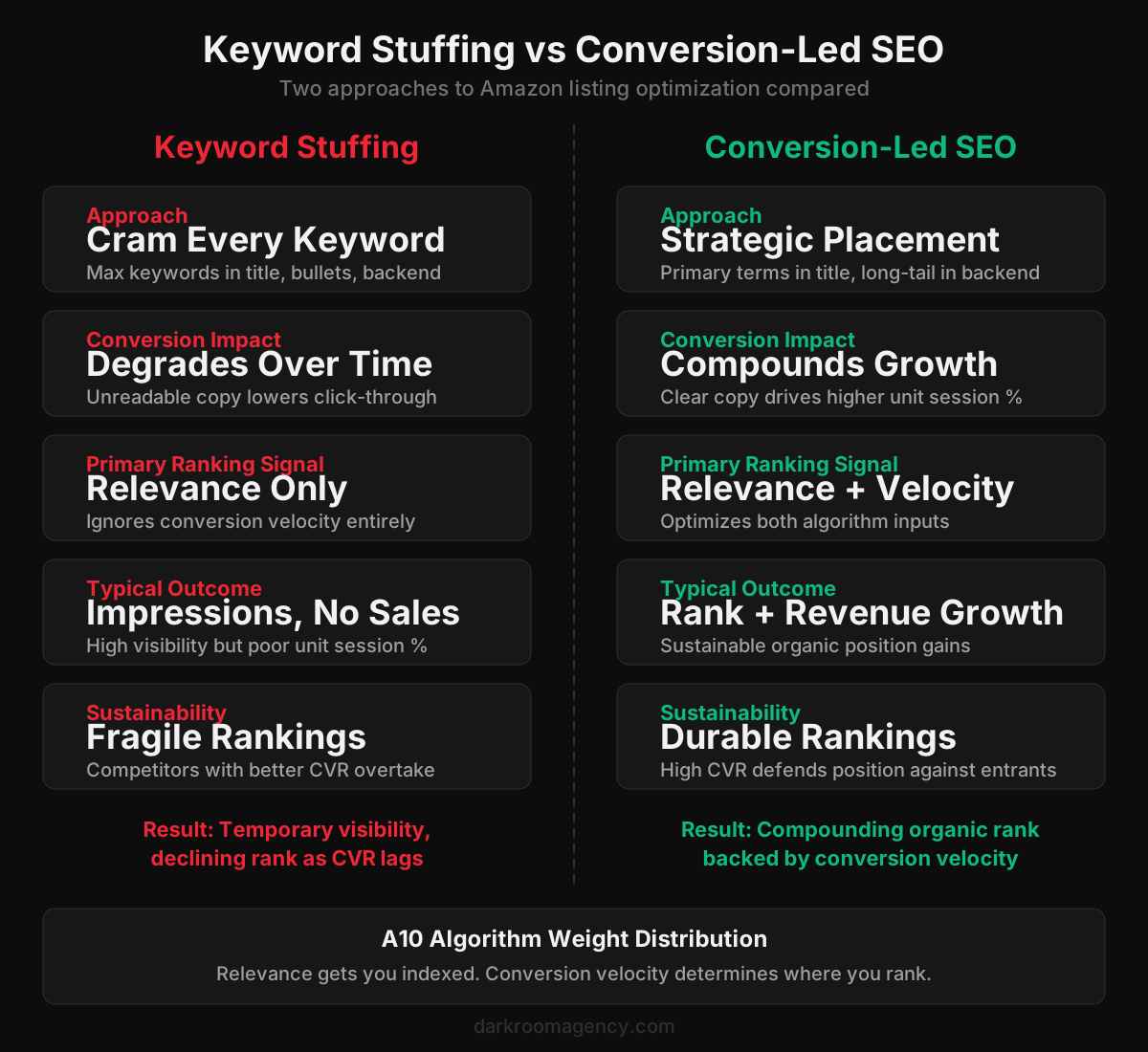
Keyword stuffing worked on Amazon in 2018. You could pack 300 characters of keywords into your title, fill your bullets with repetitive phrases, and stack your backend search terms with every conceivable synonym. Working with a Amazon advertising creative strategy can accelerate this process. The algorithm would index all of it, and because competition was lighter, that indexing alone was enough to rank.
That era is over. Amazon's algorithm now penalizes listings where keyword density harms readability. The mechanism is indirect but real: stuffed titles get lower click-through rates from search results because they look spammy. Lower CTR means fewer sessions. Fewer sessions with the same conversion rate means lower total sales velocity. Lower velocity means lower rank. The algorithm does not explicitly penalize stuffing. Working with a the Amazon marketing flywheel can accelerate this process. The shoppers do, and the algorithm follows their behavior.
There is also an indexing ceiling. Amazon does not rank listings for keywords they cannot convert on. If your listing is indexed for 500 keywords but only converts on 30 of them, the algorithm will suppress your visibility for the other 470 over time. You cannot trick the system into ranking for terms where your product is a poor match. Working with a Amazon DSP can accelerate this process. Relevance without conversion is wasted indexing.
According to Jungle Scout's research on Amazon SEO, listings that balance keyword coverage with conversion-optimized copy consistently outperform those that prioritize keyword volume alone. The data is clear: the algorithm rewards listings that sell, not listings that index for the most terms.
The conversion-led approach is different. You identify 15-25 high-intent keywords where your product genuinely solves the shopper's problem. Read more in our article on Amazon Brand Registry guide for 2026. You place the highest-volume terms in your title. You weave secondary terms into your bullet points naturally. You fill your backend search terms with long-tail synonyms, misspellings, and Spanish equivalents that do not appear in your visible copy. Then you spend the rest of your energy making the listing convert: compelling images, clear benefit communication, social proof integration, and pricing strategy.
This approach works because it aligns with how the algorithm works. You get indexed for the terms that matter. Your listing converts when shoppers arrive. Conversion velocity pushes you up the rankings. Higher rank means more impressions. More impressions at a high conversion rate means more sales. The flywheel starts turning.
The Complete Amazon Listing Anatomy
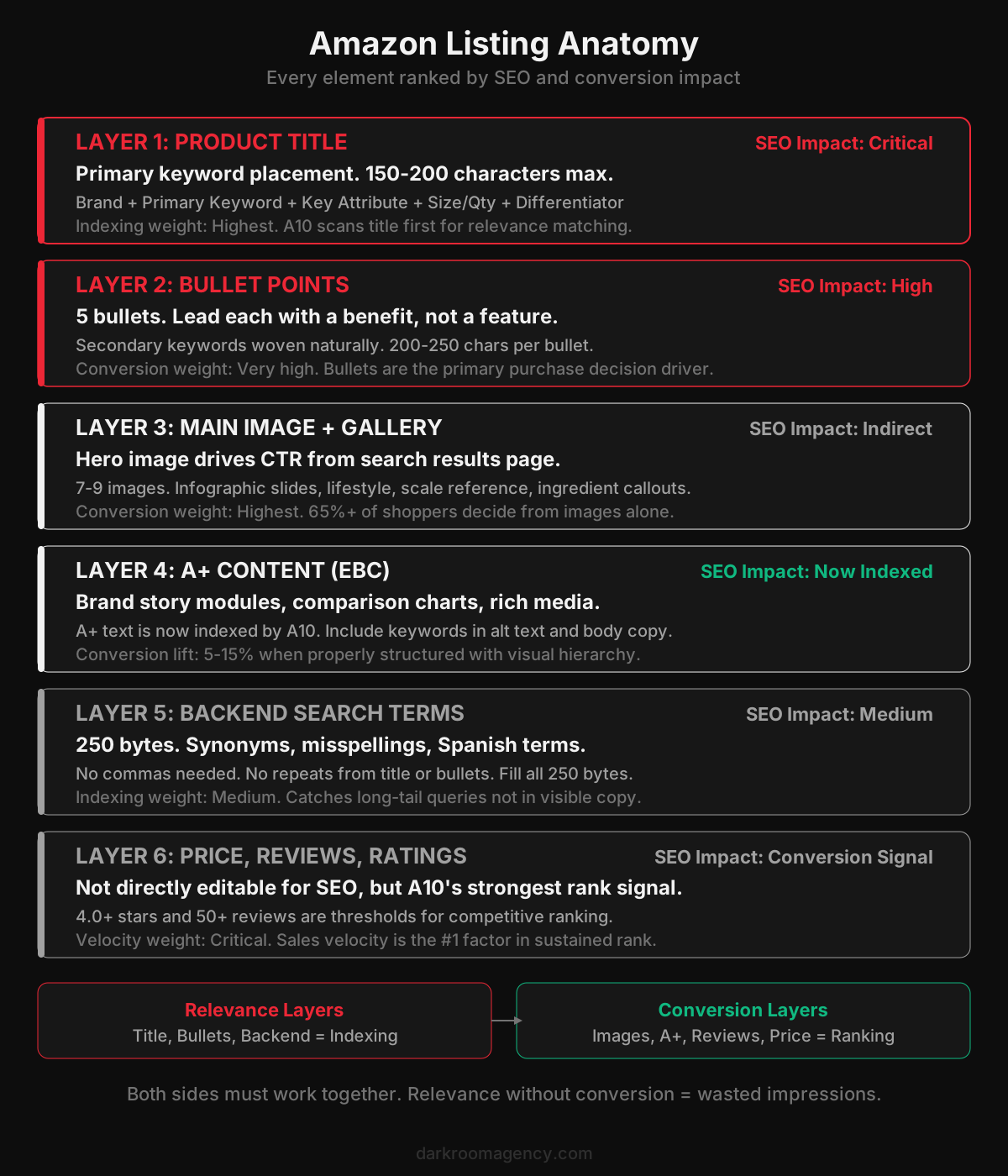
Every Amazon listing has six layers that contribute to SEO and conversion performance. Most sellers optimize one or two of these layers and leave the rest untouched. This is supported by our research on Amazon PPC management costs in 2026. The brands that dominate their category optimize all six, and they treat each layer as an ongoing testing surface rather than a one-time setup.
The product title carries the highest indexing weight. Amazon's algorithm scans the title first when determining relevance for a search query. Your title should follow a clear structure: Brand Name + Primary Keyword + Key Product Attribute + Size or Quantity + Differentiator. Keep it under 200 characters, but front-load the first 80 characters with your most important terms because that is all that displays on mobile. A title that reads naturally while containing your primary keyword will outperform a stuffed title every time.
Bullet points are the primary purchase decision driver for shoppers who scroll past the images. Each bullet should lead with a benefit in capital letters, followed by a supporting sentence that embeds a secondary keyword. You get five bullets. Use all five. Target 200-250 characters per bullet. The goal is not to list every feature. The goal is to address the top five reasons someone would or would not buy, and to do so with language that includes your target keywords organically.
Your main image and gallery are where most conversions are won or lost. Amazon Seller Central's own documentation confirms that product images are the strongest conversion driver on the platform. Use 7-9 images: a clean hero image on white background, lifestyle images showing the product in use, infographic images that highlight key features, a size or scale reference image, an ingredient or material callout, and a social proof image showing ratings or awards. Over 65% of Amazon shoppers report that images are the primary factor in their purchase decision.
A+ Content (formerly Enhanced Brand Content) sits below the fold but has a major impact on conversion rate. Amazon now indexes the text in A+ Content modules, which means your A+ section contributes to both SEO and conversion. Use comparison charts, brand story modules, and rich media to communicate your value proposition. Well-structured A+ Content lifts conversion rate by 5-15% according to brand-registered seller data. This is not optional for serious sellers. It is a baseline requirement.
Backend search terms give you 250 bytes of hidden keyword real estate. This is where you place synonyms, common misspellings, Spanish translations, and long-tail terms that do not fit naturally in your visible copy. Do not use commas. Do not repeat terms that already appear in your title or bullets. Fill all 250 bytes. Every unused byte is a missed indexing opportunity.
Finally, price, reviews, and ratings are not directly editable for SEO purposes, but they are the algorithm's strongest rank signal. A product with 4.0+ stars and 50+ reviews crosses the threshold where Amazon considers it competitively viable for top-of-search placement. Sales velocity driven by competitive pricing is the single strongest factor in sustained organic rank. You cannot SEO your way out of a pricing or reviews deficit.
Element | Priority | Impact on CVR | Time to Implement |
|---|---|---|---|
Title | Critical | +15–25% | 30 minutes |
Main Image | Critical | +20–40% | 1–2 weeks |
Bullet Points | High | +10–15% | 1–2 hours |
A+ Content | High | +5–15% | 1–3 weeks |
Backend Keywords | Medium | Indirect (discovery) | 1 hour |
Secondary Images | High | +10–20% | 1–2 weeks |
Product Video | Medium | +5–10% | 2–4 weeks |
Keyword Research for Amazon: A Different Playbook Than Google
Amazon keyword research is fundamentally different from Google keyword research. On Google, you optimize for informational and navigational queries. On Amazon, every query is transactional. The shopper typing "wireless earbuds noise canceling" is not researching. They are buying. Your keyword strategy needs to reflect that buying intent.
Start with Brand Analytics if you have brand registry. This is Amazon's own data on what shoppers search for and what they click after searching. It gives you actual search frequency rank, click share, and conversion share for the top three products per search term. No third-party tool matches this accuracy because it comes directly from Amazon's own data.
Layer in reverse ASIN analysis using tools like Helium 10's Cerebro tool. Run your top three competitors through a reverse lookup to see which keywords they rank for organically and which they bid on in sponsored ads. The keywords where all three competitors overlap are your must-have terms. The keywords where only one or two competitors rank represent your opportunity gaps.
Segment your keyword list into three tiers. Head terms (1-2 words, highest volume, hardest to rank for) go in your title. Mid-tail terms (2-3 words, moderate volume, competitive but achievable) go in your bullets and A+ Content. Long-tail terms (3+ words, lower volume, easier to rank for) go in your backend search terms. This tiered structure ensures you are indexed broadly while focusing your visible copy on the terms most likely to drive conversion.
One critical difference: Amazon does not care about keyword density the way Google used to. Mentioning a keyword once in your listing is enough to index for it. Repeating it four times adds zero SEO value and makes your copy worse. Place each keyword once in the most impactful location and move on.
Title Optimization: The 80-Character Rule
Your product title is the single most important element of your Amazon SEO strategy. It carries more indexing weight than any other field, and it is the first thing shoppers see in search results. For a deeper dive, see our breakdown of Amazon vs retail media networks in 2026. Getting it wrong means you are fighting uphill on everything else.
The 80-character rule exists because that is the approximate truncation point on mobile search results. Over 70% of Amazon shopping sessions happen on mobile. If your primary keyword and key differentiator do not appear in the first 80 characters, most shoppers will never see them. They will see a truncated title and a competitor with a cleaner listing.
Here is the title formula that works: Brand + Primary Keyword + Key Attribute + Size/Quantity + Differentiator. For a protein powder, that looks like: "NutraBrand Whey Protein Powder, 25g Protein Per Serving, Chocolate, 2 lb, Grass-Fed and Sugar-Free." The primary keyword (whey protein powder) appears in the first 40 characters. The key attributes follow. The differentiators close. It reads naturally. It indexes perfectly.
What to avoid: repeating the brand name, using promotional language (Best Seller, Top Rated), stuffing multiple keyword variations into the title, or exceeding category-specific character limits. Amazon will suppress listings that violate title guidelines, and even if they do not suppress you, a cluttered title destroys click-through rate.
Test your title by reading it aloud. If it sounds like a sentence a human would say, it is probably fine. If it sounds like a search engine query list, rewrite it. The algorithm rewards relevance, but shoppers reward clarity. You need both.
Bullet Points That Convert and Rank Simultaneously
Bullet points serve dual duty: they index for secondary keywords and they convert browsers into buyers. Most sellers write bullets that do one or the other. The winning approach does both.
Structure each bullet like this: BENEFIT HEADLINE in caps, followed by a supporting sentence that addresses a specific objection or desire, followed by a proof point or specification. Embed one secondary keyword per bullet. Do not force it. If the keyword does not fit naturally, use a synonym or move it to backend search terms.
The first bullet should address the primary reason someone would buy your product. The second should address the most common objection or concern. The third should highlight a differentiating feature. The fourth should provide a use case or application. The fifth should close with a guarantee, warranty, or trust signal.
For example, if you sell a portable blender, your first bullet might be: "BLEND ANYWHERE IN 30 SECONDS. The 20oz personal blender crushes ice, frozen fruit, and protein powder with a 300W motor that charges via USB-C. Take it to the gym, the office, or the trail without worrying about outlets." This contains the keyword "personal blender," addresses a benefit, and provides a specification. It reads naturally. It converts.
Avoid starting every bullet with the brand name. Avoid generic phrases like "high quality" or "premium materials" without proof. Avoid walls of text. Each bullet should be scannable in under three seconds. If a shopper cannot extract the key benefit from a bullet in a quick glance, the bullet is too long or too vague.
The Paid-Organic Flywheel: How Sponsored Ads Accelerate SEO
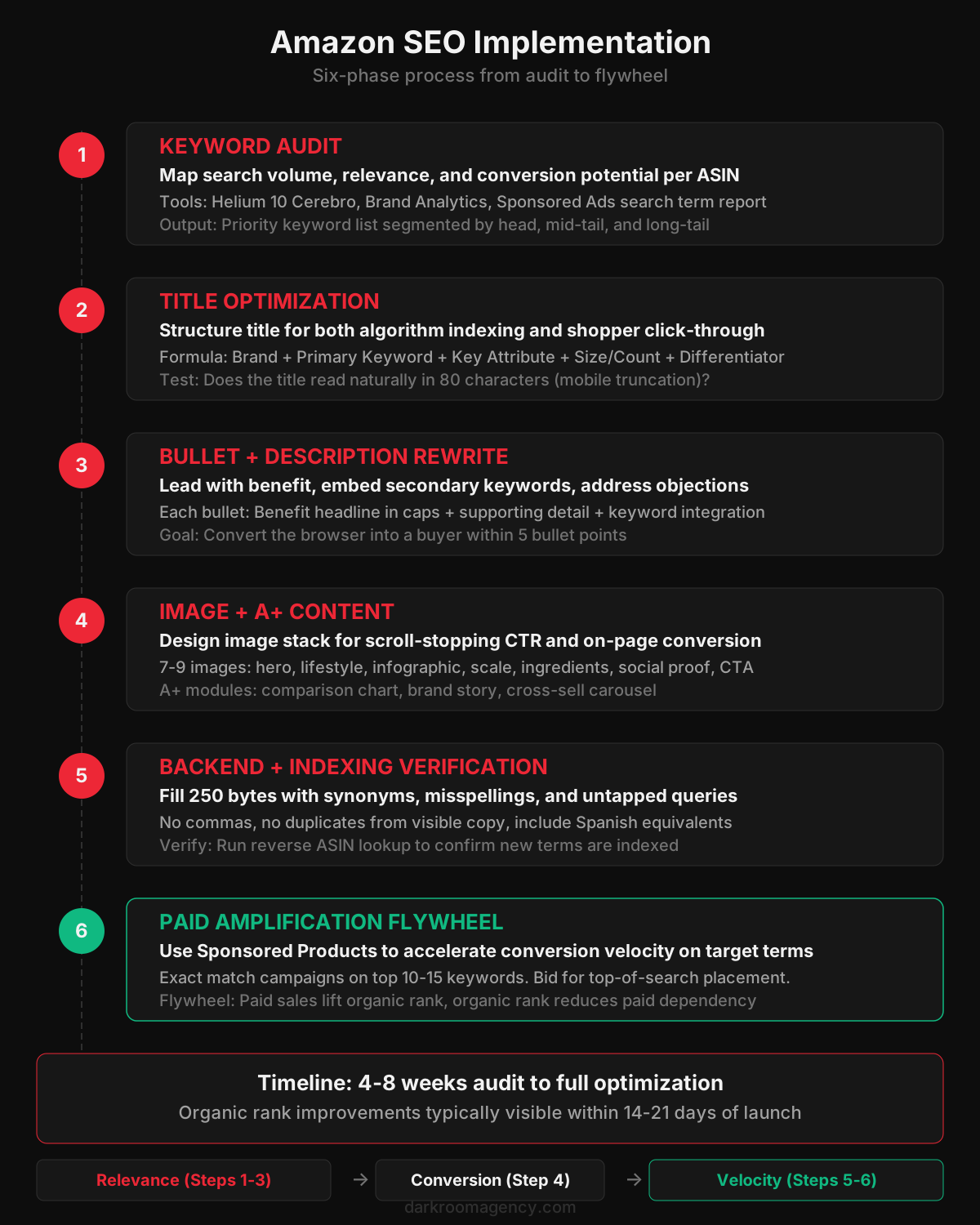
Here is where most Amazon SEO guides stop. They cover keywords, titles, and bullets, then tell you to wait for organic rank to improve. Our article on Amazon SEO best practices for higher rankings covers the framework in detail. That is incomplete. The fastest path to organic rank on Amazon is through paid amplification, and understanding this flywheel is what separates brands that plateau from brands that compound.
The mechanism is straightforward. When you run Sponsored Products campaigns on exact-match keywords and your listing converts those paid clicks into sales, Amazon attributes those sales to the keyword. If you generate enough sales velocity on a keyword through paid campaigns, your organic rank for that keyword improves. As your organic rank improves, you receive free organic impressions. Those organic impressions convert at the same rate (or higher, since organic shoppers tend to have higher intent). The additional organic sales further improve your rank. Your paid dependency decreases as organic takes over.
This is the Amazon flywheel that most agencies miss. Paid and organic are not separate channels. They are the same channel viewed through different lenses. A dollar spent on Sponsored Products that generates a sale is simultaneously a paid conversion and an organic rank signal. Smart brands use this to their advantage by investing heavily in paid campaigns during launch and optimization phases, then gradually reducing spend as organic rank improves.
The tactical implementation: identify your top 10-15 target keywords from your keyword research. Create exact-match Sponsored Products campaigns for each one. Bid aggressively for top-of-search placement (the premium placement modifier is your friend here). Run these campaigns for 4-8 weeks while monitoring organic rank movement. As organic rank improves for each keyword, reduce your bid gradually. The goal is not to eliminate paid spend. The goal is to reach a steady state where organic generates 60-70% of your keyword sales and paid fills in the remaining 30-40%.
According to eMarketer's Amazon advertising data, brands that coordinate their paid and organic strategies see 2-3x higher return on advertising spend compared to brands that manage them independently. The flywheel is real, and it is the most underutilized lever in Amazon SEO.
Backend Search Terms: The Invisible SEO Layer
Backend search terms are Amazon's hidden keyword field. Shoppers never see them. The algorithm always reads them. You get 250 bytes (not characters, bytes, which matters for accented characters and special symbols) to index for terms that do not appear anywhere else in your listing.
The rules are simple. Do not repeat any word that already appears in your title, bullets, or product description. Amazon indexes each word only once across your entire listing, so duplicates waste space. Do not use commas or punctuation. Amazon reads backend terms as a continuous string separated by spaces. Do not include brand names (yours or competitors). Amazon's terms of service prohibit this, and violations can get your listing suppressed.
What should you include? Start with common misspellings of your product name or category. Add Spanish translations of your primary keywords (the US Amazon marketplace has a significant Spanish-speaking customer base). Include synonyms that shoppers might use. Add related use case terms. If you sell a yoga mat, your backend might include: "ejercicio esterilla pilates mat thick nonslip excersize workout padding cushion floor fitness stretching gym home."
After you update backend search terms, verify indexing. Search for each backend term on Amazon and check that your ASIN appears in results. If it does not appear after 48 hours, the term may be blocked by Amazon's content policy or your listing may need a catalog update to refresh indexing. Tools like Helium 10 Index Checker can automate this verification at scale.
Backend search terms are not glamorous. They are not visible. But they catch long-tail queries that your visible copy misses. A well-optimized backend can index your listing for an additional 50-100 search terms that you would otherwise miss entirely. Over time, those long-tail terms compound into meaningful traffic.
Measuring Amazon SEO Performance
You cannot improve what you do not measure. Amazon SEO measurement requires tracking three categories of metrics: indexing metrics, ranking metrics, and conversion metrics. We explored this concept further in our piece on Amazon content optimization testing playbook.
Indexing metrics tell you whether Amazon recognizes your listing as relevant for your target keywords. Use reverse ASIN lookups to check how many keywords your listing is indexed for. Track this monthly. If your indexed keyword count is declining, something in your listing has changed or a competitor has taken share. The target is to be indexed for at least 80% of the keywords in your research list.
Ranking metrics tell you where you appear in search results for your target keywords. Track organic rank for your top 15-20 keywords weekly. Use a rank tracking tool to automate this. The key metric is not absolute rank but rank trajectory. Are you moving up, holding steady, or declining? If you are declining on a keyword where your conversion rate is strong, a competitor is outspending you on paid or they have improved their listing.
Conversion metrics tell you whether your listing is doing its job once shoppers arrive. Unit session percentage (Amazon's version of conversion rate) is the most important metric in your entire Amazon SEO program. Track it weekly. If it drops below your category average, your listing needs work regardless of how well your keywords are performing. A 1% improvement in unit session percentage is worth more than ranking for 50 additional keywords because it multiplies the value of every impression you receive.
If you are managing this across multiple ASINs, the complexity scales quickly. This is where working with a team that specializes in Amazon channel management becomes valuable. Whether you handle this internally or work with an Amazon marketing agency, the measurement infrastructure alone requires dedicated attention to maintain.
Common Amazon SEO Mistakes That Kill Rankings
After auditing hundreds of Amazon listings across categories, the same mistakes appear repeatedly. Avoiding these is often more impactful than implementing any single optimization.
Changing your title too frequently is the most common self-inflicted wound. Every title change triggers a re-indexing process. If you change your title weekly, you are resetting your ranking signal repeatedly. Amazon's algorithm needs stability to assign rank. Change your title only when you have strong evidence that the new version will outperform, and give each version at least 4-6 weeks to stabilize before evaluating.
Ignoring mobile formatting is the second most common mistake. If your title is 250 characters, most shoppers see only the first 80. If your main image has small text overlays, they are illegible on a 6-inch screen. If your bullet points are 400 characters each, mobile shoppers see a wall of text. Design every element of your listing for a phone screen first, desktop second.
Running out of stock destroys organic rank. Amazon's algorithm penalizes listings that go out of stock because it cannot show unavailable products. A single stockout event can drop your organic rank by 20-50 positions, and recovering that rank takes weeks of sustained sales velocity. Inventory management is not just a supply chain function. It is an SEO function. If you are investing in listing optimization and performance creative but running out of stock quarterly, you are undoing your own work.
Neglecting review velocity is the fourth critical mistake. New reviews signal ongoing product quality and customer satisfaction to the algorithm. A listing that received 50 reviews in its first year and zero reviews in its second year will lose rank to a newer listing that is accumulating reviews at a faster rate. Use Amazon's Vine program, follow-up email sequences, and product inserts (within TOS) to maintain review velocity.
Finally, treating Amazon SEO as a one-time project rather than an ongoing program guarantees stagnation. Your competitors are optimizing their listings continuously. Category dynamics shift seasonally. Amazon updates its algorithm multiple times per year. A listing optimized in January and left untouched through December will be outranked by competitors who iterate monthly.
Building an Amazon SEO Program That Compounds
The difference between brands that plateau and brands that grow on Amazon is whether they treat SEO as a project or a program. Projects have start and end dates. For related analysis, read our guide on Amazon conversion rate optimization retail-ready playbook. Programs have cycles and compound over time.
A compounding Amazon SEO program operates on a quarterly cycle. In the first month of each quarter, audit your keyword performance. Identify keywords where you have lost rank or where new opportunities have emerged. Update your keyword map accordingly.
In the second month, optimize your listing assets based on the updated keyword map. Refresh your title if warranted. Rewrite bullets that are not converting. Update A+ Content modules. Refresh backend search terms. Update your image gallery with new lifestyle or infographic images that address current competitor gaps.
In the third month, amplify. Increase your Sponsored Products spend on keywords where you have improved your listing but have not yet gained organic rank. Use the paid-organic flywheel to accelerate rank movement. Monitor conversion metrics to ensure your optimizations are working.
Repeat every quarter. Each cycle builds on the previous one. Your keyword coverage expands. Your conversion rate improves incrementally. Your organic rank strengthens. Your paid efficiency improves because better listings convert more paid clicks. Over four quarters, this approach typically yields 30-60% improvement in organic traffic and a corresponding reduction in advertising cost per acquisition.
This is the operational cadence that our team at Darkroom runs for Amazon brands. It is not glamorous. There is no single hack that transforms performance overnight. But compounding works. It always works. The brands that commit to the cycle outperform the brands that chase shortcuts.
If you want to understand how creative strategy integrates with this SEO framework, or how DSP fits into the full-funnel picture, those playbooks layer directly on top of this foundation. SEO is the base. Everything else amplifies it.
Frequently Asked Questions
How long does it take for Amazon SEO changes to affect ranking?
Most listing changes take 48-72 hours to re-index. Organic rank improvements from those changes typically appear within 14-21 days if the changes improve conversion rate. Significant rank shifts (moving from page 3 to page 1) can take 6-12 weeks of sustained optimization and sales velocity. The timeline accelerates when you combine listing optimization with paid amplification through the flywheel approach.
Is Amazon SEO different from Google SEO?
Fundamentally different. Google SEO optimizes for informational and navigational queries where the goal is a click and engagement. Amazon SEO optimizes for transactional queries where the goal is a purchase. Google rewards content depth, backlinks, and domain authority. Amazon rewards conversion velocity, sales history, and seller performance. The keyword research process is similar, but the optimization strategy is entirely different.
Do I need brand registry for Amazon SEO?
Brand registry is not required for basic listing optimization (titles, bullets, backend terms). However, it is required for A+ Content, Sponsored Brand campaigns, Brand Analytics access, and Amazon Stores. Since A+ Content is now indexed by the algorithm and contributes directly to both SEO and conversion, brand registry is effectively a prerequisite for competitive Amazon SEO in 2026.
How many keywords should I target per listing?
Target 15-25 keywords per ASIN across all tiers. Your title should contain your top 2-3 head terms. Your bullets should incorporate 5-8 mid-tail terms. Your backend should capture 15-25 long-tail terms. Going beyond this creates diminishing returns because you cannot convert on keywords that are not genuinely relevant to your product.
Should I use the same keywords in my title and my Sponsored Products campaigns?
Yes. Your highest-priority organic keywords should also be your highest-priority paid keywords. This is the foundation of the paid-organic flywheel. When your Sponsored Products campaigns drive sales on a keyword, those sales contribute to your organic rank for that same keyword. Aligning paid and organic keyword targeting is the fastest way to build sustainable rank.
What unit session percentage should I target?
This varies by category. Consumer electronics typically sees 3-8%. Consumables and supplements see 8-15%. Home goods fall between 5-12%. The benchmark that matters most is your category average, which you can find in Brand Analytics. If you are below category average, your listing needs conversion optimization before you invest further in keyword expansion.
Can I lose organic rank by pausing Sponsored Products campaigns?
Yes, temporarily. If a significant portion of your keyword sales come from paid campaigns, pausing those campaigns reduces your total sales velocity on those keywords. Reduced velocity can cause organic rank to slip within 1-2 weeks. The solution is to reduce paid spend gradually rather than pausing abruptly, allowing organic impressions to fill the gap incrementally.
How often should I update my Amazon listings?
Follow a quarterly optimization cycle: keyword audit in month one, listing optimization in month two, paid amplification in month three. Between quarterly cycles, monitor weekly for any significant changes in conversion rate or rank. Do not make changes more frequently than monthly unless you have specific data indicating a problem. Stability helps the algorithm assign rank.
Amazon SEO is not a set-it-and-forget-it function. It is an ongoing optimization program that compounds over time when you commit to the cycle of research, optimization, amplification, and measurement. The brands that win on Amazon are the ones that treat their listings as living assets, not finished projects. Book a call with Darkroom to build a listing optimization program that compounds.