
RETENTION MARKETING
AI Email Marketing: How DTC Brands Personalize at Scale in 2026




Written by Darkroom leardership
Last update: August 5, 2026

Klaviyo will not show you a predicted customer lifetime value until you have at least 500 customers who have placed an order, 180 days of order history, orders in the last 30 days, and some customers who have bought three or more times. Those thresholds are published in Klaviyo's own documentation, and almost no article about AI email marketing mentions them.
That omission is the whole problem with this category. AI in email is not a content problem, it is a data problem. Every predictive technique below degrades toward guesswork under a data threshold, and the vendors selling those techniques rarely lead with the number.
This guide covers what each technique actually does, the data it needs before it is reliable, how to prove it produced the lift, and whether you should build the capability in-house or bring in a partner. For the tactical version, we have written separately on AI strategies for email and SMS. This piece is the strategic one.
What is AI email marketing?
AI email marketing is the use of machine learning to make three decisions that used to be made by hand: who gets a message, when it arrives, and what it says. Darkroom is a retention marketing agency for consumer brands, and the first thing we do in an audit is separate those three, because they are not the same technology.
Most confusion in this category comes from treating AI as one capability. It is two, and they behave differently.
Generative versus predictive: the distinction that matters
Generative AI writes. It drafts subject lines, body copy and variants, and it is a productivity gain. Predictive AI decides. It models segments, send timing, lifetime value and churn risk from behavioural data, and it is a performance gain.
The practical differences matter more than the definitions:
Data requirement. Generative needs your brand guidelines and a few good examples. Predictive needs hundreds of customers and months of order history.
Risk profile. Generative fails visibly, in the form of copy that sounds wrong. Predictive fails invisibly, in the form of a confident segment built on noise.
Time to value. Generative works on day one. Predictive works once thresholds clear.
Vendors sell them in that order, generative first, because generative demos well. Adopt them in the opposite order of importance: generative saves hours, predictive changes revenue. What AI adds to your existing email marketing automation is decisions, not just drafts.
The AI email use cases that actually work
Six techniques are worth your attention. The rest are features. Here is what each one needs before it produces anything trustworthy.
Technique | What it predicts or produces | Minimum data | Metric it moves |
|---|---|---|---|
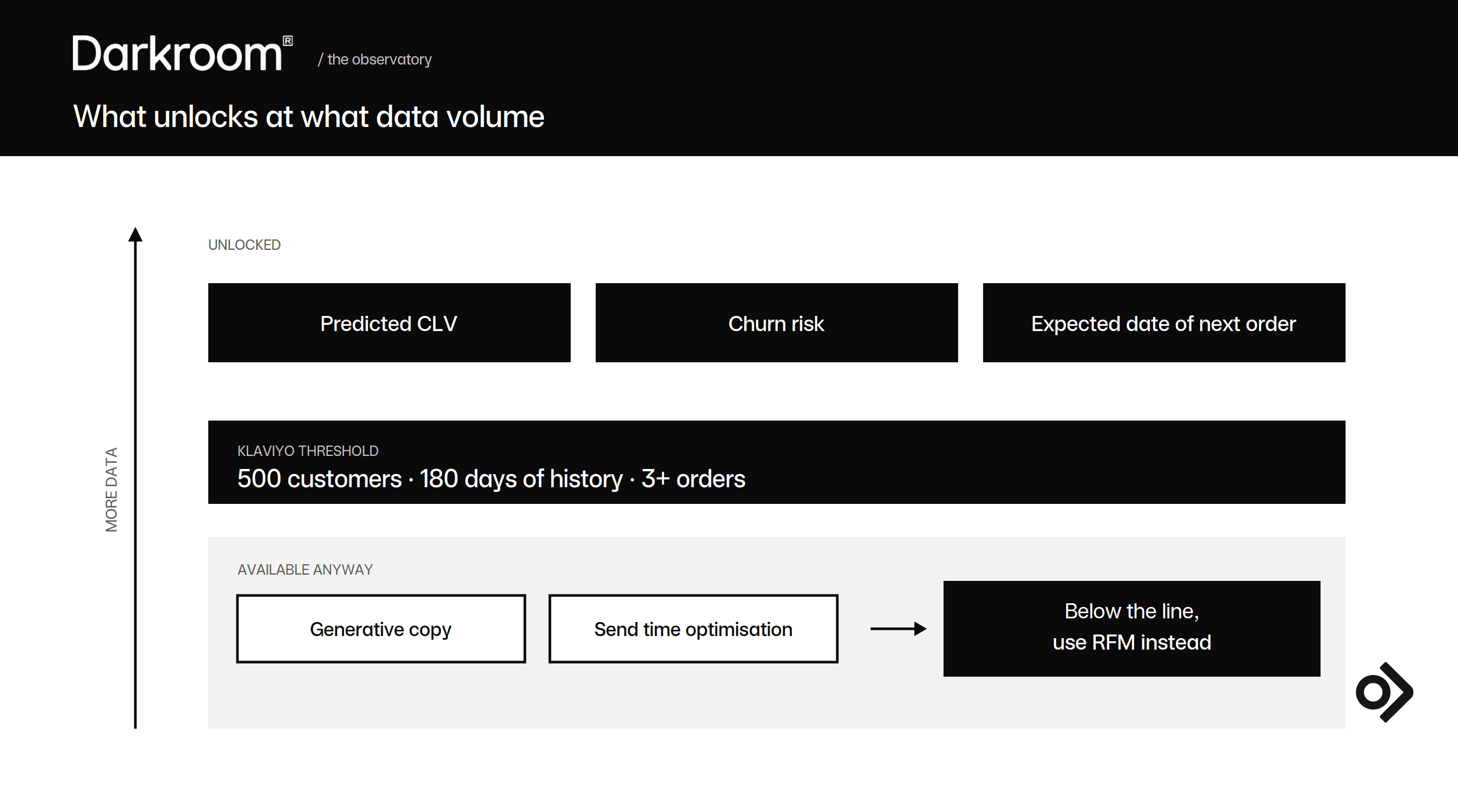
Predicted CLV | Forward-looking value per customer over a 365-day window | 500+ customers with orders, 180 days history, some 3+ time buyers | Segment prioritisation, offer depth |
Churn risk | Probability a customer does not buy again | Same threshold as above | Win-back timing, suppression |
Expected date of next order | When a specific customer will reorder | Same, plus repeat-purchase behaviour | Repeat purchase rate |
Send time optimisation | Best delivery window per subscriber | Engagement history per subscriber | Open and click rate, marginally |
Generative copy and subject lines | Draft variants at volume | Brand guidelines and examples | Testing velocity, production cost |
Product recommendations | Next likely product | Catalogue plus purchase history | Average order value, cross-sell rate |
The thresholds in the second column are Klaviyo's published requirements, and they apply to the first three rows as a set. Other platforms differ, but the shape is the same: predictive features need a few hundred repeat customers before the model has anything to learn from.
Read the table as a sequence rather than a menu. Below the threshold, turn on generative and send time optimisation. Above it, the predictive three become available and are where the revenue is.
How do predictive segments work, and how much data do they need?
Predictive segments work by training a model on your own customers' purchase histories and scoring each individual against that pattern. This is customer segmentation done by inference rather than by rule, and it needs enough customers to establish the pattern, which is where most brands discover they are not ready.
Klaviyo publishes the criteria plainly. Its churn model requires at least 500 customers who have placed an order, 180 days of order history with orders in the last 30 days, and some customers who have placed three or more orders. The 500-customer floor exists so the model can compare individual behaviour against a large enough sample of your overall base.
The predictive analytics suite retrains at least weekly, and all standard insights use a 365-day forward-looking window unless you are on a plan that lets you customise it. That window matters for seasonal brands, where a 365-day prediction is either exactly right or badly wrong depending on your purchase cycle.
Below the threshold, use RFM analysis instead. Recency, frequency and monetary segmentation is transparent, defensible and buildable in a spreadsheet, and it beats a model trained on 200 customers every time. This is the honest answer nobody selling software will give you.
One more caution on interpretation. Klaviyo notes that most customers across most industries are one or two-time purchasers, so most of your base will show a churn risk above 50%. A high average churn risk is usually a first-to-second-purchase problem, not a model output worth acting on directly.
Predicted CLV and how to use it without over-trusting it
Use predicted CLV to rank customers, not to forecast revenue. It is a relative score, and it is reliable for ordering your base from most to least valuable. It is far less reliable as an absolute number you put in a board deck.
The practical applications are ranking-based: set offer depth by predicted value, prioritise which segments get the expensive creative, and decide who is worth a win-back incentive. Our pillar on customer lifetime value covers the calculation methods behind the score.
The failure mode is treating the prediction as a fact. If your catalogue changed, your pricing moved, or you ran an unusual promotional period, the model is extrapolating from a pattern that no longer exists.
Does send time optimisation actually improve results?
Send time optimisation produces modest, real gains for some audiences and negligible gains for others, and the honest answer is that it depends on whether your list has a genuine timing pattern. It is the lowest-risk AI feature to switch on and the one most likely to be oversold to you.
The mechanism is straightforward. The platform scores delivery windows for each subscriber based on when that subscriber has previously engaged, then schedules their copy of the send into their predicted window rather than blasting the whole list at one time.
Two things determine whether it helps. First, whether your audience actually varies. A list of office workers in one time zone has less timing spread than a national consumer list. Second, and more important, whether the engagement data the model is learning from is real.
Why Apple Mail Privacy Protection broke open-rate models
Since September 2021, open-rate data has been unreliable, and any model trained on opens alone is partly learning from machines rather than people. Apple released Mail Privacy Protection with iOS 15, macOS Monterey, iPadOS 15 and watchOS 8, and it works by pre-fetching the tracking pixel on Apple's servers whether or not the recipient ever looks at the message.
Klaviyo documents the consequence directly: MPP artificially inflates open rates and makes it harder to identify subscribers who are truly engaged, and it flags these as Apple Privacy Opens so you can exclude them from engagement criteria.
There is a specific, actionable threshold in Klaviyo's own guidance. If more than 45% of your email opens come from Apple Mail, switch your A/B test winning metric to click rate. The same guidance notes that Klaviyo's smart send time algorithm does not look at open data at the individual level, so its results should stay accurate but may take longer to calculate.
Do this before anything else: pull the share of your opens that are Apple Privacy Opens. That single number tells you how much of your engagement reporting is fiction, and it changes which metrics you are allowed to optimise against.
Generative copy testing: where it helps and where it hurts
Generative AI helps most where volume is the constraint. If your testing cadence is limited by how fast a copywriter can produce variants, AI copywriting removes that ceiling immediately, and it is the fastest payback in this article.
It hurts in two specific places. The first is brand voice drift, which compounds quietly: each AI-generated email sounds almost right, and six months later the programme has averaged into something generic. The second is unverified claims, where a model produces a confident sentence about your product that nobody checked.
The workflow that works is narrow. Use AI for variant generation against a human-written control, never for the control itself. Feed it your best-performing historical copy rather than a style prompt. Have a human approve every send.
An AI subject line generator is the safest starting point, because subject lines are short, high-volume, easily tested and low-risk if one underperforms. Full body copy for a flagship campaign is the least safe.
What to never let a model ship unreviewed
Four categories, no exceptions:
Product claims. Efficacy, ingredients, performance, comparisons.
Pricing and offer terms. Discount depth, expiry, exclusions.
Compliance language. Unsubscribe, consent, regulated category disclosures.
Anything legal or medical. Including anything a model has inferred rather than been told.
The review gate costs minutes per send. A retracted claim costs considerably more.
Churn prediction and win-back timing
Churn prediction replaces a fixed lapse window with a modelled one, and it matters because "lapsed" means something different for every customer. A subscriber who buys every 100 days is not lapsed at day 60. One who buys every 20 days probably is.
Klaviyo's model reflects this. It learns each customer's own purchase rhythm, so risk climbs at a different rate for a 100-day buyer than for a 50-day buyer, rather than applying one countdown to everyone.
The practical build is a win-back flow triggered a few days before the expected date of next order rather than a fixed number of days after the last one. That converts win-back from a recovery message into a pre-emptive one, which is a materially different conversation with the customer.
The threshold applies here too. Without enough repeat purchasers to define what a normal gap looks like, the model has no rhythm to learn and you are better off with a fixed window derived from your average time between orders. Our guide to why subscribers cancel covers the reasons behind the lapse, which is what the message actually has to address.
This is also the point where AI cannot rescue a missing structure. If your flow architecture has gaps, a churn model will identify at-risk customers you have no automated way to reach. The email revenue architecture has to exist before the intelligence layer is worth adding, and the same holds for static customer journeys that never adapt to behaviour.
How do you prove the AI actually caused the lift?
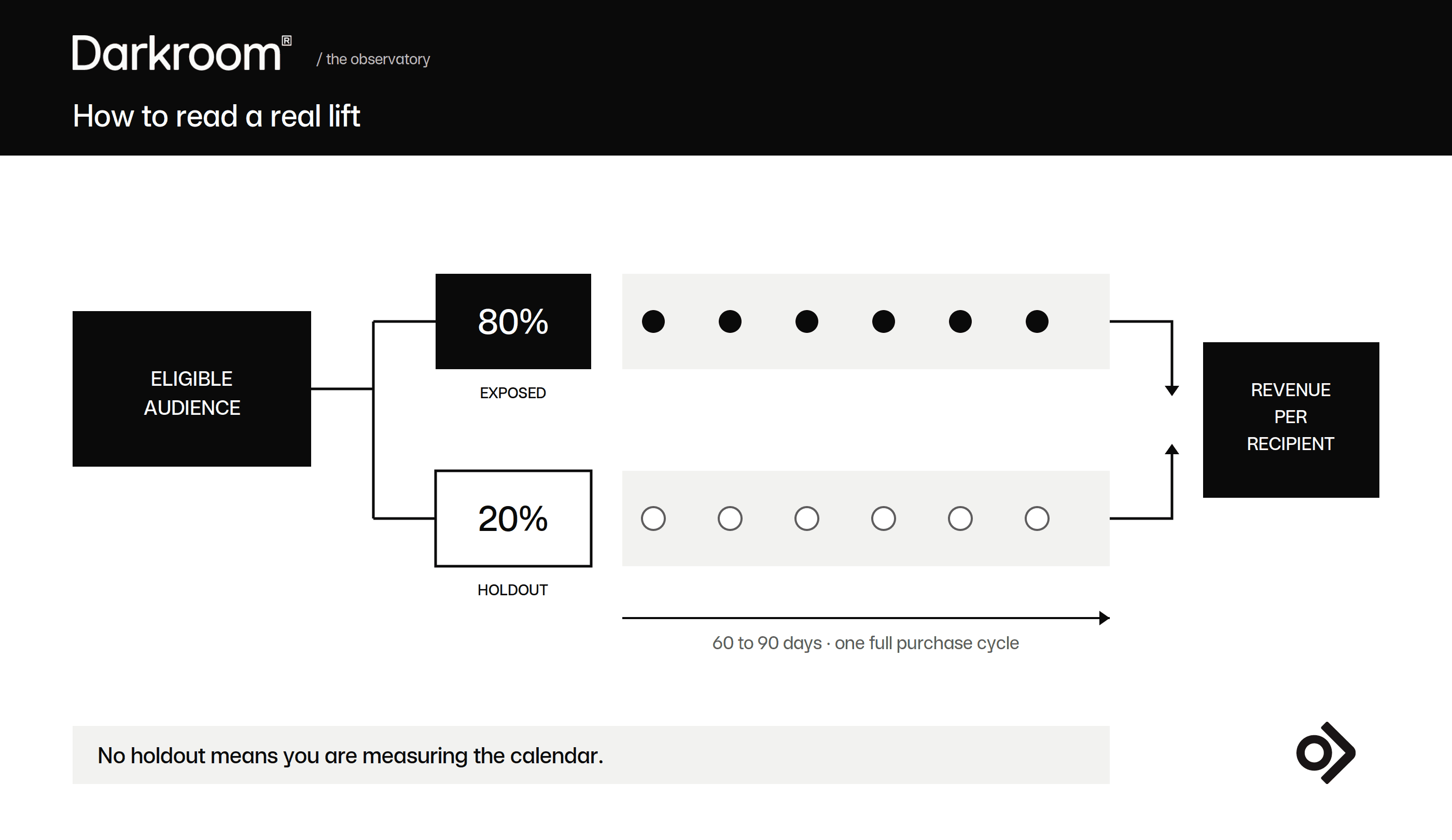
Use a holdout. Randomly withhold a portion of the eligible audience from the AI-driven treatment, run both for a full purchase cycle, and compare. Without a control group, you are measuring the calendar, not the model.
This is the section that separates this article from the vendor content ranking above it, so here is the design in full.
Define the eligible population before you split it. Everyone who would qualify for the treatment.
Randomise into exposed and holdout. Ten to twenty percent held out is usually enough at DTC list sizes.
Run for at least one full purchase cycle. For most consumer brands, that is 60 to 90 days. Shorter windows measure novelty.
Compare revenue per recipient, not open rate, between the two groups.
Repeat before scaling. One clean read on one technique beats four ambiguous ones.
Year-over-year comparison is the trap. In a seasonal business, last year's same month differs in promotional calendar, list size, catalogue and market conditions, so any change gets attributed to the newest thing you turned on. Our retention measurement framework covers how to construct comparisons that survive scrutiny.
Be sceptical of published lift figures generally. The overwhelming majority of AI email statistics circulating online come from the vendors selling the feature and are uncontrolled. Treat them as marketing, run your own holdout, and trust that number instead.
The metrics that move first
Revenue per recipient is the primary metric, always. It survives Apple MPP, it accounts for list size, and it is the number a CFO recognises.
Then, in order of how quickly they respond: click rate, conversion rate, repeat purchase rate, and finally lifetime value, which moves last and slowest. Our customer retention metrics guide defines each formula, and you will need a baseline before you start, which is what email marketing benchmarks are for.
Open rate is not on this list. After MPP, it is a diagnostic at best, useful for spotting deliverability problems and nothing else.
Should you build AI email capability in-house or partner?
Build in-house when you have the data, the headcount and a stable enough catalogue to make the models worth maintaining. Partner when any one of those is missing. Here is the scoring, and it is genuinely two-sided.
Factor | Points to building | Points to partnering |
|---|---|---|
List and customer base | Above predictive thresholds comfortably | Near or below 500 repeat customers |
Data maturity | Warehouse in place, clean identity resolution | Fragmented sources, duplicate records |
Lifecycle headcount | One dedicated owner, not a shared role | Email is somebody's third priority |
Analyst access | Someone who can design a holdout | Nobody owns measurement |
Testing cadence | Weekly tests already running | Tests happen when someone remembers |
Channel complexity | Email only | Email, SMS, loyalty and paid interacting |
Catalogue stability | Stable SKUs and pricing | Frequent launches, shifting assortment |
Score it honestly. Four or more in the right-hand column and building in-house will produce a model nobody maintains.
When building in-house is the right call
If you have a large list well above threshold, an existing data team, one person whose actual job is lifecycle, and a catalogue that does not change every month, build it. The platform-native features will get you most of the way, and the marginal value a partner adds is smaller than the retainer.
That is a real recommendation and it applies to more brands than agencies like to admit. The retention marketing stack breakdown covers what you actually need versus what vendors will sell you.
When a partner pays for itself
Sub-threshold data is the clearest case, because the work is fixing the data foundation before any model is worth running. Multi-channel complexity is the second, since email, SMS and loyalty interacting properly is an orchestration problem rather than a tooling one.
The third is testing cadence. AI email marketing tools produce value proportional to how often you test, and most in-house teams cannot sustain a weekly cadence alongside the campaign calendar. If nobody owns measurement, a partner buys you the discipline rather than the software.
Cost context is in our breakdown of what retention marketing costs, and the specifics of working with a Klaviyo partner cover what that engagement looks like in practice. The economics are on retention's side either way: acquiring a new customer costs 5 to 25 times more than retaining one, per Bain research published in Harvard Business Review.
What Darkroom does differently
We start at the data layer and we measure with holdouts. That is less exciting than a capability list and it is the reason the numbers hold up.
With Public Goods we built segmented campaigns, automated flows and SMS alongside predictive replenishment and cross-sell triggers timed to product-specific reorder windows. Retention-attributed revenue grew 36.85% quarter over quarter, with email campaigns alone up 44.7%.
With Morphe, a welcome-discount test returned 49% higher revenue per recipient at a lower offer. Better targeting beat a bigger incentive, which is the entire argument for predictive segmentation expressed as one result.
The through-line is the same one we found rebuilding personalization for Drip Hydration: unify the data before you personalize anything. The wider pattern across discovery and merchandising is covered in our work on AI in product discovery and personalization, and the measurement philosophy behind it in predictive measurement.
If your predictive features are switched on and nobody can tell you whether they are working, get a free retention audit. We will tell you which thresholds you clear, which you do not, and what to turn off.
AI email marketing FAQs
What is AI email marketing?
AI email marketing uses machine learning to decide who receives a message, when it sends and what it says. It divides into generative AI, which drafts copy and variants, and predictive AI, which models segments, send timing, lifetime value and churn risk from a brand's own behavioural and purchase data.
Does AI actually improve email marketing results?
Sometimes, and the honest way to find out is a holdout test on your own list. Most published lift figures come from vendors selling the feature and are uncontrolled. Withhold ten to twenty percent of the eligible audience, run for a full purchase cycle, and compare revenue per recipient between groups.
How much data do you need before predictive segments work?
Klaviyo requires at least 500 customers who have placed an order, 180 days of order history including orders in the last 30 days, and some customers with three or more orders. Other platforms differ, but all need a few hundred repeat customers before the model has a pattern to learn.
Does send time optimisation work with Apple Mail Privacy Protection?
Yes, with a caveat. Klaviyo states its smart send time algorithm does not use individual open data, so results stay accurate but take longer to calculate. Check what share of your opens are Apple Privacy Opens first, since that number determines which engagement metrics you can trust.
Can AI write emails that sound like our brand?
It can approximate your voice if you feed it your best-performing historical copy rather than an abstract style prompt. The risk is drift, where each email sounds almost right and the programme averages into something generic. Use AI for variants against a human-written control, and review every send.
Should we use our platform's built-in AI or a separate tool?
Start with platform-native features. They run on data already in the system, cost nothing extra, and cover predicted lifetime value, churn risk, send timing and copy generation. Add a separate tool only when you have a specific capability gap you can name and a way to measure whether it closed.