
RETENTION MARKETING
Why Most DTC Brands Need a Retention Marketing Agency Before They Think They Do




Written by Darkroom leardership

Written & peer reviewed by 4 Darkroom team members
TL;DR: Most DTC brands leave 30-40% of revenue on the table because their retention systems are either broken or stale. This is not about sending more emails. It is about building a compounding system of flows, campaigns, SMS, segmentation, and reporting that turns first-time buyers into repeat revenue. If your lifecycle flows have not been updated in 6+ months, your CAC math does not work, or email/SMS drives less than 30% of total revenue, you need a retention marketing agency yesterday. This article covers what that actually means, how Klaviyo fits, and when to stop doing it yourself.
The Revenue You Are Not Capturing
Here is the pattern we see in nearly every DTC brand that contacts us about retention. They built their Klaviyo account during launch. They set up a welcome flow, an abandoned cart sequence, maybe a post-purchase email. Then they shifted all their attention to paid media. That was 12 to 24 months ago.
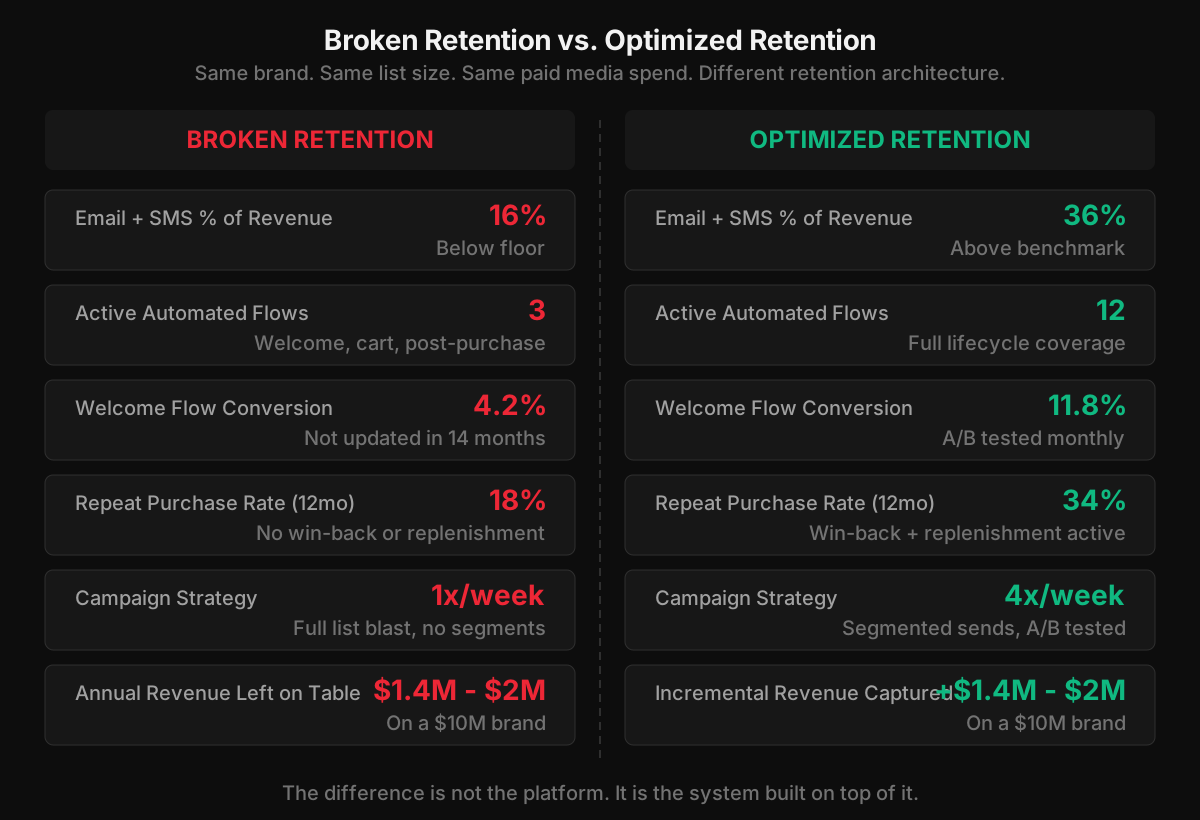
The flows still run. The numbers look okay on the surface. Open rates are "fine." But when you actually pull the revenue data, email and SMS account for 15-20% of total revenue. For a well-architected retention program, that number should be 30-40%.
That gap is not marginal. On a $10M brand, that is $1.5M to $2M in annual revenue sitting in your existing customer base, unactivated. Not because the customers do not exist. Because the system designed to reach them was built once and never rebuilt.
According to McKinsey's personalization research, companies that excel at personalization generate 40% more revenue from those activities than average players. That is not an email metric. That is a business metric. And it directly connects to what a retention marketing agency builds.
The reason this gap exists is simple. Retention is not email. Email is a channel. Retention is an interconnected system of behavioral triggers, segmentation logic, cross-channel orchestration, and measurement tied to unit economics. Most brands treat it as the former. The ones that grow treat it as the latter.
What a Retention Marketing Agency Actually Manages
The phrase "retention marketing agency" is vague enough that it means different things to different people. Some agencies will send your weekly campaigns and call it retention. That is email marketing services. A real retention agency manages the full retention stack, and the scope is significantly broader than most brands realize.
This is what a real engagement looks like:
Function | What Is Managed | Frequency | KPIs |
|---|---|---|---|
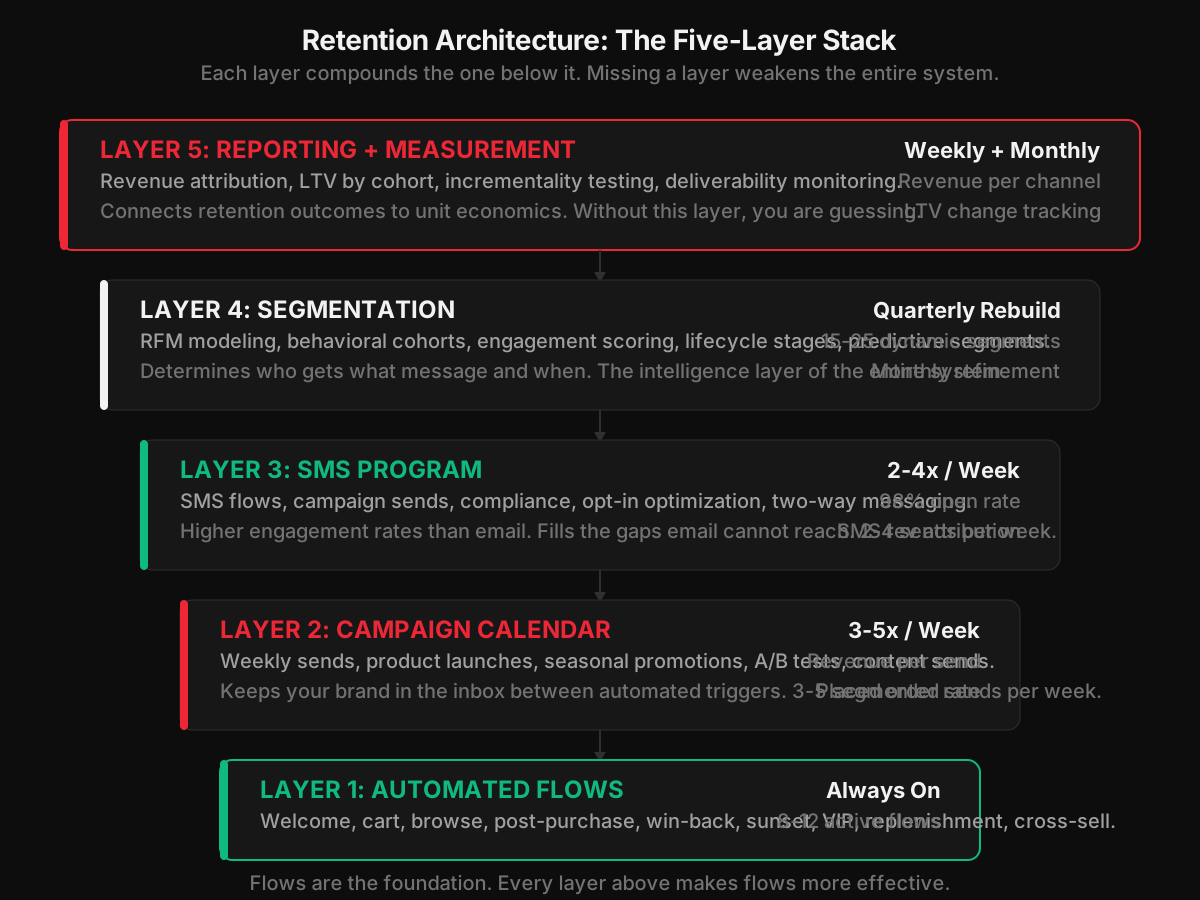
Automated Flows | Welcome, abandoned cart, browse abandonment, post-purchase, win-back, sunset, VIP, replenishment, cross-sell | Built once, optimized monthly | Flow revenue per recipient, conversion rate, revenue per flow |
Campaign Calendar | Weekly sends, product launches, seasonal promotions, content-driven sends, A/B tests | 3-5 campaigns per week | Revenue per send, placed order rate, list growth rate |
SMS Program | SMS flows, campaign sends, compliance management, opt-in optimization, two-way messaging | 2-4 SMS sends per week | SMS revenue attribution, opt-out rate, cost per conversion |
Segmentation | RFM modeling, behavioral cohorts, purchase frequency tiers, engagement scoring, predictive segments | Rebuilt quarterly, refined monthly | Segment performance differential, suppression accuracy, deliverability |
Reporting | Revenue attribution, LTV by cohort, incrementality testing, channel contribution, deliverability monitoring | Weekly reporting, monthly strategy reviews | Revenue attributable to retention, LTV change, repeat purchase rate |
If you are paying an agency and they are only covering one or two rows of this table, you do not have a retention agency. You have an email vendor. The difference matters because each function reinforces the others. Segmentation makes flows smarter. Flows feed campaign strategy. SMS fills the gaps email cannot reach. Reporting tells you which of these investments actually moved the needle.
This is why retention, when managed as a complete architecture, compounds. Every improvement to one layer creates leverage across the others.
Why Your CAC Math Breaks Without Retention
This is the section that matters most if you are running paid media. And we know you are, because that is the buyer profile for every retention engagement we close.
Here is the math. Say your blended CAC is $45. Your average first-purchase AOV is $65. Your gross margin is 65%. That means you make approximately $42.25 on the first order before you account for acquisition cost. After CAC, you made negative $2.75 on that customer.
If that customer never comes back, you lost money acquiring them. Every dollar you spent on Meta, Google, and TikTok to bring them in was a net loss. Your growth marketing strategy only works if the second, third, and fourth purchases happen. And those purchases are retention's job.
According to Harvard Business Review, increasing customer retention rates by 5% increases profits by 25-95%. That is not a theoretical number. It is the mathematical reality of what happens when you stop treating every sale as a standalone transaction and start treating your customer base as a compounding asset.
When brands tell us their CAC is "too high," the first thing we look at is retention. Not because paid media does not matter. Because paid media without retention is a leaking bucket. You are paying to fill it. Retention is what keeps the water in.
This is also why brands that bundle retention with paid media see better outcomes than those who run them separately. When the retention team knows your CAC by channel and the paid team knows your LTV by segment, both teams make smarter allocation decisions. The data has to flow both directions.
The Klaviyo Problem: Why Platform Access Is Not Strategy
We are putting this in its own section because "Klaviyo agency" is where a significant portion of search volume lives, and because the confusion between platform management and retention strategy is the single biggest reason brands underinvest in this area.
Klaviyo is excellent software. It handles email, SMS, segmentation, flows, reporting, and integrations with Shopify and most ecommerce stacks. For a brand doing under $2M in revenue with a founder who has 10 hours a week to dedicate to email, Klaviyo's built-in templates and pre-built flows are genuinely sufficient.
But Klaviyo does not make strategic decisions. It does not tell you which segments to prioritize. It does not design a lifecycle architecture that maps to your specific product repurchase cycle. It does not know that your VIP segment responds to early access while your lapsed buyers need a different incentive. It does not optimize your send cadence against deliverability signals. It does not connect your email revenue to your paid media CAC to determine whether you are actually profitable.
This is what a retention marketing agency layered on top of Klaviyo provides. The platform is the instrument. The agency is the musician. A $50,000 piano does not produce great music on its own.
Here is what proper Klaviyo architecture looks like when managed by an agency versus the typical self-managed setup:
Self-managed Klaviyo (typical): 3-4 basic flows (welcome, abandoned cart, post-purchase thank you), weekly campaign blast to full list, default segments, deliverability unchecked, no A/B testing, no SMS integration, reporting limited to dashboard metrics.
Agency-managed Klaviyo: 8-12 behavior-triggered flows, 3-5 segmented campaigns per week, RFM-based segment architecture, monthly deliverability audits, continuous A/B testing on subject lines, send times, and content, integrated SMS program, revenue attribution tied to incrementality, quarterly lifecycle redesign based on performance data.
The gap between those two setups is the 30-40% revenue difference we referenced at the top. It is not a platform problem. It is a strategy and execution problem. And that is exactly what a retention marketing agency solves.
Retention Performance Benchmarks: Where You Should Be
Benchmarks matter because most brands have no idea whether their retention program is performing well or poorly. They see revenue attributed to email in Klaviyo and assume things are working. Without context, those numbers are meaningless.
Here are the benchmarks we use at Darkroom across our retention engagements, broken down by revenue stage:
Metric | $1M-$5M Revenue | $5M-$15M Revenue | $15M-$50M Revenue |
|---|---|---|---|
Email + SMS % of Total Revenue | 20-25% | 28-35% | 32-40% |
Welcome Flow Conversion Rate | 5-8% | 8-12% | 10-15% |
Abandoned Cart Recovery Rate | 3-5% | 5-8% | 7-10% |
Repeat Purchase Rate (12mo) | 20-25% | 28-35% | 35-45% |
Active Automated Flows | 5-6 | 8-10 | 12-15+ |
Campaign Send Frequency | 2-3/week | 3-5/week | 5-7/week |
SMS Subscriber Rate (of email list) | 10-15% | 15-25% | 20-30% |
Email List Growth Rate (monthly) | 8-12% | 5-8% | 3-5% |
If you are below these benchmarks in more than two categories, your retention program is underperforming. And if you are significantly below in most categories, the revenue opportunity from fixing it is substantial enough to justify the investment in an agency.
The Four Signs You Need a Retention Agency Now
Not every brand needs an agency. Some are early enough that a founder or marketing manager can handle email themselves. But there are specific inflection points where doing it in-house stops making sense and starts costing you money. Here is the framework we use to evaluate readiness.
Sign 1: Your Flows Have Not Been Updated in 6+ Months
Flows are not set-and-forget. Customer behavior changes. Product catalogs evolve. Seasonality shifts. Best practices around deliverability, send timing, and content format change constantly. A flow you built 18 months ago is operating on assumptions that may no longer be true.
We audit retention programs regularly where the abandoned cart flow still references a promotion that ended 8 months ago, or the welcome series sends 7 emails over 3 days because someone read a blog post that said "more touchpoints = more conversion." Stale flows do not just underperform. They actively damage deliverability and brand perception.
Sign 2: Email and SMS Drive Less Than 30% of Revenue
This is the clearest signal. If your owned channels account for less than 30% of total revenue, there is a structural problem in your retention architecture. Either your list is under-monetized, your flows are underbuilt, your segmentation is too broad, or your campaign strategy is nonexistent.
For context, the best-performing DTC brands we work with drive 35-45% of total revenue through email and SMS combined. That is not because they send more emails. It is because every message is targeted, timed, and relevant to the recipient's lifecycle stage.
Sign 3: Your CAC Is Rising and You Have Not Addressed Retention
CAC increases are a reality of paid media in 2026. Meta's ad revenue continues climbing, which means CPMs go up and your cost to acquire goes up with them. The only way to maintain profitability when CAC rises is to increase LTV. And LTV is a retention metric.
If your response to rising CAC is only to optimize ad creative and bidding strategy, you are fighting on one front. Performance creative matters. But the brands that maintain margin in expensive acquisition environments are the ones who extract maximum value from every customer they already acquired.
Sign 4: You Are Spending $20K+/Month on Paid Media Without a Retention Partner
This is the economic argument. If you are spending $20,000 or more per month on acquisition, you are bringing in enough new customers that even a modest retention improvement creates significant revenue. A 10% improvement in repeat purchase rate on a $20K/month ad spend that generates 1,000 new customers per month means 100 additional repeat purchases per month. At a $65 AOV, that is $6,500/month in incremental revenue from retention work that costs $5,000-$8,000/month.
The math only gets more favorable as spend increases. Which is why most of our retention clients are brands already doing performance creative and paid media with us who realize the back end of the funnel needs the same level of sophistication as the front end.
How Retention Integrates With Your Paid Media Strategy
This is where Darkroom's full-service model creates an advantage that single-channel agencies cannot replicate. Retention and acquisition are not separate disciplines. They are two halves of the same P&L.
Here is how the integration works in practice:
Audience suppression. Your retention team identifies customers who are already in an active email flow. Your paid media team suppresses those audiences from acquisition campaigns. Result: you stop paying to re-acquire people who are already in your pipeline. We have seen brands waste 8-15% of ad spend retargeting customers who were about to receive an email that would have converted them for free.
LTV-informed bidding. When retention builds LTV models by segment, paid media can bid more aggressively for customer profiles that have higher predicted repeat rates. A customer who is likely to purchase 3 times in 12 months is worth a higher CPA than one who purchases once. Without retention data, your bidding treats all customers as equal. They are not.
Post-purchase handoff. The moment a paid media conversion happens, retention takes over. The quality of that handoff determines whether the customer becomes a one-time buyer or a long-term asset. A well-designed post-purchase flow can increase second-purchase rates by 20-30% compared to a generic thank you email.
Win-back vs. re-acquisition. When a customer lapses, should you try to win them back via email or re-acquire them via paid ads? The answer depends on their engagement history, time since last purchase, and your cost to re-engage versus cost to re-acquire. This decision requires data from both teams.
Brands that run retention and paid media under separate agencies with no data sharing leave these optimizations on the table. The relationship between agency and brand works best when the retention data informs acquisition strategy in real time.
The Retention Audit Framework: Evaluating Your Current State
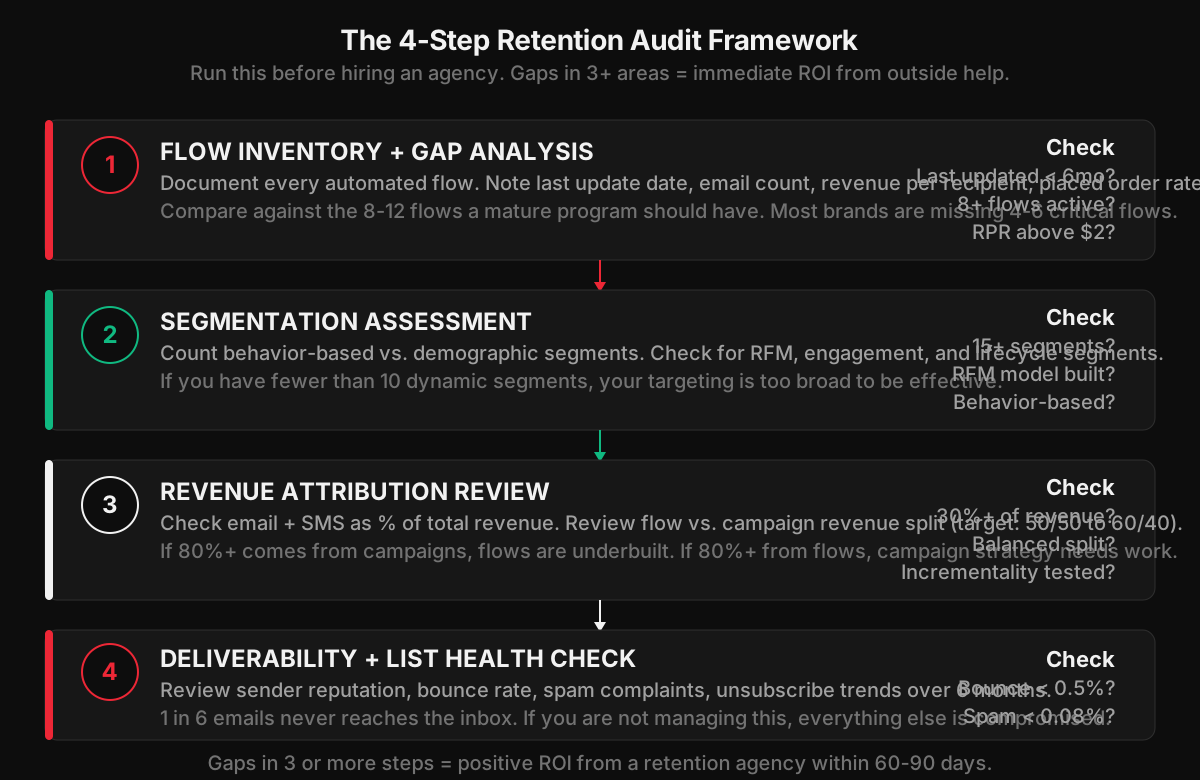
Before you hire an agency, you need to know where you stand. This is the four-step audit framework we use in every initial engagement. You can run a version of it yourself to understand the scope of the opportunity.
Step 1: Flow Inventory and Gap Analysis
Document every automated flow currently running. For each flow, note: when it was last updated, how many emails or SMS messages it contains, its revenue per recipient over the last 90 days, and its placed order rate. Then compare against the full list of flows a mature retention program should have. Most brands discover they are missing 4-6 critical flows entirely.
Step 2: Segmentation Assessment
Pull your current segment list. Count how many segments are behavior-based versus demographic-based. Check whether you have RFM segments, engagement-based segments, and lifecycle stage segments. If your segments are primarily "all customers," "purchased in last 30 days," and "VIP," your segmentation is not sophisticated enough to support targeted messaging. A retention agency typically builds 15-25 dynamic segments that inform every flow and campaign.
Step 3: Revenue Attribution Review
Look at what percentage of total revenue Klaviyo attributes to email and SMS. Then look at the split between flow revenue and campaign revenue. Healthy programs have a 50/50 to 60/40 split between flows and campaigns. If 80%+ of your retention revenue comes from campaigns, your flows are underperforming. If 80%+ comes from flows, your campaign strategy needs work.
Step 4: Deliverability and List Health Check
Check your sender reputation scores. Review your bounce rate, spam complaint rate, and unsubscribe rate trends over the last 6 months. If any of these are trending upward, you have a deliverability problem that is silently reducing the effectiveness of everything else. According to Validity's State of Email report, one in six legitimate emails never reaches the inbox. If you are not actively managing deliverability, your retention program is fighting with one hand tied behind its back.
If this audit reveals gaps in three or more areas, the return on hiring a retention marketing agency will be positive within 60-90 days. That is not a sales pitch. That is math. The revenue sitting in your existing customer base is already there. You just need the system to activate it.
What the First 90 Days With a Retention Agency Look Like
Understanding the timeline matters because it sets expectations. Retention is not a switch you flip. It is infrastructure you build. Here is what a typical engagement looks like at Darkroom.
Days 1-30: Audit and Foundation. We audit every existing flow, campaign, segment, and deliverability metric. We conduct a full Klaviyo architecture review. We identify the highest-impact gaps and build a prioritized roadmap. We fix any deliverability issues immediately because nothing else works if your emails are not reaching inboxes.
Days 30-60: Core Build. We rebuild or create the critical flows: welcome series, abandoned cart, post-purchase, browse abandonment, and win-back. We build the segmentation architecture. We launch the SMS program if one does not exist. We start the campaign calendar with 3-5 weekly sends.
Days 60-90: Optimization and Expansion. We A/B test subject lines, send times, content formats, and offers across every flow. We add secondary flows: VIP recognition, replenishment, cross-sell, and sunset. We build the reporting framework that ties retention revenue to unit economics. We start sharing LTV data with the paid media team to inform bidding.
By day 90, most brands see a 15-30% increase in revenue attributed to email and SMS. Not because we discovered some secret. Because we built the system that should have existed from the start and optimized it with data the brand already had but was not using.
Why Retention Is the Highest-ROI Agency Investment
Every agency service has an ROI profile. Paid media delivers immediate volume but requires continuous spend. Performance creative improves efficiency but needs constant iteration. Retention is different because it compounds.
A flow you build today will generate revenue next week, next month, and next year. Every customer who enters your welcome series, moves through your post-purchase sequence, and gets re-engaged by your win-back flow is generating revenue without incremental acquisition cost. The work is front-loaded. The returns are ongoing.
This is also why retention is the stickiest agency service. Once the infrastructure is built and working, brands rarely bring it back in-house. The cost of a retention agency at $5,000-$10,000/month is trivial relative to the revenue it manages. And the alternative, hiring an in-house lifecycle marketer at $85K-$120K plus benefits, plus the tools, plus the learning curve, almost always costs more and delivers less in the first 12 months.
For brands evaluating where to allocate their next dollar of agency spend, retention has the most asymmetric upside. The ceiling is high, the floor is knowable, and the payback period is short. If your retention budget is currently zero, the first dollar you spend here will outperform the marginal dollar spent on any other channel.
The Loyalty Connection: Why Programs Fail Without Retention Infrastructure
Many brands launch a loyalty program thinking it will solve retention. Points. Tiers. Rewards. The logic makes sense on paper: give customers a reason to come back.
But loyalty programs are communication-dependent. A customer who earns 500 points but never receives a well-timed, personalized notification about those points will not redeem them. A VIP tier that is not integrated into your email segmentation and flow architecture is invisible to the customer.
Loyalty programs fail without retention infrastructure because the program is the incentive and the retention system is the delivery mechanism. Building one without the other is like designing a product but never building the distribution. The best loyalty programs we have seen are not the ones with the most creative reward structures. They are the ones embedded into a retention architecture that ensures the right message reaches the right customer at the right time.
FAQ
What does a retention marketing agency do?
A retention marketing agency builds and manages the systems that turn one-time buyers into repeat customers. This includes email and SMS flow architecture, campaign strategy, advanced segmentation, Klaviyo or platform management, deliverability monitoring, and lifecycle reporting tied to revenue outcomes rather than vanity metrics.
How much does a retention marketing agency cost?
Retention marketing agencies typically charge $3,000 to $12,000 per month depending on list size, number of flows, SMS volume, and reporting complexity. Brands doing $5M to $30M in annual revenue usually invest $5,000 to $10,000 per month for a managed retention program.
When should a DTC brand hire a retention marketing agency?
Hire a retention agency when your email list exceeds 15,000 subscribers, your flows have not been updated in 6 or more months, email and SMS drive less than 30% of total revenue, or your CAC is rising and you need owned channels to offset acquisition costs. Most brands wait too long and leave significant revenue on the table.
What is the difference between a Klaviyo agency and a retention agency?
A Klaviyo agency manages your Klaviyo account: building flows, sending campaigns, and maintaining the platform. A retention marketing agency does all of that plus the strategic layer: segmentation architecture, lifecycle design, cross-channel orchestration between email and SMS, measurement tied to LTV and unit economics, and integration with your broader growth strategy including paid media.
How do I know if my retention program is underperforming?
Key indicators: email and SMS drive less than 30% of total revenue, your welcome flow conversion rate is below 8%, abandoned cart recovery is under 5%, repeat purchase rate is below 25%, and you have fewer than 8 active automated flows. If your flows have not been updated in 6 or more months, they are almost certainly underperforming current benchmarks.
Can a retention agency work alongside my existing paid media agency?
Yes, and the best outcomes happen when retention and paid media share data. When your retention agency understands CAC by channel and your paid media team understands LTV by segment, both teams make better decisions. Many brands eventually consolidate under one agency for this reason.
How long does it take to see results from a retention agency?
Most brands see measurable improvement within 60 to 90 days. The first 30 days focus on auditing existing flows, fixing deliverability issues, and building the segmentation foundation. Months 2 and 3 typically show 15-30% revenue lift from email and SMS as new flows go live and campaigns are optimized.
What Klaviyo flows should every ecommerce brand have?
At minimum: welcome series, abandoned cart, abandoned browse, post-purchase education, win-back, sunset suppression, VIP recognition, and replenishment or cross-sell. Most brands have 3 to 4 of these. A retention agency builds all 8 or more and continuously optimizes them based on performance data.
Audit Your Retention Stack With Darkroom
If you read this far, one of two things is true. Either your retention program is already running well and this article confirmed what you already know. Or you recognized your brand in the patterns described above: stale flows, low email revenue percentage, rising CAC without a retention counterstrategy.
If it is the second, we should talk. Darkroom's retention practice manages the full lifecycle stack: Klaviyo architecture, email and SMS flows, segmentation, campaigns, and reporting tied to your actual unit economics. We integrate retention with paid media and performance creative so your customer data informs every channel decision.
Every engagement starts with a full retention audit, the same four-step framework described above. If the audit reveals meaningful revenue opportunity, which it almost always does, we build the roadmap and start executing within 30 days.