
RETENTION MARKETING
How Much Does Retention Marketing Cost in 2026? (Email, SMS & Lifecycle Pricing)




Written by Darkroom leardership

Written & peer reviewed by 4 Darkroom team members
TL;DR: Retention marketing costs range from $4,000 to $17,500 per month when you stack every layer: email platform, agency retainer, SMS, design, and integration. The agency retainer ($3K-$10K/mo) is the largest line item and the highest-ROI investment. Klaviyo platform costs scale from $150/mo at 10K profiles to $2,500+/mo at 250K. SMS runs $0.01-$0.015 per message. Hidden costs like migration, template design, and list cleaning add $3,500-$12,500 upfront. The good news: retention typically returns 8-12x on agency spend, making it the most efficient marketing investment most DTC brands can make. If you want to understand what these numbers look like for your brand, Darkroom builds retention systems that pay for themselves.
Why Retention Marketing Cost Is the Wrong First Question
Every brand eventually asks the same question: how much does email marketing cost? How much does a Klaviyo agency charge? What should we budget for SMS? These are reasonable questions. They are also the wrong starting point.
The right first question is: how much revenue are we leaving on the table by not investing in retention? For most DTC brands doing $3M-$20M in revenue, the answer is somewhere between $300,000 and $2,000,000 per year. That is not a theoretical number. It comes from the gap between where their email and SMS revenue sits today (typically 15-20% of total revenue) and where it should sit with proper retention marketing architecture (30-40% of total revenue).
Cost matters. But cost without context is just a number. This article gives you both: the actual line-item costs of every retention marketing component in 2026, and the ROI framework that shows whether the investment makes sense for your business.
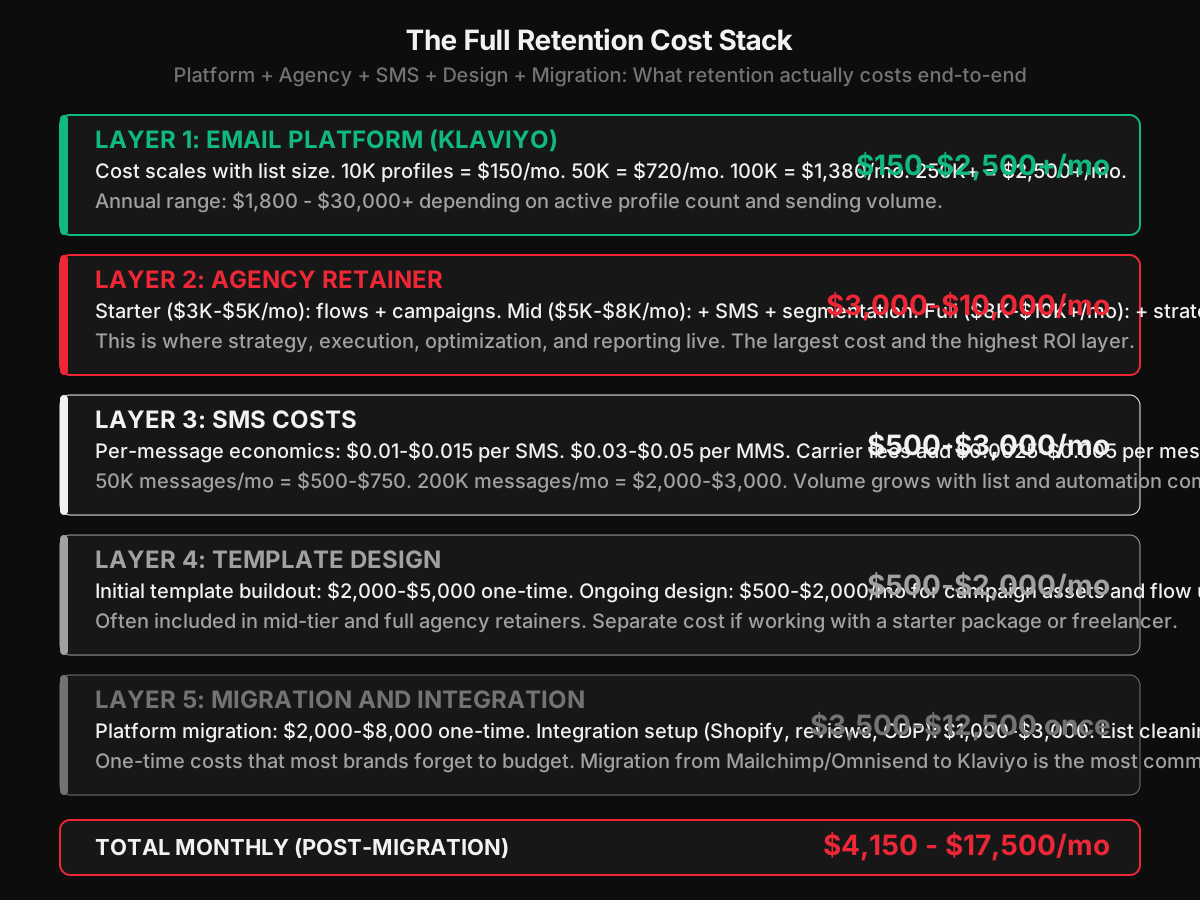
The Retention Marketing Cost Stack: Five Layers
Retention marketing is not a single expense. It is a stack of five cost layers, each with its own pricing model and scaling mechanics. Most brands only think about the first two. The last three are where surprise invoices live.
Layer 1: Email Platform Costs (Klaviyo Pricing by List Size)
Klaviyo is the dominant platform for ecommerce retention, and its pricing is straightforward: you pay based on active profile count. Here is the 2026 pricing structure for the most common list sizes:
Active Profiles | Monthly Cost | Annual Cost | Email Sends Included |
|---|---|---|---|
Up to 500 | Free | $0 | 500 monthly sends |
1,001 - 5,000 | $45 - $100 | $540 - $1,200 | 10x - 12x profile count |
5,001 - 15,000 | $100 - $250 | $1,200 - $3,000 | 10x profile count |
15,001 - 50,000 | $250 - $720 | $3,000 - $8,640 | 10x profile count |
50,001 - 100,000 | $720 - $1,380 | $8,640 - $16,560 | 10x profile count |
100,001 - 250,000 | $1,380 - $2,500+ | $16,560 - $30,000+ | 10x profile count |
The critical nuance: Klaviyo charges for active profiles, not total contacts. List hygiene directly impacts your platform cost. If you have 100,000 contacts but only 60,000 are engaged, proper list management saves you $300-$500 per month. This is why list cleaning is not optional. It is a cost management strategy.
Brands that skip list hygiene end up paying for profiles that will never convert. A good retention marketing agency starts every engagement with a list audit precisely because it reduces your ongoing platform cost while improving deliverability.
Layer 2: Agency Retainer Costs by Tier
This is the line item that gets the most questions and the vaguest answers. Here is what retention agency pricing actually looks like in 2026, broken down by what you get at each tier:
Tier | Monthly Retainer | What Is Included | Best For |
|---|---|---|---|
Starter | $3,000 - $5,000 | Core flow setup (welcome, cart, post-purchase), 3-4 campaigns/week, basic segmentation, monthly reporting | Brands at $1M-$5M revenue getting serious about retention for the first time |
Mid-Tier | $5,000 - $8,000 | Full flow architecture (8-12 flows), SMS program, advanced segmentation, A/B testing cadence, bi-weekly strategy calls, template design | Brands at $5M-$15M with established acquisition spending and retention underperforming |
Full-Service | $8,000 - $10,000+ | Lifecycle strategy, cross-channel orchestration, advanced analytics and attribution, CDP integration, weekly strategy calls, dedicated account team | Brands at $15M+ where retention is a primary revenue lever and complexity demands senior strategy |
The difference between tiers is not just volume of work. It is the depth of strategic thinking applied. A starter engagement optimizes what exists. A mid-tier engagement rebuilds the architecture. A full-service engagement designs the entire email marketing revenue architecture from customer data through to attribution.
One pattern we see repeatedly: brands start at the starter tier, realize they need strategic depth, and move to mid-tier within 3-4 months. If your retention marketing budget allows for mid-tier from the start, the time to ROI is significantly faster.
Layer 3: SMS Costs (Per-Message Economics)
SMS is the fastest-growing retention channel and the one with the most misunderstood cost structure. Unlike email where you pay per profile, SMS charges per message sent. The economics look like this:
Base message cost: $0.01-$0.015 per SMS (text only). MMS messages with images: $0.03-$0.05 per message. Carrier fees: $0.0025-$0.005 per message on top of base cost. These add up fast. A brand sending 100,000 SMS messages per month pays $1,000-$1,500 in messaging costs alone, before any platform fees.
But here is what makes SMS economics work: revenue per message is dramatically higher than email. A well-segmented SMS campaign generates $0.10-$0.30 per message sent, compared to $0.01-$0.05 for email. The cost-per-message is higher, but the return-per-message is 5-10x higher. This is why the email versus SMS revenue question is not about choosing one channel. It is about understanding the different economics of each.
SMS costs scale with automation complexity. More flows firing more messages means higher monthly send volume. A starter SMS program might send 20,000-30,000 messages per month. A mature program with triggered flows, campaigns, and conversational SMS can reach 200,000+ messages monthly.
Layer 4: Template Design Costs
This is the cost most brands forget until they see the first round of agency deliverables. Retention emails need to look good, load fast, and render correctly across 50+ email clients. That requires professional template design.
Initial template buildout typically runs $2,000-$5,000 one-time. This covers your core templates: promotional campaign, flow emails, product announcement, content/editorial, and transactional. Ongoing design for weekly campaigns, seasonal updates, and flow optimization adds $500-$2,000 per month.
Mid-tier and full-service agency retainers usually include design. If you are on a starter package or working with a freelance strategist, design is a separate line item. The quality gap between template-based design and custom performance creative is significant in terms of conversion rates. Templates convert. Custom design optimized for your audience converts better.
Layer 5: Migration and Integration Costs
If you are switching platforms (Mailchimp to Klaviyo is the most common migration path), budget for one-time costs that rarely appear in initial proposals:
Platform migration: $2,000-$8,000 depending on complexity. This includes moving subscriber lists, recreating flows, migrating templates, and setting up tracking. The price scales with how many flows and segments need to be rebuilt. A brand with 3 basic flows migrates for $2,000. A brand with 15 flows and complex segmentation logic pays $6,000-$8,000.
Integration setup: $1,000-$3,000. Connecting Klaviyo to Shopify, review platforms (Yotpo, Judge.me), loyalty programs, CDPs, and analytics tools requires configuration work. Each integration has nuances that affect data flow and trigger reliability.
List cleaning: $500-$1,500. Before migrating, you need to verify email addresses, remove invalid contacts, and segment by engagement recency. This reduces your Day 1 platform cost and protects your sender reputation on the new platform.
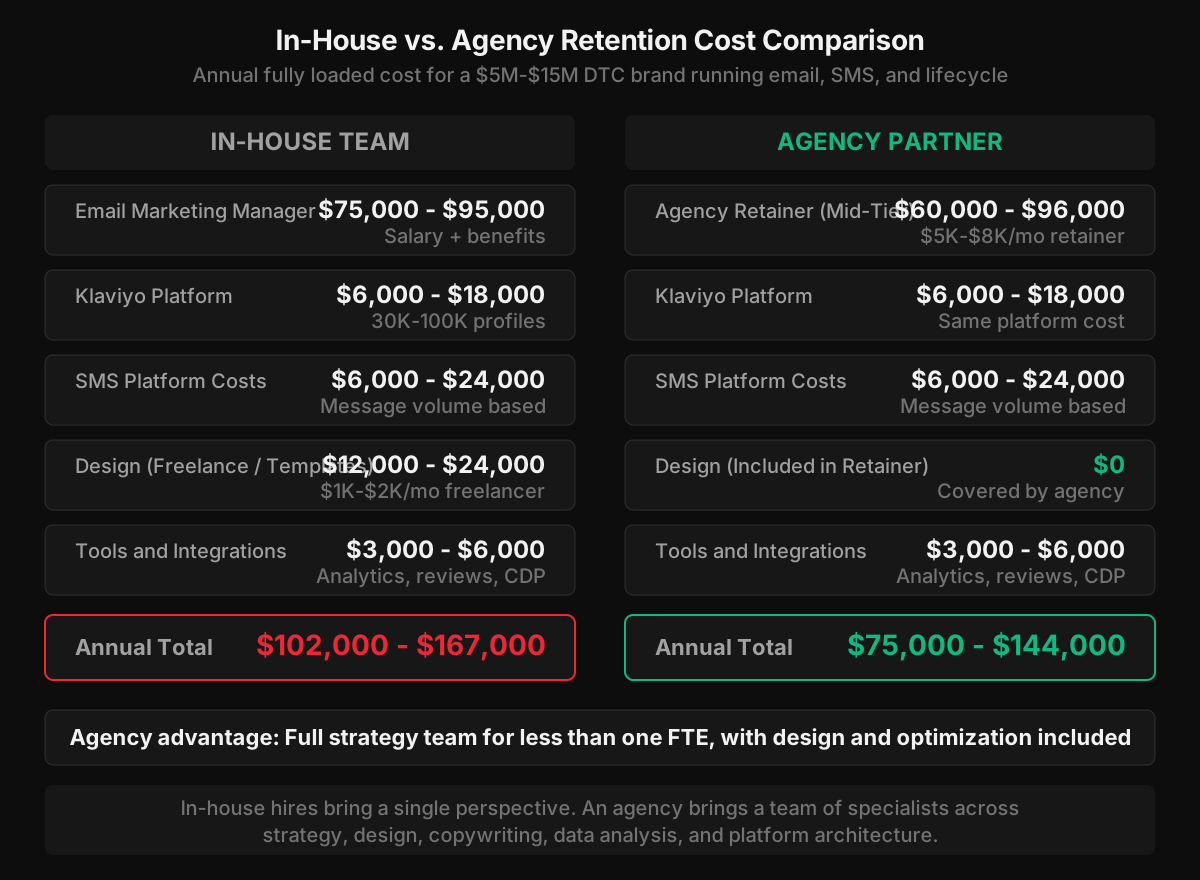
In-House vs. Agency: The Real Cost Comparison
The most common alternative to hiring an agency is hiring an in-house email marketing manager. Here is how those costs actually compare for a mid-market DTC brand ($5M-$15M revenue).
An in-house email marketing manager costs $75,000-$95,000 annually in salary and benefits. Add $12,000-$24,000 for freelance design support, $6,000-$18,000 for the Klaviyo platform, $6,000-$24,000 for SMS, and $3,000-$6,000 for supplementary tools. Total in-house cost: $102,000-$167,000 per year.
A mid-tier agency retainer costs $60,000-$96,000 annually ($5K-$8K/mo). Add the same platform and SMS costs (those do not change with an agency), and you get $75,000-$144,000 per year. The agency provides an entire team: strategist, designer, copywriter, data analyst, and platform specialist. The in-house hire is one person doing all of those jobs.
The cost difference is smaller than most people expect. But the capability difference is significant. A single hire brings one perspective and one skillset. An agency brings a full retention marketing stack of specialized knowledge across hundreds of brands.
There is an important caveat: once you reach $20M+ in revenue and retention is generating 35%+ of total revenue, bringing strategy in-house and using an agency for execution or specialized projects often makes sense. The breakpoint is not about cost. It is about whether you have enough complexity and volume to justify a full internal team.
The Hidden Costs Nobody Tells You About
Beyond the five-layer cost stack, several expenses consistently surprise brands in their first year of serious retention investment:
Deliverability recovery: If your sender reputation has been damaged by years of poor list management or aggressive sending, fixing it takes 4-8 weeks of careful warm-up. Some agencies charge separately for deliverability audits and recovery ($1,000-$3,000). Others include it in onboarding. Ask before you sign.
Pop-up and form tools: List growth depends on on-site capture. Tools like Justuno, Privy, or Klaviyo's native forms cost $0-$200/mo depending on features. The real cost is the design and A/B testing time to optimize them, which your agency should be handling.
Review and UGC platforms: Post-purchase flows that request reviews depend on integration with platforms like Yotpo, Judge.me, or Stamped.io. These run $50-$500/mo depending on order volume. They are not retention costs per se, but they are required infrastructure for the flows that drive repeat purchases.
Data and analytics tools: Advanced retention strategy requires analytics beyond what Klaviyo provides natively. Tools like Lifetimely for cohort analysis ($150-$300/mo), Triple Whale or Northbeam for attribution, and custom dashboard tools add $200-$1,000/mo to the stack.
Seasonal surge costs: SMS and email volume spikes during BFCM, holiday season, and major promotions can push platform and messaging costs 2-3x above normal monthly rates. Budget for Q4 costs that are 50-100% higher than your average monthly spend.
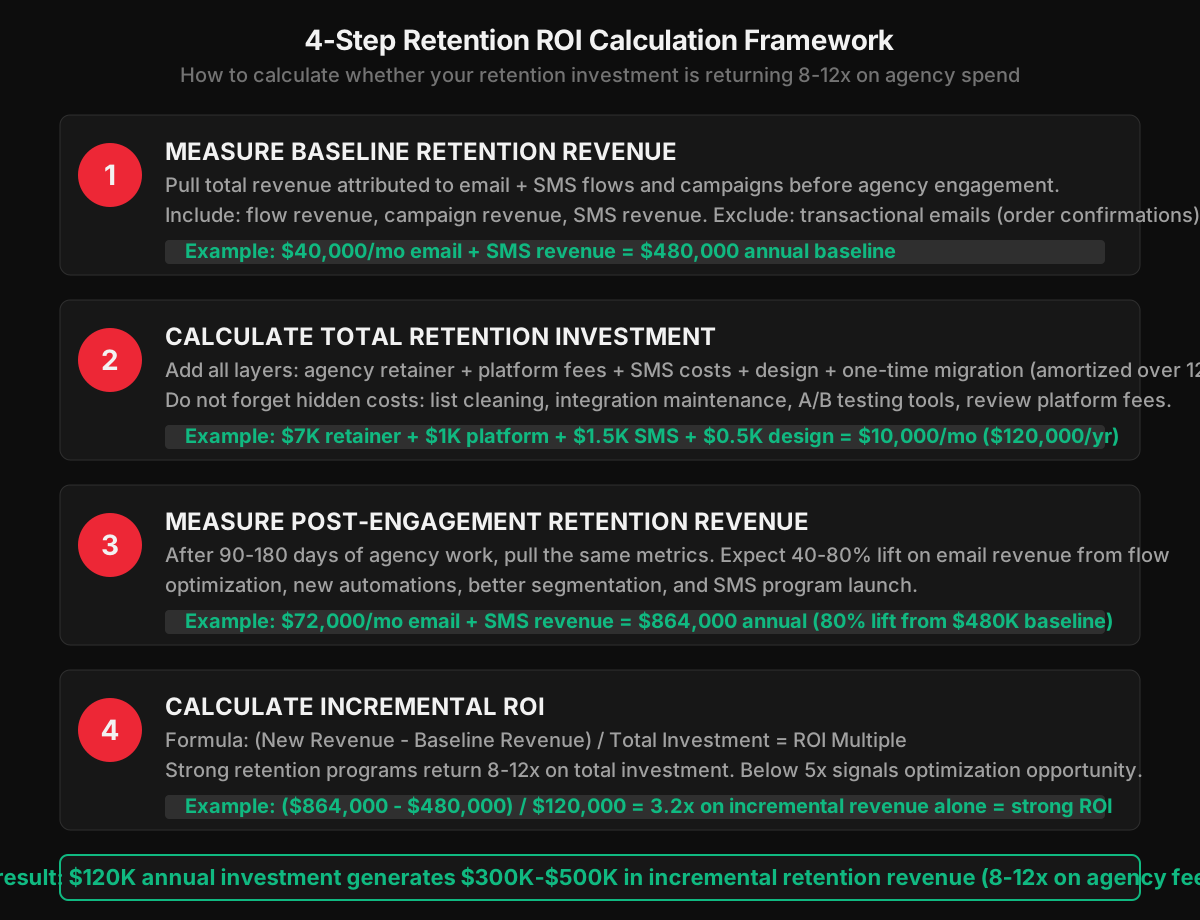
The ROI Math: Why Retention Returns 8-12x on Agency Spend
This is the number that makes every cost discussion irrelevant once you see it. Retention marketing, when executed properly, consistently returns 8-12x on agency fees alone. Here is how the math works.
Take a brand doing $8M in annual revenue with email and SMS generating 18% of total ($1.44M annually, or $120K/mo). They invest $7,000/mo in an agency retainer, $1,000/mo in platform, $1,500/mo in SMS costs, and $500/mo in design. Total monthly investment: $10,000.
After 6 months of agency work, email and SMS revenue grows from 18% to 32% of total revenue. On the same $8M topline, that is $2.56M annually from retention, or $213K/mo. The incremental revenue is $93,000 per month, against $10,000 in total retention costs. That is a 9.3x return on total investment, or a 13.3x return on agency fees alone.
This math holds because retention revenue is largely incremental. These are customers who already exist in your database. You are not paying acquisition costs to reach them. The cost to generate $1 in retention revenue is roughly $0.08-$0.12, compared to $0.25-$0.50 for a dollar of acquisition revenue. That is a full-funnel marketing reality that changes how you think about agency spending entirely.
The brands that see below-average ROI (3-5x instead of 8-12x) typically share one characteristic: they started retention work before their acquisition engine was generating enough volume. Retention multiplies what acquisition builds. Without enough customers entering the top of the funnel, even perfect retention systems cannot generate outsized returns.
When You Need an Agency vs. When You Do Not
Not every brand needs a retention agency. Here is an honest assessment of when the investment makes sense and when it does not.
You probably do not need an agency if: You are under $1M in annual revenue. Your email list is under 5,000 contacts. You have a team member with genuine retention expertise (not just someone who knows how to use Klaviyo). Your product has a naturally high repeat purchase rate above 40% and retention is already generating 30%+ of revenue. In these cases, platform-native tools and good templates will capture most of the value.
You likely need an agency if: You are spending $50K+/mo on paid acquisition but retention revenue is below 25% of total. Your email list has grown past 20,000 contacts and you have fewer than 8 active automated flows. Your retention marketing is failing because it started with email execution rather than customer data strategy. Your repeat purchase rate is below 25% and you do not know why. You are on Klaviyo but have never done a proper segmentation overhaul.
The tipping point for most brands is somewhere between $2M-$5M in annual revenue. At that point, the gap between what retention is producing and what it could produce justifies the investment. The retention marketing work we do at Darkroom typically starts paying for itself within the first 60-90 days.
How Retention Cost Fits Into Total Marketing Spend
Retention marketing should represent 15-25% of total marketing spend for most DTC brands. If you are spending $40,000/mo on total marketing (paid media, creative, retention, Amazon, influencer), your retention investment should be $6,000-$10,000/mo across all layers.
Here is why that ratio matters: acquisition and retention are not competing budget items. They are multipliers. Every dollar spent on paid media management becomes more valuable when retention captures and reactivates those customers. Every dollar spent on retention becomes more valuable when acquisition keeps the funnel full. The brands that grow fastest are the ones that fund both simultaneously rather than robbing one to pay the other.
A common mistake is to view retention as something you invest in "after" you have acquisition figured out. Acquisition is never figured out. CAC rises every year. Platform costs increase. Competition intensifies. Retention is the counterweight that keeps unit economics viable while you scale acquisition. That is the performance-driven approach that separates growing brands from stalling ones.
If your overall marketing services budget is constrained, prioritize the mid-tier agency retainer ($5K-$8K/mo) over premium platform add-ons or expensive supplementary tools. The strategic thinking and execution a mid-tier retainer provides generates more ROI than any tool purchase.
The Loyalty and Repeat Revenue Connection
Retention marketing costs do not exist in isolation. They sit inside a larger system of repeat revenue infrastructure that includes loyalty programs, subscription models, referral systems, and post-purchase experience design. The brands that get the highest ROI from retention spending are the ones that integrate these systems.
A loyalty program adds 10-25% to customer lifetime value, but only if retention flows are built to promote and reinforce program participation. SMS automations that remind members of points balances, tier upgrades, and exclusive offers transform a passive loyalty program into an active revenue driver. The marginal cost of adding loyalty messaging to your existing retention flows is near zero, but the incremental revenue is substantial.
This is also where the agency versus in-house question gets clearer. An in-house email manager rarely has the bandwidth or expertise to integrate loyalty, subscription, and retention systems into a cohesive architecture. A best-in-class DTC agency does this as a standard part of lifecycle strategy.
How to Evaluate Retention Agency Proposals
When you start soliciting proposals from retention agencies, look for these signals that separate real operators from email template factories:
Specificity on deliverables: Good agencies tell you exactly how many flows they will build, how many campaigns per week, what segmentation logic they will implement, and what reporting cadence to expect. Vague proposals that promise "email optimization" without specifics are red flags.
ROI projections with methodology: Any agency worth hiring should be able to show you their ROI calculation framework and the assumptions behind their projections. If they promise 10x ROI without explaining how they calculated that number, they are guessing.
Onboarding timeline and first 90 days: The first 90 days determine whether the engagement will succeed. Good agencies have a documented onboarding process: audit, strategy development, flow buildout, campaign launch, optimization cycle. If there is no clear plan for the first 90 days, expect slow results.
Attribution and measurement approach: Ask how they attribute revenue to retention. If the answer is "Klaviyo's built-in attribution," that is a starting point but not sufficient. Advanced agencies use incrementality testing and holdout groups to prove that retention spending is generating revenue that would not have occurred otherwise.
Contract flexibility: The best agencies offer month-to-month or 90-day commitments because they are confident in their ability to prove ROI quickly. Agencies that require 12-month contracts before showing any results are protecting themselves from underperformance.
FAQ
How much does retention marketing cost per month?
Total retention marketing costs typically range from $4,000 to $17,500 per month. This includes the agency retainer ($3,000-$10,000), email platform like Klaviyo ($150-$2,500+), SMS messaging costs ($500-$3,000), and template design ($500-$2,000). One-time migration and setup costs add $3,500-$12,500.
How much does a Klaviyo agency cost?
A Klaviyo-focused retention agency typically charges $3,000 to $10,000 per month depending on the tier. Starter packages ($3K-$5K) cover flow setup and campaign management. Mid-tier ($5K-$8K) adds SMS, segmentation strategy, and A/B testing. Full-service ($8K-$10K+) includes lifecycle strategy, advanced analytics, and cross-channel orchestration.
Is it cheaper to hire in-house or use a retention agency?
For most DTC brands in the $5M-$15M revenue range, an agency is more cost-effective. An in-house email marketing manager costs $75,000-$95,000 annually in salary and benefits alone, plus you still need design, strategy, and platform costs. A mid-tier agency retainer of $5K-$8K per month ($60K-$96K annually) provides an entire team of specialists for comparable or lower total cost.
What ROI should I expect from a retention marketing agency?
Well-run retention programs typically return 8-12x on agency fees alone. A brand investing $7,000 per month in agency retainer fees should expect to see $56,000-$84,000 in monthly incremental retention revenue within 90-180 days. The key metric is incremental revenue: the difference between retention revenue before and after agency engagement.
What are the hidden costs of retention marketing?
The most overlooked retention costs include platform migration ($2,000-$8,000 one-time), template design buildout ($2,000-$5,000 one-time), list cleaning and hygiene ($500-$1,500), integration setup with Shopify, review platforms, and CDPs ($1,000-$3,000), and SMS carrier fees that add $0.0025-$0.005 per message on top of base messaging costs.
How much does SMS marketing cost for ecommerce?
SMS marketing costs $0.01-$0.015 per text message and $0.03-$0.05 per MMS message, plus carrier fees of $0.0025-$0.005 per message. For a brand sending 50,000 messages per month, expect $500-$750 in SMS costs. At 200,000 messages per month, costs reach $2,000-$3,000. SMS typically generates higher per-message revenue than email, making the economics favorable despite higher unit costs.
When should a brand hire a retention marketing agency?
Most brands benefit from a retention agency when they cross $2M-$3M in annual revenue and are spending meaningfully on paid acquisition. At that point, the math shifts: improving retention by even 10-15% has a larger impact on profitability than increasing acquisition spend by the same percentage. Other signals include stagnant email revenue share below 25%, fewer than 8 active automated flows, and repeat purchase rates below 25%.
Build a Retention System That Pays for Itself
The cost of retention marketing is real. Platform fees, agency retainers, SMS charges, design, and migration all add up. But retention is the rare marketing investment where the ROI math is not theoretical. You can measure baseline revenue before engagement, track incremental growth during the engagement, and calculate exact return on every dollar invested.
Most brands that invest $5K-$10K per month in retention see that investment return within 60-90 days and continue compounding for years. The customers you retain today do not just buy again tomorrow. They buy again next quarter, next year, and for years beyond that. Retention revenue compounds in a way that acquisition revenue never does.
If you are evaluating retention marketing costs and want clarity on what the investment looks like for your specific brand, Darkroom's retention marketing team can build a custom cost and ROI projection based on your actual data. We do not do vague estimates. We do the math. Book a call with our team to see what retention should be producing for your business.