
RETENTION MARKETING
Email Marketing Benchmarks for Ecommerce: Flow-Level Data That Actually Matters in 2026




Written by Darkroom leardership

TL;DR
Most email marketing benchmark articles give you open rates and call it a day. This is the deeper version: flow-level benchmarks by type (welcome, cart abandonment, post-purchase, win-back, sunset), revenue benchmarks by brand size ($5M, $20M, $50M+), campaign versus flow revenue splits, email versus SMS channel allocation, and the context that tells you what these numbers actually mean for your business. If your email program is not driving 30-40% of total revenue, you are underperforming regardless of what your open rates say. Darkroom manages retention programs for ecommerce brands across Klaviyo, and these are the benchmarks we hold ourselves to.
Why Most Email Benchmarks Are Useless
Open rates do not tell you whether your email program is working. Revenue per recipient does.
Every year, Klaviyo, Mailchimp, and a dozen SaaS companies publish email benchmarks. They give you average open rates (35-42% in 2026, inflated by Apple MPP), average click rates (2-4%), and average unsubscribe rates (0.1-0.3%). These numbers are directionally accurate and operationally useless.
They are useless because they flatten all email into one category. A welcome flow email and a Tuesday promotional campaign serve fundamentally different purposes, reach fundamentally different audiences, and should be held to fundamentally different standards. Benchmarking them against the same metric is like benchmarking your car's highway speed and your walking pace and calling the average your "transportation speed." According to Klaviyo's 2026 benchmark report, ecommerce brands see a 40-60% open rate on welcome flows but only 18-25% on campaigns. Blending these into a single "open rate benchmark" helps nobody.
The benchmarks that matter are the ones that connect to revenue. Flow conversion rates by type. Revenue per recipient by segment. The split between flow revenue and campaign revenue. Email versus SMS contribution. And most importantly, email as a percentage of total business revenue. If you are not measuring these, you are optimizing for vanity metrics while leaving money on the table. This is the framework that connects to your broader email revenue architecture.
Flow-Level Benchmarks by Type
Each flow has its own performance ceiling. Comparing your welcome flow to your win-back flow is comparing entirely different jobs.
Automated flows are the compounding engine of email marketing. They run while you sleep, they improve with testing, and they generate revenue from every new subscriber or customer action. Here is where your flows should perform in 2026, based on Darkroom's portfolio data across 50+ ecommerce brands on Klaviyo, cross-referenced with Litmus State of Email 2026 industry data.
Flow Type | Open Rate | Click Rate | Conversion Rate | Revenue/Recipient |
|---|---|---|---|---|
Welcome Series | 40-60% | 8-15% | 8-12% | $1.50-$4.00 |
Cart Abandonment | 40-50% | 6-12% | 5-10% | $3.00-$8.00 |
Browse Abandonment | 30-42% | 3-7% | 2-4% | $0.40-$1.20 |
Post-Purchase | 50-65% | 5-10% | 3-6% (cross-sell) | $0.80-$2.50 |
Win-Back | 20-30% | 2-5% | 2-5% | $0.30-$1.00 |
Sunset/Re-engagement | 12-20% | 1-3% | 0.5-2% | $0.05-$0.20 |
Replenishment | 35-50% | 5-10% | 6-12% | $2.00-$5.00 |
What these numbers actually mean. Your welcome flow is your highest-volume entry point. If it is below 40% open and 8% conversion, you are losing first-purchase revenue at scale. Cart abandonment is your highest-RPR flow because the intent is already there. If your recovery rate is below 5%, you almost certainly have a single-email flow that needs to become a multi-step sequence with SMS. The win-back flow has the lowest engagement because you are reaching people who have already disengaged. But a 2-5% conversion rate on a large lapsed-customer segment can represent significant revenue. Do not dismiss it because the open rate is low.
Replenishment flows deserve special attention. For consumable products (supplements, skincare, food), these consistently outperform post-purchase cross-sell because the timing matches actual need. If you sell consumables and do not have a replenishment flow, you are missing one of the highest-ROI automation opportunities in your stack. This connects directly to how your retention marketing stack should be architected.
Revenue Benchmarks by Brand Size
A $5M brand and a $50M brand have different retention ceilings. Here is what "good" looks like at each stage.
Benchmarks without context are dangerous. A 30% email revenue share is excellent for a $5M brand but table stakes for a $50M brand with a mature retention program. The following benchmarks are segmented by annual revenue, based on Darkroom's client portfolio and validated against Omnisend's 2026 ecommerce statistics.
Metric | $5M Brand | $20M Brand | $50M+ Brand |
|---|---|---|---|
Email + SMS Revenue | $750K-$1.5M | $4M-$7M | $12M-$20M |
% of Total Revenue | 15-30% | 20-35% | 25-40% |
Active Flows | 6-8 | 10-14 | 14-20 |
Flow vs Campaign Split | 40/60 | 50/50 | 55/45 to 60/40 |
Email vs SMS Split | 90/10 | 80/20 | 75/25 |
List Size | 15K-50K | 80K-250K | 300K-1M+ |
Campaign Frequency | 2-3x/week | 3-5x/week | 5-7x/week (segmented) |
Retention Agency Investment | $3K-$5K/mo | $5K-$10K/mo | $8K-$15K/mo |
The pattern to notice. As brands grow, the percentage of revenue from email and SMS increases, not decreases. This is counterintuitive. You would expect acquisition to dominate at scale. But what actually happens is that larger brands have larger email lists, more customer data for segmentation, more product lines for cross-sell, and the compounding effect of years of flow optimization. Understanding the cost structure of retention marketing helps contextualize these investment levels.
The flow versus campaign revenue split is particularly telling. At $5M, campaigns dominate because the brand often has few flows beyond the basics. By $50M+, flows should drive the majority of email revenue. Flows compound. Campaigns require constant manual effort. If your campaigns still account for 70%+ of email revenue at $20M, your flow architecture is underdeveloped.
Campaign vs. Flow Revenue: The Split That Reveals Your Maturity
Campaign-dependent email programs are labor-intensive and fragile. Flow-dominant programs compound automatically.
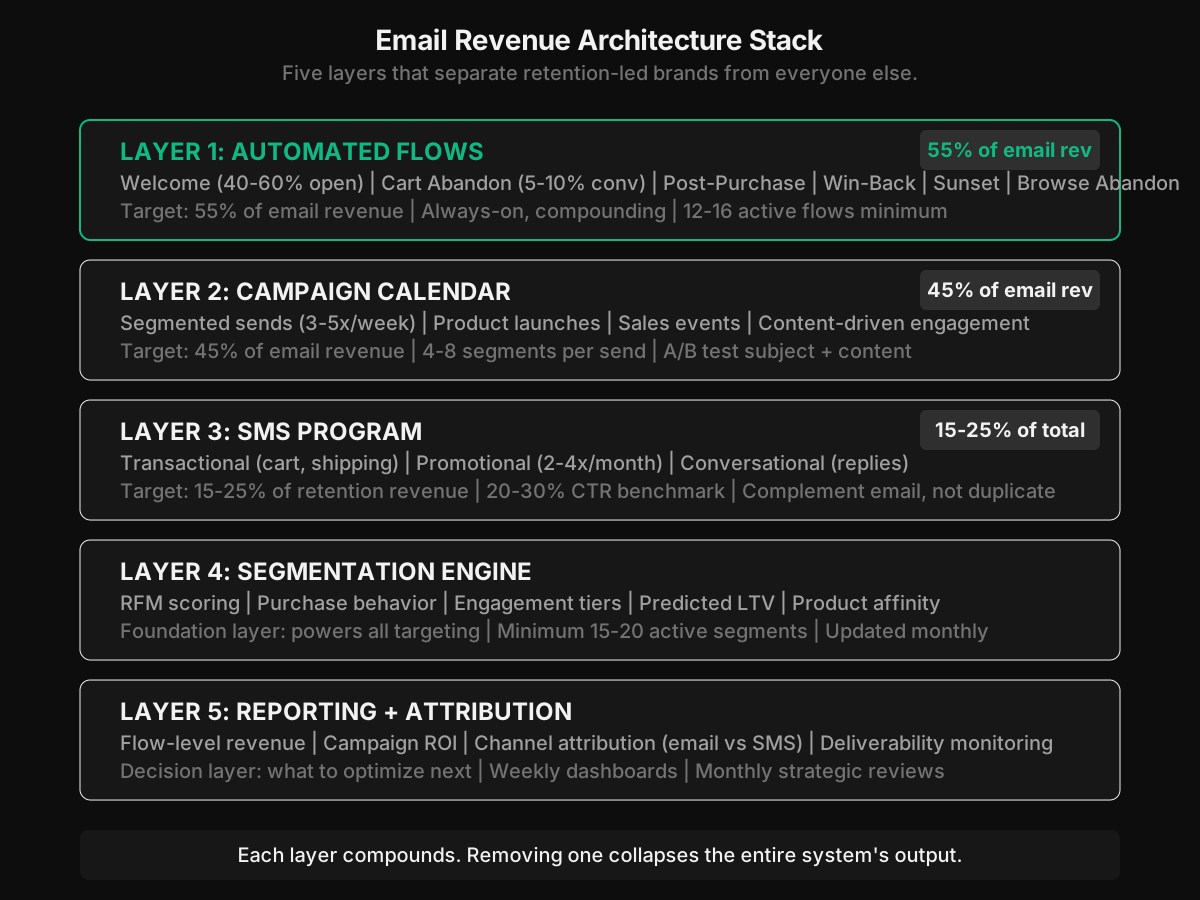
The single most diagnostic metric for an email program's health is the ratio of flow revenue to campaign revenue. Here is why: campaigns require someone to write, design, segment, schedule, and send an email every single time. If that person goes on vacation, gets sick, or quits, campaign revenue drops to zero. Flows, by contrast, run automatically. Once built and optimized, they generate revenue from every customer action without ongoing manual effort.
The benchmark progression looks like this. Early-stage programs (under $5M): 25-35% flow, 65-75% campaign. This is normal. You have a few basic flows and your revenue comes from weekly sends. Growth-stage programs ($5M-$20M): 40-50% flow, 50-60% campaign. You have built out core flows and they are starting to contribute meaningfully. Mature programs ($20M+): 50-60% flow, 40-50% campaign. Flows are the backbone. Campaigns supplement with timely content, sales, and product launches.
If you are a $20M brand with 25% flow revenue, you have a structural problem. You are doing the hard work (campaigns) while leaving the easy money (flows) undeveloped. The fix is not sending more campaigns. It is building more flows. Most brands have 4-6 flows when they should have 12-16. The missing flows (browse abandonment, replenishment, VIP, price drop, back-in-stock, cross-sell) collectively represent 15-25% of email revenue that you are not capturing. This is exactly what a retention marketing agency addresses first.
Email vs. SMS: Channel Split Benchmarks
SMS is not a replacement for email. It is a complement with different economics and different use cases.
The relationship between email and SMS is not competitive. It is complementary. Email carries the narrative (product education, brand storytelling, detailed offers). SMS carries the urgency (flash sales, cart reminders, shipping updates, time-sensitive promotions). Together, they cover the full spectrum of customer communication.
The benchmark split for most DTC brands is 75-80% email revenue and 20-25% SMS revenue. Brands in certain categories (food and beverage, beauty, supplements) may see SMS climb to 30% because their products have higher repurchase frequency and benefit from timely reminders. The key metric for SMS is not open rate (which is 95%+ and meaningless) but click-through rate (target: 20-30%) and revenue per message sent (target: $0.10-$0.40).
The common mistake is treating SMS as "short email." SMS messages should be 1-2 sentences. They should link directly to a product or cart. They should feel like a text from a friend, not a marketing message. And they should never duplicate an email that was sent the same day. The orchestration between email and SMS, meaning which channel gets which message at which time, is where most brands fail. It requires deliberate channel strategy, not just "send everything on both channels."
The Metrics That Actually Predict Revenue Growth
Open rates are vanity metrics. These five numbers predict whether your email program will grow or plateau.
1. Revenue per recipient (RPR). This is total email revenue divided by total recipients across all sends. It normalizes for list size and send frequency. The benchmark is $0.08-$0.12 for campaigns and $0.15-$0.25 for flows. If your RPR is declining month over month, you are either over-sending, under-segmenting, or suffering from creative fatigue.
2. Repeat purchase rate (RPR - different acronym, same importance). What percentage of customers buy a second time within 12 months? The ecommerce median is 25-30%. Top performers hit 35-45%. This is the ultimate retention metric because it measures whether your entire lifecycle program is working, not just email. Your loyalty program directly impacts this number.
3. List growth rate (net of churn). Gross list growth minus unsubscribes minus bounces minus suppressions. The target is 8-15% monthly net growth. If your list is shrinking or flat, your acquisition and retention programs are in a losing race. Understanding your profit per visitor helps contextualize the value of each new subscriber.
4. Flow coverage rate. What percentage of key customer actions trigger an automated flow? If a customer abandons a cart and there is no flow, that is a gap. If a customer buys and there is no post-purchase sequence, that is a gap. Top performers have flows for 12-16 customer actions. Most brands cover 4-6. Every uncovered action is leaked revenue.
5. Deliverability score. If your emails do not reach the inbox, none of the above matters. Target: 95%+ inbox placement rate, bounce rate below 0.5%, spam complaint rate below 0.08%. Use tools like GlockApps or Inbox Monster to monitor. Deliverability problems are invisible in platform dashboards until they become catastrophic.
Klaviyo-Specific Benchmarks: Platform Context That Matters
Klaviyo powers 60%+ of DTC email programs. Here is what the platform data actually tells us.
Most ecommerce brands on Klaviyo treat it as an email sending tool. The benchmark difference between brands that use Klaviyo as a sending tool versus those that use it as a retention operating system is dramatic. Sending-tool users average 15-20% of revenue from email. Retention-system users average 30-40%.
The differences are structural. Sending-tool users have basic segments (engaged 30-day, engaged 90-day). Retention-system users have 20+ segments based on RFM scoring, purchase behavior, product affinity, predicted LTV, and engagement tiers. Sending-tool users have 3-5 flows. Retention-system users have 12-16. Sending-tool users A/B test subject lines. Retention-system users test entire flow architectures, incentive strategies, and send timing across segments.
Klaviyo's predictive analytics features (predicted CLV, churn risk, next order date) are among the most underutilized tools in DTC marketing. Fewer than 20% of Klaviyo accounts use predicted CLV for segmentation. The brands that do see 15-25% higher RPR on campaigns because they are sending the right message to the right value tier. This is a capability gap, not a platform gap. The platform can do it. Most brands have not set it up. A proper retention marketing engagement addresses this from day one.
Deliverability: The Invisible Benchmark That Invalidates Everything Else
If your emails are not reaching the inbox, every other benchmark is a fiction.
Deliverability is the foundation that all email performance sits on. You can have the best subject lines, the most compelling creative, and the most sophisticated segmentation. If 15% of your emails land in spam or the Promotions tab, your effective performance is 15% lower than what your dashboard shows.
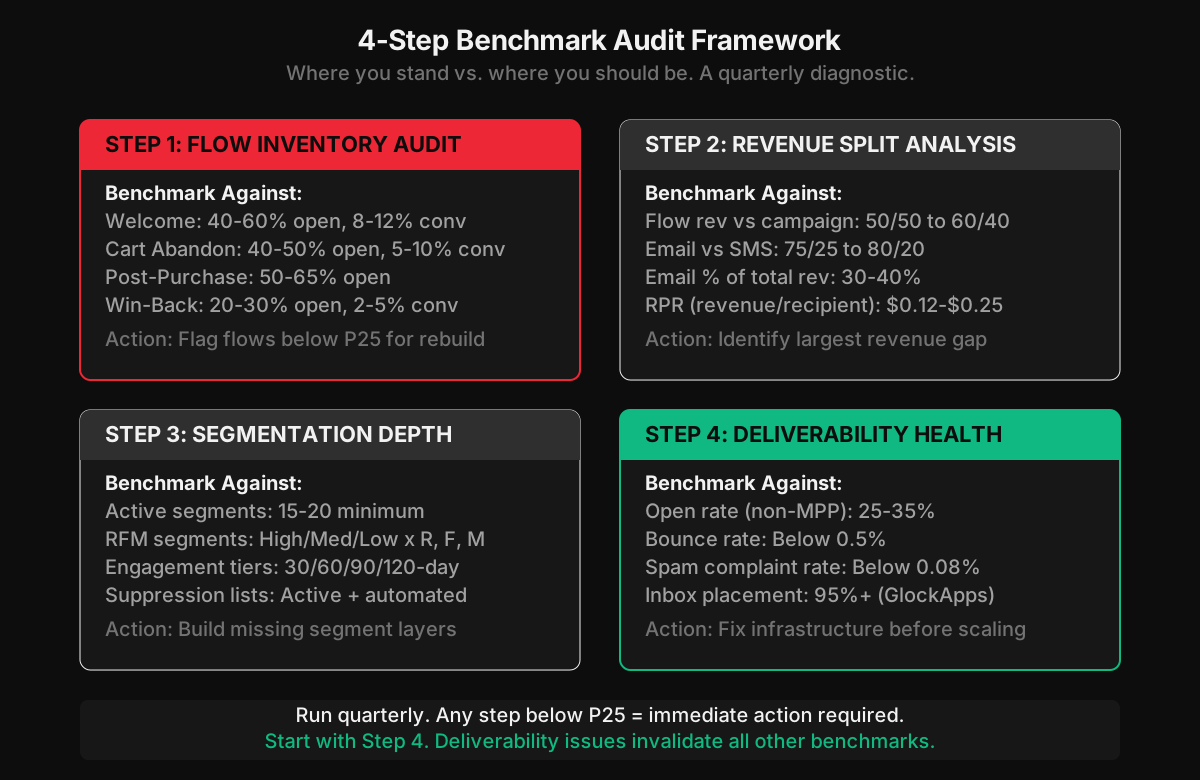
The deliverability benchmarks for 2026: inbox placement rate should be 95%+ (measure with a seed list tool, not Klaviyo's built-in metrics). Bounce rate should be below 0.5% per send. Spam complaint rate should be below 0.08% (Google's threshold for reputation damage). Unsubscribe rate should be below 0.3% per campaign send. If any of these are off, fix them before optimizing anything else. A brand with 85% inbox placement and great creative will always underperform a brand with 98% inbox placement and decent creative.
The most common deliverability killers in 2026: sending to unengaged subscribers (anyone who has not opened or clicked in 120+ days should be suppressed or sunset), sudden volume spikes (increasing send volume by more than 30% week-over-week triggers spam filters), and authentication gaps (DMARC, DKIM, and SPF must all be properly configured). These are technical issues that require expertise to diagnose and fix, which is why they persist for months in brands without dedicated retention oversight.
What These Benchmarks Mean For Your Business
Numbers without context are just numbers. Here is the interpretive framework that turns benchmarks into action.
If your email revenue is below 25% of total, your retention program is subsidizing your acquisition costs. Every dollar of CAC that you spend acquires a customer that your email program fails to monetize fully. The fix is not spending more on acquisition. It is building the retention infrastructure that makes each acquired customer worth more. This is the core thesis behind the full-funnel marketing system.
If your flows drive less than 40% of email revenue, you have a structural automation gap. Map every customer action (signup, browse, add to cart, purchase, no activity for 30/60/90 days) and verify that each one triggers a flow. The missing flows are almost always browse abandonment, replenishment, VIP tiers, and back-in-stock. Each one is relatively easy to build and generates revenue from day one.
If your welcome flow converts below 8%, your first impression is broken. The welcome flow is your highest-leverage automation because every new subscriber enters it. A 4% conversion rate versus a 12% conversion rate, on a list adding 5,000 subscribers per month, represents hundreds of thousands of dollars in annual revenue difference. Test subject lines, timing, incentive structure, email count, and content format. This is the flow to over-invest in. Evaluating the right agency partner starts with asking how they would approach your welcome flow.
If your SMS contribution is below 15% of retention revenue, you are under-leveraging the channel. SMS has higher costs per message but dramatically higher engagement rates. The ROI is typically 25-40x for well-timed SMS flows. The key is not sending more. It is sending smarter: cart recovery, flash sales, VIP early access, and restock reminders. Understanding agency cost structures helps you evaluate whether adding SMS management to your retention scope is worthwhile.
The Quarterly Benchmark Audit
Benchmarks are not a one-time exercise. They are a quarterly diagnostic that prevents decay.
Email programs decay. Flows that performed well six months ago degrade as customer expectations change, competitors improve, and platform algorithms shift. The only defense against decay is systematic auditing. Run this audit every quarter.
Flow inventory audit. List every active flow. Compare each flow's current performance against the benchmarks in the table above. Flag any flow performing below the 25th percentile for immediate rebuild. Check when each flow was last updated. Any flow untouched for 6+ months is almost certainly underperforming.
Revenue split analysis. Calculate your flow versus campaign revenue split, email versus SMS split, and email as a percentage of total revenue. Compare against the benchmarks for your revenue stage. The largest gap represents your highest-leverage optimization opportunity.
Segmentation depth check. Count your active segments. If you have fewer than 15, you are under-segmenting. Check that you have RFM-based segments (recency, frequency, monetary value), engagement tier segments (30/60/90/120-day), lifecycle segments (new subscriber, first-time buyer, repeat buyer, VIP, lapsed), and suppression segments (unengaged, bounced, complained). A sophisticated approach to performance creative depends on this segmentation layer to deliver the right message to the right audience.
Deliverability health check. Run a seed list test. Check inbox placement across Gmail, Yahoo, and Outlook. Review bounce rate, complaint rate, and unsubscribe rate trends. If any metric is worsening month over month, address it before optimizing creative or copy. Deliverability problems compound. A small issue today becomes a major reputation problem in 90 days.
How Retention Benchmarks Connect to Your Paid Media Performance
Your email benchmarks do not exist in isolation. They directly affect the economics of your paid media program.
The relationship between retention and acquisition is mathematical. If your email program generates $50 of lifetime value from each customer, you can afford to spend $25 to acquire them. If your email program generates $100 of lifetime value, you can afford $50. The higher your retention benchmarks, the more aggressively you can bid on paid media.
This is why the best-performing ecommerce brands treat retention and paid media as a single system, not separate channels. When your retention agency and your media team share data, both programs improve. The media team knows which customer segments have the highest LTV (and should be targeted more aggressively). The retention team knows which acquisition channels produce the best email engagement (and should be prioritized). This integration is the foundation of a proper retention marketing approach.
Specifically, watch these cross-channel metrics: new customer email opt-in rate by acquisition channel (Meta, Google, organic, direct), 60-day LTV by acquisition source, email engagement rate by acquisition cohort, and second purchase rate by first-purchase channel. These tell you which acquisition channels produce the most valuable long-term customers, which is a fundamentally different question than which channels produce the cheapest initial purchases.
The Benchmarks Nobody Publishes: What "Best in Class" Actually Looks Like
Industry averages are helpful for context. P90 benchmarks are helpful for ambition. Here is where the top 10% actually performs.
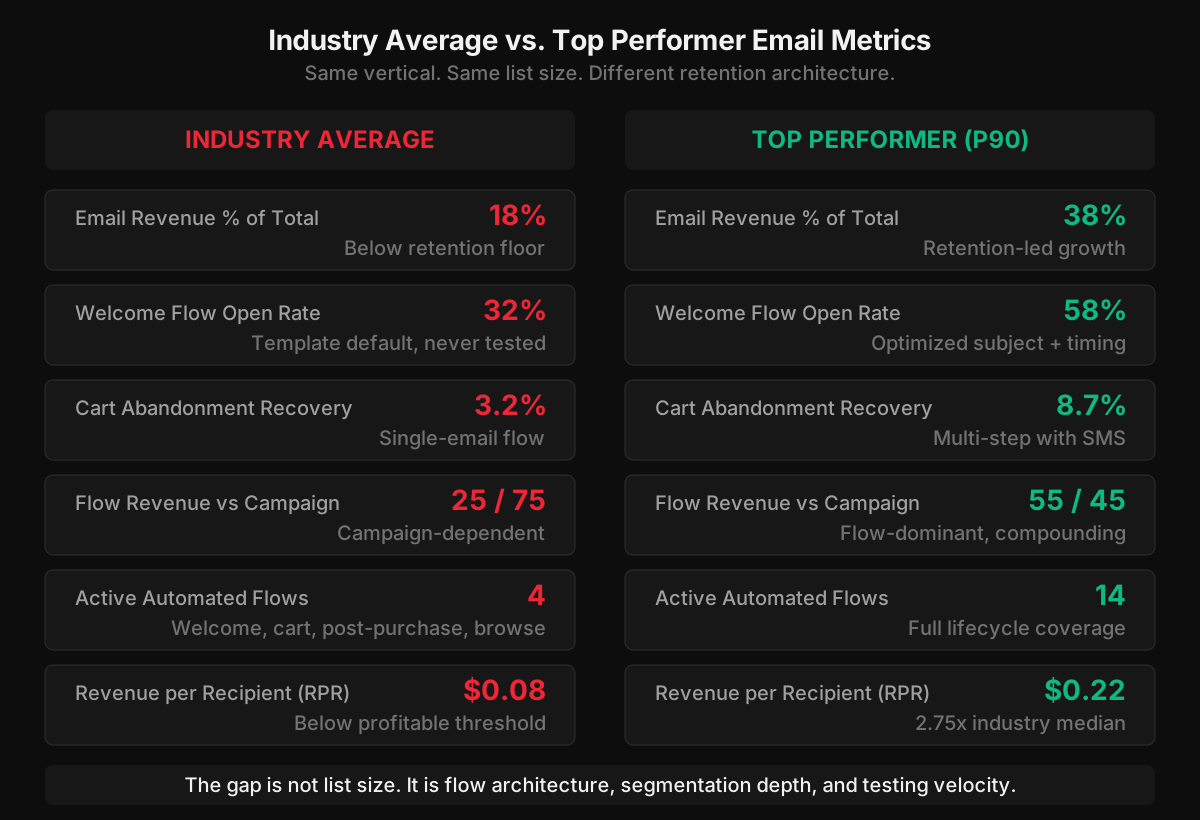
The benchmarks published by Klaviyo, Litmus, and Omnisend are medians. They represent the middle of the pack. If you are at the median, half of your competitors are outperforming you. The brands we work with at Darkroom's CRO practice aim for the 90th percentile because that is where retention becomes a genuine competitive advantage.
P90 benchmarks for 2026: email + SMS as percentage of total revenue: 38-45%. Flow revenue as percentage of email revenue: 58-65%. Welcome flow conversion rate: 12-18%. Cart abandonment recovery rate: 8-12%. Revenue per recipient (campaigns): $0.18-$0.30. Revenue per recipient (flows): $0.25-$0.45. Repeat purchase rate (12-month): 38-48%. Active automated flows: 16-22.
These numbers are not aspirational fiction. They are the performance levels of brands that have invested in retention infrastructure: proper segmentation, comprehensive flow architecture, systematic testing, and dedicated retention management. The gap between the median and the 90th percentile represents, for most brands, 50-100% more email revenue from the same list size. It is the same subscribers. It is different architecture.
Building Your Benchmark Dashboard
You cannot improve what you do not measure consistently. Here is the dashboard that makes benchmarking actionable.
Build a monthly dashboard that tracks these metrics over time. The trend matters more than any single data point. A welcome flow at 9% conversion rate that was 11% two months ago is more concerning than a welcome flow at 7% that is climbing from 5%. Connecting your retention work to your broader growth strategy requires this kind of visibility.
The dashboard should include: total email + SMS revenue and percentage of total revenue (monthly trend), flow revenue versus campaign revenue split (monthly trend), top 5 flows by revenue with conversion rate trend, RPR by campaign type (promotional, content, product launch), SMS metrics (CTR, revenue per message, opt-out rate), deliverability health (inbox placement, bounce, complaint), list growth (gross adds minus churn, net growth rate), and repeat purchase rate by 30/60/90-day cohorts.
Automate this dashboard in Klaviyo or export to a BI tool. The point is not to create more reports. It is to create one report that tells you exactly where your retention program stands relative to where it should be and what to optimize next. This is what a comprehensive agency engagement delivers from the start: not just execution, but measurement infrastructure that makes execution accountable.
FAQ
What is a good email open rate for ecommerce in 2026?
The median ecommerce email open rate in 2026 is 35-42% for flows and 18-25% for campaigns, but these numbers are inflated by Apple Mail Privacy Protection. Focus instead on click rate (2.5-4.5% for campaigns, 5-12% for flows) and revenue per recipient ($0.08-$0.25 depending on segment and flow type).
What percentage of ecommerce revenue should come from email?
Top-performing ecommerce brands generate 30-40% of total revenue from email and SMS combined. If you are below 25%, your retention program is underperforming. The split between email and SMS should be roughly 75-80% email and 20-25% SMS for most DTC brands.
What is a good cart abandonment recovery rate?
The industry median cart abandonment recovery rate is 3-5%. Top performers recover 8-12% through multi-step flows combining email and SMS with dynamic content, urgency triggers, and strategic incentive placement. A single-email cart abandonment flow typically recovers only 2-3%.
How many automated email flows should an ecommerce brand have?
Top-performing ecommerce brands run 12-16 active automated flows. At minimum, you need welcome, cart abandonment, browse abandonment, post-purchase, win-back, and sunset flows. Advanced programs add replenishment, cross-sell, VIP, price drop, back-in-stock, and review request flows.
What are good Klaviyo benchmarks for 2026?
For Klaviyo-powered ecommerce brands in 2026, target benchmarks are: flow revenue 50-60% of total email revenue, welcome flow open rate 40-60%, welcome flow conversion 8-12%, campaign click rate 2.5-4.5%, RPR (revenue per recipient) above $0.12, and list growth rate of 8-15% monthly net of churn.
What should the revenue split be between email flows and campaigns?
Mature ecommerce retention programs generate 50-60% of email revenue from automated flows and 40-50% from campaigns. If campaigns account for more than 70% of email revenue, your flow architecture is underdeveloped and you are leaving compounding revenue on the table.
How do email benchmarks differ by brand revenue size?
Brands at $5M revenue typically generate $750K-$1.2M from email. At $20M, the target is $4M-$7M. At $50M+, email should drive $12M-$18M annually. The percentage of revenue from email increases as brands mature because retention compounds while acquisition costs rise.
What is the difference between email marketing benchmarks and retention benchmarks?
Email marketing benchmarks measure channel metrics like open rate, click rate, and unsubscribe rate. Retention benchmarks measure business outcomes like repeat purchase rate, customer lifetime value, revenue per recipient, and the percentage of total revenue driven by owned channels. The latter is what actually matters for growth.
Audit Your Email Benchmarks With Darkroom
Most brands do not know where they stand because they have never compared their flow-level performance to calibrated benchmarks. Darkroom manages retention programs across Klaviyo for ecommerce brands from $5M to $100M+. Our benchmark audit identifies the specific gaps in your flow architecture, segmentation depth, and channel mix that represent the largest revenue opportunities.
Book a retention benchmark audit and we will show you exactly where your program stands relative to the benchmarks in this article and what it would take to close the gap.