SUCCESS STORIES
Amazon Brand Store: The Organic-First Rebuild Behind Brami’s 41% Growth




Written by Darkroom leardership
Last update: August 6, 2026

An Amazon Brand Store is the multi-page destination you own inside Amazon, where your full catalog is merchandised as a brand rather than as isolated listings. Rebuilt before ad spend scales, it lowers the cost of every paid click you send to it.
Brami proved the sequence. The plant-based snack brand grew Amazon sales 41% and lifted conversion 25% across its product listings after its Store, listings and creative were rebuilt first and spend was scaled second. The full case study publishes every number in this article. What follows is the playbook.
What is an Amazon Brand Store, and what does it actually do?
An Amazon Brand Store is the free, multi-page storefront Amazon grants sellers enrolled in Brand Registry: your own URL inside the marketplace, reachable from the byline link on every listing and from your ads. You build it from Amazon’s modular Store builder, which is why design quality varies so widely between brands paying the same fee of zero.
Some teams call it the Amazon brand page. Amazon calls it a Store, and it is the only page on the platform where your catalog appears without competitor ads beside it.
That last property is the point. A detail page rents attention in an auction. The Store is owned shelf space, and it does the job a category aisle does in retail: it shows a shopper who arrived for one product that a brand exists behind it.
At Darkroom, an Amazon marketing agency for consumer brands, we treat the Store as the hinge of any Amazon marketplace strategy: downstream of brand, upstream of conversion. What it is not is a website replacement or a magic ranking lever. It converts interest your listings and ads create, which is why the rebuild order matters so much.
Why rebuild the Brand Store before you scale ad spend?
Because conversion rate sets your ad cost, so every dollar spent against weak destinations buys a worse price for every future order.
Amazon’s auction rewards ads that convert; a listing converting below category median pays more per click, wins fewer placements, and generates less of the sales velocity that organic rank feeds on. Amazon profitability is decided at the destination, not in the bid.
This is the core of the Amazon marketing strategy we run across client accounts, and it is why we build listings that convert before running ads in every engagement. The comparison below is the whole argument in one table, read through TACOS, total advertising cost of sales.
Question | Ads first | Store and listings first |
What the first dollar buys | Traffic to pages converting below category median | The conversion rate that prices every future click |
Effective cost per order | Rises as spend scales against flat conversion | Falls as conversion lifts against the same bids |
Organic rank | Starved, because velocity is bought and never compounds | Fed, because paid velocity converts and compounds |
Margin consequence | TACOS creeps up every quarter | TACOS falls as organic carries more volume |
Who it favors | The auction | The brand |
The compounding mechanism is the Amazon flywheel: paid velocity lifts organic rank, organic orders lower blended acquisition cost, and the savings fund the next test. This article covers building the Store; for using your Store as a paid-traffic destination, see our conversion playbook.
What breaks when you scale ads on a weak listing?
The account enters a loop that reporting usually misreads as a media problem. Low conversion raises effective cost per order, high cost forces bid cuts, lost placement kills sales velocity, and falling velocity drops organic rank, so the brand pays more each quarter for less.
The symptom is rising TACOS with flat sales. The cause is rarely the campaigns.
How did Brami rebuild its Brand Store and listings?
The rebuild ran from the storefront down to the backend, and it happened before advertising scaled.
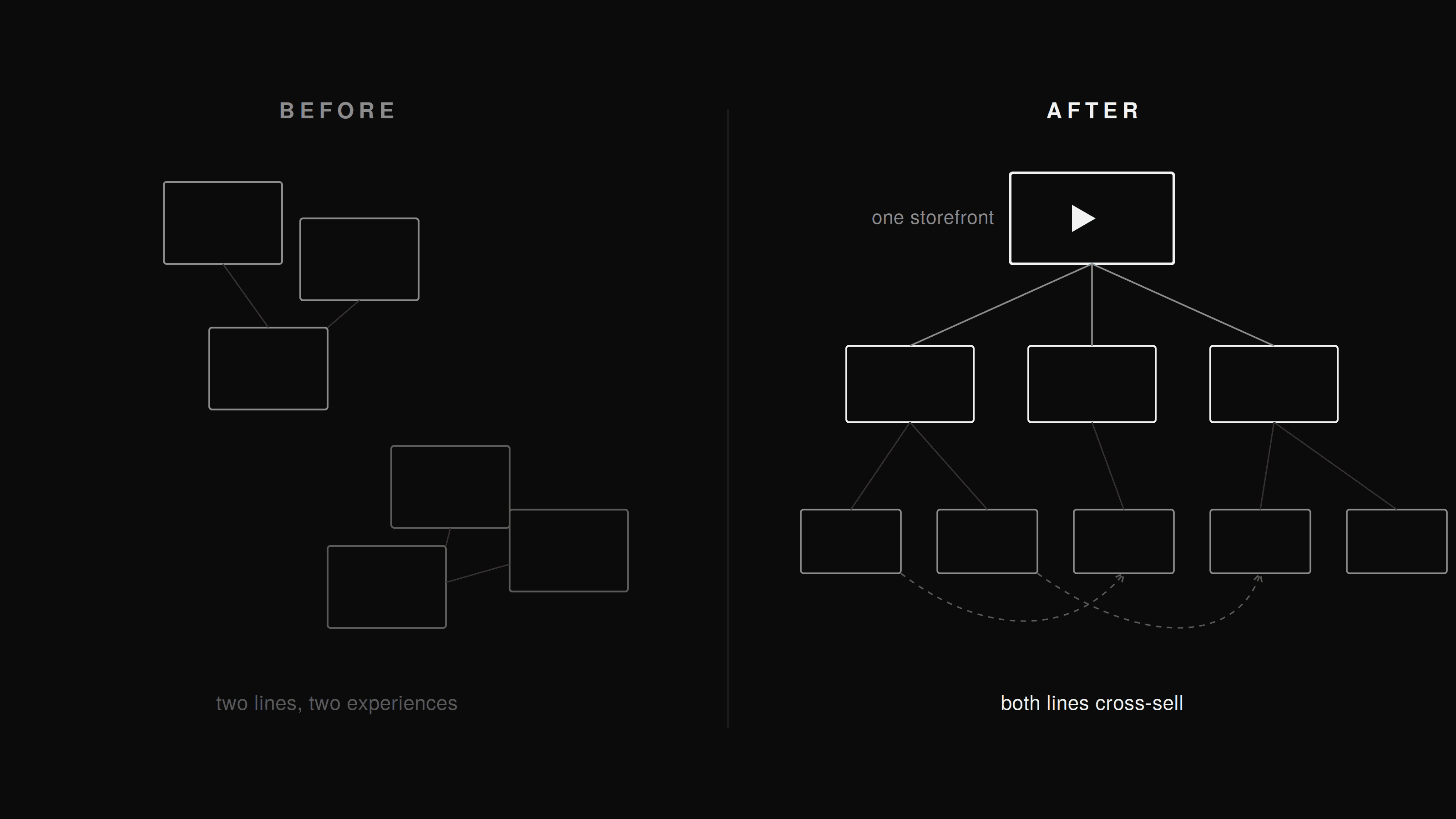
The redesigned Store unified Brami’s two product lines, established lupini snacks and newly launched protein pasta, under one brand experience, with video assets doing the category education a new food format needs. The Amazon storefront design carried one job: make a lupini buyer discover the pasta, and vice versa.
Underneath the Store, every listing was rebuilt. Product titles were restructured to lead with pack size and format, informed by keyword research into how the category actually searches.
A+ content was produced with comparison charts positioning Brami against incumbent snack brands; our breakdown of the A+ content elements to test first ranks the modules by conversion impact.
Backend work followed the Amazon SEO playbook: indexed keywords, complete attributes, content the algorithm can parse.
The published results: 41% growth in Amazon sales, a 25% conversion increase across product listings, and a #6 organic ranking on Amazon for the term “protein pasta”, earned by a line that launched from zero rank.
Our Amazon marketing agency service page summarizes the same engagement as 41% revenue growth with 42% unit sales growth. The near-identical revenue and unit figures tell you the growth came from volume, not price.
What makes an Amazon Brand Store design convert?
Organization by use case, not by your internal catalog tree. Shoppers arrive with a job in mind, so an Amazon Brand Store design that mirrors your org chart (“Snacks Division”, “Pasta Division”) converts worse than one built around occasions and needs: high-protein snacking, weeknight dinners, pantry staples.
Three rules carry most of the result. Lead each page with the claim that brought the shopper, because message continuity from ad to Store is what keeps the visit alive.
Cross-link bestsellers to bundles and adjacent lines, since the Store’s economic job is raising order value and cross-line discovery. And refresh hero modules with launches and seasonal collections, so repeat visitors see a brand in motion rather than a brochure.
How does creative change the Amazon conversion rate?
Creative is what wins the auction at equal bids: two ads with identical targeting and budget separate on the strength of the main image and the legibility of the claim.
NCSolutions’ updated Five Keys analysis (2023) of nearly 450 campaigns attributes 49% of advertising-driven sales lift to creative, more than brand, reach and targeting combined. That study covers consumer packaged goods broadly, not Amazon alone, but the direction holds in every account we run.
On Amazon the creative surface is wider than ads: image stacks, A+ modules, Store pages and video are all Amazon conversion rate optimization surfaces, and they are the ones treated as an afterthought in most pay-per-click-only (PPC) engagements.
Brands often split this work between an Amazon creative agency and a separate media shop. It performs better priced and planned as one system, because the Amazon creative that wins is built against search terms, not brand decks.
Do Amazon Vine reviews help a new product launch?
Yes, for exactly one problem: the zero-review cold start. Amazon Vine reviews come from invited reviewers who receive the product free, capped at 30 units per parent ASIN (Amazon’s identifier for a listing).
Amazon currently prices enrollment in tiers of $0, $75 and $200 by unit count, charged only after the first review publishes. It has revised Vine pricing before, so confirm the schedule in Seller Central before budgeting it.
For a new product with no social proof, Vine converts the first weeks of traffic from bounces into consideration. Brami used it that way, enrolling the new protein pasta listings while the established lupini line carried the brand’s review equity.
What Vine cannot do is guarantee sentiment, since reviewers score honestly, or substitute for sustained sales velocity. It buys credibility at launch. The listing has to earn everything after that.
What is a good TACOS on Amazon?
For most scaling consumer brands, a healthy TACOS on Amazon sits between 5% and 10%, with launch phases running above 15% and mature organic-led catalogs dipping under 5%.
TACOS, total advertising cost of sales, divides ad spend by total revenue, so it falls only when organic sales grow faster than ad spend. That makes it the honest scoreboard for an organic-first rebuild, while ACoS, the ad-attributed version of the same ratio, stays a per-product margin question; here is what a good ACoS looks like by campaign type.
Brami published both of its figures, which almost nobody does:
TACOS band | What it usually means | Brami reference |
Under 5% | Mature, organic-led; check you are not underinvesting in growth | n/a |
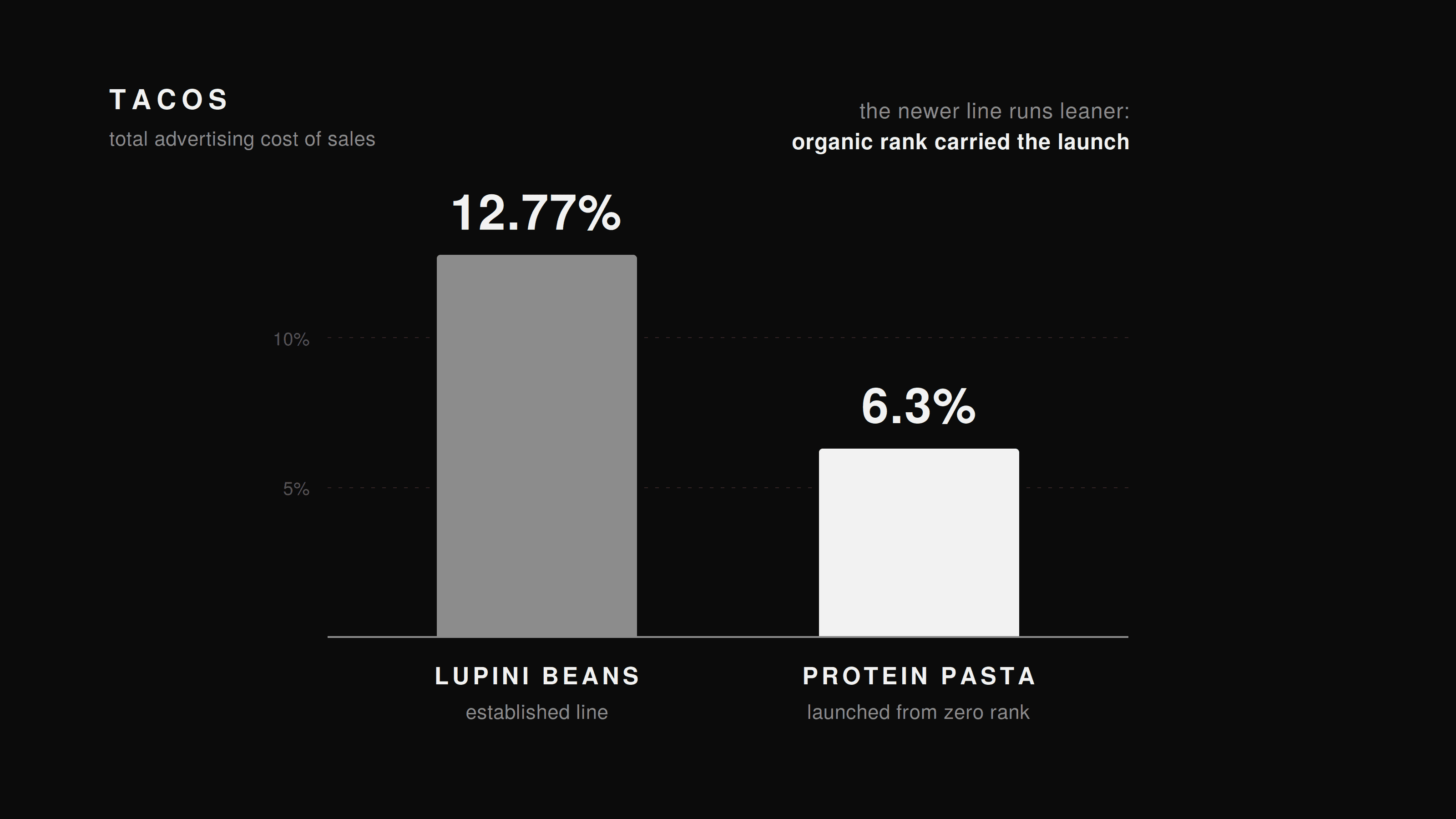
5% to 10% | Healthy balance of paid and organic | 6.3% on protein pasta, a line launched from zero rank |
10% to 15% | Deliberate growth investment | 12.77% on lupini beans, defending and growing the core niche |
Above 15% | Launch mode, or a conversion problem wearing a media badge | The zone the sequencing exists to avoid |
Read the inversion, because it is the whole thesis. The new line runs leaner than the established one: protein pasta launched into listings, Store placement and Vine reviews that were already built, reached a #6 organic rank, and let organic volume carry it to a 6.3% TACOS.
Launches only run expensive when paid traffic has to compensate for missing foundations. Bands are Darkroom working benchmarks from client accounts, directional by category.
How does Subscribe & Save turn Brand Store traffic into repeat revenue?
Amazon Subscribe and Save converts a single well-earned purchase into a recurring order line, which is where a consumables brand’s margin actually lives.
Retention costs less than acquisition. Harvard Business Review put the range at 5 to 25 times back in 2014, noting it varies widely by industry and by which study you trust, so treat it as a direction of travel rather than a number to plan against. On Amazon, Subscribe & Save is the retention infrastructure you get without building any.
Brami’s rebuild treated enrollment as a design goal, not a checkbox: subscription prompts positioned across the rebuilt listings and Store, with the case study reporting a positive Subscribe & Save subscriber growth trend across the full catalog.
Measure the program on subscriber count and second-order rate, never on coupon redemptions, because the discount is the cost of the asset, not the asset itself.
Each enrollment compounds customer lifetime value while adding the steady order velocity that organic rank rewards, and each subscriber’s reorders arrive with no new ad spend attached.
That recurring base is what makes revenue forecastable enough to plan inventory and media against, which is the point at which an Amazon account stops being a channel and starts being a business line.
How to increase Amazon sales: five moves you can copy
Every move below transfers to any consumer brand on Amazon. Each one names the metric it moves and the internal blocker it will hit, because the blocker is the part most plans forget to budget for.
Move | Metric it moves | Internal blocker it will hit |
Rebuild the Brand Store around use cases, not your catalog tree | Store conversion and cross-line discovery | Brand guidelines written for your own site, not Amazon’s modules |
Restructure titles to lead with pack size and format | Search visibility and click-through rate | Merchandising owns copy and reviews every character |
Build comparison charts against named incumbents | Detail page conversion rate | Legal review of competitor claims |
Enroll new products in Vine before launch spend | Review velocity at launch | Finance resists giving away sellable inventory |
Treat Subscribe & Save as retention, not a discount | Repeat purchase rate and lifetime value | Pricing team guards the subscription margin |
The system scales with catalog size: the same sequence ran a 90-product Amazon launch for fragrance brand DedCool across 10 categories. And once it holds on Amazon, marketplace diversification is the next compounding move, because the assets transfer.
Quick answers on Amazon Brand Store strategy
Is a Brand Store free? Yes. Amazon charges nothing for the Store itself; you pay in design, content and upkeep.
Does a Store rank in Google? Store pages can index, but treat any external traffic as upside, not the plan.
How often should a Store be updated? On every launch and season, at minimum quarterly. A static Store reads as an abandoned one.
Work with a team that sequences Amazon correctly
If your TACOS rises while sales stay flat, the fix is rarely more spend. It is the sequence. Darkroom rebuilds the Store, listings and creative first, then scales media into destinations that convert.
That system has produced 57% average Amazon sales growth, 2.35x higher ad conversion rates and 38% lower ACoS across client accounts, the figures our Amazon service page publishes.
Proof published with numbers: Brami’s 41% growth, 25% conversion lift and both TACOS figures are public
Creative, catalog and media run as one system, measured on profit rather than platform metrics
Built for consumer brands where Amazon growth has to fund itself
Get your Amazon account audited by the team that ran this playbook, and see the sequence mapped against your own catalog. And when repeat revenue outgrows the marketplace, our retention marketing agency practice runs the owned-channel version across email, SMS and loyalty.
Amazon Brand Store FAQs
What is an Amazon Brand Store?
A Brand Store is the dedicated, no-cost destination Amazon gives Brand Registry members: several linked pages under your own marketplace URL where the catalog sells as one brand. No competitor advertising appears inside it, so it functions as shelf space you control on a platform where attention is otherwise auctioned.
Does an Amazon Brand Store actually increase sales?
As part of a full rebuild, yes: Brami grew Amazon sales 41% and lifted listing conversion 25% after the storefront, detail pages and creative were reworked as one system. The Store alone did not produce those numbers. It converts and cross-sells demand that optimized listings generate underneath it.
Should you rebuild your Brand Store before running Amazon ads?
Yes, and rebuild the listings beneath it at the same time. Conversion rate sets your effective ad cost, so spend scaled onto weak destinations pays more per order every month. Brami’s sequence, Store and listings first, then media, is why its new line launched at a 6.3% TACOS.
What is a good TACOS on Amazon?
Between 5% and 10% is healthy for most scaling consumer brands, under 5% signals a mature organic-led catalog, and above 15% should be temporary launch mode. Brami ran 12.77% on its established lupini line and 6.3% on protein pasta, with organic rank carrying the newer line.
Do Amazon Vine reviews actually help a new product launch?
Yes, for the zero-review cold start specifically. Vine places up to 30 units per parent ASIN with invited reviewers, at fees tiered up to $200, converting a new listing’s first traffic into consideration. It cannot guarantee positive sentiment or replace sales velocity, so treat it as launch credibility only.
How long does it take to rank organically on Amazon?
It depends on conversion and velocity, not the calendar. A listing that converts above category median compounds rank within a few months; a weak one never does at any spend level. Brami’s protein pasta reached a #6 organic ranking for its head term within the engagement.
How does Subscribe & Save affect customer lifetime value?
Directly: each enrollment converts one purchase into a recurring order line, multiplying lifetime value while feeding the steady velocity organic rank rewards. Harvard Business Review’s 2014 range put acquisition at 5 to 25 times the cost of retention, so subscription enrollment is the cheapest revenue a consumables brand can add.