
SOCIAL COMMERCE
Amazon + TikTok Shop: The Marketplace Diversification Strategy That Creates a Revenue Flywheel




Written by Darkroom leardership

SOCIAL COMMERCE
Written & peer reviewed by 4 Darkroom team members
TL;DR
Amazon sellers are the natural next buyers for TikTok Shop, and TikTok Shop sellers should be expanding to Amazon. The two platforms are not competitors. They are complementary channels that create a flywheel: TikTok content drives Amazon ranking through external traffic, Amazon reviews build TikTok Shop credibility through social proof, and the cycle compounds. This article covers the strategic case for marketplace diversification, the revenue thresholds and product fit criteria for expansion, the flywheel mechanics, and a framework for execution. If you are doing $500K+ on Amazon with 40%+ margins and visually demonstrable products, TikTok Shop represents 15-30% incremental revenue within 12 months. Darkroom manages both Amazon and TikTok Shop for ecommerce brands, and this is the expansion playbook we use.
The Case Against Single-Platform Dependency
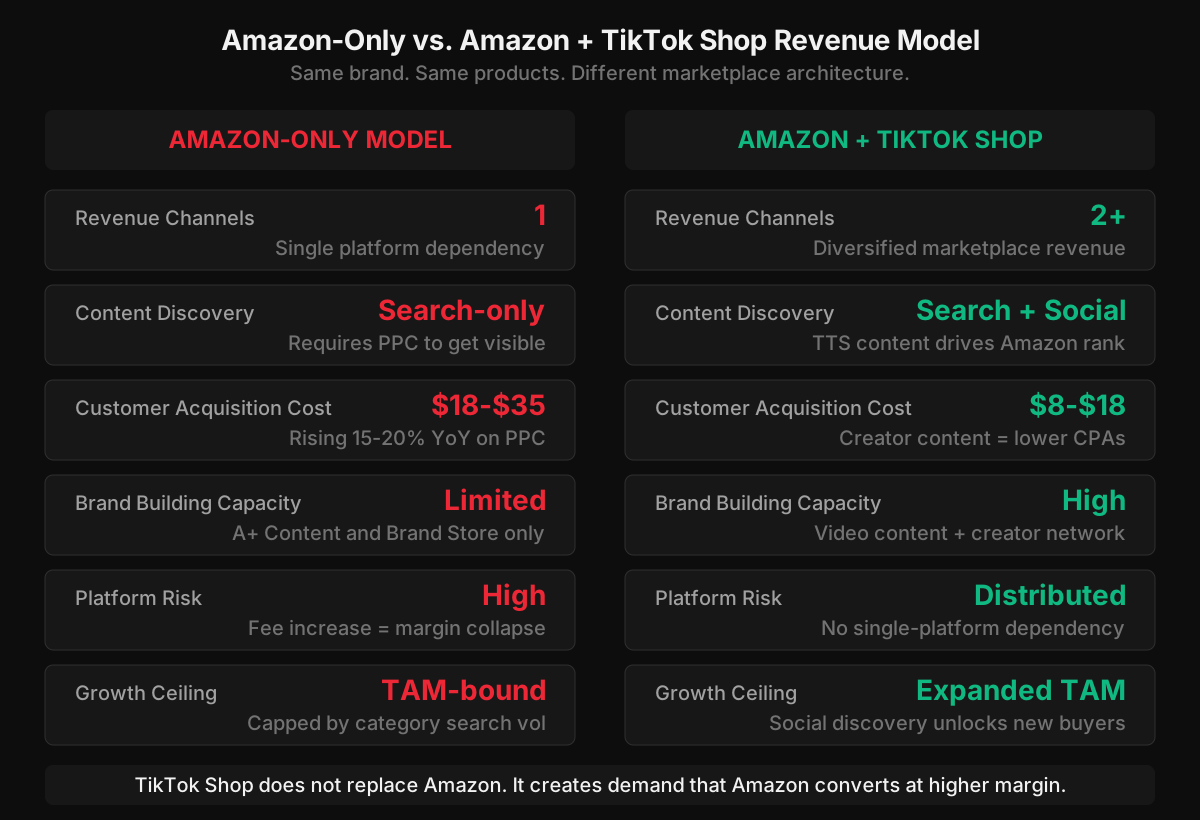
If Amazon represents 80%+ of your marketplace revenue, you do not have a marketplace strategy. You have an Amazon dependency with marketplace risk.
Amazon sellers have built incredible businesses on the platform. But the economics are shifting. Referral fees have increased an average of 3-5% over the past three years. PPC costs have risen 15-20% year over year. The number of competitors in most categories has doubled since 2022. And Amazon's own private label brands continue to encroach on the categories where third-party sellers generate the highest margins.
This is not an argument against Amazon. Amazon remains the largest and most profitable marketplace for most ecommerce brands. It is an argument against Amazon as your only marketplace. According to Jungle Scout's 2026 State of the Amazon Seller report, 67% of Amazon sellers report declining margins over the past 12 months. The primary driver is not declining demand. It is increasing cost of sale as competition and fees compound.
Marketplace diversification is the strategic response. Not abandoning Amazon, but reducing dependency by building revenue on complementary platforms. And TikTok Shop, with its fundamentally different discovery model and customer acquisition economics, is the most natural complement to Amazon for most product categories. Understanding how these two platforms compare is the starting point, covered in our analysis of TikTok Shop versus Amazon for DTC brands.
Why Amazon Sellers Are the Perfect TikTok Shop Candidates
Amazon sellers already have the hardest parts: proven products, supply chain infrastructure, and validated demand. TikTok Shop adds the growth channel they are missing.
The reason Amazon sellers are the natural expansion candidates for TikTok Shop is that they have already solved the hardest problems in ecommerce. They have products that people want to buy (proven by Amazon sales data). They have supply chain and fulfillment infrastructure (FBA or 3PL). They have customer reviews that validate product quality. And they have margin data that tells them exactly what they can afford to spend on acquisition.
What Amazon sellers lack is a content-driven discovery channel. Amazon is search-based. People find your product by typing a query. This means you are competing for a fixed pool of search demand, and the cost of capturing that demand rises every year as more sellers bid on the same keywords. TikTok Shop flips this model. People discover your product through content, not search. The discovery is driven by creators, not keywords. And the cost of content-driven discovery is currently 40-60% lower than Amazon PPC for most categories.
An Amazon marketing agency can help optimize your existing Amazon presence, but the ceiling on Amazon growth is bound by search volume and PPC economics. TikTok Shop removes that ceiling by introducing a fundamentally different acquisition channel. The brands that understand this early are building the two-platform flywheel that will define marketplace strategy for the next five years.
The Flywheel: How Each Platform Amplifies the Other
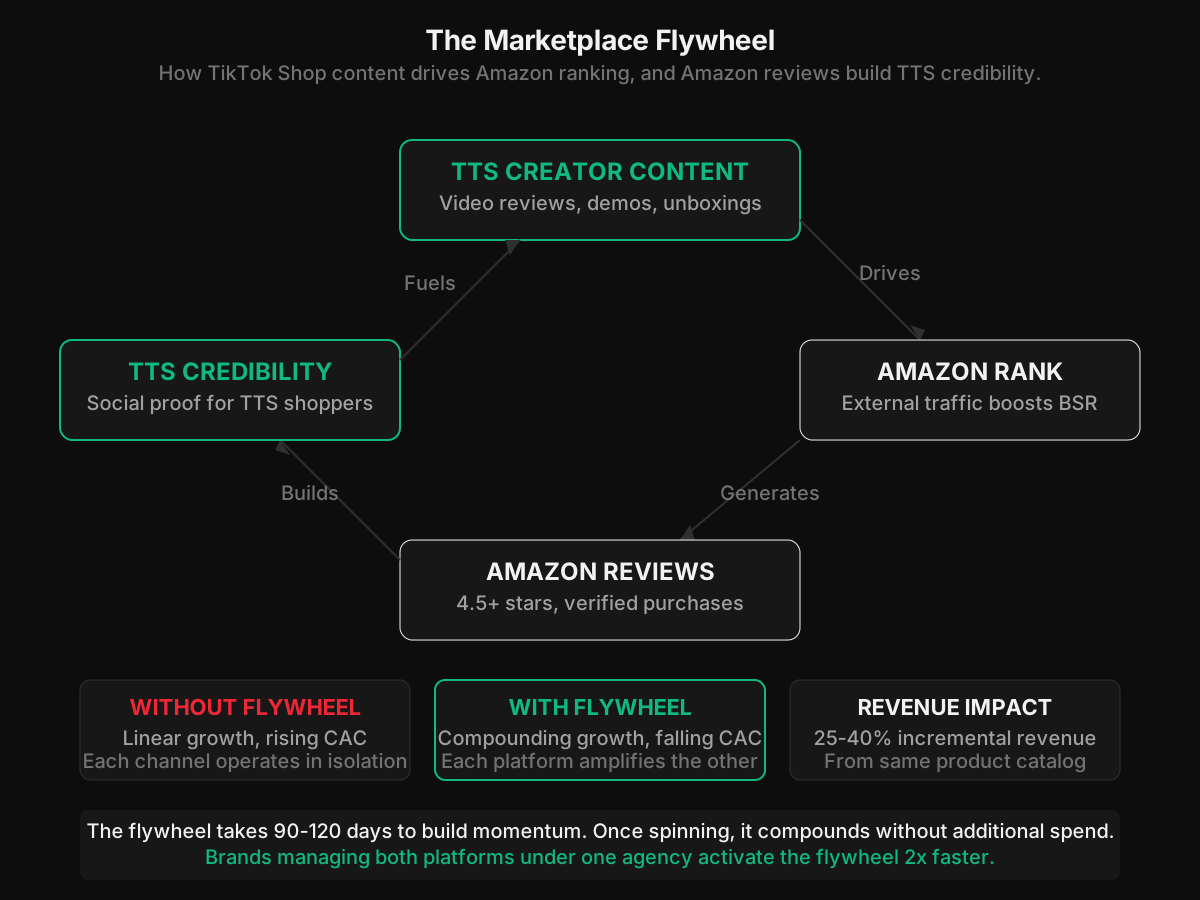
TikTok content drives Amazon ranking. Amazon reviews build TikTok credibility. The cycle compounds without additional spend.
The marketplace flywheel is not a metaphor. It is a measurable, data-backed phenomenon that brands with presence on both platforms consistently observe. Here is how it works.
TikTok content creates external traffic to Amazon. When a TikTok creator reviews your product, a percentage of viewers will search for it on Amazon rather than purchasing through TikTok Shop (especially for higher-priced items where buyers want Amazon's return policy). Amazon's algorithm treats external traffic as a strong ranking signal because it indicates demand beyond Amazon's own ecosystem. The result: products featured in popular TikTok content see 15-30% lifts in organic Amazon ranking within 2-4 weeks.
Higher Amazon ranking generates more Amazon sales. Better organic ranking means more visibility on Amazon, which means more sales, which means more reviews. This is Amazon's own flywheel, but your TikTok content is providing the external traffic fuel that accelerates it. Understanding the Amazon marketing flywheel in detail shows how this external traffic integrates with your organic and PPC strategy.
Amazon reviews build TikTok Shop credibility. When a TikTok Shop buyer is considering your product, what do they do? Many check Amazon reviews. A product with 2,000+ Amazon reviews and a 4.5-star rating has instant credibility on TikTok Shop, where review counts are typically lower. Your Amazon review base becomes a cross-platform trust asset that reduces purchase friction on TikTok Shop.
TikTok Shop sales generate content that feeds the cycle. Every TikTok Shop purchase can become a customer video, a review, a piece of UGC. This content feeds back into the TikTok algorithm, driving more discovery, more Amazon searches, and more of the flywheel. The economics improve with every rotation because the content asset base grows while the marginal cost of each new piece of content decreases.
Platform Comparison: Amazon vs. TikTok Shop
Different platforms, different economics, different customer journeys. Here is where each one excels.
Dimension | Amazon | TikTok Shop |
|---|---|---|
Discovery Model | Search-based (query intent) | Content-based (algorithmic discovery) |
Customer Acquisition | PPC + organic ranking | Creator content + Shop Ads |
Average Order Value | $35-$65 (category-dependent) | $20-$45 (impulse-driven) |
Total Cost of Sale | 25-40% (fees + PPC + FBA) | 15-25% (commission + affiliate) |
Fulfillment | FBA or FBM | Fulfilled by TikTok or self-ship |
Repeat Purchase | Subscribe & Save, reorder | Limited (no Subscribe & Save) |
Content Requirement | Listings, A+ Content, Brand Store | Video content (high volume, ongoing) |
Best For | High-intent, research-heavy, commodity | Visual, demonstrable, impulse, story-driven |
The key insight is that these platforms serve different purchase behaviors. Amazon captures demand from people who know what they want. TikTok Shop creates demand among people who did not know they wanted your product. Running both means you capture the full spectrum of purchase intent. Understanding TikTok Shop's fee structure in detail is essential before modeling the combined economics.
When to Expand: Revenue Thresholds and Product Fit
Not every Amazon seller should add TikTok Shop. Here is the readiness criteria that predicts success.
Marketplace diversification is a strategic decision that requires specific conditions to succeed. Expanding too early wastes resources. Expanding too late cedes the advantage to competitors who moved first. The readiness assessment covers four dimensions.
Revenue threshold. Your Amazon business should be generating at least $500K annually before expanding to TikTok Shop. Below this, you likely have not stabilized your supply chain, refined your product-market fit, or accumulated enough reviews to provide cross-platform credibility. The exception is brands that are content-native (already producing TikTok content for paid media) and have video assets ready to deploy.
Margin structure. TikTok Shop's combined cost of sale (platform commission + affiliate commission + Shop Ads) typically runs 15-25%. Your gross margins need to be 40%+ to absorb these costs while maintaining profitability. Brands with 30% gross margins may find TikTok Shop unprofitable unless they have exceptionally low content production costs or high average order values. Understanding these advertising cost structures across both platforms helps model the combined P&L.
Product fit. TikTok Shop favors products that are visually demonstrable (before/after, unboxing reveals), in the $20-$80 price range (the impulse purchase sweet spot), in categories with creator ecosystem depth (beauty, wellness, food, home), and not commodity items where the buying decision is purely price-driven. If your product requires a 10-minute explanation to understand why it is better than alternatives, TikTok Shop will be an uphill battle.
Content capacity. TikTok Shop requires ongoing video content production. You need the ability to produce or source 15-30 videos per month through a combination of creator partnerships, in-house production, and user-generated content. If you have no video production capability and no creator relationships, you will need to build this infrastructure before launching. Working with a TikTok Shop agency accelerates this build.
Expansion Readiness Scorecard
Score yourself on each dimension. A total above 16 means you are ready to expand.
Dimension | Score 1 (Not Ready) | Score 3 (Getting Close) | Score 5 (Ready) |
|---|---|---|---|
Amazon Revenue | Under $250K/yr | $250K-$500K/yr | $500K+/yr |
Product Reviews | Under 50 reviews, sub-4.0 | 50-100 reviews, 4.0+ | 100+ reviews, 4.3+ |
Gross Margin | Under 30% | 30-40% | 40%+ |
Visual Demo Potential | Commodity, no visual hook | Some visual appeal | Strong before/after or demo |
Content Capacity | No video production | Some video, no creator network | Active video + creator relationships |
Score 16-25: Ready to launch. Begin the expansion framework immediately. Your Amazon foundation is strong enough to support a second platform and your product characteristics fit TikTok Shop's discovery model. Score 11-15: Build first, then launch. Focus on strengthening your Amazon metrics and building video content capability before expanding. Score below 11: Not yet. Stabilize Amazon operations first. Premature expansion will divide resources without generating incremental returns.
The Execution Framework: From Amazon to Amazon + TTS
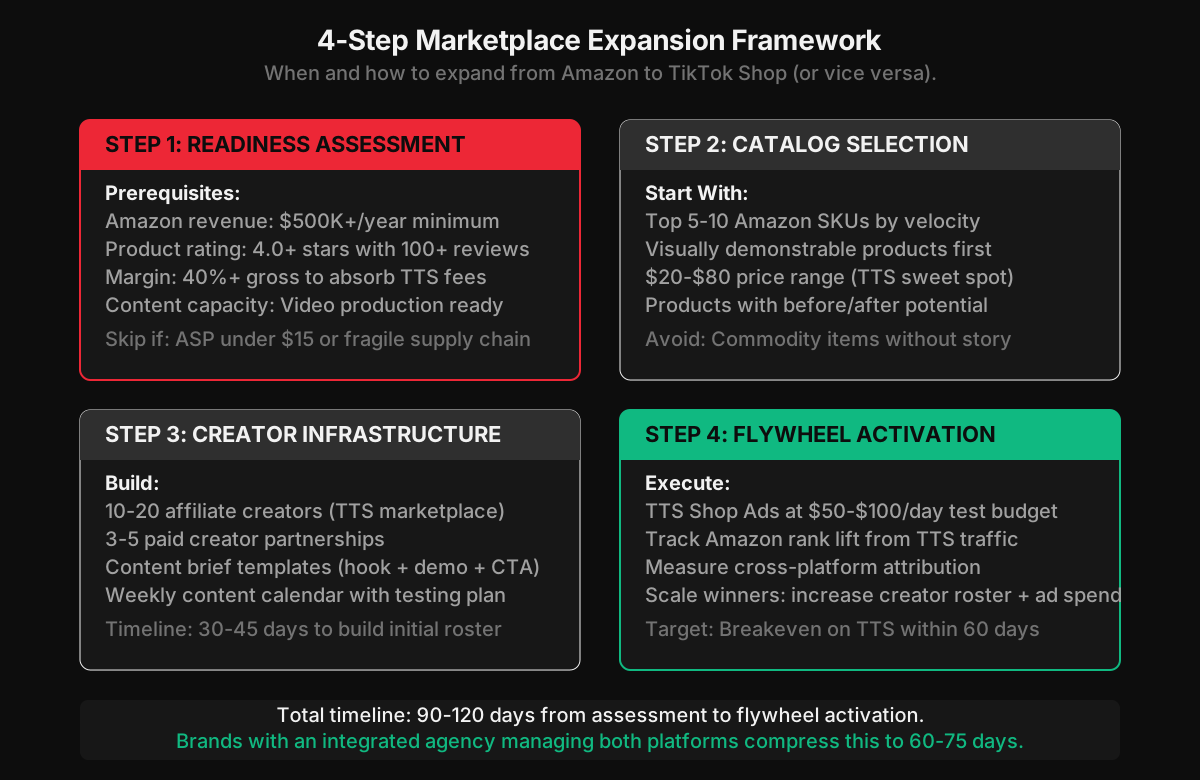
Expansion is not a switch you flip. It is a 90-120 day buildout with four distinct phases.
Phase 1: Foundation (Days 1-30). Set up TikTok Shop account with proper business verification. Import top 5-10 Amazon SKUs based on sales velocity and visual demonstration potential. Create optimized product listings (titles, descriptions, images adapted for TikTok's format). Build initial creator roster: recruit 10-20 affiliate creators through TikTok Shop's creator marketplace plus 3-5 paid creator partnerships. Develop content brief templates that include hook, demonstration, and call-to-action structures. The complete guide to selling on TikTok Shop covers the operational setup in detail.
Phase 2: Content Launch (Days 15-45). Launch first wave of creator content (target: 20-30 videos in the first month). Activate TikTok Shop Ads at a test budget of $50-$100 per day. Monitor which creator styles, hooks, and product angles drive the highest Shop conversions. Begin tracking cross-platform effects: monitor Amazon search volume for your brand terms and organic ranking changes for featured products. Understanding how TikTok Shop Ads create a creative commerce loop is essential for optimizing ad spend during this phase.
Phase 3: Optimization (Days 30-75). Double down on winning creator partnerships. Scale ad spend on proven content. Introduce new product SKUs based on Phase 2 learnings. Build the cross-platform measurement framework: track Amazon rank changes correlated with TikTok content spikes, brand search volume trends, and combined-platform ROAS. Adjust content strategy based on data (which hooks drive TTS conversion versus which hooks drive Amazon traffic).
Phase 4: Flywheel Activation (Days 60-120). At this stage, both platforms should be generating revenue and the cross-platform effects should be measurable. Scale creator roster to 30-50+ affiliates. Increase ad budget based on proven ROAS. Implement coordinated inventory planning across both platforms. Begin testing TikTok Shop's livestream capabilities for products that benefit from real-time demonstration. The relationship between TikTok content and Amazon performance, as explored in the Amazon marketing flywheel framework, should now be visible in your data.
Managing the Economics: Combined P&L Modeling
The flywheel creates revenue that neither platform would generate alone. Here is how to model it.
The mistake most brands make when modeling marketplace diversification is treating each platform as independent. They calculate Amazon P&L and TikTok Shop P&L separately, then add them together. This misses the flywheel revenue: the Amazon sales driven by TikTok content and the TikTok Shop conversions driven by Amazon review credibility.
A proper combined model accounts for direct TikTok Shop revenue (sales through the TikTok Shop checkout), indirect Amazon lift (increased organic Amazon sales attributable to TikTok-driven brand awareness and external traffic), content asset value (TikTok creator content that can be repurposed for Meta ads, Google Shopping, and Amazon A+ Content), and reduced Amazon PPC dependency (as organic ranking improves from external traffic, PPC spend can shift from defense to offense).
Based on Darkroom's portfolio data, brands that successfully activate the flywheel see TikTok Shop contribute 15-25% of total marketplace revenue within 12 months, with an additional 10-15% lift in Amazon organic sales that would not have occurred without the TikTok content driving external traffic. The combined effect is 25-40% incremental revenue from the same product catalog. This is the strongest argument for consolidating both platforms under one agency that can measure and optimize the cross-platform effects. Evaluating the right DTC agency partner should include assessing their cross-platform marketplace capability.
Content Strategy: What Works on Both Platforms
The best content strategy creates assets that perform on TikTok and drive Amazon traffic simultaneously.
The content that drives TikTok Shop conversions is not the same content that drives Amazon ranking, but there is significant overlap. TikTok conversion content focuses on immediate purchase triggers: problem-solution hooks, before/after demonstrations, creator testimonials, and urgency messaging. Amazon traffic content focuses on brand awareness: product category education, comparison reviews, and "things I found on Amazon" content that sends viewers to search for your brand.
The integrated content strategy produces both types from the same creator relationships. A single creator partnership might produce 3-4 TikTok Shop conversion videos (with product links in the video) and 1-2 brand awareness videos (mentioning the product name without a direct link, optimized for virality). The conversion videos drive direct TikTok Shop revenue. The awareness videos drive Amazon searches and organic traffic. Both feed the flywheel. Working with a performance creative team that understands both platforms is critical for maximizing content ROI across channels.
Creator content can also be repurposed. Top-performing TikTok videos can be edited for Meta ads (adding product overlays and CTAs). Product demonstration clips can be used in Amazon A+ Content and Brand Store. Customer testimonial videos from TikTok creators can be featured on your DTC site. Each piece of content generated for TikTok Shop has 3-4 additional use cases across other channels. This multiplier effect means your effective cost per content asset decreases as you expand the distribution footprint.
Risk Management: What Can Go Wrong
Marketplace diversification reduces platform risk, but introduces execution risk. Here is how to manage it.
Inventory coordination. Running two marketplaces means managing inventory allocation between Amazon FBA, TikTok fulfillment, and potentially self-ship. Stockouts on either platform damage ranking and trust. Build a buffer inventory model that accounts for demand variability across both platforms. Most brands need 15-20% more total inventory during the expansion phase than they would for Amazon alone.
Pricing consistency. TikTok Shop's promotional environment often involves discounts and coupon stacking. If your TikTok Shop price is significantly lower than Amazon, you risk Amazon penalizing your listing or confusing customers. Maintain pricing within 10% across platforms and use bundling or exclusive variants on TikTok Shop rather than straight discounting to differentiate.
Creator management at scale. Managing 30-50 creator relationships is operationally intensive. Build a system: standardized briefs, content approval workflows, performance tracking dashboards, and payment automation. Most brands underestimate the operational overhead of creator management by 50%. Budget for a dedicated person or partner to manage creator operations once you exceed 20 active relationships. Understanding the full-funnel marketing system helps integrate creator management into your broader operations.
TikTok regulatory risk. TikTok's regulatory status continues to evolve. While TikTok Shop operations are currently stable in 2026, brands should maintain the ability to redirect TikTok content investment to other short-form video platforms (Instagram Reels, YouTube Shorts) if the regulatory landscape changes. This is another argument for diversification: your content strategy should not be locked to any single distribution platform.
Why One Agency Should Manage Both Platforms
Separate Amazon and TikTok agencies cannot see the flywheel. They optimize each platform in isolation and miss the compounding effects.
The flywheel only works when someone is measuring and optimizing the cross-platform effects. A dedicated Amazon agency sees Amazon metrics. A TikTok Shop agency sees TikTok metrics. Neither can attribute the Amazon organic ranking lift to TikTok content, quantify the review credibility effect on TikTok Shop conversion, coordinate content strategy for both direct conversion and brand awareness, or make allocation decisions between platforms based on combined incremental returns.
An integrated marketplace agency that manages both platforms can do all of these things. They can tell you that a specific TikTok creator's viral video drove a 22% increase in Amazon branded search, which generated $45K in additional Amazon revenue that would not appear in TikTok's attribution. They can coordinate inventory, pricing, and content across both platforms. And they can make allocation decisions that maximize combined-platform returns rather than optimizing each platform in its own silo. Darkroom's TikTok Shop practice and Amazon practice operate as an integrated team for exactly this reason.
FAQ
Should Amazon sellers also sell on TikTok Shop?
Yes, if they meet the readiness criteria: $500K+ annual Amazon revenue, 40%+ gross margins, products with visual demonstration potential, and capacity for video content production. TikTok Shop creates demand that flows back to Amazon through increased brand searches and external traffic, creating a cross-platform flywheel.
How does TikTok Shop content help Amazon rankings?
TikTok content drives external traffic to Amazon listings. Amazon's algorithm rewards external traffic with improved organic rankings because it signals demand beyond Amazon's ecosystem. Brands running TikTok Shop alongside Amazon consistently see 15-30% lifts in organic Amazon ranking for products featured in viral TikTok content.
What products sell best on TikTok Shop vs Amazon?
Products in the $20-$80 price range with visual demonstration potential perform best on TikTok Shop. Categories include beauty, skincare, supplements, kitchen gadgets, and home goods. Amazon performs better for higher-priced items, technical products, and commodity purchases where search intent is primary.
How much does it cost to sell on TikTok Shop vs Amazon?
TikTok Shop charges a base commission of 2-8% depending on category, plus affiliate commissions of 10-20% for creator-driven sales. Amazon charges 8-15% referral fees plus FBA fees of $3-$8 per unit. Total cost of sale on TikTok Shop is typically 15-25% versus 25-40% on Amazon.
When should an Amazon seller expand to TikTok Shop?
Expand when Amazon revenue exceeds $500K annually, product ratings are 4.0+ stars with 100+ reviews, gross margins are 40%+ to absorb TTS fees, and you have capacity for video content production. Brands meeting these criteria typically see TikTok Shop contribute 15-30% incremental revenue within 6-12 months.
Can one agency manage both Amazon and TikTok Shop?
Yes, and having one agency manage both platforms accelerates the flywheel because they can coordinate content strategy, cross-platform attribution, and inventory planning. Separate agencies miss the cross-platform revenue effects and cannot optimize the flywheel dynamics.
What is marketplace diversification in ecommerce?
Marketplace diversification means selling through multiple online marketplaces rather than depending on a single platform. For most DTC brands, this means expanding beyond Amazon to include TikTok Shop, and potentially Walmart Marketplace or other platforms. The goal is to reduce platform dependency risk while creating cross-platform growth flywheels.
Build Your Marketplace Flywheel With Darkroom
Darkroom manages both Amazon and TikTok Shop as an integrated marketplace system. Our cross-platform approach activates the flywheel faster because we coordinate content strategy, manage creator relationships, and measure the combined revenue effects that separate agencies cannot see.
Book a marketplace expansion consultation and we will assess your readiness score, model the combined P&L, and outline the 90-day expansion framework for your specific product catalog.