
AMAZON AND RETAIL MEDIA
How Much Does Amazon Advertising Cost in 2026? (PPC, DSP & Sponsored Brands Pricing)



Written by Darkroom leardership

Written & peer reviewed by 4 Darkroom team members
Amazon advertising costs range from $0.30 per click for Sponsored Display to $15 CPM for DSP. But the number on the invoice is never the full cost. The real number includes ad spend, agency or management fees, content production, and the operational overhead of running campaigns across four distinct ad formats on a platform that changes weekly.
This article breaks down every Amazon ad type by pricing model, benchmarks by category, the true total cost of advertising on Amazon, and the decision framework for when to move from self-serve to managed or DSP. These are the numbers Darkroom sees across the portfolio, not theoretical ranges from Amazon documentation.
The Four Amazon Ad Formats and What They Actually Cost
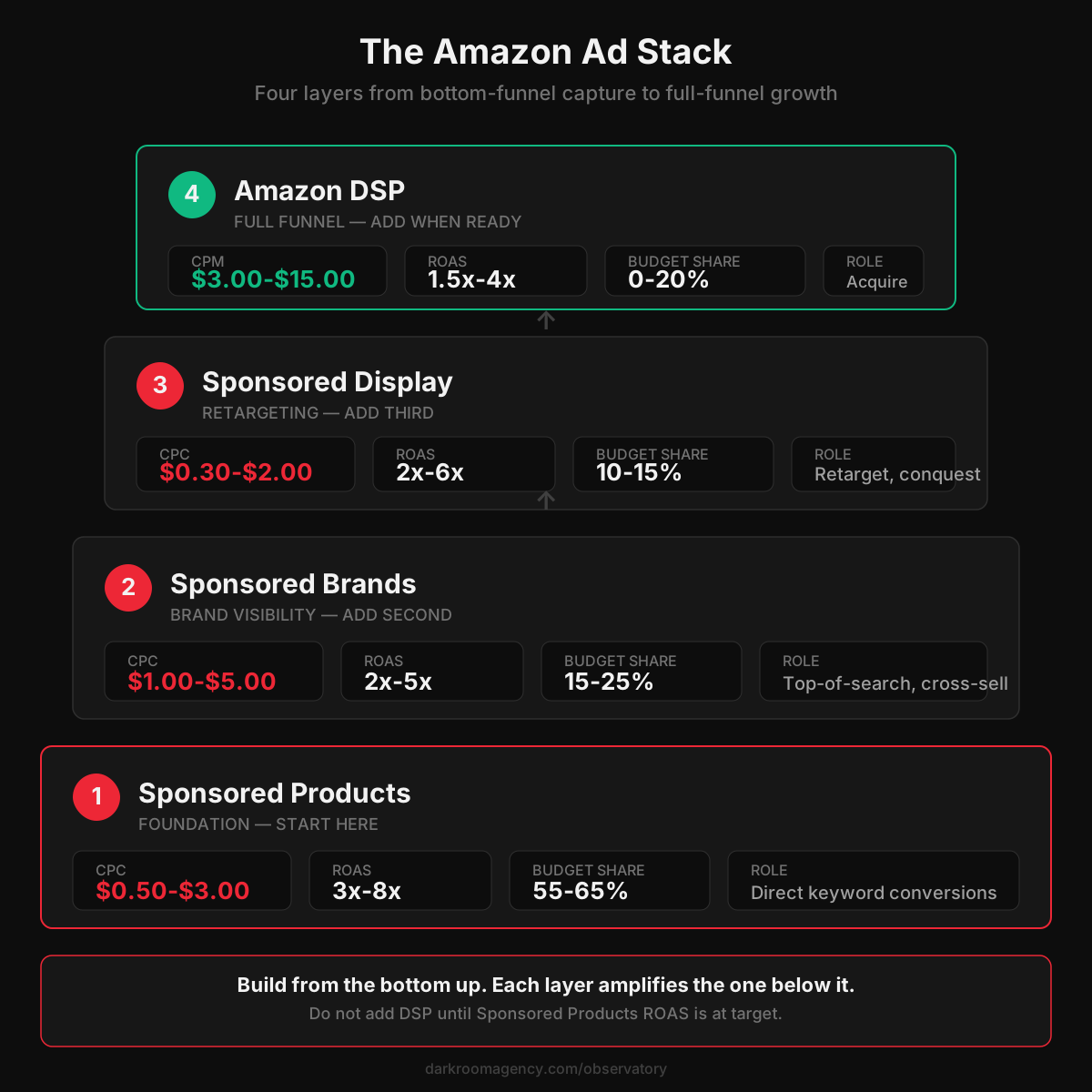
Amazon advertising operates through four primary ad products. Each has different pricing mechanics, performance expectations, and strategic use cases. Understanding the cost of each is the foundation for budgeting.
Sponsored Products (CPC: $0.50-$3.00): This is the workhorse of Amazon advertising. You pay per click, and ads appear in search results and on product detail pages. Average CPC across categories sits between $0.81 and $1.20 in 2026, but highly competitive categories like supplements and electronics push CPCs to $2.00-$3.00+. Sponsored Products typically deliver the highest ROAS of any Amazon ad format because they capture bottom-funnel purchase intent. Expect 3x-8x ROAS depending on category and optimization maturity. For most brands, Sponsored Products represent 60-70% of total Amazon ad spend.
Sponsored Brands (CPC: $1.00-$5.00): These ads appear at the top of search results with your brand logo, custom headline, and multiple products. CPCs run higher than Sponsored Products because of the premium placement and because these ads serve a dual purpose: conversion and brand awareness. Average CPC is $1.50-$2.50, with competitive categories pushing to $4.00-$5.00. ROAS is typically lower than Sponsored Products (2x-5x) because a portion of clicks are brand-discovery rather than direct purchase. Sponsored Brands are most effective for brands with a catalog of 10+ products that benefit from cross-selling. They represent 15-25% of total spend for mature advertisers.
Sponsored Display (CPC: $0.30-$2.00): Sponsored Display ads appear on product detail pages, customer review pages, and off-Amazon placements through Amazon's audience network. CPCs are the lowest of the self-serve formats, averaging $0.50-$0.80. However, click quality varies more widely because targeting is less intent-driven. ROAS ranges from 2x-6x, with retargeting campaigns (reaching people who viewed your product but did not purchase) outperforming prospecting campaigns significantly. Sponsored Display is the bridge between self-serve and DSP. It represents 10-15% of spend for most advertisers and is the first ad format brands should test when exploring audience-based targeting beyond keywords.
Amazon DSP (CPM: $3.00-$15.00): DSP (Demand-Side Platform) is Amazon's programmatic display and video advertising platform. Unlike self-serve ads, DSP operates on a CPM basis, meaning you pay per thousand impressions. CPMs range from $3.00 for standard display to $15.00+ for video and premium placements. DSP is fundamentally different from Sponsored Products because it targets audiences rather than keywords. You can reach shoppers based on purchase history, browsing behavior, lifestyle segments, and lookalike audiences, both on and off Amazon. ROAS is harder to measure directly because DSP operates at the top and middle of the funnel. Brands typically see 1.5x-4x ROAS when measured on a last-touch basis, but the true impact on total Amazon revenue is often 20-40% higher when accounting for halo effects on organic ranking and Sponsored Products performance. DSP requires a minimum spend of $10,000-$15,000/month through Amazon Managed Service, or $5,000+ through an agency with DSP access. This is why DSP is typically the last ad format brands add to their Amazon marketing flywheel.
Amazon Ad Format Cost Comparison
Ad Format | Pricing Model | Cost Range | Avg ROAS | Best For |
|---|---|---|---|---|
Sponsored Products | CPC | $0.50-$3.00 | 3x-8x | Direct conversions, keyword capture, new product launches |
Sponsored Brands | CPC | $1.00-$5.00 | 2x-5x | Brand awareness, catalog cross-sell, top-of-search dominance |
Sponsored Display | CPC | $0.30-$2.00 | 2x-6x | Retargeting, competitor conquesting, audience expansion |
Amazon DSP | CPM | $3.00-$15.00 | 1.5x-4x | Upper funnel, audience targeting, off-Amazon reach, video |
Amazon Advertising Cost by Category
Amazon ad costs vary significantly by product category. Competitive intensity, average order value, and conversion rates all influence what you actually pay per acquisition. Here are 2026 benchmarks from accounts Darkroom manages across five major categories.
Category | Avg SP CPC | Avg SB CPC | Avg ACoS | Avg ROAS | Competitive Intensity |
|---|---|---|---|---|---|
Beauty & Personal Care | $0.85-$1.80 | $1.50-$3.50 | 20-35% | 3x-5x | High |
Supplements & Wellness | $1.20-$3.00 | $2.00-$5.00 | 25-45% | 2x-4x | Very High |
Home & Kitchen | $0.60-$1.40 | $1.00-$2.50 | 15-28% | 4x-7x | Medium |
Electronics & Accessories | $0.70-$2.20 | $1.50-$4.00 | 18-32% | 3x-6x | High |
CPG / Grocery | $0.45-$1.10 | $0.80-$2.00 | 12-22% | 5x-9x | Medium-Low |
The category benchmarks reveal a consistent pattern: higher AOV categories tolerate higher CPCs because each conversion drives more revenue. CPG brands pay the least per click but also have the smallest margin per unit, which means ACoS management is more critical than CPC management. Supplements face the most punishing economics because CPCs are high, competition is fierce, and Amazon's advertising policies restrict certain claim-based targeting.
These numbers should inform your budget, not dictate it. A beauty brand with strong listing optimization and high conversion rates can operate profitably at CPCs well above the category average. A supplement brand with weak creative will hemorrhage budget even at below-average CPCs. The cost per click is only one variable. Conversion rate, which is driven by listing optimization and creative strategy, determines whether that click is profitable.
The Real Total Cost of Amazon Advertising
The biggest mistake brands make when budgeting for Amazon advertising is treating ad spend as the total cost. Ad spend is the media budget. The total cost includes three additional layers that most brands underestimate.
Layer 1: Ad Spend (60-75% of total cost). This is the money you pay to Amazon for clicks and impressions. For a brand spending $50,000/month on Amazon ads, this is the $50,000 line item. It is the largest single cost, but it is not the only one.
Layer 2: Management Fees (15-25% of total cost). Whether you manage campaigns in-house or through an agency, there is a management cost. In-house, this is payroll: an Amazon advertising specialist costs $80,000-$140,000 annually, fully loaded. Through an agency, management fees range from 15-25% of ad spend or $5,000-$25,000/month on a flat-fee basis. For a detailed breakdown, see our guide on Amazon PPC management costs.
Layer 3: Content Production (10-20% of total cost). Amazon advertising performance is directly tied to the quality of your product listings, A+ content, and ad creative. Photography costs $500-$2,000 per ASIN. Video production for Sponsored Brands Video runs $1,000-$5,000 per asset. A+ content development costs $300-$1,000 per ASIN. For a brand with 50 ASINs refreshing creative annually, content production runs $25,000-$75,000. This is the cost most brands omit from their Amazon advertising budget, and it is often the highest-ROI investment they can make.
Layer 4: Tools and Software (3-5% of total cost). Bid management platforms, analytics dashboards, competitive intelligence tools, and repricing software add $1,500-$3,000/month to your operating cost. These tools are not optional at scale. Without them, your team is making decisions with incomplete data.
Here is the math for a mid-market brand:
- Monthly ad spend: $50,000
- Agency management (20% of spend): $10,000
- Content production (amortized monthly): $4,000
- Software and tools: $2,000
- Total monthly cost: $66,000
- Total cost as percentage of ad spend: 132%
For every $1.00 you spend on Amazon ads, you are actually spending $1.32 when you include management, creative, and tools. Most brands budget for $1.00 and are surprised when the real number is 30% higher. Understanding this total cost is critical for setting realistic ROAS targets and profitability expectations.
Self-Serve vs Managed Amazon Advertising
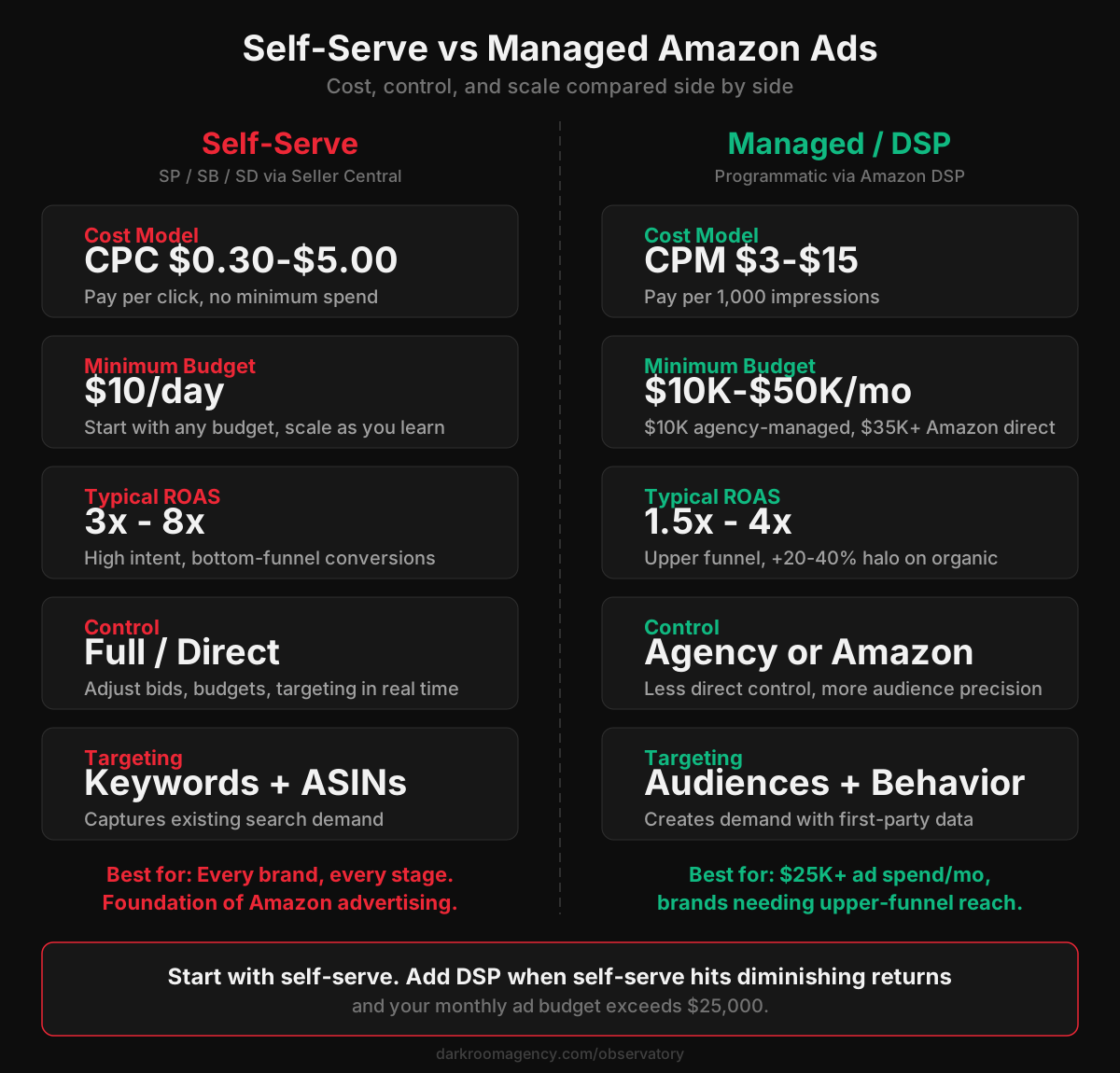
Amazon offers two distinct advertising ecosystems: self-serve (Sponsored Products, Sponsored Brands, Sponsored Display) and managed (DSP). The decision of when to move from self-serve to managed is one of the most consequential budget decisions a brand makes on Amazon.
Self-Serve Advertising: Available through Amazon Seller Central or Vendor Central. No minimum spend. You control budgets, bids, and targeting directly. Self-serve is where every brand starts and where most brands should stay until they have exhausted optimization opportunities. The economics are straightforward: you set a daily budget, Amazon charges per click, and you can pause or adjust campaigns at any time. Self-serve campaigns are the most efficient way to capture existing demand for your products.
Amazon Managed Service (DSP Direct): Amazon's own team manages your DSP campaigns. Minimum monthly commitment of $35,000-$50,000 in ad spend. You get access to Amazon's first-party audience data and programmatic display inventory, but you have less control over day-to-day optimization. Managed Service is best for large brands with significant budgets that want Amazon's proprietary insights and are comfortable with higher minimum commitments.
Agency-Managed DSP: An agency with Amazon DSP access manages campaigns on your behalf. Minimum spend is typically $10,000-$15,000/month in ad spend, plus agency management fees. This is the most common DSP entry point for growth-stage brands because it offers DSP capabilities at lower minimums with more hands-on optimization than Amazon Managed Service. For a deeper understanding of what DSP does and when it makes sense, see our guide on Amazon DSP.
The cost difference between self-serve and managed is significant. A brand spending $30,000/month on self-serve advertising (Sponsored Products and Brands) might pay $4,500-$7,500/month in agency fees. Adding DSP at $15,000/month in ad spend adds another $3,000-$5,000/month in agency fees, plus the DSP spend itself. Total advertising cost can jump from $37,500 to $55,000+ per month when you add DSP to the mix.
This is not an argument against DSP. It is a call to understand the full cost before you commit. DSP delivers value that self-serve cannot: audience-based targeting, off-Amazon reach, video advertising at scale, and the ability to influence shoppers before they start searching. But it requires sufficient budget and organizational readiness to execute well.
When to Graduate From Self-Serve to DSP
Not every brand needs DSP. Many brands are not ready for it. The decision to add DSP should be based on specific signals, not arbitrary revenue thresholds.
Signal 1: Self-serve campaigns are hitting diminishing returns. If you have optimized Sponsored Products and Sponsored Brands for 6+ months and your ACoS has stabilized or started creeping up despite continued optimization, you may have captured the available demand. DSP creates new demand by reaching shoppers who are not actively searching for your product category.
Signal 2: You have a monthly ad budget of $25,000+. Below $25,000/month in total ad spend, adding DSP dilutes your self-serve budget without generating enough DSP impressions to move the needle. At $25,000+, you can allocate $8,000-$12,000 to DSP while maintaining strong self-serve campaigns.
Signal 3: Your product listings are optimized. DSP drives traffic to your product pages. If those pages have poor images, weak A+ content, or insufficient reviews, DSP traffic will not convert. Fix the foundation before investing in upper-funnel traffic. This is where Amazon SEO and listing optimization becomes a prerequisite for DSP success.
Signal 4: You need to compete for category share, not just keyword share. Self-serve advertising targets keywords. DSP targets audiences and behaviors. If your growth strategy requires reaching new customers who are not yet searching for your product category, DSP is the tool that enables that. This is especially important in competitive categories where keyword costs are rising and organic visibility is declining.
Signal 5: You have creative assets for display and video. DSP runs on display banners and video ads. If you only have product photography, you need to invest in creative production before DSP spend will be effective. Budget $5,000-$15,000 for initial DSP creative development.
The Four-Step Amazon Ad Budget Framework
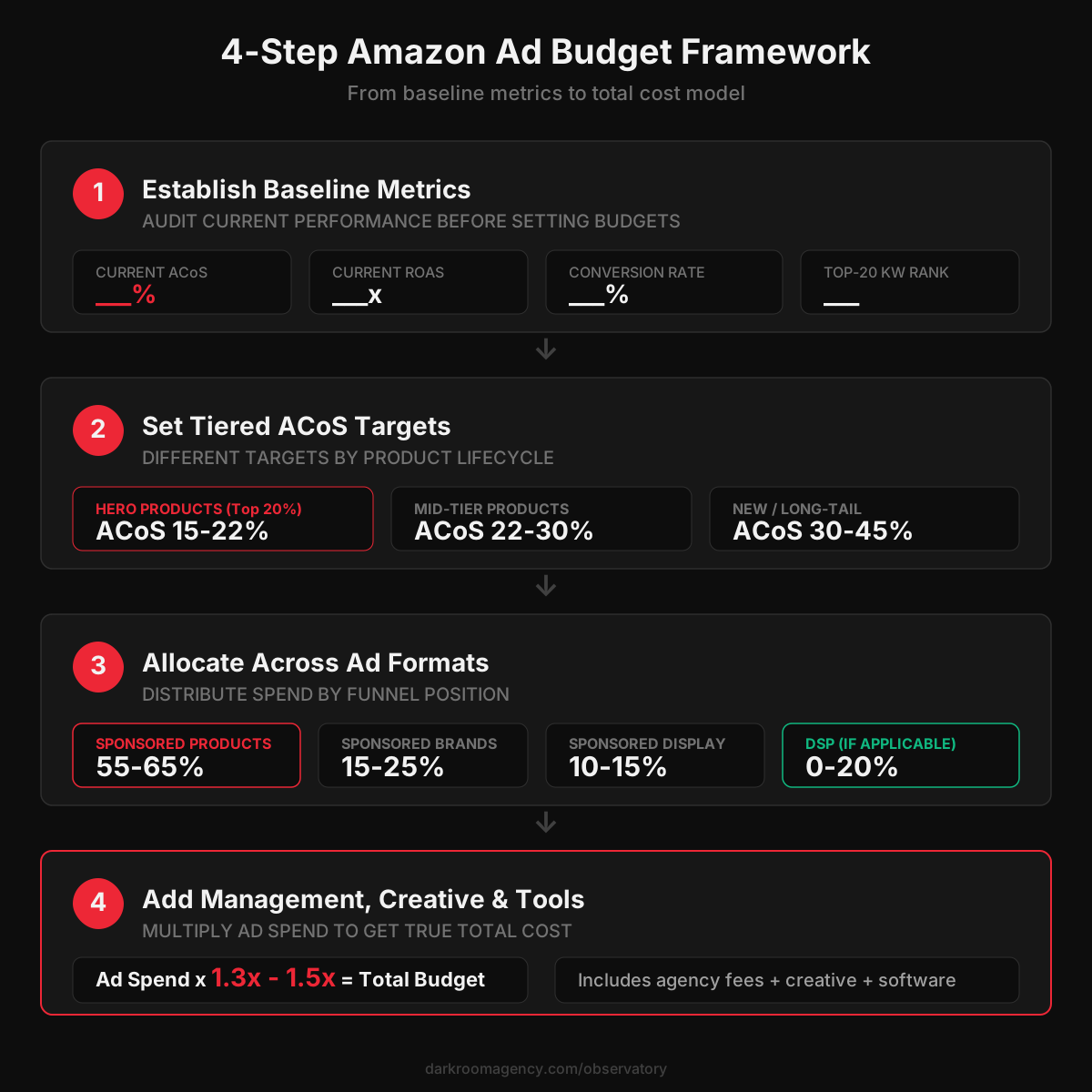
Building an Amazon advertising budget requires a structured approach. Here is the framework Darkroom uses with clients across categories.
Step 1: Establish baseline metrics. Before setting a budget, document your current ACoS, ROAS, conversion rate, and organic rank for your top 20 keywords. These baselines determine whether your advertising investment is working. Without them, you are budgeting blind. Pull these numbers from Amazon Advertising Console and Brand Analytics for the last 90 days.
Step 2: Set your target ACoS by product tier. Not every product should have the same ACoS target. Your hero products (top 20% by revenue) should have aggressive ACoS targets (15-22%) because they drive the most revenue and benefit from scale. Your mid-tier products should have moderate targets (22-30%). Your long-tail or new products should have higher ACoS tolerance (30-45%) because they need investment to build ranking and reviews. This tiered approach prevents over-investing in products that cannot deliver returns and under-investing in products that need advertising to gain traction.
Step 3: Allocate across ad formats based on funnel stage. For most brands, the allocation should follow this pattern: Sponsored Products 55-65% of total ad spend, Sponsored Brands 15-25%, Sponsored Display 10-15%, and DSP 0-20% (if applicable). Adjust based on your category and growth stage. Brands in highly competitive categories need more Sponsored Brands investment for top-of-search visibility. Brands with strong organic rank can shift budget toward DSP for audience expansion. Brands launching new products should over-index on Sponsored Products to build initial velocity.
Step 4: Build in management, creative, and tool costs. Take your target ad spend and multiply by 1.3x-1.5x to get your true total Amazon advertising budget. This multiplier accounts for agency or in-house management, content production, and software. If your target ad spend is $40,000/month, budget $52,000-$60,000/month total. This prevents the common problem of brands setting an ad spend budget and then being surprised by management and creative costs that erode profitability. For guidance on evaluating what agencies include, see our breakdown of Amazon marketing agency services.
Monthly Budget Ranges by Brand Stage
Here is what Amazon advertising typically costs by brand maturity and revenue stage. These ranges include ad spend plus management but exclude content production, which varies by catalog size.
Early Stage ($0-$500K annual Amazon revenue): $2,000-$8,000/month total. Focus entirely on Sponsored Products. Use automatic campaigns to discover keywords, then build manual campaigns around winners. At this stage, most brands manage campaigns themselves or use a freelance specialist ($500-$1,500/month). The goal is not profitability from advertising. The goal is building enough sales velocity and reviews to establish organic rank. Expect ACoS of 30-50% during this phase.
Growth Stage ($500K-$3M annual Amazon revenue): $8,000-$30,000/month total. Add Sponsored Brands and begin testing Sponsored Display. This is where agency management typically becomes cost-effective because the complexity of managing three ad formats across a growing catalog exceeds what one person can optimize. Agency fees at this stage run $3,000-$8,000/month. Target ACoS of 20-35% depending on category.
Scale Stage ($3M-$10M annual Amazon revenue): $30,000-$80,000/month total. All self-serve formats are active. DSP enters the picture at the higher end of this range. You need dedicated management, whether in-house or agency, with specialists across campaign types. Agency fees run $8,000-$20,000/month. This is the stage where the flywheel between organic and paid becomes critical. Target ACoS of 15-28%.
Enterprise Stage ($10M+ annual Amazon revenue): $80,000-$250,000+/month total. Full ad stack including DSP. Multiple team members managing different campaign types. Agency fees run $20,000-$50,000+/month, or you have a dedicated in-house team costing $250,000-$400,000+ annually. At this level, Amazon advertising is a P&L line item, not a marketing experiment. The focus shifts from ROAS optimization to market share capture, category defense, and new product launch velocity. Comparison with other retail media networks becomes relevant at this stage for portfolio allocation.
Why CPC Is Not the Number That Matters
Brands obsess over CPC because it is the most visible cost metric. But CPC in isolation tells you almost nothing about advertising efficiency.
A $2.50 CPC that converts at 15% costs you $16.67 per acquisition. A $0.80 CPC that converts at 3% costs you $26.67 per acquisition. The cheaper click is the more expensive sale.
The metrics that actually determine Amazon advertising cost-effectiveness are:
ACoS (Advertising Cost of Sale): Ad spend divided by ad-attributed revenue. This is the primary efficiency metric for self-serve campaigns. Lower ACoS means more efficient advertising. Target ACoS should be set relative to your product margin. If your margin is 40%, an ACoS of 25% leaves 15% profit. An ACoS of 45% means you are losing money on every ad-attributed sale.
TACoS (Total Advertising Cost of Sale): Total ad spend divided by total Amazon revenue (including organic). This is the metric that captures the full impact of advertising on your business. Advertising drives organic rank velocity, which drives organic sales. A brand with 25% ACoS but 12% TACoS is generating significant organic revenue from advertising investment. TACoS is the metric Darkroom optimizes for because it captures the true return on advertising dollars, not just the direct return.
New-to-Brand Percentage: For Sponsored Brands and DSP, Amazon reports what percentage of your ad-attributed sales came from customers who had not purchased from your brand in the last 12 months. This metric is critical for brands focused on growth rather than defending existing customers. Higher new-to-brand percentages justify higher CPCs because you are acquiring new customers, not just re-engaging existing ones.
The implication for budgeting is clear: do not set your Amazon advertising budget based on target CPCs. Set it based on target ACoS and TACoS relative to your margin structure. Then optimize campaign structure, creative, and listing quality to drive conversion rates that make those CPCs profitable. For a complete view of how to connect analytics and attribution to these decisions, Darkroom recommends building a measurement stack before scaling ad spend.
Agency Fee Structures for Amazon Advertising
How much does it cost to have someone manage your Amazon advertising? The answer depends on the fee model and your spend level.
Percentage of Ad Spend (15-25%): The most common model. You pay the agency a percentage of your monthly ad spend. At $50,000/month in ad spend, a 20% fee means $10,000/month for management. This model aligns agency incentives with your spending, but can create perverse incentives to increase spend rather than improve efficiency. The best agencies using this model pair it with performance thresholds that reward efficiency improvements.
Flat Monthly Retainer ($5,000-$30,000/month): A fixed fee regardless of ad spend. This model creates better alignment because the agency profits from efficiency. At $50,000/month in ad spend, a $10,000 flat fee is the same 20%, but it does not increase as your spend scales. For brands planning to scale aggressively, flat fees become more cost-effective over time. For a broader view of how agency pricing works across all channels, see our breakdown of marketing agency costs by service.
Hybrid (Base + Performance): A smaller base fee ($5,000-$10,000) plus a performance bonus tied to ROAS or revenue targets. This model works well when both parties agree on realistic targets and measurement methodology. It fails when targets are arbitrary or when the measurement window is too short to capture DSP halo effects.
DSP-Specific Fees: DSP management is often priced separately from self-serve management. Expect an additional $3,000-$8,000/month for DSP management, or 10-15% of DSP spend. Some agencies bundle DSP into their overall fee, but most do not because DSP requires different expertise and more labor-intensive optimization.
When evaluating agency costs, compare the total fee against what you would pay for equivalent in-house capability. A $15,000/month agency fee covers a team of specialists (strategist, campaign manager, analyst) whose equivalent in-house cost would be $200,000-$300,000+ in annual payroll. For brands spending less than $100,000/month on Amazon ads, agency management is almost always more cost-effective than building an in-house team. This math shifts at higher spend levels, which is why large brands often run hybrid models with in-house leads supplemented by agency specialists.
Common Budgeting Mistakes on Amazon
After managing Amazon advertising for hundreds of brands, Darkroom sees the same budgeting mistakes repeatedly.
Mistake 1: Setting one ACoS target for all products. A single ACoS target treats hero products and new launches the same way. Hero products should be optimized for margin. New products need investment to build velocity. Use tiered ACoS targets based on product lifecycle stage.
Mistake 2: Cutting ad spend when ACoS rises. Rising ACoS is a signal to optimize, not a signal to cut. When you cut ad spend, you lose ranking velocity, which reduces organic sales, which increases your TACoS. The correct response to rising ACoS is to audit campaign structure, negative keyword lists, bid strategies, and listing conversion rates.
Mistake 3: Adding DSP too early. DSP is not a fix for underperforming self-serve campaigns. If your Sponsored Products are not delivering acceptable ROAS, DSP will not improve the situation. DSP amplifies what is already working. Fix self-serve first.
Mistake 4: Ignoring content production costs. A brand that spends $50,000/month on ads but $0 on creative is wasting a significant portion of that ad spend. Ad clicks land on product pages. If those pages do not convert, you are paying for traffic that does not buy. Budget 10-20% of your ad spend for ongoing creative and content investment.
Mistake 5: Comparing Amazon ad costs to other platforms without context. Amazon CPCs look expensive compared to TikTok Shop or even Google Shopping. But Amazon shoppers have dramatically higher purchase intent. A $1.50 CPC on Amazon that converts at 12% is more efficient than a $0.30 CPC on another platform that converts at 1.5%. Compare cost per acquisition, not cost per click.
How Darkroom Approaches Amazon Advertising Budgets
Darkroom manages Amazon advertising as a system, not a collection of campaigns. The budget framework connects ad spend to listing quality, creative production, and organic performance in a single operating model.
For every new Amazon client, Darkroom conducts a 30-day diagnostic that maps current advertising efficiency, identifies wasted spend, benchmarks performance against category averages, and builds a 90-day optimization roadmap with specific budget recommendations by ad format and product tier.
This diagnostic typically identifies 15-25% in wasted ad spend from poor campaign structure, missing negative keywords, or misallocated budgets between automatic and manual campaigns. Reallocating that waste funds optimization improvements without increasing total ad spend.
The operating model then layers in creative testing (new ad copy, imagery, and A+ content), listing optimization (title, bullet, and backend keyword improvements), and strategic DSP activation when the self-serve foundation is delivering target-range ROAS. This integrated approach is what separates advertising management from Amazon marketing as a flywheel.
For brands evaluating whether to manage Amazon advertising in-house or with agency support, the decision often comes down to operational density: how many optimizations per dollar of spend your team can execute weekly. Darkroom's team structure delivers higher operational density than most in-house setups because each specialist focuses on one function (campaign management, creative, analytics) rather than splitting attention across all of them.
Frequently Asked Questions
How much should I spend on Amazon advertising per month?
Most brands should allocate 10-15% of their Amazon revenue to advertising. A brand doing $200,000/month in Amazon revenue should budget $20,000-$30,000/month in ad spend, plus $6,000-$12,000 in management, creative, and tools. The exact amount depends on your category, growth targets, and margin structure. Brands in launch phase may need to invest 20-30% of revenue temporarily to build velocity.
What is a good ACoS on Amazon in 2026?
There is no universal good ACoS. The right ACoS depends on your margin. If your product margin is 50%, an ACoS of 30% is profitable. If your margin is 25%, an ACoS of 30% means you are losing money on every ad-driven sale. Target ACoS should be set at 50-70% of your gross margin to leave room for other costs (fulfillment, overhead, returns).
Is Amazon DSP worth it for small brands?
Generally no, unless you define small as $1M+ in annual Amazon revenue. DSP requires minimum $10,000-$15,000/month in ad spend to generate meaningful data and results. Below that, the impressions are too few to drive measurable impact. Small brands should focus on maximizing Sponsored Products and Sponsored Brands before considering DSP.
How do Amazon advertising costs compare to Google or Meta ads?
Amazon CPCs ($0.50-$3.00 for Sponsored Products) are generally higher than Google Shopping ($0.30-$1.50) but lower than Google Search brand terms ($2.00-$8.00+). Meta CPMs ($8-$25) are comparable to Amazon DSP ($3-$15). The critical difference is conversion rate: Amazon shoppers convert at 10-15% on average, while Google Shopping converts at 2-4% and Meta traffic converts at 1-3%. Cost per acquisition on Amazon is often lower despite higher CPCs.
Can I start Amazon advertising with a small budget?
Yes. You can start Sponsored Products with as little as $10-$20/day ($300-$600/month). This is enough to test keywords, gather data on conversion rates, and identify which products respond to advertising. The limitation of small budgets is not that they do not work, but that they generate data slowly. A $500/month budget might take 3-4 months to gather enough data for meaningful optimization. A $5,000/month budget compresses that learning period to 4-6 weeks.
What is the minimum budget for Amazon DSP?
Through Amazon Managed Service, the minimum is $35,000-$50,000/month in ad spend. Through an agency with DSP access, minimums are typically $10,000-$15,000/month. Some agencies accept lower DSP budgets ($5,000-$8,000/month) as part of a bundled self-serve and DSP engagement, but results at that spend level are limited.
How long does it take for Amazon advertising to show results?
Sponsored Products campaigns typically show directional data within 2-4 weeks and reach optimization maturity in 8-12 weeks. Sponsored Brands take 4-6 weeks for initial data. DSP campaigns require 6-8 weeks before performance stabilizes because programmatic campaigns need time to optimize audience segments and bid strategies. Do not judge Amazon advertising effectiveness on less than 90 days of data.
Should I hire an agency or manage Amazon ads myself?
If you are spending less than $5,000/month on Amazon ads, self-management or a freelance specialist is cost-effective. Between $5,000 and $20,000/month, a specialized agency delivers better returns than most in-house generalists. Above $20,000/month, the decision depends on whether you can hire and retain Amazon advertising specialists. For most brands in the $10,000-$100,000/month range, agency management is more cost-effective than in-house because of team specialization and reduced turnover risk.
Build Your Amazon Advertising Budget With Real Numbers
Amazon advertising cost is not a single number. It is a system of interconnected costs: ad spend, management, creative, and tools. The brands that win on Amazon are the ones that budget for the full system, not just the ad spend line item.
Start with your margin structure. Set tiered ACoS targets. Allocate across ad formats based on your growth stage. Build in management and creative costs from the beginning. And measure TACoS, not just ACoS, to understand the true return on your advertising investment.
If you want Darkroom to audit your current Amazon advertising spend and build a budget framework specific to your category and growth stage, book a call with our team. We will benchmark your performance against category averages and show you exactly where your budget is working and where it is being wasted.
Explore Darkroom's Amazon services, paid media management, and performance creative capabilities. Start at www.darkroomagency.com