
SOCIAL COMMERCE
TikTok Shop Fees Explained: The Complete Seller Cost Breakdown for 2026




Written by Darkroom leardership

Written & peer reviewed by 4 Darkroom team members
TL;DR: TikTok Shop's advertised fees look low on paper: 2-8% referral fees plus payment processing. The reality is more complex. When you add transaction fees, shipping costs, affiliate commissions (5-20%), Shop Ads spend (15-25% of revenue), content production, returns, and chargebacks, the total cost of selling on TikTok Shop runs 35-55% of revenue depending on category and scale. This article breaks down every fee layer, compares the total cost against Amazon and Shopify DTC, and provides a profitability framework for forecasting your real margins. Darkroom publishes these numbers because accurate cost modeling is the difference between scaling profitably and burning cash.
Why TikTok Shop Fees Are More Complex Than They Appear
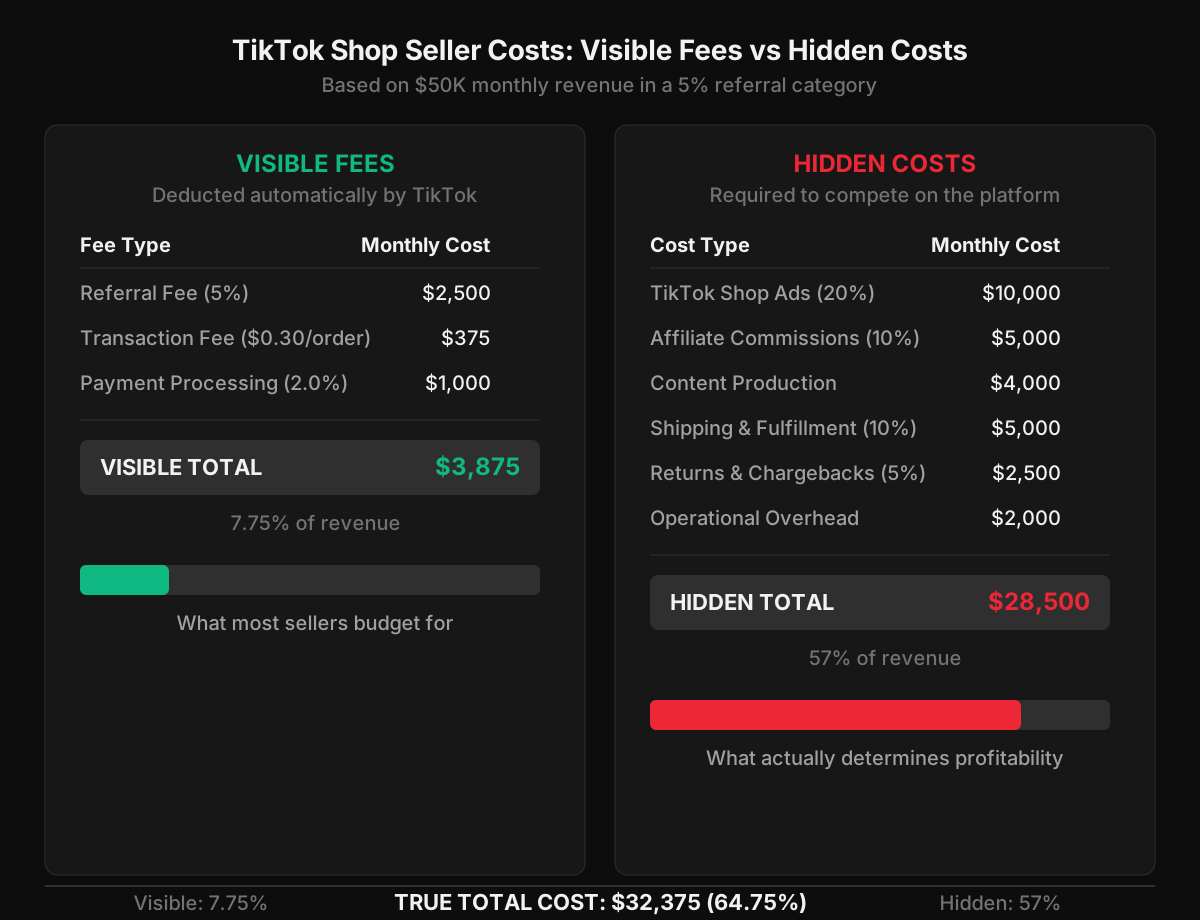
TikTok Shop publishes a simple fee schedule. Referral fees by category. Payment processing. Done. If you take that at face value, you will calculate a 7-10% cost of sale and build your business model around margins that do not exist in practice.
The platform's fee structure is layered. Some fees are mandatory and deducted automatically. Others are technically optional but functionally required if you want to generate meaningful revenue. And a third category of costs sits entirely outside TikTok's fee schedule but is directly caused by operating on the platform.
According to TikTok for Business, the Shop integration is designed as a discovery-first commerce channel. That architectural decision means organic traffic is limited and paid promotion is the primary driver of visibility. The platform's fee schedule does not account for this reality, which is why sellers who budget only for referral and transaction fees consistently underestimate their true cost of sale.
Understanding the full cost stack is not optional. It is the prerequisite for every pricing, margin, and growth decision you will make on the platform. The sections below break down each fee layer individually, then aggregate them into the actual cost of doing business on TikTok Shop in 2026.
Referral Fees by Category: The Base Layer
TikTok Shop charges a referral fee on every order, calculated as a percentage of the total order value (product price plus shipping charged to the customer, minus any TikTok-funded discounts). This is the fee most sellers reference when discussing TikTok Shop costs, and it varies significantly by product category.
Product Category | Referral Fee | New Seller Rate (First 90 Days) | Notes |
|---|---|---|---|
Fashion & Apparel | 8% | 2% | Highest category rate. Includes clothing, shoes, accessories. |
Beauty & Personal Care | 5% | 2% | Skincare, makeup, haircare, fragrance. |
Health & Wellness | 6% | 2% | Supplements, fitness, personal health devices. |
Home & Garden | 5% | 2% | Decor, kitchen, outdoor, cleaning supplies. |
Electronics & Accessories | 3% | 2% | Lowest standard rate. Phone accessories, gadgets, audio. |
Sports & Outdoors | 5% | 2% | Athletic gear, camping, outdoor recreation. |
Food & Beverages | 2% | 2% | Lowest overall rate. Packaged food, drinks, snacks. |
Baby & Maternity | 5% | 2% | Baby gear, maternity products, nursery. |
The new seller promotional rate of 2% applies for the first 90 days after your shop goes live. This is designed to lower the barrier to entry, but it also distorts your initial unit economics. Sellers who launch during the promotional window and set pricing based on 2% referral fees face a margin shock when the standard rate kicks in. Plan your pricing around the standard rate from day one.
These rates are competitive compared to Amazon's 8-15% referral fees, but the comparison is misleading without accounting for the other cost layers that follow. A lower referral fee does not automatically mean lower total cost of sale.
Transaction Fees and Payment Processing
On top of referral fees, TikTok Shop charges two additional per-order fees that are deducted before your payout.
Transaction fee: $0.30 per order. This is a flat fee regardless of order value. On a $50 order, it represents 0.6%. On a $15 order, it represents 2%. Low-AOV sellers feel this fee disproportionately.
Payment processing fee: 2.0% of order value. This covers the cost of processing credit cards, debit cards, and digital wallets through TikTok's payment infrastructure. Unlike platforms like Shopify where you can choose your payment processor, TikTok Shop mandates its own processing and sets the rate.
Combined with referral fees, a $50 order in a 5% referral category costs you: $2.50 (referral) + $0.30 (transaction) + $1.00 (processing) = $3.80, or 7.6% of order value. That is the visible platform cost before any other expenses.
For low-AOV products under $20, the transaction fee becomes more punitive. A $12 product in a 5% category costs $0.60 + $0.30 + $0.24 = $1.14, or 9.5% of order value. If your product line skews toward lower price points, the effective platform fee rate is higher than the headline percentages suggest.
Shipping Fees: What TikTok Covers and What You Pay
TikTok Shop offers multiple fulfillment models, each with different cost structures.
Fulfilled by TikTok (FBT): TikTok handles storage, packing, and shipping. You send inventory to their fulfillment centers. Fees include storage fees ($0.75-$1.50 per cubic foot/month), pick-and-pack fees ($2.50-$4.50 per order depending on size and weight), and shipping charges passed through at TikTok's negotiated carrier rates. FBT is comparable to Amazon FBA in structure, though the network is smaller and less geographically distributed.
Seller Fulfilled: You handle all logistics through your own 3PL or in-house fulfillment. TikTok generates shipping labels but you manage the process. Shipping costs depend on your carrier contracts and typically run $3-$8 per order for standard domestic shipping. You maintain more control but absorb all fulfillment overhead.
TikTok Shipping Subsidies: TikTok periodically offers shipping subsidies during promotional events and for sellers participating in specific programs. These subsidies can reduce shipping costs by 30-50% but are temporary and unpredictable. Do not build your margin model around subsidies. Treat them as a bonus when they appear.
Regardless of model, expect shipping and fulfillment to cost 8-15% of order value for products in the $20-$80 range. Higher-AOV products see lower percentages. Lower-AOV products see higher percentages. This is the second-largest cost bucket after advertising.
Affiliate Commission Structures: The Creator Economy Tax
TikTok Shop's affiliate program is the engine that drives product discovery. Creators promote your products through their content and earn a commission on each sale they generate. This is not a traditional advertising cost. It is a revenue share that functions as a variable cost of acquisition.
You set your own affiliate commission rates, but the market determines what is competitive. In practice, the ranges look like this:
Open collaboration (marketplace): 5-15% commission. You list your product in the affiliate marketplace and any creator can promote it. This is the self-service model. Lower-commission offers attract fewer creators and less competitive ones. Most brands set 10-15% to get meaningful creator volume.
Targeted collaboration: 10-20% commission. You invite specific creators to promote your products. Higher commission rates incentivize better content quality and creator commitment. Top-performing affiliates typically negotiate for 15-20%.
Direct partnerships: Flat fees ($200-$2,000 per video) plus performance bonuses. These are negotiated relationships with high-performing creators who produce dedicated content for your brand. The economics are better at scale but require upfront investment and relationship management.
For most sellers, affiliate commissions represent 8-15% of affiliate-driven revenue. If affiliate sales make up 40-60% of your total TikTok Shop revenue (common for growing brands), the blended impact on total revenue is 4-9%. This is a cost that does not exist on Amazon or Shopify DTC in the same form, and it catches many sellers off guard.
For a deeper look at managing creator and influencer partnerships effectively, we cover the operational side in a separate guide.
TikTok Shop Ads: The Required Investment
TikTok Shop Ads are technically optional. Practically, they are mandatory. The platform's discovery algorithm favors storefronts with active ad spend, and organic visibility on TikTok Shop is limited compared to the main TikTok feed.
According to Jungle Scout's 2026 ecommerce seller report, TikTok Shop sellers without active ad campaigns see traffic decline 30-50% month over month after initial launch momentum fades. The algorithm rewards consistent investment.
Product Shopping Ads (PSA): Your products appear in the Shop tab and search results. CPC ranges from $0.30-$1.50 depending on category competition. Fashion and beauty run higher ($0.80-$1.50). Niche categories run lower ($0.30-$0.60). This is the baseline ad format most sellers start with.
Video Shopping Ads (VSA): Your product videos appear in the For You feed with integrated Shop checkout. CPM ranges from $5-$15 depending on audience and creative quality. These ads blend content and commerce in a single experience, which is why the creative-commerce loop is so critical to ad efficiency.
LIVE Shopping Ads: Promoted live streams that drive viewers to your live selling sessions. CPM ranges from $3-$10. These are lower cost but require investment in live streaming infrastructure and talent.
Most successful sellers allocate 15-25% of revenue to TikTok Shop Ads. On $50,000 monthly revenue, that is $7,500-$12,500 in ad spend. ROAS targets vary by maturity: new stores target 1.5-2.5x, growing stores target 2.5-4x, and mature operations target 4-6x. Running at 2x ROAS means you spend $1 to make $2, leaving $1 to cover all other costs. The margin is tight.
Brands that invest in performance creative to improve ad efficiency see meaningful gains in ROAS, which directly impacts profitability. A 1% improvement in video hook rate translates to measurable ROAS lift because TikTok's algorithm amplifies content that drives engagement.
Hidden Costs: Returns, Chargebacks, and Content Production
These costs do not appear in TikTok Shop's fee schedule, but they are real operating expenses directly tied to selling on the platform.
Returns and refunds: TikTok Shop requires sellers to accept returns within a specified window (typically 15-30 days). Return rates on TikTok Shop tend to run 10-20% for fashion and apparel, 5-10% for beauty, and 3-8% for home goods. Each return costs you the original shipping, return shipping (if you offer free returns), restocking labor, and in some cases damaged or unsellable inventory. Budget 3-8% of revenue for return-related costs.
Chargebacks and disputes: TikTok Shop charges $20 per chargeback dispute. The platform also penalizes sellers with high dispute rates through reduced visibility and potential account restrictions. Chargeback rates should stay below 0.5% of orders. If they creep above 1%, you have a product quality, listing accuracy, or fulfillment speed problem that needs immediate attention.
Content production: Every SKU on TikTok Shop needs video content. Not product photos and descriptions. Video. This is a fundamentally different content requirement than Amazon or Shopify. A single TikTok Shop video costs $500-$3,000 to produce in-house or $1,500-$5,000 through creators or agencies. Brands maintaining competitive visibility need 3-5 new videos per week. Monthly content costs range from $2,000-$10,000 depending on production approach and volume. This is 3-8% of revenue for most growing brands.
Platform compliance and operations: Managing a TikTok Shop requires ongoing operational attention. Product listing updates, inventory syncing, customer service responses (TikTok enforces response time SLAs), policy compliance, and platform updates all consume time. For brands scaling beyond $20K monthly revenue, this justifies $1,500-$3,000 monthly in dedicated operational overhead, whether from internal staff time or outsourced management through a TikTok Shop agency.
The Full Fee Stack: What a $50K Month Actually Costs
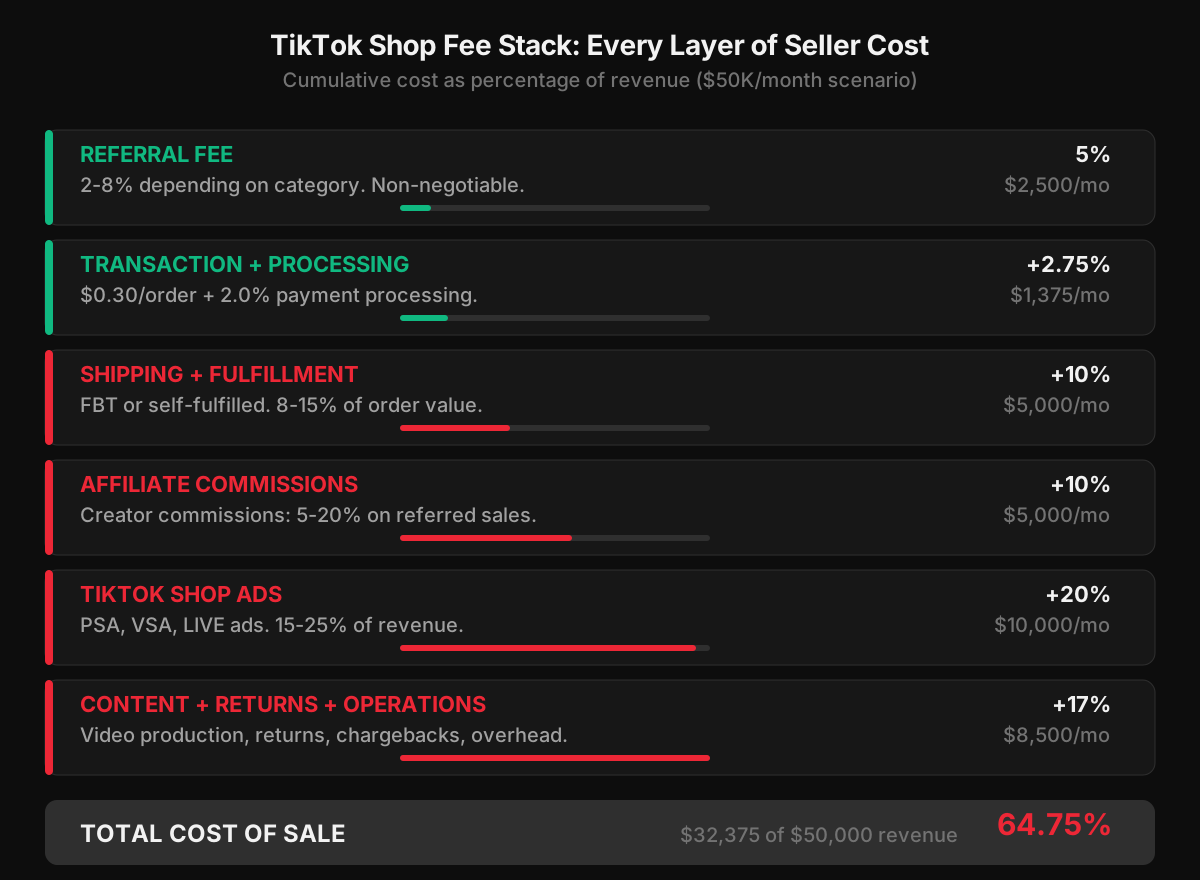
Here is the complete cost breakdown for a fashion brand generating $50,000 monthly revenue on TikTok Shop. Fashion is used because it has the highest referral fee rate and illustrates the maximum cost scenario.
Referral fee (8%): $4,000
Transaction fees ($0.30 x ~1,250 orders at $40 AOV): $375
Payment processing (2.0%): $1,000
Shipping and fulfillment (~10%): $5,000
Affiliate commissions (~10% blended): $5,000
TikTok Shop Ads (~20%): $10,000
Content production: $4,000
Returns and chargebacks (~5%): $2,500
Operational overhead: $2,000
Total monthly cost: $33,875
Total as percentage of revenue: 67.75%
That leaves $16,125 to cover COGS. If your product cost is 30% of retail ($15,000), you are left with $1,125 in profit on $50,000 in revenue. That is a 2.25% net margin.
The math improves at scale. A $200K/month seller in the same category benefits from lower per-unit content costs, better ad efficiency, stronger creator relationships, and operational leverage. Their cost percentage might compress to 45-50% of revenue, yielding 15-20% net margins. But the ramp to profitability is real, and sellers who do not model these costs accurately burn through capital before reaching that inflection point.
This is exactly why treating TikTok Shop like a traditional marketplace fails. The cost structure demands a content-first, community-driven approach that is fundamentally different from listing products and waiting for orders.
TikTok Shop vs Amazon vs Shopify DTC: Total Cost Comparison
Comparing platform fees alone is misleading. What matters is the total cost to generate $1 of revenue on each platform. This table uses a $50,000 monthly revenue scenario across all three channels for a mid-market consumer brand.
Cost Category | TikTok Shop | Amazon FBA | Shopify DTC |
|---|---|---|---|
Platform/Referral Fees | 5-8% ($2,500-$4,000) | 8-15% ($4,000-$7,500) | ~0.5% ($299/mo + processing) |
Payment Processing | 2.0% + $0.30/order ($1,375) | Included in referral fee | 2.4-2.9% ($1,200-$1,450) |
Shipping/Fulfillment | 8-15% ($4,000-$7,500) | 20-30% FBA ($10,000-$15,000) | 8-12% ($4,000-$6,000) |
Advertising | 15-25% ($7,500-$12,500) | 15-25% PPC ($7,500-$12,500) | 20-35% paid social/search ($10,000-$17,500) |
Affiliate/Creator Costs | 5-15% ($2,500-$7,500) | 0-3% ($0-$1,500) | 0-5% ($0-$2,500) |
Content Production | 4-8% ($2,000-$4,000) | 1-3% ($500-$1,500) | 3-6% ($1,500-$3,000) |
Returns/Chargebacks | 3-8% ($1,500-$4,000) | 3-8% ($1,500-$4,000) | 2-5% ($1,000-$2,500) |
Operational Overhead | 3-5% ($1,500-$2,500) | 2-4% ($1,000-$2,000) | 3-5% ($1,500-$2,500) |
Total Cost Range | 35-55% ($17,500-$27,500) | 30-45% ($15,000-$22,500) | 25-40% ($12,500-$20,000) |
Several patterns emerge from this comparison. TikTok Shop has the lowest platform fees but the highest total cost due to mandatory creator and content investments. Amazon has the highest platform fees but lower total costs because the marketplace provides built-in demand and does not require creator content. Shopify DTC has the lowest total cost but requires you to build and own your entire traffic engine.
The right channel depends on your product, your audience, and your capabilities. Brands with strong creative teams and existing creator relationships are better positioned for TikTok Shop. Brands with established search demand and catalog depth are better positioned for Amazon. Brands with strong email lists and organic social presence are better positioned for Shopify DTC. For a more detailed analysis, read our TikTok Shop vs Amazon DTC comparison. According to Statista's TikTok Shop GMV data, the platform's global merchandise volume continues to grow rapidly, but growth does not eliminate the cost structure that sellers must navigate.
Most scaling brands operate on two or three of these channels simultaneously. The goal is not to choose one. It is to understand the cost structure of each so you can allocate capital, inventory, and creative resources where they generate the best return. This is what a full-funnel marketing system looks like in practice.
The Four-Step Profitability Framework for TikTok Shop Sellers
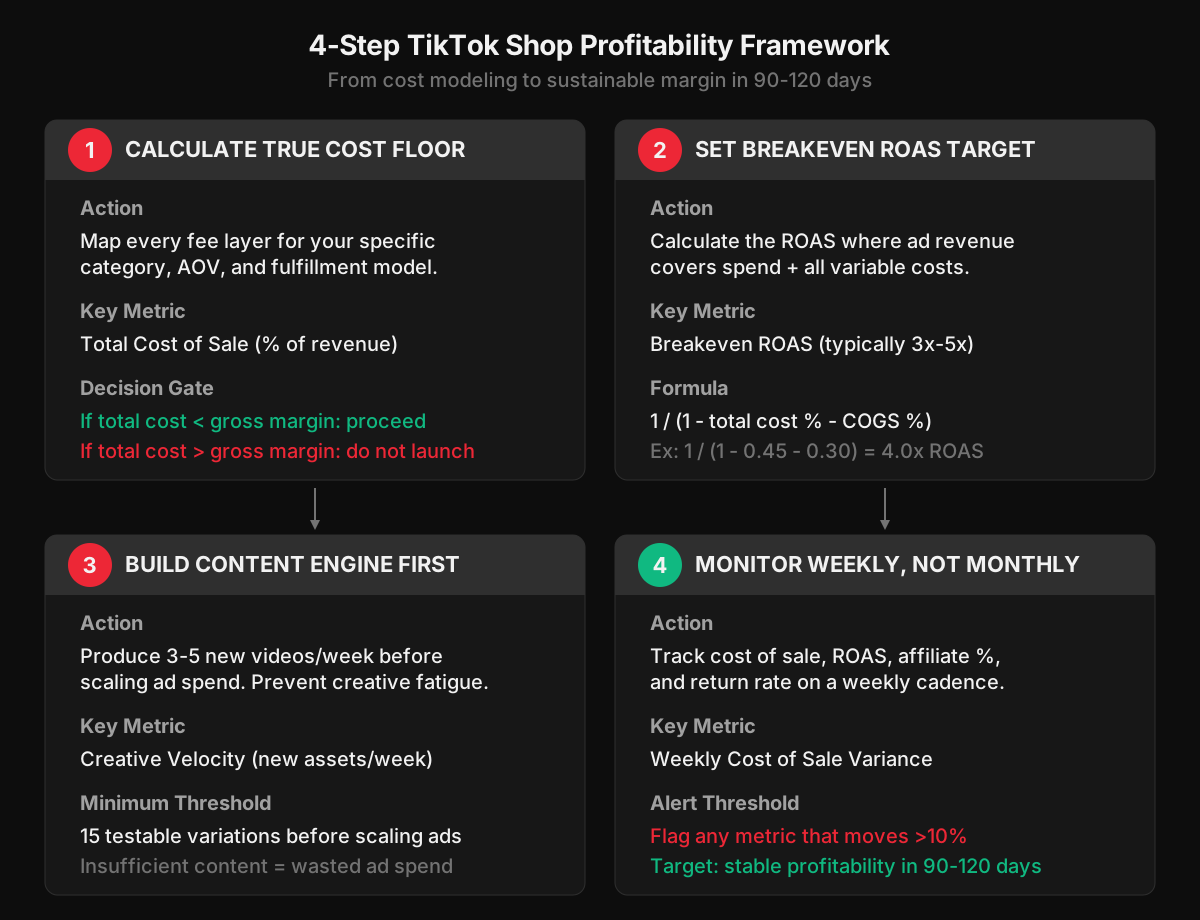
Knowing the fees is step one. Turning that knowledge into a profitable operation requires a systematic approach. This framework applies whether you are pre-launch or already selling.
Step 1: Calculate your true cost floor. Add up every fee layer outlined in this article for your specific category. Do not use averages. Use your actual referral rate, your actual AOV, your actual shipping cost, and your projected affiliate and ad spend rates. If the total cost exceeds your gross margin (revenue minus COGS), TikTok Shop is not viable for that product at that price point. Adjust pricing, reduce COGS, or choose a different channel.
Step 2: Set your breakeven ROAS target. Your breakeven ROAS is the point where ad revenue covers ad spend plus all other variable costs. For most TikTok Shop sellers, breakeven ROAS falls between 3x and 5x depending on margin structure. If your true cost of sale is 45% of revenue and your COGS is 30%, you need every dollar of ad spend to generate at least $3.33 in revenue just to break even. Know this number before you spend your first dollar on ads.
Step 3: Build your content engine before scaling spend. The biggest mistake sellers make is scaling ad spend before they have a repeatable content production system. Without sufficient creative volume, ad performance degrades as creative fatigue sets in. Build a system that produces 3-5 new videos per week before increasing ad budgets. The creative fatigue and testing framework we developed addresses this directly.
Step 4: Monitor unit economics weekly, not monthly. TikTok Shop's costs fluctuate based on ad performance, creator activity, and platform promotions. Monthly reporting hides volatility. Track your cost of sale, ROAS, affiliate revenue percentage, and return rate weekly. Flag any metric that moves more than 10% from its trailing average. Early detection prevents small margin erosion from becoming a profitability crisis.
Brands that follow this framework and work with a dedicated growth team typically reach stable profitability within 90-120 days. Brands that wing it often spend 6-9 months before understanding their real cost structure, by which point they have already invested heavily in an unprofitable model.
How to Reduce Your TikTok Shop Fee Burden
Some costs are fixed by the platform. Others are within your control. Focus your optimization on the levers you can actually pull.
Increase AOV to dilute fixed per-order fees. The $0.30 transaction fee and flat fulfillment costs have less impact on higher-value orders. Bundles, upsells, and multi-unit discounts increase AOV and improve fee efficiency. A $40 AOV product pays 0.75% in transaction fees. An $80 AOV product pays 0.375%.
Improve creative quality to lower advertising cost. Better-performing creative earns lower CPMs and higher conversion rates, which drives ROAS up. Investing an additional $2,000/month in creative production that improves ROAS from 2.5x to 3.5x saves far more in ad spend than the creative cost. This is where performance creative services deliver outsized ROI.
Negotiate creator commissions through volume and exclusivity. Creators who see consistent sales from your brand will accept lower commission rates in exchange for reliable income and exclusive access. Build long-term partnerships instead of running constant open marketplace campaigns at premium rates.
Optimize fulfillment model. Compare FBT costs against your own 3PL. Depending on product size, weight, and volume, one model may be significantly cheaper. Run a 30-day cost comparison with real order data before committing to either approach.
Reduce return rate through accurate listings. Most TikTok Shop returns result from mismatched expectations. Size chart issues, color inconsistencies, and overpromising in video content drive returns up. Improving listing accuracy by 2-3 percentage points in return rate saves more than most sellers realize. A brand doing $50K/month that reduces returns from 12% to 9% saves $1,500/month in return-related costs alone.
When TikTok Shop Fees Make Sense (and When They Do Not)
TikTok Shop's cost structure favors certain product profiles and disfavors others. Here is the honest assessment.
TikTok Shop makes sense for: Products with 60%+ gross margins. Products that demonstrate well in short-form video (beauty, fashion, home gadgets, wellness). Brands with existing creator networks or the capacity to build them. Products targeting demographics under 40 who are active TikTok users. Brands willing to invest in content as a primary growth driver.
TikTok Shop does not make sense for: Products with margins below 40%. Products that require long-form explanation or trust-building (complex supplements, high-ticket electronics). Brands without creative capacity or willingness to invest in video production. Products targeting demographics that are not active on TikTok. Commoditized products where price is the only differentiator.
If your product falls in the "makes sense" category, the fee structure is manageable and the growth opportunity is real. TikTok Shop is still in a relative growth phase compared to Amazon and Shopify, which means early movers with strong creative engines can establish category dominance before fees and competition increase further. Our guide on how to sell on TikTok Shop in 2026 covers the operational setup in detail.
If your product falls in the "does not make sense" category, no amount of fee optimization will fix a structural mismatch. Focus your resources on channels where the economics work. Our growth marketing vs performance marketing analysis can help you think through channel allocation strategy.
FAQ
How much does TikTok Shop charge sellers per transaction?
TikTok Shop charges a referral fee ranging from 2% to 8% depending on product category, plus a flat transaction fee of $0.30 per order. Payment processing adds another 2.0% on top. On a $50 order in a 5% referral category, the platform takes approximately $3.80 before shipping, affiliate, or advertising costs.
What is the TikTok Shop referral fee by category?
Referral fees vary by product category. Fashion and apparel pay 8%, beauty and personal care pay 5%, electronics pay 3%, home and garden pay 5%, health and wellness pay 6%, food and beverages pay 2%, and sports and outdoors pay 5%. These rates are subject to change and may include promotional reductions for new sellers during their first 90 days.
Is TikTok Shop cheaper than selling on Amazon?
TikTok Shop has lower platform fees (2-8% referral vs Amazon's 8-15%), but the total cost of selling is comparable or higher when you factor in mandatory content production, affiliate commissions, and TikTok Shop Ads spend. Total blended cost on TikTok Shop runs 35-55% of revenue vs 30-45% on Amazon, depending on category and scale.
Do I have to pay for TikTok Shop Ads to get sales?
Technically no, but practically yes. Organic discovery on TikTok Shop is limited compared to the main TikTok feed. Sellers without active ad campaigns see traffic decline 30-50% month over month after initial launch. Most successful sellers allocate 15-25% of revenue to Shop Ads to maintain consistent visibility and sales volume.
What are the hidden costs of selling on TikTok Shop?
Hidden costs include content production ($1,500-$10,000/month depending on volume), return processing (5-10% of orders), chargeback fees ($20 per dispute), affiliate commissions (5-20% per referred sale), inventory holding costs for TikTok Fulfilled orders, and the operational overhead of managing a separate sales channel. These hidden costs often equal or exceed the visible platform fees.
How much do TikTok Shop affiliate commissions cost?
TikTok Shop affiliate commissions are set by the seller and typically range from 5% to 20% of the sale price. Most competitive categories require 10-15% commission rates to attract quality creators. Direct creator partnerships may involve flat fees ($200-$2,000 per video) plus performance commissions, bringing total creator costs to 10-20% of revenue.
What is the minimum budget to start selling on TikTok Shop?
You can list products with no upfront cost beyond inventory, but realistic launch budgets include $2,000-$5,000 for initial content production, $1,000-$3,000 for the first month of Shop Ads, and $500-$1,500 for creator seeding. Total minimum viable launch budget is $3,500-$9,500, with ongoing monthly costs of $3,000-$10,000 to maintain momentum.
How do TikTok Shop fees compare to Shopify fees?
Shopify charges $39-$399/month for the platform plus 2.4-2.9% payment processing. There are no referral fees, affiliate commissions, or mandatory ad costs built into the platform. However, Shopify requires you to drive all your own traffic, which typically costs 20-40% of revenue in paid acquisition. TikTok Shop has higher platform-level costs but provides built-in discovery mechanics that Shopify does not.
Build Your TikTok Shop Cost Model Before You Scale
TikTok Shop fees are not complicated. They are layered. The referral rate is straightforward. The transaction and processing fees are predictable. What catches sellers off guard is the compounding effect of affiliate commissions, mandatory ad spend, content production, and operational costs on top of visible platform fees.
The sellers who succeed on TikTok Shop are the ones who model their true cost of sale before they scale, not after they have already committed inventory and budget to a channel that does not pencil out. Use the fee breakdown and cost analysis framework in this article to build a realistic financial model for your specific products and categories.
If the math works, TikTok Shop represents a genuine growth channel with less competition and lower customer acquisition costs than mature platforms. If the math does not work, that is equally valuable information. Better to know before you invest than to discover it through a quarter of negative unit economics.
Darkroom helps growth-focused brands build profitable TikTok Shop operations through strategic media management, creative systems, and UGC-driven content strategies. Explore our full range of services or book a call with our team for a realistic cost assessment tailored to your brand.