
Marketplace
Walmart Marketplace in 2026: Fees, Requirements and Whether It Is Worth It for Your Brand




Written by Darkroom leardership
11 min read
Sep 22, 2026

Walmart Marketplace is the third-party selling program on Walmart.com, where approved brands list their own products next to Walmart's first-party inventory and pay a referral fee on each sale instead of a monthly subscription. Sellers set the price, own the stock, and either ship orders themselves or hand fulfillment to Walmart.
The channel is growing fast. In the quarter ended 31 July 2026, Walmart said U.S. marketplace net sales grew more than 50%, and nearly half of that business flowed through its fulfillment services.
So the question isn't whether Walmart matters. It's whether it pays for your brand this year.
Here are the 2026 numbers, straight from Walmart.
Key takeaways:
There's no monthly fee: Referral fees run from 5% to 20% by category, and most categories pay 15%.
New sellers pay less until 31 January 2027: New-Seller Savings cuts base referral fees by 20% to 40%.
WFS is priced by weight: A 1 lb item costs $3.45 to fulfill, and items priced under $10 pay $1 more.
Walmart wins on fees; Amazon still wins on scale. Most brands end up running both.
What is Walmart Marketplace and how does it work?
Think of Walmart Marketplace as a shared storefront. Walmart lists its own products, but approved third-party sellers can list theirs right alongside, showing up in the same search results and even on the same product pages.
Walmart won’t buy your products upfront. Instead, you keep ownership of your inventory, and Walmart takes a cut from each sale, known as a referral fee. That’s how they make money from the marketplace.
You’re in charge of three big things: pricing, inventory, and order fulfillment. But here’s the catch, because Walmart decides who gets to join the marketplace. That approval step matters more here than on most other platforms.
The main draw for brands is Walmart’s massive audience. According to Walmart, about 280 million customers and members visit over 10,900 stores in 19 countries every week. On the digital side, Walmart U.S. eCommerce grew by 24% in the quarter ending July 31, 2026. Their ad business, Walmart Connect, also jumped 43% (excluding VIZIO), and the marketplace is now reaching beyond the US.
That’s a demand pool that’s actually growing faster than the main channel most brands already use. We will dig into how this compares to Amazon in just a bit.
How can a shopper tell a marketplace item from a Walmart item?
By the seller name on the listing. Marketplace items appear alongside Walmart's own products, and the product page lists the seller. For your brand, that means the listing has to earn trust on its own: complete content, reliable delivery, and competitive pricing.
What do you need to get approved as a Walmart seller in 2026?
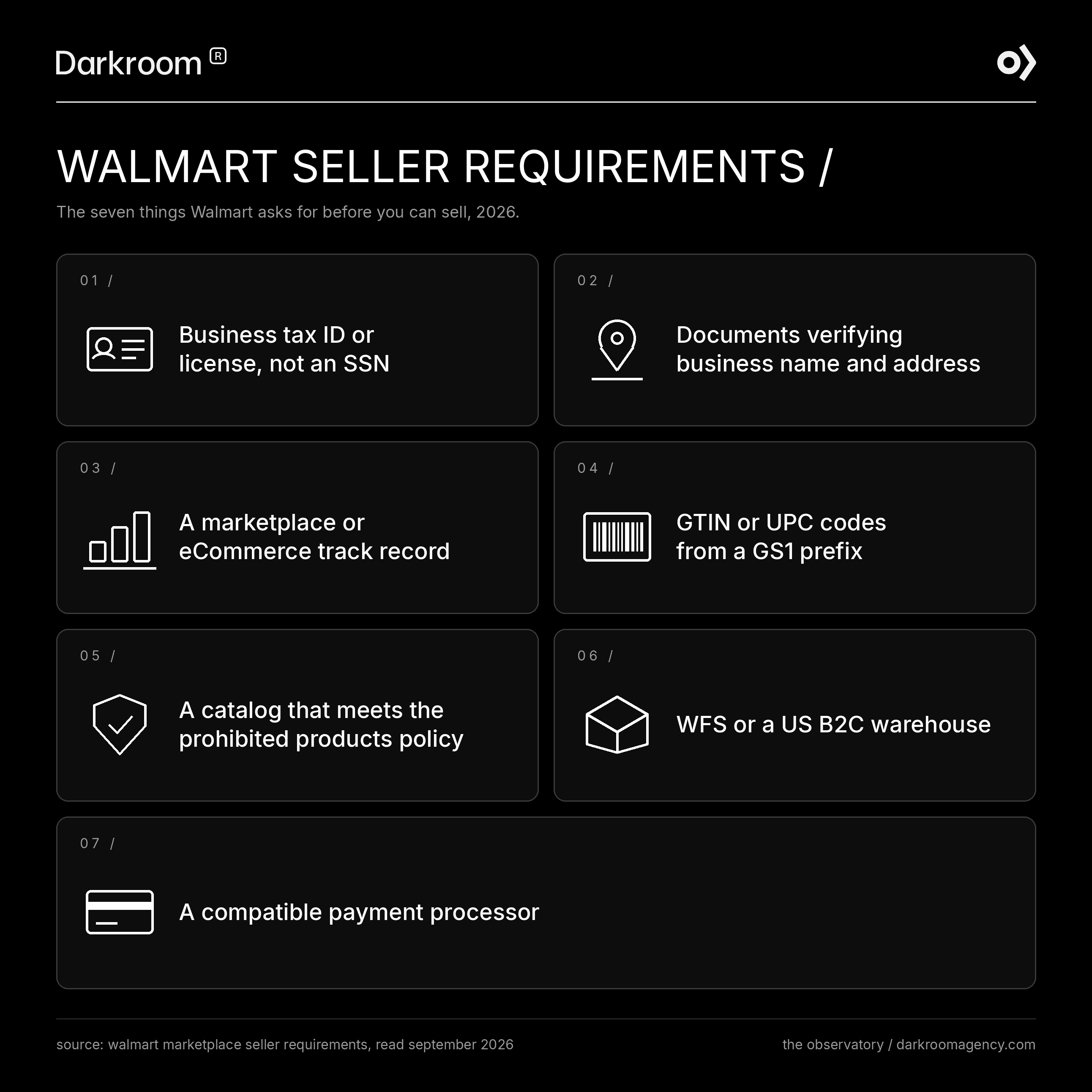
Walmart has a checklist of seven things every seller needs before joining its marketplace, and it outlines them all on its site.
A business tax ID or business license number is required, since Walmart does not accept a Social Security Number.
Documents that verify your business name and address.
A track record of success selling on other marketplaces or through your own e-commerce site.
Products with GTINs or UPCs, and these must come from a GS1 company prefix.
A product catalog that follows Walmart’s rules about what can and cannot be sold.
A way to fulfill orders, either through Walmart Fulfillment Services (WFS) or another US-based business-to-consumer warehouse.
An account with a payment processor that works with Walmart’s system.
The third requirement is where many sellers get stuck. Walmart wants to see that you already know how to sell online, so brands with experience on Amazon or their own direct-to-consumer site have a head start.
The fourth requirement covers what you can sell. As long as your products have valid GS1 barcodes and are not on Walmart’s prohibited list, you are good to go. If your catalog uses Amazon-only identifiers, it is best to update those before applying.
Wondering how long approval takes? Walmart does not publish a review timeline, so focus on submitting a complete application instead of waiting for a specific date.
Once approved, the Walmart Seller Center manages everything from listings and inventory to orders and payouts.
Read also: How to Launch Your Business on Walmart Marketplace Successfully
How much does it cost to sell on Walmart? Referral fees by category
Walmart charges no setup, monthly, or hidden fees. You pay a referral fee on each sale, and nothing else to list.
The referral fee is a percentage of the total sales price, which includes the item price plus shipping, handling, and gift wrap. The rate depends on the category Walmart assigns to your item.
Here are the rates from Walmart's referral fee schedule, last updated 8 March 2026:
Category | Referral fee |
|---|---|
Personal computers | 6% |
Consumer electronics, camera and photo, video game consoles, major appliances | 8% |
Plumbing, heating, cooling and ventilation; tires and wheels | 10% |
Automotive and powersports, industrial and scientific, musical instruments | 12% |
Apparel and accessories | 5% up to $15, 10% from $15 to $20, 15% above $20 |
Beauty, health and personal care; baby products | 8% up to $10, 15% above $10 |
Grocery | 8% up to $15, 15% above $15 |
Electronics accessories | 15% on the first $100, 8% on the portion above |
Indoor and outdoor furniture | 15% on the first $200, 10% on the portion above |
Jewelry and precious metals | 20% on the first $250, 5% on the portion above |
Home, kitchen, decor and garden; pet supplies; toys and games | 15% |
Everything else | 15% |
The 15% rate covers most of the catalog. The categories that pay less are electronics, appliances, and price-tiered consumables, where the lower rate applies to low-priced items or to the part of the price above a threshold.
How much can new sellers save in 2026?
Walmart's New-Seller Savings 2026 program runs from 2 February 2026 to 31 January 2027, for sellers who go live after 1 February 2026. It's worth up to $75,000:
Component | What you get |
|---|---|
Referral fees, first $50K in GMV | 20% off base referral fees |
Referral fees, $50K to $500K in GMV | 30% off |
Referral fees, above $500K in GMV | 40% off |
WFS | 10% off WFS-fulfilled items, up to $2,000 |
Search engine marketing | Up to $1,000 in credits |
Walmart Connect | Up to $500 in ad credits |
The referral discounts make up $72,000 of the $75,000. For a brand planning a 2026 launch, the timing matters: the discount ends on 31 January 2027, whenever you go live. Walmart says savings vary by seller and eligibility criteria apply.
How do Walmart Fulfillment Services fees and economics work?
With Walmart Fulfillment Services (WFS), you send inventory to Walmart's fulfillment centers, and Walmart stores, packs, ships, and processes returns. You pay two recurring fees: a fulfillment fee for every unit sold, and a monthly storage fee for the space your inventory takes up.
There's no sign-up fee, no monthly subscription, and no minimum inventory.
Which products can go into WFS?
Walmart's WFS page accepts items that are:
Up to 500 lb and 120 × 105 × 93 inches, including packaging
Non-perishable, with no temperature control needed
Shipped from the US or already cleared through customs
Anything over 150 lb or 108 inches on its longest side counts as "big and bulky" and ships by freight at a separate rate.
How is the WFS fulfillment fee calculated?
The fee depends on shipping weight.
Step 1: find the shipping weight.
Items under 1 lb: take the unit weight, add 0.25 lb for packaging, and round up to the next pound.
Items of 1 lb or more: use whichever is greater, the actual weight or the dimensional weight. Dimensional weight is length × width × height in inches, divided by 139.
Step 2: look up the base fee.
Shipping weight | Base fee per unit |
|---|---|
1 lb or less | $3.45 |
2 lb | $4.95 |
3 lb | $5.45 |
4 to 20 lb | $5.75, plus $0.40 for each lb above 4 |
Step 3: add any surcharges
If your item is... | Add per unit |
|---|---|
Priced under $10 | $1.00 |
Apparel | $0.50 |
Hazardous (chemicals, aerosols, batteries) | $0.50 |
Oversize (longest side over 48 inches, or other size limits) | $3 to $20 |
A 2 lb pillow in a 16 × 12 × 6 inch box has a dimensional weight of 8.3 lb. Walmart bills it as an 8 to 9 lb item, about $7.35 to $7.75 per unit, not the $4.95 its real weight suggests. Shrink the packaging before you ship light, bulky products into WFS.
Walmart vs Amazon fees: which products are cheaper to sell on Walmart?
Products priced $10 or more are cheaper to sell on Walmart, by about 3 to 4 points of the sale price per unit. Products under $10 are cheaper to sell on Amazon.
What each marketplace takes per product
Amazon's referral fees match Walmart's in most categories, so the difference comes from fulfillment. Here's the referral fee plus the fulfillment fee on three typical products, using Walmart's WFS rates and Amazon's 2026 FBA rates with its 3.5% fuel surcharge:
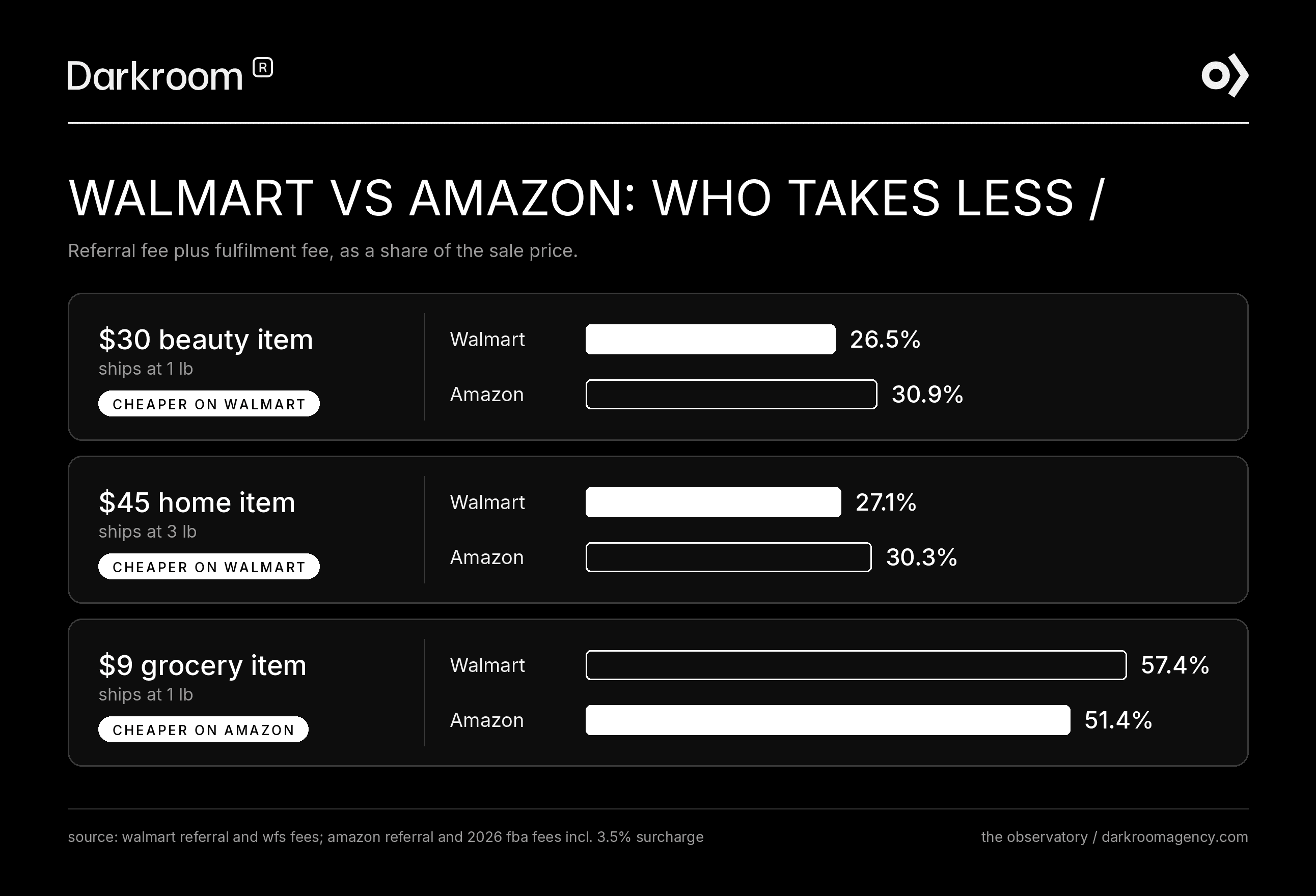
The split happens at $10 because the two marketplaces treat cheap items differently: Amazon gives them a lower fulfillment rate, and Walmart adds $1.
Where to sell each product
Priced at $10 or more and compact: list it on Walmart and Amazon. You keep more of every sale on Walmart.
Priced under $10: keep it on Amazon, or bundle it above $10 before listing it on Walmart.
Apparel over $20 or computers: Walmart also wins on referral fees (15% vs 17%, and 6% vs 8%).
Amazon still sells far more, with $116.2 billion in North America sales in the quarter ended 30 June 2026, so treat Walmart as extra margin on top of Amazon. That's how we run Amazon management alongside Walmart.
Read also: Amazon vs Walmart KPIs and 2026 Performance Benchmarks
Is Walmart Marketplace worth it for your brand?
Walmart Marketplace can be a great opportunity, but it really pays off when three key conditions are met at the same time. If even one of these is missing, it’s usually best to hold off for now.
First, make sure your margins can cover Walmart’s referral fee: Walmart shoppers compare prices across sites, so run your numbers based on the lowest price you offer anywhere. Subtract the category referral fee, and if you’re using Walmart Fulfillment Services (WFS), include the fulfillment fee as well. If your contribution margin is still positive after factoring in ad spend, you’re in good shape.
Make sure your catalog works with Walmart’s fulfillment options: If your products fit within WFS size and weight limits and are priced high enough that the flat fee doesn’t eat up your profits, you’re in good shape. Alternatively, if you already have a US-based B2C warehouse that can meet Walmart’s delivery standards, you’re covered there too.
Walmart looks for sellers with a proven track record: This usually means having a history of success on other marketplaces or in eCommerce. For example, if you already sell on Amazon or have a direct-to-consumer (DTC) business, you’ll likely meet this requirement. Brands just starting online may need to build up some experience first.
If you check all three boxes, 2026 brings even more upside. Walmart is offering up to 40% off referral fees until 31 January 2027, along with credits for WFS and advertising. These incentives can make a big difference to your bottom line.
For brands that are already profitable on Amazon, Walmart in 2026 stands out as one of the most affordable ways to add extra revenue. The referral fee discount is temporary, so brands that start now can build valuable review history before the offer ends.
How to grow on Walmart once you are live
Three main levers drive growth on Walmart, and the order you tackle them matters.
Fix the listing before you buy traffic: Complete content, a competitive price, and a two-day delivery promise do more for a new listing than ad spend. Walmart optimization is as much about the offer as the copy.
Then turn on ads: Walmart Connect grew 43% in the US last quarter, excluding VIZIO. When you're ready for off-site and programmatic reach, Walmart DSP extends the same shopper data.
Connect your online efforts with what’s happening in-store: Walmart’s massive store footprint isn’t just for shopping; it’s also a powerful advertising surface.
Deciding where to invest the next dollar depends a lot on how your other retail media networks are performing. Start by figuring out which channel should get the first share of your retail media budget.
Read also: Amazon vs Retail Media Networks - Where Brands Should Actually Spend in 2026
Run Walmart as one part of a retail media system
Most shoppers today are not loyal to just one retailer. It is common for someone to buy groceries at Walmart, pick up essentials from Amazon, and order last-minute items through Instacart, all within the same week.
Managing campaigns across multiple retail media platforms can get complicated fast. That is why Darkroom uses Shadow, an always-on AI platform, to plan, bid, and reallocate budgets across Amazon, Walmart Connect, Target Roundel, Instacart, and Criteo as a single system.
The process starts with a thorough audit and planning phase during the first one to two weeks. By week four, campaigns are rebuilt from the ground up and ready to launch, ensuring everything is set up for success.
Curious how Walmart can fit into your retail media strategy? Book a call with the retail media team to explore the possibilities and get tailored recommendations.