
PAID MEDIA
Paid Media Strategy for Ecommerce: How to Allocate Budget Across Channels Without Guessing




Written by Darkroom leardership

PAID MEDIA
Written & peer reviewed by 4 Darkroom team members
TL;DR
Most ecommerce brands build paid media strategy by stacking channels, each with its own budget, buyer, and targets. The result is a fragmented media plan where every channel looks profitable in its own dashboard while blended CAC rises and contribution margin erodes. The fix is a portfolio-based allocation model that starts with incrementality data, allocates on marginal returns, and treats the media plan as one system. This article provides the structural framework and operational playbook for channel allocation that connects to business outcomes. Darkroom builds paid media programs around portfolio allocation, not channel-level optimization.
The Frankenstein Media Plan Problem
The problem is not that your channels are underperforming. The problem is that they were never designed to work as a system.
Here is how most ecommerce brands build their paid media strategy. They start with Meta because that is where DTC brands start. They hire a buyer or an agency. They set a ROAS target. They scale until performance hits a ceiling. Then they add Google Shopping for high-intent demand. They add another budget line. Maybe another agency. Then TikTok enters because the CEO saw a competitor go viral. Same process: new budget, new buyer, new target.
Within 18 months, the brand has three or four paid channels, each with its own budget, optimization logic, reporting cadence, and definition of success. Meta reports a 3.2x ROAS. Google reports a 4.5x. TikTok reports a 2.1x. Every channel looks profitable. But blended customer acquisition cost has climbed 35%, and contribution margin has compressed by 8 points.
This is the Frankenstein media plan. It is not one strategy. It is multiple independent strategies stitched together, each optimizing for its own survival rather than the health of the whole. The channels overlap in audience targeting. They cannibalize each other's conversions. They inflate each other's attribution. And because no one measures the system as a whole, no one sees the compounding inefficiency until the P&L tells the story months later.
According to a McKinsey analysis of marketing efficiency, brands that allocate media budgets based on cross-channel incrementality data achieve 15-25% higher marketing ROI than those optimizing channels independently. The gap is not about talent or technology. It is about structure.
Why Channel-Siloed Budgeting Fails at Scale
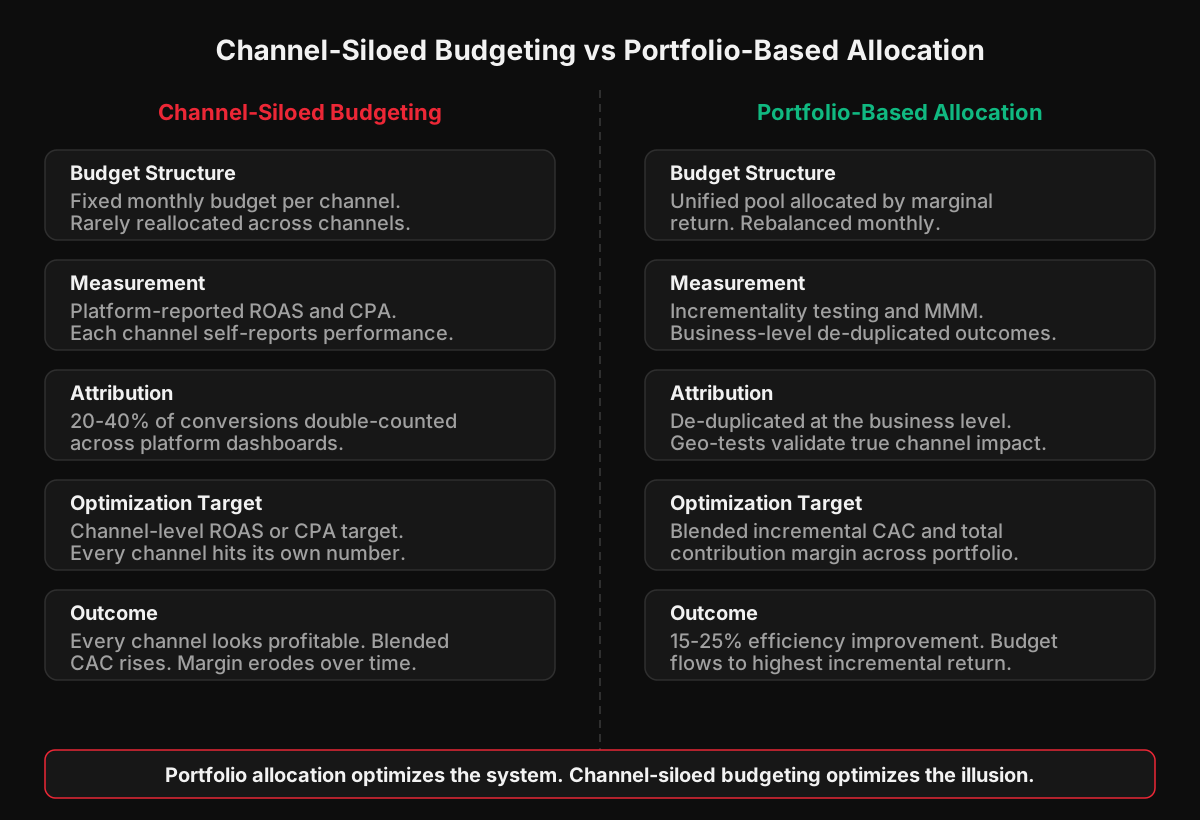
Channel-siloed budgeting creates the illusion of performance while obscuring the cost of overlap.
When each channel has its own budget and performance target, three structural problems emerge that no amount of in-channel optimization can solve.
The Attribution Overlap Problem
Meta and Google both claim credit for the same conversion. A customer sees a Meta ad on Tuesday, searches your brand on Google on Thursday, and purchases. Both platforms attribute the sale. For most ecommerce brands spending across multiple platforms, 20-40% of attributed conversions are double-counted. Each new channel adds another layer of overlap, and the gap between reported performance and actual business performance widens. Understanding how platform metrics differ from business outcomes is the first step toward fixing this.
The Budget Rigidity Problem
Siloed budgets create artificial constraints that prevent capital from flowing to the highest-return opportunities. If Meta has a $50K monthly budget and Google has $30K, those numbers rarely change based on real-time marginal returns. But the marginal return on the 50,000th dollar in Meta might be negative while the marginal return on the 30,001st dollar in Google might be strongly positive. Channel buyers are measured on spending their budget efficiently, not on whether the budget should exist in its current form. Agencies are compensated based on media managed, which creates incentive to maintain budgets rather than reallocate them.
The Incrementality Blind Spot
Without incrementality testing or media mix modeling, you allocate millions of dollars based on platform-reported metrics that have structural incentive to overstate their own impact. The brand retargeting campaign that reports a 6x ROAS might have near-zero incrementality. The TikTok prospecting campaign that reports a 1.5x ROAS might have the highest incrementality in your entire media plan. Without incrementality data, every budget decision is a guess disguised as analysis.
The Portfolio Model: Treating Paid Media as One System
Portfolio-based allocation borrows from investment management: optimize the total return of the portfolio, not the return of any individual holding.
The alternative to channel-siloed budgeting is a portfolio model where the entire paid media budget is one pool of capital. Allocation decisions are based on where the next marginal dollar produces the highest incremental return across the entire system. Channels are not independent profit centers. They are instruments in a portfolio, each with a different risk profile, return curve, and role.
In a portfolio model, the question changes from "What is Meta's ROAS?" to "If I move $10,000 from Meta retargeting to TikTok prospecting, does total incremental revenue go up or down?" This is a fundamentally different optimization problem. The portfolio model requires three inputs most brands lack: incrementality data by channel, marginal return curves for each channel, and a unified reporting layer that shows business-level outcomes. Building these inputs is the operational work of developing a real paid media strategy.
Dimension | Channel-Siloed Budgeting | Portfolio-Based Allocation |
|---|---|---|
Budget Structure | Fixed monthly budgets per channel | Unified pool allocated by marginal return |
Optimization Target | Channel-level ROAS or CPA | Blended incremental CAC and contribution margin |
Measurement | Platform-reported attribution | Incrementality testing + MMM |
Reallocation Speed | Quarterly or annual budget reviews | Monthly based on marginal return data |
Attribution Handling | Each platform counts its own conversions | De-duplicated at the business level |
Agency/Buyer Incentive | Maximize spend in assigned channel | Maximize total portfolio return |
The Paid Media Allocation Hierarchy
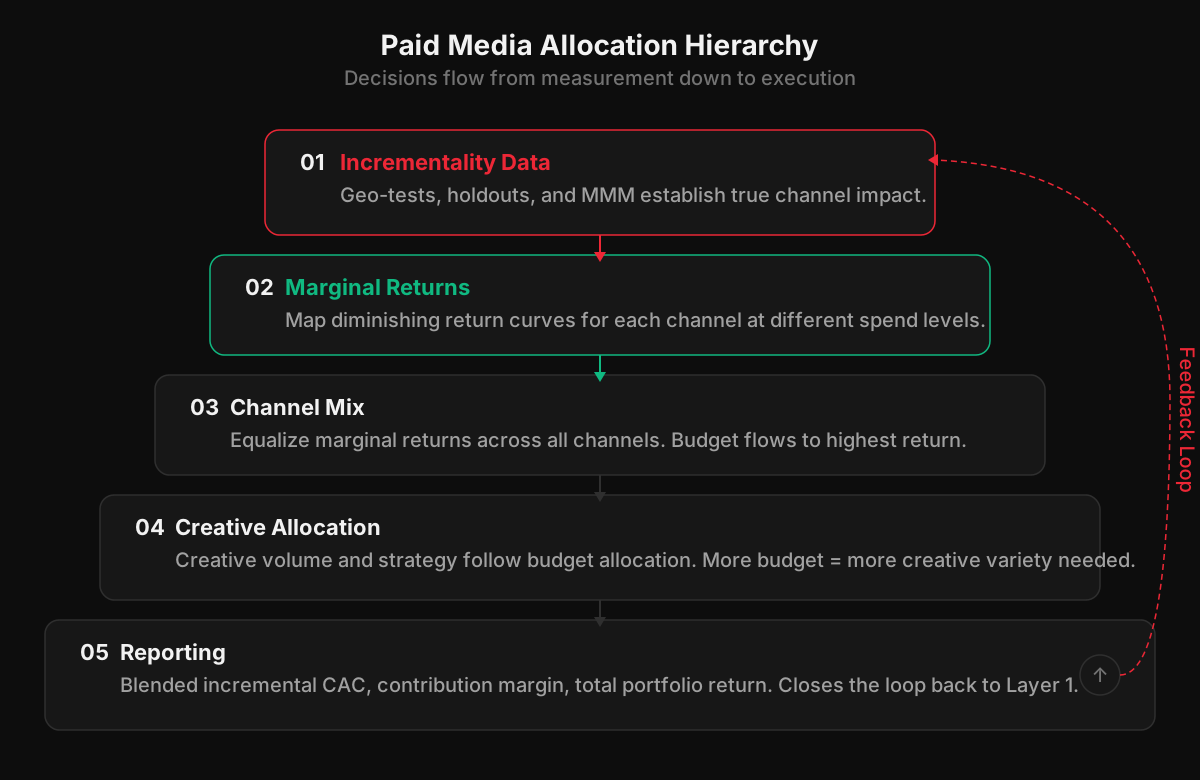
Allocation decisions should flow from incrementality data down to creative execution, not the other way around.
Most brands build their media plan from the bottom up. They start with creative assets, decide which platforms to run them on, set budgets based on historical patterns, and then try to measure whether it worked. This is backwards. The hierarchy should flow from measurement to allocation to execution.
Layer 1: Incrementality Data. Before you allocate a dollar, you need to know what each channel actually produces. This means running geo experiments, holdout tests, or media mix models that separate true channel impact from attribution overlap.
Layer 2: Marginal Returns. Once you know each channel's true incremental contribution, map how that contribution changes as spend increases. Every channel has a diminishing returns curve. Meta prospecting might deliver $4 of incremental revenue per dollar at $30K monthly spend, but only $1.50 at $80K. The marginal return curve tells you where reallocation should happen.
Layer 3: Channel Mix. With incrementality data and marginal return curves in hand, allocate where the marginal return is highest. The optimal mix is the point where the marginal return of the last dollar spent in every channel is approximately equal. This is basic portfolio theory applied to media buying, and almost no one does it because almost no one has the data.
Layer 4: Creative Allocation. Channels that receive more budget need more creative volume and variety to avoid fatigue. Creative resources follow the budget allocation, not the other way around. Managing creative fatigue through systematic testing becomes critical at this stage.
Layer 5: Reporting. The reporting layer closes the loop by measuring blended incremental CAC, contribution margin by channel, and total portfolio return. This data feeds back into Layer 1, creating a continuous optimization cycle.
The Four-Step Channel Allocation Framework
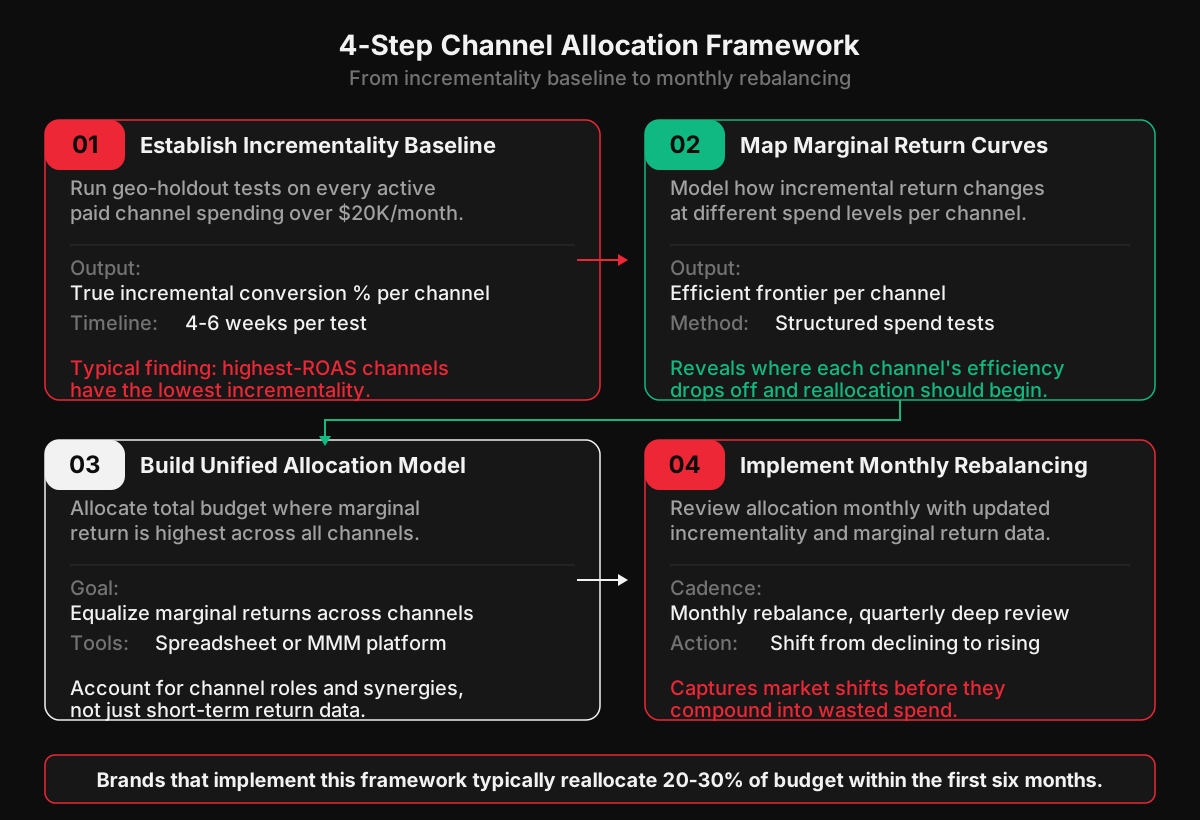
This is the operational playbook for moving from siloed budgets to portfolio-based allocation.
Step 1: Establish the Incrementality Baseline. Run incrementality tests on every active paid channel. For channels spending over $20K monthly, use geo-holdout tests that pause spend in specific markets and measure revenue impact. The goal is a single number for each channel: the percentage of attributed conversions that are truly incremental. Most brands find that their highest-ROAS channels have the lowest incrementality. According to McKinsey's research on marketing measurement, brands that implement incrementality testing reallocate 20-30% of media budget within the first six months.
Step 2: Map the Marginal Return Curves. For each channel, model how incremental return changes at different spend levels using historical data analysis or structured spend tests. The point where each curve flattens is the channel's efficient frontier. A typical finding: Meta prospecting has significant headroom while Meta retargeting is well past diminishing returns. Google Brand search is over-indexed because ROAS looks great but incrementality is near zero.
Step 3: Build the Unified Allocation Model. Create a model that allocates total media budget based on where marginal return is highest. A well-structured spreadsheet works for brands spending under $500K monthly. For larger budgets, invest in media mix modeling tools. The model should account for channel roles, not just returns. Building a full-funnel marketing system means allocating to every stage of the customer journey.
Step 4: Implement Monthly Rebalancing. Review allocation monthly using updated incrementality data. Shift budget from channels where marginal returns are declining to channels where they remain strong. A channel efficient in January may saturate by March. A new creative angle on TikTok may open headroom that did not exist before. Monthly rebalancing captures these shifts before they compound into wasted spend.
Channel Roles in the Portfolio
Not every channel should be measured on the same KPIs because not every channel serves the same function.
Channel Role | Examples | Primary KPI | Budget Flexibility |
|---|---|---|---|
Prospecting | Meta broad, TikTok TopView, YouTube | Incremental new customer cost | High. Scale when returns hold. |
Demand Capture | Google Shopping, Brand, Amazon PPC | Incremental ROAS (de-duplicated) | Low. Budget follows search volume. |
Retargeting | Meta DPA, Google Display retargeting | Incremental lift vs. holdout | Medium. Cap based on incrementality. |
Marketplace | Amazon Sponsored, TikTok Shop Ads | TACoS | Medium. Tied to organic rank goals. |
Brand | Connected TV, podcast, influencer | Brand search lift, aided awareness | Low. Commit quarterly. |
This framework prevents the common mistake of holding every channel to the same ROAS target. A prospecting channel delivering 1.8x ROAS but acquiring genuinely new customers at profitable unit economics is more valuable than a retargeting channel delivering 5x ROAS by claiming conversions from customers already in your email funnel.
Marketplace channels like Amazon PPC and TikTok Shop ads require their own measurement logic because organic and paid performance are deeply intertwined. For Amazon, understanding how paid and organic interact is essential for accurate allocation.
Common Allocation Mistakes
The mistakes are structural, not tactical. They are built into how teams are organized and how incentives flow.
Allocating based on last year's spend. Most budget planning starts with last year's allocation and adjusts by 10-20%. This anchoring bias preserves previous inefficiencies. Portfolio allocation starts from zero each period and allocates based on current marginal return data.
Over-indexing on retargeting. Retargeting consistently produces the best platform-reported ROAS because it targets customers close to conversion. But incrementality testing almost always reveals retargeting has the lowest incremental impact. Cap retargeting based on incrementality, not ROAS, and reallocate excess to prospecting.
Separate agencies per channel. When each channel has a different agency, no one has the incentive or data to optimize across channels. This is why working with a unified paid media management partner produces structurally better allocation decisions.
Ignoring creative as an allocation lever. A channel that is underperforming may not need less budget. It may need better creative. Before reducing allocation, test whether new performance creative can improve the marginal return curve. A UGC-driven approach on TikTok may unlock headroom that polished brand creative cannot.
Not accounting for channel interaction effects. Increasing Meta prospecting spend often increases Google brand search volume. Cutting Meta may reduce Google conversions. A Nielsen study on cross-channel effects found that accounting for interactions improved allocation model accuracy by 15-30%. Your model must account for these synergies.
The Measurement Stack for Portfolio Allocation
You cannot allocate what you cannot measure.
Portfolio allocation requires three measurement components. First, incrementality testing provides ground truth for individual channels through geo-holdout tests, conversion lift studies, and platform-level holdouts. Run these quarterly on your largest channels.
Second, media mix modeling provides the cross-channel view, modeling each channel's contribution to total revenue while accounting for interactions, seasonality, and external factors. According to IAB's State of Data research, brands investing in MMM alongside incrementality testing make budget decisions 2-3x faster than those relying on platform attribution alone. For brands spending over $200K monthly across three or more channels, MMM is the analytical backbone of portfolio allocation. The distinction between growth marketing and performance marketing often comes down to whether this system-level measurement layer exists.
Third, unified business reporting provides weekly pulse: blended CAC, contribution margin, new customer acquisition rate, and total revenue alongside channel spend. Most brands have this component but lack the first two. And without incrementality testing and MMM, the dashboard just shows numbers you cannot act on because you do not know which channels actually produced them.
When to Add New Channels
New channels should enter the portfolio when existing channels hit diminishing returns, not when the channel is trending.
Adding TikTok because "everyone is on TikTok" is not a portfolio decision. Adding TikTok because Meta prospecting efficiency has declined 40% at current spend and TikTok offers access to demographics Meta cannot reach efficiently is a portfolio decision.
When adding a channel, allocate 5-10% of total media budget as a testing allocation. Run for 8-12 weeks. Measure incrementality from day one. If the channel shows positive incrementality at acceptable unit economics, scale. If not, reallocate back to proven channels. For brands considering TikTok Shop, the hybrid commerce model requires a different measurement approach than pure media channels. Choosing the right partner ensures you get portfolio-level thinking rather than channel-level execution.
The Agency Structure Question
The agency structure you choose determines whether portfolio allocation is even possible.
If each channel is managed by a different agency, portfolio allocation is structurally impossible. Agency A has no incentive to recommend shifting budget to Agency B. This is why agency-brand relationships often fail within 90 days. The structural setup prevents the outcomes the brand expects.
Portfolio allocation requires either a single integrated partner that manages all paid channels or a lead agency model where one partner owns the allocation framework while specialists execute within their channels. Both work. Neither is possible when channels are managed independently. This is what separates a true paid media agency from a collection of channel specialists. The former optimizes the system. The latter optimizes components.
Frequently Asked Questions
How much should an ecommerce brand spend on paid media as a percentage of revenue?
Most DTC brands spend 15-25% of revenue on paid media during growth phases and 8-15% at scale. The more important question is whether the marginal dollar produces incremental revenue at acceptable unit economics. A brand spending 12% efficiently is better positioned than one spending 20% with significant attribution overlap and channel saturation.
How do I know if my channels are cannibalizing each other?
Run geo-holdout tests. Pause one channel in specific markets for 4-6 weeks and measure whether total revenue declines proportionally to the channel's reported contribution. If you pause Meta and total revenue only drops by 40% of what Meta claims, the other 60% was cannibalization or organic.
What is the right number of paid channels for an ecommerce brand?
Most DTC brands at $5-20M revenue operate efficiently with 2-3 core channels plus marketplace advertising. Brands at $20-50M may benefit from 3-5 channels. Add channels only when existing channels have hit diminishing marginal returns, not for coverage.
How often should I rebalance my media budget across channels?
Monthly rebalancing with quarterly deep reviews using updated incrementality testing. Weekly adjustments within channels are fine for tactical optimization. Less frequent cross-channel rebalancing allows inefficiencies to compound.
Should I cut a channel that has low ROAS but high incrementality?
No. High incrementality with low ROAS means the channel reaches genuinely new customers who require more touchpoints. Evaluate on incremental CAC against customer lifetime value, not short-window ROAS.
How does paid media allocation change during peak seasons?
Demand capture channels like Google Shopping see increased efficiency as search volume rises. Prospecting channels often see decreased efficiency as CPMs increase. The portfolio response is to shift toward demand capture during peak and toward prospecting during off-peak. This is counterintuitive because most brands increase prospecting heading into peak, but the marginal return data usually argues for the opposite.
Build the System, Not the Channels
The brands that outperform on paid media efficiency will not be the ones with the best Meta buyer or the most sophisticated Google bidding strategy. They will be the ones that treat their media plan as a portfolio and allocate based on where the marginal dollar produces the highest incremental return.
The transition from siloed budgeting to portfolio allocation requires measurement infrastructure most brands have not built, changes to how agencies are compensated, and accepting that some of your best-looking channels are your least incremental. But brands that make this transition typically find 15-25% improvement in marketing efficiency without increasing total spend, by moving dollars from where they are wasted to where they work.
Paid media strategy is not about picking the right channels. It is about building the system that tells you where your money actually produces results, and then having the discipline to act on that information every month.
Ready to move from channel-level optimization to portfolio-based paid media allocation? Book a call with Darkroom to build a measurement-driven media strategy that allocates budget based on incrementality data, not platform dashboards.