Retention Marketing
20 Welcome Email Examples That Turn Subscribers Into First-Time Buyers




Written by Darkroom leardership
Jul 30, 2026

A welcome email is the automated message a brand sends the moment someone joins its list. The best welcome email examples share four traits: a clear subject line, immediate send timing, one deliberate offer, and a single CTA, and they convert at roughly 26 times the rate of regular campaigns.
The welcome email lands at the moment of peak intent: someone just handed you their address, and most brands answer with a logo and a limp 10% code. That gap is the opportunity. Across the welcome flows Darkroom builds for DTC clients, this one automation routinely outearns entire campaign calendars per recipient.
This teardown covers 20 real welcome emails from real DTC brands, each broken down the same way: subject line, timing, offer strategy, and the metric it moves. Then it hands you the 4-email series framework we deploy, so you can rebuild your flow this week instead of admiring screenshots.
Why the welcome email is your highest-ROI send?
Welcome automations convert at 2.11% versus 0.08% for campaigns, roughly a 26x gap, and generate $6.16 in revenue per email versus $0.155, per Omnisend's 2025 benchmarks across 27,000+ ecommerce brands. No other send in the program touches that efficiency.
The first-purchase math is even more direct. In Klaviyo's 2026 benchmarks from 183,000+ merchants, flows drive 3x the click rate and 13x the placed-order rate of campaigns, and nearly 48% of flow-driven email revenue comes from new buyers, versus just 16% for campaigns. Flows are where subscribers become customers; the welcome flow is where it starts.
Two more numbers frame the stakes. Klaviyo pegs welcome series revenue per recipient at $2.65 versus $0.11 for campaigns, and GetResponse's benchmark report puts welcome opens at 83.63% against a 39.64% all-email average (opens are inflated by Apple's privacy features, so read the gap, not the absolute). Every first purchase you win here compounds into customer lifetime value; our email marketing benchmarks breakdown covers flow-level data in depth.
What makes a welcome email convert: the 4 criteria
Every example below is judged on the same four criteria, because these four decisions do most of the converting. Use them as your teardown rubric for any welcome email flow you audit.
Subject line. It should deliver on the signup promise, not tease it. If someone signed up for 10% off, the subject says so.
Timing. Email 1 fires immediately on signup. Klaviyo's guidance is unambiguous ("your first email should go out immediately"), and Omnisend recommends within five minutes when an incentive is promised, because most subscribers buy within about 10 days of joining.
Offer strategy. A deliberate choice, not a default. In Klaviyo's A/B research across seven brands, discount-based sign-up forms drove 90% higher subscription rates and made viewers 190% more likely to make a first purchase (2021 study; small sample, so test it). Depth matters too: when we rebuilt Morphe's welcome series, one discount test produced 49% higher revenue per recipient at a lower offer, alongside a 23% higher order rate for the new flow overall.
Single CTA. One job per email. Multi-CTA welcomes split intent at the exact moment it peaks.
The 20 best welcome email examples, by strategy
The best welcome emails cluster into four strategies: offer-led, brand-story-led, education-led, and community-led. All 20 examples below are real sends from live DTC programs, sourced via the ReallyGoodEmails and Email Love archives; every subject line is quoted verbatim. Timing is the trigger norm (on signup) unless a source confirms otherwise.
Offer-led welcome emails (examples 1–5)
Glossier (beauty) Subject: "Welcome to Glossier. Here's 10% off, just for you." · Send: on signup · Offer: 10% off first order. The subject is the offer, so the open decision and the shop decision collapse into a single decision. Clean layout, one CTA. Metric it moves: conversion rate on email 1, the single highest-leverage send in the flow.
Olive & June (beauty) Subject: "Welcome to Olive & June 💅 Your 20% off code is inside" · Send: on signup · Offer: 20% off code "Inside" turns the open itself into code retrieval, which is why offer-in-subject welcomes post-outlier open-to-click rates. A deeper 20% cut signals a considered-purchase category. Metric: click-to-open rate.
Magic Spoon (food) Subject: "Welcome to the world of Magic Spoon" · Send: on signup · Offer: free shipping code on first order. Free shipping, rather than a percentage, protects a premium price point while still removing the checkout objection. The retro brand-world visuals serve double duty as a point of differentiation. Metric: first-order AOV, which percentage discounts quietly erode.
AG1 (supplements) Subject: "This free AG1 Welcome Kit could be yours" · Send: welcome-flow offer email · Offer: free Welcome Kit with first subscription A gift beats a discount for premium subscription products: it adds tangible value without repricing the product. Note the subscription-first framing: the offer exists only within the recurring relationship. Metric: subscription starts, not one-off orders.
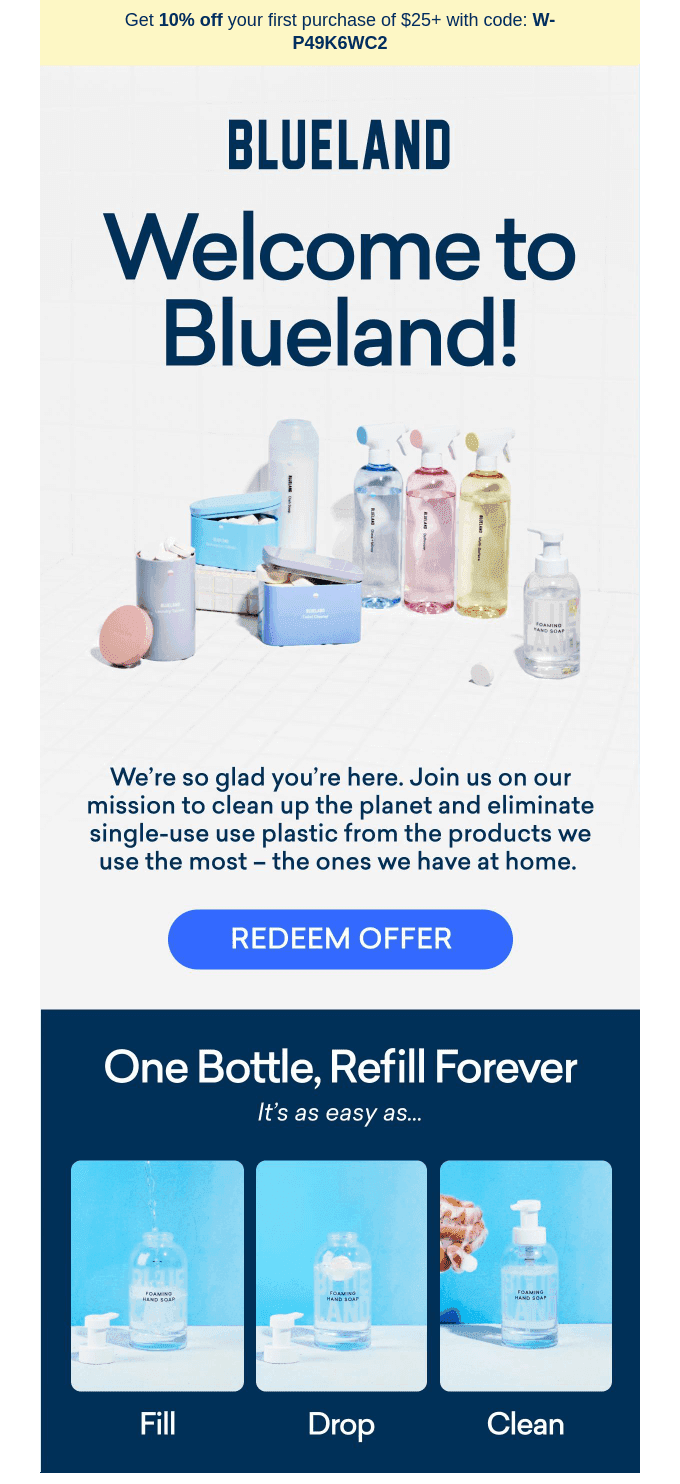
Blueland (home) Subject: "Welcome to Blueland! 10% off your first purchase" · Send: on signup · Offer: 10% off first purchase. A standard 10%, but welded to the refill-system pitch, so the discount recruits people into a repeat-purchase model rather than a one-time basket. Metric: second-order rate downstream of the welcome cohort.
Brand-story-led welcome emails (examples 6–10)
Story beats discount when the purchase is considered, the founder narrative is real, or margin cannot fund coupons. A story-led email 1 also trains subscribers that your sends are worth opening without a bribe.
Allbirds (footwear) Subject: "Welcome To The Flock" · Send: on signup · Offer: none Materials and mission carry the whole email; the identity framing ("the flock") makes joining the list feel like joining something. Metric: long-run open rates, which no-discount welcomes protect.
OMSOM (food) Subject: "Let's play with fire 🔥" · Send: on signup · Offer: none Founder-forward and loud, with the sisters' "proud, loud Asian flavors" mission up top. When the category needs explaining, personality is the education. Metric: reply and engagement signals that feed deliverability.
Fishwife (food) Subject: "💖 welcome to fishwife 🎣 !!" · Send: on signup · Offer: new-customer discount, secondary Lowercase voice, illustrated world, one positioning statement, and the discount tucked under the identity rather than leading it. Metric: click rate on brand-block content, proof the voice is pulling.
Hiya Health (kids' supplements) Subject: "Welcome to the Hiya Family" · Send: on signup · Offer: none Two dads, pediatrician-developed, no sugar: the founder story is structured objection handling for anxious parents. Metric: conversion on the follow-up sends the story warms up.
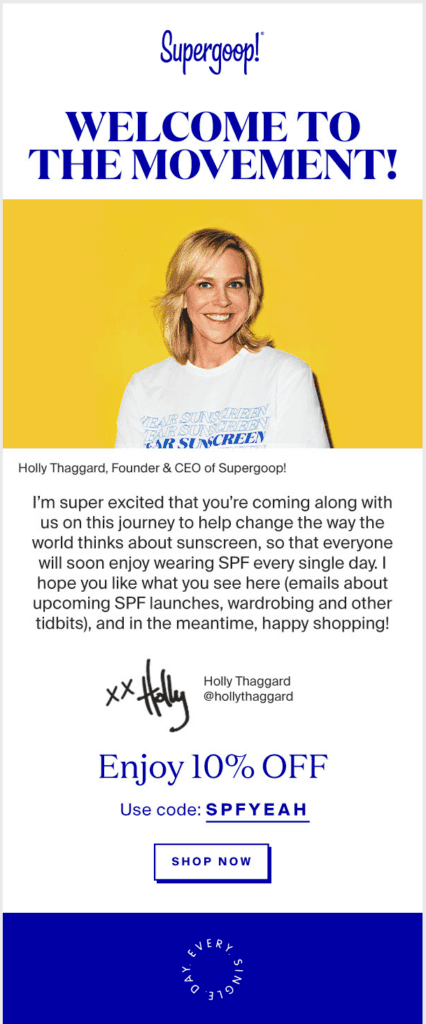
Supergoop! (beauty) Subject: "Welcome to the Movement" · Send: on signup · Offer: none A founder introduction plus a worldview (daily SPF, framed as optimism) that turns a sunscreen brand into a POV. Metric: list retention; POV subscribers unsubscribe less.
Education-led welcome emails (examples 11–15)
Education-led onboarding email examples earn their slot when the product needs explaining: a new category, a novel buying mechanic, or science the label cannot carry. Seed, for instance, times its education to product delivery, not signup, so the lesson lands with the first dose.
Warby Parker (eyewear) Subject: "Welcome!" · Send: on signup; email 2 confirmed at day 3 · Offer: none A plain subject, then a masterclass in explaining a buying mechanic (the home try-on, since retired) with the brand story held for email 2. Metric: funnel progression rate from email to the try-on/quiz step.
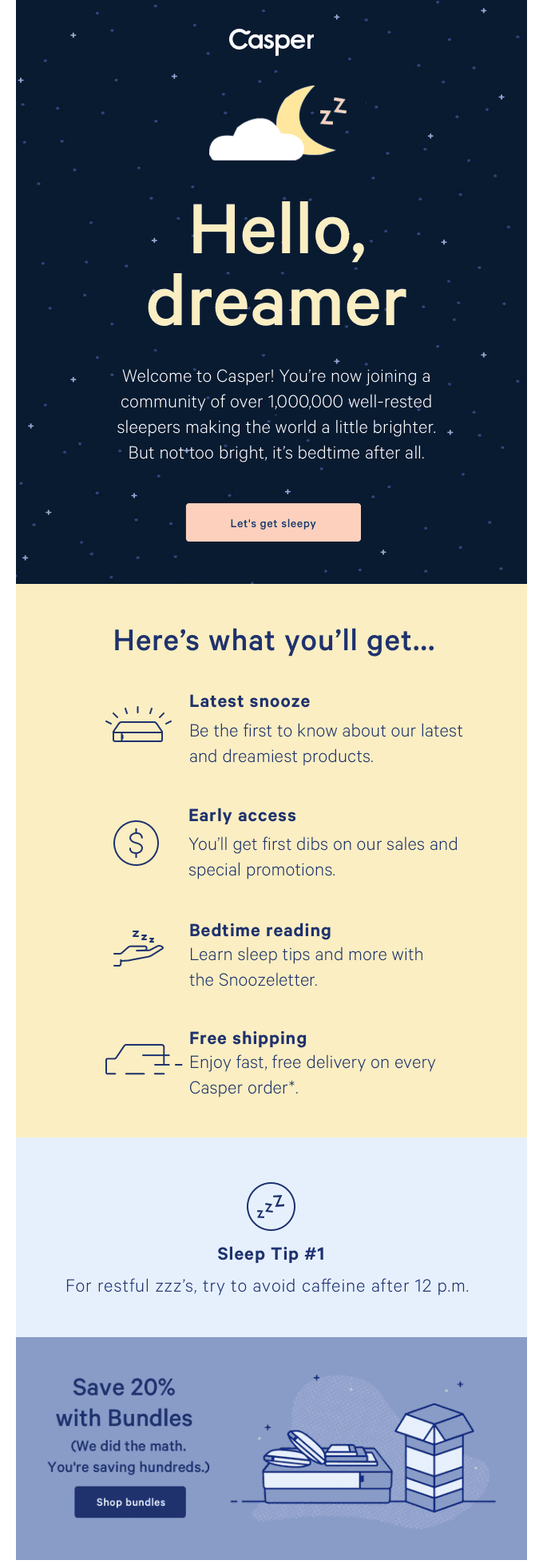
Casper (sleep) Subject: "Welcome to Casper!" · Send: immediate; email 2 at day 3 · Offer: none Educates on the 100-night trial to de-risk a four-figure considered purchase, with press awards as trust ballast. Metric: time-to-first-purchase, the number trial education exists to shorten.
Made In (cookware) Subject: "Welcome to Made In! 🔪🍳" · Send: on signup · Offer: none Chef-led how-to video content in the welcome program sells competence instead of coupons; the product proves itself in use. Metric: video click-through, a high-intent signal for follow-up segmentation.
Harry's (grooming) Subject: "The easiest way to try Harry's" · Send: welcome-flow entry email · Offer: trial set The subject names the job: lower the entry barrier. One hero image, one trial CTA, nothing else competing. Metric: trial-set conversion, the cheapest first yes in the category.
Moment (camera gear) Subject: "Welcome to Moment" · Send: on signup · Offer: 10% off Getting-started onboarding with a discount attached, a deliberate education-plus-offer hybrid for a gear brand whose buyers research heavily. Metric: conversion among non-buyers at day 14, where educated subscribers outperform.
Community & UGC-led welcome emails (examples 16–20)
Social proof works hardest at the moment of maximum skepticism, which is exactly where a new subscriber sits. These welcomes make belonging, reviews, or membership the offer.
Outdoor Voices (activewear) Subject: "Thanks for stopping by!" · Send: on signup · Offer: none The #DoingThings ethos is presented as something you join, with mix-and-match product styled as participation. Metric: UGC and social click-through, the community's compounding asset.
Ritual (supplements) Subject: "Transparency is kind of our thing" · Send: welcome-series send · Offer: none in this send Five-star testimonials and a social feed block do the persuading; notably, Ritual holds its 20% offer until email 4, letting proof warm the discount. Metric: discount efficiency, the revenue each point of offer buys.
Bobo Choses (kids' apparel) Subject: "Welcome to our vibrant community! | Bobo Choses" · Send: on signup · Offer: 10% off Community belonging leads, the discount follows, a clean stack for identity-driven categories. Metric: repeat open behavior across the series.
Bouche (wine) Subject: "Welcome to the club 🍾" · Send: on signup · Offer: membership framing Club language reframes a wine list as a membership, which suits any brand whose end state is a subscription. Metric: welcome-to-subscription conversion.
Tracksmith (running apparel) Subject: "Welcome To The Team" · Send: on signup · Offer: none Team framing for amateur runners turns a niche positioning into an insider identity from the first send. Metric: segment engagement among the core-identity audience the brand actually monetizes.

All 20 welcome email subject lines (steal these)
Scan the welcome email subject line patterns before you write your own: the converters either deliver the promise outright or make identity the hook. Almost none tease.
Brand | Subject line | The open driver |
|---|---|---|
Glossier | Welcome to Glossier. Here's 10% off, just for you. | Offer delivered in subject |
Olive & June | Welcome to Olive & June 💅 Your 20% off code is inside | Code retrieval curiosity |
Magic Spoon | Welcome to the world of Magic Spoon | Brand-world invitation |
AG1 | This free AG1 Welcome Kit could be yours | Free-gift intrigue |
Blueland | Welcome to Blueland! 10% off your first purchase | Offer delivered in subject |
Allbirds | Welcome To The Flock | Identity ("the flock") |
OMSOM | Let's play with fire 🔥 | Voice and energy |
Fishwife | 💖 welcome to fishwife 🎣 !! | Distinct lowercase voice |
Hiya Health | Welcome to the Hiya Family | Belonging ("family") |
Supergoop! | Welcome to the Bright Side | Brand POV as destination |
Warby Parker | Welcome! | Radical simplicity |
Casper | Welcome to Casper! | Clarity over cleverness |
Made In | Welcome to Made In! 🔪🍳 | Category emoji signal |
Harry's | The easiest way to try Harry's | Friction removal promise |
Moment | Welcome to Moment | Clean brand confirmation |
Outdoor Voices | Thanks for stopping by! | Casual human register |
Ritual | Transparency is kind of our thing | Values-led curiosity |
Bobo Choses | Welcome to our vibrant community! | Bobo Choses | Community invitation |
Bouche | Welcome to the club 🍾 | Membership framing |
Tracksmith | Welcome To The Team | Team identity |
The 4-email welcome series framework (swipeable)
Use this as your welcome email template: a 4-email welcome series that compresses the proven patterns above into one buildable welcome email sequence. It is the same architecture we ship inside client programs, sequenced against the roughly 10-day window in which most new subscribers make their first purchase. Structurally, it is a triggered drip campaign, and it sits at the front of your broader email revenue architecture.
Flow logic first, because the welcome email flow fails on triggers more often than on copy: trigger on list signup, exclude existing customers, and suppress anyone who purchases out of the remaining sends into the post-purchase flow. If you capture phone numbers, run the email vs SMS split deliberately: SMS delivers the code instantly, email carries the story.
Email 1: deliver + hook (send immediately)
Deliver exactly what the signup form promised, in the subject line, within minutes. One CTA to shop, an expectation-setting line (what you send, how often), and nothing else competing. This email will be the highest-converting send in your entire program; resist the urge to decorate it.
Email 2: story + differentiation (day 2)
Founder, mission, or materials, the Allbirds/OMSOM play, plus one proof element such as a review strip. The job is to give non-buyers a non-price reason to buy and to train opens without an offer. CTA: one flagship product or collection.
Email 3: objection handling + education (day 4)
FAQ-style education aimed at your top exit-survey objection: how the product works, how to choose, quiz or guide if the catalog is deep. This is also the natural home for zero-party data capture, asking one preference question that sharpens later segmentation. CTA: the educated next step, like a quiz result or bestseller.
Email 4: urgency + close (day 6–7)
Re-present the offer with a real expiry and a last-call subject. Urgency only works if it is true, so actually expire the code and suppress everyone who already converted; nothing burns trust like a fake deadline sent to a paying customer. CTA: checkout, full stop.
Welcome series mistakes that kill first purchases
These welcome email series mistakes cost more revenue than weak copy ever will, because they break the system rather than the sentence.
No expiry on the offer. An open-ended code creates no reason to act inside the 10-day intent window and leaks margin for months afterward.
Multi-CTA sprawl. Shop, follow, read, refer, download: five CTAs at peak intent is four too many. One job per email.
Ignoring the SMS split. Sending the same code on both channels at the same moment doubles cost without adding conversion. Sequence the channels.
No suppression logic. Discount emails arriving after a purchase either burn trust or eat margin as customers ask for retroactive codes. Suppress converters into the post-purchase flow.
Batch mindset. Blasting the welcome sequence manually to signup batches destroys the timing advantage and looks like spike-pattern sending to inbox providers, a sender-reputation risk our email deliverability guide covers in depth.
How to measure your welcome flow
Measure the welcome flow on four numbers: open rate, click rate, conversion to first purchase, and revenue per recipient. Against Klaviyo's welcome benchmarks, the averages to beat are a 51.26% open rate and a 1.97% placed-order rate, with top-performing welcome emails reaching 15% clicks and placed-order rates near 10%. Track the flow's numbers as a cohort against the benchmarks and offers above, and treat revenue per recipient as the tiebreaker when tests conflict.
Darkroom, the retention marketing agency behind this guide, runs the AI-native layer on top: predictive send-time optimization for emails 2 through 4, and offer depth varied per subscriber based on predicted first-purchase probability, so high-intent signups never get your deepest discount. The tactics are in our AI strategies for email guide.
This is also where flow work proves itself on the P&L. The welcome rebuild inside Morphe's program is covered above; the same full-lifecycle approach scaled Drip Hydration, an IV-therapy health franchise, to a 42% higher conversion rate and 15% stronger return on ad spend year over year.
If your list is growing but first purchases are not, run this sequence:
Audit against the 4 criteria. Subject, timing, offer, single CTA, for every send in the current flow.
Fix triggers and suppression before copy. Immediate send, buyer exclusion, converter suppression.
Test offer depth, not offer existence. The Morphe result above says the cheaper offer can win; find your version.
Or have us do it: Darkroom's retention program builds your welcome series, post-purchase sequences, win-back campaigns and abandonment flows, tested and generating revenue before you send a single broadcast. Book a call.