RETENTION MARKETING
12 Loyalty Program Examples From Retail Leaders (And What Makes Them Work)




Written by Darkroom leardership
Last update: August 5, 2028

Most loyalty program examples you will read about are really discount programs wearing a points badge. In March 2026, the largest customer loyalty program in retail publicly conceded the point.
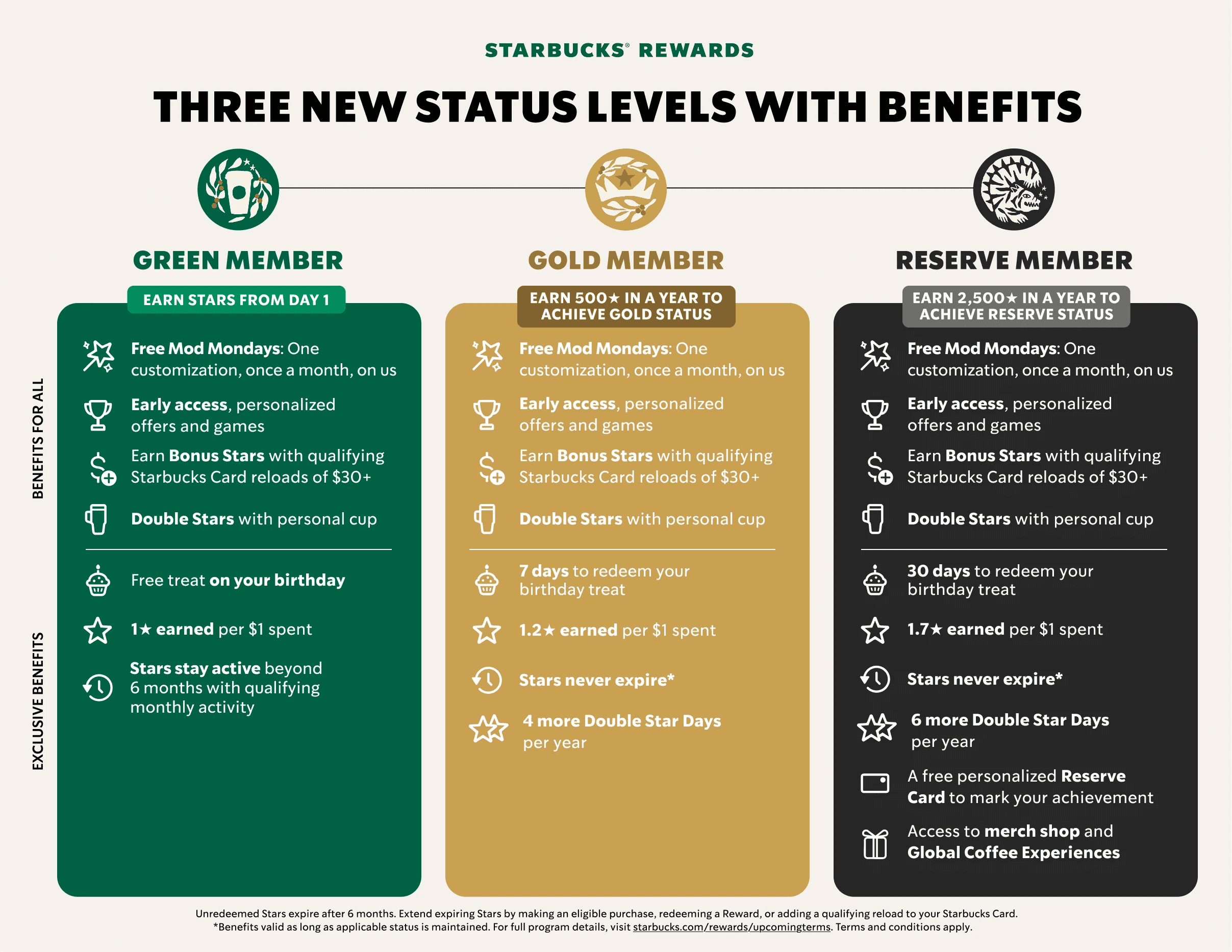
Starbucks took a program that had run a flat, everyone-gets-the-same structure since 2019 and rebuilt it around status tiers. It was not failing. Starbucks describes 35.5 million active US members, and launched the redesign explicitly to drive frequency and transactions, according to its investor release.
The problem with a flat structure is simple. Your most frequent and least frequent customers receive identical treatment, so the program spends the same to keep someone who was never leaving as it does to move someone who might.
Below are twelve programs, grouped by structural model, with the mechanics written out. Every figure is traced to a company source or attributed to the publication that reported it.
What separates a loyalty program from a discount program
A loyalty program changes behavior. A discount program changes margin. The distinction is whether the reward is tied to something you want the customer to do more of, or to money they were already going to spend.
Most programs fail this test. Points issued at a flat rate are a delayed, unconditional discount, and the customer buying weekly anyway collects the largest share.
The same pattern shows up in retention marketing generally: spend goes to the people least at risk of leaving. Darkroom is a retention marketing agency for consumer brands, and the first thing we check in a loyalty audit is what share of rewards land on behavior that was already happening.
The alternative demonstrably works better. With the global beauty brand Morphe, a smaller welcome discount beat a larger one, producing 49% higher revenue per recipient. Better matching beat a bigger incentive.
Four structural models, and what each one buys
Every program here is one of four things. Choosing the wrong model for your category is the most expensive mistake available, because you cannot fix it without relaunching.
Tiered points. Best for high-frequency categories where status is visible and attainable. Buys frequency.
Paid membership. Best where the benefit is ongoing, and the category is high-repeat. Buys commitment and predictable revenue.
Free membership at scale. Best for broad, low-margin retail. Buys data and reach.
Access and community. Best where the product carries cultural weight. Buys advocacy, and costs the least in margin.
Points are the default choice and rarely the right one. They are easy to launch and hard to unwind, creating a balance-sheet liability that outlives the team that approved it.
The 12 best loyalty programs for retail e-commerce
1. Starbucks Rewards
How it works: Members earn Stars on purchases and redeem them for food and drink. Since 10 March 2026 the program has three levels: Green, Gold and Reserve. Gold is reached at 500 Stars in a rolling year, Reserve at 2,500, with earn rates rising from 1.0 Star per dollar at Green to 1.2 at Gold and 1.7 at Reserve. Starbucks cites 35.5 million active US members and more than 38 million across North America.
What it rewards: Frequency, explicitly. Tier is set by Stars earned, and the reward for climbing is a faster earn rate, which compounds.
What we would change: Starbucks made Stars non-expiring at Gold and Reserve, while Green members must complete a monthly qualifying activity to extend theirs. That mechanic is the sharpest part of the design and the least discussed, because it converts the bottom tier from passive to active.
The launch drew criticism, since base members earn fewer Stars per dollar than under the old flat structure. That is the unavoidable cost of funding differentiation. Communicate the tradeoff before launch, not after.
The failure worth studying: Starbucks Odyssey, an NFT-based rewards experiment launched in late 2022, was discontinued by March 2024. The lesson is not that the technology was wrong. It is that a novelty mechanic cannot substitute for reliable core value, and loyalty members consistently choose the free drink over the collectible.
2. Sephora Beauty Insider
How it works: Three tiers set by annual spend: Insider free, VIB at $350 and Rouge at $1,000, per Sephora's terms. Insiders earn 1 point per dollar; VIB and Rouge earn 1.25 and 1.5.
What it rewards: Annual spend concentration. Status earned is valid for the rest of that calendar year and all of the next, a generous window that reduces the anxiety of chasing a threshold. Sephora's loyalty pages set redemption at 50 to 749 points requiring a purchase, while rewards from 750 points upward do not and ship free; Rouge members exchange 2,500 points for a $100 reward.
What we would change: Very little, and the reason is the Rewards Bazaar. Instead of a fixed points-to-dollars ladder, redemption runs through a rotating catalogue of samples, full-size products and experiences, which lets Sephora vary reward cost and perceived value continuously.
Points also accrue across Sephora, Sephora at Kohl's, kohls.com, Instacart, DoorDash and Uber Eats, so the program follows the customer off Sephora's own property.
3. Ulta Beauty Rewards
How it works: A tiered points program, renamed from Ultamate Rewards in 2024. Members earn points on spend and redeem them against purchases as currency at checkout.
What it rewards: Spend. The redemption model is the differentiator: points behave like money rather than unlocking a catalogue.
What we would change: The cleanest illustration of a design tradeoff. Currency redemption is easy to understand and drives enrolment, but it is functionally a discount and forfeits the merchandising control Sephora keeps through a curated catalogue. Do not copy it just because it is simpler.
4. The Nordy Club (Nordstrom)
How it works: A tiered program open to both cardholders and non-cardholders, converting points earned on spend into rewards.
What it rewards: Spend, with status benefits weighted toward access and services rather than discounts.
What we would change: The decision worth stealing is opening the program to non-cardholders. Many retailers gate their best benefits behind a store credit card, capping membership at the population willing to open one. Separating status from credit approval widens the funnel considerably.
5. Amazon Prime
How it works: A paid membership at $139 per year in the US. No points. The value proposition is entirely benefits: shipping, Prime Video, music and grocery integration.
What it rewards: Nothing conventional, and that is the point. Prime does not reward behavior after the fact. It changes the default beforehand, because shipping already paid for makes the marginal order feel free.
What we would change: Prime is the least copyable program here, since the bundle spans entertainment and logistics. Study the mechanic rather than the benefits: a prepaid fee reframes every subsequent purchase decision.
6. Walmart+
How it works: $98 per year, or $12.95 monthly. Free shipping with no minimum, same-day grocery delivery on qualifying orders, fuel discounts and in-store scan-and-go.
What it rewards: Trip frequency in a weekly category. The fuel benefit creates a reason to engage between shopping trips.
What we would change: Walmart+ prices below Prime deliberately and competes on grocery rather than breadth. The transferable lesson: do not match the incumbent's bundle; undercut it where you have a structural advantage.
7. Target Circle 360
How it works: It contains three tiers, being free Circle membership, the Circle Card, and paid Circle 360 at $99 a year or $10.99 monthly, $49 for cardholders. Target launched the paid tier in April 2024 with unlimited same-day delivery on $35+ orders plus free two-day shipping, and discounts for students, military and assistance recipients.
What it rewards: Consolidation of household spend into Target.
What we would change: The structure is the strongest idea here. Free, credit-linked and paid tiers running in parallel means the program does not force one commitment level on a varied customer base.
Same-day delivery from more than 100 partner retailers through Shipt extends the membership beyond Target's own assortment, which is how a paid program survives a quarter where the customer needs nothing from you.
8. IKEA Family
How it works: A free membership built around perks, offers and services rather than a points-first economy.
What it rewards: Engagement with the planning process, not just the transaction. Where the purchase cycle runs to years, rewarding wish lists, planning sessions and in-store services keeps the relationship alive between purchases.
What we would change: The most under-copied program here. Any brand with a long consideration cycle should reward the research phase rather than waiting for the order. Copy the decision about which behavior to recognise, not the mechanics.
9. myWalgreens
How it works: Replaced Balance Rewards in 2020, moving from points to a cash-value currency earned on spend.
What it rewards: Spend, redeemed in a unit customers understand immediately.
What we would change: The migration is the lesson. Points requiring mental arithmetic suppress redemption, and redemption is what makes a program feel valuable. If members cannot state what their balance is worth without opening the app, the currency is too abstract.
10. adidas adiClub
How it works: A free, tiered program earning points on purchases and on engagement inside adidas apps.
What it rewards: Spend and participation together. Training app activity and profile completion earn alongside purchases.
What we would change: adiClub shows non-purchase earn actions are not a gimmick. They generate first-party data and keep the program alive between orders, which matters in apparel where purchase frequency is low, but engagement is high.
11. Nike Membership
How it works: Free membership with no points economy. Members receive product access, exclusive releases, app-based services and events.
What it rewards: Affiliation. No earn rate to manage and no liability to accrue.
What we would change: The model most brands should consider before defaulting to points, and almost nobody does. It costs no margin. Its currency is access, which is finite and therefore valuable, and it works because Nike has products people want before they are discounted.
12. The North Face XPLR Pass
How it works: A free program earning points on purchases plus non-purchase actions, with rewards weighted toward experiences and early access to drops.
What it rewards: Behavior aligned to brand identity, not spend. Members earn through outdoor activities and by returning used product for resale.
What we would change: XPLR Pass is the clearest evidence for the thesis at the top of this article. It rewards a customer for doing the thing the brand exists to support, which is a different proposition to rewarding spend. Early access also converts scarcity into a benefit at no discount cost.
How do you design tiers that actually change behavior?
Set thresholds from your own spend distribution, not a benchmark. Sephora's $350 and $1,000 work because they sit at meaningful points in Sephora's customer base. Transplanted into a different average order value, the same numbers are either trivially easy or unreachable, and both kill the goal-gradient effect that makes tiers work.
The method is straightforward. Pull your spend distribution for the last twelve months. Place the first threshold just above where a meaningful group already sits, so it is reachable with one more purchase. Place the top threshold where your high-value cohort already is, so it recognises them rather than asking them to stretch.
RFM analysis is the fastest way to find those boundaries, because it segments on recency and frequency alongside spend rather than treating a single large order as loyalty.
What belongs at the top tier
Access, not depth of discount. The economics are obvious once stated: a deeper discount at the top tier costs margin on your highest-value customers, which is the worst place to give it away.
Early access, exclusive experiences, and service benefits cost far less and signal status more effectively. Starbucks put curated coffee experiences at Reserve; Nike built the entire program on access. Both avoid paying their best customers to buy what they were buying anyway.
Tier design also shapes your customer lifetime value model, since a well-built ladder produces measurably different LTV curves per tier. If it does not, the tiers are cosmetic.
When does a paid membership beat a free program?
A paid membership beats a free program when the benefit is continuous, the category is high-repeat, and the fee is small against the annual value the member extracts. Amazon, Walmart and Target clear those tests. Most brands do not.
Run the arithmetic before the design work. Take your annual purchase frequency per customer, multiply by the per-order benefit you intend to give away, and compare it to the fee. If a member breaks even in two orders, the program is a discount with extra steps. If break-even takes most of a year, few people will join.
Then consider churn. A paid program converts a loyalty problem into a subscription problem, and subscriptions cancel. Same dynamics as our analysis of subscription churn, needing the same lifecycle infrastructure.
At mid-market scale the model works when paired with personalised timing. With Public Goods we built predictive replenishment and cross-sell triggers around product-specific reorder timing, and retention-attributed revenue grew 36.85% quarter over quarter.
What should members earn points for besides buying?
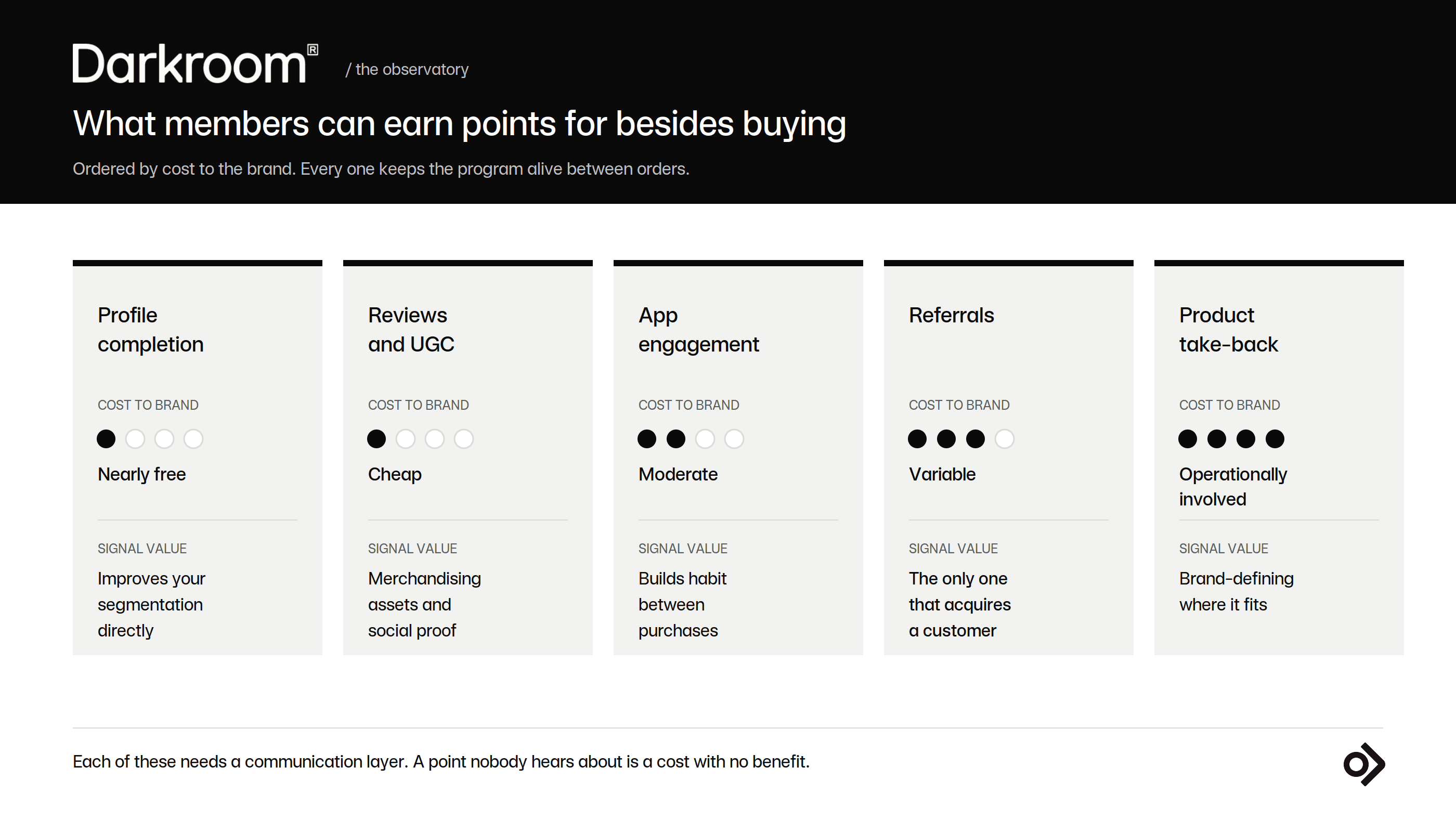
Non-purchase earn actions do two jobs: they keep the program alive between orders and generate first-party data you cannot buy. In low-frequency categories, they are the difference between a program members remember and one they forget.
The options, roughly ordered by cost to you:
Profile completion and preferences. Nearly free. Directly improves segmentation.
Reviews and UGC. Cheap. Produces merchandising assets and social proof.
App engagement or service usage. Moderate. Builds habit, as adiClub does.
Referrals. Variable, and the only action on this list that acquires a customer.
Sustainability actions like product take-back. Operationally involved, brand-defining where it fits.
Each needs a communication layer, which is where programs quietly fail. Our comparison of email vs SMS covers which channel suits which prompt, and the lifecycle marketing architecture determines whether a member ever hears about points they earned.
What a loyalty program actually costs you
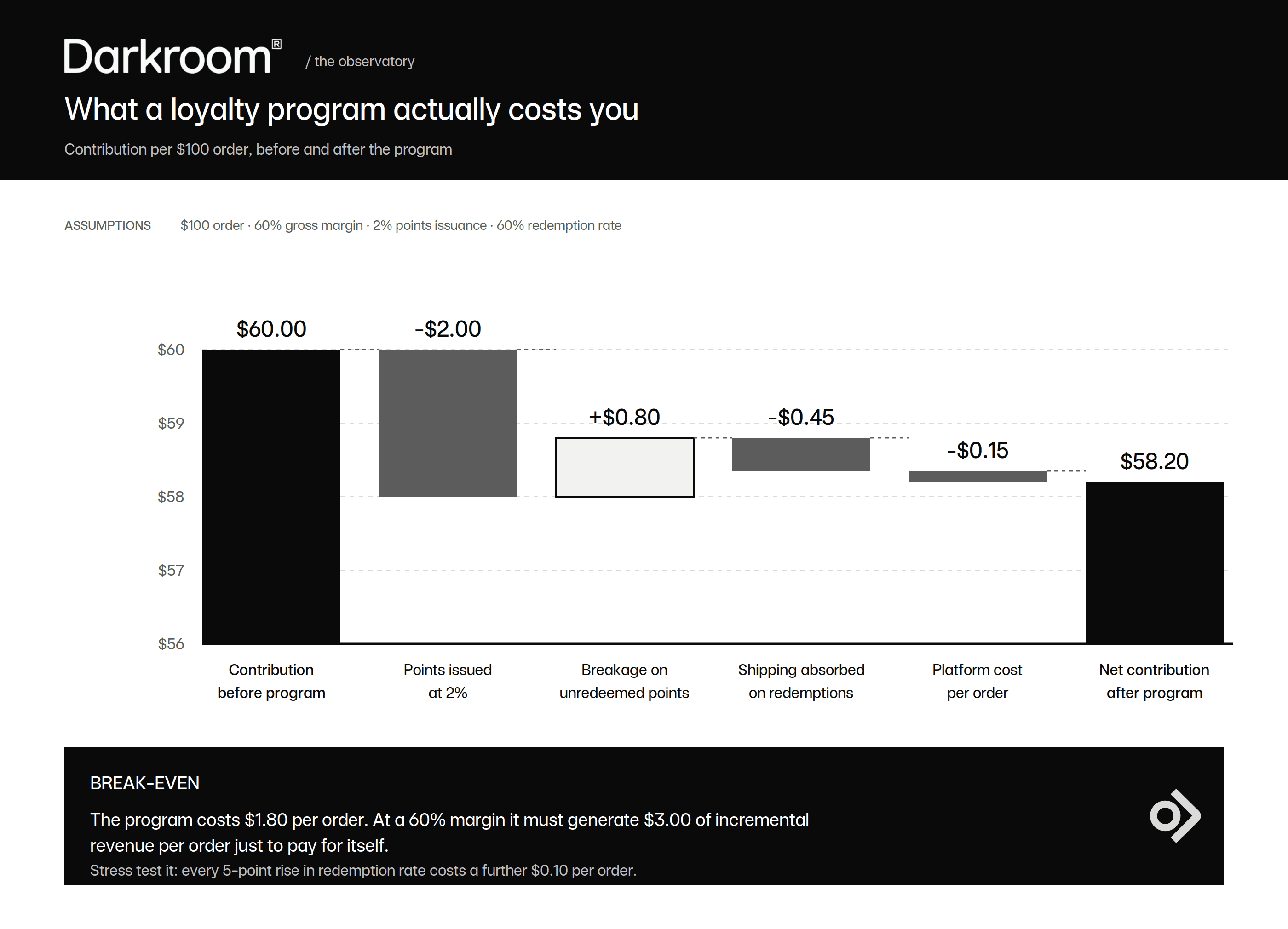
Points are a liability and most brands do not model them until finance asks. Every unredeemed point is a future obligation, so the cost is not last quarter's rewards but the breakage-adjusted value of everything outstanding.
Four numbers to model before launch:
Issuance rate. Points issued per dollar of revenue, across all earn actions, not just purchases.
Redemption rate. The share of issued points that get redeemed. This is the single biggest swing factor and it rises as a program matures.
Cost per redeemed order. The margin given up when a reward is used, including any shipping you absorb.
Incremental share. What proportion of rewarded behavior would have happened anyway. This is the number nobody wants to calculate and the only one that determines whether the program is an investment or a leak.
Stress test it: model redemption five points above forecast. If the program stops working, your margin assumptions are carrying the design rather than the design carrying itself. Budget context is in our retention marketing budget guide.
How do you know if your loyalty program is working?
Compare member and non-member behavior on matched cohorts, not raw averages. Members always look better, because the people who join are already your more engaged customers. That proves selection, not causation.
Three measures that survive scrutiny:
Matched-cohort repeat purchase rate. Members versus similar non-members with comparable purchase history at enrolment.
Redemption rate. Low redemption is not a saving. It signals a currency people do not value.
Incremental margin. Revenue attributable to the program minus reward cost minus what would have happened anyway.
Enrolment count is the vanity metric to avoid, especially when enrolment is a checkout default. Our customer retention metrics guide defines the formulas, the retention measurement framework covers control-group construction, and our roundup of customer retention tactics covers the wider levers.
Design the program before you pick the platform
The twelve programs above share one thing: someone decided which behavior was worth paying for before deciding how to pay for it. Most brands invert that, pick a platform, inherit its default points mechanics, and discover eighteen months later they have been discounting their most loyal customers.
If you are scoping a program before BFCM, or rebuilding one that is issuing points without moving repeat rate, get a free retention audit. Darkroom maps your customer journey, models the program economics, and shows you which behavior is actually worth rewarding.
Loyalty program FAQs
What are the best retail loyalty program examples?
The most instructive are Starbucks Rewards for tiered frequency, Sephora Beauty Insider for catalogue-based redemption, Amazon Prime for paid membership, Nike Membership for access without points, and The North Face XPLR Pass for non-purchase earning. Each represents a different structural model rather than a variation on the same one.
What is the difference between a points program and a tiered program?
A points program gives every member the same earn rate and rewards spend. A tiered program varies benefits or earn rates by status, rewarding sustained behavior. Most strong programs combine both, using points as the currency and tiers as the mechanism that differentiates high-value customers from occasional buyers.
How many points should a dollar be worth?
Set redemption value at a level members can state without arithmetic, commonly one to two percent of spend returned. Sephora uses 500 points for a $10 reward on 1 point per dollar earning. The exact ratio matters less than clarity: an unclear currency suppresses redemption, and unredeemed points create liability without loyalty.
Do loyalty programs actually increase customer lifetime value?
They can, but proving it requires a matched control group. Members outperform non-members in almost every program, largely because engaged customers self-select into joining. Genuine lift is measured by comparing enrolled members against similar customers who did not enrol, on repeat rate and margin rather than revenue.
How long does it take to launch a loyalty program?
Budget 12 to 16 weeks for an enterprise launch: four weeks of data and economic modelling, four for platform selection and tier design, four to six for build, integration and QA, then an enrolment period before you need members to be active. Compressing below twelve weeks usually means skipping the economics.
When is a paid membership program worth it?
When the benefit is continuous, purchase frequency is high, and break-even for the member takes several months rather than two orders. Paid membership converts loyalty into a subscription, which produces predictable revenue and self-selects committed customers, but it introduces churn dynamics that free programs do not have.