Success Stories
Lovable Growth Teardown: How Lovable Reached $500M ARR in 19 Months




Written by Darkroom leardership
13 min read
Sep 11, 2026

Lovable growth took the company from a November 2024 product launch to a $500 million annualized run rate by June 2026, and to a $13.3 billion valuation two months later. The mechanism was not AI timing. It was a product whose every output is a public, shareable web page.
It’s easy to be impressed by fast growth, but it’s a lot harder to verify what’s really going on. Most of the numbers you see about Lovable are technically correct, but they don’t always mean what you might think at first glance.
Much of the confusion comes from three different starting points: the earlier GPT Engineer project, the official November 2024 launch, and the month Lovable hit its first $1 million in revenue.
In this article, you will read the full teardown of how Lovable achieved its growth peak in less than one year, and what happened after that.
Lovable growth: key takeaways
Lovable reached a $500 million annualized run rate in 19 months from its November 2024 launch.
Lovable’s real growth engine isn’t about being first with AI. It’s about distribution. Every project someone builds gets its own public web page, and by August 2026, that added up to over 900 million monthly visits to user-created apps.
Growth has started to slow down a bit. For example, it took only one month to go from $300M to $400M ARR, but four months to go from $400M to $500M.
How fast was Lovable's growth, really?

Lovable went from launch to a $500 million annualized run rate in 19 months. That’s the number that really matters, and it’s actually a bit slower than what you might have seen reported elsewhere.
Lovable is a Swedish company whose product turns a written prompt into a working web application. You describe what you want, the system builds it, and it publishes the result at a live URL anyone can open.
Lovable product was launched in November 2024. Its open-source predecessor, GPT Engineer, was a separate project that founder Anton Osika announced in June 2023. From there, the time to $500M is 36 months, which is how some published timelines arrive at a figure nearly double the real one.
The widely repeated "eight months" figure comes from Lovable itself and is accurate on its own terms. In July 2025, the company announced $100M ARR, eight months after crossing its first $1 million. That is eight months from first revenue, not from launch. Repeat it without the qualifier, and you have changed what the number means.
So, depending on your starting point, you get three different answers. For this breakdown, we are using the official launch date, since that’s clearly documented and aligns with how most companies report their numbers.
What does Lovable's funding and valuation timeline look like?
Lovable's funding and revenue milestones are set out below, each one tiered by how it reached the public record.
Four disclosed rounds totaling $945 million, and a valuation path from $1.8 billion in July 2025 to $13.3 billion in August 2026. Lovable funding accelerated in step with revenue, and both are documented in the company's own published numbers.
We used no aggregator estimates, which is why some cells are blunter than the ones on revenue-tracking sites.
Nov 2024 | Lovable product launches | |
Jan 2025 | $10M ARR, two months from zero | |
Feb 2025 | $15M added funding | |
Jul 2025 | $200M raised at $1.8B valuation | |
Jul 2025 | $100M ARR, eight months from first $1M | |
Nov 2025 | $200M ARR, doubled in four months. 5M daily visits to Lovable-built apps. 100,000 new projects daily. 100,000+ community members | |
Dec 2025 | $330M raised at $6.6B valuation | |
Jan 2026 | $300M ARR | Stated to TechCrunch |
Feb 2026 | $400M ARR, up $100M in a single month. 146 full-time employees. ~8M users | Stated to TechCrunch |
Jun 2026 | $500M ARR. 1M new projects per week | Stated to TechCrunch |
Aug 2026 | $400M Series C at $13.3B valuation. 60M+ projects. 900M+ monthly visits to Lovable-built apps. Nearly two-thirds of the Fortune 500 reached |
Lovable valuation milestones track the revenue curve closely: $1.8 billion in July 2025, $6.6 billion that December, $13.3 billion in August 2026.
Menlo Ventures and the Scaleup Europe Fund led the last of those rounds, with Tencent, Salesforce Ventures, Darkroom, and HubSpot Ventures participating. Strategic money at that concentration usually signals distribution agreements forming behind the round.
What actually drove Lovable's growth?
Six mechanisms drove the growth: the product manufactures its own distribution; it created a category; its community runs itself; enterprise arrived bottom-up; capital efficiency became a story; and shipping cadence replaced a content calendar.
Growth mechanism | Action | Results |
The product manufactures the distribution | Every project publishes to a public URL | 900M+ monthly visits to Lovable-built apps, Aug 2026 |
The community organises itself | Member-run events, not company-run | 100,000+ members, 10–30 weekly events, Nov 2025 |
Enterprise arrived bottom-up | Measured as reaching employees, not signing contracts | Half to nearly two-thirds of the Fortune 500 in under a year |
Capital efficiency became its own channel | Revenue per head generated its own coverage | $2.77M ARR per employee at 146 staff, Feb 2026 |
Shipping cadence replaced a content calendar | The product roadmap is the editorial calendar | Four posts in the first ten days of Sep 2026 |
1. The product manufactures the distribution
Every Lovable project is a public web page with a shareable link. That single design decision converts each user into a publisher.
The scale is the evidence. In August 2026, Lovable reported 900 million monthly visits to apps built on the platform. Its own marketing site reported 42 million monthly visitors that month. The direction is clear: the surface Lovable users create dwarfs the surface the company controls.
Most companies have to spend big to get their product in front of people. With Lovable, reach comes naturally as more people use the product. That means the cost to acquire new users actually goes down as adoption grows, instead of getting more expensive.
2. The community organizes itself
Lovable reported more than 100,000 community members at its first anniversary. The real story isn’t just the number of events, but who’s running them. The community itself organizes these meetups and hackathons, not Lovable.
When your users are running their own events, you’ve built a distribution channel that’s way more cost-effective than anything you could pay for, and it’s one of the hardest things for a company to pull off on purpose. On cost, and the hardest of these six mechanisms to manufacture deliberately.
3. Enterprise arrived from the bottom up
Lovable’s reach inside Fortune 500 companies jumped from about half to almost two-thirds in less than a year. This means employees at those companies are using Lovable, not that the company has signed big enterprise contracts.
That is consumer adoption happening inside large organizations, which is a fundamentally cheaper motion than enterprise sales. Klarna, Delivery Hero, HCvA Healthcare and Microsoft all appear in Lovable's own first-anniversary post.
Read also: Go-to-Market Strategy for Consumer Tech: The Launch Playbook
4. Capital efficiency became its own channel
At $400 million ARR in February 2026, Lovable had 146 full-time employees. TechCrunch calculated that as roughly $2.77 million of ARR per employee.
That efficiency ratio became a story in itself. Media coverage about it brought in more signups, so the company’s efficiency basically did the job of a paid marketing campaign for free. To be fair, Lovable said in August 2026 that it’s hiring up to about 450 people, so that famous ratio is coming down by design. This is what it looks like when an AI-native company turns efficiency into more capacity.
5. The shipping calendar is the content calendar
Just in the first ten days of September 2026, Lovable put out four updates: a new model version, a collaboration feature, a partner program, and a customer story. That means the product roadmap itself is the editorial calendar.
To sum up, every ship is a reason to publish, and the cost is near zero because the work was happening anyway.
Read also: The Content Flywheel Strategy That Wins Rankings and AI Citations
Is Lovable's growth still accelerating?
Lovable’s overall growth is still incredible, but the pace has slowed down since early 2026.
Let’s look at the timeline: it took four months to go from $100M to $200M ARR (July to November 2025), about two months to hit $300M, just one month to reach $400M, and then four months to get to $500M. That one-month jump from $300M to $400M was Lovable’s fastest ever. The growth curve is still steep, but the pace started to slow down in the first half of 2026.
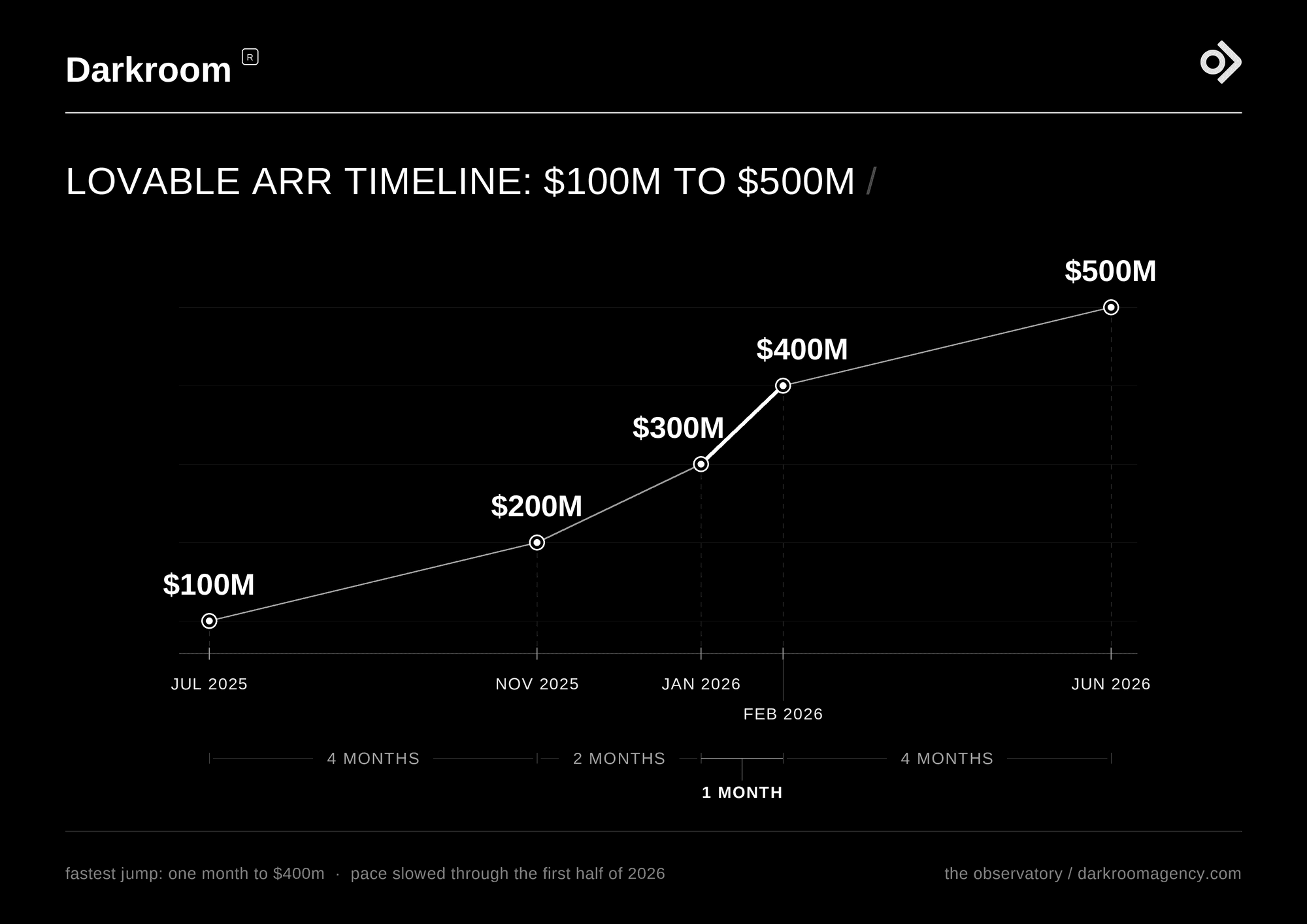
A second signal is worth naming precisely. Lovable's own Series C announcement in August 2026, the moment a company most wants a revenue figure in the headline, contains no ARR number at all. Instead, it publishes projects, visits, Fortune 500 reach, and hiring plans.
Lovable hasn’t completely stopped talking about revenue, as they confirmed the $500M number to TechCrunch in August. But they’re no longer sharing revenue updates on their own website or blog, which is a more interesting shift.
What we do know now is that Lovable has some serious leverage: about 8 million users as of February 2026, but the company has never said how many of those are actually paying customers.
Nearly 8 in 10 users are building a business or a monetizable side project, with more than a third already earning revenue. That last figure is the interesting one for the business model, because a user whose own income depends on what they built has a retention profile no lifecycle campaign can buy.
But without knowing Lovable’s gross margin, we can’t say for sure if that leverage holds up after accounting for the costs of running all those AI models. There’s also not enough data to run a real cohort analysis or estimate customer lifetime value.
Work with a growth strategy team that writes the plan down
Darkroom is the growth agency high-growth consumer and enterprise brands choose for high-profile go-to-market launches, and our growth strategy practice analyzes operations for your business.
You’ll work with a senior strategist who takes ownership of your growth plan, handles media mix modeling, and digs into root-cause analysis using Shadow, our AI-powered commerce platform. You also get a live Flight Plan that connects your business goals to daily performance and your P&L.
Contact our team today and discover how we can help your company grow through digital strategies.