Consumer Technology
Go-to-Market Strategy for Consumer Tech: The Launch Playbook




Written by Darkroom leardership
15 min read
Sep 2, 2026

Most consumer tech launches fail not because the product is bad, but because the steps are done in the wrong order. For example, choosing a sales channel before knowing your buyer can waste your launch budget on things you could have figured out earlier.
If you’re launching a connected device, wearable, or a consumer fintech or AI product, your choices are very different from those of enterprise companies. You need to decide which channel will test your idea first and have a plan if that channel doesn’t work.
This article covers the main definitions of a go-to-market strategy, best practices for a successful launch, and real examples to inspire you.
What is a go-to-market strategy?
A go-to-market strategy is the plan that defines the audience, positioning, pricing, and channels a product uses to generate initial revenue. It answers four questions before a dollar of media is committed: who is this for, what does it replace, what does it cost, and where does it sell first.
Go-to-market is often called GTM in meetings or presentations. They mean the same thing. Don’t let complex diagrams or frameworks distract you. The important part is the order of your decisions, not just filling out slides.
Go-to-market vs. market entry
It’s easy to mix up go-to-market strategy with market entry strategy, but they’re not the same. Go-to-market is about your positioning, messaging, pricing, and audience. Market entry is all the behind-the-scenes stuff: setting up your business entity, tax registration, fulfillment, and costs.
One is about how you sell, and the other is about how you run your business. Mixing them up often causes launch delays.

Why do most consumer tech launches fail?
Not for the reason that almost everyone repeats. The claim that 95% of new products fail is not traceable to any study.
It is usually attributed to a Harvard Business School article on Clayton Christensen's work, whose actual sentence reads: "each year 30,000 new consumer products are launched, and many of them fail." The 30,000 is real. The percentage was added later and repeated until it reads like research.
The defensible number is roughly 40%. Reviewing nineteen peer-reviewed studies from 1945 to 2004, Castellion and Markham found failure rates clustered in the 30% to 49% range and called the 80% to 90% figure in circulation an urban legend, sustained in part by the self-interest of consultants repeating it.
Nielsen is stricter. Across more than 21,000 new US consumer products launched between 2004 and 2008, over half failed to sustain year-one sales into year two, and only one in three sustained the launch-year rate through year three.
So, putting it all together: about six out of ten launches succeed at first, but only a third keep going strong after a year or two. The real risk usually isn’t the product itself, because most teams have already nailed product-market fit before they invest big.
The problem is that the launch sequence never gets properly tested, so when year two rolls around, no one can say which decision actually made the difference.
The 5 decisions every consumer tech go-to-market strategy has to make
You need to make five key decisions, and the order is important. Each decision affects the next. If you try to do everything at once, you risk wasting your launch budget just to learn what works.
A go-to-market strategy template should be a sequence, not just a checklist. Here’s the launch structure we use at Darkroom.
1. Who is this actually for?
Start by figuring out your audience. Many consumer tech teams focus on age or demographics, but behavior matters more. Instead of asking which age group is interested, ask who has the problem badly enough to change their habits. People pay for solutions that are worth the effort.
2. What is the one thing it replaces?
Next, focus on positioning. It’s more important to know what your product replaces than just how it’s different. For example, Whoop eliminated the need for a coach, and Ramp eliminated expense reports. If you can clearly say what you’re removing from someone’s life, it will have a lasting impact.
3. What does it cost, and what is the unit?
Next is pricing and your offer, which is where many launches get stuck. Whether you choose a subscription, bundle hardware, offer a freemium model, or charge a one-time fee, each option affects everything else, including which channels will work.
Always set your price based on your customer’s lifetime value and your real margins, not just on what competitors charge.
Now it’s time to pick your channel. For consumer tech, you usually have three main options: selling direct-to-consumer on your own site, using a marketplace, or going through social commerce like TikTok Shop.
The key difference between channels is not their size, but how quickly you can see if your idea works. Marketplaces show if your offer can compete directly, while DTC helps you see if your story connects with buyers. Pick the channel that gives you answers fastest, not just the one that looks good on paper.
5. What will you believe?
Finally, decide how you’ll measure success before you launch. Agree on one key number that will settle debates a few months in, while everyone is still clear-headed. This step turns your launch plan into a real growth strategy, not just a one-time campaign.
What does a consumer tech product launch strategy look like in the first 90 days?
In the first 90 days of your launch, break the process into three phases. Each phase should have a clear goal, one metric to track, and a decision to make at the end. Don’t try to scale yet; scaling too soon, especially in month two, is a costly mistake.
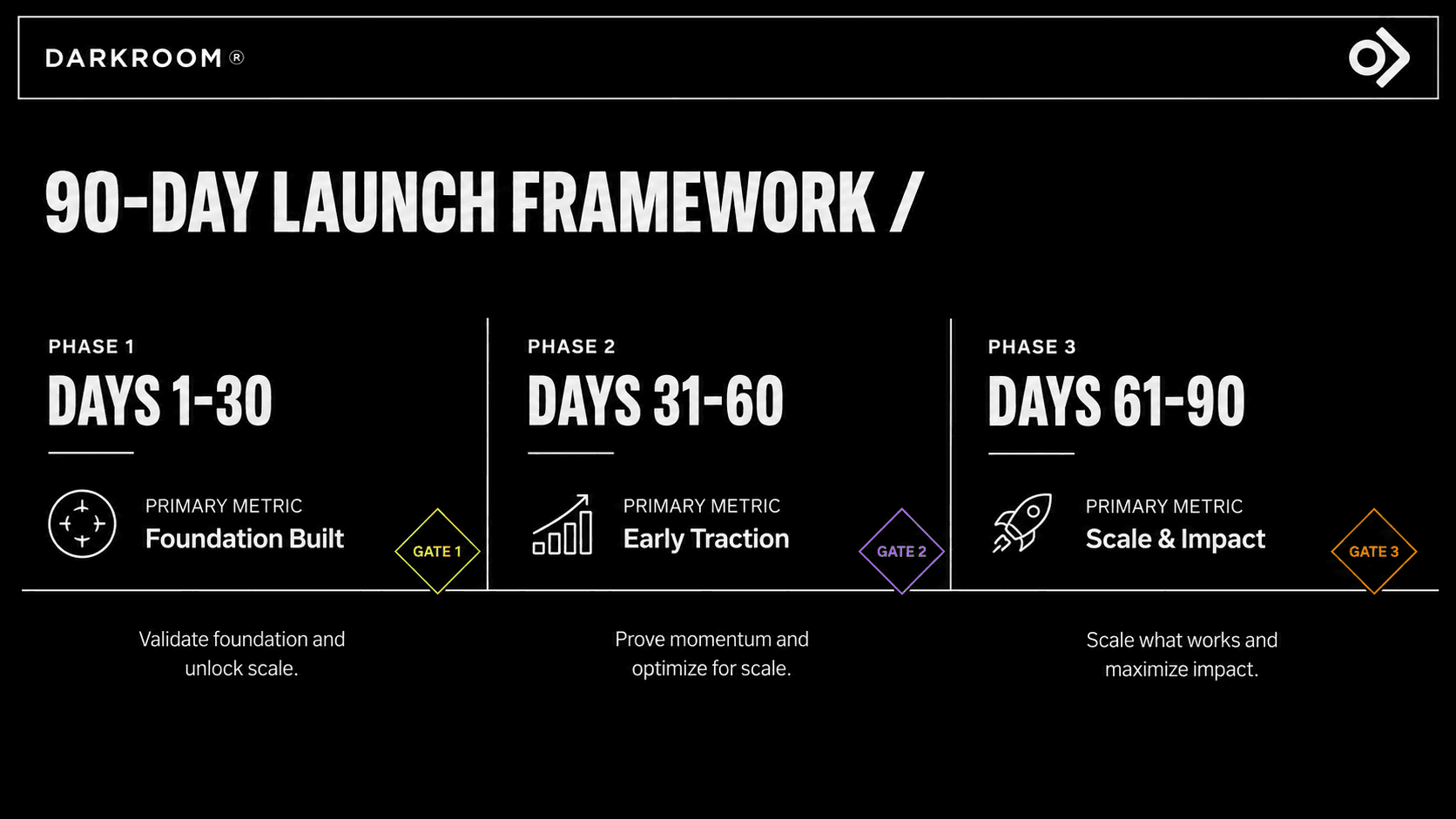
Days 1 to 30: prove the offer converts at all
This window has one job, and growth is not it. You are testing whether the offer converts for the audience you defined, on one channel, with nothing else running to muddy the read.
Launch teams at large consumer companies often make the same mistake: opening three channels at once because each stakeholder wants their own. By day 30, no one can tell what worked. The key is to keep things simple. Every extra variable in month one costs you a month of clarity later.
Launch on the single channel from decision four. No second channel, no retargeting layer, no creator flight running alongside it.
Set the spend floor before you start. Work backward from your expected conversion rate to the daily volume that produces a readable sample inside 30 days, and size the test before you run it rather than after the number disappoints.
Ship retention infrastructure live on day one. Welcome flow, post-purchase sequence, browse and cart abandonment, winback trigger. All of it built before the first order, not after the first month.
Cap creative at three to five concepts against one audience. More concepts at this budget produce noise, not learning.
Instrument before you spend. Server-side events, a single agreed-upon source of truth for orders, and a named owner for the weekly number.
Keep the offer the same for all 30 days. Changing the price or bundle during this time ruins the results you’re trying to measure.
On day 30, decide: is the offer viable, or does it need to be restated? If conversion sits below the floor you set, the answer is the offer, not the media.
Day-one retention is where we do our clearest work. For Evolv, Darkroom architected the full retention infrastructure before launch. Retention drove 48% of Black Friday Cyber Monday revenue and a placed-order rate of 1.56% against a 0.11% benchmark, with the welcome flow alone producing a third of it with no discount.
Days 31 to 60: find the constraint
The second window is diagnostic. You know the offer converts, so now you find out what is holding it back. At this stage, only two candidates are worth testing: the creative or the offer itself.
Adding a channel at this stage is the most common and costly mistake in the 90-day process. It gives you two variables to track and no way to separate them. This usually happens because month one looked good and someone wants to push ahead. Resist the urge. The second channel is a decision for day 61, and it will still be available then.
Hold spend flat for the entire window. Changing budget and creative at the same time means you cannot attribute the difference to either.
Move to volume on creative. Fifteen to twenty-five net-new concepts across the month, produced in batches rather than one at a time.
Test one variable per batch: hook, format, or proof. Never all three in the same batch.
Watch frequency and first-frame retention as leading indicators. Both move before cost per acquisition does, which buys you a week of warning.
Update your landing page to match the winning ad, not just your brand guidelines. Ensuring the message matches across the ad and the page is usually more valuable than a full site redesign.
Read the month-one cohort. Repeat rate on day 30 tells you whether you acquired the buyer you defined or a discount-seeking one who is wearing their demographics.
At day 60, decide: is the constraint the creative or the offer? If your best-performing concept still cannot meet the target cost per acquisition, the offer is wrong, and no amount of creative will fix it.
Days 61 to 90: open the second channel and read the blend
Only now does a second channel earn its place, because you have a proven offer and a creative library big enough to feed it without starting over.
The goal of this phase is not just to get more volume. You need to find out if the first channel was responsible for all your results or if there is demand elsewhere too. This difference will shape your future budget and is when blended economics start to matter.
Open one channel, not two, and choose it by what it tests. A marketplace tests whether the offer survives direct comparison; search tests whether demand already exists, retail media tests category behavior.
Port your top three concepts rather than producing net-new. The new channel is the variable. Keep the creative constant.
Run a holdout or a geo split for two weeks before you trust any incremental read from the new channel.
Move budget on marginal contribution, not channel-level return on ad spend, and allocate budget across channels to where the next dollar earns the most.
Watch for a big change in your blended numbers. If adding a channel increases total revenue but not blended contribution profit, you’re just selling more to your existing buyers.
Set the operating cadence now: weekly creative review, biweekly budget reallocation, monthly cohort read. Whatever you establish here becomes the rhythm for the next year.
At day 90, decide: fund, hold, or re-sequence. Re-sequencing is a legitimate outcome, and treating it as failure is how teams keep funding a channel that never worked.
At day 90, the strategy shifts. The launch turns into a full-funnel approach, with a new focus on managing the middle of the funnel and changing how you measure success.
Go-to-market strategy examples for consumer technology companies
Let’s look at four companies that each chose a different channel, but all made the same key decision: they picked the path that would test their idea the fastest, even if it meant accepting some unknowns.
Cash App: the network was the channel
Block's shareholder letter holds the strongest publicly documented go-to-market number in consumer fintech. Describing 2020, the company wrote that peer-to-peer network effects "complemented our paid marketing campaigns, allowing us to maintain a low acquisition cost of fewer than $5 in 2020 for a new transacting active customer".
The counterpoint sits in the same document. Bitcoin drove $4.57 billion in 2020 revenue and $97 million in gross profit, with a margin near 2%. Enormous top line, thin economics. Cash App reported 59 million monthly transacting active users in June 2026. The lesson is that the growth motion and the profit motion were never the same motion.
Ramp: pick a wedge narrow enough to be obviously better
Ramp is now a $44 billion company with more than $1 billion in annualized revenue and over 70,000 customers. The instructive part is the first eighteen months: first customer in August 2019, public launch in February 2020, and by April 2021 more than 1,000 customers with transaction volume up roughly 400% in six months.
Just to be clear, Ramp hasn’t shared details about its early channel mix or customer acquisition costs, so any numbers out there are just estimates. What we do know is their angle: Ramp wasn’t just another corporate card; it eliminated expense reports. That’s a pitch any finance leader can understand in a single meeting.
Whoop: price the outcome, not the device
Whoop bundles the hardware into the membership rather than selling it, with tiers priced at $199, $239, and $359 per year, each including the device, band, and charger (Whoop). The company reports more than 2.5 million members, 2025 bookings up 103% year over year, and a $10.1 billion valuation at its Series G.
Here’s what most people miss: bundling hardware into a subscription only works if your subscription revenue covers the cost of the device, with some margin left over. Most hardware companies can’t pull this off. If you copy Whoop’s pricing model without having the same margins, you risk running out of cash even as you grow.
ChatGPT: distribution can be the product
OpenAI launched ChatGPT on 30 November 2022 as a research preview, free while it ran. It now reports more than 1 billion weekly active users and more than 50 million consumer subscribers, and has begun introducing an advertising-supported free tier.
The sequence is unusual rather than exemplary: distribution came first and the business model years later, an order available to almost nobody else.
The pattern across this case and the previous ones is the decision, not the channel. Each accepted a blind spot in exchange for speed of proof.
How do you know a go-to-market strategy is working?
Don’t judge your launch by return on ad spend or any metric that needs a year’s worth of data. Instead, focus on one key number:
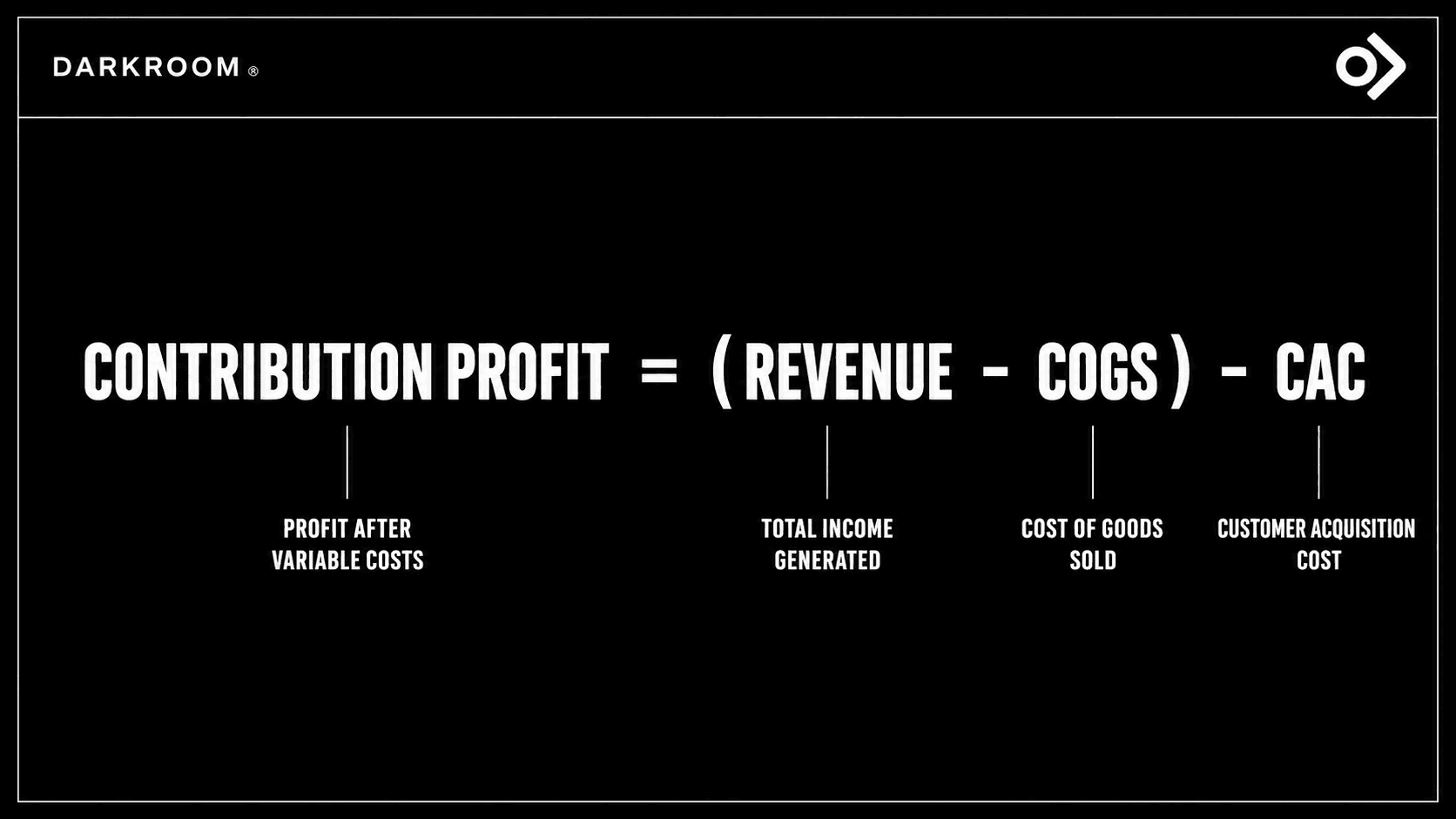
Contribution profit per acquired customer = (Revenue per customer − COGS − shipping − payment fees − variable fulfillment) − (Media spend ÷ new customers acquired)
If your contribution profit per acquired customer is positive for two months in a row, your launch sequence is working. If it’s only positive because your volume is very low, you haven’t learned much yet. Finance teams already use contribution margin, so making it the focus helps launch reviews go more smoothly.
A couple of extra tips: the marketing efficiency ratio is helpful when you don’t have enough channel history to build a model. Plan to start incrementality testing in month four, but be honest, since neither incrementality nor media mix modeling will give you reliable results in the first month.
Darkroom, a growth strategy agency working with consumer, mid-market, and enterprise brands, runs this as infrastructure. Shadow, our AI commerce layer, performs marketing mix modeling and root cause analysis, and the Flight Plan connects the business goal, the P&L, media investment, and pacing into a single live artifact.
If your launch plan isn’t connected to your P&L, it’s just a document. But when you tie it directly to your finances, it becomes your operating system. That’s the difference between just reviewing a launch and actually steering it. Want to see how a growth strategy agency puts this into practice?
Pressure-test the sequence before you fund it
Most launch reviews only check if the plan is finished. A better question is: which of the five key decisions is still undecided, and what’s the risk of launching without it settled?
That’s the first conversation we have with clients. Darkroom is the agency high-profile consumer tech brands turn to when their product is ready, but their launch sequence isn’t. Our first step is always a diagnostic, where we identify which decisions remain open, which channels have untested assumptions, and what the next 90 days should prove.
If you’ve already set your launch date but haven’t finalized your channel strategy, talk to a growth strategy partner before you commit your media budget, not after.