Growth Strategy
The Content Flywheel: How Compounding Content Wins Rankings and AI Citations




Written by Darkroom leardership
12 min read
Sep 7, 2026

Here’s a common mistake we see: companies often measure their content programs the same way they measure campaigns. The problem is, campaigns are all about quick wins and immediate results, usually within a single quarter. Content, on the other hand, works more like a flywheel.
It starts off slow, barely moving in the first quarter, but by the fourth quarter, it’s really picking up speed and delivering results. If you judge your content program by campaign standards, you’ll probably pull the plug just when it’s about to take off.
In this article, we will walk you through a simple model for understanding how content programs really work, including the natural lag you should expect, the four key numbers you’ll want to have ready for your next finance review, and where things can go off track. If you’re leading growth, brand, or ecommerce at a consumer brand and you’ve got a content budget to defend, this is for you.
What is a content flywheel?
A content flywheel is a publishing approach where each piece you create helps boost the results of the next. This happens through building up search value, earning citations that lead to more citations, and using distribution channels you set up once and use again.
The process has five steps: produce, structure, distribute, get cited, and convert. Each step supports the next, and the cycle repeats when conversion data shows you what to make next.
The term flywheel is important here. In mechanics, a flywheel stores energy. It takes a lot of effort to get it moving, but once it is spinning, it needs little effort to keep going and will keep turning even after you stop pushing.
This describes a well-developed content library well, but it does not fit paid media, which stops working as soon as you stop paying for it. This difference is the main reason to use a content flywheel.
A content flywheel is not the same as a content calendar, and this difference is important when you need to justify your budget. A calendar tells you what gets published and when. A flywheel focuses on how each piece of content helps the next one, which is why it includes a step for bringing things together, unlike a calendar.
The flywheel is part of growth marketing, not separate from it. It is the organic part of a growth system, and it is the only part that keeps giving value even after you stop spending money on it.
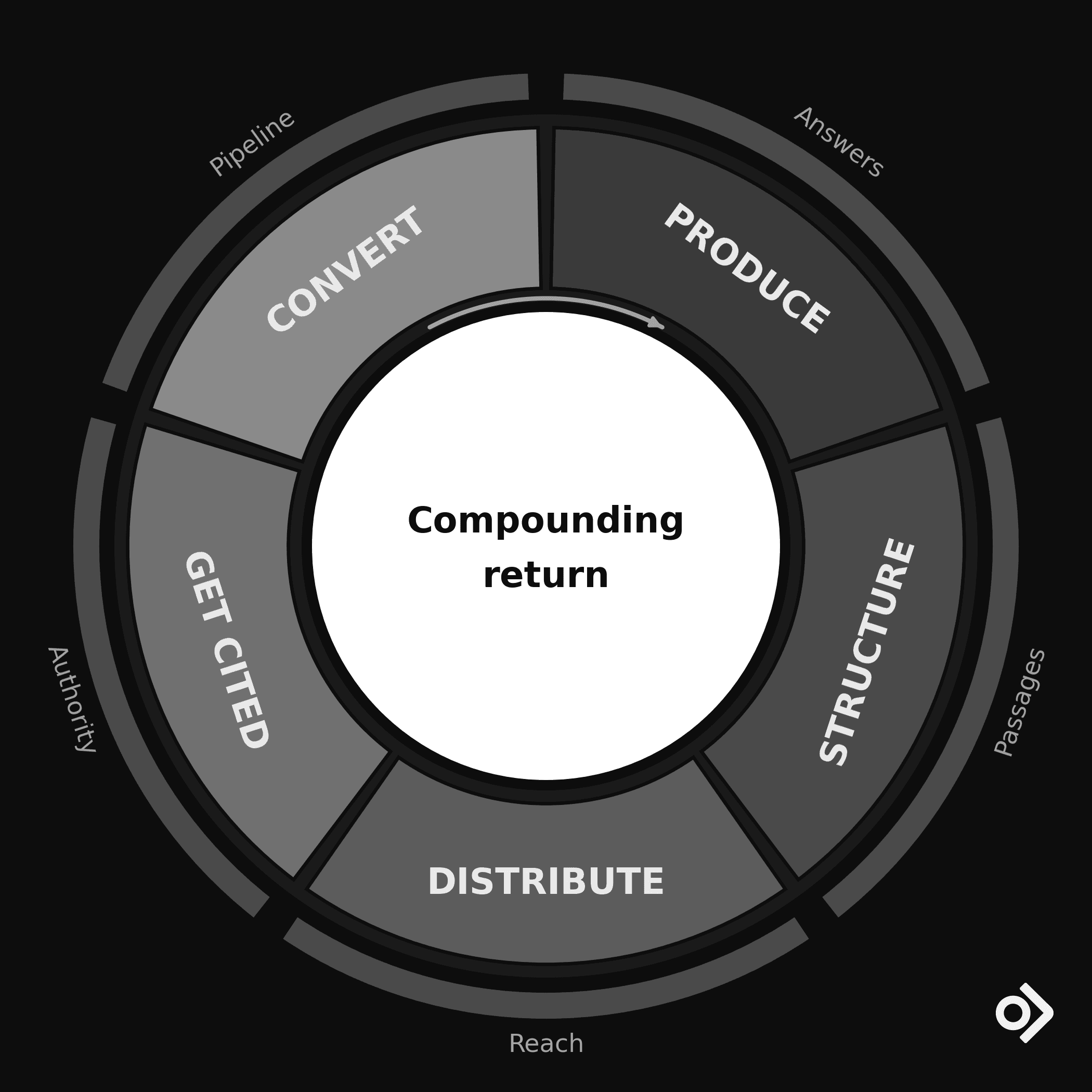
The five stages of a content flywheel
Produce, structure, distribute, get cited, convert. Each stage has one input, one output, a lag before it shows, and one failure mode that stops the wheel. Treat it as a content strategy framework rather than a checklist, because the stages are sequential and skipping one does not slow the flywheel down, it stops it.
Stage 1: Produce
Instead of building your content around a topic calendar, try starting with a ranked list of real buying questions. A topic calendar usually comes from what your team thinks is interesting or what your competitors are talking about. But a list of buying questions is based on actual evidence.
You can pull these questions from sales call recordings, support tickets, on-site search logs, Search Console queries that send people to the wrong page, and even the prompts buyers type into chat assistants. This way, you’re focusing on what your customers genuinely want to know.
Once you have your list of questions, rank them before you start creating any content. Look at two things: first, how close each question is to a purchase decision (that’s called commercial proximity). Second, check if you already have a live page that answers that question. If you create new content for something you already cover, you risk having your own pages compete with each other in search results.
Aim for one piece of content to answer one question fully. This simple rule is more powerful than it seems. It helps you avoid those massive 4,000-word guides that try to cover everything but end up not ranking for anything. Instead, you’ll build a content library where every page has a clear purpose you can sum up in a single sentence.
Stage 2: Structure
Make sure each section can stand alone and answer its own question, even if it is removed from the page. This is now a necessity, not just a style choice. Retrieval systems return passages instead of whole pages, so each section needs to make sense by itself.
Start each section with a direct answer in the first sentence, before giving any background. Write headings as the questions readers are likely to ask. Do not use numbers or phrases like "as we saw above," since these do not help when a section is taken out of context.
Tables should include enough detail in each cell so that any row, if taken alone, does not misrepresent the data. Also, the schema should explain what the page is about, not just add decoration.
The human-machine split matters most here, and deciding which parts of content production to give to AI can either protect the asset or dilute it. The judgment calls, the thesis, and the limits are human work. Drafting to a defined shape is not.
A common mistake is confusing formatting with real design. Using bold text and pull quotes can make a page look polished, but these do not help make a passage easy to extract. Only true structure adds lasting value.
Stage 3: Distribute
Before you start writing any asset, take a moment to decide where it will live, who will own it, and what format it should take. This might sound like a small detail, but it actually shapes everything that follows.
For example, if you’re creating something for your sales team, you’ll want to include an executive summary that can stand on its own. If you’re aiming for LinkedIn, think about adding a chart that still makes sense even if someone screenshots it and the caption disappears. If you skip this step and try to make one piece fit every channel, you usually end up with something that doesn’t quite work anywhere.
This is the point where your content flywheel either picks up momentum or starts to slow down. Oddly enough, it’s also the step that often gets handed off to whoever happens to be free when it’s time to publish.
To avoid that, try assigning the channel, owner, and format right when you commission the asset, ideally in the same brief where you spell out the main question the piece is supposed to answer.
Distribution is actually the fastest feedback loop in the whole process. You’ll usually know within a week or two if your asset is reaching people. If it’s not getting any traction in that window, you’re looking at a distribution issue that you can address right away.
Don’t wait months to see if it ranks in search, because that mixes up two different problems that need different solutions.
Stage 4: Get cited
To get cited, say something specific that others will want to repeat. Citations do not reward general quality. Instead, they happen when you share an idea that someone else can easily use and credit.
There are four things that make a passage quotable:
Include a number along with its sample and date.
Set a clear limit for your advice, showing where it no longer applies.
Admit a failure, which is rare and stands out.
Share original data, even if it is just a small, anonymized sample.
The opposite is true for most online content. Generic advice is not cited because it does not belong to anyone in particular. If a sentence could appear in any competitor’s article, it will not help you get recognized.
This stage has the longest delay in the process, usually lasting from thirty to one hundred eighty days, because it relies on others to take action. That delay is also why this step is often the first to be cut during a budget review. When it is removed, a content library becomes more of a traffic experiment.
Stage 5: Convert
Think of conversion as guiding your reader from helpful information to a commercial page, but only when it makes sense for them. The best time to introduce that next step is when your content has genuinely earned their interest. Just adding a call to action at the end of a page and hoping for the best isn't a real strategy. Instead, you want to create a clear path that feels natural for the reader.
Every piece of content should have a clear next step, and you should decide it before you even start creating it. Sometimes the next step is sending someone to your service page, but more often, it's pointing them to another helpful resource that gets them ready for a commercial conversation. If you send someone who's just starting to learn straight to a pricing page, you risk losing their interest.
This approach is really about bringing together your creative work, media, CRO, and the whole customer journey into one connected system. The same rules apply whether you're working with paid or organic content: you need a clear next action, someone responsible for it, and a way to track what happens as people move from one step to the next.
Conversion is also how you close the loop and learn what really matters to your audience. When you see what actually leads to conversions, you know which questions were worth answering in the first place. This insight helps you prioritize what to create next.
Why does a marketing flywheel beat a funnel for content?
Because a funnel prices content as a cost per lead that resets every quarter, while a marketing flywheel prices it as an asset whose return rises with age.
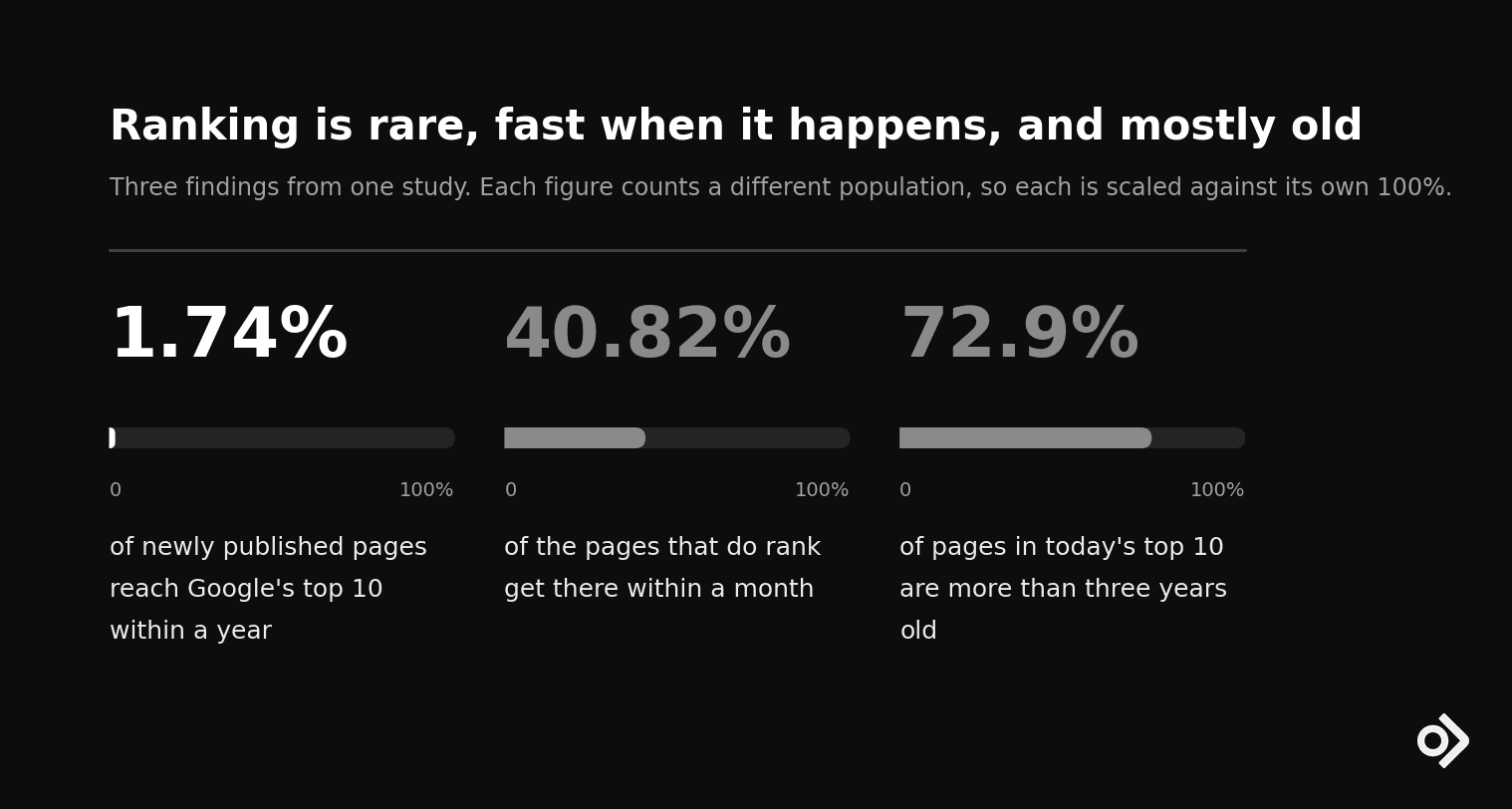
The evidence for the asset framing is the age of the pages that actually rank. Ahrefs found that 72.9% of pages in Google's top 10 are more than three years old, and the average number one page is five years old, up from two years in 2017, across 1.3 million random US keywords.
If the pages winning your category are five years old, a content program funded and judged in twelve month increments is structurally incapable of producing one.
Funnel logic | Flywheel logic | |
|---|---|---|
Unit of work | The campaign. Scoped, shipped, closed. | The library. Assets stay in service and are revised. |
When the return arrives | Inside the campaign window, or it did not work. | On a curve. Nearly flat for two quarters, then steepening. |
What happens when you stop spending | Delivery stops the same day. | The library keeps returning, decaying slowly rather than instantly. |
What finance sees in month three | A cost per lead it can compare. | A cost with no matching return yet, which is why the lag has to be agreed up front. |
The flywheel model is not a rejection of funnel thinking. Paid media and content answer different questions on different horizons, which is the practical difference between growth marketing and performance marketing. You need both. You cannot run them on one clock.
Read also: The Amazon Flywheel Most Agencies Miss
How long does a content flywheel take to turn?
It usually takes two to three quarters before you see real progress, and the first quarter often looks like a failure even if things are on track. Ahrefs tracked one million URLs crawled in September 2023 over twelve months and found that only 1.74% reached Google's top 10 within a year. Of the pages that did rank, 40.82% made it within a month.
These two numbers matter most when you look at them together. Ranking is rare, and when it happens, it usually happens quickly. If a page is still outside the top 10 after 60 days, it probably needs a new approach or a different question, not just more time. This shift turns content reviews from debates into clear decisions.
Payback month = (assets shipped × fully loaded cost per asset) ÷ monthly contribution attributable to the library |
If you use that formula honestly, the denominator will be close to zero in the first quarter by design, not because of failure. What really matters is how quickly the denominator grows in the second and third quarters.
Decide on the growth rate you expect before you begin, ideally in the same meeting where you set the budget. This makes finance discussions less confrontational. Two things make the formula solid: using contribution instead of revenue, so the program is measured like your marketing budget, and having a realistic view of customer lifetime value, since content often attracts researchers who buy later and make repeat purchases.
How do you know whether your content flywheel is turning?
When it comes to measuring content performance, it’s much more useful to look at your entire content library instead of focusing on individual articles. We at Darkroom recommend tracking four key numbers on a regular schedule:
Track the overall impression growth of your content library, not just individual URLs.
Measure your share of answer by running a consistent set of prompts on the same assistants each month.
Focus on assisted contribution instead of just last click
Keep an eye on consolidation debt, which is basically how many of your own pages are competing with each other.
Let’s talk about last click attribution. It really needs to be set aside, because it tends to undervalue channels that play a long game. That’s why, for content programs, your measurement approach should be more about incrementality testing and media mix modeling, not just relying on what your platform reports tell you.
That’s the key takeaway: your content library can be growing overall, while some individual pages are declining. Only by measuring at the library level can you see wins and losses at the same time.
Track all four measures every month, and stick with it for at least three quarters. What you’re really looking for is the trend over time, not just a single month’s numbers. One month of data won’t tell you if your content strategy is actually moving the needle.
How does a content flywheel build brand authority that AI assistants cite?
Authority compounds because each citation makes the next one more likely, and AI assistants now choose sources using brand signals that ranking alone no longer predicts. Ahrefs analyzed 863,000 keyword SERPs and roughly 4 million AI Overview URLs and found only 38% of AI Overview citations come from pages ranking in Google's top 10, down from 76% in July 2025.
The decoupling goes further than Google's own surface. Across assistants, only 12% of cited URLs rank in Google's top 10 for the same prompt, from 15,000 long tail queries. Ranking and being cited used to be the same job. They are now two jobs, and brand authority is what carries the second one.
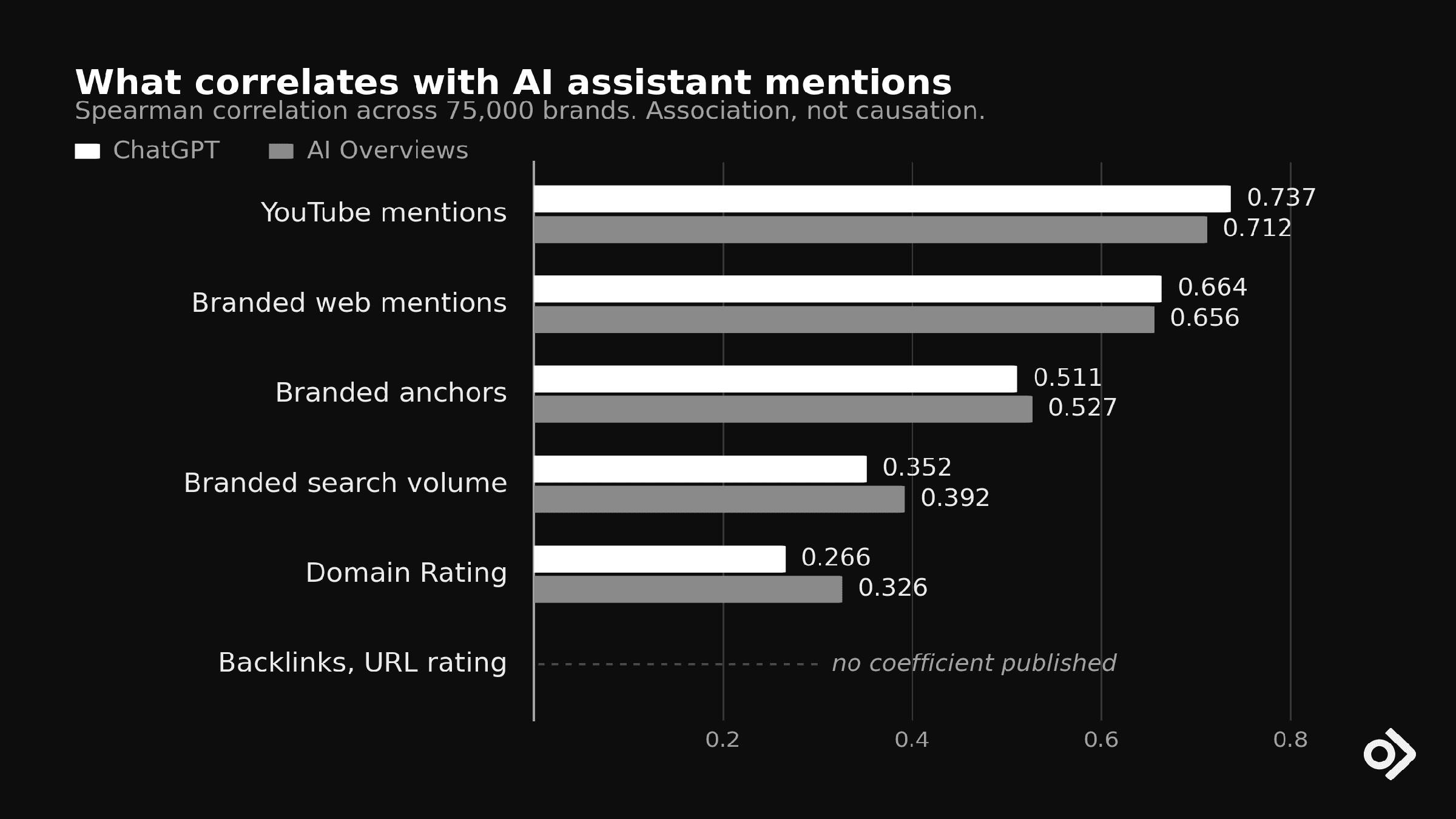
On the one row without a number: Ahrefs describes link metrics as very weakly correlated across all three systems without publishing a per-platform figure. Its earlier study of AI Overviews alone does put backlinks at 0.218 across the same 75,000 brands, which is the lowest coefficient in that set.
The practical instruction is that topical authority built through depth on a narrow set of questions, and mentions earned off your own domain, both move the needle more than link acquisition does. That is a content and distribution program, not a link building one.
Where do content flywheels break?
They break at consolidation. A library that competes with itself decays while its output rises, which is the most common and least diagnosed failure in the model. Four failure modes account for almost all of it.
Publishing faster than you consolidate
When two pages target the same query, they end up competing with each other and neither ranks well. The solution is to set up a redirect, not to write another article. Content operations need to handle this regularly, or it will keep being overlooked.
Treating distribution as a send
Just publishing something and putting it in a newsletter does not count as real distribution. This is why even good content often goes unnoticed. Since 96.55% of pages get no traffic from Google, any asset without a clear channel, owner, and format is likely to be ignored.
Measuring the article instead of the library
Reporting on individual articles often leads to the wrong decisions, especially around month nine. At this point, single pages may still seem weak, even though the library is just starting to show results. The numbers shown to reviewers at this stage often make them want to cancel the project.
Stopping in quarter two
According to Ahrefs data, the pages that perform best have been around for years. If a program is canceled after eight months, you pay all the costs but see none of the benefits. Restarting later means starting over, not picking up where you left off.
Build a content flywheel that compounds
If you feel like your content program is always being measured by campaign deadlines, the real issue might be the timeline itself, not the content. At Darkroom, we tackle this by focusing on three key solutions, and none of them involve just churning out more articles:
First, we bring in a senior strategist who takes full ownership of your plan and how it's measured across every channel, including direct-to-consumer. Their focus is on real results.
Next, we use Shadow, our AI-powered commerce tool. Instead of relying on last-click attribution, Shadow uses media mix modeling and root cause analysis. This way, your content library gets credit for the real impact it makes.
Finally, we set up a Flight Plan. This is a live planning document that links your content investment directly to contribution profit and daily pacing. It helps everyone get on the same page about timing, so there are no surprises or debates about delays.
When you put all these pieces together, you get a system that actually drives commercial results. For example, when we applied this approach to Laundry Sauce on Amazon, it led to a 290% increase in net revenue and a 23% boost in repeat order rate. These are program-wide results, not just claims about what a single piece of content did.
Darkroom is a growth marketing agency that helps brands of all sizes with content, search, and AI-driven visibility programs. We’re also the go-to innovation partner for major product launches. If you’re about to review your content program, the most valuable first step isn’t just counting articles. Instead, ask if you’re measuring your program on the right timeline.
If you want to talk it through, reach out to our growth strategy team.