SUCCESS STORIES
Body Care Brand Strategy: How Nécessaire and Darkroom Built Premium Growth




Written by Darkroom leardership
Time to read: 10 mins
Last update: August 12, 2026

A body care brand strategy is how a company competing in a category of near-identical products builds preference somewhere other than the formulation. For Nécessaire, that meant premium positioning, a single connected paid media system, and a channel mix that treated direct-to-consumer and retail as one business.
Here is what that produced, in a single fourth quarter, measured year over year.
Result | Figure | Scope |
|---|---|---|
Paid social cost per acquisition | 14% below goal | Q4, year over year |
Paid media revenue | Up 118% | Q4, year over year |
Total revenue | Up 43% | Q4, year over year |
Black Friday and Cyber Monday (BFCM) Meta advertisers | Highest percentile | Q4, year over year |
Source: Darkroom client engagement. First-party figures, client-reported. The engagement period is the fourth quarter following Apple's iOS 14 privacy changes, which began with iOS 14 in September 2020 and became mandatory with App Tracking Transparency in April 2021. Exact dates are not public.
Darkroom was the agency partner on that work, running paid social, paid search, paid media, performance creative, dynamic ads, and influencer whitelisting across the quarter. This article explains the three decisions behind those numbers and which of them you can copy. Full details sit in the full engagement.
The constraint: a commodity category and a broken signal
Nécessaire, also written Necessaire, had two problems at once, which is what makes the quarter worth studying. The category could not differentiate on product, and the measurement layer everyone relied on had just degraded.
Body care is among the most substitutable categories in personal care. Formulations converge, ingredient stories repeat, and the shelf is crowded with products that genuinely do the same job. Beauty Independent has described the segment as a commoditized environment dominated by entrenched budget players, which is the competitive reality any premium entrant inherits.
When products are interchangeable, media efficiency converges too, because every brand is bidding for the same person with roughly the same promise.
The second problem was timing. This work followed Apple's App Tracking Transparency framework, which Apple made mandatory from 26 April 2021 with iOS 14.5, requiring apps to request permission before tracking users or accessing the advertising identifier.
That took a meaningful bite out of the targeting and measurement direct response advertising had been built on. Signal degraded across the industry that year, and the brands buying growth through precise targeting felt it first.
Those two pressures compound rather than add. Weaker signal pushes every advertiser toward broader targeting, broader targeting puts more brands in front of the same person, and where products do the same job the only tiebreaker left is recognition.
That inverts the usual advice. When you cannot out-target the competition and you cannot out-formulate them, the remaining lever is what the customer already believes before the ad loads, which is why this belongs in a full-funnel growth system rather than in a channel plan.
What makes a body care brand premium?
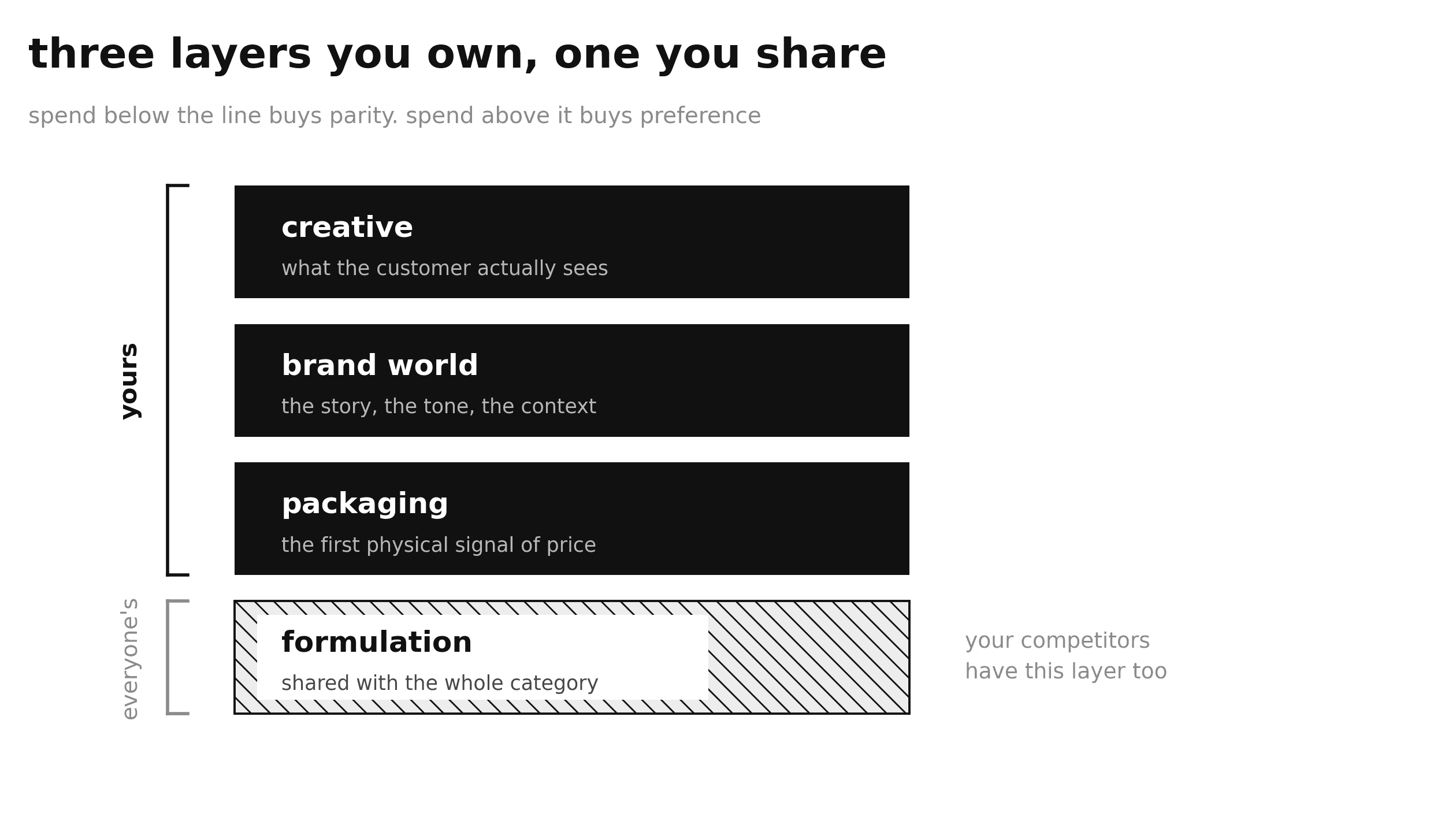
Nécessaire's advantage was decided years before this campaign. Since 2018 the brand has treated body care with the seriousness and restraint usually reserved for facial skincare, and it sells through prestige retailers including Nordstrom and Sephora rather than the drugstore aisle.
The pricing shows the decision plainly. At Sephora the body wash runs $28 to $42, the body lotion $52 and the body retinol serum $65, in a category where the mass-market equivalent costs a few dollars.
Co-founder Randi Christiansen has described the reasoning directly: "We knew intuitively that we're not going to be able to be drugstore prices. We knew we had to be a little bit more expensive."
That sounds like an aesthetic choice. It is a commercial one. Reframing body wash as a considered purchase rather than a replenishment purchase changes what a customer will pay, how much they buy at once, and how much attention they will give an advertisement for it.
This is the part of the story that belongs to the brand rather than to any agency. The positioning predates the engagement, and the media strategy worked because it had something real to amplify. A brand positioning strategy is the precondition for efficient media, not a deliverable you can bolt on when the numbers soften.
Two things make premium positioning legible in this category, and both are visual before they are verbal. The first is restraint in the design system, which is why design as a commercial decision is a growth topic rather than a brand topic.
The second is context: where the product sits, physically and digitally, and next to what. For how that plays out across categories, see our piece on premium positioning.
The paid media strategy: one programme, not two budgets
The central decision was structural. Darkroom treated the influencer programme and the paid advertising programme as interconnected parts of the same strategy rather than as two budgets with two owners.
Most brands do the opposite, and the seam is visible to the customer. The influencer content says one thing in one register, the paid ads say something else in another, and a person exposed to both in a week experiences two brands rather than one. Worse, the two teams optimise against different metrics and neither is accountable for the handoff.
Run as one system, assets get assigned to funnel positions rather than to departments.
Funnel stage | Asset type | The job it does |
|---|---|---|
Top and middle | Influencer video, luxury framing | Establish considered-purchase framing faster than a product shot can |
Middle and lower | Reviews and publication quotes | Shift the question from what is this to should I trust it |
Lower | Dynamic ads, high-AOV products with customer testimonials | Recover cart abandoners at the moment hesitation costs most |
That bottom row is more specific than it first appears. The highest average order value products get the most social proof at precisely the point where a lost session is most expensive.
Making this work is a volume problem as much as a strategy one, since one connected system needs enough assets to fill every stage without repeating itself. That is what a creative system that scales is for, and why creator content in paid belongs inside the media plan rather than beside it.
If your question is the adjacent one, how budget gets allocated across channels, that is a separate discipline and we have covered it in full.
What is an omnichannel retail strategy, and why plan DTC and wholesale together?
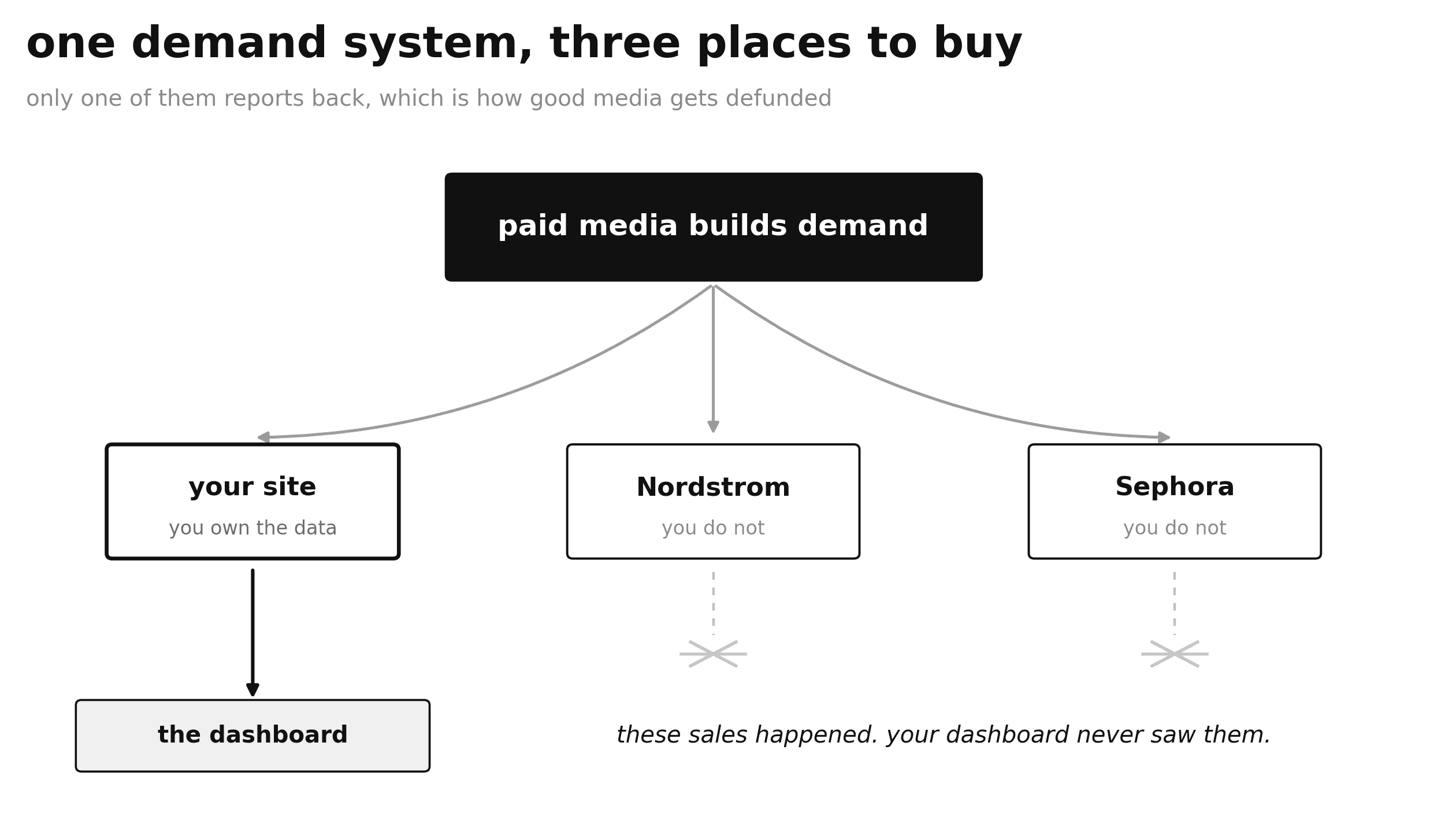
An omnichannel retail strategy plans direct-to-consumer (DTC) and wholesale as one demand system instead of two profit and loss statements. For a brand selling on its own site alongside Nordstrom and Sephora, that is not a philosophical preference. It is the only way the numbers make sense.
Here is the mechanic. Paid media builds demand. That demand converts wherever the customer finds it most convenient, which is frequently a retail partner the brand does not own and cannot track. The advertising did the work, the sale happened somewhere else, and the direct-to-consumer dashboard records a miss.
Brands that judge media only on owned-channel return therefore underinvest in exactly the campaigns doing the most for the business. They cut the top of the funnel first, because it looks least efficient, and then wonder why wholesale sell-through softens a quarter later.
The correction is not complicated, though it is uncomfortable: judge media against total revenue, and accept that attribution will be incomplete rather than pretending it is not.
The quarter described here was planned that way, which is why paid media revenue grew 118 percent against 43 percent total revenue growth in the same period, and why the gap between the two is informative rather than embarrassing.
This is also the direction the wider market has moved, as retail partners have built advertising businesses of their own and the line between buying media and buying shelf has blurred. Our overview of retail media covers that shift.
How does a body care brand strategy show up in the numbers?
The most interesting figure is not the largest one. Paid media revenue grew 118 percent while total revenue grew 43 percent, and the distance between those two numbers is the finding.
Paid scaled roughly two and a half times faster than the business overall. That is what channel efficiency looks like when the brand underneath is already doing the differentiation work: media stops fighting for attention and starts collecting demand that positioning created.
The cost per acquisition result reinforces it. Paid social came in 14 percent below goal in a quarter when signal loss was pushing acquisition costs up across the industry.
The competitive placement is the third signal and the easiest to skim past. Landing in the highest percentile of Black Friday and Cyber Monday advertisers on Meta is a relative measure rather than an absolute one, which makes it the most useful of the four.
It says the brand outperformed its peers in the same auction, under the same conditions, in the most contested trading fortnight of the year.
One honest caveat. All four figures cover a single Q4 measured year over year, they are first-party numbers from the client engagement rather than independently audited ones, and they describe one brand in one category with a positioning advantage that took years to build. They are evidence that the approach works, not a forecast for a brand starting somewhere else.
What transfers to your brand?
Three decisions here are portable, and none of them requires a budget increase.
Decision | The mechanism | What it produced here |
|---|---|---|
Fix the positioning before you scale the spend | Media amplifies whatever the brand already means, so budget applied to a thin proposition buys indifference at volume | Paid media revenue up 118%, with cost per acquisition 14% under goal. Media collecting demand rather than manufacturing it |
Give influencer and paid one owner and one plan | The efficiency sits in the handoff between funnel stages, and a handoff cannot be optimised by two teams reporting separately | Highest percentile of BFCM Meta advertisers, in the peak trading window where auction pressure is greatest |
Judge media against total revenue when you sell through retail | The owned-channel dashboard is a partial view, and treating it as complete systematically defunds your best-performing work | Total revenue up 43%, while paid grew at more than twice that rate |
Note what is not on that list. None of the three is a channel choice, a platform, or a tactic that expires when an algorithm changes. They are decisions about sequence, ownership and what you measure, which is why they survive the specifics of any one quarter.
The order matters too. Running the second decision without the first gives you a well-coordinated programme saying nothing in particular, and the third without the second gives you a truer number attached to work you cannot repeat.
The compounding effect shows up later, in who comes back. A customer who bought into a brand behaves differently from one who bought a discount, which is why building an audience that returns and the retention metrics that matter belong in the same conversation as acquisition.
If your category has stopped differentiating on product and your media is getting more expensive, the constraint is usually creative rather than budget.
Darkroom builds performance creative systems for growth-stage consumer brands, producing the asset volume a single connected programme needs across every funnel stage. That is the work behind the Q4 described here: paid media revenue up 118 percent, total revenue up 43 percent.
Frequently asked questions
What is a body care brand strategy?
It is the plan for building preference when rival products do substantially the same job. Because the formulation cannot carry differentiation, the work moves to positioning, design, creative and channel mix. The test is whether a customer would pay more for yours than for a functionally identical competitor.
How do you market a body care brand in a commoditised category?
Start with positioning, because media amplifies meaning rather than creating it. Then run creator content and paid advertising as one programme with one owner so the funnel has no seams. Then judge performance on total revenue rather than on the channel that happens to report best.
What is an omnichannel retail strategy?
It treats your own site and your retail partners as one demand system rather than separate businesses. Advertising creates intent that converts wherever the shopper prefers, frequently in a store you neither own nor track. Judging media on owned channels alone understates whatever is working hardest.
Should influencer and paid media run as one programme?
Yes, and the reason is mechanical rather than philosophical. Split budgets produce split creative, optimised against different metrics, and the discontinuity is obvious to anyone exposed to both. A single owner lets each asset be placed by funnel stage rather than by team.
What results did Nécessaire see?
Across one Q4 against the prior year, the brand beat its paid social acquisition cost target by 14 percent, grew paid media revenue 118 percent, lifted total revenue 43 percent, and ranked in the top percentile of Meta advertisers over Black Friday weekend. Figures are first-party, from the client engagement.