PAID MEDIA
What is Cost Per Acquisition (CPA) and How to Set a Target Your Margins Can Afford




Written by Darkroom leardership
9 min read
October 7, 2026

If you run paid media, you've probably had some version of this conversation. Your ad platform says each customer costs $35.71, and your finance team says it was $50.00.
Here's the strange part: both numbers come from the same $500,000 of monthly spend, and nobody made a mistake. The two teams are simply dividing by different things.
In this guide, we'll walk through how to calculate CPA, how to find the most you can afford to pay for a customer, and how to set a target that holds up when finance checks the math.
Key takeaways
It is possible for both the platform and the finance team to report different costs for the same spend and still be correct. This happens because the platform might count conversions, while finance focuses on new customers.
The CPA formula is solid, but what matters most is the inputs you use. It is a good reminder that sometimes the numbers change not because of performance, but because of how the data is being measured.
There is no one-size-fits-all benchmark for CPA. For one brand, a $40 CPA might be a win, while for another, it could mean a loss.
The first order sets the ceiling: break-even CPA comes from the first order, which tends to be smaller than the average order value, so using AOV overstates what you can afford.
Sometimes, what looks like an improvement isn't what it seems. For example, in our model, the platform CPA dropped by 12.5 percent, but the blended CAC actually went up by 11.1 percent, even though the spend stayed the same.
What is cost per acquisition (CPA)?
Cost per acquisition is the average amount of ad spend it takes to get one conversion. Think of it as the price tag on the result you asked an ad platform to deliver.
So if someone asks what is CPA in marketing, it's what you paid, on average, for each sale, sign-up, or other win.
The word "acquisition" depends on the conversion event you choose. For an e-commerce brand, it's usually a purchase. For a subscription business, it's a paid account, and for a CPG brand buying retail media, it's an attributed sale at the retailer.
That choice matters more than it looks. A conversion and a new customer aren't always the same person, and that gap runs through the rest of this article.
One practical tip before we move on: pick one conversion event per account and stick with it, so every CPA in your dashboard measures the same thing.
What is the CPA formula, and how do you calculate it?
The CPA formula itself is simple. You divide what you spent on ads by the number of conversions those ads produced:
CPA = total ad spend ÷ conversions
This is the same math Google uses for its own cost-per-conversion metric: total cost divided by the conversions it recorded. One detail worth noticing is that Google only counts the interactions it can track, which is an early hint that platform numbers show part of the picture.
The cost per acquisition formula is the easy bit; the inputs are where a CPA calculation usually goes wrong.

3 steps to a CPA you can trust
Calculating cost per acquisition (CPA) can be straightforward, but you should do it in a way that stands up to scrutiny.
Pick the event: choose one conversion event and one attribution window, and write both down.
Match the spend: pull ad spend for the same date range and campaigns as your conversions.
Divide: let's say you spent $500,000 last month and recorded 14,000 purchases, so $500,000 ÷ 14,000 = a $35.71 CPA.
It can be helpful to run this calculation using different attribution windows, such as 1 day versus 30 days. The CPA will change depending on how you count conversions, even if spend stays the same.
The formula itself does not change. What shifts is the definition of a conversion, which can significantly affect the final CPA.
This is why it is so important to focus on what CPA is actually sustainable for the business. Understanding the true cost helps guide smarter decisions.
How do you find your break-even CPA?
Your break-even CPA is the most you can pay to win a customer before their first order starts losing you money. To find it, take what the first order brings in and subtract the costs that come with it.
Break-even CPA = first-order value − COGS − fulfillment and freight − payment processing
To make this concrete, we'll follow one model brand with illustrative numbers for the rest of this article.
Line | Per first order |
|---|---|
First-order value | $80.00 |
Cost of goods sold (COGS), 35% | -$28.00 |
Fulfillment and freight | -$9.00 |
Payment processing, 3% | -$2.40 |
Contribution per order before marketing | $40.60 |
So for this brand, the break-even CPA is $40.60. Use your first-order value for this, since first orders tend to be smaller and more discounted than your site-wide average order value (AOV).

These cost lines should look familiar to your finance team, because they're the same ones used for contribution margin. If your break-even CPA doesn't match a number your CFO recognizes, fix the inputs before you set a target.
Why break-even CPA and break-even ROAS draw the same line
If your team prefers to look at return on ad spend, or ROAS, the math lines up just as neatly. In this example, $40.60 represents 50.75% of an $80 order. To find the break-even ROAS, just divide 1 by that margin. That means this brand needs a ROAS of 1.97 to break even.
Both break-even CPA and break-even ROAS are just two ways of looking at the same numbers. ROAS helps evaluate overall campaign performance, while break-even CPA focuses on the cost to acquire each customer. Most acquisition decisions come down to that per-customer cost, but both metrics tell the same story from different angles.
Read also: Contribution Margin for Marketing: How Finance Judges Your Budget
Should your target CPA cover the first order or lifetime value?
Once you know your break-even, the next decision is how much of it to spend. It comes down to one question: do you need each customer to be profitable on their first order, or can you wait for them to come back?
Both answers are legitimate, as long as your team agrees which one you're running.
When a first-order target is the right call
With a first-order target, you set your CPA below break-even, so every first order makes some profit. Let's say this brand wants to keep $5.60 from each first order, which makes its target $40.60 − $5.60 = $35.00.
It fits three situations:
One-time purchase categories: customers rarely reorder, so the first order is the whole relationship.
Cash-constrained quarters: you can't afford to carry a loss on new customers while you wait for them to return.
New products: there's no cohort history yet to prove people will buy again.
When an LTV-backed target is the right call
An LTV-backed target lets you pay more than the first order earns, because you're counting on later orders to make up the difference. The ceiling is the contribution a customer brings in over a period you're willing to wait.
Here's how that works in the model. Customers place 1.8 orders in their first 12 months, and each order contributes $40.60, totaling $73.08 per customer over a year. That's the most this brand could pay and still break even within 12 months.
The brand settled on a blended target of $60. It sits between first-order break-even ($40.60) and the 12-month ceiling ($73.08), and leaves $13.08 of contribution per customer over the year.
The catch is that an LTV-backed target is only as good as the repeat rate behind it. Build it on margin-adjusted lifetime value, and check for a repeat rate that holds through orders 2 to 4. If customers stop coming back, the extra you paid up front becomes a loss you can't recover.
How is CPA different from CAC?
This is where most of the confusion between marketing and finance comes from. CPA divides one platform's spend by the conversions that platform reports, while blended customer acquisition cost (CAC) divides your total marketing spend by the new customers your store actually recorded.
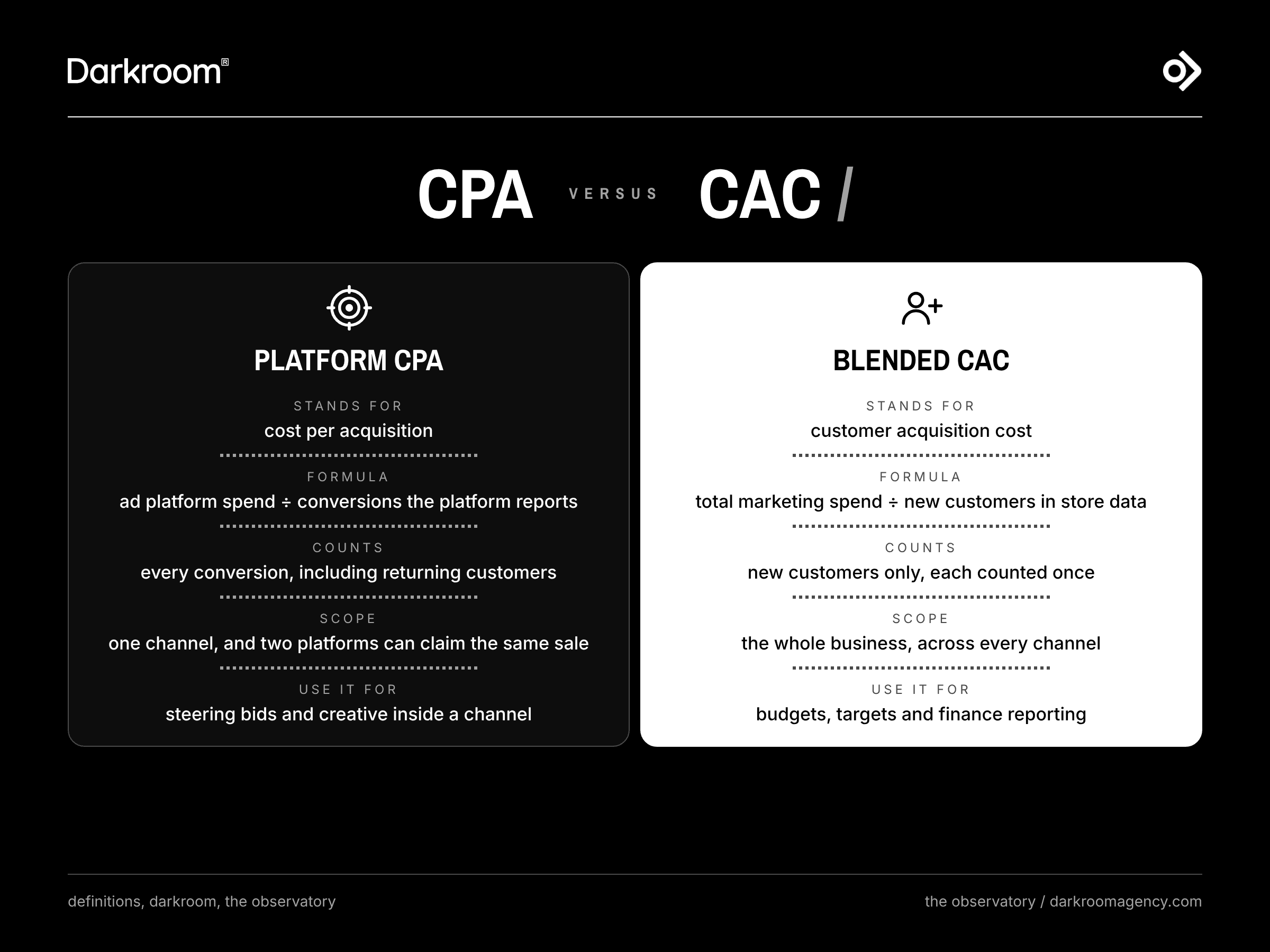
Here's how the two differ in practice:
Source: CPA comes from each ad platform's own reporting, and blended CAC comes from your store and finance data.
Returning customers: CPA counts them whenever they convert after an ad, so a repeat buyer can lower it, while blended CAC only counts first-time buyers.
Double counting: two platforms can both claim the same sale in their CPA, while blended CAC counts each new customer once.
Scope: CPA describes one channel at a time, and blended CAC covers every channel together.
Best use: CPA is the number for steering bids and creative inside a channel, and blended CAC is the one for budgets, targets, and finance reporting.
There's also a version in between: paid CAC, which divides paid media spend by new customers from paid channels and helps when brand or organic spend blurs the blended number.
So which one should you bring to CPA vs CAC reviews? Both. CPA helps you steer each channel, and CAC tells you what growth is really costing the business.
Read also: Marketing Efficiency Ratio: One P&L, Three Ways to Read It
Why can a falling platform CPA hide a rising blended CAC?
Remember the gap between conversions and new customers? This is where it shows up. Ad platforms count conversions, and conversions include people who already buy from you, so a platform's CPA can improve in the same month you win fewer new customers.
There are five common reasons this happens:
Returning customers: a loyal buyer clicks a retargeting ad and orders again, so the platform records a conversion while your new-customer count stays flat.
Shared credit: Meta, Google, and TikTok can each claim the same purchase, which is why a measurement stack built only on platform data overcounts.
Window changes: Google only counts conversions inside the conversion window you set (30 days after a click by default on Search and Display), so changing it moves CPA with no change in customers.
Retargeting drift: automated campaigns learn that warm audiences convert cheaply and gradually shift budget toward them.
Cheap-conversion bidding: a tight target CPA pushes the algorithm toward the easiest conversions available, and those are often existing customers.
This is easy to catch. Once a month, divide platform-reported conversions by new customers from your store data. If that ratio is climbing, your platform CPA is making you look more efficient than you are.
What is a good cost per acquisition?
A good cost per acquisition is one your margins can pay for, measured on new customers. That's why there's no single good number: a $40 CPA can be a great result for one brand and a loss for another.
Industry averages online give you a rough sense of scale. The problem is that an average mixes brands with very different margins, order values, and repeat rates, so it can't tell you whether your own CPA makes money.
A better way to judge your CPA is to run it through three tests.
Three tests for a good CPA
Below break-even: if your CPA sits under your break-even, each first order pays for itself. For our model brand, that means anything under $40.60.
Inside your target: if you run an LTV-backed target, a good CPA sits at or below the number your team agreed on, and below the 12-month ceiling. For our model brand, that's $60, with a ceiling of $73.08.
Confirmed by new customers: a CPA only counts as good if blended CAC agrees, because platform conversions can include returning customers and sales two platforms both claimed.
The third test is the one teams skip most often. In our model, the brand kept spend flat at $500,000 a month while automated campaigns leaned into retargeting, and platform CPA improved from $35.71 to $31.25.
Over the same month, new customers fell from 10,000 to 9,000, so blended CAC rose from $50.00 to $55.56. The dashboard showed a better CPA, but each new customer actually cost more.
How do you lower CPA without raising CAC?
Lowering CPA the right way means bringing in more new customers for the same spend. Here's a step-by-step plan, in the order we'd run it, so every improvement you see is real.

1. Measure your starting point
Before you change anything, write down two numbers for the last full month: blended CAC and platform conversions per new customer. These are your baseline.
Every step after this one gets judged against them. If CPA drops but blended CAC doesn't, you haven't lowered your cost of growth.
2. Exclude existing customers from prospecting
Upload your customer lists and exclude them from prospecting campaigns. That way, the budget meant for finding new buyers stops paying to reach people who already buy from you.
This step usually moves platform CPA up a little at first, because returning customers were the cheapest conversions in the account. That's expected, and it means your CPA is finally measuring what you care about.
3. Improve your landing page conversion rate
Next, work on what happens after the click. When more visitors turn into buyers, CPA falls without changing who you reach or what you pay for traffic.
Start with the pages your highest-spend campaigns send people to, since that's where a small lift moves the most money.
4. Raise first-order value
Bundles, kits, and free-shipping thresholds make the first order bigger. A bigger first order lifts your break-even CPA, which gives you more room at the same cost per acquisition.
Watch the discount you use to get there, though. If the offer costs more margin than it adds in order value, break-even goes down.
5. Refresh tired creative
When CPA climbs on an ad that used to work, the creative is often the cause. Check for the signs of ad fatigue before you touch bids, because a new ad fixes a fatigue problem that bid changes only cover up.
6. Prove the lift with a holdout test
Finally, before you scale a channel or campaign that now looks cheap, hold back spend in one region or audience and measure the difference in new customers.
If a lower CPA doesn't show up as more new customers, the reporting changed, and the business didn't. A holdout test is how you tell the two apart.
Read also: Incrementality Testing vs Media Mix Modeling: What Growth Teams Actually Need in 2026
Set CPA targets with a paid media team that optimizes toward margin
Setting a CPA target that makes sense to both marketing and finance teams can be tricky. A good starting point is to run a business and profit-and-loss (P&L) audit to map out your margins and contribution goals before launching any paid campaigns. This approach ensures every dollar spent on ads aligns with your business objectives.
Once the audit is complete, the next step is to allocate budget toward the channels and strategies that actually drive contribution profit. This means looking beyond just the numbers reported by ad platforms.
For example, when Nécessaire used a closed-loop system based on first-party purchase data, they saw a 118% increase in paid media revenue in Q4. This approach helps ensure marketing spend is truly moving the needle.
By gathering key numbers like your first-order value, costs, and new customer count, it becomes much easier to set a CPA target that your margins can actually support. This way, the CPA goal is grounded in real business data, not just marketing wishful thinking.
Book a call with our paid media team
Frequently asked questions
What is the difference between CPA and CPM?
Cost per mille (CPM) is what you pay for every 1,000 ad impressions, and cost per acquisition is what you pay for each conversion. CPM measures the price of reach, so it can rise while CPA falls if your ads start converting better. A cheap CPM only helps when enough of those impressions turn into customers.
What is the difference between CPA and CPC?
Cost per click (CPC) is what you pay for each ad click, and cost per acquisition is what you pay for each conversion. Conversion rate connects them: CPA equals CPC divided by conversion rate. A $1.60 CPC at a 4% conversion rate gives a $40 CPA, so a better landing page lowers CPA without touching bids.
What is the difference between CPA and cost per lead (CPL)?
Cost per lead (CPL) counts form fills, sign-ups or demo requests, while CPA counts the conversion that earns revenue, usually a purchase or a paid account. For lead-driven businesses, CPA equals CPL divided by the lead-to-customer close rate, so a $50 CPL at a 10% close rate works out to a $500 CPA.
Should CPA include agency fees and creative costs?
Platform CPA uses media spend only, which keeps it comparable inside each ad account. Fully loaded CPA adds agency fees, creative production and tools, and it's the version to check against break-even. Track both, label them clearly, and only compare a fully loaded CPA with a fully loaded target.
How often should you reset a target CPA?
Revisit it every month, and any time an input moves: product cost, shipping rates, first-order value, or the repeat rate behind an LTV-backed target. Seasonal peaks change the math too, because discounts cut contribution per order, so a target set in January can sit above break-even by November.